
Semester VIII DSE-17 Ethics, Politics and Governance
Unit II · 26 min read · Updated 24 Nov 2026
As per the University of Delhi (DU) BA (Hons) Political Science syllabus
Contents
- 2.1 Food Security, Homelessness and Freedom
- Dimensions of Food Security
- India’s Food Policy
- Waldron on Homelessness and Freedom
- Shelter, Courts and Policy in India
- Food Waste and Distribution
- 2.2 Hunger and Global Poverty
- Sen’s Entitlement Approach
- The Right to Food in India
- Global Poverty: The Facts and the Duties
- Statist Objections and Debates on Aid
- 2.3 Corruption
- Types and Causes of Corruption
- India’s Anti-Corruption Framework
- Why Corruption Is an Ethical Problem
- Global Efforts against Corruption
- 2.4 Important Questions
- Discuss food security, homelessness and freedom as ethical issues.
- Discuss hunger with reference to capabilities and the right to food.
- Do we have international obligations to remove poverty? Discuss.
- Discuss corruption in public and private life as an ethical issue.
- Short Notes
प्रत्येक व्यक्ति को अपने और अपने परिवार के स्वास्थ्य और कल्याण के लिए पर्याप्त जीवन-स्तर का अधिकार है, जिसमें भोजन, वस्त्र, आवास और चिकित्सा सम्मिलित हैं।
Everyone has the right to a standard of living adequate for the health and well-being of himself and of his family, including food, clothing, housing and medical care.
— Universal Declaration of Human Rights, Article 25 (1948)
ETHICS becomes most urgent when people lack the basic conditions of a decent life. This chapter examines four ethical issues in politics and governance: food security, homelessness and freedom; hunger, capabilities and the right to food; international obligations to remove poverty; and corruption in public and private life. It draws on Carolyn Dimitri, Jeremy Waldron, Amartya Sen, Thomas Pogge, Luis Cabrera and Bernard Williams, with examples from India.

2.1 Food Security, Homelessness and Freedom
Food security exists when all people at all times have access to sufficient, safe and nutritious food. Homelessness denies people a place to live and, as Jeremy Waldron argues, a place where they are free to perform basic acts. Both raise the question whether freedom means only the absence of interference or also the real ability to live with dignity.
Dimensions of Food Security
The World Food Summit of 1996 defined food security as existing when all people, at all times, have physical and economic access to sufficient, safe and nutritious food that meets their dietary needs and food preferences for an active and healthy life. The definition has four dimensions:
- Availability. Enough food must be produced or imported.
- Access. People must have the income, land or entitlements to obtain food.
- Utilisation. Food must be safe and nutritious, and people must have clean water, sanitation and health care to absorb it.
- Stability. Access must not be disrupted by shocks such as droughts, price rises or conflicts.
Experts have since added agency, people’s ability to make choices about food, and sustainability, protecting the natural base of food production. In India, the National Family Health Survey of 2019 to 2021 found that about 35 per cent of children under five were stunted and more than half of women were anaemic, showing that food security is not only about calories but about nutrition.
India’s Food Policy
- Public Distribution System. Rationing began during the Second World War and grew into a national system of fair price shops; it was targeted to the poor in 1997.
- Antyodaya Anna Yojana (2000). It provides highly subsidised grain to the poorest families.
- National Food Security Act (2013). It entitles up to 75 per cent of the rural and 50 per cent of the urban population to five kilograms of grain per person a month at low prices, with special provisions for pregnant women and children.
- Free grain. The PM Garib Kalyan Anna Yojana, begun during the pandemic in 2020, was extended in 2024 to provide free grain for five years.
- Child nutrition. The Integrated Child Development Services (1975) and the mid-day meal scheme, renamed PM POSHAN in 2021, provide food to children.
Waldron on Homelessness and Freedom
Jeremy Waldron, in Homelessness and the Issue of Freedom (1991), argues that everything a person does must be done somewhere. People with homes have private places where they are free to sleep, wash and urinate. Homeless people have only public places, and when laws forbid sleeping, washing or urinating in streets and parks, there is literally nowhere they are free to perform these basic acts. Waldron concludes that homelessness is not only a problem of welfare but of freedom in the negative sense, the absence of coercion, which even libertarians claim to value. The 2011 Census counted about 1.77 million homeless people in India, though activists believe the true number is higher.
Shelter, Courts and Policy in India
Indian courts have linked shelter with the right to life. In Olga Tellis (1985), the Supreme Court held that evicting pavement dwellers affects their right to livelihood, and in Chameli Singh (1996) it recognised the right to shelter as part of Article 21. In the right to food case, the Court also directed states to provide night shelters for the urban homeless. The Pradhan Mantri Awas Yojana of 2015 aims at housing for all, and the National Urban Livelihoods Mission includes shelters for the urban homeless. Isaiah Berlin’s distinction between negative liberty, freedom from interference, and positive liberty, the capacity to act, helps explain why critics say that housing policy must secure real freedom, not only formal rights.
Food Waste and Distribution
Hunger exists alongside waste. The UN Environment Programme’s Food Waste Index Report of 2024 estimated that about 1.05 billion tonnes of food were wasted in 2022, close to a fifth of the food available to consumers, while hundreds of millions went hungry; Indian households were estimated to waste about 55 kilograms of food per person a year. India has also faced the paradox of large stocks of grain in government godowns alongside malnutrition. These facts support Sen’s argument that hunger is a problem of access and distribution, and they raise ethical questions about consumption in rich households and the duties of the state to ensure that surplus reaches those in need.
2.2 Hunger and Global Poverty
Amartya Sen showed that famines result from people losing their entitlement to food, not simply from a lack of food. India has recognised a right to food through courts and the National Food Security Act. At the global level, thinkers such as Thomas Pogge and Peter Singer argue that rich countries have strong duties to remove poverty.

Sen’s Entitlement Approach
Amartya Sen, in Poverty and Famines (1981), rejected the food availability decline explanation of famine. Studying the Bengal famine of 1943, in which about three million people died, and famines in Ethiopia and Bangladesh in the 1970s, he showed that food output had not fallen sharply; instead, groups such as landless labourers, fishermen and artisans lost their entitlements, the means of commanding food. Entitlements depend on endowments, what a person owns, such as land or labour power, and exchange entitlements, what they can obtain through trade, wages and public support. When wages fall or prices soar, people starve even amid plenty. With Jean Drèze, Sen extended this analysis in Hunger and Public Action (1989), arguing for public action to protect entitlements.
The Right to Food in India
- International law. Article 11 of the International Covenant on Economic, Social and Cultural Rights (1966) recognises the right to adequate food and freedom from hunger.
- The PUCL case. In 2001, during a drought in Rajasthan, the People’s Union for Civil Liberties petitioned the Supreme Court because grain was rotting in government godowns while people starved; the Court’s interim orders turned food schemes into legal entitlements.
- Commissioners. The Court appointed commissioners, such as N.C. Saxena, to monitor implementation, and the Right to Food Campaign mobilised citizens.
- Legislation. The campaign culminated in the National Food Security Act of 2013.
Global Poverty: The Facts and the Duties
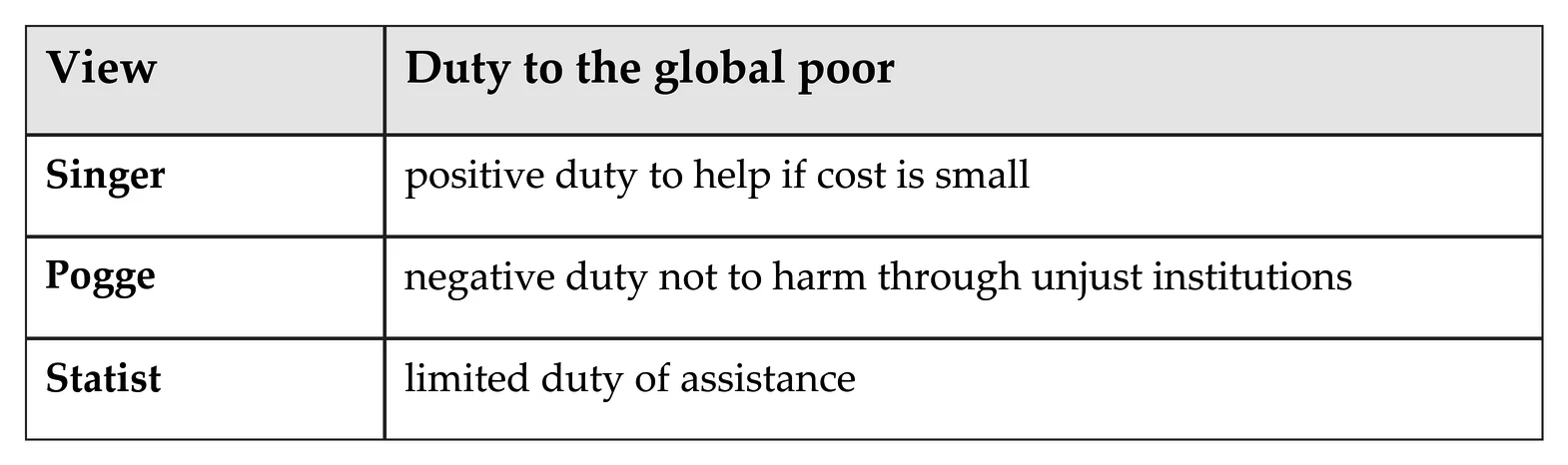
Hundreds of millions of people still live in extreme poverty, measured by the World Bank’s international poverty line, which was revised in 2025 to three dollars a day. India has made major progress: a NITI Aayog paper of 2024 estimated that about 248 million people escaped multidimensional poverty between 2013–14 and 2022–23. Philosophers debate what the rich owe the poor. Peter Singer, in Famine, Affluence, and Morality (1972), argued that if we can prevent something very bad without sacrificing anything of comparable moral importance, we ought to do it, comparing distant poverty with a child drowning in a pond. Thomas Pogge, in World Poverty and Human Rights (2002), argued that rich countries violate a negative duty not to harm, because they impose a global order, including trade rules and the recognition of dictators’ rights to sell resources and borrow, that foreseeably keeps people poor.
Statist Objections and Debates on Aid
Some thinkers limit duties of justice to fellow citizens. John Rawls, in The Law of Peoples (1999), accepted only a duty of assistance to help burdened societies build decent institutions, and Thomas Nagel argued in 2005 that full justice applies only within a state. Debates on aid are equally sharp: Jeffrey Sachs, in The End of Poverty (2005), called for a big push of aid, while William Easterly, in The White Man’s Burden (2006), and Dambisa Moyo, in Dead Aid (2009), argued that aid often fuels dependency and corruption. The effective altruism movement, associated with Singer and William MacAskill’s Doing Good Better (2015), urges individuals to give to the most cost-effective charities.
2.3 Corruption
Corruption is the abuse of entrusted power for private gain, in government and in business. It harms the poor, wastes resources and destroys trust. India has fought corruption through laws, vigilance bodies, the Right to Information and the Lokpal, but it remains widespread. Bernard Williams reminds us that politics also raises deeper questions of moral character.
Types and Causes of Corruption
- Petty and grand corruption. Petty corruption involves small bribes to officials for everyday services; grand corruption involves high-level officials and large contracts.
- Collusive and coercive corruption. In collusive corruption, both parties gain at public expense; in coercive or harassment bribery, citizens pay for services they are entitled to; Kaushik Basu proposed in 2011 that giving harassment bribes be made legal to encourage reporting.
- Klitgaard’s formula. Robert Klitgaard, in Controlling Corruption (1988), summed up its causes as corruption equals monopoly plus discretion minus accountability.
- Institutional corruption. Dennis Thompson described practices that are legal but undermine institutions, such as campaign contributions that buy access.
- Measuring corruption. Transparency International, founded in 1993, publishes a Corruption Perceptions Index each year, in which India usually scores below the midpoint of the scale.
India’s Anti-Corruption Framework
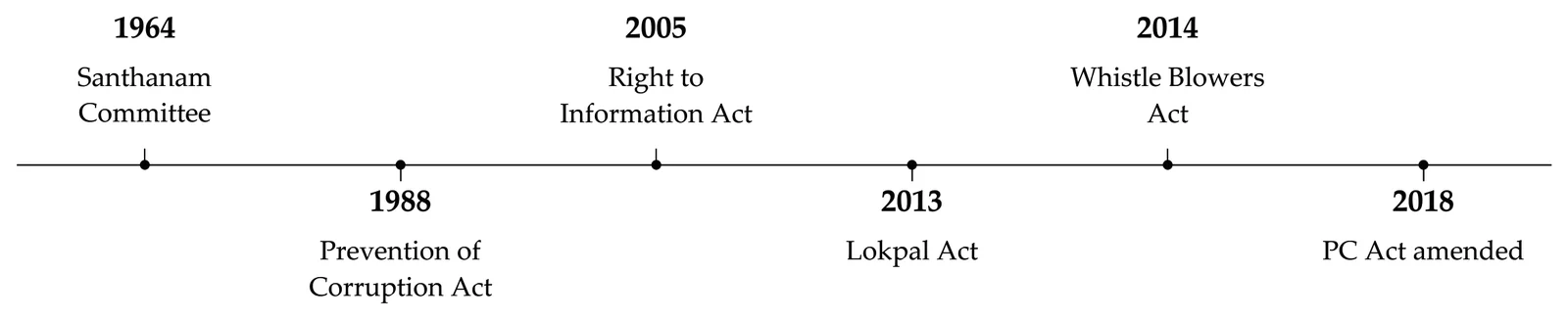
- Investigative agencies. The Central Bureau of Investigation was set up in 1963, building on the Special Police Establishment of 1941, and the Central Vigilance Commission in 1964 on the recommendation of the Santhanam Committee; the CVC became statutory in 2003.
- Prevention of Corruption Act (1988). Amended in 2018, it made bribe-giving a specific offence but required prior approval for investigating public servants for decisions taken in official duties.
- Right to Information Act (2005). It enabled citizens to expose corruption, though many RTI activists have been attacked.
- Lokpal. The Lokpal and Lokayuktas Act of 2013 created an anti-corruption ombudsman, and the first Lokpal, Justice Pinaki Chandra Ghose, was appointed in 2019.
- Whistle-blowers. The murder of engineer Satyendra Dubey in 2003, after he exposed corruption in a highway project, led to demands for protection, but the Whistle Blowers Protection Act of 2014 has not been fully implemented.
- International commitments. India ratified the UN Convention against Corruption in 2011.
Why Corruption Is an Ethical Problem
Corruption is wrong for several reasons. It breaks trust, since officials betray the power the public entrusted to them. It is unjust, because it favours those who can pay and hurts the poor most, who depend on public services and cannot afford bribes. It wastes resources meant for schools, hospitals and roads. It undermines democracy, as money buys influence and citizens lose faith in institutions. Ethical theories agree on its wrongness: utilitarians stress its harmful consequences, Kantians stress the treatment of citizens as mere means, and virtue ethicists stress the vice of greed and the importance of integrity in public life.
Global Efforts against Corruption
Corruption also crosses borders. The United States passed the Foreign Corrupt Practices Act in 1977, making it a crime for American companies to bribe foreign officials, and the OECD Anti-Bribery Convention of 1997 required member states to do the same. The United Kingdom’s Bribery Act of 2010 made companies liable for failing to prevent bribery by those acting for them. The UN Convention against Corruption of 2003 covers prevention, criminalisation, international cooperation and the recovery of stolen assets, an issue of special importance to developing countries whose wealth has been hidden abroad.
2.4 Important Questions
- Question 1 Discuss food security, homelessness and freedom as ethical issues.
- Question 2 Discuss hunger with reference to capabilities and the right to food.
- Question 3 Do we have international obligations to remove poverty? Discuss.
- Question 4 Discuss corruption in public and private life as an ethical issue.
DU asks the same idea in different words. So learn one broad answer for each question below; the same answer works for every question joined by OR.
Important Question 1
Discuss food security, homelessness and freedom as ethical issues.
OR
Examine Waldron’s argument on homelessness and freedom.
OR
Is food security a matter of freedom? Discuss.
Model Answer
“Everything that is done has to be done somewhere. No one is free to perform an action unless there is somewhere he is free to perform it.”
— Jeremy Waldron, Homelessness and the Issue of Freedom (1991)
Introduction. Food and shelter are the most basic needs of human life. Yet millions of people lack secure access to nutritious food or a place to live. These are not only economic problems but ethical ones, raising questions about freedom, dignity and the duties of the state. Carolyn Dimitri and Sarah Rogus discuss food choices and security, while Jeremy Waldron links homelessness with freedom.
1. Meaning of Food Security
The World Food Summit of 1996 defined food security as existing when all people, at all times, have physical and economic access to sufficient, safe and nutritious food that meets their dietary needs for an active and healthy life.
2. Dimensions
Food security has dimensions of availability, whether enough food is produced; access, whether people can obtain it; utilisation, whether it provides nutrition; and stability, whether access is secure over time.
3. Dimitri and Rogus on Food Choices
Carolyn Dimitri and Sarah Rogus show that food choices are shaped by income, prices, access to shops and public policy, so that poor households often cannot afford healthy diets even when food is available.
4. Food Insecurity in India
India produces enough grain, yet malnutrition remains high. The National Family Health Survey of 2019–21 found that more than a third of young children were stunted, showing that access and nutrition, not only production, matter.
5. Food Policy in India
India’s Public Distribution System and the National Food Security Act of 2013 provide subsidised grain to about two-thirds of the population. Since 2024, free grain is provided to more than 80 crore people.
6. Meaning of Homelessness
Homelessness means lacking a secure place to live. It includes people sleeping on streets and pavements and those in temporary shelters. The 2011 Census counted about 1.77 million homeless people in India, though activists believe the real number is higher.
7. Waldron’s Argument
Jeremy Waldron argues that everything we do must be done somewhere. Property rules decide where people may act, and homeless people own no place where they are free to sleep, wash or rest. Laws banning such acts in public places therefore deny them freedom itself.
8. Freedom and Property
Waldron shows that the homeless are not free in any meaningful sense, even if no one directly coerces them, because the rules of property exclude them from almost every place. Freedom depends on having somewhere to exercise it.
9. Negative and Positive Freedom
Isaiah Berlin distinguished negative freedom, the absence of interference, from positive freedom, the ability to act. Food and shelter show that without basic resources, negative freedom has little value.
10. Sen’s Development as Freedom
Amartya Sen argues that development means expanding real freedoms, including freedom from hunger and from lack of shelter, which are basic capabilities.
11. Indian Courts
In Olga Tellis (1985), the Supreme Court linked the right to life with livelihood for pavement dwellers, and in Chameli Singh (1996) it recognised a right to shelter as part of Article 21. It has also ordered night shelters for the homeless.
12. Housing Policy
The Pradhan Mantri Awas Yojana, launched in 2015, aims to provide housing for all, while urban homelessness programmes provide shelters, though gaps remain.
13. Ethical Questions
These issues raise questions of justice: whether society owes everyone basic food and shelter, how to balance property rights with human needs, and how to treat the poor with dignity.
14. Criticisms of Welfare
Some argue that welfare creates dependence or is inefficient. Supporters reply that hunger and homelessness destroy freedom and that basic provision enables people to participate as citizens.
15. Food Waste and Distribution
A large share of the food produced in the world, and in India, is lost or wasted through poor storage, transport and consumption, while many go hungry. Ethicists argue that reducing waste and improving distribution are moral as well as economic priorities, since food security depends on getting food to those who need it.
16. Evaluation
Food security and shelter are conditions of real freedom, making them central ethical responsibilities of governance.
Conclusion. Thus, food security means secure access to sufficient, nutritious food, shaped by income and policy, as Dimitri and Rogus show. Waldron argues that homelessness denies freedom because everything must be done somewhere. Indian law and policy, from the Food Security Act to the right to shelter, recognise that food and housing are conditions of freedom.
Important Question 2
Discuss hunger with reference to capabilities and the right to food.
OR
Examine Sen’s entitlement approach to famines.
OR
Discuss the right to food in India.
Model Answer
“Starvation is the characteristic of some people not having enough food to eat. It is not the characteristic of there being not enough food to eat.”
— Amartya Sen, Poverty and Famines (1981)
Introduction. Hunger remains one of the gravest moral problems of the modern world, even though the world produces enough food for everyone. Amartya Sen transformed our understanding of hunger by showing that it results from people’s lack of entitlements and capabilities. In India, the right to food has been recognised through courts, campaigns and legislation.
1. Hunger and Food Availability
It was long assumed that famines are caused by a decline in food availability. Sen showed that famines can occur even when food supplies are adequate.
2. Sen’s Entitlement Approach
Sen argued that people starve when they lose their entitlement to food, the ability to obtain food through production, trade, wages or state support. A fall in wages or a rise in prices can destroy entitlements without any fall in food supply.
3. The Bengal Famine
Sen showed that in the Bengal famine of 1943, in which about three million people died, food availability was not much lower than in earlier years, but wartime inflation destroyed the entitlements of rural labourers.
4. Endowments and Exchange
A person’s endowment is what they own, such as land and labour power, and their exchange entitlement is what they can obtain by trading it. Hunger results when this exchange fails.
5. Capabilities
Sen’s capability approach sees being well nourished as a basic capability. Hunger is a deprivation of the freedom to live a healthy life, not only a lack of income.
6. Democracy and Famine
Sen observed that no major famine has occurred in a functioning democracy with a free press, because governments that face elections and criticism must act to prevent starvation.
7. Hunger and Public Action
Jean Drèze and Sen, in Hunger and Public Action (1989), argued that public action by the state and civil society, such as employment programmes and public food distribution, is essential to eliminate hunger.
8. The Right to Food
The right to food is recognised in Article 25 of the Universal Declaration of Human Rights and Article 11 of the International Covenant on Economic, Social and Cultural Rights.
9. The PUCL Case
In 2001, during starvation deaths in Rajasthan while government godowns overflowed, the People’s Union for Civil Liberties approached the Supreme Court, which treated the right to food as part of the right to life and ordered cooked mid-day meals in schools.
10. The Right to Food Campaign
The Right to Food Campaign, a network of activists, pressed for implementation of court orders and for legislation, linking hunger with democratic rights.
11. National Food Security Act
The National Food Security Act of 2013 gave legal entitlements to subsidised grain to up to 75 per cent of the rural and 50 per cent of the urban population, along with maternity benefits and meals for children.
12. Nutrition Schemes
The Integrated Child Development Services and the mid-day meal scheme, now PM POSHAN, provide nutrition to children and mothers, recognising that hunger includes malnutrition.
13. Debates
Debates continue over whether cash transfers should replace grain distribution, how to prevent exclusion through errors in identification and how to improve nutrition, not only calorie intake.
14. Ethical Significance
Treating food as a right rather than charity affirms the dignity of the poor and makes the state accountable for preventing hunger.
15. Hidden Hunger
Hunger includes hidden hunger, the lack of essential micronutrients such as iron, iodine and vitamin A, even when calorie intake is adequate. Anaemia affects more than half of Indian women according to national surveys, showing that the right to food must include nutrition, not only grain.
16. Starvation Deaths and Accountability
Reports of starvation deaths, as in Jharkhand in 2017 when a girl died after her family’s ration card was cancelled for not being linked to Aadhaar, raised concerns that technology-based targeting can exclude the poor. Such cases show that the right to food requires accountability and flexibility in delivery.
17. Evaluation
Sen’s approach shows that hunger is a failure of entitlements and capabilities, and India’s right to food shows how ethics can become law.
Conclusion. Thus, Sen showed that starvation results from loss of entitlements, as in the Bengal famine, and that being well nourished is a basic capability. Drèze and Sen stress public action, and India recognised the right to food through the PUCL case and the National Food Security Act, turning a moral claim into a legal right.
Important Question 3
Do we have international obligations to remove poverty? Discuss.
OR
Examine Pogge’s argument on global poverty and human rights.
OR
Discuss the ethics of global distributive justice.
Model Answer
“Each State Party undertakes to take steps, individually and through international assistance and co-operation, especially economic and technical, to the maximum of its available resources, with a view to achieving progressively the full realization of the rights recognized.”
— International Covenant on Economic, Social and Cultural Rights, Article 2 (1966)
Introduction. Hundreds of millions of people live in extreme poverty, while others enjoy great wealth. Do rich countries and individuals have obligations to help? Michael Schramm, Thomas Pogge and Elke Mack, and Luis Cabrera, examine the empirical facts of poverty and the moral theories of global justice. The debate concerns whether duties are positive, to help, or negative, to stop causing harm.
1. The Facts of Poverty
The World Bank measures extreme poverty by an international poverty line. Although extreme poverty has fallen since 1990, hundreds of millions still lack adequate food, water, health care and education.
2. Schramm, Pogge and Mack
In Absolute Poverty and Global Justice (2009), Michael Schramm, Thomas Pogge and Elke Mack bring together empirical data on poverty, moral theories and practical initiatives, arguing that eradicating absolute poverty is a moral priority.
3. Singer’s Positive Duty
Peter Singer argues that if we can prevent something bad without sacrificing anything of comparable moral importance, we ought to do it. Since a small donation can save lives, affluent people have a strong duty to give.
4. Pogge’s Negative Duty
Thomas Pogge argues that the affluent are not merely failing to help but are harming the poor by upholding an unjust global institutional order, so their duty is a negative duty not to harm.
5. The Global Institutional Order
Pogge points to trade rules that protect rich countries’ agriculture, the international resource privilege that lets any ruler sell a country’s resources, and the borrowing privilege that lets dictators burden their peoples with debt.
6. Cabrera on Global Distributive Justice
Luis Cabrera surveys debates on poverty, inequality and global distributive justice, contrasting cosmopolitans who extend justice globally with statists who limit it, and argues for global institutions that can address inequality.
7. Statist Objections
Statists, such as John Rawls and Thomas Nagel, argue that duties of justice apply mainly within states, with only a duty of assistance to burdened societies abroad.
8. Human Rights and Poverty
Many argue that severe poverty violates human rights to food, health and life, and that states and the international community have obligations under human rights law to address it.
9. Aid
In 1970, the UN set a target for rich countries to give 0.7 per cent of their national income as official development aid, but most have not met it.
10. Debt Relief and Trade
Campaigns such as Jubilee 2000 led to debt relief for poor countries, and many argue that fairer trade rules would help the poor more than aid.
11. The SDGs
The first Sustainable Development Goal aims to end poverty in all its forms everywhere by 2030, expressing a global commitment to eradicate poverty.
12. Criticisms of Aid
Critics argue that aid can be wasted, support corrupt governments or create dependency, and that development depends mainly on domestic institutions and growth.
13. India’s Role
India has reduced poverty substantially since the 1990s and also provides development assistance to other countries through programmes such as the Indian Technical and Economic Cooperation programme, begun in 1964.
14. Individual and Collective Duties
Obligations to remove poverty fall on individuals, through giving and ethical consumption, and on governments and institutions, through policy and reform.
15. Effective Altruism
The effective altruism movement, inspired partly by Singer, urges people to give to charities that do the most good per rupee or dollar, such as those providing bed nets against malaria. Critics argue that it focuses on measurable short-term results and neglects the structural and political causes of poverty that Pogge emphasises.
16. Evaluation
There are strong ethical arguments for international obligations to remove poverty, whether based on positive duties of help or negative duties not to harm.
Conclusion. Thus, Schramm, Pogge and Mack show that absolute poverty is a moral priority. Singer argues for a positive duty to help, while Pogge argues that the global order harms the poor, creating a negative duty. Cabrera examines global distributive justice, and aid, debt relief, fair trade and the SDGs express these obligations.
Important Question 4
Discuss corruption in public and private life as an ethical issue.
OR
What are the causes and consequences of corruption? Suggest remedies.
OR
Examine the relationship between politics and moral character.
Model Answer
“Power tends to corrupt, and absolute power corrupts absolutely.”
— Lord Acton, Letter to Bishop Mandell Creighton (1887)
Introduction. Corruption is one of the most serious ethical problems in politics and governance. It undermines public trust, wastes resources, distorts markets and hurts the poor most. It occurs not only in government but also in business and private life. Bernard Williams’s reflections on politics and moral character help explain why corruption is an ethical as well as a legal issue.
1. Meaning
Transparency International defines corruption as the abuse of entrusted power for private gain. It includes bribery, embezzlement, nepotism, favouritism, extortion and fraud.
2. Public Corruption
Public corruption involves officials and politicians misusing public office, such as taking bribes for licences, diverting funds from welfare schemes or awarding contracts to favoured companies.
3. Private Corruption
Corruption in private life includes fraud by company managers, bribery between firms and manipulation of accounts. The Satyam accounting fraud revealed in 2009 showed how corporate corruption can harm investors and employees.
4. Causes
Robert Klitgaard summarised the causes of corruption as monopoly plus discretion minus accountability. Weak institutions, low salaries, complex rules, lack of transparency and political funding needs also contribute.
5. Consequences
Corruption increases costs, reduces the quality of public services, diverts funds from the poor, discourages investment, weakens the rule of law and destroys trust in democracy.
6. Williams on Moral Character
Bernard Williams argued that politics requires people of moral character who feel the weight of the hard choices they make. Those who lose this sensitivity may slide into using power for themselves rather than the public.
7. Acton’s Warning
Lord Acton warned that power tends to corrupt and absolute power corrupts absolutely, which is why checks and balances, accountability and transparency are essential.
8. Anti-Corruption Bodies
On the recommendation of the Santhanam Committee, India set up the Central Vigilance Commission in 1964. The Central Bureau of Investigation investigates major corruption cases.
9. The Prevention of Corruption Act
The Prevention of Corruption Act of 1988 punishes bribery and misuse of office by public servants. Its 2018 amendment made giving a bribe an offence but required prior approval to investigate officials, which critics said could protect the corrupt.
10. Transparency Measures
The Right to Information Act of 2005, e-governance and direct benefit transfers have reduced opportunities for corruption by making information public and cutting out middlemen.
11. The Lokpal and Whistle-Blowers
The Lokpal and Lokayuktas Act of 2013 created anti-corruption ombudsmen, and the Whistle Blowers Protection Act of 2014 aimed to protect those who expose corruption, though it has not been fully implemented.
12. Political Funding
Opaque political funding fuels corruption. The Supreme Court struck down the electoral bonds scheme in 2024 for violating voters’ right to know who funds parties.
13. Corporate Governance
The Companies Act of 2013, independent directors, audit rules and regulation by SEBI aim to prevent corporate fraud and improve accountability in business.
14. Ethical Culture
Laws alone cannot end corruption. An ethical culture in public service, honest leadership, civic awareness and social disapproval of corruption are also needed.
15. Petty and Grand Corruption
Scholars distinguish petty corruption, the small bribes ordinary people pay for services such as licences and certificates, from grand corruption by high officials and politicians involving large contracts and policies. Petty corruption hurts the poor directly, while grand corruption distorts national decisions and wastes vast public resources.
16. International Efforts
The UN Convention against Corruption of 2003, which India ratified in 2011, requires states to prevent and punish corruption and to cooperate in recovering stolen assets. International efforts also target money laundering and tax havens, through which corrupt money is often hidden abroad.
17. Evaluation
Corruption is both an ethical failure of individuals and a failure of institutions, requiring reform of both character and systems.
Conclusion. Thus, corruption is the abuse of entrusted power for private gain in public and private life. Klitgaard explains its causes, Acton warns of power’s tendency to corrupt and Williams stresses moral character. India’s CVC, Prevention of Corruption Act, RTI, Lokpal and corporate governance reforms address it, but an ethical culture is also essential.
Short Notes
(a) Entitlement
In Sen’s approach, the set of commodities a person can obtain through production, trade, wages or state support; loss of entitlement causes hunger.
(b) Resource privilege
Pogge’s term for the international practice that lets whoever controls a country sell its natural resources, even if they are a dictator.
(c) Klitgaard’s formula
Corruption equals monopoly plus discretion minus accountability, a summary of the conditions that encourage corruption.
More notes: DSE-17 Ethics, Politics and Governance
These notes are prepared by PADHO TO AISE for study help. They are not an official University of Delhi publication.