
Semester VIII DSE-17 Ethics, Politics and Governance
Unit I · 27 min read · Updated 24 Nov 2026
As per the University of Delhi (DU) BA (Hons) Political Science syllabus
Contents
- 1.1 What Is Ethics
- Socrates and the Origins of Ethics
- Branches of Ethics with Examples
- Rachels’s Hard Cases
- Ethics in Public Life
- Indian Ethical Traditions
- 1.2 Rationality and Objectivity in Ethics
- Cultural Relativism and Its Roots
- Rachels’s Critique of Relativism
- Subjectivism, Emotivism and the Is-Ought Problem
- The Point of View of the Universe
- Pluralism and Objectivity
- 1.3 Ethical Theories and Politics
- Classical Utilitarianism
- Kant and Ross
- Virtue Ethics and the Ethics of Care
- Ethics and Politics
- 1.4 Important Questions
- What is ethics? Discuss its nature and branches.
- Can ethics be rational and objective? Discuss.
- Discuss consequentialist, deontological and virtue ethics theories.
- Discuss the role of ethics in politics and public policy.
- Short Notes
बिना परखा हुआ जीवन जीने योग्य नहीं है।
The unexamined life is not worth living.
— Socrates, in Plato’s Apology
ETHICS is the study of how we ought to live and act. In politics and governance, ethical questions arise constantly: should a government lie to protect security, how should scarce resources be shared, what do we owe to strangers? This chapter explains what ethics is, whether moral judgements can be rational and objective, and the three main ethical theories, consequentialism, deontology and virtue ethics, before turning to ethics in politics and public policy. It draws on James Rachels, Joseph Raz, Katarzyna de Lazari-Radek and Peter Singer, Jonathan Boston, Tom Beauchamp and James Childress, and Bernard Williams.

1.1 What Is Ethics
Ethics, from the Greek ethos, meaning character, is the systematic study of right and wrong, good and bad, and how we should live. James Rachels describes a minimum conception of morality: guiding one’s conduct by reason while giving equal weight to the interests of everyone affected. Ethics has three branches: metaethics, normative ethics and applied ethics.
Socrates and the Origins of Ethics
Western ethics is often traced to Socrates (469 to 399 BCE), who questioned the citizens of Athens about justice, courage and virtue and, according to Plato’s Apology, declared at his trial that the unexamined life is not worth living. Plato’s dialogue Euthyphro raised a question that still divides thinkers: is something good because the gods command it, or do the gods command it because it is good. If the first, morality seems arbitrary; if the second, goodness is independent of religion and can be discovered by reason. Most moral philosophers since have tried to ground ethics in reason, so that people of different faiths can reason together about right and wrong.
Branches of Ethics with Examples
- Metaethics asks what moral words such as good and right mean, whether moral facts exist and how we can know them; an example is the debate between objectivists and relativists.
- Normative ethics develops theories of how we ought to act, such as utilitarianism, Kantian ethics and virtue ethics.
- Applied ethics deals with practical issues, such as euthanasia, animal rights, capital punishment, climate change, business ethics and the ethics of technology.
- Descriptive ethics, studied by anthropologists and psychologists, describes what moral beliefs people actually hold, without judging whether they are correct.
Rachels’s Hard Cases
James Rachels, in The Elements of Moral Philosophy (1986), begins with three real cases to show how moral reasoning works. Baby Theresa, born in Florida in 1992 without most of her brain, raised the question whether her organs could be taken to save other infants before her inevitable death. Jodie and Mary, conjoined twins born in Britain in 2000, could be separated to save Jodie only by causing Mary’s death, and the courts ordered the operation against the parents’ wishes. Tracy Latimer, a Canadian girl with severe cerebral palsy, was killed by her father in 1993, who said he wanted to end her suffering. From these cases Rachels concludes that morality requires reasoning carefully, checking facts, avoiding prejudice and giving equal weight to the interests of each person affected.
Ethics in Public Life
Joseph Raz, in Ethics in the Public Domain (1994), examines how moral values shape law and politics. Practical codes of public ethics have also developed. In Britain, the Nolan Committee of 1995 set out seven principles of public life: selflessness, integrity, objectivity, accountability, openness, honesty and leadership. In India, the Second Administrative Reforms Commission’s report Ethics in Governance (2007) recommended a code of ethics for ministers and civil servants. Gandhi’s list of seven social sins, published in Young India in 1925, politics without principles, wealth without work, pleasure without conscience, knowledge without character, commerce without morality, science without humanity and worship without sacrifice, remains a popular summary of public morality in India.
Indian Ethical Traditions
- Dharma. Hindu ethics centres on dharma, duty appropriate to one’s role and stage of life, along with universal duties such as non-violence, truthfulness and self-control (sadharana dharma).
- Buddhist ethics. The Buddha’s Noble Eightfold Path includes right speech, right action and right livelihood, and the virtues of compassion (karuna) and loving-kindness (maitri).
- Jain ethics. Jainism stresses ahimsa in thought, word and deed and anekantavada, the many-sidedness of truth, which encourages tolerance of other views.
- Gandhian ethics. Gandhi joined truth and non-violence and insisted on pure means for good ends.
1.2 Rationality and Objectivity in Ethics
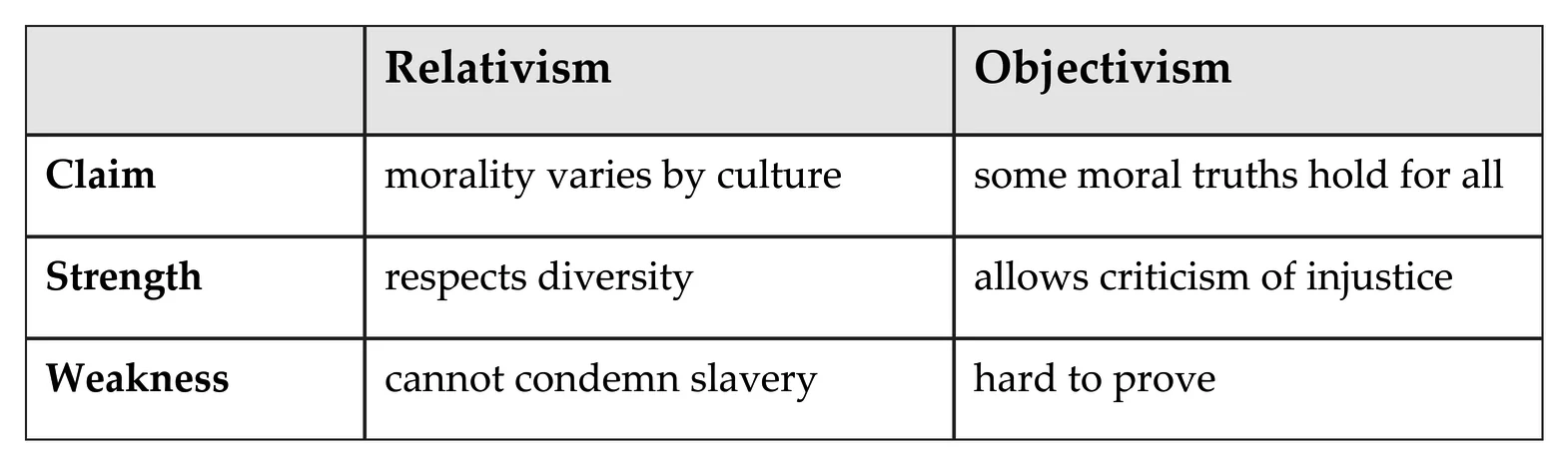
Are moral judgements merely cultural customs or personal feelings, or can they be true and rational? Relativists say morality varies from culture to culture, while objectivists hold that some moral truths apply to everyone. Rachels criticises relativism, and de Lazari-Radek and Singer defend the objectivity of ethics based on impartial reason.
Cultural Relativism and Its Roots
The Greek historian Herodotus tells that the Persian king Darius asked some Greeks, who burned their dead, what would make them eat their dead fathers, and they were horrified; he then asked the Callatians, who ate their dead, what would make them burn their fathers, and they were equally horrified. Herodotus concluded, quoting the poet Pindar, that custom is king of all. Modern anthropologists such as William Graham Sumner, in Folkways (1906), and Ruth Benedict, in Patterns of Culture (1934), argued that morality is relative to each culture. Cultural relativism encourages humility and tolerance, but critics point to serious problems.
Rachels’s Critique of Relativism
- A logical gap. From the fact that cultures disagree about morality, it does not follow that there is no objective truth, just as disagreement about the shape of the earth did not mean it had no shape.
- No criticism of other societies. If relativism were true, we could not say that slavery, genocide or the persecution of minorities in another society was wrong.
- No criticism of our own society. We could not question our own society’s practices, since right would simply mean approved by our culture.
- No moral progress. Reforms such as the abolition of slavery or votes for women could not count as improvements, only as changes.
- Less disagreement than it seems. Many differences arise from different factual beliefs or circumstances, not from different values; all societies value care for the young, truth-telling and prohibitions on murder.
Subjectivism, Emotivism and the Is-Ought Problem
David Hume, in A Treatise of Human Nature (1739 to 1740), observed that writers often move from statements about what is to statements about what ought to be without explaining how, and argued that morality is rooted in feeling rather than reason. G.E. Moore, in Principia Ethica (1903), called the attempt to define good in natural terms the naturalistic fallacy. In the twentieth century, A.J. Ayer, in Language, Truth and Logic (1936), and C.L. Stevenson defended emotivism, the view that moral statements express feelings and try to influence others rather than state facts. Rachels replies that moral judgments must be supported by reasons, and that good reasons, unlike mere feelings, can be assessed for truth and relevance.
The Point of View of the Universe
Henry Sidgwick, in The Methods of Ethics (1874), argued that reason reveals self-evident principles, including that the good of any one individual is of no more importance, from the point of view of the universe, than the good of any other. He was troubled, however, by the dualism of practical reason, the apparent conflict between rational egoism and impartial benevolence. Katarzyna de Lazari-Radek and Peter Singer, in The Point of View of the Universe (2014), defend Sidgwick’s objectivism and argue that impartial benevolence survives critical scrutiny better than egoism. John Rawls’s method of reflective equilibrium, adjusting principles and considered judgments until they fit together, and Derek Parfit’s On What Matters (2011) offer other defences of rational, objective ethics.
Pluralism and Objectivity
Objectivity does not require that every moral question has one simple answer. Isaiah Berlin argued for value pluralism, the view that genuine values such as liberty and equality can conflict and cannot always be ranked. Others note that we can have objectivity without certainty: we can be confident that torturing innocents for fun is wrong while remaining unsure about hard cases. The Universal Declaration of Human Rights of 1948, drafted by people from many cultures, shows that agreement on basic values across cultures is possible.
1.3 Ethical Theories and Politics
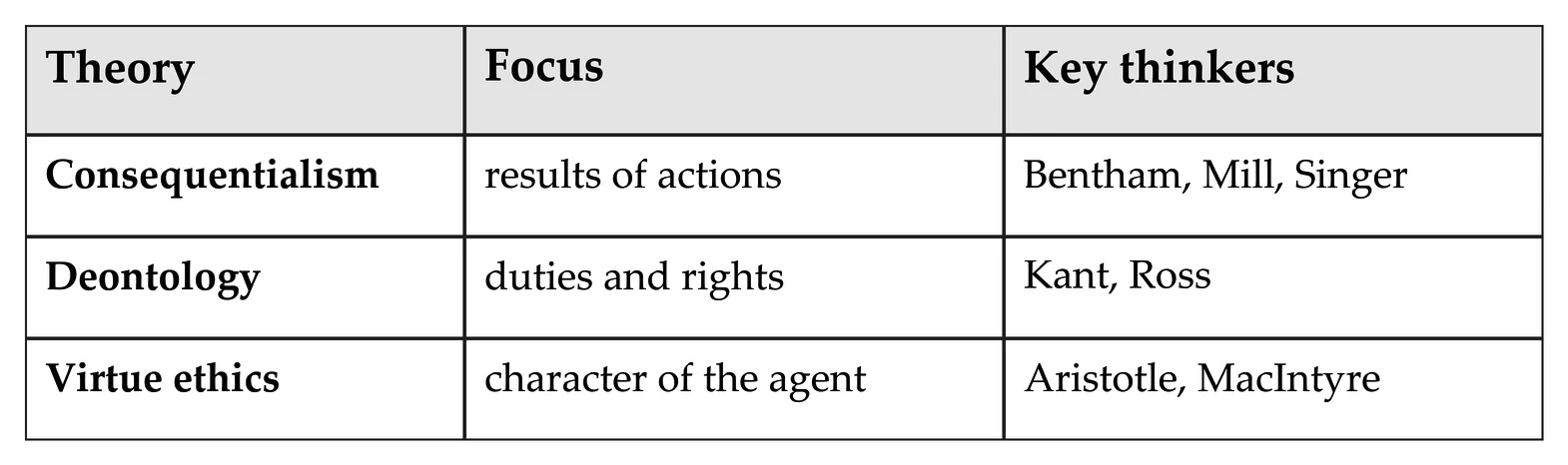
Consequentialism judges actions by their results, deontology by duties and rights, and virtue ethics by the character of the agent. In politics, these theories guide public policy, but politicians face special dilemmas, such as the problem of dirty hands, which Bernard Williams and Michael Walzer discuss.
Classical Utilitarianism
Jeremy Bentham, in An Introduction to the Principles of Morals and Legislation (1789), held that nature has placed humans under two masters, pain and pleasure, and that the right action is the one that produces the greatest happiness. He proposed a felicific calculus measuring pleasures by intensity, duration, certainty, nearness, fruitfulness, purity and extent. John Stuart Mill, in Utilitarianism (1861), distinguished higher pleasures of the intellect and feelings from lower bodily pleasures, saying it is better to be a dissatisfied human than a satisfied pig. Later utilitarians distinguished act utilitarianism, which judges each act by its consequences, from rule utilitarianism, which judges acts by rules that generally produce the best consequences.
Kant and Ross
Immanuel Kant, in the Groundwork of the Metaphysics of Morals (1785), argued that morality rests on the categorical imperative, a command of reason binding on all rational beings regardless of their desires. Its first formula requires us to act only on maxims that we could will to become universal laws, so lying is wrong because a world of universal lying would make promises impossible. Its second formula requires us to treat humanity, in ourselves and others, always as an end and never merely as a means. W.D. Ross, in The Right and the Good (1930), softened Kant’s strictness by listing prima facie duties, fidelity, reparation, gratitude, justice, beneficence, self-improvement and non-maleficence, which can conflict, so that judgment is needed to decide which is weightier in a given case.
Virtue Ethics and the Ethics of Care
- Aristotle. In the Nicomachean Ethics, Aristotle held that virtue is a settled disposition lying in a mean between excess and deficiency, as courage lies between rashness and cowardice, and that practical wisdom (phronesis) is needed to find it.
- Revival. Elizabeth Anscombe’s essay Modern Moral Philosophy (1958) and Alasdair MacIntyre’s After Virtue (1981) revived virtue ethics, criticising rule-based theories for neglecting character and community.
- Care ethics. Carol Gilligan, in In a Different Voice (1982), argued that women often reason in terms of care and relationships rather than abstract rules, and Nel Noddings, in Caring (1984), developed an ethics centred on caring relations.
- The trolley problem. Philippa Foot (1967) and Judith Jarvis Thomson asked whether it is permissible to divert a runaway trolley to kill one person instead of five, a puzzle that tests the conflict between consequences and duties.
Ethics and Politics
Politics raises special ethical problems. Machiavelli, in The Prince (1513), advised rulers to learn how not to be good when necessary. Max Weber, in Politics as a Vocation (1919), distinguished an ethic of conviction, acting on principle regardless of results, from an ethic of responsibility, which takes account of the foreseeable consequences of action, and argued that a mature politician must combine both. Michael Walzer, in Political Action: The Problem of Dirty Hands (1973), argued that politicians sometimes must do wrong to achieve important goods, yet should still feel guilt for it. Bernard Williams, in Politics and Moral Character (1978), warned that those who become too comfortable with dirty hands lose the moral sense that should restrain them. Gandhi rejected the separation of ends and means, writing in Hind Swaraj (1909) that the means are to the end as the seed is to the tree.
1.4 Important Questions
- Question 1 What is ethics? Discuss its nature and branches.
- Question 2 Can ethics be rational and objective? Discuss.
- Question 3 Discuss consequentialist, deontological and virtue ethics theories.
- Question 4 Discuss the role of ethics in politics and public policy.
DU asks the same idea in different words. So learn one broad answer for each question below; the same answer works for every question joined by OR.
Important Question 1
What is ethics? Discuss its nature and branches.
OR
Explain Rachels’s minimum conception of morality.
OR
Distinguish between ethics, law and religion.
Model Answer
“Morality is, at the very least, the effort to guide one’s conduct by reason, that is, to do what there are the best reasons for doing, while giving equal weight to the interests of each individual affected by one’s decision.”
— James Rachels, The Elements of Moral Philosophy
Introduction. Ethics is one of the oldest branches of philosophy, concerned with how we should live and what we ought to do. It examines the standards by which actions, persons and institutions are judged right or wrong, good or bad. In public life, ethics guides the conduct of citizens, officials and governments. James Rachels and Joseph Raz help explain its nature.
1. Meaning
Ethics, from the Greek ethos, meaning character or custom, is the systematic study of moral values and principles. Morality, from the Latin mores, refers to the actual beliefs and practices about right and wrong in a society.
2. Socratic Origin
Socrates taught that the unexamined life is not worth living. By questioning accepted beliefs about justice, courage and goodness, he showed that ethics requires critical reflection rather than blind acceptance of custom.
3. Rachels’s Minimum Conception
James Rachels argues that whatever else morality is, it involves two things: being guided by reason, doing what there are the best reasons to do, and impartiality, giving equal weight to the interests of everyone affected.
4. Reason in Ethics
Moral judgements must be backed by good reasons, not merely feelings or prejudices. Rachels shows this through hard cases, such as decisions about disabled infants, where careful reasoning reveals which arguments hold.
5. Impartiality
Impartiality means that each person’s interests are equally important. Discrimination based on race, caste or sex violates this requirement unless there is a relevant difference that justifies different treatment.
6. Metaethics
Metaethics asks about the nature of morality itself: whether moral statements can be true, whether there are moral facts and how we can know them.
7. Normative Ethics
Normative ethics develops theories of what makes actions right or wrong, such as consequentialism, deontology and virtue ethics.
8. Applied Ethics
Applied ethics examines specific issues, such as euthanasia, abortion, animal rights, environmental protection, war, poverty and new technologies, and includes fields such as bioethics and business ethics.
9. Ethics and Law
Law is enforced by the state, while ethics depends on conscience and social approval. Many laws reflect moral principles, but some laws are unjust, and some moral duties are not legal requirements.
10. Ethics and Religion
Religions offer moral teachings, but Plato’s Euthyphro asked whether things are good because God commands them or God commands them because they are good. Most philosophers hold that ethics can be grounded in reason accessible to all.
11. Raz on Ethics in the Public Domain
Joseph Raz examines how ethics applies to law and politics. He argues that political institutions should help people lead autonomous lives with a range of valuable options, linking public morality with individual well-being.
12. Ethics in Professions
Professions such as medicine, law, administration and business have codes of ethics. Elizabeth Scott shows that organisations also have moral values that shape the conduct of their members.
13. Indian Traditions
Indian thought discusses ethics through ideas such as dharma, the Gita’s teaching of action without attachment to results and Gandhi’s insistence that ends and means must both be pure.
14. Why Ethics Matters
Ethics matters because our choices affect others, because societies need shared standards to cooperate and because public power must be justified to those subject to it.
15. Descriptive and Normative
Ethics differs from the descriptive study of morality. Anthropologists and psychologists describe what moral beliefs people actually hold, while ethics asks which beliefs are justified. Knowing that a society once accepted untouchability does not tell us whether it was right, which is a normative question.
16. Moral Reasoning in Practice
Moral reasoning involves getting the facts right, identifying the relevant principles, considering the interests of all affected and testing arguments for consistency. Rachels shows that many moral disagreements turn out to rest on disagreements about facts, which careful inquiry can sometimes resolve.
17. Evaluation
Ethics is reasoned reflection on how to live and act, guided by impartial concern for all affected.
Conclusion. Thus, ethics is the systematic study of right and wrong, with metaethics, normative ethics and applied ethics as its branches. Rachels’s minimum conception stresses reason and impartiality, Raz links ethics with law and politics, and ethics differs from law and religion while informing both.
Important Question 2
Can ethics be rational and objective? Discuss.
OR
Examine the challenge of cultural relativism to ethics.
OR
Discuss de Lazari-Radek and Singer’s argument for the objectivity of ethics.
Model Answer
“The good of any one individual is of no more importance, from the point of view (if I may say so) of the Universe, than the good of any other.”
— Henry Sidgwick, The Methods of Ethics (1874)
Introduction. A central question in ethics is whether moral judgements can be rational and objective, or whether they are only expressions of culture or feeling. If ethics is merely relative, we cannot criticise injustice in other societies. Philosophers such as James Rachels, Katarzyna de Lazari-Radek and Peter Singer argue that ethics can be rational and objective.
1. The Question
When we say that slavery is wrong, are we stating a truth, expressing our culture’s customs or simply expressing our feelings? The answer determines whether moral debate can be settled by reason.
2. Cultural Relativism
Cultural relativism holds that different societies have different moral codes and that there is no objective standard to judge one better than another. Rachels recalls Herodotus’s story of Greeks and Callatians, who were horrified by each other’s funeral customs.
3. Rachels’s Critique of Relativism
Rachels argues that the fact that cultures disagree does not show that there is no truth, just as disagreement about the shape of the earth did not mean there was no fact. Relativism would also prevent us from condemning slavery or genocide in other societies.
4. What Relativism Gets Right
Rachels accepts that relativism teaches humility: many practices are merely customs, and we should not assume our own culture is always right.
5. Subjectivism and Emotivism
Subjectivism holds that moral judgements report personal feelings, and emotivism holds that they express feelings rather than state facts. Critics reply that moral judgements are supported by reasons, unlike mere tastes.
6. Reasons and Objectivity
Rachels argues that moral truths are truths of reason: a moral judgement is correct if it is supported by better reasons than the alternatives. This gives ethics a form of objectivity.
7. Sidgwick’s Point of View
Henry Sidgwick argued that from the point of view of the universe, no one’s good matters more than anyone else’s. This impartial standpoint grounds objective ethical reasoning.
8. The Dualism of Practical Reason
Sidgwick found that reason seemed to support both egoism, pursuing one’s own good, and universal benevolence, pursuing the good of all, a conflict he called the dualism of practical reason.
9. De Lazari-Radek and Singer
Katarzyna de Lazari-Radek and Peter Singer argue that ethics is objective and that Sidgwick’s dualism can be resolved in favour of impartial benevolence, because our egoistic impulses can be explained by evolution, while impartial concern is a genuine insight of reason.
10. Reflective Equilibrium
John Rawls proposed reflective equilibrium, adjusting moral principles and considered judgements until they fit together, as a method of rational moral reasoning.
11. Moral Progress
The abolition of slavery, the extension of rights to women and the condemnation of untouchability suggest moral progress, which makes sense only if some moral views are better than others.
12. Pluralism
Joseph Raz and others defend value pluralism: there are many genuine values that cannot always be ranked, so objectivity does not mean that every question has a single answer.
13. Objectivity in Public Life
Constitutions and human rights rest on the belief that some principles, such as human dignity and equality, are binding on all, not merely matters of local custom.
14. Criticisms
Critics argue that claims of objectivity may hide cultural bias, as when Western values are presented as universal. A balanced view combines objectivity with openness to different perspectives.
15. Objectivity without Certainty
Accepting the objectivity of ethics does not mean claiming certainty. Just as scientists hold theories that may later be revised, people can hold moral views with confidence while remaining open to better arguments. Objectivity means that there is something to be right or wrong about, not that we already know every answer.
16. Universal Human Rights
The Universal Declaration of Human Rights of 1948, drafted by people from many cultures, shows that agreement on basic moral standards across traditions is possible. Thinkers from India, such as Hansa Mehta, who helped change the wording to all human beings are born free and equal, contributed to this shared statement.
17. Evaluation
Ethics can be rational and, in an important sense, objective, since moral views can be supported or refuted by reasons.
Conclusion. Thus, cultural relativism and subjectivism challenge the objectivity of ethics, but Rachels shows that disagreement does not mean there is no moral truth. Sidgwick’s point of view of the universe and de Lazari-Radek and Singer’s defence of impartial benevolence support objective ethics, while pluralism reminds us that not every question has one answer.
Important Question 3
Discuss consequentialist, deontological and virtue ethics theories.
OR
Compare utilitarianism and Kantian ethics.
OR
Examine the relevance of virtue ethics in politics.
Model Answer
“Act only according to that maxim whereby you can at the same time will that it should become a universal law.”
— Immanuel Kant, Groundwork of the Metaphysics of Morals (1785)
Introduction. Normative ethics offers three main theories of what makes actions right or wrong. Consequentialism judges actions by their results, deontology by whether they respect duties and rights, and virtue ethics by the character they express. Each offers insights into ethics in politics, and each faces criticisms.
1. Consequentialism
Consequentialism holds that the rightness of an action depends only on its consequences. The best action is the one that produces the best overall results.
2. Utilitarianism
Utilitarianism, developed by Jeremy Bentham and John Stuart Mill, holds that we should maximise happiness or welfare for all affected. Bentham proposed measuring pleasures and pains, while Mill distinguished higher and lower pleasures.
3. Act and Rule
Act utilitarianism judges each action by its consequences, while rule utilitarianism judges actions by whether they follow rules that generally produce the best consequences.
4. Strengths and Weaknesses
Utilitarianism is impartial and practical, and it underlies cost-benefit analysis in public policy. But critics say it can justify sacrificing individuals, such as punishing an innocent person to calm a mob, and that it is too demanding.
5. Deontology
Deontology, from the Greek deon, meaning duty, holds that some actions are right or wrong in themselves, regardless of consequences, because they respect or violate duties and rights.
6. Kant’s Categorical Imperative
Immanuel Kant argued that we should act only on maxims that we could will to become universal laws, and that we should treat humanity always as an end and never merely as a means.
7. Ross’s Prima Facie Duties
W.D. Ross argued that we have several prima facie duties, such as fidelity, non-maleficence, justice and beneficence, which may conflict, so judgement is needed to decide which prevails.
8. Strengths and Weaknesses
Deontology protects rights and dignity and explains why some acts, such as torture, are wrong whatever the benefits. But critics say it can be rigid, as when Kant held that one must not lie even to a murderer.
9. Virtue Ethics
Virtue ethics, rooted in Aristotle, asks what kind of person one should be. Virtues such as courage, justice, temperance and practical wisdom are traits that enable a person to flourish.
10. The Golden Mean
Aristotle saw virtue as a mean between extremes, such as courage between cowardice and rashness, discovered through practical wisdom (phronesis) and practice.
11. Revival of Virtue Ethics
Elizabeth Anscombe in 1958 and Alasdair MacIntyre in After Virtue (1981) revived virtue ethics, criticising modern theories for neglecting character and community.
12. Virtue in Politics
Virtue ethics stresses that good governance depends on the character of leaders and officials, such as integrity, prudence and public spirit, not only on rules and calculations.
13. Criticisms of Virtue Ethics
Critics argue that virtue ethics gives little guidance in hard cases and that ideas of virtue vary across cultures.
14. Combining Theories
In practice, public ethics often combines theories: policies consider consequences, respect rights and depend on the character of those who carry them out.
15. The Trolley Problem
Philosophers use the trolley problem to test these theories. If a runaway trolley will kill five people unless diverted onto a track where it will kill one, most people think diverting it is permissible, as consequentialists say. But most reject pushing a person off a bridge to stop the trolley, which suggests that duties against using people as means also matter, as deontologists argue.
16. Ethics of Care
Feminist thinkers such as Carol Gilligan and Nel Noddings developed an ethics of care, which stresses relationships, responsiveness and attention to particular needs rather than abstract rules or calculations. In public policy, it draws attention to care work, dependency and the vulnerable, adding to the three main theories.
17. Evaluation
Each theory captures an important part of morality, and together they provide a rich framework for ethical reasoning in politics.
Conclusion. Thus, consequentialism, as in Bentham and Mill, judges actions by their results; deontology, as in Kant and Ross, by duties and rights; and virtue ethics, as in Aristotle and MacIntyre, by character. Each has strengths and weaknesses, and good public ethics draws on all three.
Important Question 4
Discuss the role of ethics in politics and public policy.
OR
Examine the problem of dirty hands in politics.
OR
Why does ethics matter in public policy? Discuss.
Model Answer
“Politics is a strong and slow boring of hard boards. It takes both passion and perspective.”
— Max Weber, Politics as a Vocation (1919)
Introduction. Politics involves the exercise of power over others, often in conditions of conflict and uncertainty. Ethics asks how this power should be used and justified. Jonathan Boston and his co-authors argue that ethics matters in public policy, while Max Weber, Bernard Williams and Michael Walzer discuss the moral dilemmas of political action.
1. Why Ethics Matters in Policy
Jonathan Boston, Andrew Bradstock and David Eng argue that every public policy involves value choices about who benefits, who pays and what kind of society we want, so ethics cannot be separated from policy analysis.
2. Values in Policy
Policies on taxation, health, education, environment and security involve values such as fairness, liberty, welfare and dignity, which must be weighed and justified to citizens.
3. Principles from Bioethics
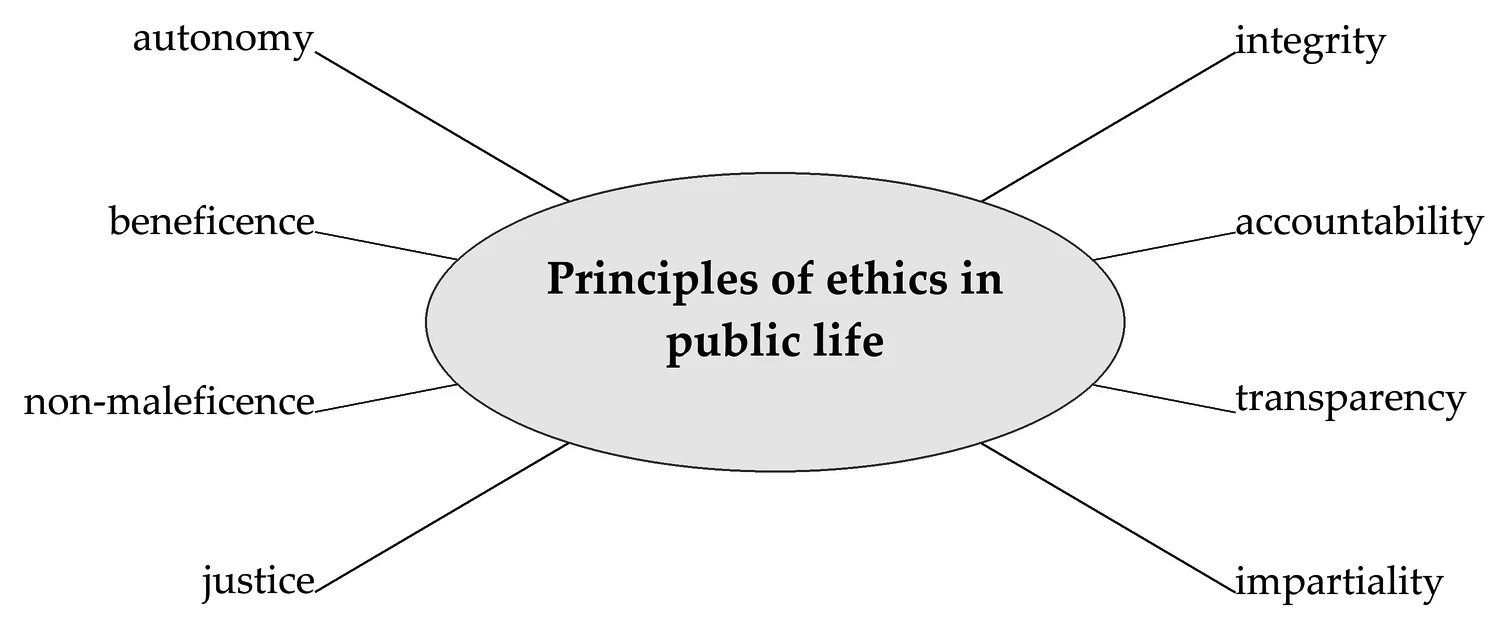
Tom Beauchamp and James Childress proposed four principles for medical ethics: respect for autonomy, beneficence, non-maleficence and justice. These principles also guide public policy on health and welfare.
4. Weber’s Two Ethics
Max Weber distinguished the ethic of conviction, acting on principle regardless of consequences, from the ethic of responsibility, taking account of the foreseeable results of one’s actions. He argued that a true politician must combine both.
5. Machiavelli’s Challenge
Machiavelli argued that a ruler must learn how not to be good when necessary to preserve the state, raising the question whether politics has its own morality.
6. The Problem of Dirty Hands
Michael Walzer, in 1973, described the problem of dirty hands: a politician may have to do something morally wrong, such as ordering the torture of a terrorist to prevent a bombing, to achieve a greater good, and should still feel guilt.
7. Williams on Moral Character
Bernard Williams, in Politics and Moral Character (1978), argued that politicians may need to do morally disagreeable things, but that only those who retain a reluctance and sense of the moral cost of such acts can be trusted with power.
8. Public and Private Morality
Williams and others ask whether public officials should follow the same morality as private persons, or whether their role permits actions, such as secrecy or force, that would be wrong in private life.
9. Principles of Public Life
Britain’s Nolan Committee in 1995 set out seven principles of public life: selflessness, integrity, objectivity, accountability, openness, honesty and leadership.
10. Ethics in Governance in India
The Second Administrative Reforms Commission, in its report on Ethics in Governance (2007), recommended codes of ethics for ministers, legislators and civil servants, and stronger measures against corruption.
11. Constitutional Morality
In India, constitutional morality, respect for the Constitution’s values and procedures, provides an ethical framework for public officials, as Ambedkar stressed.
12. Ethical Dilemmas
Officials face dilemmas such as loyalty to superiors versus public interest, confidentiality versus transparency, and efficiency versus fairness, which require ethical judgement.
13. Institutions for Ethics
Institutions such as the Right to Information, the Lokpal, ethics committees in legislatures and whistle-blower protection help enforce ethical conduct in public life.
14. Gandhi’s Ends and Means
Gandhi insisted that means are as important as ends and that impure means corrupt even good goals, a challenge to the idea that politics justifies dirty hands.
15. Ethics of Lying in Politics
Political leaders sometimes justify lying to protect national security or prevent panic. Plato spoke of a noble lie, while critics argue that deception by governments undermines democratic consent, since citizens cannot judge policies they are misled about. Most ethicists accept secrecy in narrow cases but condemn lies that avoid accountability.
16. Conflict of Interest
A conflict of interest arises when an official’s private interests may influence public duties, as when a minister makes decisions affecting a company owned by relatives. Codes of conduct require officials to declare interests and withdraw from such decisions, protecting impartiality and public trust.
17. Evaluation
Ethics is essential in politics and policy, though political life raises special dilemmas that require both principle and responsibility.
Conclusion. Thus, ethics matters in politics and policy because every decision involves value choices, as Boston and his co-authors show. Weber’s ethics of conviction and responsibility, Walzer’s dirty hands and Williams’s reluctant politician capture the dilemmas of power, while principles of public life and institutions help ensure ethical governance.
Short Notes
(a) Minimum conception of morality
Rachels’s view that morality at least involves guiding conduct by reason and giving equal weight to the interests of all affected.
(b) Categorical imperative
Kant’s supreme moral principle: act only on maxims you could will to be universal laws, and treat humanity always as an end.
(c) Dirty hands
The dilemma, discussed by Walzer and Williams, in which a politician must do something morally wrong to achieve a greater good.
More notes: DSE-17 Ethics, Politics and Governance
These notes are prepared by PADHO TO AISE for study help. They are not an official University of Delhi publication.