
Semester VIII DSE-16 Environment
Unit 4 · 23 min read · Updated 24 Nov 2026
As per the University of Delhi (DU) BA (Hons) Political Science syllabus
Contents
- 4.1 Climate Policy and the NAPCC
- The Eight National Missions
- Evolution of India’s Climate Policy
- Adaptation and Climate Justice
- 4.2 River Cleaning and Environmental Law
- From the Ganga Action Plan to Namami Gange
- Milestones of Environmental Law
- 4.3 Forest Management in India
- Forest Policy since Independence
- Uttarakhand in Detail
- Jharkhand and the North-east
- 4.4 Important Questions
- Discuss the National Action Plan on Climate Change and the evolution of climate policy in India.
- Examine the Ganga Action Plan as a case study of pollution control in India.
- Discuss environmental legislation in India with reference to the Eco-Mark and the National Green Tribunal.
- Discuss forest management in India with reference to Uttarakhand, Jharkhand and the North-east.
- Short Notes
जलवायु संकट संस्कृति का भी संकट है, और इसलिए कल्पना का भी।
The climate crisis is also a crisis of culture, and thus of the imagination.
— Amitav Ghosh, The Great Derangement (2016)
INDIA faces severe environmental challenges: climate change, polluted rivers, degraded forests, air pollution and water scarcity. It has responded with a National Action Plan on Climate Change, river cleaning programmes beginning with the Ganga Action Plan, a wide body of environmental legislation, the Eco-Mark scheme and the National Green Tribunal. Forest management varies across regions, from the van panchayats of Uttarakhand to the tribal forests of Jharkhand and the community forests of the North-east. This chapter examines these strategies, drawing on Navroz Dubash, Usha Menon, Shyam Divan and Armin Rosencranz, and Satyajit Singh.
4.1 Climate Policy and the NAPCC
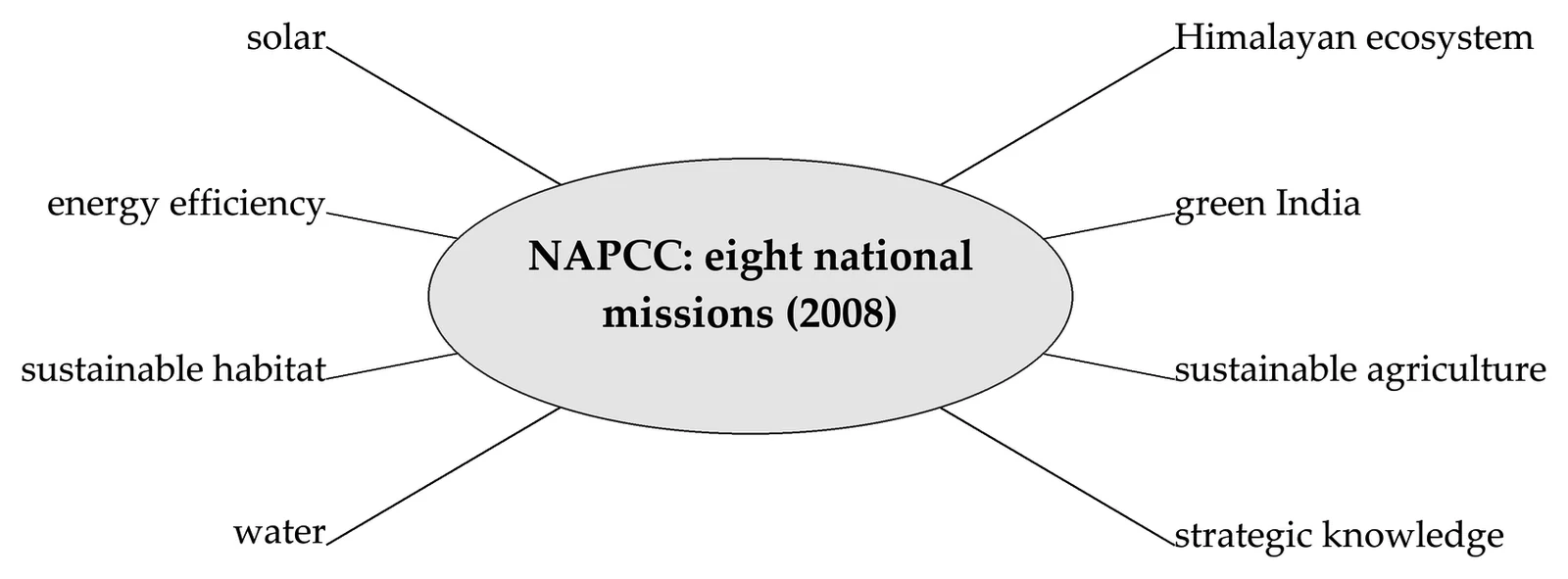
The National Action Plan on Climate Change (NAPCC) of 2008 set out eight national missions on solar energy, energy efficiency, sustainable habitat, water, the Himalayan ecosystem, green India, sustainable agriculture and strategic knowledge. States prepared their own action plans. Navroz Dubash and Neha Joseph show how India’s climate institutions evolved around a co-benefits approach that links climate action with development.
The Eight National Missions
- National Solar Mission. Launched in 2010, its target was raised in 2015 to 100 gigawatts of solar capacity by 2022.
- Enhanced Energy Efficiency. It introduced the Perform, Achieve and Trade scheme in 2012, under which energy-intensive industries trade energy-saving certificates.
- Sustainable Habitat. It promotes energy efficiency in buildings, urban planning, waste management and public transport.
- National Water Mission. It aims to increase water-use efficiency by twenty per cent.
- Sustaining the Himalayan Ecosystem. It studies glaciers and protects mountain ecosystems.
- Green India. It aims to increase and improve forest and tree cover.
- Sustainable Agriculture. It promotes climate-resilient farming, soil health and water management.
- Strategic Knowledge. It builds research capacity on climate science.
Evolution of India’s Climate Policy
India’s climate policy has evolved from a defensive stance to a more active one. In 2007, Prime Minister Manmohan Singh pledged that India’s emissions per person would never exceed those of developed countries. Navroz Dubash, in the edited volume India in a Warming World (2019), describes how India moved towards a co-benefits approach, pursuing measures such as energy efficiency and renewable energy that serve both development and climate goals. At Glasgow in 2021 India announced the Panchamrit commitments, including net zero by 2070, and in 2022 it submitted a long-term low-emission development strategy. The Energy Conservation (Amendment) Act of 2022 enabled a domestic carbon credit trading scheme, and a Green Credit Programme was launched in 2023. In 2025, the government reported that non-fossil sources had reached half of installed electricity capacity.
Adaptation and Climate Justice
India is highly vulnerable to climate change through heatwaves, floods, cyclones, glacial retreat and erratic monsoons. Ahmedabad’s Heat Action Plan of 2013, the first in South Asia, became a model for early warnings and public health measures, and many states have since adopted similar plans. Odisha’s cyclone preparedness greatly reduced deaths compared with the super-cyclone of 1999. Scholars stress that adaptation must address the vulnerability of farmers, fishers, outdoor workers and slum dwellers, linking climate policy with social justice.
4.2 River Cleaning and Environmental Law
The Ganga Action Plan of 1986 sought to clean the Ganga by treating sewage, but it achieved limited results, as Usha Menon and later reviews showed. India also built a large body of environmental law, from the Wild Life Act of 1972 to the Environment (Protection) Act of 1986, supported by the Eco-Mark label for green products and the National Green Tribunal for quick environmental justice.
From the Ganga Action Plan to Namami Gange
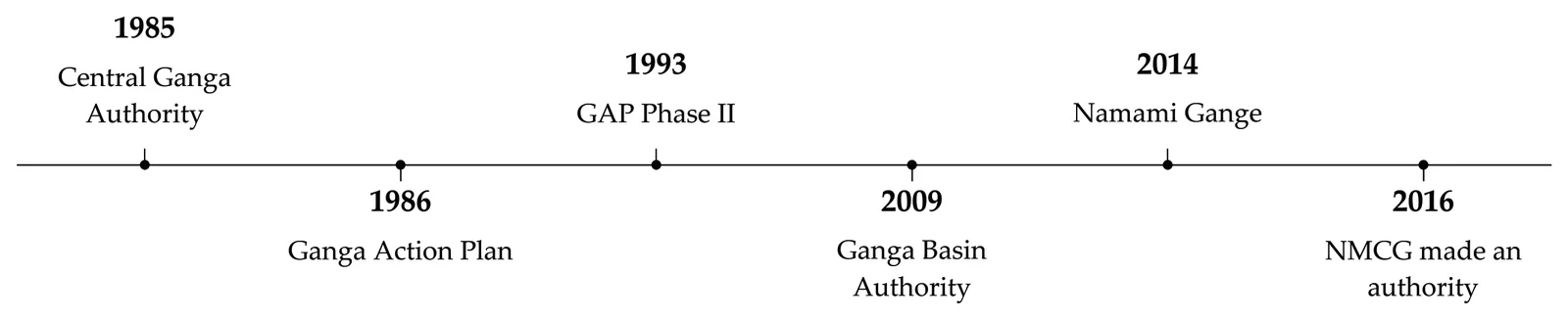
- 1985 and 1986 → The Central Ganga Authority was set up and the Ganga Action Plan launched to intercept, divert and treat sewage in towns along the river.
- 1987 → In a public interest case filed by M.C. Mehta, the Supreme Court ordered the closure of tanneries in Kanpur that did not treat their waste.
- 1993 and 1995 → The second phase of the plan extended it to tributaries, and the National River Conservation Plan covered other rivers.
- 2008 and 2009 → The Ganga was declared a national river and the National Ganga River Basin Authority was created under the Prime Minister.
- 2014 and 2015 → The Namami Gange programme was launched with a budget of about Rs 20,000 crore, and in 2016 a National Ganga Council chaired by the Prime Minister replaced the earlier authority.
- 2018 → The environmental scientist G.D. Agrawal, known as Swami Sanand, died after a long fast demanding protection of the river’s flow.
Milestones of Environmental Law
- Constitution. The 42nd Amendment of 1976 added Article 48A, directing the state to protect the environment, and Article 51A(g), making it a duty of citizens; courts later read the right to a clean environment into Article 21.
- Water and air. The Water Act of 1974 and the Air Act of 1981 created pollution control boards.
- Forests. The Forest (Conservation) Act of 1980 required central approval for diversion of forest land; it was amended in 2023.
- The umbrella law. The Environment (Protection) Act of 1986, passed after the Bhopal disaster of 1984, gave the Union wide powers and is the basis of the environmental impact assessment notifications of 1994 and 2006.
- Liability and tribunals. The Public Liability Insurance Act of 1991 and the National Green Tribunal Act of 2010 provided compensation and specialised justice.
Shyam Divan and Armin Rosencranz, in Environmental Law and Policy in India, show that India has strong laws but weak enforcement, because pollution control boards lack staff, funds and independence.
4.3 Forest Management in India
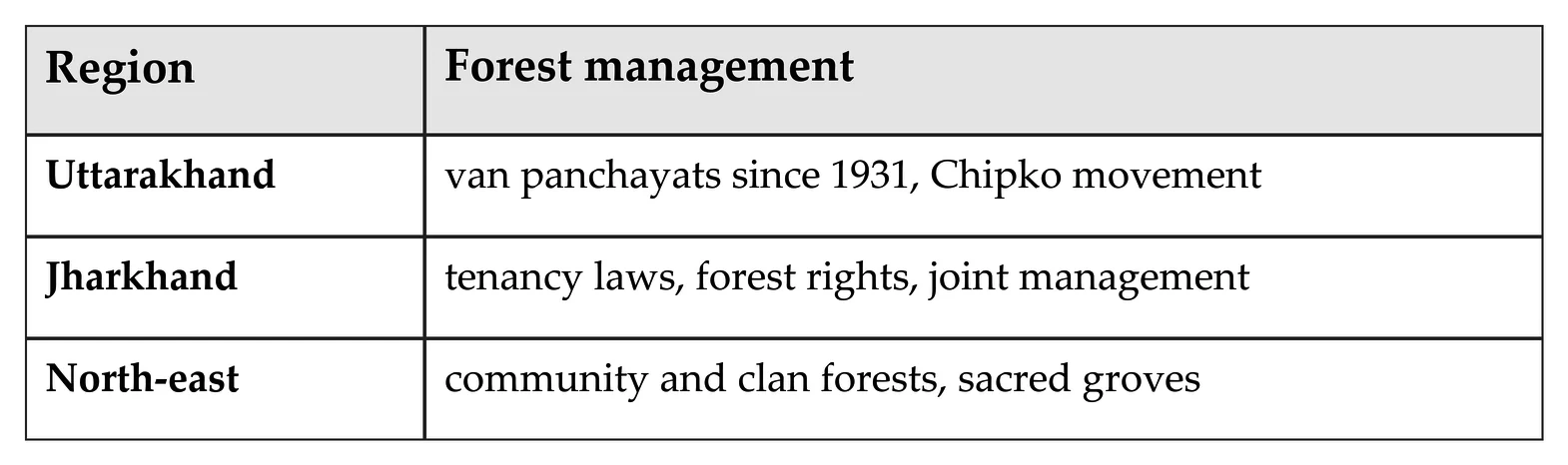
Forest management in India ranges from state control to community governance. Uttarakhand has village forest councils, the van panchayats, dating from 1931, and the Chipko movement. Jharkhand has tribal land laws and struggles over forests and mining. The North-east has extensive community and clan ownership of forests and sacred groves.
Forest Policy since Independence
Independent India first continued colonial forest policy. The National Forest Policy of 1952 emphasised national needs such as industry and defence. The National Forest Policy of 1988 marked a shift, giving priority to ecological balance and the needs of local people and aiming for one-third of the country’s area under forest and tree cover. Building on an experiment at Arabari in West Bengal in the early 1970s, a central circular of 1990 introduced Joint Forest Management, in which villagers protect forests in return for a share of produce. The Forest Rights Act of 2006 recognised the individual and community forest rights of Scheduled Tribes and other traditional forest dwellers, and in 2009 the village of Mendha-Lekha in Gadchiroli became one of the first to receive community forest resource rights.
Uttarakhand in Detail
In Kumaon, protests against colonial forest restrictions and forced labour led to the Kumaon Forest Grievances Committee of 1921 and the Van Panchayat Rules of 1931, which allowed villages to manage their own forests through elected councils. The Chipko movement began in 1973 when villagers of Mandal, organised by Chandi Prasad Bhatt’s Dasholi Gram Swarajya Sangh, prevented a sports goods company from felling ash trees, and spread to Reni in 1974. Sunderlal Bahuguna carried its message nationally, and in 1980 the Union government imposed a fifteen-year ban on green felling in the Himalayan forests of Uttar Pradesh. Ramachandra Guha, in The Unquiet Woods (1989), traces Chipko to a long history of peasant resistance.
Jharkhand and the North-east
In Jharkhand, forests are bound up with Adivasi identity and struggles over land. The Chota Nagpur Tenancy Act of 1908, passed after Birsa Munda’s ulgulan of 1899 to 1900, and the Santhal Pargana Tenancy Act of 1949 restrict the transfer of tribal land. In the late 1970s and 1980, Adivasis protested against the replacement of sal forests with teak plantations, and the Pathalgadi movement of 2017 and 2018 asserted the authority of gram sabhas under the PESA Act of 1996 against mining and land acquisition. In the North-east, the Sixth Schedule, Article 371A for Nagaland and Article 371G for Mizoram protect customary rights, and most forests in states such as Meghalaya and Nagaland are owned by clans and communities. Sacred groves, such as Mawphlang in Meghalaya, and village initiatives, such as Khonoma in Nagaland, which banned hunting in 1998, show successful community conservation, while shifting cultivation (jhum) remains a subject of debate.
4.4 Important Questions
- Question 1 Discuss the National Action Plan on Climate Change and the evolution of climate policy in India.
- Question 2 Examine the Ganga Action Plan as a case study of pollution control in India.
- Question 3 Discuss environmental legislation in India with reference to the Eco-Mark and the National Green Tribunal.
- Question 4 Discuss forest management in India with reference to Uttarakhand, Jharkhand and the North-east.
DU asks the same idea in different words. So learn one broad answer for each question below; the same answer works for every question joined by OR.
Important Question 1
Discuss the National Action Plan on Climate Change and the evolution of climate policy in India.
OR
Examine the eight national missions under the NAPCC.
OR
How have institutions for climate policy evolved in India?
Model Answer
“India is determined that its per capita greenhouse gas emissions will at no point exceed that of developed countries even as we pursue our development objectives.”
— National Action Plan on Climate Change (2008)
Introduction. India is highly vulnerable to climate change, with its dependence on the monsoon, long coastline, Himalayan glaciers and large poor population. At the same time, it is a growing emitter. In 2008, India released its National Action Plan on Climate Change, and since then its climate policy and institutions have evolved, as Navroz Dubash and Neha Joseph, and Aaron Atteridge and colleagues, have shown.
1. India’s Vulnerability
Climate change threatens India through rising temperatures, heatwaves, erratic monsoons, floods, droughts, sea-level rise and melting glaciers, affecting agriculture, water and health. R.K. Mall and colleagues show the risks to India’s water resources.
2. The NAPCC
The NAPCC was released on 30 June 2008 by the Prime Minister’s Council on Climate Change. It stressed that development and poverty reduction remain India’s priorities, while pursuing climate goals through co-benefits.
3. Mitigation Missions
The National Solar Mission aimed to expand solar power, the National Mission for Enhanced Energy Efficiency to reduce energy use in industry, and the National Mission on Sustainable Habitat to improve energy efficiency in buildings and transport.
4. Adaptation Missions
The National Water Mission, the National Mission for Sustaining the Himalayan Ecosystem, the Green India Mission and the National Mission for Sustainable Agriculture focus on adaptation, while the National Mission on Strategic Knowledge supports research.
5. State Action Plans
From 2009, states prepared State Action Plans on Climate Change to address local vulnerabilities, though many lacked funds and capacity.
6. Dubash and Joseph on Institutions
Navroz Dubash and Neha Joseph show that India’s climate institutions developed piecemeal, with the Prime Minister’s Council, the environment ministry and other ministries sharing responsibility, and argue for stronger coordination and a long-term framework.
7. Co-Benefits
India’s approach emphasises co-benefits: policies such as energy efficiency and renewable energy are justified by their development benefits, such as energy security and cleaner air, as well as climate benefits.
8. Atteridge and Colleagues
Aaron Atteridge and colleagues found that India’s climate policy is shaped by international negotiations, domestic concerns such as energy security and development, and the initiatives of particular states and ministries.
9. Vulnerability Assessment
Chandni Singh and colleagues review how vulnerability to climate change is assessed in India, showing that methods vary widely and calling for approaches that capture social as well as physical vulnerability.
10. International Commitments
India’s commitments under the Paris Agreement include reducing emission intensity by 45 per cent from 2005 levels and reaching 50 per cent non-fossil power capacity by 2030, and net zero emissions by 2070.
11. New Instruments
Recent measures include the Energy Conservation (Amendment) Act of 2022, which enabled a carbon credit trading scheme, the National Green Hydrogen Mission of 2023 and Mission LiFE, promoting sustainable lifestyles.
12. Renewable Energy Growth
India has rapidly expanded solar and wind power and has become one of the world’s largest renewable energy markets, though coal still dominates electricity generation.
13. Challenges
Challenges include continued dependence on coal, the need for finance and technology, weak coordination between the Centre and states, and protecting the poor from climate impacts.
14. Climate Justice
India insists on equity and common but differentiated responsibilities, arguing that its low per capita emissions and development needs must be respected in global climate action.
15. Evaluation
The NAPCC laid the foundation of India’s climate policy, which has grown in ambition and institutions, though coordination and implementation remain weak.
Conclusion. Thus, the NAPCC of 2008 set out eight missions on solar energy, efficiency, habitat, water, the Himalaya, green India, agriculture and knowledge, based on co-benefits. Dubash and Joseph show the gradual evolution of climate institutions, and India’s targets for 2030 and 2070 show growing ambition, though coal dependence and coordination remain challenges.
Important Question 2
Examine the Ganga Action Plan as a case study of pollution control in India.
OR
Why did the Ganga Action Plan fail to achieve its goals?
OR
Discuss the evolution of programmes to clean the Ganga from 1986 to Namami Gange.
Model Answer
“The Ganga, especially, is the river of India, beloved of her people, round which are intertwined her racial memories, her hopes and fears, her songs of triumph, her victories and her defeats.”
— Jawaharlal Nehru, Will and Testament (1954)
Introduction. The Ganga is India’s most sacred and important river, supporting hundreds of millions of people, but it became heavily polluted by sewage, industrial waste and runoff. The Ganga Action Plan, launched in 1986, was India’s first major river cleaning programme. Its limited success, analysed by Usha Menon and others, offers lessons for pollution control.
1. Pollution of the Ganga
The Ganga receives untreated sewage from many cities, effluents from tanneries, sugar mills and other industries, agricultural chemicals and religious waste, making many stretches unfit for bathing.
2. Launch of the GAP
The Central Ganga Authority was created in 1985, and the Ganga Action Plan was launched at Varanasi in June 1986. Its main aim was to intercept, divert and treat the sewage of major towns along the river in Uttar Pradesh, Bihar and West Bengal.
3. GAP Phase II
GAP Phase II, approved in 1993, extended the programme to tributaries such as the Yamuna, Gomti and Damodar, and was later merged into the National River Conservation Plan of 1995.
4. Menon’s Critique
Usha Menon, writing in 1988, criticised the GAP for relying on foreign aid and imported technology, adopting a top-down, technocratic approach and neglecting local institutions and low-cost solutions.
5. Reasons for Failure
The GAP was undermined by inadequate sewage treatment capacity compared with the growing volume of sewage, frequent power failures, poor maintenance, weak coordination between agencies and lack of public participation.
6. Industrial Pollution
Industrial pollution was not effectively controlled. In M.C. Mehta’s Ganga pollution case in the late 1980s, the Supreme Court ordered tanneries in Kanpur to install treatment plants or close.
7. The National River
In 2008, the Ganga was declared a national river, and in 2009 the National Ganga River Basin Authority was created, chaired by the Prime Minister, adopting a river basin approach.
8. Namami Gange
The Namami Gange programme, approved in 2015 with a large budget, expanded sewage treatment, riverfront development, ghats, crematoria, afforestation and biodiversity conservation, managed by the National Mission for Clean Ganga.
9. Institutional Reform
In 2016, the National Mission for Clean Ganga was given legal authority, and a National Ganga Council chaired by the Prime Minister was created to oversee the river’s rejuvenation.
10. Flow and Ecology
Environmentalists argue that cleaning the Ganga requires maintaining adequate ecological flow, which is reduced by dams and diversions, not only treating sewage.
11. Legal Personhood
In 2017, the Uttarakhand High Court declared the Ganga and Yamuna legal persons, though the Supreme Court stayed the order, reflecting new legal approaches to river protection.
12. Results
Water quality has improved in some stretches, and sewage treatment capacity has grown, but many parts of the river remain polluted, especially by untreated urban sewage.
13. Lessons
The Ganga experience shows that pollution control needs adequate infrastructure, reliable operation and maintenance, control of industrial waste, ecological flows, coordination and the participation of people living along the river.
14. Cultural Dimension
The Ganga’s religious significance has helped mobilise public support, but beliefs that the river purifies itself have sometimes reduced concern about pollution.
15. Participation of Riverside Communities
Experts argue that river cleaning cannot succeed without the people who live along the river. Programmes such as Ganga Praharis, trained volunteers who monitor the river and its biodiversity, and the involvement of local bodies in sanitation aim to make the Ganga’s rejuvenation a shared public responsibility rather than only a government project.
16. Lessons from Other Rivers
Experience abroad shows that river cleaning takes decades and strong institutions. London’s Thames was declared biologically dead in the late 1950s but recovered through sewage treatment and strict regulation over many years. After a chemical fire at Basel in November 1986 poisoned the Rhine, the countries along the river adopted the Rhine Action Programme of 1987 under an international commission, setting targets, monitoring progress and involving industry. Both cases show the value of treating sewage and industrial waste together, maintaining flows and sustaining effort over a long period, lessons that apply directly to the Ganga.
17. Evaluation
The Ganga Action Plan was a pioneering but flawed effort, and its lessons have shaped later programmes such as Namami Gange.
Conclusion. Thus, the Ganga Action Plan of 1986 aimed to treat sewage in towns along the Ganga but, as Menon and later reviews show, it suffered from a top-down approach, inadequate capacity, poor maintenance and weak participation. The river basin approach, Namami Gange and the National Ganga Council have built on these lessons, though pollution remains.
Important Question 3
Discuss environmental legislation in India with reference to the Eco-Mark and the National Green Tribunal.
OR
Examine the role of the National Green Tribunal in environmental governance.
OR
Discuss the main environmental laws of India.
Model Answer
“For the effective and expeditious disposal of cases relating to environmental protection and conservation of forests and other natural resources.”
— National Green Tribunal Act, 2010, Preamble
Introduction. India has built a comprehensive framework of environmental law since the 1970s, prompted by the Stockholm conference, the Bhopal gas disaster and judicial activism. Shyam Divan and Armin Rosencranz document this framework. Two institutions, the Eco-Mark scheme for green products and the National Green Tribunal for environmental justice, show different approaches to environmental governance.
1. Constitutional Basis
The 42nd Amendment of 1976 added Article 48A, directing the state to protect the environment, and Article 51A(g), making it a citizen’s duty. Courts have read the right to a healthy environment into Article 21.
2. Wild Life Act, 1972
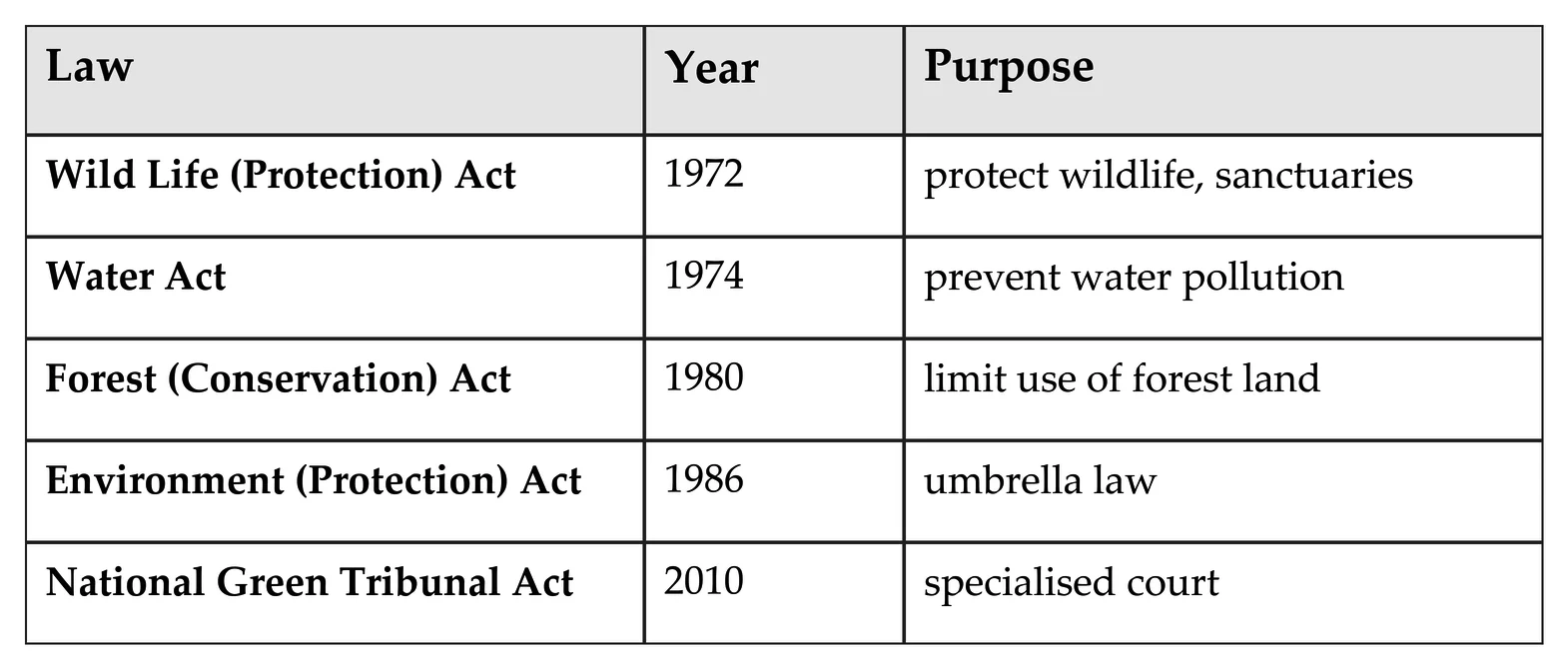
The Wild Life (Protection) Act of 1972 protects listed species, prohibits hunting and provides for national parks and sanctuaries.
3. Water and Air Acts
The Water (Prevention and Control of Pollution) Act of 1974 created the Central and State Pollution Control Boards, and the Air Act of 1981 gave them powers over air pollution.
4. Forest Conservation Act, 1980
The Forest (Conservation) Act of 1980 requires central approval for using forest land for non-forest purposes, slowing deforestation. It was amended in 2023 amid concerns about weakening forest protection.
5. Environment (Protection) Act, 1986
After the Bhopal gas disaster of 1984, Parliament passed the Environment (Protection) Act of 1986, an umbrella law giving the Union wide powers to set standards, regulate hazardous substances and require environmental impact assessment.
6. Other Laws
Other laws include the Public Liability Insurance Act of 1991, the Biological Diversity Act of 2002, the Forest Rights Act of 2006 and the Compensatory Afforestation Fund Act of 2016.
7. Divan and Rosencranz
Shyam Divan and Armin Rosencranz show that India has strong environmental laws on paper, but that enforcement by pollution control boards and agencies has been weak, leading courts to play an active role.
8. The Eco-Mark Scheme
The Eco-Mark scheme was launched in 1991 to label consumer products that meet environmental standards, encouraging consumers to choose eco-friendly goods and manufacturers to reduce harm.
9. Limits of Eco-Mark
The scheme had little impact because of low awareness, complex certification and few participating firms. It was relaunched with new rules in 2024 to promote environment-friendly products in line with Mission LiFE.
10. The National Green Tribunal
The National Green Tribunal was established in October 2010 as a specialised body with judicial and expert members to decide environmental cases quickly, with its principal bench in Delhi and regional benches.
11. Principles Applied
The NGT applies the principles of sustainable development, precaution and polluter pays, and can order compensation and restoration of the environment.
12. Impact of the NGT
The NGT has acted on air pollution in Delhi, river pollution, illegal sand mining, solid waste and the Art of Living event on the Yamuna floodplain in 2016, imposing heavy penalties.
13. Criticisms of the NGT
Critics say the NGT has sometimes overreached, issuing orders difficult to implement, while governments have weakened it through vacancies and appointments, and its orders are not always enforced.
14. Enforcement Gap
The main problem of Indian environmental law is weak enforcement, due to understaffed regulators, political pressure and the priority given to growth.
15. Environmental Impact Assessment
The Environment Impact Assessment Notification of 2006 requires large projects to obtain prior environmental clearance after expert appraisal and public hearings. Critics argue that assessments are often prepared by consultants paid by project developers and that later changes, such as allowing clearance after projects begin, have weakened the process.
16. Evaluation
India has a strong legal framework and a specialised tribunal, but voluntary schemes like Eco-Mark have had little impact, and enforcement remains the key challenge.
Conclusion. Thus, India’s environmental law rests on Articles 48A and 51A(g) and laws from the Wild Life Act of 1972 to the Environment (Protection) Act of 1986. The Eco-Mark scheme of 1991 sought green consumption but had limited impact, while the NGT of 2010 has provided quick environmental justice, though enforcement remains weak.
Important Question 4
Discuss forest management in India with reference to Uttarakhand, Jharkhand and the North-east.
OR
Examine community forest management in India.
OR
How have local institutions shaped forest governance in different regions of India?
Model Answer
“The forest rights on ancestral lands and their habitat were not adequately recognised in the consolidation of State forests during the colonial period as well as in independent India resulting in historical injustice to the forest dwelling Scheduled Tribes.”
— Forest Rights Act, 2006, Preamble
Introduction. Forests cover about a fifth of India’s area and support millions of forest dwellers. Forest management has moved from colonial state control towards greater recognition of community rights. Regional experiences differ greatly: Uttarakhand’s van panchayats, Jharkhand’s tribal struggles and the North-east’s community ownership show different models. Satyajit Singh examines how decentralisation affects local environmental governance.
1. Colonial Legacy
Colonial forest laws of 1865, 1878 and 1927 brought most forests under state control for timber, restricting the rights of local communities and causing protests across India.
2. Joint Forest Management
From 1990, Joint Forest Management allowed village committees to protect and regenerate degraded forests with the forest department and share benefits. It improved forest cover in many areas but often kept power with officials.
3. The Forest Rights Act
The Forest Rights Act of 2006 recognised the individual and community rights of forest dwellers, including the right to manage community forest resources, to correct historical injustice.
4. Uttarakhand’s Van Panchayats
After protests against colonial forest control in Kumaon in the 1920s, the Forest Panchayat Rules of 1931 created van panchayats, village forest councils that manage local forests. Thousands of van panchayats still exist.
5. Chipko
The Chipko movement began in 1973 in the Garhwal Himalaya, when villagers, led by Chandi Prasad Bhatt and later women such as Gaura Devi, hugged trees to stop commercial felling, leading to a ban on green felling in the Himalaya in the 1980s.
6. Singh on Decentralisation
Satyajit Singh shows that the autonomy of van panchayats was gradually eroded by new rules that increased the control of revenue and forest officials, illustrating the tension between decentralisation and state control.
7. Jharkhand’s Tribal Forests
In Jharkhand, Adivasi communities depend on forests, protected by laws such as the Chotanagpur Tenancy Act of 1908 and the Santhal Parganas Tenancy Act of 1949, which restrict transfer of tribal land.
8. Forest Struggles in Jharkhand
In the late 1970s, the Jharkhand forest movement in Singhbhum resisted the replacement of sal forests with commercial teak plantations, and Adivasis have resisted displacement by mines and dams.
9. Community Initiatives in Jharkhand
Village forest protection committees and gram sabhas in Jharkhand have protected forests and claimed community forest rights under the 2006 Act, though implementation has been slow.
10. The North-east
In much of the North-east, forests are owned by communities, clans or individuals rather than the state, protected by the Sixth Schedule’s autonomous district councils and, in Nagaland, by Article 371A.
11. Sacred Groves and Jhum
Communities in Meghalaya protect sacred groves such as Mawphlang, while shifting cultivation (jhum) is a traditional practice that is sustainable with long fallow periods but strained by shorter cycles.
12. Community Conservation
Khonoma in Nagaland banned hunting and logging in its forests in 1998 and became known as a green village, showing community-led conservation.
13. Challenges
Forests face pressure from mining, infrastructure, plantations and encroachment. Weak implementation of forest rights and conflicts between conservation and livelihoods remain major problems.
14. Lessons
Regional experiences show that secure community rights, local institutions and support from the state can protect forests better than state control alone.
15. Mendha Lekha
The village of Mendha Lekha in Gadchiroli, Maharashtra, became the first to receive community forest rights over bamboo under the 2006 Act. Its gram sabha manages and sells bamboo and uses the income for village development, showing how community rights can combine conservation with livelihoods.
16. Evaluation
India’s forest management is moving from state control to shared and community governance, with regional models offering important lessons.
Conclusion. Thus, forest management in India has moved from colonial state control to JFM and the Forest Rights Act. Uttarakhand’s van panchayats and Chipko, Jharkhand’s tribal laws and struggles, and the North-east’s community and clan forests show diverse models, while Satyajit Singh shows how state control can erode local institutions.
Short Notes
(a) Co-benefits approach
India’s strategy of pursuing climate actions, such as energy efficiency and renewables, that also bring development benefits like energy security and cleaner air.
(b) Eco-Mark
A labelling scheme launched in 1991 to identify environment-friendly consumer products, relaunched with new rules in 2024.
(c) Van panchayats
Village forest councils in Uttarakhand, created under the Forest Panchayat Rules of 1931, that manage local forests.
(d) National Green Tribunal
A specialised tribunal set up in 2010 with judicial and expert members to decide environmental cases quickly, applying precaution and polluter pays.
More notes: DSE-16 Environment
These notes are prepared by PADHO TO AISE for study help. They are not an official University of Delhi publication.