
Semester VIII DSE-16 Environment
Unit 1 · 25 min read · Updated 24 Nov 2026
As per the University of Delhi (DU) BA (Hons) Political Science syllabus
Contents
- 1.1 Environment and Civilisation
- Gadgil and Guha’s Ecological History
- Features of the Modes of Resource Use
- The Anthropocene
- Development and Displacement
- 1.2 Ecology, Biodiversity and the Value of Nature
- Origins of Ecology and Biodiversity
- India’s Biodiversity and Its Threats
- Valuing Nature
- Limits of the Utilitarian View
- 1.3 Environmental Discourses
- Dryzek’s Map of Environmental Discourses
- Deep Ecology and Its Third World Critique
- The Environmentalism of the Poor
- Environmental Justice
- 1.4 Important Questions
- Discuss the interface between environment and civilisation with reference to India.
- What is ecology? Discuss the importance of biodiversity and its conservation.
- Discuss the utilitarian perspective on the value of nature.
- Discuss the different environmental discourses and varieties of environmentalism.
- Short Notes
हम भूमि का दुरुपयोग करते हैं क्योंकि हम उसे अपनी वस्तु मानते हैं। जब हम भूमि को ऐसा समुदाय मानेंगे जिसके हम सदस्य हैं, तब हम उसका प्रेम और सम्मान से उपयोग करने लगेंगे।
We abuse land because we regard it as a commodity belonging to us. When we see land as a community to which we belong, we may begin to use it with love and respect.
— Aldo Leopold, A Sand County Almanac (1949)
EVERY civilisation depends on its environment for food, water, energy and materials, and every civilisation changes its environment. How we understand and value nature shapes how we use it. This chapter examines the interface between civilisation and environment, the meaning of ecology and biodiversity, the utilitarian approach to valuing nature, and the different discourses and varieties of environmentalism. It draws on Madhav Gadgil and Ramachandra Guha, Ismail Serageldin and Andrew Steer, Dale Jamieson, John Dryzek and Joan Martinez-Alier.
1.1 Environment and Civilisation
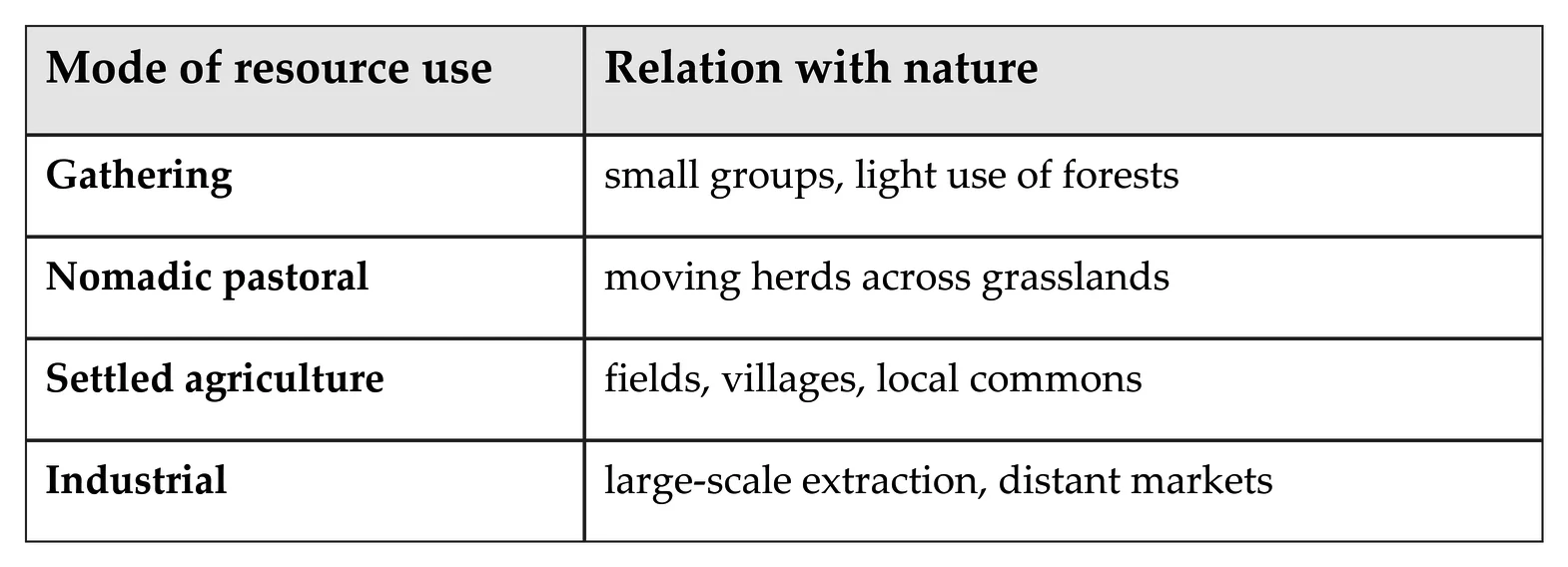
The relationship between civilisation and environment has changed with the way people use resources: gathering, pastoralism, settled agriculture and industry. Madhav Gadgil and Ramachandra Guha show that in modern India, omnivores who draw resources from everywhere prosper, while ecosystem people who depend on local nature, and ecological refugees displaced by development, bear the costs.
Gadgil and Guha’s Ecological History
Madhav Gadgil and Ramachandra Guha, in This Fissured Land: An Ecological History of India (1992), argued that each mode of resource use, gathering, nomadic pastoralism, settled cultivation and industry, has its own pattern of using nature, its own social organisation and its own ideas about the environment. In Ecology and Equity (1995), they applied this to modern India, showing how development benefited a minority of omnivores, urban elites, rich farmers and industry who can draw resources from anywhere, while ecosystem people, such as tribal communities, small farmers, herders and fishers who depend on local resources, and ecological refugees, displaced by dams, mines and degraded land, bore the costs.
Features of the Modes of Resource Use
- Gathering. Hunter-gatherers lived in small groups with simple technology, and many observed restraints, such as sacred groves and taboos on killing certain animals, which helped conserve resources.
- Pastoralism. Herders moved seasonally with their animals, using pastures over large areas, as the Gujjars, Gaddis and Raikas still do.
- Settled cultivation. Agriculture produced surpluses that supported towns, states and specialists; Gadgil and Guha argue that caste society in India partly divided resources among groups, reducing competition.
- Colonial forestry. The British created a Forest Department in 1864 under Dietrich Brandis and passed the Indian Forest Acts of 1865, 1878 and 1927, turning forests into state property for timber, especially railway sleepers, and restricting the customary rights of villagers.
- The industrial mode. Fossil fuels and modern technology allow resources to be drawn from distant places, so local limits no longer restrain consumption, and the costs fall on distant people and future generations.
The Anthropocene
In 2000, the chemist Paul Crutzen and the biologist Eugene Stoermer proposed that humanity had entered a new geological epoch, the Anthropocene, in which human activity is the main force changing the earth’s climate, landscapes and living systems. Although geologists voted in 2024 not to make it a formal unit of the geological time scale, the term is widely used to describe the scale of human impact. Amitav Ghosh, in The Great Derangement (2016), argues that climate change is also a crisis of imagination, since modern literature, history and politics have found it hard to take seriously forces beyond human control, and that the burdens of the crisis fall most heavily on the poor of the global South.
Development and Displacement
Large projects such as dams, mines, industrial zones and highways have displaced millions of Indians since independence, most of them Adivasis, Dalits and the rural poor, according to estimates by scholars such as Walter Fernandes. Many were never properly resettled. The struggle over the Sardar Sarovar dam on the Narmada, led by the Narmada Bachao Andolan from the late 1980s, became a symbol of this conflict. The colonial Land Acquisition Act of 1894 was finally replaced by the Right to Fair Compensation and Transparency in Land Acquisition, Rehabilitation and Resettlement Act of 2013, which requires social impact assessment and consent in some cases.
1.2 Ecology, Biodiversity and the Value of Nature
Ecology studies the relations between living things and their environment, and biodiversity is the variety of life at the genetic, species and ecosystem levels. The utilitarian perspective values nature for the benefits it gives people, and economists such as those in the World Bank volume edited by Ismail Serageldin and Andrew Steer try to put a value on these benefits so that they count in decisions.

Origins of Ecology and Biodiversity
The German biologist Ernst Haeckel coined the word ecology in 1866, from the Greek oikos, meaning household, to describe the study of the relations between organisms and their surroundings. The British ecologist Arthur Tansley introduced the term ecosystem in 1935 for a community of living things together with its physical environment. The word biodiversity became popular after a National Forum on BioDiversity in Washington in 1986, whose papers were published by the biologist E.O. Wilson in 1988. Biodiversity is usually studied at three levels: genetic diversity within species, species diversity and the diversity of ecosystems.
India’s Biodiversity and Its Threats
- A megadiverse country. India has only about 2.4 per cent of the world’s land area but around 7 to 8 per cent of recorded species, and contains parts of four of the world’s thirty-six biodiversity hotspots: the Himalaya, the Western Ghats, Indo-Burma and Sundaland, which includes the Nicobar Islands.
- Habitat loss. Forests, grasslands and wetlands are lost to agriculture, mining, dams, roads and cities; E.O. Wilson summed up the main threats with the acronym HIPPO: habitat loss, invasive species, pollution, human population and overharvesting.
- Global extinction risk. The IPBES Global Assessment of 2019 warned that about one million species face extinction, many within decades.
- Conservation laws. The Wild Life (Protection) Act of 1972 created protected areas and banned hunting of listed species; the Biological Diversity Act of 2002 created a National Biodiversity Authority, State Biodiversity Boards and local Biodiversity Management Committees that prepare People’s Biodiversity Registers.
- Flagship programmes. Project Tiger (1973) helped the tiger population recover to more than three thousand, Project Elephant began in 1992 and cheetahs were reintroduced in Kuno National Park in 2022.
Valuing Nature
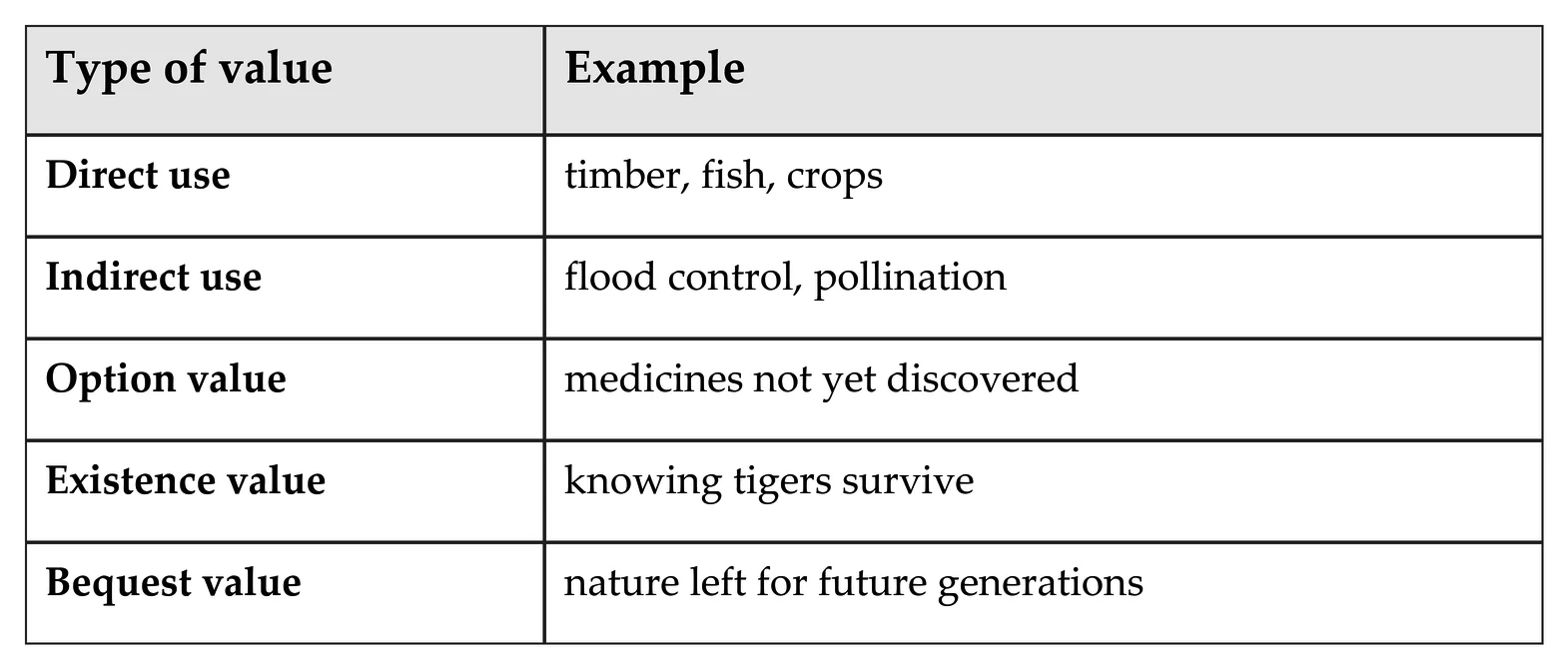
Economists classify the total economic value of nature into use values, which include direct uses such as timber and fish, indirect uses such as flood control and pollination, and option values for possible future use, and non-use values, such as the value of knowing that a species exists (existence value) or of leaving nature to future generations (bequest value). The Millennium Ecosystem Assessment of 2005 grouped ecosystem services into provisioning, regulating, cultural and supporting services. Robert Costanza and colleagues estimated in 1997 that the world’s ecosystem services were worth more than the entire global economy, and the international study on The Economics of Ecosystems and Biodiversity (TEEB), led by Pavan Sukhdev from 2007, and the Dasgupta Review of 2021 urged that nature be counted in national accounts.
Limits of the Utilitarian View
Critics argue that putting a price on nature can be misleading and even harmful. Mark Sagoff argued that citizens judge environmental questions as matters of value and principle, not only as consumers with preferences. Some values, such as the sacredness of a grove to a community or the right of a species to exist, cannot be measured in money. Valuation methods often give less weight to the poor, whose willingness to pay is low, and to future generations through discounting. Peter Singer, in Animal Liberation (1975), extended utilitarian concern to the suffering of animals, but deep ecologists argue that nature has value in itself, regardless of its usefulness to humans or sentient beings.
1.3 Environmental Discourses
John Dryzek identifies different environmental discourses, from problem-solving and survivalism to sustainability and green radicalism. Ramachandra Guha and Joan Martinez-Alier contrast the environmentalism of the affluent North, concerned with wilderness and quality of life, with the environmentalism of the poor in the South, concerned with livelihood and survival.
Dryzek’s Map of Environmental Discourses
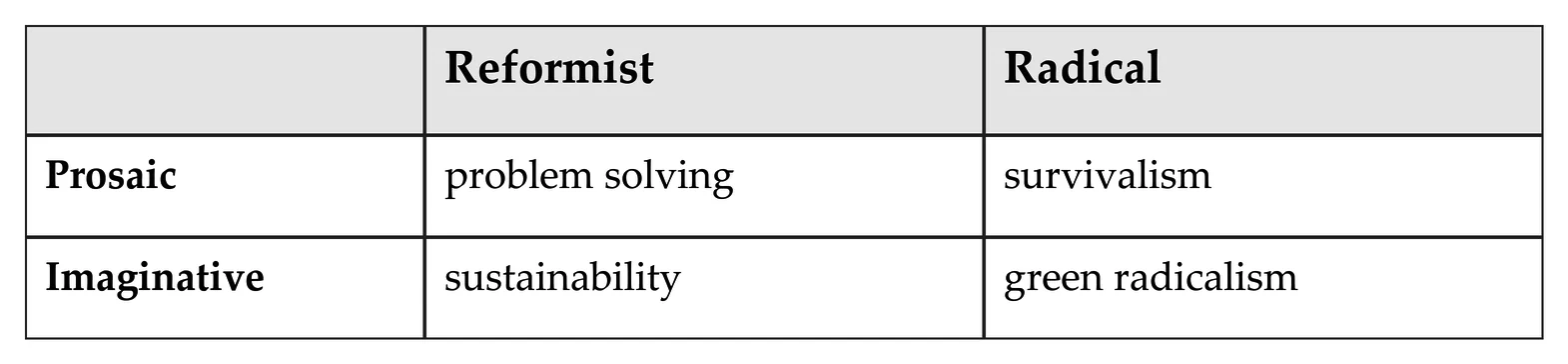
John Dryzek, in The Politics of the Earth (1997), classifies environmental discourses along two dimensions: whether they are reformist or radical in relation to industrial society, and whether they are prosaic, accepting the existing political and economic framework, or imaginative, seeking to redefine it. This produces four groups:
- Survivalism (prosaic and radical). It stresses limits to growth, as in The Limits to Growth (1972) prepared for the Club of Rome and Paul Ehrlich’s The Population Bomb (1968), and often calls for strong central control.
- Problem solving (prosaic and reformist). It treats environmental problems as manageable within existing institutions, through administrative rationalism (experts and agencies), democratic pragmatism (participation and bargaining) or economic rationalism (markets and prices).
- Sustainability (imaginative and reformist). It seeks to reconcile environment and growth, through sustainable development and ecological modernisation, the idea that pollution prevention can pay.
- Green radicalism (imaginative and radical). It rejects the basic structures of industrial society, through green romanticism, such as deep ecology and some ecofeminism, or green rationalism, such as social ecology and environmental justice.
Deep Ecology and Its Third World Critique
The Norwegian philosopher Arne Naess, in an essay of 1973, distinguished shallow ecology, which fights pollution and resource depletion for the health of people in developed countries, from deep ecology, which holds that all living beings have intrinsic value and calls for a reduction in human population and consumption. In 1989, Ramachandra Guha published a Third World critique of radical American environmentalism, arguing that the focus on wilderness preservation ignored problems of consumption and militarisation and, when exported to countries like India, led to the creation of parks that expelled peasants and tribal people.
The Environmentalism of the Poor
Joan Martinez-Alier, in The Environmentalism of the Poor (2002), and Guha and Martinez-Alier, in Varieties of Environmentalism (1997), argue that in the global South environmental conflicts are often struggles of the poor to defend the resources on which their livelihoods depend. Indian examples include the Chipko movement against commercial felling, the campaign that saved Kerala’s Silent Valley from a dam and led to a national park in 1984, the Narmada struggle and the Dongria Kondh of Niyamgiri in Odisha, whose gram sabhas rejected bauxite mining in 2013 after the Supreme Court asked for their consent. Rob Nixon, in Slow Violence and the Environmentalism of the Poor (2011), describes the gradual and often invisible harm caused by pollution and degradation.
Environmental Justice
The environmental justice movement began in the United States, where protests in Warren County, North Carolina, in 1982 against a toxic waste dump in a mainly African-American community drew attention to the unequal distribution of pollution. In 1991, the First National People of Color Environmental Leadership Summit adopted principles of environmental justice. The idea has since been applied globally, to the dumping of hazardous waste in poor countries, to the Bhopal gas disaster of 1984 and to climate change, where those who contributed least to the problem suffer most.
1.4 Important Questions
- Question 1 Discuss the interface between environment and civilisation with reference to India.
- Question 2 What is ecology? Discuss the importance of biodiversity and its conservation.
- Question 3 Discuss the utilitarian perspective on the value of nature.
- Question 4 Discuss the different environmental discourses and varieties of environmentalism.
DU asks the same idea in different words. So learn one broad answer for each question below; the same answer works for every question joined by OR.
Important Question 1
Discuss the interface between environment and civilisation with reference to India.
OR
Examine Gadgil and Guha’s classification of omnivores, ecosystem people and ecological refugees.
OR
How has the relationship between society and nature changed over time?
Model Answer
“Let us not, however, flatter ourselves overmuch on account of our human victories over nature. For each such victory nature takes its revenge on us.”
— Friedrich Engels, Dialectics of Nature (1876)
Introduction. Human civilisations have always depended on and transformed their environment. Early societies lived lightly on the land, while agriculture and industry changed landscapes on a large scale. In India, Madhav Gadgil and Ramachandra Guha have shown how different modes of resource use and the unequal distribution of resources shape the relationship between society and nature.
1. Nature and Society
The environment provides the air, water, soil, forests and minerals on which societies depend, while societies shape the environment through farming, building, mining and industry. The relationship is two-way and changes over time.
2. Modes of Resource Use
Gadgil and Guha identify four modes of resource use: gathering, nomadic pastoralism, settled agriculture and industry. Each mode has its own technology, economy, social organisation and attitude to nature.
3. Gathering and Pastoralism
Gatherers and nomadic pastoralists lived in small groups and used resources over large areas. They often developed practices of restraint, such as protecting sacred groves or rotating grazing grounds, which helped sustain resources.
4. Settled Agriculture
Settled agriculture supported villages, towns and states. Communities managed common lands, forests and water through customary rules, though caste and landlord power created inequalities in access.
5. Ancient Civilisations
The Harappan civilisation depended on rivers and fertile plains, and many scholars link its decline partly to environmental changes such as shifts in rivers and a drier climate, showing how civilisations depend on their environment.
6. Traditions of Conservation
Indian traditions include sacred groves, sacred animals and plants, and communities such as the Bishnois, who in 1730 at Khejarli gave their lives to protect trees, showing cultural limits on the use of nature.
7. Colonial Transformation
Colonial rule brought commercial forestry, plantations, railways and mining. The forest laws of 1865 and 1878 took forests away from communities, causing ecological damage and social conflict.
8. Industrial Mode
The industrial mode uses fossil fuels and draws resources from distant places, allowing a huge increase in production but also pollution, deforestation and climate change.
9. Omnivores
Gadgil and Guha call the urban middle classes, industrialists and rich farmers omnivores, because they consume resources drawn from across the country and the world, while being shielded from the local costs of their use.
10. Ecosystem People
Ecosystem people, such as small peasants, tribal communities, pastoralists and fisherfolk, depend on local land, forests and water. When these are degraded, they lose their livelihoods.
11. Ecological Refugees
Ecological refugees are people displaced by dams, mines and degraded environments, who migrate to cities and live in slums, forming a large and growing group in modern India.
12. Ecology and Equity
Gadgil and Guha argue that ecological degradation and social inequality are linked, so environmental policy must address equity by restoring the rights of ecosystem people over local resources.
13. The Anthropocene
Scientists now speak of the Anthropocene, an age in which human activity has become a major force shaping the earth’s climate, ecosystems and geology, showing the scale of the civilisation–environment interface.
14. Ghosh on Imagination
Amitav Ghosh, in The Great Derangement (2016), argues that climate change is also a crisis of culture and imagination, since modern societies have failed to take seriously the power of nature.
15. Development and Displacement
Large projects such as dams, mines and industrial zones have displaced millions of people in India since independence, many of them Adivasis. Estimates by scholars such as Walter Fernandes suggest that tens of millions have been displaced, often without adequate rehabilitation, turning ecosystem people into ecological refugees.
16. Evaluation
The relationship between civilisation and environment shapes both prosperity and inequality, and sustainable development requires attention to who benefits and who bears the costs.
Conclusion. Thus, civilisations have moved through gathering, pastoral, agricultural and industrial modes of resource use, as Gadgil and Guha show, each changing nature. In India, omnivores gain while ecosystem people and ecological refugees suffer, so ecology and equity must go together, as traditions of conservation and the warnings of Engels and Ghosh suggest.
Important Question 2
What is ecology? Discuss the importance of biodiversity and its conservation.
OR
Examine the levels of biodiversity and the threats to it.
OR
Discuss biodiversity conservation in India.
Model Answer
“Biological diversity means the variability among living organisms from all sources and the ecological complexes of which they are part; this includes diversity within species, between species and of ecosystems.”
— Convention on Biological Diversity, Article 2 (1992)
Introduction. Ecology is the science that studies how living organisms relate to one another and to their physical environment. Biodiversity, the variety of life on earth, is the result of millions of years of evolution and the foundation of ecosystems on which humans depend. Today, biodiversity is declining rapidly, making its conservation an urgent political issue.
1. Meaning of Ecology
The term ecology was coined by Ernst Haeckel in 1866 from the Greek oikos, meaning house. Ecology studies the relationships among organisms and their environment, from individuals to populations, communities and ecosystems.
2. Ecosystems
An ecosystem, a term introduced by Arthur Tansley in 1935, is a community of living organisms interacting with their physical environment through flows of energy and cycles of nutrients, such as a forest, wetland or ocean.
3. Meaning of Biodiversity
Biodiversity, short for biological diversity, means the variety of life at three levels: genetic diversity within species, diversity of species and diversity of ecosystems.
4. Importance of Biodiversity
Biodiversity provides food, medicines, fibre and fuel, maintains ecosystem services such as pollination, soil fertility and water purification, supports livelihoods and has cultural, aesthetic and intrinsic value.
5. India’s Biodiversity
India is one of the world’s seventeen megadiverse countries, with about seven to eight per cent of the world’s recorded species on about 2.4 per cent of its land area, and parts of four biodiversity hotspots: the Himalaya, Indo-Burma, the Western Ghats and Sundaland.
6. Threats
Biodiversity is threatened by habitat loss, invasive species, pollution, overexploitation and climate change. Scientists warn that the current rate of extinction is far higher than the natural rate.
7. Habitat Loss
Clearing forests and wetlands for agriculture, mining, dams, roads and cities is the biggest threat, fragmenting habitats and isolating populations of plants and animals.
8. In-Situ Conservation
In-situ conservation protects species in their natural habitats through national parks, wildlife sanctuaries, biosphere reserves and community reserves. India has more than a hundred national parks.
9. Ex-Situ Conservation
Ex-situ conservation protects species outside their habitats through zoos, botanical gardens, seed banks and gene banks, as a backup for species at risk.
10. Project Tiger
Project Tiger, launched in 1973, created tiger reserves and helped India’s tiger population recover to more than three thousand by the 2022 census, though it also displaced some forest communities.
11. Legal Framework
India’s Wild Life (Protection) Act of 1972 and Biological Diversity Act of 2002 protect species and regulate access to biological resources, with a National Biodiversity Authority and local biodiversity committees.
12. Community Conservation
Communities conserve biodiversity through sacred groves, community forests and traditional knowledge, and the Forest Rights Act of 2006 recognises their role in managing forests.
13. Global Efforts
The Convention on Biological Diversity of 1992 and the Kunming-Montreal Global Biodiversity Framework of 2022, which aims to protect 30 per cent of land and seas by 2030, guide global conservation.
14. Biodiversity and Justice
Conservation raises questions of justice, since protected areas may exclude local people, and benefits from genetic resources often go to companies in rich countries rather than the communities that conserved them.
15. Biodiversity and Livelihoods
In India, millions of people depend on biodiversity for their livelihoods through farming, fishing, collecting forest produce and grazing. Traditional crop varieties, medicinal plants and local breeds of livestock are part of this biodiversity, and their loss affects food security and health, especially for the rural poor.
16. Evaluation
Biodiversity is the foundation of ecosystems and human well-being, and its conservation requires both protected areas and the participation of local communities.
Conclusion. Thus, ecology studies the relations between organisms and their environment, and biodiversity is the variety of life at genetic, species and ecosystem levels. India is megadiverse, but habitat loss and other threats endanger it. In-situ and ex-situ conservation, laws such as the Biological Diversity Act and community participation are needed to protect it.
Important Question 3
Discuss the utilitarian perspective on the value of nature.
OR
How can the environment be valued in economic terms? Discuss its merits and limits.
OR
Examine the idea of total economic value of the environment.
Model Answer
“The question is not, Can they reason? nor, Can they talk? but, Can they suffer?”
— Jeremy Bentham, An Introduction to the Principles of Morals and Legislation (1789)
Introduction. Why should we protect nature? The utilitarian perspective answers that nature should be protected because of the benefits it gives to people, and sometimes to other sentient beings. Economists have developed methods to value these benefits so that they can be counted in policy decisions. Ismail Serageldin and Andrew Steer, and Dale Jamieson, discuss this approach and its limits.
1. Utilitarianism
Utilitarianism, developed by Jeremy Bentham and John Stuart Mill, holds that the right action is the one that produces the greatest happiness or welfare for the greatest number.
2. Nature as a Resource
In the utilitarian view, nature has value because it provides resources and services that increase human welfare. Gifford Pinchot, a founder of American conservation, spoke of using resources for the greatest good of the greatest number for the longest time.
3. Externalities
Arthur Pigou explained pollution as an externality, a cost imposed on others that the polluter does not pay. Utilitarian economists argue for taxes or charges to make polluters bear these costs, the basis of the polluter pays principle.
4. Valuing the Environment
The World Bank volume Valuing the Environment, edited by Ismail Serageldin and Andrew Steer in 1993, argued that environmental resources must be given a value in economic decisions, so that development does not destroy natural capital.
5. Total Economic Value
Economists divide the value of the environment into direct use value, such as timber; indirect use value, such as flood control; option value for future use; existence value, from knowing a species exists; and bequest value for future generations.
6. Methods of Valuation
Methods include market prices, the cost of travel to a park, differences in house prices near clean or polluted areas, and surveys asking how much people would pay to protect nature.
7. Ecosystem Services
Scientists estimate the value of ecosystem services such as pollination, carbon storage and water supply. A 1997 study by Robert Costanza and colleagues estimated them at tens of trillions of dollars a year, more than world output at the time.
8. Green Accounting
Green accounting adjusts national income to account for the depletion of natural resources and environmental damage, giving a truer picture of sustainable development.
9. Animals and Utility
Bentham argued that what matters is the capacity to suffer, not reason. Peter Singer extended this to animals, arguing that their suffering must count equally in moral calculations.
10. Jamieson on Environmental Ethics
Dale Jamieson explains that utilitarian approaches are practical and widely used in policy, but that they struggle with the interests of future generations, non-human nature and values that cannot be measured in money.
11. Merits
The utilitarian approach makes environmental costs visible to policy-makers, allows comparison with other goals and supports tools such as cost-benefit analysis, pollution taxes and payments for ecosystem services.
12. Criticisms
Critics argue that putting a price on nature treats it as a commodity, ignores intrinsic value and moral duties, and favours the rich, whose willingness to pay is greater. Mark Sagoff argued that citizens judge environmental issues by values, not prices.
13. Problems of Measurement
Many values, such as the beauty of a mountain or the existence of a species, are hard to measure, and estimates vary widely depending on methods and assumptions.
14. Justice
Utilitarian calculations may justify harming a few for the benefit of many, as when dams displace tribal communities, raising questions of distributive justice.
15. The Stern Review
The Stern Review on the Economics of Climate Change, published in 2006, applied economic analysis to climate change and argued that the costs of strong early action would be much smaller than the costs of inaction, which could reach a large share of world output. It showed how utilitarian valuation can support environmental protection.
16. Evaluation
The utilitarian perspective helps bring nature into economic decisions, but it must be balanced with intrinsic values, rights and justice.
Conclusion. Thus, the utilitarian perspective values nature for its benefits to human and sentient welfare. Serageldin and Steer argue for valuing the environment, using total economic value, ecosystem services and green accounting. Jamieson, Sagoff and others show its limits in dealing with intrinsic value, future generations and justice.
Important Question 4
Discuss the different environmental discourses and varieties of environmentalism.
OR
Examine Dryzek’s classification of environmental discourses.
OR
Distinguish between the environmentalism of the North and the environmentalism of the poor.
Model Answer
“Are not poverty and need the greatest polluters?”
— Indira Gandhi, address to the UN Conference on the Human Environment, Stockholm (1972)
Introduction. Environmentalism is not one single movement or idea. People understand environmental problems in different ways and propose different solutions. John Dryzek classifies these ways of thinking as environmental discourses, while Ramachandra Guha and Joan Martinez-Alier distinguish the environmentalism of the affluent North from the environmentalism of the poor in the South.
1. Meaning of Discourse
A discourse is a shared way of understanding the world, with its own assumptions, stories and key terms. Dryzek argues that environmental politics is shaped by competing discourses about the relationship between humans and nature.
2. Dryzek’s Classification
Dryzek classifies discourses by whether they are reformist or radical, and prosaic, taking the existing economy for granted, or imaginative, seeking new ways of thinking.
3. Survivalism
Survivalism, a prosaic and radical discourse, warns that growth is reaching the earth’s limits, as in the Club of Rome’s Limits to Growth (1972). Its opposite, the Promethean discourse, trusts human ingenuity to overcome limits.
4. Problem Solving
Problem-solving discourses, prosaic and reformist, include administrative rationalism, which relies on experts and bureaucracy; democratic pragmatism, which relies on public participation; and economic rationalism, which relies on markets and incentives.
5. Sustainability
Sustainability discourses, imaginative and reformist, include sustainable development, which reconciles growth with environmental protection, and ecological modernisation, which sees environmental protection as good for business.
6. Green Radicalism
Green radicalism, imaginative and radical, includes green romanticism, such as deep ecology and ecofeminism, which seeks new sensibilities, and green rationalism, such as social ecology and environmental justice, which seeks structural change.
7. Varieties of Environmentalism
Ramachandra Guha and Joan Martinez-Alier argue that environmentalism takes different forms in different societies, depending on their economies and histories.
8. Environmentalism of the North
In rich countries, environmentalism grew from post-materialist concerns for wilderness, recreation and quality of life, which Guha calls full-stomach environmentalism, often focused on protecting nature from people.
9. Environmentalism of the Poor
In the global South, environmental struggles are often struggles for livelihood, as peasants, tribals and fisherfolk defend forests, rivers and land against dams, mines and plantations. This is the environmentalism of the poor, or empty-belly environmentalism.
10. Indian Examples
The Chipko movement (1973), the Appiko movement in Karnataka (1983), the campaign to save Silent Valley and the Narmada Bachao Andolan are examples of the environmentalism of the poor.
11. Guha’s Global History
In Environmentalism: A Global History (2000), Guha traces waves of environmental thought and activism, from early critics of industrialisation, including Gandhi, to the global movement after the 1960s.
12. Stockholm, 1972
At the Stockholm conference of 1972, Indira Gandhi asked whether poverty and need were not the greatest polluters, expressing the developing countries’ view that development and environment must go together.
13. Environmental Justice
The environmental justice movement, which began in the United States, shows that poor and minority communities bear more pollution, linking environmentalism with equality and rights.
14. Discourses in India
Indian environmental politics combines discourses: administrative rationalism in pollution control boards, sustainable development in national policy and green radicalism and environmental justice in grassroots movements.
15. Ecological Modernisation in India
Indian policy increasingly uses the language of ecological modernisation, presenting renewable energy, electric vehicles and green technology as sources of growth and jobs. Critics argue that this approach avoids difficult questions about consumption, displacement and the rights of communities affected by large green projects such as solar parks.
16. Evaluation
Understanding different discourses and varieties of environmentalism helps explain environmental conflicts and why solutions differ across societies.
Conclusion. Thus, Dryzek classifies environmental discourses as problem solving, survivalism, sustainability and green radicalism. Guha and Martinez-Alier distinguish the full-stomach environmentalism of the North from the environmentalism of the poor, seen in Chipko and Narmada, while Indira Gandhi’s Stockholm question linked environment with poverty and development.
Short Notes
(a) Ecosystem people
Gadgil and Guha’s term for communities, such as peasants, tribals and fisherfolk, who depend directly on local natural resources for their livelihood.
(b) Total economic value
The sum of the use and non-use values of the environment, including direct use, indirect use, option, existence and bequest values.
(c) Environmentalism of the poor
Environmental struggles in the South in which defending land, forests and water is a struggle for livelihood and survival.
(d) Omnivores
Gadgil and Guha’s term for groups, such as urban elites and rich farmers, who draw on resources from across the country and the world while escaping the local costs.
More notes: DSE-16 Environment
These notes are prepared by PADHO TO AISE for study help. They are not an official University of Delhi publication.