
Semester IV MDSE-2b India's National Security
Unit IV (4.2) · 24 min read · Updated 24 Nov 2026
As per the University of Delhi (DU) BA (Hons) Political Science syllabus
Contents
- 5.1 The Maoist or Naxalite Challenge
- Origins and Growth
- Causes
- Ramana: The State’s Response
- 5.2 Separatist Movements: Jammu and Kashmir and the Northeast
- Jammu and Kashmir
- The Northeast
- 5.3 Cyber Warfare and Information Warfare
- A New Battlefield
- Libicki: The Convergence of Information Warfare
- India’s Institutions and Policies
- Debates on Cyber Policy
- 5.4 Important Questions
- Discuss the Maoist or Naxalite challenge to India’s internal security and the state’s response.
- Discuss the separatist movement in Jammu and Kashmir as a challenge to India’s national security.
- Discuss the separatist movements in Northeast India and the state’s response.
- Discuss cyber warfare and information warfare as challenges to India’s national security.
- Short Notes
मेरी राय में हमें सबसे पहले अपने सामाजिक और आर्थिक लक्ष्यों को पाने के संवैधानिक तरीकों को दृढ़ता से पकड़े रहना चाहिए। इसका अर्थ है कि हमें क्रांति के खूनी तरीकों को छोड़ देना चाहिए।
The first thing in my judgement we must do is to hold fast to constitutional methods of achieving our social and economic objectives. It means we must abandon the bloody methods of revolution.
— B. R. Ambedkar, Speech in the Constituent Assembly, 25 November 1949
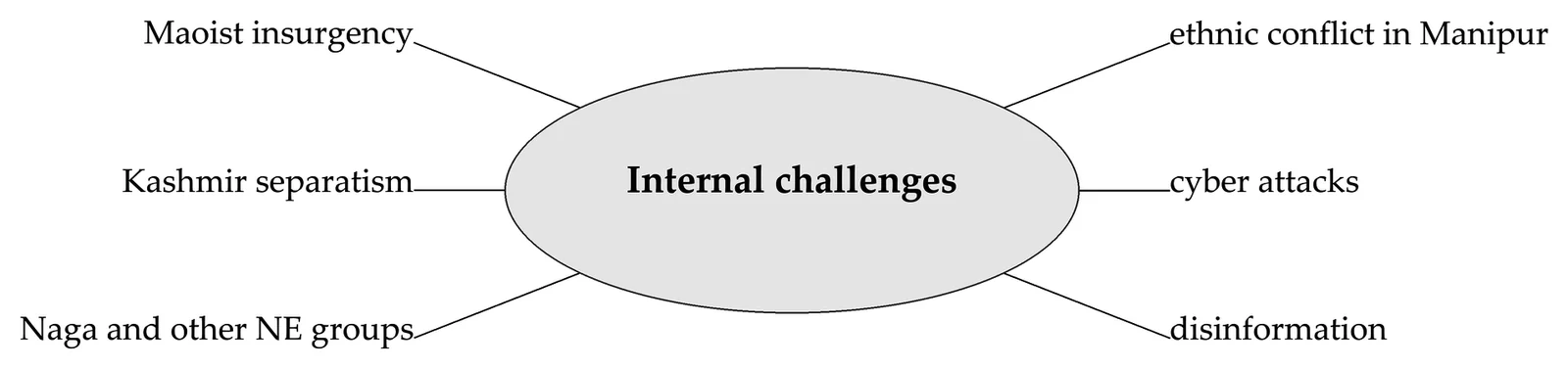
NNOT all threats to India come from across its borders. Some of the most persistent challenges have grown inside the country, often from long-standing grievances, weak governance and the support of hostile neighbours. This chapter studies the internal challenges listed in Unit IV of the syllabus: the Maoist or Naxalite insurgency in central and eastern India, separatist movements in Jammu and Kashmir and the Northeast, and the new challenge of cyber warfare and information warfare. For each, we look at causes, the state’s response and the debates among scholars.
5.1 The Maoist or Naxalite Challenge
Origins and Growth
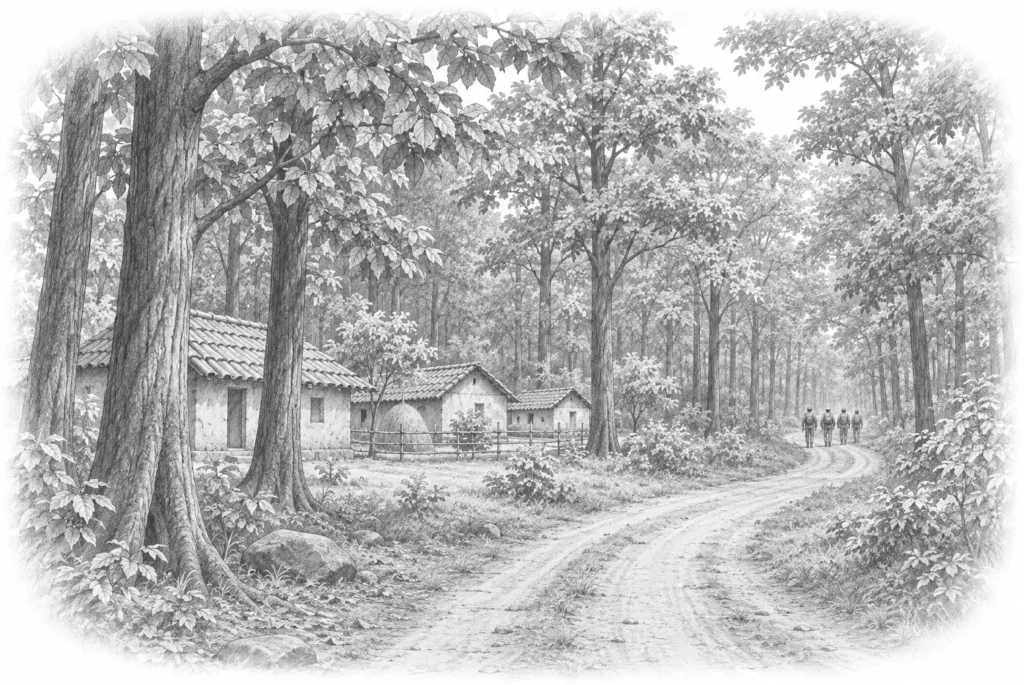
The movement takes its name from Naxalbari, a village in north Bengal where, in 1967, peasants led by Charu Majumdar, Kanu Sanyal and Jangal Santhal rose against landlords. Inspired by Mao Zedong’s idea of a protracted people’s war, Majumdar formed the CPI (Marxist-Leninist) in 1969, but the movement was crushed in the early 1970s. It revived in Andhra Pradesh through the People’s War Group (1980) and in Bihar and Jharkhand through the Maoist Communist Centre. Their merger in 2004 created the CPI (Maoist), which built a Red Corridor across the forested, mineral-rich tribal belt from Jharkhand and Odisha to Chhattisgarh, Maharashtra and Andhra Pradesh. In 2006, Prime Minister Manmohan Singh called it the single biggest internal security challenge India had ever faced.
Causes
- Land and livelihood. Landlessness, land alienation and the loss of forest rights among Adivasis and Dalits.
- Displacement. Mining, dams and industrial projects displaced large numbers of tribal people without fair rehabilitation.
- Absence of governance. Remote areas lacked schools, health centres, roads and responsive administration, leaving a vacuum the Maoists filled.
- Exploitation. Moneylenders, contractors and forest officials exploited tribal communities, and laws protecting them were poorly enforced.
- Ideology and organisation. A disciplined armed party with a revolutionary ideology turned grievances into an insurgency.
E. N. Rammohan (2011), a former police officer, argues that the rise of Naxalism reflects the failure of land reforms and the neglect of tribal areas, and that it threatens national security because it seeks to overthrow the state by force. Ramachandra Guha, in Adivasis, Naxalites and Indian Democracy (2007), argues that Adivasis have been the biggest losers of India’s development, and that they are caught in a crossfire between Maoist violence and state violence, including the Salwa Judum militia set up in Chhattisgarh in 2005. He calls for a democratic solution that gives Adivasis real rights and a voice.
Ramana: The State’s Response
P. V. Ramana, in State Response to the Maoist Challenge: An Overview (2011), explains that the state’s response has been two-pronged: security operations and development. Since law and order is a state subject, the Union supports the states with central armed police forces, funds and coordination. Ramana notes that the response was long uneven, with states treating the problem differently, but that coordinated operations and development schemes gradually reduced Maoist influence.
- Security. Andhra Pradesh’s specialised Greyhounds force (1989) became a model; the CRPF’s CoBRA battalions (2008) and Operation Green Hunt (2009) expanded central operations.
- SAMADHAN (2017). A strategy stressing smart leadership, aggressive operations, actionable intelligence, technology and cutting off Maoist funding.
- Development. The Integrated Action Plan (2010), road and mobile tower schemes, and the Aspirational Districts programme (2018).
- Rights. The PESA Act (1996) and the Forest Rights Act (2006) sought to give tribal communities control over land and resources.
- Surrender and rehabilitation. Policies offering cash, training and housing to those who give up arms.
By 2024, the number of districts affected by left-wing extremism had fallen sharply, and the Union government set March 2026 as its target for ending the insurgency. In May 2025, the CPI (Maoist) general secretary Nambala Keshava Rao, known as Basavaraju, was killed in an operation in Chhattisgarh. Critics warn, however, that security success without justice for Adivasis may leave the underlying grievances unresolved.

5.2 Separatist Movements: Jammu and Kashmir and the Northeast
Jammu and Kashmir
Maharaja Hari Singh signed the Instrument of Accession on 26 October 1947, after tribal raiders backed by Pakistan invaded the state. Article 370 gave Jammu and Kashmir special autonomy, but this was steadily reduced in the decades that followed. The arrest of Sheikh Abdullah in 1953, the dismissal of elected governments and the widely alleged rigging of the 1987 election alienated many Kashmiris. An armed insurgency began in 1989, led first by the pro-independence JKLF and then by pro-Pakistan groups such as Hizbul Mujahideen, with training, arms and fighters from Pakistan. The violence forced most Kashmiri Pandits to leave the Valley in 1990.
Navnita Chadha Behera, in Demystifying Kashmir (2006), argues that New Delhi’s political gambit, i.e. its effort to keep control through centralisation, manipulation of elections and reliance on friendly local leaders, eroded autonomy and democracy in the state and helped produce alienation. She also stresses the internal diversity of the state, where Jammu, the Valley and Ladakh have different identities and demands. Rekha Chowdhary (2014) calls for a holistic response that combines security with political dialogue, good governance and respect for the plural identities of the region. V. G. Patankar (2009), writing from military experience, describes the conflict as both an insurgency and a proxy war by Pakistan, which required the Army, including the specially raised Rashtriya Rifles, to combine force with efforts to win local support.
- Security measures. The Armed Forces (Jammu and Kashmir) Special Powers Act, 1990, fencing of the Line of Control, and counter-infiltration grids.
- Political processes. Elections in 1996, 2002, 2008 and 2014; Vajpayee’s outreach in 2003; and dialogue with separatist leaders at various times.
- Article 370 abrogated. On 5 August 2019, the special status was ended and the state was reorganised into two Union Territories; the Supreme Court upheld the decision in December 2023.
- Elections of 2024. Assembly elections were held in September–October 2024 and an elected government took office, and the demand for restoring statehood became a central political issue.

The Northeast
The Northeast is connected to the rest of India by the narrow Siliguri corridor and shares about 98 per cent of its borders with other countries. It is home to many ethnic groups with distinct histories, several of which were loosely administered under colonial rule. Sanjib Baruah, in Regionalism and Secessionism (2011), and in his book Durable Disorder (2005), argues that the region’s insurgencies grew out of its colonial frontier legacy, fears of losing land and identity to migrants, and a state that treated the region mainly as a security frontier. India’s response has mixed counterinsurgency with the creation of new states and ethnic homelands, special constitutional provisions and peace accords, but Baruah warns that long use of emergency laws like AFSPA has normalised military rule and weakened democracy.
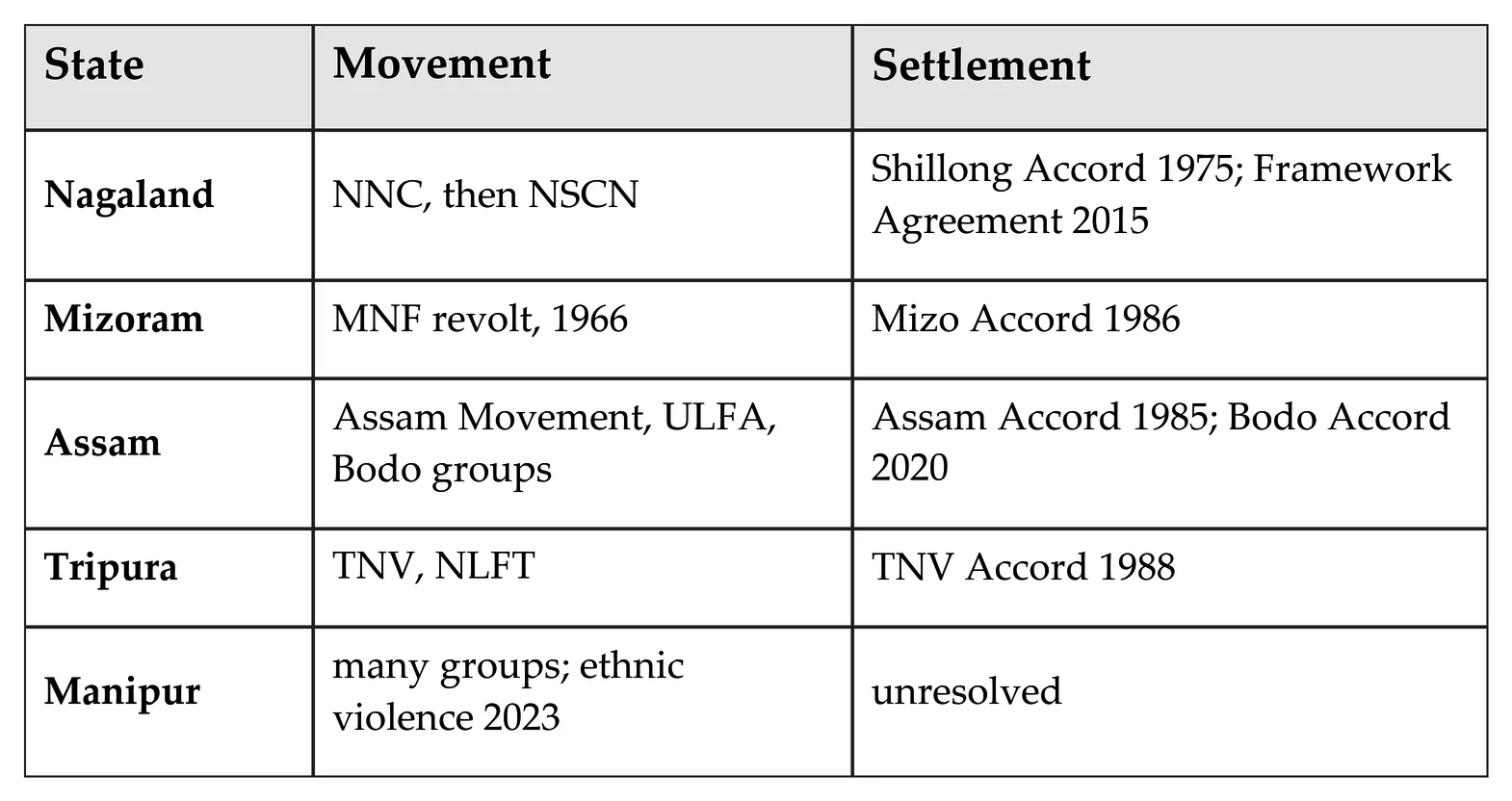
- Nagaland. The Naga National Council under A. Z. Phizo declared independence in 1947 and began an armed struggle; Nagaland became a state in 1963; the Shillong Accord (1975) failed to end the conflict; the NSCN (1980) split in 1988, and a ceasefire with NSCN (IM) in 1997 led to a Framework Agreement in 2015.
- Mizoram. The Mizo National Front under Laldenga revolted in 1966 after a famine; the Mizo Accord of 1986 brought the rebels into politics and is seen as India’s most successful peace settlement.
- Assam. The anti-foreigner Assam Movement (1979–85) ended with the Assam Accord; ULFA waged an armed struggle from 1979 until a faction signed a peace agreement in 2023; Bodo accords were signed in 1993, 2003 and 2020.
- Tripura. The Tripura National Volunteers accord of 1988 and later operations ended the insurgency, and AFSPA was withdrawn in 2015.
- Manipur. Many armed groups remain active, and ethnic violence between Meiteis and Kukis from May 2023 led to President’s Rule in 2025.
Walter Ladwig, in Insights from the Northeast (2009), compares counterinsurgency in Nagaland and Mizoram. He finds that heavy-handed tactics, such as the forced grouping of villages in Mizoram, alienated people, while success came when military pressure was combined with political accommodation, autonomy under the Sixth Schedule or special provisions such as Articles 371A and 371G, and negotiations that brought rebel leaders into elected office.
5.3 Cyber Warfare and Information Warfare
A New Battlefield
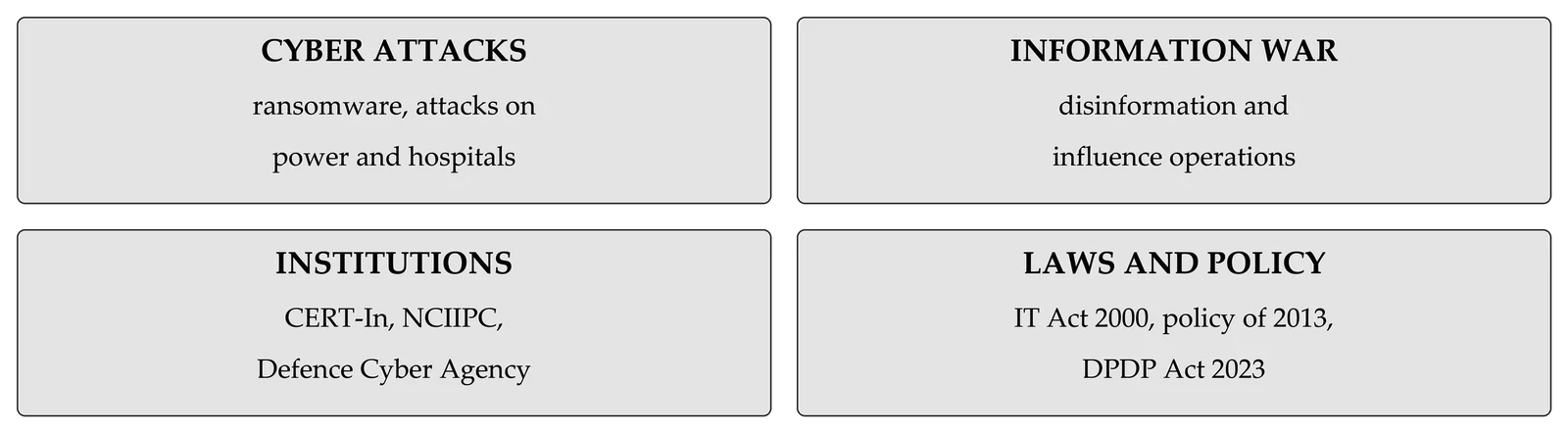
Cyberspace has become a domain of conflict alongside land, sea, air and space. Cyber warfare means attacks on computer networks to steal information, disrupt services or damage physical systems, while information warfare uses information itself, through propaganda, disinformation and manipulation of social media, to influence people and governments. India, with one of the world’s largest numbers of internet users and a fast-growing digital economy built on Aadhaar, UPI and online services, is both highly connected and highly exposed.
- 2019. Malware was found on the administrative network of the Kudankulam nuclear power plant.
- October 2020. A major power outage in Mumbai was later linked by researchers to a suspected Chinese hacking campaign against India’s power grid.
- November 2022. A ransomware attack crippled the servers of AIIMS, New Delhi, for days.
- Information operations. Disinformation campaigns during crises with Pakistan and China, and the spread of rumours on messaging apps leading to mob violence.
Libicki: The Convergence of Information Warfare
Martin Libicki, in The Convergence of Information Warfare (2017), argues that cyber war, electronic warfare, psychological operations and strategic deception, once treated separately, are converging because they all target information and the systems that carry it. States can now combine hacking, jamming, propaganda and deception in a single campaign, as seen in recent conflicts. For India, this means that cyber security cannot be treated as a purely technical matter for IT departments; it is part of national strategy.
India’s Institutions and Policies
- Information Technology Act, 2000, amended in 2008 to define cyber terrorism (Section 66F) and protect critical information infrastructure (Section 70).
- CERT-In (2004), the national agency for responding to cyber incidents.
- National Cyber Security Policy, 2013, which set the goal of a secure and resilient cyberspace.
- NCIIPC (2014), which protects critical information infrastructure such as power, banking and telecom.
- National Cyber Security Coordinator in the National Security Council Secretariat, and the Defence Cyber Agency (2019).
- Indian Cyber Crime Coordination Centre (2020) and the Digital Personal Data Protection Act, 2023.
- Bans on apps. In June 2020, after Galwan, India banned 59 Chinese apps, including TikTok, on grounds of security and sovereignty.
Debates on Cyber Policy
Prateek Waghre and Shibani Mehta, writing in The Diplomat (2019), argue that India’s national cybersecurity policy must acknowledge modern realities: the 2013 policy was outdated, focused on technical threats and ignored information operations, disinformation and the role of private platforms. A new national cybersecurity strategy was drafted in 2020, but its release was long delayed. Saikat Datta (2016) traces how India’s position on internet governance shifted from proposing a UN-based Committee for Internet-Related Policies in 2011 to supporting the multistakeholder model in 2015, and how cyber security became part of foreign policy. Asoke Mukerji (2018) explains India’s role in international cooperation on cyberspace, including UN discussions on norms of responsible state behaviour, and argues that India should help shape global cyber rules as a leading digital democracy.
5.4 Important Questions
- Question 1 Discuss the Maoist or Naxalite challenge to India’s internal security and the state’s response.
- Question 2 Discuss the separatist movement in Jammu and Kashmir as a challenge to India’s national security.
- Question 3 Discuss the separatist movements in Northeast India and the state’s response.
- Question 4 Discuss cyber warfare and information warfare as challenges to India’s national security.
DU asks the same idea in different words. So learn one broad answer for each question below; the same answer works for every question joined by OR.
Important Question 1
Discuss the Maoist or Naxalite challenge to India’s internal security and the state’s response.
OR
Examine the causes of the rise of Naxalism in India.
OR
Critically evaluate the state’s response to the Maoist challenge.
Model Answer
“It would not be an exaggeration to say that the problem of Naxalism is the single biggest internal security challenge ever faced by our country.”
— Manmohan Singh, meeting of Chief Ministers on Naxalism (13 April 2006)
Introduction. The Maoist or Naxalite movement began with the Naxalbari uprising of 1967 and became, by the 2000s, an armed insurgency across India’s tribal heartland. It combines a revolutionary ideology with the real grievances of Adivasis and the rural poor. The state has responded with security operations and development, and the debate continues over whether force or justice is the real solution.
1. Naxalbari
In 1967, peasants at Naxalbari in north Bengal, led by Charu Majumdar and Kanu Sanyal, rose against landlords, giving the movement its name.
2. Maoist Ideology
The movement follows Mao’s idea of protracted people’s war, aiming to seize power through armed struggle from rural bases.
3. Revival and Merger
After being crushed in the 1970s, the movement revived through the People’s War Group and the MCC, which merged in 2004 to form the CPI (Maoist).
4. The Red Corridor
At its peak, Maoist influence stretched across forested, mineral-rich tribal districts from Jharkhand to Andhra Pradesh.
5. Land and Displacement
Land alienation, loss of forest rights and displacement by mines and dams pushed many Adivasis towards the Maoists.
6. Absence of Governance
Remote areas lacked schools, health care, roads and fair administration, leaving a vacuum that armed groups filled.
7. Guha’s Argument
Ramachandra Guha argues that Adivasis are the biggest losers of development and are caught between Maoist and state violence.
8. Rammohan’s View
E. N. Rammohan links Naxalism to failed land reforms and neglect, and treats it as a serious threat because it seeks to overthrow the state.
9. Major Attacks
Attacks such as Dantewada in 2010 and Jhiram Ghati in 2013, which killed senior political leaders, showed the movement’s strength.
10. Ramana’s Two-Pronged Response
P. V. Ramana shows that the state combined security operations with development, with the Union supporting the states.
11. Security Operations
The Greyhounds of Andhra Pradesh, CoBRA battalions and the SAMADHAN strategy improved intelligence, training and coordination.
12. Development and Rights
Road and telecom schemes, Aspirational Districts, PESA and the Forest Rights Act sought to address the roots of discontent.
13. Salwa Judum
The state-backed Salwa Judum militia drew criticism for human rights abuses, and the Supreme Court declared it unconstitutional in 2011.
14. Decline of the Insurgency
Affected districts fell sharply by 2024, and the killing of the general secretary Basavaraju in 2025 weakened the leadership.
15. Remaining Concerns
Critics warn that security gains without justice, land rights and consent for mining projects may leave grievances alive.
16. Maoist Funding
The Maoists raised money through levies on contractors, mining companies and forest produce such as tendu leaves. Cutting off this funding, through the NIA and financial intelligence, became an important part of the state’s strategy under SAMADHAN.
17. Urban Networks and Debate
The state has also targeted alleged urban supporters of the Maoists, but critics argue that some of these cases, filed under the UAPA, have been used against activists and lawyers, raising concerns about civil liberties.
18. Evaluation
Naxalism is both a security threat and a symptom of development failure, so a lasting solution needs force, governance and rights together.
Conclusion. Thus, the Maoist movement, which Manmohan Singh called the single biggest internal security challenge, grew from the grievances of Adivasis and the rural poor. The state’s two-pronged response has greatly reduced violence, but as Guha argues, only democratic rights and fair development can remove the roots of the conflict.
Important Question 2
Discuss the separatist movement in Jammu and Kashmir as a challenge to India’s national security.
OR
Examine the causes of insurgency in Jammu and Kashmir.
OR
Critically evaluate India’s response to the Kashmir insurgency.
Model Answer
“इंसानियत, जम्हूरियत और कश्मीरियत: humanity, democracy and the composite culture of Kashmir.”
— Atal Bihari Vajpayee, Srinagar (April 2003)
Introduction. Jammu and Kashmir has been at the centre of India’s security concerns since 1947. The separatist insurgency that began in 1989 combined local alienation with a proxy war waged by Pakistan. Scholars such as Navnita Chadha Behera and Rekha Chowdhary argue that the problem has political roots, while military writers stress the role of Pakistan. India’s response has moved from counterinsurgency and dialogue to the abrogation of Article 370 in 2019.
1. Accession
Maharaja Hari Singh signed the Instrument of Accession on 26 October 1947, after Pakistan-backed tribal raiders invaded the state.
2. Article 370
Article 370 gave the state special autonomy, but presidential orders gradually extended most Union laws, reducing that autonomy.
3. Political Alienation
The arrest of Sheikh Abdullah in 1953, dismissals of elected governments and the disputed 1987 election alienated many Kashmiris.
4. Behera’s Political Gambit
Navnita Chadha Behera argues that New Delhi’s centralising political gambit eroded democracy and autonomy, contributing to alienation.
5. The Insurgency of 1989
An armed insurgency began in 1989, led first by the pro-independence JKLF and then by pro-Pakistan groups such as Hizbul Mujahideen.
6. Pakistan’s Proxy War
V. G. Patankar describes the conflict as a proxy war, with Pakistan providing training, arms, money and foreign fighters.
7. Exodus of Kashmiri Pandits
Targeted killings and threats forced most Kashmiri Pandits to leave the Valley in 1990, a lasting humanitarian wound.
8. Counterinsurgency
India deployed the Army, Rashtriya Rifles and police under AFSPA, fenced the Line of Control and built counter-infiltration grids.
9. Human Rights Concerns
Allegations of abuses, custodial deaths and the long use of emergency laws added to alienation and drew criticism.
10. Political Processes
Elections from 1996 onwards and Vajpayee’s outreach based on humanity, democracy and Kashmiriyat showed the value of political engagement.
11. Chowdhary’s Holistic Approach
Rekha Chowdhary calls for combining security with dialogue, good governance and respect for the region’s plural identities.
12. Regional Diversity
Jammu, the Valley and Ladakh have different identities and demands, so no single solution satisfies all regions.
13. Abrogation of Article 370
On 5 August 2019, the special status was ended and the state became two Union Territories; the Supreme Court upheld this in 2023.
14. After 2019
Violence and stone-pelting declined and tourism grew, but attacks continued, including the Pahalgam attack of April 2025.
15. Elections of 2024
Assembly elections in 2024 brought an elected government, though demands for the restoration of statehood remain.
16. Radicalisation and Social Media
Since the 2010s, local recruitment, often inspired through social media, has replaced many foreign fighters, as seen after the killing of militant commander Burhan Wani in 2016, which led to months of unrest.
17. Ladakh’s Distinct Demands
Ladakh welcomed its separation as a Union Territory in 2019, but its people later demanded constitutional safeguards for land, jobs and culture, showing again that the region’s parts have different aspirations.
18. Evaluation
Kashmir shows that internal and external threats are linked, and that security must be combined with democracy and trust.
Conclusion. Thus, the Kashmir insurgency arose from political alienation and was fuelled by Pakistan’s proxy war. India’s response has moved from counterinsurgency and dialogue to the abrogation of Article 370, but Vajpayee’s call for humanity, democracy and Kashmiriyat reminds us that lasting peace needs the trust of the people.
Important Question 3
Discuss the separatist movements in Northeast India and the state’s response.
OR
Examine the causes of insurgency in Northeast India.
OR
Discuss the lessons that Nagaland and Mizoram offer for counterinsurgency in India.
Model Answer
“People should develop along the lines of their own genius and we should avoid imposing anything on them.”
— Jawaharlal Nehru, foreword to Verrier Elwin’s A Philosophy for NEFA (1959)
Introduction. The Northeast has seen some of India’s longest-running insurgencies, from the Naga movement that began at independence to ethnic conflict in Manipur today. Sanjib Baruah links them to the region’s colonial frontier history, fears about land and identity, and a state that treated the region as a security frontier. India’s response has combined force with accommodation, producing both failures and notable successes such as the Mizo Accord.
1. A Frontier Region
The Northeast is linked to India by the narrow Siliguri corridor and borders China, Myanmar, Bangladesh and Bhutan.
2. Ethnic Diversity
The region has many ethnic groups with distinct histories, languages and customs, several loosely administered under colonial rule.
3. Nehru’s Tribal Policy
Nehru’s Panchsheel for tribal areas, written for Verrier Elwin’s book, called for development according to the people’s own genius.
4. Baruah’s Explanation
Sanjib Baruah explains insurgency through the colonial frontier legacy, fears of migration and a security-first approach by the Indian state.
5. The Naga Movement
The Naga National Council under Phizo rejected Indian rule in 1947; despite statehood in 1963 and the Shillong Accord, the conflict continued.
6. NSCN and Peace Talks
The NSCN (IM) signed a ceasefire in 1997 and a Framework Agreement in 2015, but a final settlement remains elusive.
7. The Mizo Accord
The MNF revolt of 1966 ended with the Mizo Accord of 1986, which brought Laldenga into office and made Mizoram peaceful.
8. Assam
The Assam Movement against migrants ended with the Assam Accord in 1985; ULFA and Bodo groups were later brought into peace agreements.
9. Manipur
Manipur has many armed groups, and Meitei-Kuki ethnic violence since 2023 shows how ethnic conflict can become a security crisis.
10. Cross-Border Sanctuaries
Insurgents have used camps in Myanmar and earlier Bangladesh, so cooperation with neighbours is essential for counterinsurgency.
11. AFSPA
The Armed Forces (Special Powers) Act, 1958 gave the military wide powers; it has been withdrawn from many areas since 2015.
12. Ladwig’s Lessons
Walter Ladwig finds that forced village grouping in Mizoram alienated people, while political accommodation brought lasting success.
13. Constitutional Accommodation
The Sixth Schedule, Articles 371A and 371G and new states such as Nagaland, Meghalaya and Mizoram gave groups autonomy.
14. Development and Connectivity
Investment in roads, railways and the Act East policy aims to integrate the region economically with India and South-East Asia.
15. Criticism
Baruah warns that long use of emergency laws has weakened democracy, and that ethnic homelands can create new minorities and conflicts.
16. Migration and Identity
Fears that migrants would change the region’s demography and take land and jobs fuelled the Assam Movement and continue to shape politics, as the debates over the National Register of Citizens in Assam and the Citizenship Amendment Act (2019) show.
17. Peace Accords since 2019
The Union government signed several accords after 2019, including the Bodo Accord (2020), the Bru-Reang agreement (2020), the Karbi Anglong agreement (2021) and the ULFA agreement (2023), claiming a large fall in insurgent violence.
18. Evaluation
The Northeast shows that insurgencies end best through political settlement, autonomy and development backed by credible security.
Conclusion. Thus, separatist movements in the Northeast grew from history, identity and neglect. Nehru’s advice to let people develop according to their own genius, and the success of the Mizo Accord, show that accommodation works better than force alone, though Manipur shows that the challenge continues.
Important Question 4
Discuss cyber warfare and information warfare as challenges to India’s national security.
OR
Examine India’s cyber security policy and institutions.
OR
Discuss Martin Libicki’s argument on the convergence of information warfare.
Model Answer
“To build a secure and resilient cyberspace for citizens, businesses and Government.”
— National Cyber Security Policy, 2013 (Vision)
Introduction. Cyberspace has become a new domain of conflict. Hostile states and criminal groups can attack power grids, hospitals and banks, steal data and spread disinformation without crossing a physical border. India’s rapid digitalisation has made it both stronger and more exposed. Martin Libicki shows how different forms of information warfare are converging, while Indian analysts argue that India’s policies must catch up with these realities.
1. Meaning of Cyber Warfare
Cyber warfare means attacks on computer networks to steal information, disrupt services or damage physical systems.
2. Information Warfare
Information warfare uses propaganda, disinformation and social media manipulation to influence people and governments.
3. India’s Exposure
India has a vast number of internet users and digital systems such as Aadhaar and UPI, making cyber security a national concern.
4. Major Incidents
Malware at Kudankulam in 2019, the Mumbai power outage of 2020 and the AIIMS ransomware attack of 2022 exposed vulnerabilities.
5. State-Sponsored Threats
Hacking groups linked to China and Pakistan have targeted Indian government, defence and infrastructure networks.
6. Libicki’s Convergence
Martin Libicki argues that cyber war, electronic warfare, psychological operations and deception are converging into one form of conflict.
7. Disinformation
Rumours on messaging apps have led to mob violence, and influence campaigns during crises show the power of information as a weapon.
8. The IT Act
The IT Act, 2000, amended in 2008, defines cyber terrorism and allows protection of critical information infrastructure.
9. Institutions
CERT-In, NCIIPC, the National Cyber Security Coordinator and the Defence Cyber Agency form India’s cyber security architecture.
10. The 2013 Policy
The National Cyber Security Policy of 2013 aimed at a secure and resilient cyberspace but has been criticised as outdated.
11. Waghre and Mehta
Waghre and Mehta argue that India’s policy must address information operations, private platforms and civil liberties, not only technical threats.
12. Data Protection
The Digital Personal Data Protection Act, 2023 seeks to protect personal data, a key element of national cyber security.
13. App Bans and Sovereignty
After Galwan, India banned Chinese apps such as TikTok, showing how cyber policy is tied to geopolitics.
14. Internet Governance
Saikat Datta shows that India moved from proposing a UN-based internet body in 2011 to supporting the multistakeholder model in 2015.
15. International Cooperation
Asoke Mukerji explains India’s role in UN discussions on cyber norms and argues that India should help shape global rules.
16. Skills and Industry
India needs many more trained cyber security professionals and stronger domestic industry for secure hardware and software, since dependence on foreign equipment, especially in telecom networks, creates vulnerabilities.
17. Deterrence in Cyberspace
Deterring cyber attacks is difficult because attackers are hard to identify quickly. Experts argue that India needs both strong defences and a credible ability to respond, along with clear rules on when a cyber attack counts as an act of war.
18. Evaluation
Cyber and information warfare are among India’s fastest-growing threats, requiring skills, institutions, laws and international cooperation.
Conclusion. Thus, cyber and information warfare blur the line between internal and external security. India has built laws and institutions in pursuit of the 2013 vision of a secure and resilient cyberspace, but as Libicki and Indian analysts argue, it must update its strategy to meet converging threats.
Short Notes
(a) SAMADHAN
The Union government’s 2017 strategy against left-wing extremism, stressing smart leadership, aggressive operations, actionable intelligence, technology and cutting off Maoist funding.
(b) AFSPA
The Armed Forces (Special Powers) Act, 1958, which gives the armed forces wide powers in areas declared disturbed; it has been withdrawn from many parts of the Northeast since 2015.
(c) CERT-In
The Indian Computer Emergency Response Team, set up in 2004 under the IT ministry, the national agency for responding to cyber security incidents.
(d) Red Corridor
The belt of forested, mineral-rich tribal districts stretching from Jharkhand and Odisha through Chhattisgarh to Maharashtra and Andhra Pradesh, where Maoist influence was strongest in the 2000s. The number of affected districts has fallen sharply since 2018.
More notes: MDSE-2b India's National Security
These notes are prepared by PADHO TO AISE for study help. They are not an official University of Delhi publication.