
Semester IV MDSE-2b India's National Security
Unit III · 24 min read · Updated 24 Nov 2026
As per the University of Delhi (DU) BA (Hons) Political Science syllabus
Contents
- 3.1 The Concept of Strategic Culture
- Sources of Strategic Culture
- Debates on the Concept
- Key Thinkers on Strategic Culture
- Three Generations of Strategic Culture Studies
- 3.2 Evolution and Conceptualization of India’s Strategic Culture
- Tanham’s Interpretive Essay
- Bajpai and Mattoo: Securing India
- Jaswant Singh: Defending India
- Schools of Indian Strategic Thought
- Further Voices in the Debate
- 3.3 Contemporary Trends
- Liebig: Strategic Culture and Intelligence Culture
- Narlikar: Peculiar Chauvinism or Strategic Calculation
- Tanham Revisited: Indian Strategy in Flux
- Restraint and Its Critics
- Key Strategic Documents
- 3.4 Important Questions
- Define strategic culture and discuss the debate on whether India has a strategic culture.
- Discuss the different schools of thought in India’s strategic thinking.
- Discuss the contemporary trends in India’s strategic culture.
- Explain the negotiating strategy of a rising India with reference to Amrita Narlikar.
- Short Notes
भारतीय अभिजात वर्ग ने राष्ट्रीय रणनीति के बारे में सुसंगत और व्यवस्थित रूप से सोचने का बहुत कम प्रमाण दिया है।
Indian elites show little evidence of having thought coherently and systematically about national strategy.
— George K. Tanham, Indian Strategic Thought: An Interpretive Essay (1992)
WWHY does India behave as it does in matters of war and peace? Why has it preferred restraint, avoided formal alliances, adopted no first use of nuclear weapons and insisted on strategic autonomy? One answer lies in strategic culture, the enduring ideas, beliefs and habits about security that shape a nation’s choices. This chapter examines the evolution and conceptualization of India’s strategic culture, from George Tanham’s controversial claim that India lacks strategic thinking to the responses of Indian scholars and practitioners, and then the contemporary trends in India’s strategic culture, including its intelligence culture and negotiating behaviour.
3.1 The Concept of Strategic Culture
The term strategic culture was introduced by Jack Snyder in 1977, in a study of Soviet nuclear strategy. He defined it as the sum total of ideas, conditioned emotional responses and patterns of habitual behaviour that members of a national strategic community share with regard to strategy. Later scholars such as Colin Gray and Alastair Iain Johnston, in Cultural Realism (1995), developed the concept. Strategic culture suggests that states do not respond to threats only on the basis of material power, as realists argue, but also through ideas, history, geography, religion and political institutions that shape how threats are perceived and what responses are considered legitimate.
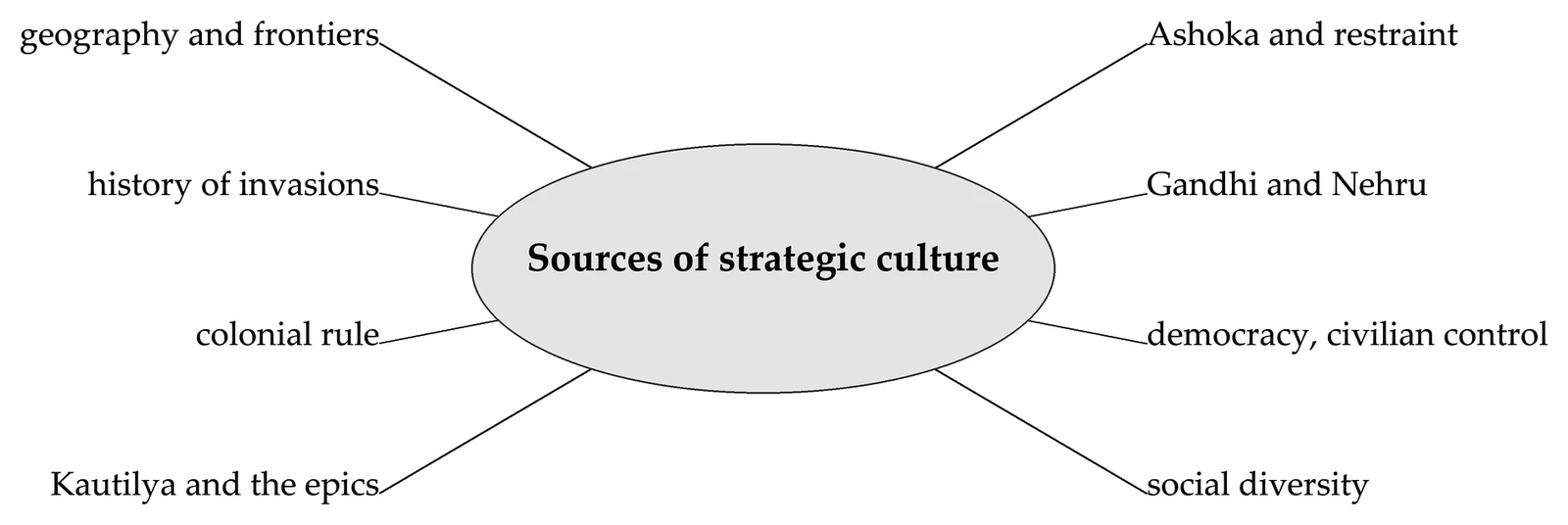
Sources of Strategic Culture
- Geography. India’s subcontinental size, the Himalayan barrier, the north-west passes and the Indian Ocean shaped its security outlook.
- History. Repeated invasions through the north-west, Mughal and Maratha statecraft, and above all colonial rule left deep memories.
- Classical traditions. The epics, Kautilya’s Arthashastra and Ashoka’s turn to dhamma after the Kalinga war offer contrasting models of realism and restraint.
- The national movement. Gandhi’s non-violence and Nehru’s internationalism shaped India’s early foreign and security policy.
- Democracy and civilian control. Civilian supremacy over the military and democratic politics shape decision-making.
- Diversity. India’s religious, linguistic and regional diversity makes internal cohesion a central security concern.
Debates on the Concept
Critics argue that strategic culture is difficult to define and measure, that it can become a vague explanation for any behaviour, and that it risks essentialising nations as if they had unchanging characters. Johnston showed that even states with apparently pacifist traditions, such as Ming China, often behaved like realists. Supporters reply that culture helps explain why states with similar power make different choices.
Key Thinkers on Strategic Culture
- Jack Snyder, The Soviet Strategic Culture: Implications for Limited Nuclear Operations (RAND, 1977), coined the term.
- Ken Booth, Strategy and Ethnocentrism (1979), warned that strategists misread rivals by viewing them through their own cultural lens.
- Colin Gray, National Style in Strategy: The American Example (1981), argued that culture forms the context of all strategic behaviour.
- Alastair Iain Johnston, Thinking about Strategic Culture (1995) and Cultural Realism (1995), tried to test culture rigorously against behaviour.
- Rodney Jones, India’s Strategic Culture (2006), applied the concept to India’s security choices.
Three Generations of Strategic Culture Studies
Johnston described three generations of writing. The first generation (late 1970s and early 1980s) used culture to explain why the Soviet Union and the United States thought differently about nuclear war. The second generation (mid-1980s) saw strategic culture as a tool of elites, i.e. rhetoric used to justify policies decided on other grounds. The third generation (1990s) treated culture as a variable that could be tested against alternatives such as realism. In simple words, the debate moved from broad national character to careful testing of how ideas affect choices, and studies of India’s strategic culture draw on all three approaches.
3.2 Evolution and Conceptualization of India’s Strategic Culture
Tanham’s Interpretive Essay
The American analyst George K. Tanham, in Indian Strategic Thought: An Interpretive Essay (RAND, 1992; reprinted in Securing India, 1996), argued that Indian elites showed little evidence of having thought coherently and systematically about national strategy. He attributed this to geography, which gave India a sense of natural unity behind natural frontiers; history, especially the experience of foreign conquest and colonial rule, which left strategy to the British; Hindu culture, with a cyclical view of time and a fatalistic outlook that he believed discouraged long-term planning; and the British Raj, whose defence planning excluded Indians. Yet Tanham also noted that India had a largely defensive orientation, a strong sense of its place as the dominant power in South Asia, and a preference for strategic autonomy. His essay provoked a strong response from Indian scholars.
Bajpai and Mattoo: Securing India
Kanti Bajpai and Amitabh Mattoo, in their introduction to Securing India: Strategic Thought and Practice (1996), engaged with Tanham’s essay. They accepted that India lacked formal, published strategic doctrines and coordinated planning institutions, but argued that India did have strategic thought, expressed in practice and in the debates of its leaders, diplomats and analysts. They called for more systematic study and institutionalised strategic planning, a call that influenced later reforms such as the National Security Council.
Jaswant Singh: Defending India
Jaswant Singh, later India’s Foreign and Defence Minister, in Defending India (1999), argued that India had lost its strategic culture during centuries of foreign rule and that after independence Nehruvian idealism neglected military power. He called for a realist strategic culture grounded in national interest, credible military strength and nuclear deterrence, while recognising India’s civilisational traditions of tolerance and assimilation. His book appeared soon after the 1998 nuclear tests, which he defended.
Schools of Indian Strategic Thought
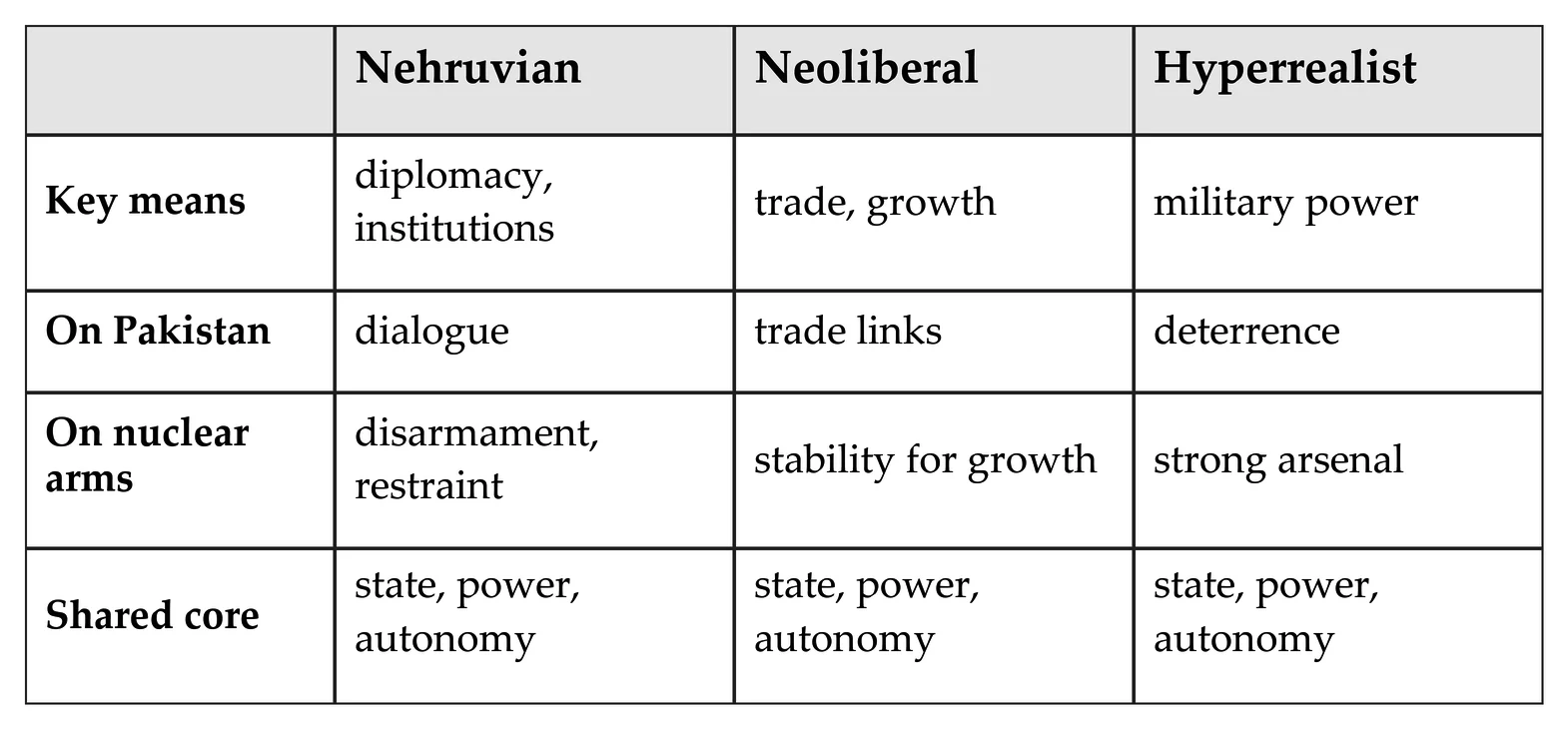
Kanti Bajpai later identified three schools of thought in India’s grand strategy: Nehruvians, who favour diplomacy, multilateralism, restraint and non-alignment; neoliberals, who stress economic growth, trade and interdependence as the basis of security; and hyperrealists, who emphasise military power, deterrence and the willingness to use force. All three share core assumptions about the importance of the state and power, but differ on the means. Bharat Karnad, in An Elephant with a Small Footprint (2014), argues that India’s strategic thought has realist roots but its practice has been timid, failing to match its potential.
Further Voices in the Debate
- K. Subrahmanyam, often called the doyen of Indian strategic thinking, argued that India’s problem was the lack of a strategic community and of political interest in strategy; he led the drafting of the draft nuclear doctrine (1999) as head of the National Security Advisory Board.
- Stephen P. Cohen and Sunil Dasgupta, Arming without Aiming (2010), argued that India modernised its military without clear political direction, a pattern they linked to strategic restraint.
- Rajesh Basrur, Minimum Deterrence and India’s Nuclear Security (2006), linked India’s small, defensive nuclear posture to its strategic culture.
- Nonalignment 2.0 (2012), written by Sunil Khilnani, Rajiv Kumar, Pratap Bhanu Mehta, Prakash Menon, Shyam Saran and others, restated strategic autonomy for a rising India.
- Shivshankar Menon, Choices: Inside the Making of India’s Foreign Policy (2016), gave a practitioner’s account of how restraint and calculation shaped decisions.
3.3 Contemporary Trends
Liebig: Strategic Culture and Intelligence Culture
Michael Liebig, in Interrogating Hyphenated Cultures: India’s Strategic Culture and Intelligence Culture (2021), argues that India’s strategic culture and intelligence culture are connected. Drawing on his work on Kautilya, he shows that the Arthashastra’s emphasis on intelligence, covert action and statecraft forms part of India’s cultural heritage, re-used in modern institutions. He argues that India’s strategic culture is hybrid, combining pre-modern Indian traditions with modern Western ideas of statecraft, and that understanding this hybridity helps explain how Indian institutions such as intelligence agencies think and act.
Narlikar: Peculiar Chauvinism or Strategic Calculation
Amrita Narlikar, in Peculiar Chauvinism or Strategic Calculation? Explaining the Negotiating Strategy of a Rising India (2006), examines India’s reputation as a tough, often obstructive negotiator in forums such as the WTO and nuclear arms control. She argues that India’s hard-line positions are not merely a peculiar national chauvinism but reflect strategic calculation: India uses its leadership of developing-country coalitions, such as the G-20 at the WTO’s Cancún meeting in 2003, to increase its bargaining power, and its domestic politics and colonial memory make concessions costly. She suggests that as India rises, it may need to move from defensive blocking to more constructive leadership.
Tanham Revisited: Indian Strategy in Flux
In Indian Strategy in Flux? (1996), Tanham himself noted that the end of the Cold War, economic liberalisation and new threats were changing Indian strategy. Since then, several trends are visible.
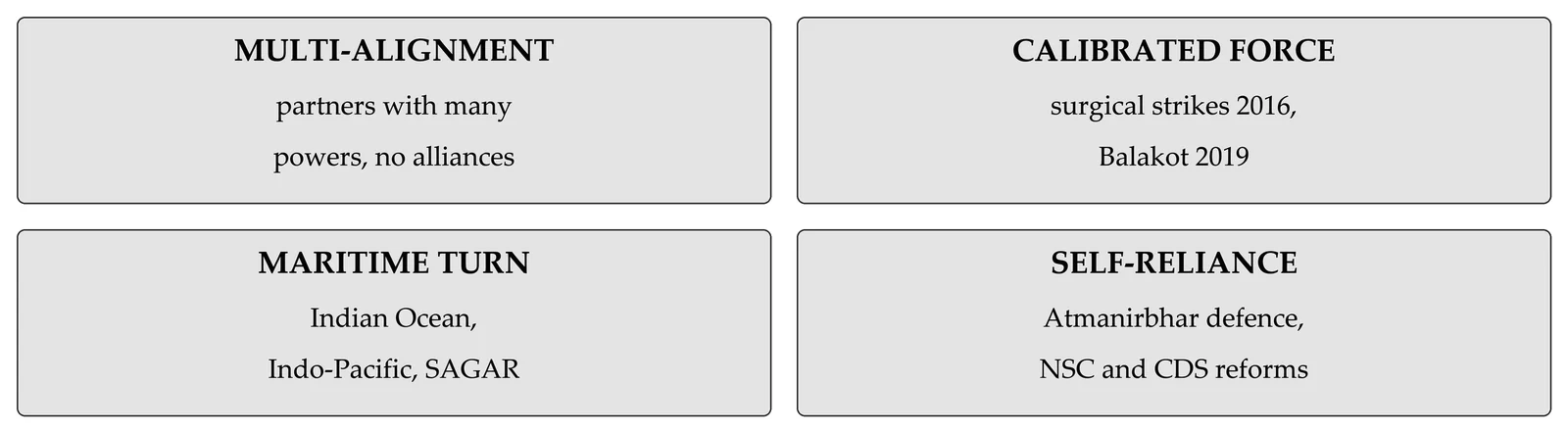
- Strategic autonomy to multi-alignment. India has moved from non-alignment to engaging several powers at once, partnering with the United States, Russia, Japan, France and the EU while managing China.
- Calibrated use of force. The surgical strikes of 2016 and Balakot strike of 2019 showed greater willingness to use limited force across the border.
- Maritime turn. Greater attention to the Indian Ocean and the Indo-Pacific, as S. Jaishankar describes in The India Way (2020).
- Neighbourhood First. Emphasis on connectivity and development assistance in South Asia.
- Self-reliance in defence. The push for Atmanirbharta to reduce dependence on imported weapons.
- Revival of tradition. Greater use of Kautilya and Indian traditions in strategic discourse, as part of a search for an indigenous vocabulary.
- Institutional reform. The NSC, CDS and Defence Planning Committee reflect the call for institutionalised strategy that Bajpai and Mattoo made in 1996.
Restraint and Its Critics
A central theme of India’s strategic culture is restraint. In the Kargil war of 1999, India did not cross the Line of Control; after the attack on Parliament in December 2001, it mobilised its forces in Operation Parakram but did not go to war; and after the Mumbai attacks of 2008, it relied on diplomacy. Supporters argue that restraint protected economic growth and won international goodwill, seen in the special waiver India received from the Nuclear Suppliers Group in 2008. Critics such as Bharat Karnad call it timidity that invites repeated provocation. The strikes of 2016 and 2019 signalled a shift towards calibrated punishment, but they remained limited in scope, which shows that restraint has been adjusted rather than abandoned.
Key Strategic Documents
- Draft Nuclear Doctrine (1999) and the official nuclear doctrine announced in January 2003, based on credible minimum deterrence and no first use.
- Ensuring Secure Seas: Indian Maritime Security Strategy (2015), the Navy’s statement of India’s maritime interests.
- Joint Doctrine of the Indian Armed Forces (2017), setting out a common framework for the three services.
- Absence of a published national security strategy, which many analysts still point to as a gap in India’s strategic culture.
3.4 Important Questions
- Question 1 Define strategic culture and discuss the debate on whether India has a strategic culture.
- Question 2 Discuss the different schools of thought in India’s strategic thinking.
- Question 3 Discuss the contemporary trends in India’s strategic culture.
- Question 4 Explain the negotiating strategy of a rising India with reference to Amrita Narlikar.
DU asks the same idea in different words. So learn one broad answer for each question below; the same answer works for every question joined by OR.
Important Question 1
Define strategic culture and discuss the debate on whether India has a strategic culture.
OR
Critically examine George Tanham’s view of Indian strategic thought.
OR
Discuss the evolution of India’s strategic culture.
Model Answer
“The sum total of ideas, conditioned emotional responses, and patterns of habitual behavior that members of a national strategic community have acquired through instruction or imitation and share with each other with regard to nuclear strategy.”
— Jack Snyder, The Soviet Strategic Culture (1977)
Introduction. Strategic culture refers to the enduring ideas and habits that shape how a nation thinks about security and the use of force. Whether India has a strategic culture became a major debate after George Tanham argued in 1992 that Indian elites had not thought systematically about strategy. Indian scholars and practitioners responded, showing that India has strategic thought rooted in its geography, history and traditions.
1. Snyder’s Definition
Jack Snyder introduced the concept in 1977, defining strategic culture as the shared ideas, emotional responses and habitual behaviour of a national strategic community.
2. Development of the Concept
Colin Gray and Alastair Iain Johnston developed the concept, arguing that culture shapes how states perceive threats and choose responses, alongside material power.
3. Tanham’s Argument
George Tanham argued in 1992 that Indian elites showed little evidence of coherent, systematic thinking about national strategy.
4. Tanham’s Explanations
He attributed this to geography, which gave India natural frontiers, to colonial rule, which left strategy to the British, and to Hindu ideas of cyclical time and fate.
5. Tanham on India’s Orientation
Tanham also noted India’s defensive orientation, its sense of being the dominant South Asian power and its preference for strategic autonomy.
6. Criticism of Tanham
Indian scholars criticised Tanham for essentialising Hindu culture and ignoring India’s strategic traditions, such as Kautilya and the epics, and its practice since 1947.
7. Bajpai and Mattoo
Bajpai and Mattoo accepted that India lacked published doctrines and planning institutions but argued that it had strategic thought expressed in practice and debate.
8. Jaswant Singh
Jaswant Singh argued that India lost its strategic culture under foreign rule and that Nehruvian idealism neglected power, calling for a realist strategic culture.
9. Geography
India’s subcontinental size, Himalayan barrier, north-west passes and maritime exposure shaped a defensive yet regionally dominant outlook.
10. History
Repeated invasions and colonial rule left a deep concern with territorial integrity, autonomy and resistance to external domination.
11. Classical Traditions
Kautilya’s realism and Ashoka’s turn to dhamma after Kalinga offer contrasting models of power and restraint within Indian tradition.
12. The National Movement
Gandhi’s non-violence and Nehru’s internationalism shaped early Indian policy, emphasising peace, non-alignment and moral leadership.
13. Restraint as a Feature
India’s no first use doctrine, reluctance to form alliances and preference for negotiation suggest a culture of strategic restraint.
14. Critiques of the Concept
Critics argue that strategic culture is vague and risks treating nations as having unchanging characters, ignoring change and debate.
15. Recent Developments
Institutional reforms such as the NSC and CDS and the revival of Kautilya show a growing effort to articulate and institutionalise Indian strategy.
16. Kautilya against Tanham
Critics point out that the Arthashastra is one of the oldest systematic treatises on statecraft in the world, which sits uneasily with Tanham’s claim that Indians did not think strategically. The problem, they argue, was not the absence of thought but the absence of modern institutions to turn it into policy.
17. Strategic Practice since 1947
India’s conduct in the 1971 war, including diplomacy with the Soviet Union and the timing of military action, shows coherent strategic planning. Its nuclear programme, pursued quietly over decades until 1998, also suggests long-term strategic thinking.
18. Evaluation
India does have a strategic culture, rooted in geography, history and traditions, though it has been expressed more in practice than in formal doctrine.
Conclusion. Thus, strategic culture, as Snyder defined it, is the shared ideas and habits of a strategic community. Tanham’s claim that India lacked strategic thinking was challenged by Bajpai, Mattoo and Jaswant Singh, who showed that India’s strategic culture, shaped by geography, history and traditions of realism and restraint, exists mainly in practice.
Important Question 2
Discuss the different schools of thought in India’s strategic thinking.
OR
Examine the Nehruvian, neoliberal and hyperrealist schools of Indian strategic thought.
OR
Discuss whether India’s strategic culture is realist or idealist.
Model Answer
“The State shall endeavour to promote international peace and security; maintain just and honourable relations between nations; and encourage settlement of international disputes by arbitration.”
— Constitution of India, Article 51 (abridged)
Introduction. Indian strategic thinking is not uniform. Kanti Bajpai identified three main schools: Nehruvians, neoliberals and hyperrealists. They share core assumptions about the importance of the state and power but differ on the best means of achieving security. Debates among these schools shape India’s choices on nuclear weapons, alliances, Pakistan and China.
1. Diversity of Thought
India’s strategic community includes politicians, diplomats, soldiers and scholars with different views, so Indian strategic thought is plural rather than monolithic.
2. Shared Core
Bajpai notes that all schools accept that the international system is made up of states seeking power and security, sharing a broadly realist core.
3. The Nehruvian School
Nehruvians favour diplomacy, multilateralism, non-alignment and restraint, believing that cooperation and international institutions can reduce conflict.
4. Nehruvian Policies
Non-alignment, support for the UN, Panchsheel with China and nuclear restraint before 1998 reflect Nehruvian thinking, reflected also in Article 51.
5. The Neoliberal School
Neoliberals stress economic growth, trade and interdependence, arguing that economic strength is the basis of security and that commerce can reduce conflict.
6. Neoliberal Policies
Liberalisation after 1991, the Look East policy and efforts to improve trade with neighbours reflect neoliberal thinking.
7. The Hyperrealist School
Hyperrealists emphasise military power, deterrence and the willingness to use force, seeing the world as dangerous and conflict as likely.
8. Hyperrealist Policies
Calls for a larger nuclear arsenal, tougher policies towards Pakistan and China and higher defence spending reflect hyperrealist thinking.
9. Karnad’s Realism
Bharat Karnad argues that India’s strategic thought has realist roots but its practice has been timid, like an elephant with a small footprint.
10. Jaswant Singh’s Realism
Jaswant Singh called for a realist strategic culture based on national interest and credible deterrence, defending the 1998 nuclear tests.
11. Idealism and Realism Combined
Indian policy has often combined idealist rhetoric with realist practice, as in the 1971 war, fought under the banner of humanitarian concern.
12. Nuclear Debate
The schools differed on nuclear weapons: Nehruvians favoured disarmament, hyperrealists favoured a strong arsenal, and the 2003 doctrine combined deterrence with restraint.
13. Pakistan and China
Nehruvians favour dialogue, neoliberals favour trade and connectivity, and hyperrealists favour deterrence and punishment in dealing with Pakistan and China.
14. Shifts over Time
Since 1998, and more so recently, hyperrealist and neoliberal ideas have gained ground, though Nehruvian commitments to autonomy remain.
15. Synthesis
India’s grand strategy is best seen as a synthesis of these schools, combining power, prosperity and principled restraint.
16. Strategic Autonomy as Common Ground
Despite their differences, all three schools value strategic autonomy, the freedom to make independent choices. This shared commitment explains why India avoids formal alliances even when it builds close partnerships.
17. Domestic Politics and the Schools
Different governments have leaned towards different schools, but the broad continuity of Indian policy across parties shows that the schools act as tendencies within one strategic community rather than rival camps.
18. Evaluation
The schools of Indian strategic thought show the richness of debate in India and explain the mix of restraint and assertion in its policies.
Conclusion. Thus, Bajpai’s Nehruvian, neoliberal and hyperrealist schools share a realist core but differ on means, from diplomacy and Article 51’s commitment to peaceful settlement, to economic interdependence, to military power. India’s strategic culture combines idealist commitments with realist practice.
Important Question 3
Discuss the contemporary trends in India’s strategic culture.
OR
Examine Michael Liebig’s argument on India’s strategic and intelligence culture.
OR
Discuss how India’s strategic culture has changed since the end of the Cold War.
Model Answer
“This is a time for us to engage America, manage China, cultivate Europe, reassure Russia, bring Japan into play.”
— S. Jaishankar, The India Way (2020)
Introduction. India’s strategic culture is not static. Since the end of the Cold War, economic liberalisation, nuclearisation, the rise of China and new threats have changed how India thinks about security. Michael Liebig shows the hybrid nature of India’s strategic and intelligence culture, while S. Jaishankar’s The India Way reflects the contemporary emphasis on multi-alignment and pragmatism.
1. Tanham’s Strategy in Flux
Tanham noted in 1996 that the end of the Cold War, liberalisation and new threats were changing Indian strategy, a process that has since accelerated.
2. Liebig’s Hybrid Culture
Michael Liebig argues that India’s strategic culture is hybrid, combining pre-modern Indian traditions, especially Kautilyan statecraft, with modern Western ideas.
3. Intelligence Culture
Liebig shows that the Arthashastra’s emphasis on intelligence and covert action forms part of India’s heritage, re-used in the thinking of modern intelligence institutions.
4. From Non-Alignment to Multi-Alignment
India has moved from non-alignment to multi-alignment, engaging several powers at once, as Jaishankar’s call to engage America and manage China illustrates.
5. Strategic Autonomy
Despite closer partnerships, India continues to insist on strategic autonomy, avoiding formal alliances and maintaining ties with Russia.
6. Calibrated Use of Force
The surgical strikes of 2016 and the Balakot strike of 2019 showed greater willingness to use limited force, signalling a shift from restraint towards calibrated deterrence.
7. The Maritime Turn
India pays greater attention to the Indian Ocean and the Indo-Pacific, with naval expansion, partnerships and the SAGAR vision announced in 2015.
8. Neighbourhood First
India emphasises connectivity, development assistance and crisis response in South Asia to counter China’s influence and build regional goodwill.
9. Defence Self-Reliance
The push for Atmanirbharta in defence seeks to reduce dependence on imported weapons and build an indigenous defence industry.
10. Institutional Reform
The NSC, the CDS and the Defence Planning Committee reflect the move towards institutionalised strategic planning that scholars long demanded.
11. Revival of Tradition
Policy-makers and scholars increasingly invoke Kautilya and Indian traditions, as Jaishankar invokes the Mahabharata, in search of an indigenous strategic vocabulary.
12. Narlikar on Negotiation
Amrita Narlikar shows that India’s tough negotiating behaviour reflects strategic calculation, which may evolve into more constructive leadership as India rises.
13. Nuclear Posture
India retains no first use and credible minimum deterrence, but debates continue about the credibility and evolution of its doctrine.
14. Continuities
Despite changes, continuities remain: civilian control, preference for autonomy, defensive orientation and a sense of civilisational identity.
15. Criticism
Critics argue that India’s strategic culture is still reactive, under-resourced and lacking a published national security strategy.
16. Quad and Minilateralism
India’s participation in the Quad with the United States, Japan and Australia, revived in 2017, shows a willingness to join issue-based groupings without accepting a formal alliance, a key feature of contemporary multi-alignment.
17. Technology and New Domains
India’s strategic culture is extending to cyber, space and emerging technologies, as seen in the Defence Space Agency, the Defence Cyber Agency and the focus on critical technologies with partners.
18. Evaluation
India’s strategic culture is becoming more confident, pragmatic and multi-aligned while retaining its core commitment to autonomy.
Conclusion. Thus, contemporary trends show a hybrid strategic culture, as Liebig argues, moving from non-alignment to multi-alignment, calibrated force, a maritime turn and defence self-reliance. Jaishankar’s call to engage America, manage China and cultivate Europe captures this pragmatic and autonomous outlook.
Important Question 4
Explain the negotiating strategy of a rising India with reference to Amrita Narlikar.
OR
Discuss whether India’s hard-line negotiating behaviour reflects peculiar chauvinism or strategic calculation.
OR
Discuss the relationship between strategic culture and India’s behaviour in international negotiations.
Model Answer
“Where freedom is menaced or justice threatened or where aggression takes place, we cannot be and shall not be neutral.”
— Jawaharlal Nehru, address to the United States Congress (13 October 1949)
Introduction. India has a reputation as a tough and sometimes obstructive negotiator in international forums such as the WTO, climate negotiations and nuclear arms control. Amrita Narlikar asks whether this reflects a peculiar national chauvinism or strategic calculation, and argues that it is largely a rational strategy shaped by history, domestic politics and India’s position as a leader of developing countries.
1. India’s Reputation
Western negotiators have often described India as a naysayer that blocks agreements, insists on principles and refuses compromise.
2. The Chauvinism Explanation
One explanation attributes this behaviour to a peculiar national chauvinism, a cultural arrogance or moralism rooted in India’s self-image.

3. Narlikar’s Argument
Narlikar argues that India’s hard-line positions largely reflect strategic calculation aimed at maximising bargaining power and protecting vital interests.
4. Coalition Leadership
India leads coalitions of developing countries, such as the G-20 formed at the WTO’s Cancún meeting in 2003, which increases its bargaining power.
5. Domestic Constraints
Domestic politics, especially the interests of farmers and small producers, make concessions costly, so negotiators adopt firm positions.
6. Colonial Memory
Memories of colonial exploitation make Indian leaders wary of agreements that appear to limit sovereignty or favour rich countries.
7. Moral Framing
India often frames its positions in moral terms, such as equity and justice for developing countries, which strengthens domestic and coalition support.
8. Nuclear Negotiations
India refused to sign the NPT and CTBT, calling them discriminatory, a firm stance that eventually led to the India-US civil nuclear agreement of 2008 on better terms.
9. Trade Negotiations
At the WTO, India has defended food security and public stockholding, securing a peace clause at Bali in 2013 despite pressure from rich countries.
10. Climate Negotiations
In climate talks, India has insisted on equity and common but differentiated responsibilities, while gradually accepting its own commitments.
11. Cultural Roots
The Narlikars’ later work links India’s bargaining style to Mahabharata patterns of heroism and refusal to compromise on principle.
12. Nehru’s Moral Stance
Nehru’s statement that India would not be neutral where freedom or justice was threatened shows the moral framing that has long characterised Indian diplomacy.
13. Costs of Hard Bargaining
Hard bargaining can lead to deadlock, isolate India and prevent it from shaping agreements, as critics of its WTO stance argue.
14. Rising Power Responsibilities
Narlikar suggests that as India rises, it may need to move from defensive blocking to constructive leadership and rule-making.
15. Recent Change
India’s G-20 presidency in 2023 and its role in climate and digital initiatives suggest a shift towards more constructive leadership.
16. Coalition Discipline
Narlikar shows that India’s coalitions hold together partly because India keeps firm positions; if it compromised easily, smaller partners would lose trust. Hard bargaining therefore also serves coalition discipline.
17. Lessons for Rising Powers
India’s experience shows that rising powers face a dilemma between defending the interests of the developing world and accepting the responsibilities of a great power that helps write global rules.
18. Evaluation
India’s negotiating behaviour is best explained by strategic calculation shaped by culture and history, rather than by chauvinism alone.
Conclusion. Thus, Narlikar shows that India’s tough negotiating strategy, in trade, nuclear and climate talks, reflects strategic calculation, coalition leadership, domestic constraints and colonial memory rather than peculiar chauvinism. Its moral framing, seen in Nehru’s refusal to be neutral where justice is threatened, remains part of India’s strategic culture.
Short Notes
(a) Strategic culture
The shared ideas, beliefs and habits of a nation’s strategic community about security and the use of force, a concept introduced by Jack Snyder in 1977.
(b) Tanham thesis
George Tanham’s argument (1992) that Indian elites had not thought coherently and systematically about national strategy, which provoked debate among Indian scholars.
(c) Multi-alignment
India’s contemporary approach of building partnerships with several major powers at once, while avoiding formal alliances and preserving strategic autonomy.
More notes: MDSE-2b India's National Security
These notes are prepared by PADHO TO AISE for study help. They are not an official University of Delhi publication.