
Semester VI DSE-4b Understanding Savarkar
Unit VI · 21 min read · Updated 24 Nov 2026
As per the University of Delhi (DU) BA (Hons) Political Science syllabus
Contents
- 6.1 Savarkar’s Critique of Caste: The Seven Shackles
- Caste as a Source of Weakness
- The Seven Shackles (Saptabandi)
- Caste Reform before Savarkar
- 6.2 Social Reform at Ratnagiri
- The Ratnagiri Programme, 1924–1937
- Assessment of the Reforms
- Savarkar’s Reform in Context
- 6.3 Savarkar, Ambedkar and the Dalits
- Savarkar and Ambedkar Compared
- Kanungo and Teltumbde: Co-opting Dalits into Hindutva
- Debates Today
- Caste in India Today
- Three Approaches to Untouchability
- Key Terms at a Glance
- 6.4 Important Questions
- Discuss Savarkar’s views on caste and untouchability.
- Discuss Savarkar’s social reform activities at Ratnagiri.
- Compare the views of Savarkar and Ambedkar on caste and untouchability.
- Discuss the relationship between Hindutva and Dalits with reference to Pralay Kanungo and Anand Teltumbde.
- Short Notes
सबसे पहले जिस बात को स्वीकार करना होगा वह यह है कि हिंदू समाज एक मिथक है।
The first and foremost thing that must be recognized is that Hindu Society is a myth.
— B. R. Ambedkar, Annihilation of Caste (1936)
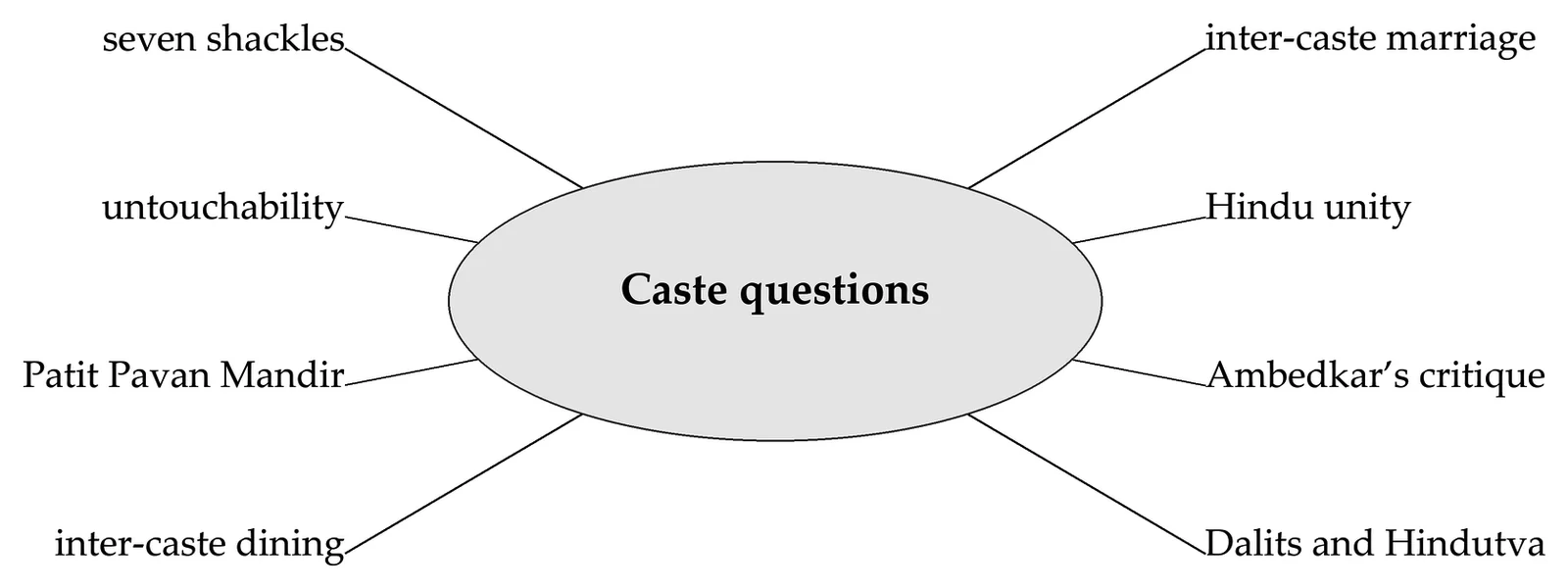
SSAVARKAR was a strong critic of caste and untouchability, and during his years at Ratnagiri he carried out a programme of social reform, including a temple open to all castes and public inter-caste dinners. Yet his motives and methods differed sharply from those of Ambedkar. For Savarkar, caste had to go because it divided and weakened the Hindu nation; for Ambedkar, caste had to be annihilated because it denied human dignity and equality, and this required rejecting the authority of the Hindu scriptures. Critics such as Anand Teltumbde argue that Hindutva seeks to bring Dalits into its fold without ending caste hierarchy. This chapter studies Unit VI of the syllabus: untouchability and caste questions in Savarkar’s thought and practice.
6.1 Savarkar’s Critique of Caste: The Seven Shackles
Caste as a Source of Weakness
In his essays on social questions, collected in the volumes of Savarkar Samagra and in his essays for the eradication of caste, Savarkar argued that the caste system, based on birth, had no basis in reason or justice and had gravely weakened Hindu society. It divided Hindus into thousands of mutually exclusive groups, prevented them from acting together, and drove many of the oppressed to leave Hinduism. He described untouchability as an inhuman practice and a stain on Hindu society. As a rationalist, he rejected the idea that caste was ordained by God and argued that the scriptures that supported it should not be treated as binding in modern times.
The Seven Shackles (Saptabandi)
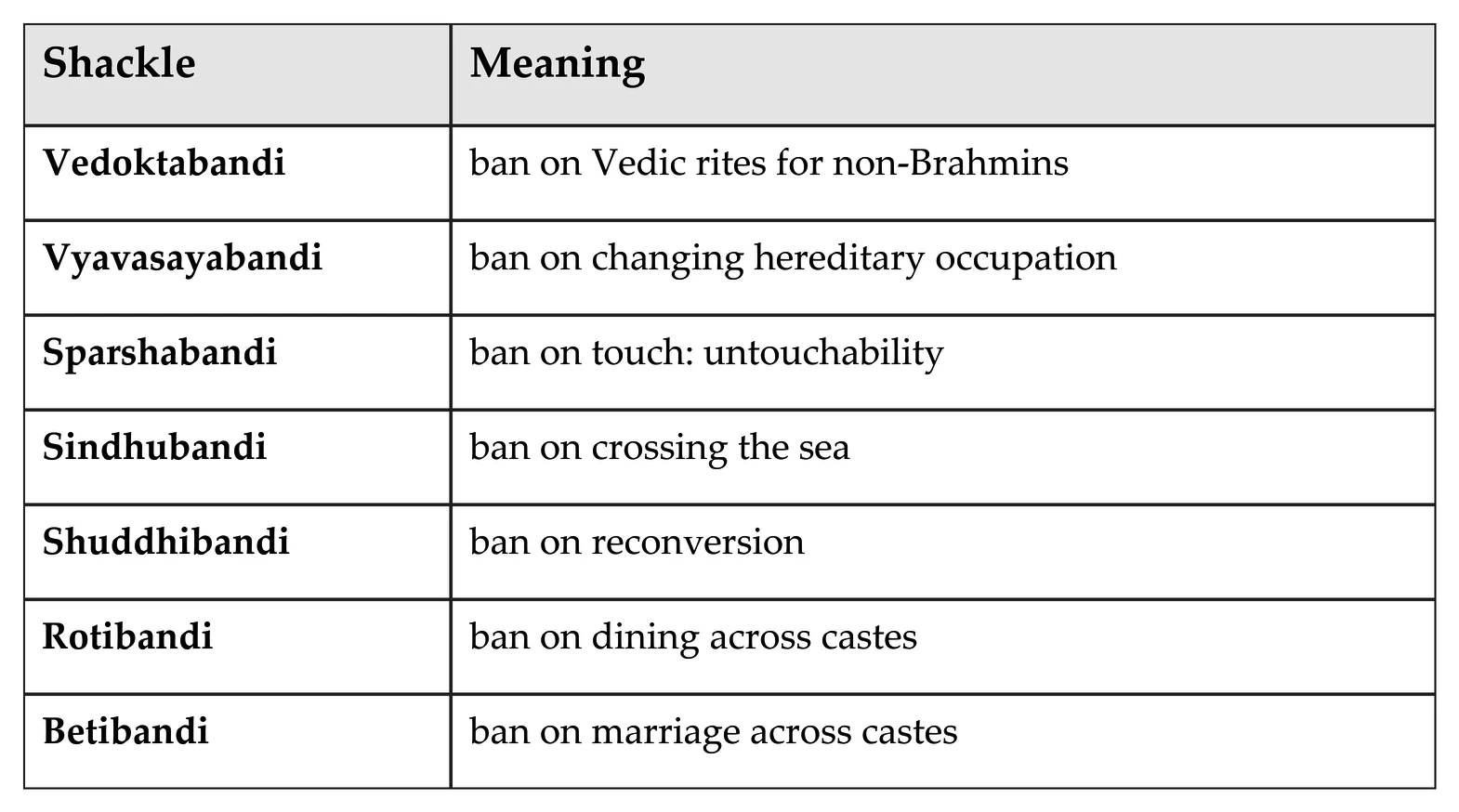
Savarkar identified seven shackles (bandi), i.e. prohibitions that bound Hindu society and needed to be broken:
- Vedoktabandi. The ban on performing Vedic rites for non-Brahmins.
- Vyavasayabandi. The ban on changing one’s hereditary occupation.
- Sparshabandi. The ban on touch, i.e. untouchability.
- Sindhubandi. The ban on crossing the sea, which treated overseas travel as polluting.
- Shuddhibandi. The ban on reconversion, which prevented converts from returning to Hinduism.
- Rotibandi. The ban on dining with members of other castes.
- Betibandi. The ban on marriage across castes.
Savarkar argued that breaking these shackles, especially through inter-caste dining and inter-caste marriage, would dissolve caste and unite Hindus. He also linked the issue to conversion: since the oppressed castes were the most likely to convert, ending untouchability was necessary to stop the loss of Hindus to other religions.
Caste Reform before Savarkar
- Jotirao and Savitribai Phule opened schools for girls and untouchables from 1848 and founded the Satyashodhak Samaj (1873).
- Narayana Guru in Kerala consecrated a Shiva idol at Aruvippuram in 1888 for those denied temple entry and preached one caste, one religion, one God for humanity.
- Periyar led the Self-Respect Movement from 1925, attacking caste and Brahmanical authority.
- Temple entry campaigns such as Vaikom (1924–25) and Guruvayur (1931–32) challenged exclusion from temples; the Travancore Temple Entry Proclamation followed in 1936.
- Ambedkar led the Mahad satyagraha (1927) and the Kalaram temple entry movement (1930).
6.2 Social Reform at Ratnagiri
The Ratnagiri Programme, 1924–1937
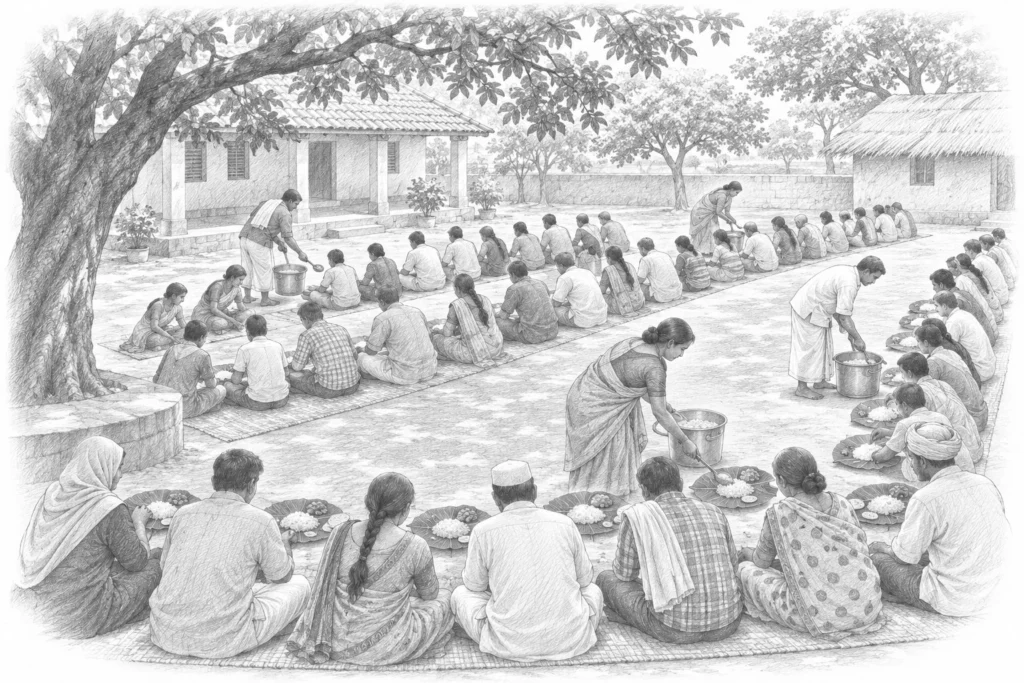
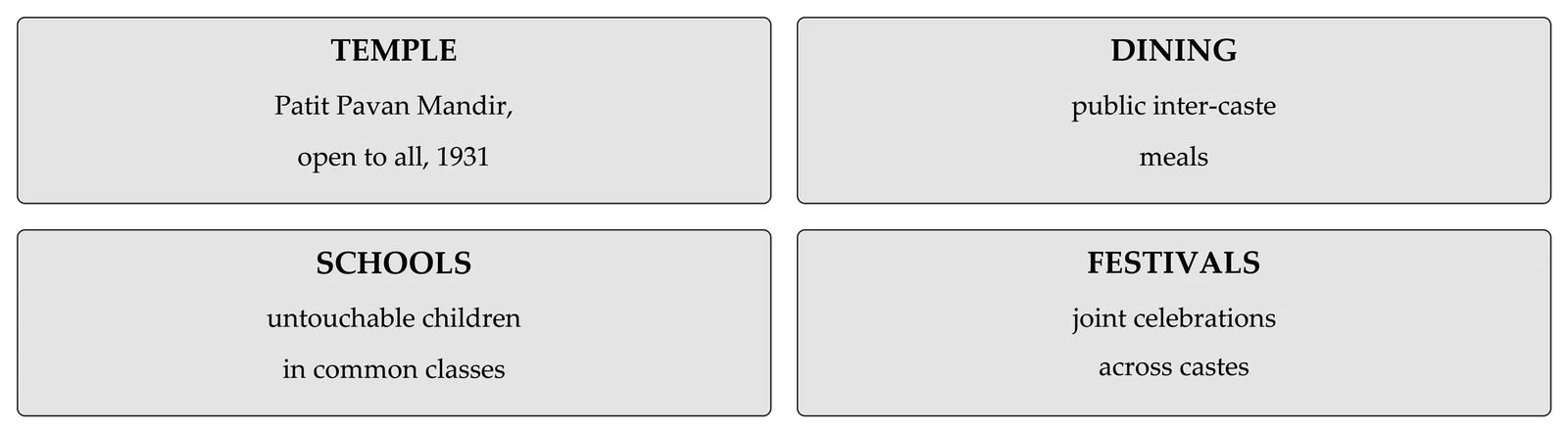
Confined to Ratnagiri district and barred from politics, Savarkar devoted much of his energy to social reform. He organised public meetings, festivals and campaigns to break caste barriers in daily life. With the help of the philanthropist Bhagoji Seth Keer, he built the Patit Pavan Mandir (temple of the Purifier of the Fallen), inaugurated in 1931, which was open to all Hindus including untouchables, with a priest who could be from any caste. He organised public inter-caste dinners (sahabhojan), in which people of all castes, including untouchables, ate together; persuaded schools to seat untouchable children with others; and encouraged joint celebrations of festivals such as Ganeshotsav across castes.
- Temple entry. The Patit Pavan Mandir allowed untouchables to worship inside, at a time when most temples excluded them.
- Inter-caste dining. Public meals broke the rule against dining across castes, a powerful symbolic act.
- Education. Untouchable children were admitted to common schools in Ratnagiri.
- Inter-caste marriage. Savarkar supported marriages across castes and praised couples who defied caste rules.
- Writing. He wrote essays, plays and poems attacking untouchability and caste prejudice.
Assessment of the Reforms
Admirers, such as Vikram Sampath, present the Ratnagiri reforms as radical for their time, carried out in the face of strong opposition from orthodox Hindus. Critics accept that Savarkar opposed untouchability sincerely, but argue that his reforms were aimed above all at Hindu consolidation: to strengthen Hindus numerically and politically against Muslims and Christians, rather than to secure the rights and power of Dalits as such. They point out that he did not support Dalits’ independent political organisation or their right to separate representation, as Ambedkar did.
Savarkar’s Reform in Context
Savarkar’s Ratnagiri reforms came in the same years as Ambedkar’s satyagrahas and Gandhi’s Harijan campaign of 1932–34. All three opposed untouchability, but they drew on different values. Gandhi relied on the conscience of caste Hindus; Ambedkar on the self-organisation and rights of Dalits; Savarkar on the rational reform of Hindu society for national strength. Understanding this context helps assess both the courage and the limits of Savarkar’s reforms.
6.3 Savarkar, Ambedkar and the Dalits
Savarkar and Ambedkar Compared
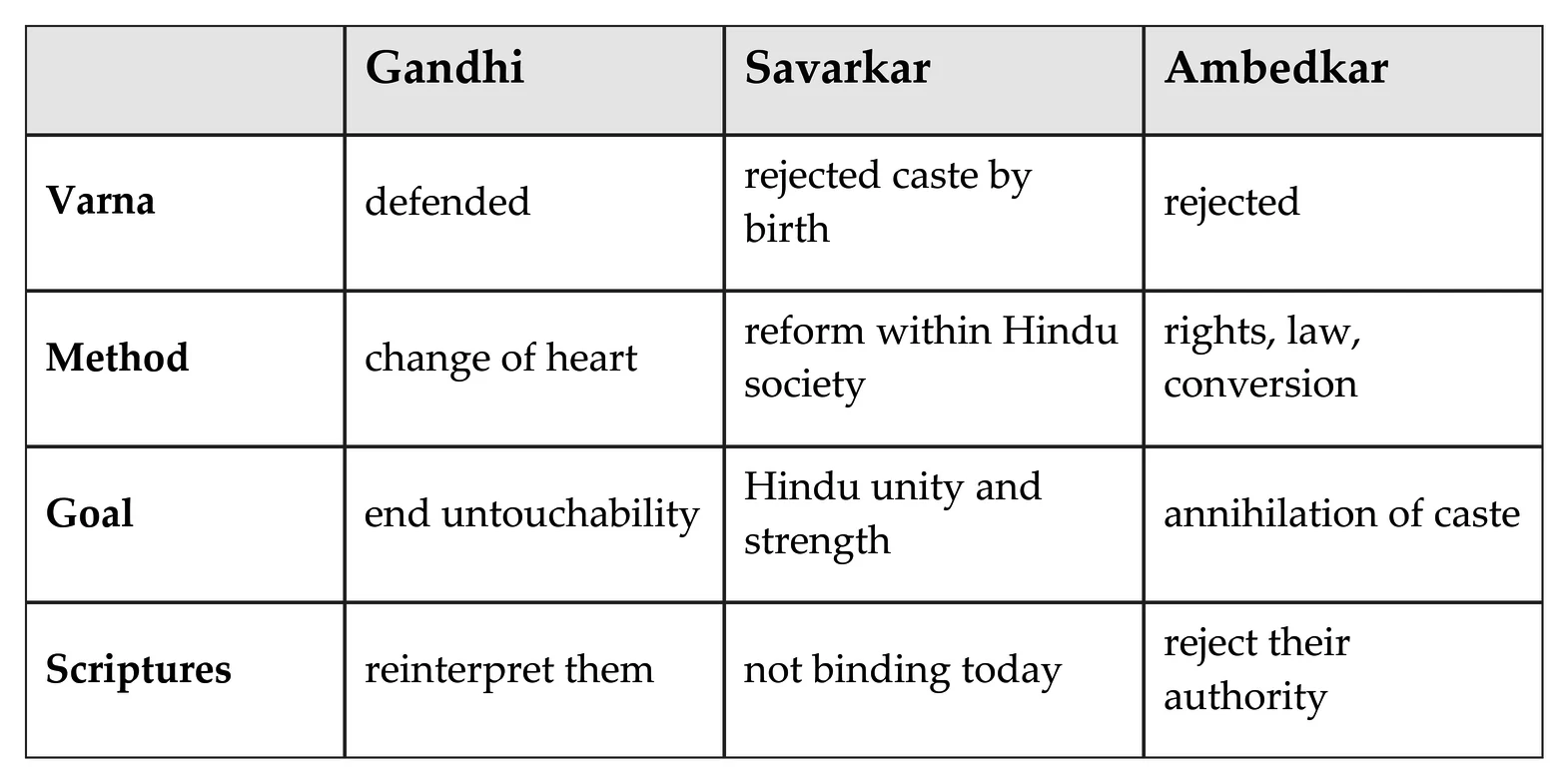
Savarkar and Ambedkar both condemned untouchability and supported inter-caste dining and marriage, but they differed deeply. For Savarkar, caste was a problem because it weakened the Hindu nation; the solution was reform within Hindu society, without rejecting its scriptures and heritage as a whole. For Ambedkar, caste was rooted in the religious authority of the Shastras and denied the dignity of the individual; the solution required destroying belief in that authority, securing rights and political power for Dalits, and, finally, leaving Hinduism. Ambedkar argued that Hindu society was a myth, only a collection of castes, so appeals to Hindu unity could not end caste. Gandhi, for his part, opposed untouchability but defended varna as a division of duties, a position both Savarkar and Ambedkar rejected.
Kanungo and Teltumbde: Co-opting Dalits into Hindutva
Pralay Kanungo, in Co-Opting Dalits into the Hindutva Fold (2007), reviews the volume Hindutva and Dalits, edited by Anand Teltumbde (2005). Its contributors argue that Hindutva organisations seek to bring Dalits into a united Hindu identity, often through symbolic inclusion and the language of samrasta (social harmony) rather than samata (equality). In this view, Dalits are welcomed as Hindus and sometimes mobilised against religious minorities, as during communal riots, while caste hierarchy and economic inequality remain largely unchallenged. The contributors also note efforts to appropriate Ambedkar’s image while downplaying his critique of Hinduism. Kanungo finds the volume valuable in exposing these strategies, while noting that Dalit responses to Hindutva vary and that some Dalits support it for their own reasons.
Debates Today
- Reservation and representation. Dalit politics, from the Republican Party to the Bahujan Samaj Party, emphasises rights, reservation and political power, following Ambedkar.
- Hindutva and Dalit votes. Hindu nationalist parties have won significant Dalit support in recent decades, which scholars explain through welfare, identity and local factors.
- Continuing discrimination. Caste violence and discrimination persist despite the law, showing that the caste question remains unresolved.
- Inter-caste marriage. It remains rare, around five per cent of marriages in some surveys, showing how deep the shackle of betibandi still is.

Caste in India Today
Despite constitutional guarantees, caste remains a powerful force in Indian society. The Protection of Civil Rights Act (1955) and the SC and ST (Prevention of Atrocities) Act (1989) punish untouchability and caste violence, yet crimes against Dalits continue to be reported in large numbers. Surveys find that untouchability is still practised in many households, and that inter-caste marriages remain rare. Debates on reservation, private-sector jobs and caste censuses show that the questions Savarkar, Gandhi and Ambedkar raised are still unresolved.
Three Approaches to Untouchability
The years between 1924 and 1936 saw three major approaches to untouchability. Gandhi’s campaign, through the Harijan Sevak Sangh (1932) and his all-India tour of 1933–34, appealed to the conscience of caste Hindus. Ambedkar’s movement, from Mahad (1927) to Annihilation of Caste (1936), demanded rights, representation and a break with scriptural authority. Savarkar’s Ratnagiri programme combined practical reform with the aim of Hindu unity. Each left a legacy: Gandhi’s in the national movement, Ambedkar’s in the Constitution and Dalit politics, and Savarkar’s in Hindu nationalist social work.
- Gandhi: change of heart, Harijan welfare, defence of varna.
- Ambedkar: rights, representation, rejection of the Shastras, conversion.
- Savarkar: rational reform within Hindu society for national strength.
Key Terms at a Glance
- Saptabandi: Savarkar’s seven shackles of Hindu society.
- Sahabhojan: public inter-caste dining organised at Ratnagiri.
- Patit Pavan Mandir: the temple open to all castes, inaugurated in 1931.
- Samrasta and samata: social harmony and equality, terms at the centre of debates on Hindutva and caste.
- Annihilation of caste: Ambedkar’s goal of ending caste by destroying belief in the authority of the Shastras.
6.4 Important Questions
- Question 1 Discuss Savarkar’s views on caste and untouchability.
- Question 2 Discuss Savarkar’s social reform activities at Ratnagiri.
- Question 3 Compare the views of Savarkar and Ambedkar on caste and untouchability.
- Question 4 Discuss the relationship between Hindutva and Dalits with reference to Pralay Kanungo and Anand Teltumbde.
DU asks the same idea in different words. So learn one broad answer for each question below; the same answer works for every question joined by OR.
Important Question 1
Discuss Savarkar’s views on caste and untouchability.
OR
Explain Savarkar’s idea of the seven shackles (saptabandi).
OR
Examine Savarkar’s critique of the caste system.
Model Answer
“Untouchability is abolished and its practice in any form is forbidden. The enforcement of any disability arising out of Untouchability shall be an offence punishable in accordance with law.”
— Constitution of India, Article 17
Introduction. Savarkar was a strong critic of caste based on birth and of untouchability. He argued that caste had divided and weakened Hindu society and identified seven shackles that had to be broken, from untouchability to the bans on inter-dining and inter-marriage. His critique was rationalist and reformist, and it was tied closely to his goal of Hindu unity.
1. Caste by Birth
Savarkar argued that caste based on birth had no basis in reason or justice. It could not be defended in modern times.
2. Caste as Weakness
He held that caste divided Hindus into thousands of exclusive groups, preventing united action.
3. Untouchability as Inhuman
He described untouchability as an inhuman practice and a stain on Hindu society.
4. Rationalist Critique
As a rationalist, he rejected the idea that caste was ordained by God.
5. Scriptures Not Binding
He argued that scriptures supporting caste should not be treated as binding in modern times.
6. Vedoktabandi
The ban on Vedic rites for non-Brahmins was one of the seven shackles he wanted broken.
7. Vyavasayabandi
The ban on changing hereditary occupation restricted freedom and efficiency.
8. Sparshabandi
The ban on touch, untouchability, was the most degrading of the shackles.
9. Sindhubandi
The ban on crossing the sea treated overseas travel as polluting and limited Hindus’ horizons.
10. Shuddhibandi
The ban on reconversion prevented converts from returning, which he saw as a loss to Hindus.
11. Rotibandi and Betibandi
The bans on inter-dining and inter-marriage kept castes apart, and breaking them would dissolve caste.
12. Link to Conversion
He argued that untouchability drove the oppressed to convert, so ending it was necessary for Hindu strength.
13. Jatyuchchhedak Nibandha
His essays for the eradication of caste set out these arguments in Marathi.
14. Practical Reform
At Ratnagiri he put his critique into practice through temple entry and inter-caste dinners.
15. Supporters’ View
Supporters see his critique as radical, rejecting birth-based caste more firmly than Gandhi.
16. Critics’ View
Critics argue that his concern was Hindu unity rather than Dalit rights and power.
17. Constitutional Comparison
Articles 15(2) and 17 later made the denial of access to public places and untouchability illegal.
18. Caste and Merit
Savarkar argued that occupation and status should depend on merit and ability, not birth, which he saw as essential for a modern, efficient nation.
19. Caste and the Army
He wanted all castes to be trained as soldiers, rejecting the idea that only some castes were fit to fight.
20. Comparison with Gandhi
Unlike Gandhi, who defended varna, Savarkar rejected caste by birth altogether and openly supported inter-caste marriage.
21. Limits of the Critique
Critics note that Savarkar did not support separate representation or independent Dalit organisation, limiting his critique to social reform.
22. Evaluation
Savarkar’s critique of caste was sincere and rationalist, but subordinated to his project of Hindu consolidation.
Conclusion. Thus, Savarkar condemned birth-based caste and untouchability and called for breaking the seven shackles. The Constitution later forbade caste-based disabilities in public places, but his critique remained tied to the goal of Hindu unity rather than Dalit empowerment.
Important Question 2
Discuss Savarkar’s social reform activities at Ratnagiri.
OR
Examine the significance of the Patit Pavan Mandir.
OR
Discuss Savarkar as a social reformer.
Model Answer
“Our religion is in the kitchen. Our God is the cooking-pot, and our religion is, Don’t touch me, I am holy.”
— Swami Vivekananda, Lectures from Colombo to Almora (1897)
Introduction. During his years of restricted life at Ratnagiri (1924–37), Savarkar devoted much of his energy to social reform. He built the Patit Pavan Mandir, open to all castes, organised public inter-caste dinners, admitted untouchable children to common schools and promoted joint festivals. Admirers see these reforms as radical for their time; critics stress their link with Hindu consolidation.
1. Context
Barred from politics after his release in 1924, Savarkar turned to social work at Ratnagiri.
2. Vivekananda’s Critique
Vivekananda had mocked a religion reduced to rules of touch and the kitchen. Savarkar attacked the same rules.
3. Patit Pavan Mandir
With Bhagoji Seth Keer, he built the Patit Pavan Mandir, inaugurated in 1931, open to all Hindus.
4. Priest from Any Caste
The temple allowed a priest from any caste, challenging Brahmin monopoly over worship.
5. Temple Entry
At a time when most temples excluded untouchables, the temple let them worship inside.
6. Inter-Caste Dining
He organised public inter-caste meals in which untouchables and others ate together.
7. Common Schools
He persuaded schools in Ratnagiri to seat untouchable children with other children.
8. Joint Festivals
He promoted joint celebrations of festivals such as Ganeshotsav across castes.
9. Inter-Caste Marriage
He supported marriages across castes and praised couples who defied caste rules.
10. Writings and Plays
He wrote essays, plays and poems attacking untouchability and caste prejudice.
11. Opposition
Orthodox Hindus strongly opposed his reforms, showing the courage they required.
12. Breaking Shackles
His reforms put into practice his call to break the shackles of touch, dining and marriage.
13. Link to Hindu Unity
He presented the reforms as necessary to unite Hindus and stop conversions.
14. Comparison with Other Reformers
Like the Phules and Narayana Guru, he challenged caste, though from a Hindu nationalist standpoint.
15. Sampath’s Assessment
Sampath presents the Ratnagiri reforms as radical for their time and evidence of Savarkar’s progressive side.
16. Critics’ Assessment
Critics argue that the reforms aimed at Hindu consolidation rather than Dalit rights and power.
17. Limited Reach
The reforms were local and did not grow into a mass movement against caste.
18. Women and Reform
Women from different castes took part in some of the Ratnagiri events, such as joint festival celebrations, challenging both caste and gender norms.
19. Same Years, Different Campaigns
The Ratnagiri reforms ran alongside Ambedkar’s Mahad and Kalaram satyagrahas and Gandhi’s Harijan tour of 1933–34, showing a wider churning on caste.
20. Public Meetings
Savarkar held public meetings and processions in which people of all castes walked together, making reform visible in public space.
21. Resistance and Persistence
Orthodox groups boycotted some events and protested against the temple, but Savarkar persisted, which admirers cite as evidence of conviction.
22. Funding the Temple
The temple was built with funds from a local philanthropist, showing how Savarkar mobilised supporters in a small district town for reform.
23. Evaluation
The Ratnagiri reforms show Savarkar as a determined social reformer, whose aims were shaped by Hindutva.
Conclusion. Thus, at Ratnagiri Savarkar attacked the religion of the kitchen and of touch that Vivekananda had mocked, through the Patit Pavan Mandir, inter-caste dinners and common schools. His reforms were bold, though critics see them as serving Hindu unity more than Dalit equality.
Important Question 3
Compare the views of Savarkar and Ambedkar on caste and untouchability.
OR
Discuss how Savarkar differed from Ambedkar on the caste question.
OR
Compare the approaches of Gandhi, Savarkar and Ambedkar to untouchability.
Model Answer
“Caste is a notion, it is a state of the mind.”
— B. R. Ambedkar, Annihilation of Caste (1936)
Introduction. Savarkar and Ambedkar both condemned untouchability and supported inter-caste dining and marriage. But they differed on why caste was wrong, what sustained it and how to end it. Savarkar sought reform within Hindu society for the sake of Hindu unity, while Ambedkar sought to annihilate caste by destroying the authority of the scriptures, securing rights and, finally, leaving Hinduism. Gandhi offered a third approach.
1. Common Ground
Both condemned untouchability and supported inter-caste dining and marriage.
2. Why Caste Is Wrong: Savarkar
For Savarkar, caste was wrong mainly because it divided and weakened the Hindu nation.
3. Why Caste Is Wrong: Ambedkar
For Ambedkar, caste was wrong because it denied the dignity, liberty and equality of the individual.
4. Source of Caste: Savarkar
Savarkar saw caste as an irrational custom that could be removed by reform.
5. Source of Caste: Ambedkar
Ambedkar argued that caste is a state of mind sustained by belief in the Shastras.
6. Scriptures
Savarkar did not reject Hindu heritage as a whole, while Ambedkar demanded destroying belief in the Shastras’ authority.
7. Hindu Society
Savarkar sought to unite Hindu society, while Ambedkar argued that Hindu society was a myth, only a collection of castes.
8. Political Representation
Ambedkar demanded separate representation for Dalits; Savarkar opposed separate electorates.
9. Conversion
Savarkar opposed conversion to non-Indic religions; Ambedkar saw conversion as a path to dignity and chose Buddhism.
10. Buddhism
Savarkar regarded Buddhism as within Hindutva, so Ambedkar’s choice did not leave the nation in his view.
11. Gandhi’s Approach
Gandhi opposed untouchability but defended varna, relying on a change of heart among caste Hindus.
12. Savarkar versus Gandhi
Savarkar rejected birth-based caste more firmly than Gandhi and supported inter-caste marriage.
13. Ambedkar versus Gandhi
Ambedkar rejected Gandhi’s defence of varna and his paternalism, demanding rights and power.
14. Motive and Method
The key difference lies in motive and method: national unity through reform versus equality through rights and rupture.
15. Legacy
Ambedkar’s approach shaped Dalit politics, while Savarkar’s shaped Hindu nationalist social reform.
16. Contemporary Debate
Debates on samrasta versus samata reflect the continuing difference between these approaches.
17. Criticism
Some argue that both approaches are needed; others insist that only Ambedkar’s addresses the roots of caste.
18. Different Audiences
Savarkar addressed caste Hindus, urging them to give up untouchability, while Ambedkar addressed Dalits, urging them to organise and claim their rights.
19. Common Rationalism
Both were rationalists who rejected the divine sanction of caste, though they drew opposite conclusions about Hinduism.
20. Evaluation
Savarkar and Ambedkar shared a hatred of untouchability but offered different paths, rooted in different values.
Conclusion. Thus, while Ambedkar saw caste as a state of mind sustained by the Shastras and sought its annihilation through rights and conversion, Savarkar sought to reform caste within Hindu society for the sake of national unity. Gandhi’s defence of varna offered a third, more conservative approach.
Important Question 4
Discuss the relationship between Hindutva and Dalits with reference to Pralay Kanungo and Anand Teltumbde.
OR
Examine the argument that Hindutva seeks to co-opt Dalits.
OR
Discuss the difference between social harmony (samrasta) and equality (samata) in debates on caste.
Model Answer
“On the 26th of January 1950, we are going to enter into a life of contradictions. In politics we will have equality and in social and economic life we will have inequality.”
— B. R. Ambedkar, speech in the Constituent Assembly (25 November 1949)
Introduction. Hindutva seeks a united Hindu identity, which requires bringing Dalits into its fold. Anand Teltumbde’s edited volume Hindutva and Dalits, reviewed by Pralay Kanungo, argues that this inclusion is largely symbolic, based on social harmony rather than equality, and can mobilise Dalits against minorities while leaving caste hierarchy intact. Others argue that Dalit responses to Hindutva are varied and that some Dalits support it for their own reasons.
1. Hindutva’s Need for Unity
Hindutva seeks a united Hindu identity, which requires including Dalits who make up a large share of Hindus.
2. Savarkar’s Legacy
Savarkar’s campaign against untouchability was part of this goal of Hindu consolidation.
3. Teltumbde’s Volume
Teltumbde’s Hindutva and Dalits (2005) collects essays analysing how Hindutva engages with Dalits.
4. Kanungo’s Review
Kanungo’s review (2007) summarises and assesses the volume’s argument about co-option.
5. Samrasta versus Samata
The contributors argue that Hindutva speaks of samrasta, harmony within hierarchy, rather than samata, equality.
6. Symbolic Inclusion
Dalits are welcomed through symbolic acts, such as shared meals and festivals, without structural change.
7. Mobilisation against Minorities
The volume argues that Dalits have sometimes been mobilised against religious minorities, as during communal riots.
8. Caste Hierarchy Intact
Critics argue that caste hierarchy and economic inequality remain largely unchallenged.
9. Appropriating Ambedkar
The contributors note efforts to appropriate Ambedkar’s image while downplaying his critique of Hinduism.
10. Ambedkar’s Warning
Ambedkar warned that political equality without social and economic equality would create a life of contradictions.
11. Varied Dalit Responses
Kanungo notes that Dalit responses vary, and some Dalits support Hindutva for their own reasons.
12. Electoral Support
Hindu nationalist parties have won significant Dalit votes, explained by welfare, identity and local factors.
13. Dalit Assertion
Dalit parties and movements, from the BSP to local organisations, continue to assert independent politics.
14. Continuing Discrimination
Caste violence and discrimination persist, showing the limits of harmony without equality.
15. Supporters’ View
Supporters argue that Hindutva organisations have worked against untouchability and for social inclusion.
16. Scholarly Debate
Scholars continue to debate whether Hindutva’s inclusion of Dalits is genuine reform or political strategy.
17. Criticism of the Volume
Some argue that the volume underestimates Dalit agency in choosing their political alliances.
18. Atrocities Act Debates
Debates in 2018 over the dilution and restoration of the Atrocities Act showed how Dalit protest can shape the policies of all parties.
19. Local Variations
The relationship between Hindutva and Dalits varies across states, depending on local caste structures, leadership and welfare politics.
20. Welfare and Outreach
Hindu nationalist organisations run schools, hostels and service projects in Dalit areas, which supporters see as genuine social work and critics as political outreach.
21. Ambedkar’s Legacy Contested
All major parties now claim Ambedkar’s legacy, but Dalit scholars insist that his critique of Hinduism and caste cannot be separated from his name.
22. Evaluation
The debate on Hindutva and Dalits shows the tension between unity of community and equality of individuals.
Conclusion. Thus, Teltumbde and Kanungo argue that Hindutva seeks to include Dalits through harmony rather than equality, leaving the life of contradictions Ambedkar warned about unresolved. Dalit responses remain varied, and the debate continues.
Short Notes
(a) Saptabandi
Savarkar’s seven shackles of Hindu society: the bans on Vedic rites, changing occupation, touch, sea travel, reconversion, inter-dining and inter-marriage.
(b) Patit Pavan Mandir
The temple at Ratnagiri, inaugurated in 1931 with the help of Bhagoji Seth Keer, open to all Hindus including untouchables.
(c) Samrasta and samata
Social harmony and equality; critics argue that Hindutva promotes harmony within hierarchy rather than the equality Ambedkar demanded.
More notes: DSE-4b Understanding Savarkar
These notes are prepared by PADHO TO AISE for study help. They are not an official University of Delhi publication.