
Semester VIII DSC-20 Development Process and Social Movements in Contemporary India
Unit I · 26 min read · Updated 24 Nov 2026
As per the University of Delhi (DU) BA (Hons) Political Science syllabus
Contents
- 1.1 State and Planning
- 1.2 Liberalisation and Reforms
- 1.3 Monetary, Fiscal and Taxation Policy
- 1.4 From the Planning Commission to NITI Aayog
- 1.5 Important Questions
- Discuss the role of the state in development planning in India since Independence.
- Discuss the economic reforms of 1991 and the politics behind them.
- Discuss recent trends in India’s monetary, fiscal and taxation policy.
- Why was the Planning Commission replaced by NITI Aayog? Does India still need a central planning institution?
- Short Notes
भारत की सेवा का अर्थ है उन करोड़ों लोगों की सेवा जो दुख झेल रहे हैं।
The service of India means the service of the millions who suffer.
— Jawaharlal Nehru, ‘Tryst with Destiny’ speech, 14 August 1947
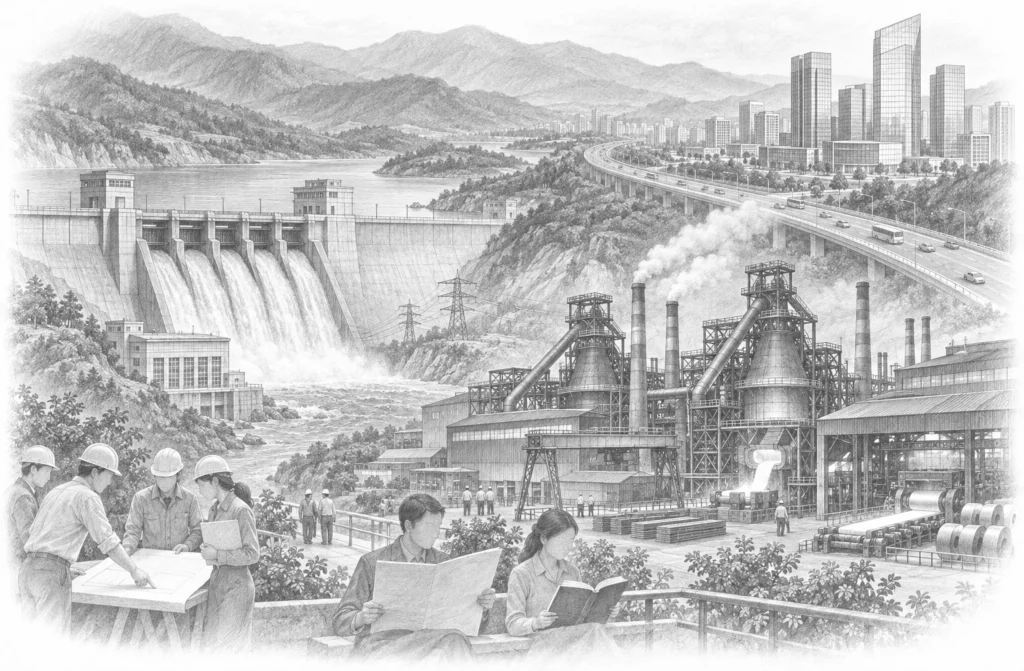
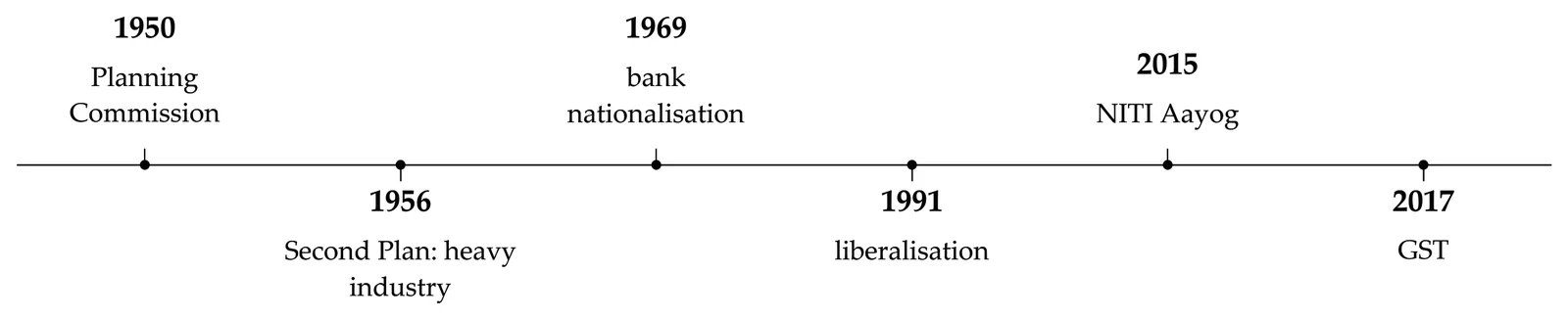
WHEN India became independent in 1947, it was one of the poorest countries in the world. Its leaders believed that the state must lead development through planning: the Planning Commission, set up in 1950, drew up Five-Year Plans that built dams, steel plants and a large public sector. By the late 1980s, slow growth and a balance-of-payments crisis led to the liberalisation of 1991, which opened the economy to markets and foreign investment. In 2015, the Planning Commission was replaced by NITI Aayog, and in 2017 the Goods and Services Tax transformed indirect taxation. This chapter studies state and planning, liberalisation and reforms, and recent trends in monetary, fiscal and taxation policy, drawing on Partha Chatterjee, Terence Byres, Ashutosh Varshney, Pranab Bardhan, Santosh Mehrotra and Pronab Sen.
1.1 State and Planning
The idea of planning predates Independence. The Congress set up a National Planning Committee under Nehru in 1938, and in 1944 leading industrialists, including J.R.D. Tata and G.D. Birla, proposed the Bombay Plan, which accepted a large role for the state in building basic industries. After 1947, the Directive Principles of the Constitution asked the state to secure a just social order and to prevent the concentration of wealth. The Planning Commission turned these goals into Five-Year Plans.
The First Plan (1951–56) focused on agriculture and irrigation. The Second Plan (1956–61), based on P.C. Mahalanobis’s model, gave priority to heavy industry in the public sector, protected by import controls and industrial licensing. Terence Byres calls this the interventionist state, which directed investment and controlled trade, prices and foreign exchange. Partha Chatterjee argues that development planning gave the post-colonial state a new basis of legitimacy, presenting the state as a rational, expert agent standing above particular interests.
From the mid-1960s planning faced crisis: wars in 1962 and 1965, severe droughts and a devaluation in 1966 led to a plan holiday (1966–69). Growth remained slow, around 3.5 per cent a year, which the economist Raj Krishna called the ‘Hindu rate of growth’. Pranab Bardhan explained the slowdown by the pressure of three dominant proprietary classes, industrial capitalists, rich farmers and professionals, whose demands for subsidies diverted resources from public investment. A. Mozoomdar traces the gradual decline of planning as the Commission lost authority.
1.2 Liberalisation and Reforms
Some liberalisation began in the 1980s, but the decisive break came with the crisis of 1991. A large fiscal deficit, rising oil prices during the Gulf War and falling remittances left India with foreign exchange reserves sufficient for only about two weeks of imports. The government of P.V. Narasimha Rao, with Manmohan Singh as Finance Minister, launched the New Economic Policy of liberalisation, privatisation and globalisation: industrial licensing was largely abolished, the rupee was devalued, tariffs were cut and foreign investment was welcomed.

Ashutosh Varshney asks how a democracy with a poor electorate could carry out such reforms. He argues that reforms advanced mainly in elite politics, the world of trade, finance and industrial policy, while mass politics was dominated by issues of caste and religion. Reforms that touched mass politics, such as labour laws or farm subsidies, moved slowly. Rob Jenkins called this reform by stealth. Critics such as Prabhat Patnaik and C.P. Chandrasekhar argue that neo-liberal reforms reduced public investment and increased inequality, and propose a radical alternative.
1.3 Monetary, Fiscal and Taxation Policy
Since the reforms, macroeconomic policy has changed significantly. In monetary policy, the Reserve Bank of India adopted inflation targeting: since 2016 a six-member Monetary Policy Committee sets the policy interest rate to keep consumer price inflation at 4 per cent, within a band of 2 to 6 per cent. In fiscal policy, the Fiscal Responsibility and Budget Management (FRBM) Act, 2003, set targets to reduce the fiscal deficit. In November 2016, the government demonetised Rs 500 and Rs 1000 notes.
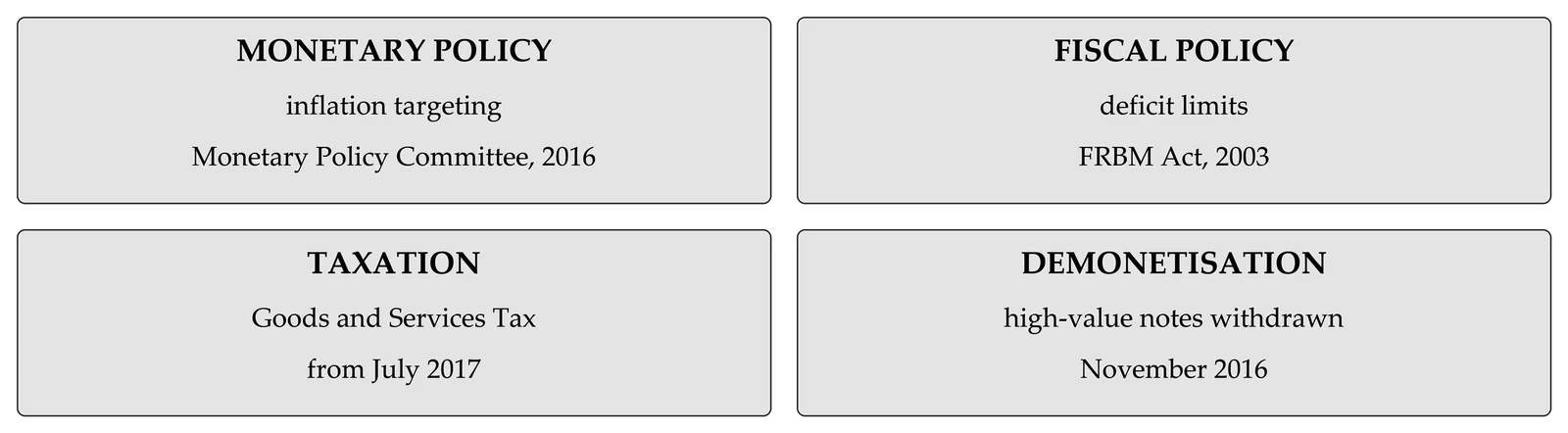
The biggest tax reform was the Goods and Services Tax (GST), introduced on 1 July 2017 under the 101st Constitutional Amendment. It replaced a range of central and state indirect taxes with a single, destination-based tax, administered jointly by the Union and the states through the GST Council. Arun Kumar criticised demonetisation for hurting the cash-dependent unorganised sector, and Surajit Das raised concerns about the GST’s effects on the fiscal autonomy of the states.
1.4 From the Planning Commission to NITI Aayog
In 2015, the Planning Commission was replaced by NITI Aayog (National Institution for Transforming India), a policy think tank chaired by the Prime Minister, with a Governing Council of all Chief Ministers. Unlike the Commission, it does not allocate funds to states. The last Five-Year Plan ended in 2017. Sylvie Guichard and Santosh Mehrotra argue that India still needs a central planning institution, while Pronab Sen advises: plan, but do not over-plan.
1.5 Important Questions
- Question 1 Discuss the role of the state in development planning in India since Independence.
- Question 2 Discuss the economic reforms of 1991 and the politics behind them.
- Question 3 Discuss recent trends in India’s monetary, fiscal and taxation policy.
- Question 4 Why was the Planning Commission replaced by NITI Aayog? Does India still need a central planning institution?
DU asks the same idea in different words. So learn one broad answer for each question below; the same answer works for every question joined by OR.
Important Question 1
Discuss the role of the state in development planning in India since Independence.
OR
Examine the rise and decline of development planning in India.
OR
‘Development planning gave the Indian state a new basis of legitimacy.’ Discuss with reference to Partha Chatterjee.
Model Answer
“The State shall strive to promote the welfare of the people by securing and protecting as effectively as it may a social order in which justice, social, economic and political, shall inform all the institutions of the national life.”
— Constitution of India, Article 38(1)
Introduction. Development planning is the deliberate allocation of national resources by the state to achieve targets of growth, investment and welfare within a fixed period. After Independence, India made planning the central instrument of development. Through the Planning Commission and its Five-Year Plans, the state sought to industrialise the economy, reduce poverty and build national self-reliance. Its role, however, changed sharply after the reforms of 1991.
1. Roots before Independence
The nationalist movement saw colonial rule as the cause of India’s poverty and believed that a free India must plan its development. The Congress set up the National Planning Committee under Nehru in 1938. In 1944, industrialists produced the Bombay Plan, while M.N. Roy proposed a People’s Plan and S.N. Agarwal a Gandhian Plan. All of them accepted a leading role for the state.
2. Constitutional Mandate
The Directive Principles of State Policy asked the state to promote a just social order, to distribute the material resources of the community to serve the common good and to prevent the concentration of wealth. Planning was seen as the means to translate these goals into concrete programmes of investment and welfare.
3. The Planning Commission
The Planning Commission was created by a Cabinet resolution in March 1950, with the Prime Minister as its chairman. It was an advisory body without a constitutional or statutory basis, yet it became very powerful because it allocated plan funds to ministries and states. The National Development Council, formed in 1952, brought the Chief Ministers into the planning process.
4. The Mahalanobis Strategy
The Second Plan (1956–61), based on the model of the statistician P.C. Mahalanobis, made rapid industrialisation the priority. It invested heavily in steel, machinery and power in the public sector, aiming to build capital goods industries that would make India self-reliant. The Industrial Policy Resolution of 1956 reserved key industries for the state and adopted the goal of a socialist pattern of society.
5. The Interventionist State
Terence Byres describes the Indian state of this period as an interventionist state. It owned the commanding heights of the economy, controlled private investment through industrial licensing, protected domestic industry through import controls and regulated prices, credit and foreign exchange. The state was not only a regulator but the main entrepreneur of development.
6. Chatterjee: Planning and Legitimacy
Partha Chatterjee argues that development became a central source of legitimacy for the post-colonial state. Planning was presented as a rational, scientific exercise carried out by experts on behalf of the whole nation, standing above the conflicts of ordinary politics. In practice, however, the planning state had to negotiate with powerful interests, and political bargaining shaped what was actually achieved.
7. Bardhan’s Dominant Classes
Pranab Bardhan argued that the Indian state was relatively autonomous but constrained by a coalition of three dominant proprietary classes: industrial capitalists, rich farmers and professionals, including the bureaucracy. Each extracted subsidies and concessions. Their competing demands diverted public resources from investment to subsidies, which helps explain the slowdown of growth from the mid-1960s.
8. Crisis of the Mid-1960s
The Third Plan (1961–66) failed to meet its targets because of wars with China in 1962 and Pakistan in 1965 and severe droughts in 1965 and 1966. Food imports and foreign aid increased, and the rupee was devalued in 1966. Planning was suspended for three years, from 1966 to 1969, a period known as the plan holiday.
9. Populism and Planning
Under Indira Gandhi, planning became more closely tied to populist politics. Banks were nationalised in 1969, the Monopolies and Restrictive Trade Practices Act was passed, and the slogan of Garibi Hatao in 1971 led to anti-poverty programmes. Controls increased, but growth remained slow, and the expert authority of the Planning Commission weakened.
10. Mozoomdar: Rise and Decline
A. Mozoomdar traces the rise and decline of development planning in India. In the Nehru era, the Planning Commission was a powerful body that set national priorities. From the mid-1960s, it lost authority: plans became bargaining exercises between ministries and states, targets were missed, and the gap between plan documents and implementation grew wider.
11. Achievements
Planning built an industrial base, a large public sector, dams, power plants and steel mills, and institutions such as the IITs and national laboratories. Together with the Green Revolution, it made India self-sufficient in food grains and ended the threat of famine. It also laid the foundations for later growth in sectors such as pharmaceuticals and software.
12. Failures
Growth averaged only about 3.5 per cent a year until the late 1970s, a pace the economist Raj Krishna called the ‘Hindu rate of growth’. Poverty remained widespread, the licence-permit raj encouraged inefficiency and corruption, public enterprises made losses, and primary education and health were neglected compared with heavy industry.
13. From Intervention to Liberalisation
Byres contrasts the interventionist state with the neo-liberal state that emerged after 1991. Liberalisation reduced the state’s direct control over investment, trade and prices. Plans became indicative, setting broad directions rather than detailed targets, and markets and private investment took over many roles once played by the state.
14. Evaluation
Planning gave the Indian state a central role in building a modern economy and helped legitimise it as an agent of national development. Its record was mixed: it built foundations for industry but delivered slow growth and limited poverty reduction. Even after liberalisation, the state remains crucial for infrastructure, welfare and regulation.
Conclusion. Thus, the Indian state, through the Planning Commission and Five-Year Plans, directed development from 1950, building heavy industry and public institutions. As Chatterjee shows, planning gave the state legitimacy, but class pressures, crises and inefficiency led to its decline, and after 1991 the interventionist state gave way to a market-friendly one.
Important Question 2
Discuss the economic reforms of 1991 and the politics behind them.
OR
Examine Ashutosh Varshney’s distinction between elite politics and mass politics in explaining India’s economic reforms.
OR
Critically evaluate the impact of liberalisation on India’s development process.
Model Answer
“No power on earth can stop an idea whose time has come.”
— Manmohan Singh, quoting Victor Hugo, Budget Speech, 24 July 1991
Introduction. In July 1991, India launched a programme of economic reforms that ended four decades of the interventionist, planned economy. Known as liberalisation, privatisation and globalisation, the reforms dismantled licensing, opened the economy to trade and foreign investment and gave markets a larger role. The question of how a poor democracy managed such reforms has been explained by scholars such as Varshney, Jenkins and Bardhan.
1. Early Liberalisation in the 1980s
Some liberalisation began in the 1980s. Indira Gandhi in her last term and Rajiv Gandhi after 1985 eased industrial licensing, reduced some import controls and encouraged private business. Scholars such as Atul Kohli describe this as a pro-business tilt. Growth rose to about 5.5 per cent a year, but it was financed by rising fiscal deficits and foreign borrowing.
2. The Crisis of 1991
By 1991, India faced a severe balance-of-payments crisis. The Gulf War raised oil prices and reduced remittances from Indian workers in West Asia, the fiscal deficit was high, and political instability shook investor confidence. Foreign exchange reserves fell to about two weeks of imports, and India pledged its gold reserves abroad to borrow money and sought help from the International Monetary Fund.
3. The New Economic Policy
The minority government of P.V. Narasimha Rao, with Manmohan Singh as Finance Minister, responded with a programme of stabilisation and structural reform. The budget of 24 July 1991 and the new industrial policy announced on the same day marked a decisive break from the past, combining fiscal correction with deregulation.
4. Industrial Deregulation
The New Industrial Policy abolished industrial licensing for all but a short list of industries, reduced the number of sectors reserved for the public sector, removed restrictions on the expansion of large firms under the MRTP Act and allowed automatic approval of foreign investment up to 51 per cent in many industries.
5. Trade and Exchange Reforms
The rupee was devalued in July 1991, import licensing was gradually removed and customs duties were cut sharply over the decade. The rupee became convertible on the current account in 1994. These measures integrated India into the world economy and encouraged export-oriented growth, especially in services and software.
6. Financial Sector Reforms
The Narasimham Committee of 1991 recommended reforms of the banking sector, and new private banks were permitted. The Securities and Exchange Board of India received statutory powers in 1992 to regulate the stock market, and foreign institutional investors were allowed to invest in Indian shares. Interest rates were gradually freed from state control.
7. Varshney: Elite and Mass Politics
Ashutosh Varshney argues that reforms succeeded in the 1990s because they were confined largely to elite politics, the arena of trade policy, exchange rates and industrial licensing, which most voters did not follow. Mass politics, which decided elections, was dominated by issues of caste, religion and identity, such as Mandal and the Ayodhya dispute. Reforms therefore did not face mass opposition.
8. Limits of Reform
Varshney adds that reforms which directly touched mass politics, such as privatisation of large public enterprises, reform of labour laws and cuts in agricultural, food and power subsidies, moved slowly. Politicians feared losing votes among workers and farmers. The pattern of reform was therefore uneven, fast in some areas and slow in others.
9. Reform by Stealth
Rob Jenkins argued that democratic politics helped rather than blocked reform. Political leaders used tactics such as reform by stealth, presenting changes as continuity, compensating losers and allowing states to compete for investment. Federalism helped, since states adopted reforms at different speeds and the Centre could share the political costs with them.
10. Bardhan’s Epilogue
Pranab Bardhan argues that the same dominant coalitions that shaped planning also shaped reform. Industrialists gained from deregulation, but the persistence of populist subsidies, weak governance and poor infrastructure limited the gains. He stresses that sustained growth requires investment in education, health and institutions, not only market reforms.
11. The Radical Critique
Prabhat Patnaik and C.P. Chandrasekhar criticise the shift from dirigisme to structural adjustment. They argue that neo-liberal reforms, influenced by the IMF and World Bank, cut public investment, weakened agriculture and the small-scale sector, produced jobless growth and increased inequality. They propose a radical alternative based on public investment, land reform and redistribution.
12. Growth and Poverty
After 1991, growth accelerated, averaging around 6 per cent in the 1990s and nearly 9 per cent in the boom years of 2003–08. Services and information technology expanded rapidly, foreign exchange reserves rose and poverty declined: by the official Tendulkar measure, the poverty ratio fell from 37.2 per cent in 2004–05 to 21.9 per cent in 2011–12.
13. Inequality and Jobs
Critics point out that growth was unequal. Income and wealth inequality rose, employment in the organised sector grew slowly, informal and contract work spread, regional disparities widened and agriculture faced a serious crisis from the late 1990s. The benefits of reform went disproportionately to urban, educated and propertied groups.
14. Evaluation
The reforms of 1991 transformed the Indian economy, ending the licence raj and producing faster growth and lower poverty. Their politics shows how a democracy can manage change through elite consensus, stealth and federal bargaining. But rising inequality, informal work and agrarian distress show that reforms alone cannot secure inclusive development.
Conclusion. Thus, the reforms of 1991, prompted by a balance-of-payments crisis, liberalised industry, trade and finance. As Varshney shows, they advanced through elite politics while mass politics focused on identity. They accelerated growth and reduced poverty, but critics such as Patnaik and Chandrasekhar highlight their costs for equality and employment.
Important Question 3
Discuss recent trends in India’s monetary, fiscal and taxation policy.
OR
Critically examine the Goods and Services Tax and its implications for Indian federalism.
OR
Examine the economic consequences of demonetisation.
Model Answer
“The President shall, within sixty days from the date of commencement of the Constitution (One Hundred and First Amendment) Act, 2016, by order, constitute a Council to be called the Goods and Services Tax Council.”
— Constitution of India, Article 279A(1)
Introduction. Monetary policy, run by the Reserve Bank of India, manages money supply and interest rates; fiscal policy, run by the government, deals with public spending, taxation and borrowing. Since the reforms, both have changed significantly. Recent trends include inflation targeting, rules to limit deficits, demonetisation in 2016 and the Goods and Services Tax in 2017, which reshaped the relationship between the Union and the states.
1. Inflation Targeting
Following the recommendations of the Urjit Patel Committee, the government and the RBI signed a Monetary Policy Framework Agreement in 2015. The RBI Act was amended in 2016 to make flexible inflation targeting the central goal of monetary policy, with a target of 4 per cent consumer price inflation within a band of 2 to 6 per cent.
2. The Monetary Policy Committee
A six-member Monetary Policy Committee, with three members from the RBI and three external experts appointed by the government, decides the policy repo rate. During the COVID-19 pandemic, it cut rates to support the economy; it raised them in 2022–23 to control inflation and lowered them again as inflation eased.
3. The FRBM Act
The Fiscal Responsibility and Budget Management Act, 2003, required the Union government to reduce its fiscal deficit to 3 per cent of GDP and eliminate the revenue deficit. The targets were repeatedly postponed during crises. In 2017, the N.K. Singh Committee recommended using public debt as the main anchor, with a ceiling of 60 per cent of GDP for the Union and states together.
4. Fiscal Trends
The pandemic raised the Union government’s fiscal deficit to about 9.2 per cent of GDP in 2020–21. Since then, the government has followed a path of fiscal consolidation while increasing capital expenditure on infrastructure, which rose to about Rs 11.11 lakh crore in the 2024–25 budget, as a way of supporting growth.
5. Direct Tax Reforms
Following the Raja Chelliah Committee of the early 1990s, income and corporate tax rates were reduced and the tax base widened. In September 2019, the corporate tax rate was cut to 22 per cent for companies giving up exemptions and to 15 per cent for new manufacturing firms, to attract investment.
6. Demonetisation
On 8 November 2016, the government withdrew the legal tender status of Rs 500 and Rs 1000 notes, which formed about 86 per cent of the currency in circulation by value. The stated aims were to curb black money, counterfeit currency and terror financing and to promote digital payments. The RBI later reported that almost all the demonetised notes had returned to the banks.
7. Arun Kumar’s Critique
Arun Kumar argues that the black economy is generated through activities such as under-reporting of income, and only a small part is held as cash, so demonetisation could not eliminate it. The sudden cash shortage, however, severely hurt the unorganised sector, which depends on cash, causing losses in output, employment and incomes, especially for workers and small traders.
8. The Goods and Services Tax
Introduced on 1 July 2017 under the 101st Constitutional Amendment, the GST replaced many central and state indirect taxes, such as excise duty, service tax and VAT, with a single destination-based tax. It has central, state and integrated components. Alcohol for human consumption is outside GST, and petroleum products remain outside until the GST Council decides otherwise.
9. The GST Council
Under Article 279A, the GST Council, chaired by the Union Finance Minister and including state finance ministers, recommends tax rates and rules. The Union has one-third of the votes and the states together two-thirds, and decisions need a three-fourths majority. Supporters see it as a model of cooperative federalism.
10. Compensation and Revenue
Because states gave up their power to levy many taxes, the Union promised to compensate them for five years for any shortfall below an assumed 14 per cent annual growth in revenue. Compensation ended in June 2022. GST collections have grown with better compliance, but states worry about their dependence on the Union.
11. Surajit Das’s Concerns
Surajit Das raised concerns about the GST: states lose fiscal autonomy because they can no longer set their own indirect tax rates; indirect taxes are regressive, falling more heavily on the poor; multiple rates and complex compliance burden small businesses; and the promised gains in growth and revenue are uncertain.
12. GST Rationalisation
Initially, GST had several rate slabs, 5, 12, 18 and 28 per cent, plus a compensation cess. In September 2025, the GST Council simplified the structure into two main rates of 5 and 18 per cent, with a higher rate of 40 per cent for certain luxury and harmful goods, to reduce complexity and support consumption.
13. Fiscal Federalism
The Finance Commission divides central taxes between the Union and states; the Fourteenth Commission raised the states’ share to 42 per cent and the Fifteenth set it at 41 per cent. However, the growing use of cesses and surcharges, which are not shared with states, has led to complaints that the Union is centralising fiscal resources.
14. Evaluation
Recent trends show a shift towards rule-based monetary and fiscal policy, a broader tax base and digital delivery of welfare. GST has unified the national market, but demonetisation imposed heavy costs, and concerns about state autonomy and the regressive burden of indirect taxes remain.
Conclusion. Thus, India’s monetary policy now targets inflation through the Monetary Policy Committee, fiscal policy follows the FRBM framework and taxation has been transformed by the GST. Demonetisation and the GST were bold reforms, but critics such as Arun Kumar and Surajit Das highlight their costs for the unorganised sector and for the fiscal autonomy of the states.
Important Question 4
Why was the Planning Commission replaced by NITI Aayog? Does India still need a central planning institution?
OR
Examine the debate on planning in twenty-first century India with reference to Santosh Mehrotra and Pronab Sen.
OR
Compare the Planning Commission and NITI Aayog.
Model Answer
“The State shall, in particular, strive to minimise the inequalities in income, and endeavour to eliminate inequalities in status, facilities and opportunities, not only amongst individuals but also amongst groups of people residing in different areas or engaged in different vocations.”
— Constitution of India, Article 38(2)
Introduction. For sixty-five years the Planning Commission was the centre of India’s development policy. In 2015, it was replaced by NITI Aayog, a think tank without power to allocate funds, and the Five-Year Plans ended in 2017. This raises an important debate: in a liberalised, market economy, does India still need planning and a central planning institution? Scholars such as Guichard, Mehrotra and Pronab Sen address this question.
1. Criticisms of the Planning Commission
Critics called the Planning Commission a super-cabinet that weakened the role of ministries and states. It imposed uniform, centrally designed schemes across a diverse country, used plan grants to control states’ spending, and continued detailed planning even after liberalisation had reduced the state’s direct role in investment.
2. The Case for Change
In 2014, the Independent Evaluation Office recommended that the Commission be replaced by a new body suited to a market economy. The same year, Prime Minister Narendra Modi announced in his Independence Day speech that the Commission would be replaced. NITI Aayog was established by a Cabinet resolution on 1 January 2015.
3. Structure of NITI Aayog
NITI Aayog is chaired by the Prime Minister. Its Governing Council includes all Chief Ministers and the Lieutenant Governors of Union Territories. It has a Vice-Chairperson, full-time members, Union ministers as ex officio members and a Chief Executive Officer. Regional councils can be formed to address issues affecting several states.
4. Functions
NITI Aayog works as a policy think tank. It promotes cooperative federalism through structured engagement with states and competitive federalism by ranking states on indices for health, education, water and the Sustainable Development Goals. It runs the Aspirational Districts Programme, launched in 2018, and the Atal Innovation Mission.
5. No Financial Powers
Unlike the Planning Commission, NITI Aayog does not allocate funds. Allocation of plan grants moved to the Finance Ministry, and the distinction between plan and non-plan expenditure was abolished from 2017–18. The Finance Commission became the main channel of transfers to states.
6. Planning in the Twenty-First Century
Sylvie Guichard and Santosh Mehrotra argue that planning is still necessary in a market economy. Markets cannot by themselves coordinate long-term investment in infrastructure, address climate change, create jobs on the required scale or ensure human development. Successful developing countries, they note, combined markets with strategic state planning.
7. Mehrotra’s Case
Santosh Mehrotra argues that India needs a central planning institution with real authority. It should coordinate across ministries and between the Union and states, plan public investment over the medium term and guide structural transformation from agriculture to manufacturing. He believes NITI Aayog lacks the resources and authority to do this.
8. Pronab Sen: Plan, but Do Not Over-plan
Pronab Sen, a former Chief Statistician, argues that planning should be selective. The state should plan in areas where markets fail, such as infrastructure, long-gestation projects, public goods and coordination problems, but should avoid detailed micro-targets and centrally designed schemes. He advises NITI Aayog to build capacity for strategic thinking and monitoring.
9. Federal Dimension
NITI Aayog was meant to give states a greater voice through the Governing Council. Supporters say it treats states as partners. Critics reply that Governing Council meetings are infrequent, that states have little influence over the Union’s priorities, and that the end of plan grants reduced their flexibility in some respects.
10. Criticisms of NITI Aayog
Critics argue that NITI Aayog has become a think tank that promotes the government’s own policies rather than an independent planning body. Without financial power, it cannot ensure coordination, and its rankings of states have been questioned for their methods. Some economists see it as weaker than the institution it replaced.
11. Defence of NITI Aayog
Supporters argue that NITI Aayog is more flexible and better suited to a market economy. Its indices encourage states to compete in improving outcomes, its Aspirational Districts Programme has focused attention on the most backward districts, and it promotes innovation and partnerships with the private sector and civil society.
12. Planning and Democracy
The syllabus asks how planning relates to democracy. Centralised planning often ignored people’s voices. Experiments such as Kerala’s People’s Plan Campaign of 1996, which gave panchayats a large share of plan funds, and Gram Panchayat Development Plans show how planning can include people’s participation from below.
13. The Way Forward
A balanced approach would combine NITI Aayog’s role as a think tank with stronger capacity for coordination, medium-term planning of public investment and evaluation. Planning for employment, climate change and regional balance requires institutions that work with states and local bodies rather than imposing plans from above.
14. Evaluation
The replacement of the Planning Commission reflected the shift to a market economy and the demand for cooperative federalism. But the debate is not settled: as Mehrotra and Sen argue, India still needs some form of strategic planning to address problems that markets cannot solve.
Conclusion. Thus, the Planning Commission was replaced by NITI Aayog in 2015 because it was seen as centralising and unsuited to a market economy. NITI Aayog works as a think tank promoting cooperative and competitive federalism. Yet scholars such as Mehrotra and Sen argue that India still needs strategic, selective planning to coordinate investment and guide development.
Short Notes
(a) Mahalanobis model
The development strategy of the Second Plan (1956–61), designed by the statistician P.C. Mahalanobis. It gave priority to investment in heavy industries producing capital goods, such as steel and machinery, mainly in the public sector, to achieve long-term growth and self-reliance.
(b) Hindu rate of growth
A phrase used by the economist Raj Krishna for India’s slow economic growth of around 3.5 per cent a year from the 1950s to the late 1970s. It referred to the economy’s performance under planning and controls, not to any religious cause.
(c) Bombay Plan
A plan for India’s economic development prepared in 1944 by leading industrialists, including J.R.D. Tata and G.D. Birla. It proposed a large role for the state in building basic industries and infrastructure, showing that Indian business also supported planning.
(d) FRBM Act
The Fiscal Responsibility and Budget Management Act, 2003, which set targets for reducing the fiscal deficit of the Union government to 3 per cent of GDP and eliminating the revenue deficit, to bring discipline into public finances.
(e) GST Council
A constitutional body under Article 279A, chaired by the Union Finance Minister and including state finance ministers. It recommends GST rates and rules. Decisions need a three-fourths majority, with the Union holding one-third of the votes and the states two-thirds.
More notes: DSC-20 Development Process and Social Movements in Contemporary India
These notes are prepared by PADHO TO AISE for study help. They are not an official University of Delhi publication.