
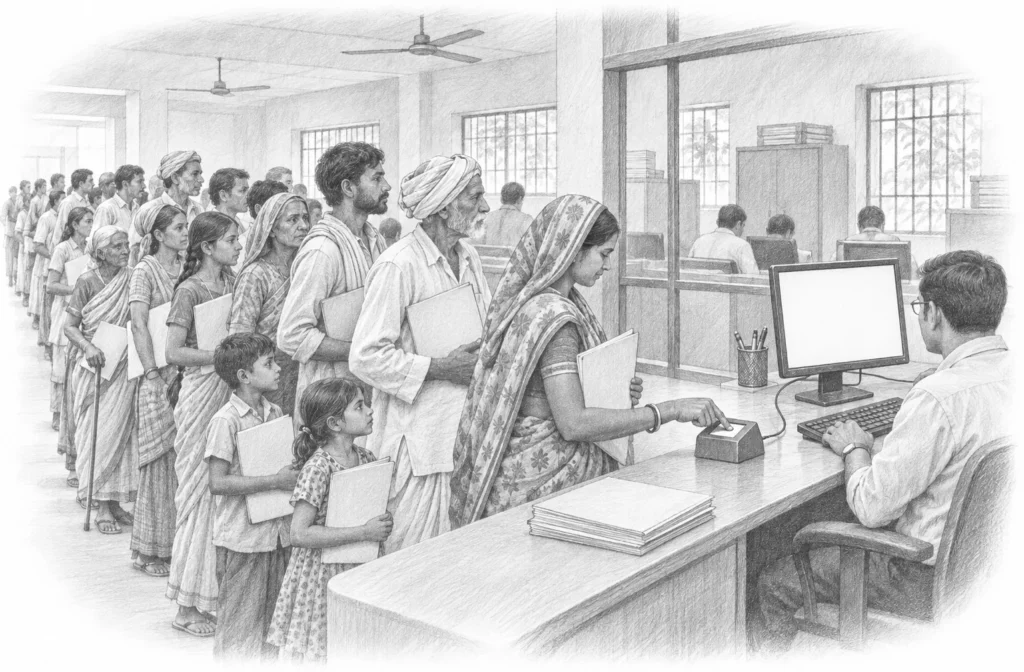
Semester VII DSE-5 Contemporary Debates in Indian Politics
Unit I · 22 min read · Updated 24 Nov 2026
As per the University of Delhi (DU) BA (Hons) Political Science syllabus
Contents
- 1.1 Citizenship in India
- 1.2 The National Register of Citizens and the CAA
- 1.3 Welfare and the Unique Identification Scheme
- 1.4 Important Questions
- What is citizenship? Discuss the changing nature of citizenship in India.
- Discuss the debate over the National Register of Citizens and the Citizenship (Amendment) Act, 2019.
- Examine the relationship between the Unique Identification (Aadhaar) scheme and the delivery of welfare in India.
- Discuss the debate on Aadhaar, privacy and surveillance in India.
- Short Notes
नागरिकता वह दर्जा है जो किसी समुदाय के पूर्ण सदस्यों को दिया जाता है।
Citizenship is a status bestowed on those who are full members of a community.
— T.H. Marshall, Citizenship and Social Class (1950)
WHO is a citizen of India, and how does the state know? These questions, once settled by the Constitution, have returned to the centre of Indian politics. Changes to the citizenship law since 1987, the National Register of Citizens (NRC) in Assam and the Citizenship (Amendment) Act, 2019, have made citizenship a matter of documents and descent. At the same time, the Unique Identification (UID) scheme, Aadhaar, has linked access to welfare with biometric identity. This chapter studies these debates about the relationship between the state and its citizens, drawing on Anupama Roy, André Béteille, Gurpreet Mahajan, Reetika Khera, Sahana Sarkar and Vrinda Bhandari.
1.1 Citizenship in India
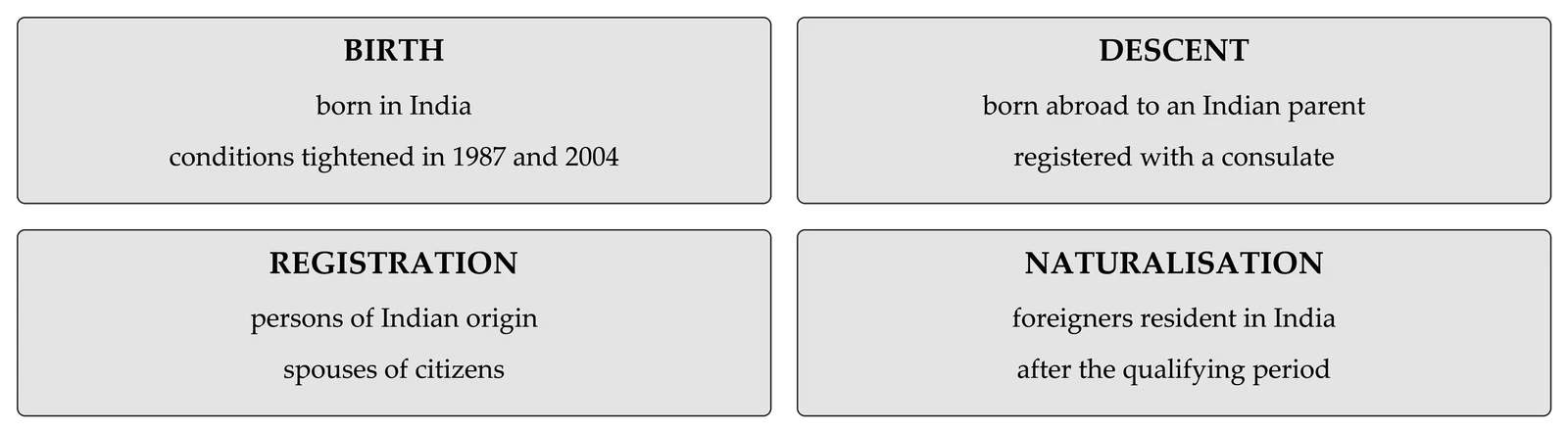
Citizenship means full membership of a political community, with equal rights and duties. India adopted a single citizenship for the whole country. At first, anyone born in India was a citizen by birth, the principle of jus soli. Amendments to the Citizenship Act changed this: from 1 July 1987, one parent had to be an Indian citizen, and from 3 December 2004, both parents had to be citizens, or one a citizen and the other not an illegal migrant. Anupama Roy describes this as a shift from birth to descent, jus sanguinis, driven by anxieties about migration.
Scholars also ask what makes citizenship real in practice. André Béteille argues that citizenship depends on open and secular institutions of civil society, in which people meet as individuals rather than as members of castes or communities. Gurpreet Mahajan examines how democratic citizenship must balance equal individual rights with the recognition of cultural and religious communities in the private sphere.
1.2 The National Register of Citizens and the CAA
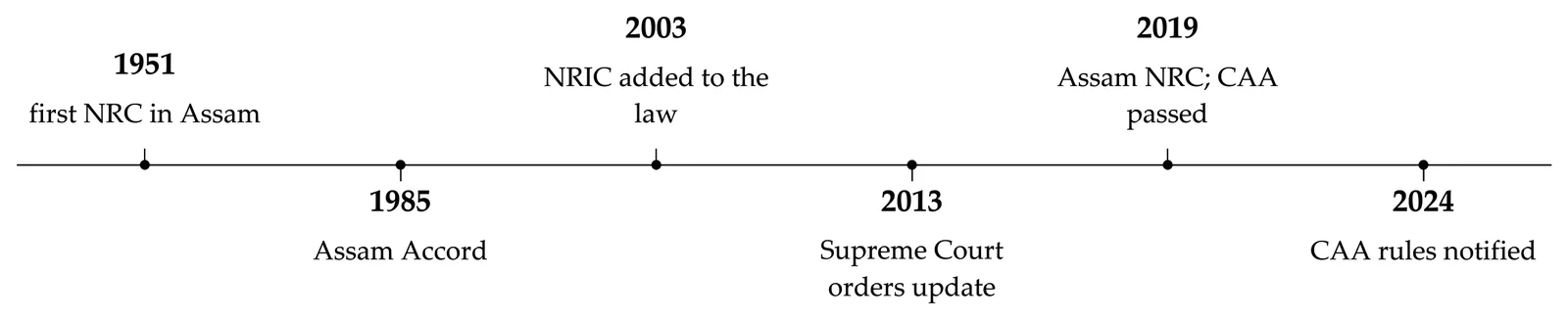
In Assam, fears of migration from Bangladesh produced the Assam Movement (1979–85), which ended with the Assam Accord of 1985, fixing 24 March 1971 as the cut-off date for detecting foreigners. Under the supervision of the Supreme Court, the NRC of 1951 was updated, and the final list, published in August 2019, left out about 19 lakh people. In December 2019, Parliament passed the Citizenship (Amendment) Act, offering a fast track to citizenship for Hindu, Sikh, Buddhist, Jain, Parsi and Christian migrants from Afghanistan, Bangladesh and Pakistan who entered India before 2015. Critics argued that it made religion a criterion of citizenship, and it provoked nationwide protests.
1.3 Welfare and the Unique Identification Scheme
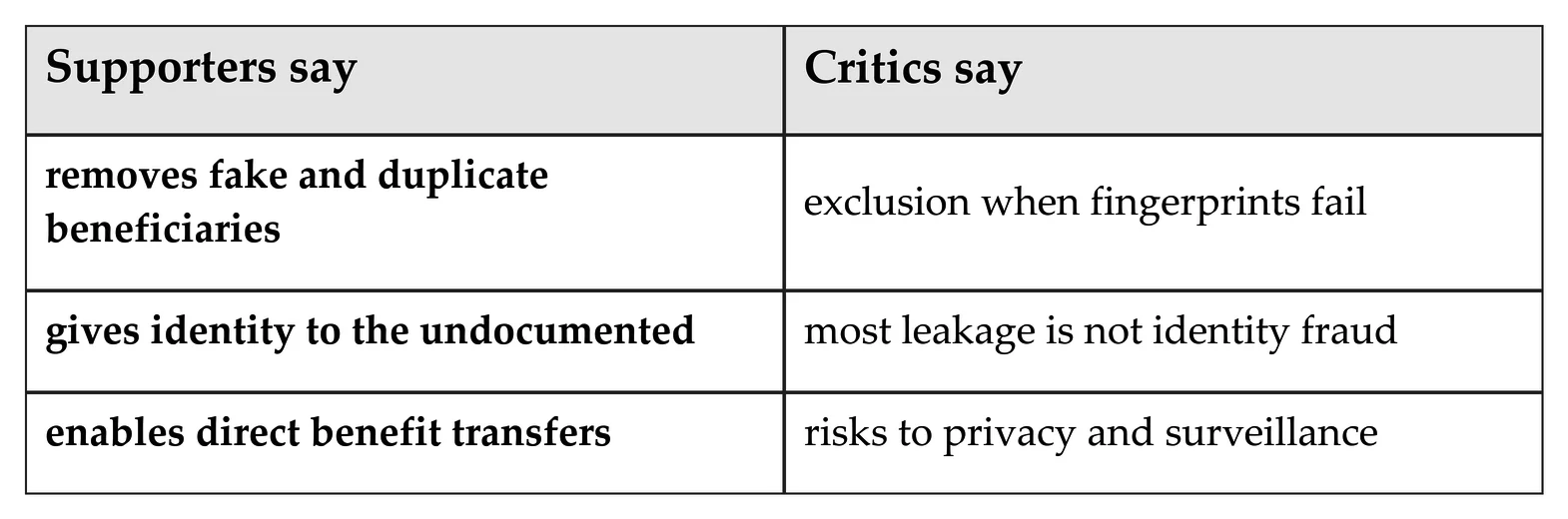
The Unique Identification Authority of India was created in 2009 to give every resident a 12-digit number, Aadhaar, linked to fingerprints, iris scans and a photograph. The Aadhaar Act, 2016, made it the basis for delivering subsidies and benefits, and direct benefit transfers sent money straight into bank accounts. Supporters argue that it removed fake and duplicate beneficiaries. Reetika Khera argues that it does not address the main sources of leakage and excludes genuine beneficiaries when authentication fails. In 2017, the Supreme Court declared privacy a fundamental right, and in 2018 it upheld Aadhaar for welfare while limiting its other uses.

1.4 Important Questions
- Question 1 What is citizenship? Discuss the changing nature of citizenship in India.
- Question 2 Discuss the debate over the National Register of Citizens and the Citizenship (Amendment) Act, 2019.
- Question 3 Examine the relationship between the Unique Identification (Aadhaar) scheme and the delivery of welfare in India.
- Question 4 Discuss the debate on Aadhaar, privacy and surveillance in India.
DU asks the same idea in different words. So learn one broad answer for each question below; the same answer works for every question joined by OR.
Important Question 1
What is citizenship? Discuss the changing nature of citizenship in India.
OR
Examine Anupama Roy’s argument about the shift from birth to descent in Indian citizenship law.
OR
Discuss the relationship between citizenship, the state and civil society in India.
Model Answer
“Nothing in the foregoing provisions of this Part shall derogate from the power of Parliament to make any provision with respect to the acquisition and termination of citizenship and all other matters relating to citizenship.”
— Constitution of India, Article 11
Introduction. Citizenship is full and equal membership of a political community. It is a legal status that brings rights and duties, an identity that tells people where they belong, and a practice through which they participate in public life. In India, citizenship was defined broadly at Independence, but changes in law and politics since the 1980s have made it narrower and more dependent on descent and documents.
1. Meaning of Citizenship
Citizenship has three dimensions. As a legal status, it defines who belongs to the state and who is a foreigner. As a bundle of rights and duties, it gives citizens protection and claims on the state. As an identity and practice, it expresses belonging and is exercised through voting, protest and participation in public life.
2. Marshall’s Three Elements
T.H. Marshall, in Citizenship and Social Class (1950), traced the growth of citizenship in Britain through civil rights in the eighteenth century, political rights in the nineteenth and social rights, such as education and welfare, in the twentieth. Full citizenship, he argued, requires all three, so that class inequality does not undermine equal membership.
3. Constitutional Provisions
Articles 5 to 11 of the Constitution defined who was a citizen at its commencement, including those who migrated from Pakistan. Article 9 rules out dual citizenship, and Article 11 gives Parliament the power to make laws on citizenship. India chose a single citizenship for the whole country despite its federal structure.
4. The Citizenship Act, 1955
The Citizenship Act provides for acquiring citizenship by birth, descent, registration and naturalisation, and through the incorporation of territory. It also provides for losing citizenship by renunciation, by termination when a person voluntarily takes another country’s citizenship, and by deprivation in cases such as fraud.
5. From Birth to Descent
Originally, anyone born in India was a citizen. From 1 July 1987, a child born in India became a citizen only if at least one parent was a citizen. From 3 December 2004, both parents had to be citizens, or one a citizen and the other not an illegal migrant. These changes responded to concerns about migration from Bangladesh.
6. Roy: Mapping Citizenship
Anupama Roy, in Mapping Citizenship in India (2010), argues that these amendments mark a shift from jus soli, citizenship by birth on the soil, to jus sanguinis, citizenship by blood or descent. Citizenship becomes graduated: some are full citizens, while others, such as doubtful voters in Assam, become suspect citizens who must prove their belonging.
7. Overseas Citizenship
Amendments in 2003 and 2005 created the Overseas Citizenship of India for persons of Indian origin abroad, giving them a lifelong visa but not voting rights. Roy asks whether it is a new Setubandhan, a bridge to a wealthy diaspora, which favours descent and economic value over residence and shows citizenship being redefined by the state’s priorities.
8. Béteille: Citizenship and Civil Society
André Béteille argues that citizenship is sustained not only by the state but by open and secular institutions of civil society, such as universities, hospitals, professional bodies and the press, in which people meet as individuals rather than as members of castes or communities. Where such institutions are weak, citizenship is undermined by the pressure of community identities.
9. Mahajan: The Public and the Private
Gurpreet Mahajan examines the boundary between the public and the private in democratic citizenship. Liberal citizenship assumes that religion and culture belong to the private sphere. In India, community identities and personal laws shape public life, so democratic citizenship must balance equal individual rights with the recognition of diversity.
10. Differentiated Citizenship
The Indian Constitution combines equal individual rights with group-differentiated rights: reservations for Scheduled Castes, Scheduled Tribes and backward classes, cultural and educational rights of minorities under Articles 29 and 30, and autonomy for tribal areas under the Sixth Schedule. Equality is pursued by recognising disadvantage.
11. Documents and Belonging
In practice, citizenship increasingly depends on documents: birth certificates, voter cards, ration cards and land records. The poor, migrants and women who move after marriage often lack such papers. The Aadhaar Act itself states that an Aadhaar number is not proof of citizenship, adding to uncertainty about what counts as proof.
12. Contemporary Debates
The NRC in Assam, the Citizenship (Amendment) Act of 2019 and the special intensive revision of electoral rolls in Bihar in 2025, which asked voters to submit documents, have revived debates about who must prove citizenship and how. These debates test the constitutional promise of equal membership.
13. Citizenship as Practice
Citizenship is also made from below. Movements for the right to information, food and work, and protests such as those against the CAA, show citizens claiming rights and redefining citizenship through participation, not merely receiving a status from the state.
14. Evaluation
Indian citizenship began with an inclusive, birth-based conception but has moved towards descent and documentation. As Roy, Béteille and Mahajan show, its meaning depends on law, civil society and the balance between equality and diversity.
Conclusion. Thus, citizenship in India is a legal status, a set of rights and a practice of belonging. The shift from birth to descent, the creation of overseas citizenship and the growing role of documents have made it more exclusive and contested, as Anupama Roy shows, raising questions about equal membership in a democratic republic.
Important Question 2
Discuss the debate over the National Register of Citizens and the Citizenship (Amendment) Act, 2019.
OR
Examine the process of updating the National Register of Citizens in Assam and its implications.
OR
‘The NRC and the CAA have changed the meaning of citizenship in India.’ Discuss.
Model Answer
“The State shall not deny to any person equality before the law or the equal protection of the laws within the territory of India.”
— Constitution of India, Article 14
Introduction. The National Register of Citizens is a list of Indian citizens, prepared for Assam in 1951 and updated between 2013 and 2019. The Citizenship (Amendment) Act, 2019, offered citizenship to non-Muslim migrants from three neighbouring countries. Together, they sparked one of the most intense debates in contemporary India about who is a citizen, how citizenship is proved and whether religion can be a criterion.
1. Migration and Assam
Migration into Assam from Bengal and later East Pakistan and Bangladesh began in colonial times, as people came to work on tea plantations and farmland. The war of 1971 brought a large wave of refugees. Many Assamese feared that migrants would change the demographic, linguistic and political balance of the state.
2. The First NRC
The first National Register of Citizens was prepared in Assam after the census of 1951, recording the citizens of each village. It was not regularly updated, but it later became the base document for identifying citizens in the state.
3. The Assam Movement
From 1979 to 1985, the All Assam Students’ Union led a mass movement demanding the detection and deportation of foreigners. The movement was marked by violence, including the Nellie massacre of 1983. It ended with the Assam Accord, signed in August 1985 by the Union government and the movement’s leaders.
4. The Assam Accord
The Accord fixed 24 March 1971 as the cut-off date: those who entered Assam after it were to be detected and expelled. Section 6A was added to the Citizenship Act to give effect to it. In 2024, a Constitution Bench of the Supreme Court upheld Section 6A by a majority.
5. The IMDT Act
The Illegal Migrants (Determination by Tribunals) Act of 1983 placed the burden of proving that a person was a foreigner on the state. In 2005, the Supreme Court struck it down, holding that it made detection difficult. The Foreigners Act, under which the person must prove citizenship, then applied in Assam.
6. Updating the NRC
Under the supervision of the Supreme Court from 2013, Assam updated the NRC. Applicants had to show that they or their ancestors were in Assam before the 1971 cut-off, using documents such as the 1951 NRC or voter lists. The final list, published in August 2019, left out about 19 lakh of over 3.3 crore applicants.
7. Human Costs
Excluded people had to appeal to Foreigners Tribunals, quasi-judicial bodies criticised for inconsistent decisions. Some declared foreigners were held in detention centres. Poor, illiterate people and married women who had moved between villages found it especially hard to produce documents, and genuine citizens were often excluded.
8. Roy: Documentary Citizenship
Anupama Roy shows how such exercises make citizenship depend on paper. The burden of proof shifts to the individual, and those without documents become suspect. Citizenship becomes something people must repeatedly prove, rather than an equal status that the state presumes.
9. The National Register beyond Assam
The Citizenship Rules of 2003 provide for a National Register of Indian Citizens for the whole country, based on a National Population Register. In 2019, statements about a nationwide NRC created fears, especially among Muslims and the poor, that many would have to prove their citizenship.
10. The CAA, 2019
The Citizenship (Amendment) Act made Hindu, Sikh, Buddhist, Jain, Parsi and Christian migrants from Afghanistan, Bangladesh and Pakistan who entered India on or before 31 December 2014 eligible for citizenship, and reduced their residence requirement for naturalisation to five years. Its rules were notified in March 2024.
11. Arguments for the CAA
The government argued that the Act offers humanitarian protection to religious minorities persecuted in neighbouring countries with a state religion, that it gives citizenship rather than taking it away, and that it does not affect any existing Indian citizen.
12. Arguments against the CAA
Critics argued that using religion as a criterion violates equality under Article 14 and the secular character of the Constitution. It excludes Muslims and persecuted groups such as Ahmadiyyas, Rohingyas and Sri Lankan Tamils. Combined with a nationwide NRC, it could allow non-Muslims excluded from the register to regain citizenship while Muslims could not.
13. Protests
The Act provoked nationwide protests from December 2019, including the sit-in by women at Shaheen Bagh in Delhi. In Assam, protesters opposed it for a different reason, fearing that it would legitimise migrants who came after 1971. Many petitions challenging the Act are before the Supreme Court.
14. Evaluation
The NRC and CAA reveal a tension between territorial security and equal citizenship. They have made citizenship more dependent on documents and, critics argue, on religion, challenging the inclusive vision of the Constitution.
Conclusion. Thus, the NRC in Assam, rooted in the Assam Accord, left about 19 lakh people outside the register, while the CAA of 2019 introduced religion into the path to citizenship. As Anupama Roy shows, these measures turned citizenship into a matter of documentary proof and sparked a national debate on equality and secularism.
Important Question 3
Examine the relationship between the Unique Identification (Aadhaar) scheme and the delivery of welfare in India.
OR
Critically examine Reetika Khera’s critique of the UID project.
OR
How has biometric identification re-imagined governance in India?
Model Answer
“The State shall regard the raising of the level of nutrition and the standard of living of its people and the improvement of public health as among its primary duties.”
— Constitution of India, Article 47
Introduction. The Unique Identification project, Aadhaar, aimed to give every resident of India a unique biometric identity. It was presented above all as a tool to improve the delivery of welfare by removing fake beneficiaries and enabling direct transfers. Scholars such as Reetika Khera, Sahana Sarkar and Vrinda Bhandari have examined whether it achieved these aims and how it changed the relationship between the state and citizens.
1. Origins of UID
The Unique Identification Authority of India was set up in January 2009, with the technology entrepreneur Nandan Nilekani as its chairman. The first Aadhaar numbers were issued in 2010. The project aimed to give every resident a unique identity that could be verified anywhere, especially for those without documents.
2. How Aadhaar Works
At enrolment, a resident’s fingerprints, iris scans, photograph and basic details are recorded, and a 12-digit number is issued. When the person seeks a service, their identity is authenticated by matching biometrics or a one-time password against the central database. Over 130 crore numbers have been issued.
3. The Aadhaar Act, 2016
The Aadhaar (Targeted Delivery of Financial and Other Subsidies, Benefits and Services) Act, 2016, gave the project a legal basis. Section 7 allowed the government to require Aadhaar for subsidies and benefits paid from the Consolidated Fund of India. The Act was passed as a money bill, which bypassed a vote in the Rajya Sabha.
4. The Welfare Argument
Supporters argued that India’s welfare schemes suffered from large leakages through fake, ghost and duplicate beneficiaries in the public distribution system, pensions, cooking gas subsidies and rural employment wages. A unique biometric identity would remove duplicates and ensure that benefits reached the right people.
5. JAM and Direct Benefit Transfer
Combined with Jan Dhan bank accounts and mobile phones, the JAM trinity, Aadhaar enabled direct benefit transfers of subsidies and wages into bank accounts. The cooking gas subsidy was shifted to direct transfers in 2015. The government claims large savings from removing ineligible beneficiaries.
6. Khera’s Critique
Reetika Khera argued in 2011 that UID could not address the main sources of leakage. In the public distribution system, most losses came from dealers who gave beneficiaries less grain than their entitlement, not from identity fraud. UID shifted attention from accountability and rights to technology and risked excluding genuine beneficiaries.
7. Exclusion Errors
Biometric authentication often fails for manual labourers with worn fingerprints, the elderly and people in areas with poor connectivity. When it fails, people are denied rations or pensions. Reports from Jharkhand in 2017 linked deaths from hunger to the cancellation of ration cards not linked to Aadhaar.
8. Costs and Benefits
In a later analysis, Khera argued that official estimates overstated Aadhaar’s savings and ignored its costs, including the burden on beneficiaries who must travel repeatedly to authenticate. A sound evaluation must count both the savings to the state and the losses to excluded citizens.
9. Sarkar: Re-imagining Governance
Sahana Sarkar argues that UID reflects a new technocratic vision of governance, in which the state sees citizens as data to be verified and managed. Biometric identity promises to make the poor legible to the state and to markets, but it shifts power towards technology and private partners and away from democratic accountability.
10. Bhandari: Digital ID for Welfare
Vrinda Bhandari studies the use of digital ID in welfare and argues for safeguards: identity systems should not be mandatory for basic entitlements, offline alternatives must be available when authentication fails, grievance redress must be easy, and data must be protected by law.
11. The Supreme Court’s Verdict
In 2018, the Supreme Court upheld the Aadhaar Act for welfare and for linking with PAN, but struck down its use by private companies and held that it could not be mandatory for bank accounts, mobile connections or school admissions. It also said that no one should be denied entitlements because of authentication failure.
12. Achievements
Aadhaar has given an identity document to millions who had none, made it easier for migrants to open bank accounts and access services, and enabled the large-scale transfer of benefits during the COVID-19 pandemic.
13. Rights or Efficiency
The debate reflects a deeper question: is welfare an entitlement of citizens or a subsidy to be targeted efficiently? Critics fear that a focus on eliminating fraud turns rights into conditional benefits and treats the poor as suspects.
14. Evaluation
Aadhaar has transformed welfare delivery and reduced some leakages, but exclusion errors, weak grievance redress and privacy risks remain. As Khera and Bhandari argue, technology must serve rights rather than replace accountability.
Conclusion. Thus, Aadhaar linked welfare to biometric identity, enabling direct benefit transfers and removing some duplicates. But critics such as Reetika Khera show that it did not tackle the main leakages and excluded genuine beneficiaries, while Sarkar shows how it re-imagined governance through data, making safeguards essential.
Important Question 4
Discuss the debate on Aadhaar, privacy and surveillance in India.
OR
Examine the significance of the Puttaswamy judgments for the right to privacy in India.
OR
Does biometric identification threaten democratic citizenship? Discuss.
Model Answer
“The right to privacy is protected as an intrinsic part of the right to life and personal liberty under Article 21 and as a part of the freedoms guaranteed by Part III of the Constitution.”
— Supreme Court of India, K.S. Puttaswamy v Union of India (2017)
Introduction. A biometric database covering more than a billion people raises serious questions about privacy and surveillance. Challenges to Aadhaar led the Supreme Court to declare privacy a fundamental right in 2017 and to decide on Aadhaar’s validity in 2018. The debate is about how far the state may collect and use personal data, and what this means for democratic citizenship.
1. Why Privacy Matters
Privacy protects a space in which individuals can think, communicate and live without being watched. It is essential to freedom of speech, association and dignity. When the state holds detailed data about citizens and can link it across databases, it gains power to profile, track and control them.
2. Earlier Law on Privacy
In M.P. Sharma (1954) and Kharak Singh (1962), the Supreme Court held that the Constitution did not guarantee a fundamental right to privacy. Later cases, such as R. Rajagopal (1994) on publication of private lives and the PUCL case (1997) on telephone tapping, recognised aspects of privacy.
3. Puttaswamy, 2017
In K.S. Puttaswamy v Union of India, a nine-judge bench unanimously held that privacy is a fundamental right under Article 21 and Part III, overruling M.P. Sharma and Kharak Singh. Any restriction must satisfy a test of legality, a legitimate aim and proportionality.
4. The Aadhaar Judgment, 2018
By a majority of four to one, the Supreme Court upheld the Aadhaar Act, holding that it pursued the legitimate aim of welfare and collected minimal data. But it struck down Section 57, which allowed private companies to use Aadhaar, and limited the storage of authentication records.
5. The Dissent
Justice D.Y. Chandrachud dissented, holding that the Act was wrongly passed as a money bill and was unconstitutional. He warned that the linking of databases could enable surveillance and profiling, and that exclusion from welfare violated dignity.
6. Data Security
Reports of data leaks, such as a newspaper investigation in 2018 that claimed access to Aadhaar details could be bought, raised concerns about security. UIDAI responded with virtual IDs and limited KYC, and insisted that the core biometric data had not been breached.
7. Function Creep
Aadhaar spread from welfare to many other uses: tax filing through linking with PAN, bank accounts, mobile connections before 2018, school admissions and even voter rolls through voluntary linking allowed in 2021. Critics call this function creep, in which a system built for one purpose is used for many others.
8. Surveillance Concerns
Critics fear that linking Aadhaar with phone, bank, travel and voter data could enable mass surveillance. The Pegasus spyware controversy of 2021, which led the Supreme Court to appoint a technical committee, heightened concerns about state surveillance of citizens.
9. Data Protection Law
After years of debate, Parliament passed the Digital Personal Data Protection Act, 2023, which requires consent for processing personal data and created a Data Protection Board. Critics note that it gives the government wide exemptions, weakening protection against state surveillance.
10. Defence of Aadhaar
UIDAI argues that Aadhaar collects only minimal data, does not record the purpose of authentication, uses encryption and allows virtual IDs. Supporters say that privacy concerns should not deny the poor the benefits of a universal identity.
11. The Data State and Citizenship
Scholars argue that biometric identification changes citizenship itself: citizens become data subjects who must repeatedly verify themselves, while the state becomes less transparent to them. This reverses the democratic principle that the state should be transparent and citizens free.
12. Balancing Rights and Welfare
The proportionality test from Puttaswamy offers a way to balance welfare and privacy: data collection must be lawful, necessary and the least intrusive means. Independent oversight, strong data protection and remedies for exclusion are needed.
13. Evaluation
The Aadhaar debate produced a landmark recognition of privacy, but the growth of digital governance continues to raise concerns about surveillance and exclusion. Democratic citizenship requires that technology be bound by rights.
Conclusion. Thus, the challenge to Aadhaar led the Supreme Court to recognise privacy as a fundamental right and to uphold Aadhaar only for welfare and limited purposes. Function creep, data security and surveillance remain serious concerns, and protecting democratic citizenship requires strong data protection and independent oversight.
Short Notes
(a) Overseas Citizenship of India
A status created by amendments in 2003 and 2005 for persons of Indian origin who are citizens of other countries. Holders receive a lifelong visa and parity with non-resident Indians in some economic matters, but not voting rights or the right to hold constitutional offices.
(b) Foreigners Tribunals
Quasi-judicial bodies in Assam set up under the Foreigners Act to decide whether a person is a foreigner. Those excluded from the NRC must appeal to them. Critics argue that their procedures are inconsistent and place an unfair burden of proof on the poor.
(c) Direct Benefit Transfer
A system, started in 2013, of transferring subsidies and welfare payments directly into beneficiaries’ bank accounts, usually linked with Aadhaar. It aims to reduce leakages and delays, though exclusion errors and access to banks remain concerns.
More notes: DSE-5 Contemporary Debates in Indian Politics
These notes are prepared by PADHO TO AISE for study help. They are not an official University of Delhi publication.