
Semester V MDSE-3b Understanding Ambedkar
Unit V · 22 min read · Updated 24 Nov 2026
As per the University of Delhi (DU) BA (Hons) Political Science syllabus
Contents
- 5.1 Rights and Representation: From Southborough to States and Minorities
- Evidence before the Southborough Committee
- From Round Tables to the Poona Pact
- States and Minorities
- Ambedkar at the Round Table Conferences
- 5.2 Ambedkar and the Making of the Constitution
- The Speech of 4 November 1948
- Constitutional Morality
- The Drafting Committee
- 5.3 The Constitution as an Instrument of Social Transformation
- A Social Document
- Singh and Roy: Ambedkar’s Constitutionalism
- Transformative Constitutionalism Today
- Ambedkar on Working the Constitution
- 5.4 Important Questions
- Discuss Ambedkar’s views on rights and representation with reference to his evidence before the Southborough Committee.
- Discuss the main proposals of Ambedkar’s States and Minorities.
- Discuss Ambedkar’s defence of the Draft Constitution in his speech of 4 November 1948.
- Discuss Ambedkar’s idea of the Constitution as an instrument of social transformation.
- Short Notes
संविधान कितना भी अच्छा क्यों न हो, यदि उसे चलाने वाले बुरे हों तो वह बुरा सिद्ध होगा। संविधान कितना भी बुरा क्यों न हो, यदि उसे चलाने वाले अच्छे हों तो वह अच्छा सिद्ध हो सकता है।
However good a Constitution may be, it is sure to turn out bad because those who are called to work it, happen to be a bad lot. However bad a Constitution may be, it may turn out to be good if those who are called to work it, happen to be a good lot.
— B. R. Ambedkar, Speech in the Constituent Assembly, 25 November 1949
AAMBEDKAR is often called the chief architect of the Indian Constitution. But his constitutional thought began decades before 1947, when as a young scholar he argued before a British committee that untouchables needed representation to become citizens. He later drafted his own model constitution, States and Minorities, and as chairman of the Drafting Committee he defended the Draft Constitution in the Constituent Assembly. For him, a constitution was a means to transform a society built on inequality. This chapter studies Unit V of the syllabus: rights and representation, and the Constitution as an instrument of social transformation.
5.1 Rights and Representation: From Southborough to States and Minorities
Evidence before the Southborough Committee
In 1919 the Southborough Committee was examining the franchise for the new legislatures under the Montagu-Chelmsford reforms. Ambedkar, then 28, submitted written and oral evidence on behalf of the untouchables. He argued that representation and the right to hold public office are the two most important rights of citizenship, and that untouchability placed them beyond the reach of the untouchables. He explained that representative government requires like-mindedness among those represented, and that touchable and untouchable Hindus were not like-minded, because untouchability separated them socially. Therefore the untouchables could not be represented by caste Hindus, and needed their own representatives, chosen by themselves, either through separate electorates or reserved seats, in proportion to their numbers, with a low franchise qualification so that they could vote.
From Round Tables to the Poona Pact
Ambedkar continued this argument at the Round Table Conferences (1930–32), where he demanded that the depressed classes be recognised as a minority with separate electorates. The Communal Award of 1932 granted them, but Gandhi’s fast led to the Poona Pact, which provided reserved seats in joint electorates. The question of rights and representation for the excluded remained at the heart of his constitutional thought.
States and Minorities
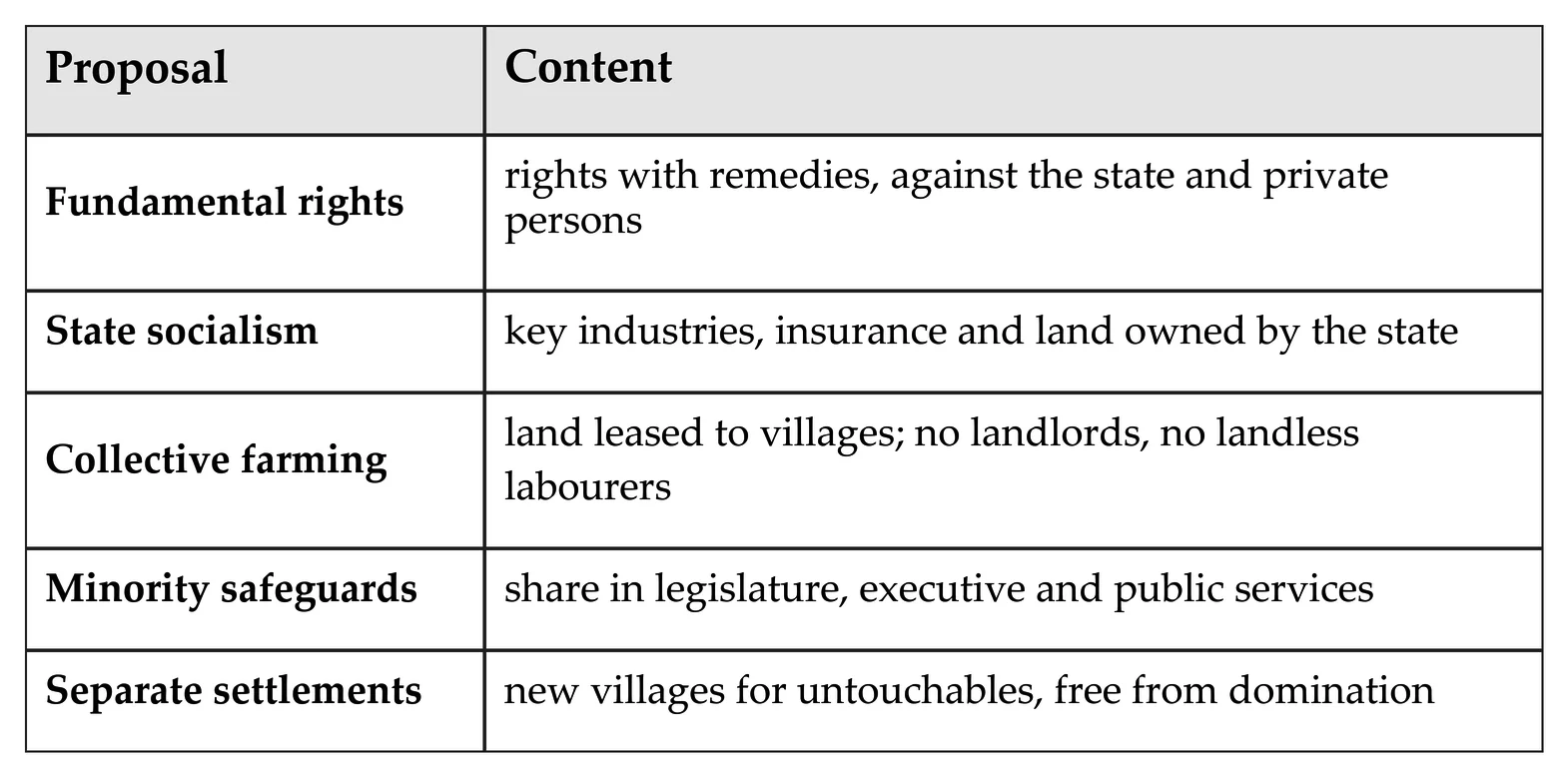
In States and Minorities (1947), Ambedkar drafted a model constitution for a United States of India, submitted on behalf of the Scheduled Castes Federation. Its main features were:
- Fundamental rights with remedies, including protection against discrimination by private persons, not only the state, and against social boycott.
- State socialism: key industries, insurance and agricultural land to be owned by the state; land to be leased to village families for collective farming, so that there would be neither landlords nor landless labourers.
- State socialism by constitutional law: these economic provisions were to be written into the Constitution itself, so that a legislative majority could not abolish them, while parliamentary democracy was retained.
- Safeguards for minorities: representation in the legislature, the executive and the public services, with protection for the Scheduled Castes as a minority.
- Separate settlements: new villages for untouchables, away from caste Hindu villages, to free them from social and economic domination.
States and Minorities shows Ambedkar’s belief that political rights must be backed by economic security, and that constitutional design could protect the weak from both the state and society.
Ambedkar at the Round Table Conferences
- First Conference (1930–31). Ambedkar demanded equal citizenship, the abolition of untouchability by law and adequate representation for the depressed classes.
- Second Conference (1931). He clashed with Gandhi, who claimed to represent the untouchables and opposed treating them as a separate minority.
- Communal Award (August 1932). The British government granted separate electorates to the depressed classes.
- Poona Pact (24 September 1932). After Gandhi’s fast at Yerwada jail, separate electorates were replaced by 148 reserved seats in joint electorates, with a primary election among depressed class voters.
5.2 Ambedkar and the Making of the Constitution
The Speech of 4 November 1948
Moving the Draft Constitution in the Constituent Assembly on 4 November 1948, Ambedkar explained and defended its main choices:
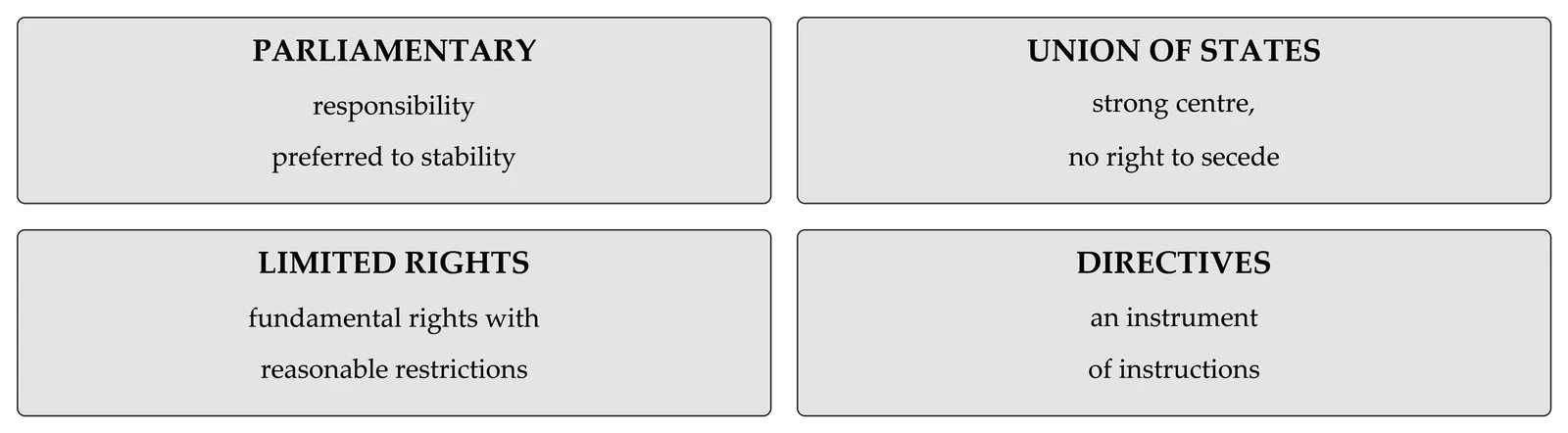
- Parliamentary government. The Drafting Committee preferred the responsibility of the executive to the legislature, as in Britain, over the stability of the American presidential system, because daily accountability suited India better.
- A Union of States. The federation was called a Union because it was not the result of an agreement among states and no state had the right to secede; the Constitution could work as federal or unitary according to circumstances, especially in emergencies.
- Single citizenship and uniformity. India would have one citizenship, an integrated judiciary and common all-India services to maintain unity.
- Fundamental rights and their limits. Rights were not absolute; the state could impose reasonable restrictions, as in all democracies.
- Directive Principles. He called them an instrument of instructions to future governments, which would have to answer to the people for implementing them.
- Detailed administrative provisions. Since constitutional morality was not yet widespread, the form of administration was written into the Constitution to prevent its perversion.
- Minorities. He asked the majority to realise its duty not to discriminate against minorities, and the minorities to show loyalty to the Constitution.
In the same speech he answered critics who wanted the village to be the basic unit of the Constitution. He described the Indian village as a sink of localism and a den of ignorance, narrow-mindedness and communalism, and was glad that the Draft had adopted the individual as its unit. This shows his deep distrust of traditional communities that had oppressed the untouchables.
Constitutional Morality
Borrowing from the historian George Grote, Ambedkar argued that the success of a constitution depends on constitutional morality, i.e. a paramount reverence for the forms of the constitution, combined with freedom of criticism and self-restraint by those in power. He warned that constitutional morality is not a natural sentiment and must be cultivated, and that democracy in India was only a top-dressing on a soil that was essentially undemocratic. Hence the Constitution included detailed provisions on administration that elsewhere are left to ordinary law.
The Drafting Committee
The Constituent Assembly appointed the Drafting Committee on 29 August 1947, with Ambedkar as chairman. Its other members were N. Gopalaswami Ayyangar, Alladi Krishnaswami Ayyar, K. M. Munshi, Syed Mohammad Saadulla, B. L. Mitter (later replaced by N. Madhava Rau) and D. P. Khaitan (replaced after his death by T. T. Krishnamachari). The Draft Constitution was published in February 1948. Members of the Assembly, including T. T. Krishnamachari, acknowledged that because of absences and deaths, the burden of drafting fell largely on Ambedkar.
5.3 The Constitution as an Instrument of Social Transformation
A Social Document
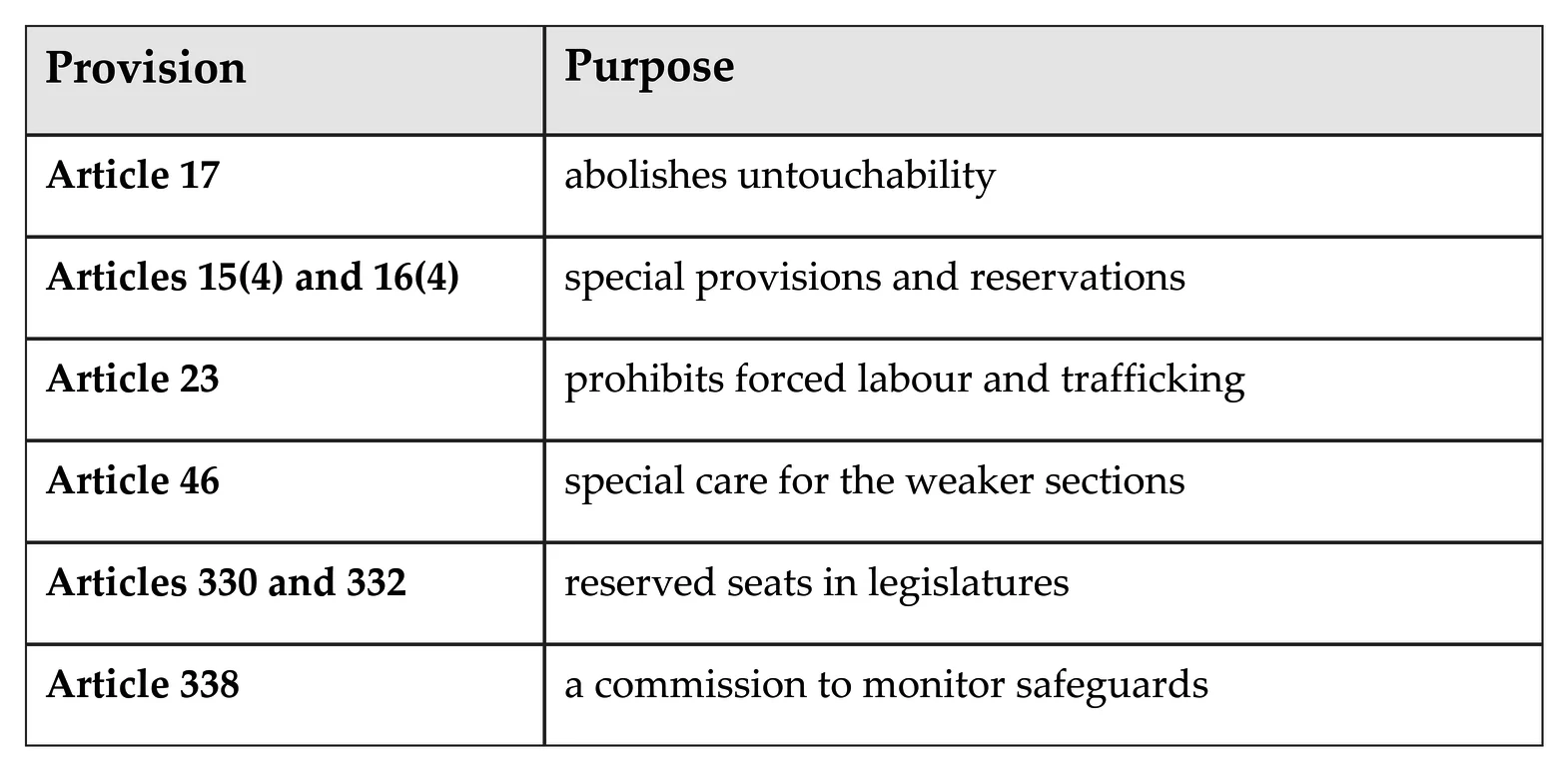
The historian Granville Austin, in The Indian Constitution: Cornerstone of a Nation (1966), described the Constitution as first and foremost a social document, aimed at a social revolution. Ambedkar’s contribution is visible in provisions designed to end caste oppression and empower the excluded.
- Article 17 abolishes untouchability and makes its practice an offence.
- Articles 15(4) and 16(4) allow special provisions and reservations for backward classes, Scheduled Castes and Scheduled Tribes; Article 15(4) was added by the First Amendment in 1951 after the Champakam Dorairajan case.
- Article 23 prohibits forced labour (begar) and trafficking.
- Article 46 directs the state to promote the educational and economic interests of the weaker sections, especially SCs and STs.
- Articles 330 and 332 reserve seats in the Lok Sabha and state assemblies for SCs and STs.
- Article 338 created a special officer, later the National Commission for Scheduled Castes, to monitor safeguards.
Singh and Roy: Ambedkar’s Constitutionalism
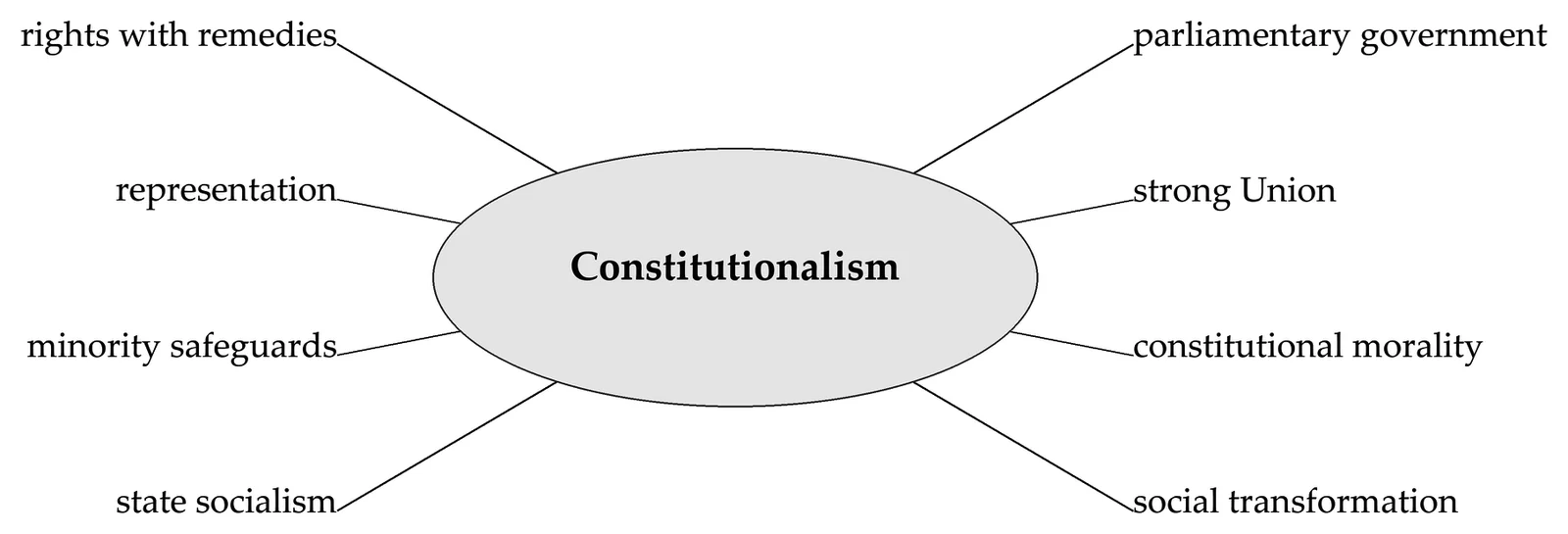
Ujjwal Kumar Singh and Anupama Roy, in B. R. Ambedkar and the Ideas of Constitutionalism and Constitutional Democracy (2017), argue that Ambedkar’s constitutionalism went beyond the liberal idea of limiting state power. He saw the constitution as a means of social transformation, using the power of the state to dismantle caste hierarchy. They highlight his ideas of constitutional morality, of democracy as associated living, of representation for the excluded and of rights enforceable against society as well as the state. They also note his worry about majoritarianism and his insistence that a constitutional democracy must protect minorities. In their reading, Ambedkar fused constitutional means with radical ends.
Transformative Constitutionalism Today
The idea of transformative constitutionalism, developed in South Africa, has been used by the Supreme Court of India to describe a Constitution that seeks to change unjust social relations. Judgments such as Navtej Singh Johar (2018) and Joseph Shine (2018) invoked Ambedkar’s constitutional morality against social morality. At the same time, persistent caste violence and inequality show that, as Ambedkar warned, the Constitution’s promise depends on those who work it.
Ambedkar on Working the Constitution
Ambedkar never treated the Constitution as perfect. In the Rajya Sabha in 1953, frustrated by its working, he said that he would be the first to burn it if it was used to harm the weak; in 1955 he explained that a temple built for a god was of no use if a devil occupied it. These remarks show his view that a constitution is valuable only if it serves justice, and that its success depends on the people who work it, as he had warned in November 1949.
5.4 Important Questions
- Question 1 Discuss Ambedkar’s views on rights and representation with reference to his evidence before the Southborough Committee.
- Question 2 Discuss the main proposals of Ambedkar’s States and Minorities.
- Question 3 Discuss Ambedkar’s defence of the Draft Constitution in his speech of 4 November 1948.
- Question 4 Discuss Ambedkar’s idea of the Constitution as an instrument of social transformation.
DU asks the same idea in different words. So learn one broad answer for each question below; the same answer works for every question joined by OR.
Important Question 1
Discuss Ambedkar’s views on rights and representation with reference to his evidence before the Southborough Committee.
OR
Examine Ambedkar’s arguments for the separate representation of the depressed classes.
OR
Explain Ambedkar’s idea that representation is essential to citizenship.
Model Answer
“The right of representation and the right to hold office under the State are the two most important rights that make up citizenship. But the untouchability of the untouchables puts these rights far beyond their reach.”
— B. R. Ambedkar, Evidence before the Southborough Committee (1919)
Introduction. Ambedkar’s constitutional thought began with his evidence before the Southborough Franchise Committee in 1919. He argued that representation and office are the core rights of citizenship and that untouchables could not enjoy them unless they had their own representatives. This argument guided his demands at the Round Table Conferences and his later constitutional work.
1. The Southborough Committee
The committee examined the franchise for legislatures under the Montagu-Chelmsford reforms. Ambedkar, aged 28, gave evidence on behalf of the untouchables.
2. Rights of Citizenship
He argued that representation and the right to hold office are the most important rights of citizenship. Untouchability denied both to the untouchables.

3. Representation and Like-Mindedness
He explained that representative government requires like-mindedness among those represented. People who share no common life cannot represent each other.
4. Touchables and Untouchables
Untouchability separated touchable and untouchable Hindus socially. They were not like-minded, so caste Hindus could not represent untouchables.
5. Their Own Representatives
Untouchables needed representatives chosen by themselves. Only then would their interests be voiced in the legislature.
6. Proportional Representation
He asked for seats in proportion to their numbers, through separate electorates or reservation. This would give them weight in decisions.
7. Low Franchise
He urged a low property qualification so that poor untouchables could vote. Without the vote, representation would be meaningless.
8. Untouchables as a Minority
He argued that untouchables were a distinct minority, like Muslims or Christians, deserving separate safeguards. Their exclusion was social, not religious.
9. Round Table Conferences
At the Round Table Conferences he demanded separate electorates for the depressed classes. The Communal Award of 1932 granted them.
10. The Poona Pact
Gandhi’s fast led to the Poona Pact, with reserved seats in joint electorates. Ambedkar later felt it weakened genuine representation.
11. Representation in the Constitution
Articles 330 and 332 reserved seats for SCs and STs in legislatures. Reservation in services followed under Article 16(4).
12. Rights with Remedies
Ambedkar insisted that rights must have remedies, which is why he called Article 32 the heart and soul of the Constitution. Rights without remedies are empty.
13. Rights against Society
He sought protection against discrimination by private persons, not only the state. Article 17 and Article 15(2) reflect this.
14. Representation and Dignity
For Ambedkar, representation gave dignity as well as power. It recognised the excluded as equal members of the polity.
15. Relevance
Debates on the effectiveness of reserved seats and on representation in services continue today. His arguments remain the starting point.
16. Criticism
Critics feared that separate representation would divide society. Ambedkar replied that society was already divided by untouchability.
17. Representation in Services
Ambedkar also demanded a share for untouchables in government services, since administration affects daily life as much as legislation; this became reservation in public employment.
18. Representation and Education
He linked effective representation with education, since only educated representatives could defend their community’s interests in legislatures.
19. Evaluation
His Southborough evidence laid the foundation of his lifelong demand for rights and representation for the excluded.
Conclusion. Thus, Ambedkar argued in 1919 that representation and office are the core rights of citizenship, which untouchability placed beyond the untouchables’ reach. His demand for their own representatives shaped the Poona Pact, the Constitution’s reserved seats and India’s politics of representation.
Important Question 2
Discuss the main proposals of Ambedkar’s States and Minorities.
OR
Examine Ambedkar’s idea of state socialism through constitutional law.
OR
Discuss Ambedkar’s views on safeguards for minorities.
Model Answer
“It is for the majority to realize its duty not to discriminate against minorities.”
— B. R. Ambedkar, speech in the Constituent Assembly (4 November 1948)
Introduction. States and Minorities (1947) was Ambedkar’s own draft of a constitution, submitted to the Constituent Assembly on behalf of the Scheduled Castes Federation. It combined fundamental rights, state socialism and safeguards for minorities. It shows his belief that political democracy must rest on economic security and that the Constitution must protect the weak from both state and society.
1. Context
As the Constituent Assembly began work, Ambedkar set out a complete model constitution. It was intended to protect the Scheduled Castes in independent India.
2. Fundamental Rights
It proposed fundamental rights with effective remedies. Rights would protect individuals against the state and against powerful private persons.
3. Protection against Social Boycott
It proposed making social boycott an offence. Boycott was a weapon used by caste Hindus against untouchables who asserted their rights.
4. State Socialism
Key industries, insurance and agricultural land were to be owned by the state. This would prevent private exploitation of the poor.
5. Collective Farming
Land would be leased to village families for collective cultivation. There would be neither landlords nor landless labourers.
6. Socialism by Constitutional Law
These economic provisions were to be written into the Constitution itself. A legislative majority could not then abolish them.
7. Retaining Parliamentary Democracy
Ambedkar retained parliamentary democracy while fixing the economic structure in the Constitution. He sought socialism without dictatorship.
8. Minority Safeguards
He proposed representation for minorities in the legislature, executive and public services. Minorities needed a share in power, not only rights.
9. Communal Majority
He argued that India’s majority was communal, fixed by birth, so minorities could not hope to become the majority. Safeguards were therefore essential.
10. Scheduled Castes as Minority
He treated the Scheduled Castes as a minority needing special protection. Their position was worse than that of religious minorities.
11. Separate Settlements
He proposed new villages for untouchables away from caste Hindu villages. This would free them from daily domination.
12. Executive Representation
He proposed that minorities have a guaranteed place in the executive. Laws are implemented by executives, so representation there mattered.
13. Influence on the Constitution
Many rights and safeguards entered the Constitution, though state socialism did not. Directive Principles reflected some economic goals.
14. Duty of the Majority
In 1948 he told the Assembly that the majority had a duty not to discriminate against minorities. Constitutional democracy depends on this.
15. Relevance
His idea that economic security underpins political rights remains important in debates on inequality and welfare.
16. Criticism
Critics argued that fixing socialism in the Constitution would limit democratic choice. Ambedkar saw it as protection against majority exploitation.
17. Insurance and Industry
He proposed compulsory insurance managed by the state and state ownership of basic industries, arguing that private enterprise could not produce rapid industrialisation with fairness.
18. Compensation
Land and industries taken over by the state were to be paid for through compensation in the form of debentures, showing his concern for legality.
19. Evaluation
States and Minorities shows Ambedkar as a constitutional thinker who joined rights, economic justice and minority protection.
Conclusion. Thus, States and Minorities proposed rights with remedies, state socialism through constitutional law and safeguards for minorities. Ambedkar’s reminder that it is the majority’s duty not to discriminate against minorities captures the spirit of this plan.
Important Question 3
Discuss Ambedkar’s defence of the Draft Constitution in his speech of 4 November 1948.
OR
Examine Ambedkar’s idea of constitutional morality.
OR
Discuss Ambedkar’s views on parliamentary government and federalism in the Constitution.
Model Answer
“Constitutional morality is not a natural sentiment. It has to be cultivated. We must realize that our people have yet to learn it.”
— B. R. Ambedkar, speech in the Constituent Assembly (4 November 1948)
Introduction. On 4 November 1948, Ambedkar moved the Draft Constitution for consideration in the Constituent Assembly. His speech explained the choice of parliamentary government, the nature of the federation, the place of fundamental rights and directive principles, and the need for constitutional morality. It is a key text for understanding the Constitution’s design.
1. The Occasion
As chairman of the Drafting Committee, Ambedkar introduced the Draft Constitution prepared over many months. He answered both praise and criticism.
2. Parliamentary Government
He explained that the Committee preferred the responsibility of the executive to the legislature over the stability of the presidential system. Daily accountability suited India better.
3. A Union of States
He said the federation was called a Union because it did not result from an agreement and no state could secede. The union was indestructible.
4. Flexible Federalism
The Constitution could be federal in normal times and unitary in emergencies. This flexibility protected national unity.
5. Single Citizenship and Integrated Institutions
India would have one citizenship, an integrated judiciary and all-India services. These would bind the country together.
6. Limits on Rights
He defended reasonable restrictions on fundamental rights, noting that rights are not absolute in any democracy.
7. Directive Principles
He called the Directive Principles an instrument of instructions to future governments. Governments would answer to voters for implementing them.
8. The Village Debate
He rejected making the village the unit of the Constitution, calling it a sink of localism and a den of ignorance and communalism. He chose the individual as the unit.
9. Constitutional Morality
Borrowing from George Grote, he defined constitutional morality as reverence for constitutional forms with freedom of criticism. It must be cultivated.
10. Democracy as Top-Dressing
He warned that democracy in India was only a top-dressing on an essentially undemocratic soil. Institutions had to be protected in writing.
11. Detailed Administrative Provisions
For this reason the Constitution included details on administration, to prevent its perversion by changing the form of administration.
12. Minorities
He asked the majority not to discriminate and the minorities to be loyal to the Constitution. Mutual trust was essential.
13. Borrowed Features
He defended borrowing from other constitutions, saying there could be nothing new in the fundamentals of a constitution.
14. Amendment
He explained that the Constitution was flexible enough to be amended, avoiding the rigidity of some federal constitutions.
15. Relevance
Courts today invoke constitutional morality, showing the lasting influence of this speech.
16. Criticism
Critics said the Draft was too centralised and borrowed too much. Ambedkar replied that unity and good administration required it.
17. Answering Critics of Borrowing
Ambedkar said that, after a hundred years of written constitutions, the fundamentals were well known, so the only new things could be variations to remedy faults and suit the country’s needs.
18. Emergency Provisions
He defended the emergency provisions as necessary for unity, though he hoped they would remain a dead letter and be used only as a last resort.
19. Evaluation
The speech shows Ambedkar as a constitutional thinker balancing unity, democracy and rights in a deeply unequal society.
Conclusion. Thus, Ambedkar’s speech of 4 November 1948 explained the choice of parliamentary government, a strong Union and limited rights, and warned that constitutional morality is not natural but must be cultivated. It remains essential for understanding the spirit of the Constitution.
Important Question 4
Discuss Ambedkar’s idea of the Constitution as an instrument of social transformation.
OR
Examine Ujjwal Kumar Singh and Anupama Roy’s account of Ambedkar’s constitutionalism.
OR
Discuss the idea of transformative constitutionalism with reference to Ambedkar.
Model Answer
“The Indian Constitution is first and foremost a social document.”
— Granville Austin, The Indian Constitution: Cornerstone of a Nation (1966)
Introduction. For Ambedkar, the Constitution was not only a framework of government but a means of transforming an unequal society. He used it to abolish untouchability, provide reservations and direct the state to protect the weak. Ujjwal Kumar Singh and Anupama Roy show how his constitutionalism fused constitutional means with radical ends, an idea now called transformative constitutionalism.
1. Beyond Liberal Constitutionalism
Liberal constitutionalism limits state power to protect liberty. Ambedkar also wanted to use state power to end social oppression.
2. A Social Document
Granville Austin called the Constitution first and foremost a social document aimed at a social revolution. Ambedkar’s work shaped this character.
3. Abolition of Untouchability
Article 17 abolished untouchability and made it an offence. This struck at the core of the caste order.
4. Reservations
Articles 15(4) and 16(4) permit special provisions and reservations. They aim at substantive, not merely formal, equality.
5. The First Amendment
After the Champakam Dorairajan case, the First Amendment of 1951 added Article 15(4). Ambedkar supported it as Law Minister.
6. Protection against Exploitation
Article 23 bans forced labour, and Article 46 directs special care for the weaker sections. These protect against economic oppression.
7. Political Representation
Reserved seats in legislatures under Articles 330 and 332 give SCs and STs a share in power.
8. Institutional Monitoring
Article 338 created machinery, later the National Commission for Scheduled Castes, to monitor safeguards.
9. The Individual as Unit
By making the individual, not the village or caste, the unit, the Constitution freed people from community domination.
10. Singh and Roy’s Reading
Singh and Roy argue that Ambedkar fused constitutional means with radical ends, using the state to dismantle hierarchy.
11. Rights against Society
They stress his insistence on rights enforceable against society as well as the state. Caste oppression is often private.
12. Constitutional Morality
They highlight constitutional morality as the ethical basis of constitutional democracy. Without it, transformation fails.
13. Against Majoritarianism
Ambedkar worried that majority rule could become tyranny over minorities. A constitutional democracy must protect them.
14. Transformative Constitutionalism
The Supreme Court has used this idea, from South Africa, in cases such as Navtej Singh Johar (2018). It invoked Ambedkar’s constitutional morality.
15. Limits of Law
Ambedkar knew that law alone could not change society. He warned that the Constitution depends on those who work it.
16. Criticism
Critics argue that judicial use of constitutional morality can be undemocratic. Supporters say it protects rights against majorities.
17. Atrocities Act
The SC and ST (Prevention of Atrocities) Act, 1989 carried forward Ambedkar’s idea that the state must protect Dalits against violence by society, not only by itself.
18. Reservation Debates
Judgments such as Indra Sawhney (1992), which upheld OBC reservation with a 50 per cent ceiling, show how the transformative provisions continue to evolve.
19. Evaluation
Ambedkar made the Constitution a charter of social transformation, a vision still being realised.
Conclusion. Thus, Ambedkar shaped a Constitution that Austin rightly called first and foremost a social document. Through Article 17, reservations and protection of the weak, and through constitutional morality, he made it an instrument for transforming an unequal society.
Short Notes
(a) Southborough Committee
The franchise committee of 1919 before which Ambedkar argued that representation and office are the core rights of citizenship and that untouchables needed their own representatives.
(b) State socialism
Ambedkar’s proposal in States and Minorities (1947) for state ownership of key industries and land, written into the Constitution so that a legislative majority could not undo it.
(c) Instrument of instructions
Ambedkar’s description of the Directive Principles of State Policy as guidelines for future governments, for whose implementation they would answer to the people.
(d) Constitutional morality
Ambedkar’s term, borrowed from George Grote, for reverence for the forms of the Constitution combined with freedom of criticism and self-restraint by those in power; he warned in 1948 that it is not natural and must be cultivated, and courts invoke it today.
More notes: MDSE-3b Understanding Ambedkar
These notes are prepared by PADHO TO AISE for study help. They are not an official University of Delhi publication.