
Semester VII DSC-19 Themes in Western Political Philosophy
Unit IV · 22 min read · Updated 24 Nov 2026
As per the University of Delhi (DU) BA (Hons) Political Science syllabus
Contents
- 6.1 Marx and His Intellectual Journey
- 6.2 Historical Materialism
- 6.3 The Concept of Value
- 6.4 Alienation, Class Struggle and the State
- 6.5 Important Questions
- Explain Marx’s theory of historical materialism.
- Explain Marx’s concept of value and the theory of surplus value.
- Discuss Marx’s concept of alienation in his early writings.
- Discuss Marx’s views on class struggle, the state and revolution.
- Short Notes
दार्शनिकों ने केवल विभिन्न तरीकों से दुनिया की व्याख्या की है; मुद्दा उसे बदलने का है।
The philosophers have only interpreted the world, in various ways; the point is to change it.
— Karl Marx, Theses on Feuerbach (1845), Thesis XI
KARL Marx (1818–1883) was a philosopher, economist and revolutionary whose ideas changed the world. Beginning as a Young Hegelian, he turned Hegel’s dialectic towards the material conditions of human life and developed historical materialism, the theory that the way people produce their livelihood shapes society, politics and ideas. In Capital (1867) he analysed capitalism through his concept of value, showing how profit arises from the surplus value produced by workers. His early writings described the alienation of labour under capitalism. With Friedrich Engels, he called on workers to overthrow capitalism and build a classless society. This unit studies historical materialism and the concept of value, drawing on Joseph Cropsey, Lawrence Wilde and Bertell Ollman.
6.1 Marx and His Intellectual Journey
Lenin described Marxism as combining three sources: German philosophy, especially Hegel’s dialectic; British political economy, especially Adam Smith and David Ricardo’s labour theory of value; and French socialism. As a Young Hegelian, Marx criticised religion and the Prussian state. Exiled from Germany, he lived in Paris and Brussels, where he met Engels, and from 1849 in London, where he studied capitalism in the British Museum. His early writings on alienation (1844) gave way to the theory of history in The German Ideology (1845–46) and the economic analysis of Capital.
Lawrence Wilde emphasises the humanism of the early Marx, centred on human self-realisation through free creative labour, while Joseph Cropsey reads Marx as a thinker who sought to overcome the limits of modern liberal society but whose materialism reduced human beings to producers. Bertell Ollman stresses Marx’s dialectical method, which studies things in their relations and changes.
6.2 Historical Materialism
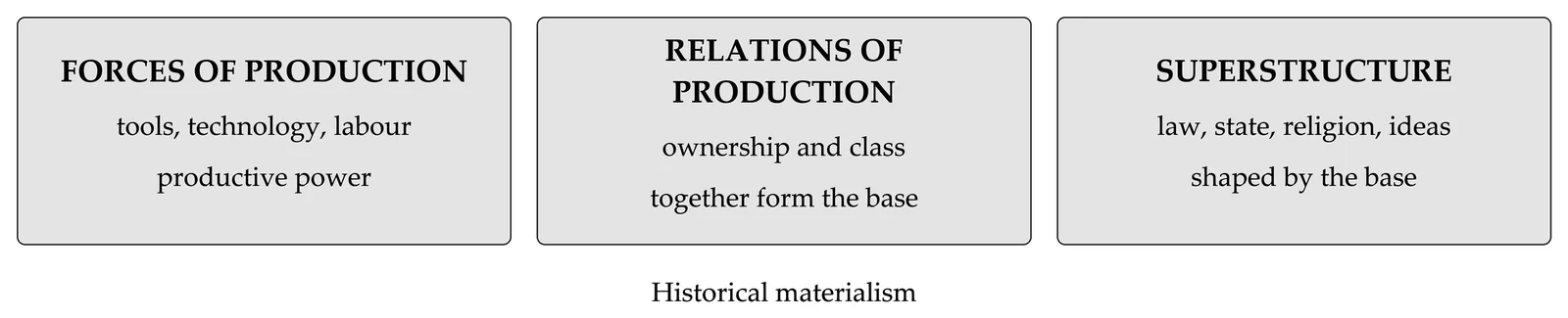
Historical materialism holds that the foundation of every society is the way it produces its material life. The forces of production, tools, technology, skills and labour, combined with the relations of production, the relations of ownership and control, form the economic base. On this base arises a superstructure of law, politics, religion and ideas. As Marx put it in 1859, it is not people’s consciousness that determines their existence, but their social existence that determines their consciousness.

History moves through modes of production: primitive communism, ancient slave society, feudalism and capitalism, to be followed by socialism and communism. Change occurs when the forces of production outgrow the relations of production, which become fetters; an era of social revolution follows. Class struggle is the motor of history: the history of all hitherto existing society is the history of class struggles, between masters and slaves, lords and serfs, and capitalists and workers.
6.3 The Concept of Value
In Capital, Marx began with the commodity, which has a use value, its usefulness, and an exchange value. The value of a commodity is determined by the socially necessary labour time required to produce it, developing the labour theory of value of Smith and Ricardo. Under capitalism, workers sell their labour power, their capacity to work, for a wage equal to the value of what they need to live. But labour power creates more value than it costs. The difference is surplus value, appropriated by the capitalist as profit.

Capitalists increase absolute surplus value by lengthening the working day and relative surplus value by raising productivity. Exploitation is hidden because the wage appears to pay for all the work done. Marx also described commodity fetishism, in which social relations among people appear as relations among things, and predicted that competition and accumulation would produce crises, a reserve army of unemployed and a tendency of the rate of profit to fall.
6.4 Alienation, Class Struggle and the State
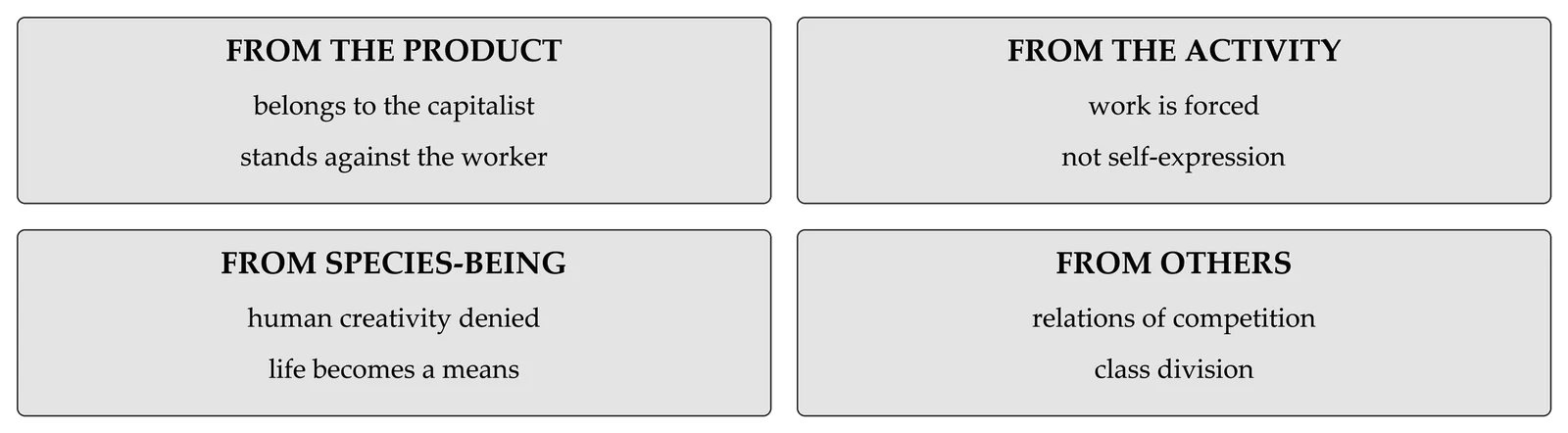
In the Economic and Philosophic Manuscripts of 1844, Marx argued that under capitalism labour is alienated: workers are alienated from the product of their labour, which belongs to the capitalist; from the activity of labour, which is forced rather than free; from their species-being, their human capacity for free creative activity; and from other people, with whom they relate through competition. Communism would overcome alienation by restoring control of production to the producers.
Marx saw the state as an instrument of class rule: the executive of the modern state is but a committee for managing the common affairs of the bourgeoisie. The proletariat would overthrow capitalism, establish a temporary dictatorship of the proletariat and build a classless society in which the state would wither away and the principle would be from each according to ability, to each according to needs.
6.5 Important Questions
- Question 1 Explain Marx’s theory of historical materialism.
- Question 2 Explain Marx’s concept of value and the theory of surplus value.
- Question 3 Discuss Marx’s concept of alienation in his early writings.
- Question 4 Discuss Marx’s views on class struggle, the state and revolution.
DU asks the same idea in different words. So learn one broad answer for each question below; the same answer works for every question joined by OR.
Important Question 1
Explain Marx’s theory of historical materialism.
OR
Discuss Marx’s concepts of base and superstructure.
OR
‘It is not the consciousness of men that determines their existence, but their social existence that determines their consciousness.’ Discuss.
Model Answer
“It is not the consciousness of men that determines their existence, but their social existence that determines their consciousness.”
— Karl Marx, Preface to A Contribution to the Critique of Political Economy (1859)
Introduction. Historical materialism, also called the materialist conception of history, is Marx’s theory of how societies are structured and how they change. It holds that the material conditions of production form the foundation of social life and that history develops through changes in production and class struggle. Marx summarised it in the Preface of 1859, and Engels described it as Marx’s great discovery.
1. From Hegel to Materialism
Hegel saw history as the self-development of spirit or ideas. Marx said he found Hegel standing on his head and turned him right side up: material production, not ideas, drives history, though Marx kept Hegel’s dialectical method.
2. Production as Foundation
Human beings must first eat, drink, have shelter and clothing before they can pursue politics, science or religion. The production of material life is therefore the first historical act and the foundation of all society.
3. Forces of Production
Forces of production include the means of production, such as tools, machines and land, and labour power, the skills and energy of workers. They develop over time with technology and knowledge.
4. Relations of Production
Relations of production are the social relations people enter into in production, especially relations of ownership and control over the means of production. They define classes, such as masters and slaves or capitalists and workers.
5. Base and Superstructure
Together, forces and relations of production form the economic structure, the real foundation or base. On it arises a legal and political superstructure, with corresponding forms of social consciousness, religion, philosophy and art.
6. Consciousness
Marx argued that it is not consciousness that determines social existence, but social existence that determines consciousness. The ruling ideas of each age are the ideas of its ruling class, which controls the means of mental production.
7. Contradiction and Revolution
At a certain stage, the forces of production come into conflict with existing relations of production, which turn into fetters on further development. Then begins an era of social revolution, transforming the base and, more or less rapidly, the superstructure.
8. Modes of Production
Marx identified successive modes of production: primitive communism, ancient slavery, feudalism and modern bourgeois capitalism, with an Asiatic mode in some writings. Capitalism would be followed by socialism and communism.
9. Class Struggle
In every class society, the class that owns the means of production exploits the class that labours. Their conflict is the motor of history: the history of all hitherto existing society is the history of class struggles.
10. Capitalism’s Historical Role
Marx praised capitalism for developing productive forces more than all previous generations combined, but argued that its own contradictions would produce its gravedigger, the proletariat.
11. Ollman on Dialectics
Bertell Ollman stresses that Marx’s method is dialectical: it studies society as a system of internal relations in constant change, rather than as separate fixed things, so base and superstructure interact.
12. Determinism Debate
Critics accuse historical materialism of economic determinism. Engels replied in later letters that the economy is determining only in the last instance, and that superstructural factors such as politics and ideas also influence history.
13. Later Developments
Gramsci emphasised the role of ideas and culture in maintaining class rule through hegemony; Althusser spoke of relative autonomy of the superstructure; and historians used historical materialism to study societies from below.
14. Criticisms
Critics such as Karl Popper argued that historical materialism makes untestable predictions, and Max Weber showed that ideas, such as the Protestant ethic, can shape economic development.
15. Evaluation
Historical materialism transformed the study of society, history and politics by emphasising material production, class and conflict. Even its critics accept that economic structures profoundly shape political and cultural life.
Conclusion. Thus, historical materialism holds that the forces and relations of production form the base of society, on which a superstructure of law, politics and ideas arises. History moves through modes of production driven by contradictions and class struggle, towards a classless society.
Important Question 2
Explain Marx’s concept of value and the theory of surplus value.
OR
How does exploitation take place under capitalism, according to Marx?
OR
Discuss Marx’s labour theory of value and commodity fetishism.
Model Answer
“Capital is dead labour, which, vampire-like, lives only by sucking living labour, and lives the more, the more labour it sucks.”
— Karl Marx, Capital, Volume I (1867)
Introduction. In Capital (1867), Marx sought to uncover the laws of motion of capitalist society. At the centre of his analysis is the concept of value, developed from the classical economists Adam Smith and David Ricardo. Marx used it to explain how profit arises from the exploitation of labour, through surplus value, even when all exchanges appear fair.
1. The Commodity
Capitalist wealth appears as an immense collection of commodities. A commodity is a thing produced for exchange, with two aspects: use value, its capacity to satisfy a need, and exchange value, the proportion in which it exchanges for other commodities.
2. Value and Labour
What makes different commodities comparable is that they are all products of human labour. Their value is determined by the amount of socially necessary labour time required to produce them under average conditions.
3. Money and Capital
In simple circulation, people sell a commodity to buy another, C–M–C. Capital moves differently, M–C–M′: money is advanced to buy commodities in order to sell them for more money. The increment is surplus value.
4. Labour Power
The source of surplus value is a unique commodity, labour power, the worker’s capacity to work. Its value, like any commodity, is the labour time needed to produce it, the cost of the worker’s subsistence.
5. Surplus Value
During the working day, the worker produces the value of his wage in part of the time, necessary labour, and works the rest of the time for free, surplus labour. The value created in surplus labour is surplus value, appropriated by the capitalist.
6. Exploitation
Exploitation is hidden because the wage appears to pay for the whole day’s work. The exchange between capitalist and worker seems equal, but the worker produces more value than he receives.
7. Constant and Variable Capital
Marx divided capital into constant capital, spent on machines and materials, which transfers its value to products, and variable capital, spent on labour power, which creates new value and surplus value. The rate of surplus value measures exploitation.
8. Absolute and Relative Surplus Value
Capitalists increase absolute surplus value by lengthening the working day, which led to struggles over working hours, and relative surplus value by raising productivity so that workers produce their wage in less time.
9. Commodity Fetishism
In capitalism, social relations between producers appear as relations between things, commodities and money, which seem to have value in themselves. Marx called this commodity fetishism, which hides exploitation.
10. Accumulation
Competition forces capitalists to reinvest surplus value and introduce machinery. This produces a reserve army of unemployed workers, which keeps wages low, and concentrates capital in fewer hands.
11. Crises
Marx argued that capitalism is prone to crises of overproduction and to a tendency of the rate of profit to fall as machinery replaces labour, contradictions that would lead to its downfall.
12. Cropsey’s Critique
Joseph Cropsey argues that Marx’s economic analysis reduces human beings to producers and that his critique of capitalism depends on a vision of human nature that is questionable.
13. Economic Criticisms
Economists such as Eugen von Böhm-Bawerk criticised the labour theory of value, arguing that prices are determined by supply, demand and marginal utility. The transformation of values into prices remains a debated problem.
14. Relevance
Despite criticisms, Marx’s analysis of exploitation, accumulation, crises and inequality remains influential in understanding capitalism, especially after the financial crisis of 2008.
15. Evaluation
Marx’s theory of value and surplus value offered a powerful explanation of profit as exploitation and of capitalism’s dynamics and crises. Its economic foundations are contested, but its critical insights endure.
Conclusion. Thus, Marx held that the value of commodities is determined by socially necessary labour time, and that profit arises from surplus value, the unpaid labour of workers who sell their labour power. Commodity fetishism hides this exploitation, and accumulation produces crises and inequality.
Important Question 3
Discuss Marx’s concept of alienation in his early writings.
OR
Examine the humanism of the early Marx with reference to Lawrence Wilde.
OR
What are the forms of alienated labour, according to Marx?
Model Answer
“The worker therefore only feels himself outside his work, and in his work feels outside himself.”
— Karl Marx, Economic and Philosophic Manuscripts (1844)
Introduction. Marx’s early writings, especially the Economic and Philosophic Manuscripts of 1844, present a humanist critique of capitalism centred on alienation. Published only in 1932, they revealed a Marx concerned with human self-realisation and freedom, not only economics. Lawrence Wilde emphasises this early, humanist Marx.
1. Sources of the Concept
Marx drew the concept of alienation from Hegel, for whom spirit is alienated in the world before recognising itself, and from Ludwig Feuerbach, who argued that humans alienate their own powers by projecting them onto God.
2. Labour and Human Nature
For Marx, human beings are distinguished by free, conscious, creative activity. Through labour, they transform nature and express and develop their capacities. Labour should be the realisation of human nature.
3. Alienated Labour
Under capitalism, labour becomes alienated: instead of expressing human nature, it becomes a means of mere survival, controlled by others and experienced as a burden.
4. Alienation from the Product
The product of labour belongs to the capitalist and confronts the worker as an alien power. The more the worker produces, the more he strengthens the power of capital over him.
5. Alienation from the Activity
Work is forced, not voluntary. The worker feels himself only outside work and outside himself in work; he feels free only in animal functions, eating and drinking, and like an animal in his human functions.
6. Alienation from Species-being
Humans are species-beings, capable of free, universal, creative activity. Alienated labour turns this life activity into a mere means of existence, estranging humans from their own nature.
7. Alienation from Others
Alienated labour also estranges people from one another. Relations between workers and capitalists, and among workers, become relations of competition and domination.
8. Private Property
Marx argued that private property is the product and consequence of alienated labour, and that its abolition is the condition for overcoming alienation.
9. Money
Money, Marx wrote, is the alienated power of humanity: it turns every human quality into its opposite, making the ugly beautiful and the dishonest honourable for those who possess it.
10. Communism as Humanism
Communism, as the positive abolition of private property, would be the genuine resolution of the conflict between humans and nature and between humans, the return of humans to themselves as social beings.
11. Wilde’s Interpretation
Lawrence Wilde argues that the early Marx’s humanist ethic of self-realisation and solidarity underlies his later economic work and gives his critique of capitalism its moral force.
12. Continuity or Break
Louis Althusser argued that there is an epistemological break between the humanist early Marx and the scientific later Marx. Others, such as Wilde and István Mészáros, see continuity, with commodity fetishism in Capital developing the theory of alienation.
13. Influence
The concept of alienation influenced Western Marxism, the Frankfurt School, existentialism and humanist socialism, and is used to analyse work, consumerism and technology.
14. Criticisms
Critics argue that Marx’s view of human nature as creative labour is speculative, and that alienation can exist in non-capitalist societies, including the Soviet Union.
15. Alienation and the Division of Labour
In The German Ideology (1845–46), Marx and Engels linked alienation to the division of labour. When each person is confined to one exclusive sphere of activity, imposed rather than chosen, the worker’s own activity becomes an alien power standing over him. In communist society, they wrote, a person could hunt in the morning, fish in the afternoon and criticise after dinner, without ever becoming only a hunter, fisherman or critic.
16. Alienation and Religion
Following Feuerbach, Marx saw religion as a form of alienation in which humans project their own powers onto God. But he argued that religion is a symptom of real suffering in an unjust world: it is the sigh of the oppressed creature and the opium of the people. To abolish religious illusion, one must abolish the conditions that require illusions, so the criticism of heaven turns into the criticism of earth.
17. Alienation in Contemporary Work
Sociologists have used Marx’s concept to study modern work. Robert Blauner measured powerlessness, meaninglessness, isolation and self-estrangement among factory workers, and Harry Braverman showed how scientific management deskills labour. Today scholars apply the idea to assembly lines, call centres and gig work controlled by digital platforms, where workers have little control over the pace, content or purpose of their labour.
18. Evaluation
Marx’s theory of alienation provides a humanist foundation for his critique of capitalism, showing how economic systems shape human self-realisation and relationships.
Conclusion. Thus, the early Marx argued that under capitalism workers are alienated from their product, their activity, their species-being and other people. Rooted in Hegel and Feuerbach and emphasised by Wilde, this humanist critique envisages communism as the restoration of free creative life.
Important Question 4
Discuss Marx’s views on class struggle, the state and revolution.
OR
‘The history of all hitherto existing society is the history of class struggles.’ Discuss.
OR
Critically evaluate the relevance of Marx today.
Model Answer
“The history of all hitherto existing society is the history of class struggles.”
— Karl Marx and Friedrich Engels, The Communist Manifesto (1848)
Introduction. Marx’s theory of history and his analysis of capitalism led to political conclusions: class struggle drives history, the state serves the ruling class, and the working class will overthrow capitalism to build a classless society. These ideas inspired revolutionary movements across the world and remain central to debates about Marx’s relevance.
1. Classes
Classes are defined by their relation to the means of production. In capitalism, the bourgeoisie owns the means of production and the proletariat owns only its labour power.
2. Class Struggle
In every class society, there is an antagonism between exploiters and exploited. This struggle, sometimes hidden, sometimes open, drives social change and ends either in revolutionary transformation or in the common ruin of the contending classes.
3. The Bourgeoisie
The Manifesto praised the bourgeoisie for revolutionising production, creating a world market and sweeping away feudal relations. All that is solid melts into air, as capitalism constantly transforms society.
4. The Proletariat
Capitalism creates the proletariat, which becomes concentrated in factories and organised. Having nothing to lose but its chains, it will become the revolutionary class.
5. The State
For Marx, the state is not neutral but an instrument of class rule. The executive of the modern state is but a committee for managing the common affairs of the whole bourgeoisie.
6. Relative Autonomy
In The Eighteenth Brumaire of Louis Bonaparte (1852), Marx showed that the state can gain some independence from classes, as under Louis Bonaparte, when classes are evenly balanced.
7. Revolution
Marx believed that the proletariat would overthrow capitalism through revolution, though he allowed that in some democracies, such as Britain or America, workers might achieve their goals peacefully.
8. Dictatorship of the Proletariat
After the revolution, a transitional dictatorship of the proletariat would use state power to abolish class rule. Marx saw the Paris Commune of 1871 as a model, with elected and recallable officials.
9. Communism
In the Critique of the Gotha Programme (1875), Marx distinguished a lower phase of communism, where reward follows work, from a higher phase, where the principle would be from each according to his ability, to each according to his needs.
10. Withering Away of the State
With the disappearance of classes, the state as an instrument of class rule would wither away, as Engels put it, leaving the administration of things.
11. Influence
Marx’s ideas inspired socialist and communist movements, the Russian and Chinese revolutions, anti-colonial movements and labour movements worldwide, including in India.
12. Criticisms
Critics point to the failure of Marx’s predictions of proletarian revolution in advanced capitalist countries, the authoritarianism of communist states and the resilience of capitalism through reforms and welfare states.
13. Cropsey’s Critique
Joseph Cropsey argues that Marx’s vision of a society without classes, state or scarcity is utopian and that his materialism neglects the political and moral dimensions of human life.
14. Relevance Today
Marx’s analysis of inequality, globalisation, crises and the power of capital remains relevant, as rising inequality and the financial crisis of 2008 renewed interest in his work.
15. Class in Itself and Class for Itself
In The Poverty of Philosophy (1847), Marx distinguished a class in itself, a group sharing a common position in production, from a class for itself, a group conscious of its common interests and organised to pursue them. Workers become a revolutionary force only when they develop class consciousness through struggles over wages, hours and conditions, and form trade unions and political parties.
16. Ideology and False Consciousness
Marx argued that the ruling ideas of every age are the ideas of its ruling class, because the class that controls material production also controls mental production. Ideologies such as the belief that markets are natural and fair present the interests of the ruling class as universal interests. Engels later called the acceptance of such ideas by the oppressed false consciousness, which delays revolution.
17. Lenin and the Vanguard Party
Lenin, in What Is to Be Done? (1902), argued that workers left to themselves develop only trade-union consciousness, and that a disciplined vanguard party of professional revolutionaries must bring socialist consciousness to them. After 1917, the Bolsheviks used this idea to justify one-party rule, which critics such as Rosa Luxemburg warned would replace the dictatorship of the proletariat with the dictatorship of a party.
18. Marx and the Peasantry
Marx doubted the revolutionary capacity of the peasantry. In The Eighteenth Brumaire, he compared French smallholding peasants to potatoes in a sack, isolated producers unable to represent themselves. Later Marxists, especially Mao Zedong in China, revised this view, building revolutions on peasant mobilisation in largely agrarian societies, a lesson that also shaped communist movements in India.
19. Evaluation
Marx’s theory of class struggle and the state offers a powerful critique of capitalist society, though his predictions and the record of states claiming his name raise serious doubts.
Conclusion. Thus, Marx held that class struggle drives history, that the state serves the ruling class, and that the proletariat would overthrow capitalism, establish a transitional dictatorship and build a classless communist society in which the state withers away. His ideas remain influential and contested.
Short Notes
(a) Base and superstructure
Marx’s metaphor for the structure of society. The base is the economic structure, the forces and relations of production; the superstructure comprises law, politics, religion and ideas, which arise on the base and broadly reflect it, though later Marxists emphasised their interaction.
(b) Surplus value
The value produced by workers beyond the value of their labour power, which they receive as wages. It is appropriated by capitalists as profit and is, for Marx, the source of exploitation under capitalism.
(c) Commodity fetishism
Marx’s term in Capital for the way social relations among producers appear as relations among things, commodities and money, which seem to have value in themselves, hiding the human labour and exploitation behind them.
(d) Alienation
In the 1844 Manuscripts, the estrangement of workers under capitalism from the product of their labour, from the activity of labour, from their species-being as free creative beings, and from other people.
More notes: DSC-19 Themes in Western Political Philosophy
These notes are prepared by PADHO TO AISE for study help. They are not an official University of Delhi publication.