
Semester V MDSE-3b Understanding Ambedkar
Unit II · 23 min read · Updated 24 Nov 2026
As per the University of Delhi (DU) BA (Hons) Political Science syllabus
Contents
- 2.1 Caste, Untouchability and the Critique of the Hindu Social Order
- Caste as a System
- The Untouchables: Who Were They
- The Hindu Social Order: Its Essential Principles
- Ambedkar and Gandhi on Untouchability
- 2.2 Islam and the Partition of India
- Thoughts on Pakistan
- Communal Majority and Minorities
- 2.3 Religion and Conversion
- What Way Emancipation
- Why Buddhism
- Buddhism after Ambedkar
- 2.4 Important Questions
- Discuss Ambedkar’s views on caste and the origin of untouchability.
- Discuss Ambedkar’s critique of the Hindu social order.
- Discuss Ambedkar’s views on Islam and the Partition of India in Thoughts on Pakistan.
- Discuss Ambedkar’s views on religion and conversion.
- Short Notes
आप जिस भी दिशा में मुड़ें, जाति वह राक्षस है जो आपका रास्ता काटता है।
Turn in any direction you like, Caste is the monster that crosses your path.
— B. R. Ambedkar, Annihilation of Caste (1936)
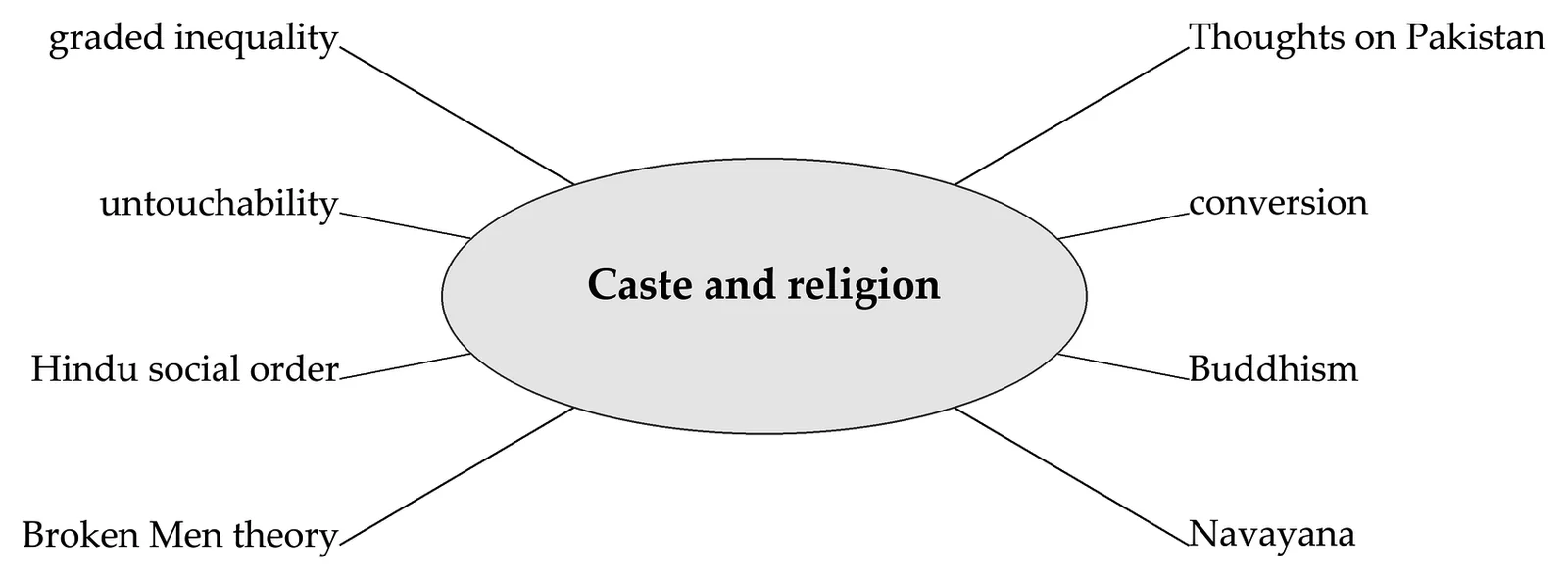
CCASTE and religion were at the centre of Ambedkar’s life and thought. He studied how caste works, where untouchability came from and why the Hindu social order resisted reform. He also wrote one of the most detailed studies of the demand for Pakistan, and in the end he concluded that the untouchables could find dignity only by leaving Hinduism. This chapter studies Unit II of the syllabus: caste, untouchability and the critique of the Hindu social order, Islam and the Partition of India, and religion and conversion.
2.1 Caste, Untouchability and the Critique of the Hindu Social Order
Caste as a System
For Ambedkar, caste was not merely a set of separate groups but a system held together by rules of endogamy, hierarchy and religious sanction. In Castes in India (1916), he argued that caste arose when some groups closed themselves through endogamy and others imitated them, and that customs such as sati, enforced widowhood and child marriage were means of controlling women to preserve endogamy. Caste, he said, is a system of graded inequality, an ascending scale of reverence and a descending scale of contempt, in which every caste except the lowest has someone beneath it. This makes it difficult for the oppressed to unite, because each group values its superiority over those below it.
The Untouchables: Who Were They
In The Untouchables: Who Were They and Why They Became Untouchables? (1948), Ambedkar rejected both the racial theory, that untouchables were a different race, and the occupational theory, that untouchability came from unclean work. He argued that untouchability is different from mere impurity, since impure persons can be purified while untouchables cannot. He offered his own historical explanation:
- Broken Men. In ancient tribal wars, defeated groups were scattered; these Broken Men settled on the outskirts of villages to guard settled communities in return for food and shelter.
- Buddhism. The Broken Men became Buddhists and did not respect Brahmans, who therefore regarded them with hatred.
- Beef. When Brahmans gave up beef-eating to compete with Buddhism and made the cow sacred, the Broken Men, who were poor, continued to eat the flesh of dead cattle.
- Untouchability. Contempt for Buddhism and the continued eating of beef turned the Broken Men into untouchables, which Ambedkar dated to around 400 CE.
Scholars debate the historical evidence for this theory, but it served Ambedkar’s purpose: it showed that untouchability was a historical and social creation, not a natural or divine order, and so could be ended.

The Hindu Social Order: Its Essential Principles
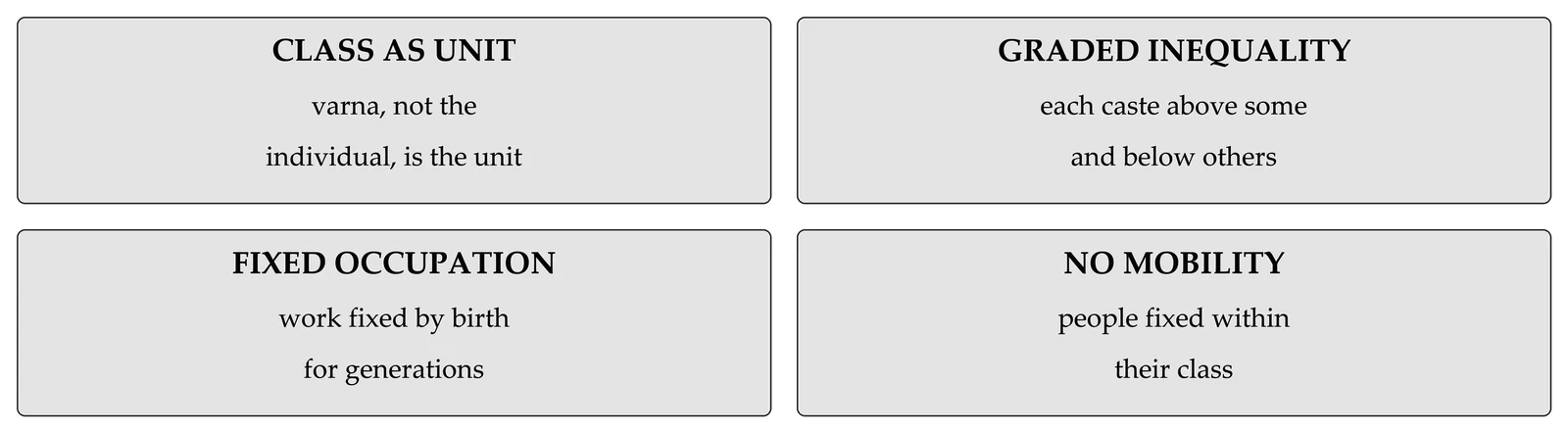
In The Hindu Social Order: Its Essential Principles, Ambedkar compared Hindu society with the ideals of a free society based on liberty, equality and fraternity. He argued that the unit of Hindu society is not the individual but the class or varna, so the individual’s worth depends on birth. Its principles are graded inequality among the classes, fixity of occupation for each class passed down through generations, and the fixing of people within their classes without the possibility of moving up. Such an order, he concluded, denies the individual moral worth, freedom and dignity, and is incompatible with democracy. In Riddles in Hinduism and other writings he went further, arguing that the religious texts themselves were full of contradictions and could not justify such inequality.
Ambedkar and Gandhi on Untouchability
Gandhi called untouchability a sin of Hindu society to be removed by the penance of caste Hindus. He named the untouchables Harijans (people of God), founded the Harijan Sevak Sangh in 1932 and campaigned for temple entry, while defending varna. Ambedkar rejected the term Harijan as patronising and argued that untouchables needed rights and political power, not charity. He saw Gandhi’s fast against separate electorates in 1932, which led to the Poona Pact, as coercion, and in What Congress and Gandhi Have Done to the Untouchables (1945) he argued that the Congress approach left the caste order intact.
- Harijan Sevak Sangh (1932): Gandhi’s organisation for the welfare of untouchables, run largely by caste Hindus.
- Temple entry: campaigns such as Vaikom (1924–25) and Guruvayur (1931–32) sought access to temples; Ambedkar later said temple entry was not his main goal.
- Self-respect: Ambedkar stressed that untouchables must win dignity through their own organisation and education.
2.2 Islam and the Partition of India
Thoughts on Pakistan
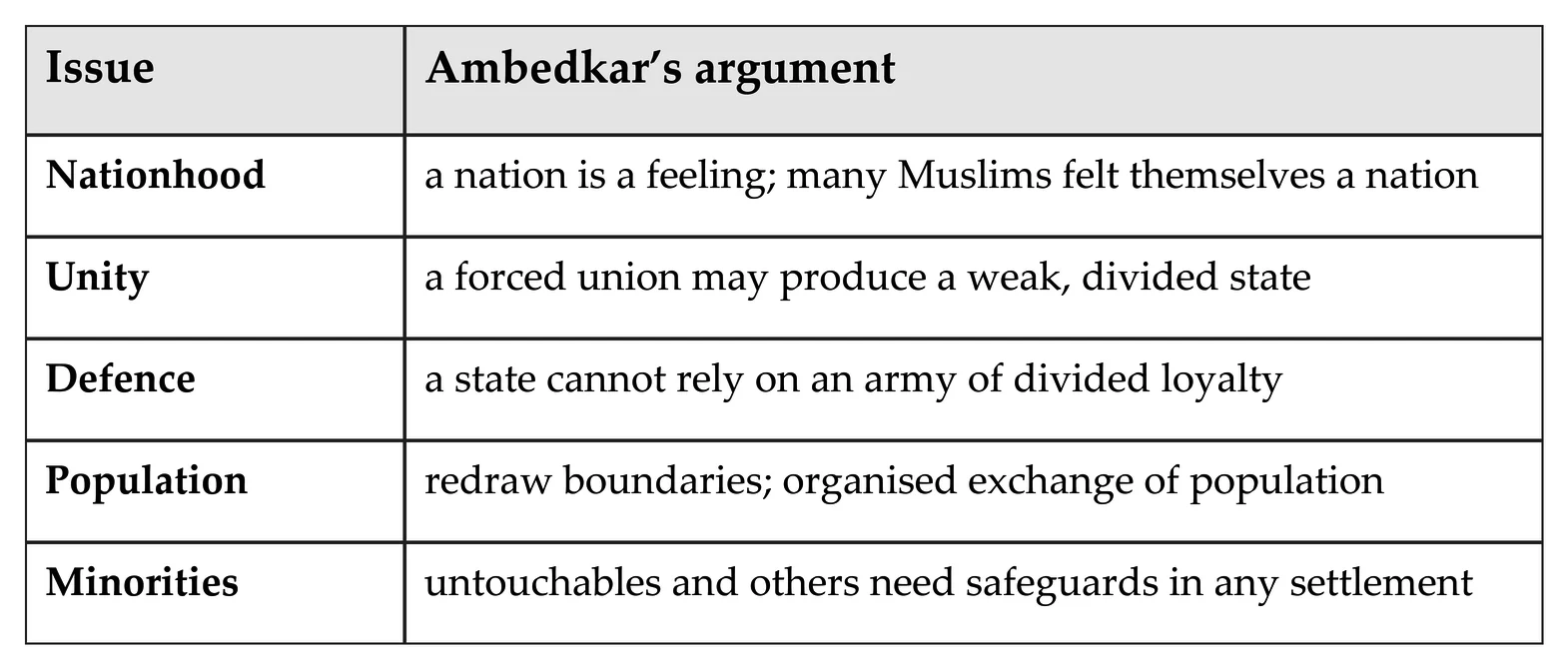
After the Muslim League adopted the Lahore Resolution in March 1940, demanding independent states in the Muslim-majority regions, Ambedkar published Thoughts on Pakistan (1940), revised as Pakistan or the Partition of India (1945). It was one of the most systematic examinations of the question by any Indian leader. He presented the case for and against Pakistan as a judge might, examining history, religion, the economy, defence and the experience of other multinational states.
- Nationhood. He argued that a nation is a matter of feeling, a consciousness of kind, and that many Muslims had come to feel themselves a separate nation, whatever the historical merits of the claim.
- Forced union. He warned that keeping unwilling groups together could produce a weak, divided state, and that partition might be better than a union full of conflict.
- Defence. He discussed the composition of the Indian Army and argued that a state cannot depend on an army whose loyalty is divided.
- Boundaries and population. If Pakistan was to be created, he proposed redrawing the boundaries of Punjab and Bengal and organising an exchange of population to make states more homogeneous, citing the Greek-Turkish exchange of 1923.
- Social reform. He criticised social evils among Muslims, such as purdah and caste-like divisions, just as he criticised Hindu society, and attacked the politics of both Hindu and Muslim communalism.
Ambedkar’s concern was also with the position of the untouchables. He feared that in a Hindu-Muslim settlement the depressed classes might be ignored, and he insisted that minorities, including untouchables, needed constitutional safeguards in any arrangement. His analysis shows his realism: he treated the question as a political problem of nationality and security rather than only a moral one.
Communal Majority and Minorities
In States and Minorities (1947), Ambedkar distinguished a political majority, which changes with opinion, from a communal majority, which is fixed by birth. In India, he argued, the majority was communal, so minorities could not hope to become the majority by persuasion. They therefore needed constitutional safeguards, such as reserved seats, rights and guarantees in services. He applied this reasoning to both religious minorities and the Scheduled Castes, and it shaped his approach to the Pakistan question and to the Constituent Assembly debates on minority rights.
2.3 Religion and Conversion
What Way Emancipation
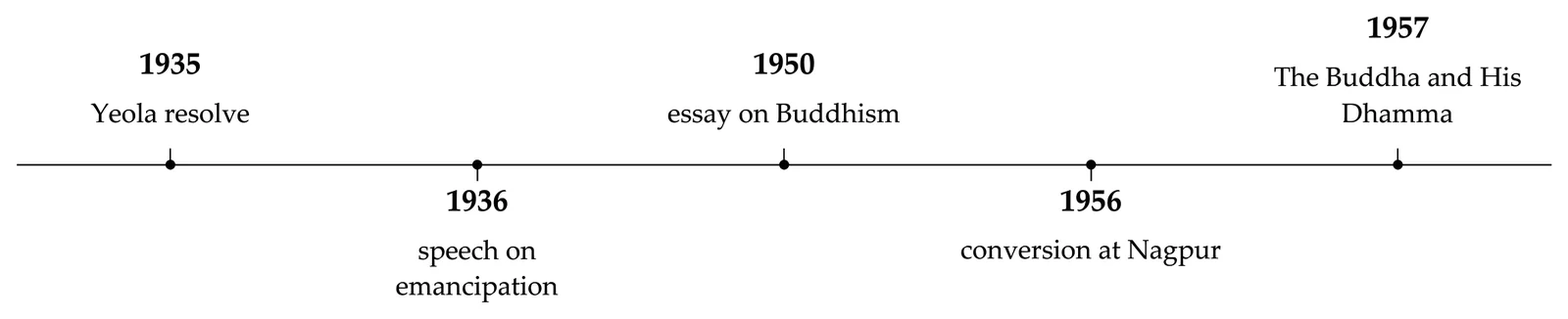
In October 1935 at Yeola, Ambedkar announced that although he had been born a Hindu, he would not die one. At the Bombay Presidency Mahar Conference in May 1936 he delivered the speech What Way Emancipation?, explaining why conversion was necessary. He argued that the conflict between touchables and untouchables was a class struggle, a permanent conflict rooted in the Hindu religion, which untouchables could not win while remaining within it. Conversion would bring both material benefits, through the strength of belonging to a community that treated them as equals, and spiritual freedom. He told his audience that religion is for man and not man for religion, and that a religion which does not treat its followers as human beings is not worth keeping.
Why Buddhism
Ambedkar studied Islam, Christianity, Sikhism and Buddhism for two decades before choosing. He preferred Buddhism because it was born in India, so conversion would not cut his people off from Indian culture; because it rejected caste, ritual and the authority of the Vedas; and because it rested on reason, morality and compassion, i.e. on liberty, equality and fraternity. In The Buddha and the Future of His Religion (1950) he argued that a religion must be in accord with science and must teach morality as a social principle. On 14 October 1956 at Nagpur he embraced Buddhism with several lakh followers and administered 22 vows rejecting Hindu deities and rituals and affirming Buddhist principles.
- Navayana. Ambedkar’s Buddhism, often called Navayana (new vehicle), reinterpreted the Buddha’s teaching as a social ethic of equality rather than mainly a path of individual renunciation.
- The Buddha and His Dhamma. His final book, published in 1957, presented Buddhism as a rational, social religion, rejecting traditional ideas of karma and rebirth as fatalistic.
- Religion and democracy. He held that democracy needs a moral foundation, and that Buddhism provides the fraternity on which democracy depends.
- Legacy. The conversion movement continues, and most of India’s Buddhists today trace their faith to it, especially in Maharashtra.
Buddhism after Ambedkar
The conversion movement continued after Ambedkar’s death in December 1956, only weeks after Nagpur. According to the Census of 2011, India had about 84 lakh Buddhists, of whom about 65 lakh lived in Maharashtra, most of them followers of Ambedkar’s Navayana. His ideas inspired Dalit literature, the Dalit Panthers (1972) and later political parties. Mass conversion events are still held, especially on the anniversary of the Nagpur ceremony, and Deekshabhoomi in Nagpur has become a major pilgrimage site.
2.4 Important Questions
- Question 1 Discuss Ambedkar’s views on caste and the origin of untouchability.
- Question 2 Discuss Ambedkar’s critique of the Hindu social order.
- Question 3 Discuss Ambedkar’s views on Islam and the Partition of India in Thoughts on Pakistan.
- Question 4 Discuss Ambedkar’s views on religion and conversion.
DU asks the same idea in different words. So learn one broad answer for each question below; the same answer works for every question joined by OR.
Important Question 1
Discuss Ambedkar’s views on caste and the origin of untouchability.
OR
Examine Ambedkar’s theory of the Broken Men.
OR
Explain Ambedkar’s distinction between caste, impurity and untouchability.
Model Answer
“Untouchability is abolished and its practice in any form is forbidden. The enforcement of any disability arising out of Untouchability shall be an offence punishable in accordance with law.”
— Constitution of India, Article 17
Introduction. Ambedkar was the foremost scholar of caste and untouchability in modern India. He explained caste as a system of graded inequality maintained by endogamy and religious sanction, and in The Untouchables (1948) he offered an original historical theory of how untouchability arose. His aim was to show that untouchability was a social creation that could be ended, a goal he later wrote into Article 17 of the Constitution.
1. Caste as a System
Ambedkar saw caste as a system of closed groups held together by endogamy, hierarchy and religious sanction.
2. Endogamy
In Castes in India (1916), he argued that endogamy, marriage within the group, is the essence of caste.
3. Control of Women
Customs such as sati, enforced widowhood and child marriage controlled women to maintain endogamy.
4. Graded Inequality
Caste is an ascending scale of reverence and a descending scale of contempt, which divides the oppressed.
5. Rejecting the Racial Theory
He rejected the view that untouchables were a separate race, finding no racial difference between castes.
6. Rejecting the Occupational Theory
He argued that unclean work alone cannot explain untouchability, since others did similar work without stigma.
7. Impurity and Untouchability
Impure persons can be purified, but untouchables cannot, so untouchability is a permanent social stigma.
8. The Broken Men
Defeated tribes became Broken Men who settled outside villages and guarded them in return for food.
9. Buddhism and Contempt
The Broken Men became Buddhists and did not respect Brahmans, who regarded them with hatred.
10. Beef-Eating
When Brahmans gave up beef and made the cow sacred, the poor Broken Men continued to eat dead cattle.
11. Birth of Untouchability
Contempt for Buddhism and beef-eating together created untouchability, which Ambedkar dated to about 400 CE.
12. Who Were the Shudras
In 1946 he argued that the Shudras were originally Kshatriyas degraded after conflict with Brahmans.
13. Social, Not Natural
His theories showed that untouchability was a historical creation, not a divine or natural order.
14. Constitutional Abolition
Article 17 abolished untouchability, enforced by laws of 1955 and 1989.
15. Continuing Practice
Despite the law, untouchability continues in forms such as denial of temple entry and separate utensils.
16. Criticism
Historians question the evidence for the Broken Men theory, but accept his central insight about social origins.
17. Caste outside India
Ambedkar noted that wherever Hindus migrate, they carry caste with them, an observation confirmed by recent debates on caste discrimination in workplaces abroad.
18. Untouchability and Space
Untouchables were made to live outside the main village, a spatial segregation that Ambedkar saw as a mark of their exclusion from the community.
19. Evaluation
Ambedkar’s analysis turned caste and untouchability from sacred order into a social problem that could be solved.
Conclusion. Thus, Ambedkar explained caste as graded inequality sustained by endogamy and untouchability as a historical product of contempt for Buddhist Broken Men. His work found its constitutional expression in Article 17, which abolishes untouchability and forbids its practice in any form.
Important Question 2
Discuss Ambedkar’s critique of the Hindu social order.
OR
Examine the essential principles of the Hindu social order according to Ambedkar.
OR
Discuss why Ambedkar considered the Hindu social order incompatible with democracy.
Model Answer
“Caste has killed public spirit. Caste has destroyed the sense of public charity. Caste has made public opinion impossible.”
— B. R. Ambedkar, Annihilation of Caste (1936)
Introduction. Ambedkar’s critique of the Hindu social order is one of the most radical in modern Indian thought. In The Hindu Social Order: Its Essential Principles, Annihilation of Caste and Riddles in Hinduism, he argued that Hindu society is built on graded inequality and the denial of individual worth, and that it is incompatible with liberty, equality and fraternity.
1. The Ideal of a Free Society
Ambedkar judged Hindu society by the ideals of liberty, equality and fraternity. In such a society, each person is treated as an end, free to develop and to share in the common life.
2. Class, Not Individual
He argued that the unit of Hindu society is the varna or class, not the individual. A person’s rights and duties depend on the varna into which he or she is born, not on personal qualities.
3. Graded Inequality
The classes are arranged in a hierarchy of graded inequality, sanctioned by religion. Unlike simple inequality, graded inequality gives almost every group someone to look down upon, which weakens resistance.
4. Fixity of Occupation
Each class has a fixed occupation passed down through generations, regardless of ability. This prevents people from choosing work suited to their talents and leaves the economy inefficient.
5. No Mobility
People are fixed within their classes, with no way of moving up through merit.
6. Denial of Individual Worth
Since worth depends on birth, the individual has no moral value of his or her own. Ambedkar saw this as the deepest injustice, since it treats a human being as a mere member of a group.
7. Denial of Liberty
Fixed occupations and rules deny freedom of choice in work, marriage and life. Liberty, for Ambedkar, means the freedom to choose one’s occupation, faith and way of life without restriction by birth.
8. Denial of Equality
Graded inequality makes inequality a principle, not an accident, of the social order.
9. Denial of Fraternity
Caste prevents a sense of common brotherhood, which is the foundation of democracy. Without fraternity, he argued, liberty and equality cannot survive, because people will not respect each other’s rights.
10. Loss of Public Spirit
Ambedkar argued that caste has killed public spirit, public charity and public opinion.
11. Religious Sanction
The Shastras give divine sanction to caste, making it harder to reform than mere custom. He argued that because caste is believed to be ordained by God, Hindus obey it out of religious duty rather than mere habit.
12. Riddles in Hinduism
In Riddles in Hinduism, he exposed contradictions in Hindu texts to undermine their authority.
13. Burning the Manusmriti
At Mahad in 1927, he burned the Manusmriti as a symbol of the law of inequality. The act declared that the untouchables rejected the authority of a text that prescribed their degradation.
14. Gandhi’s Disagreement
Gandhi defended varna as a division of duties, while Ambedkar saw it as the root of caste.
15. Incompatibility with Democracy
Ambedkar concluded that political democracy cannot survive on a social order of graded inequality. He warned in 1949 that India was entering a life of contradictions, with equality in politics and inequality in social life.
16. Criticism
Critics argue that he overlooked reformist and egalitarian strands within Hindu traditions.
17. Philosophy of Hinduism
In Philosophy of Hinduism, Ambedkar tested Hindu religion against the standards of justice and utility and concluded that it failed both, since it did not treat all as equal.
18. Brahmanism and Capitalism
Ambedkar called Brahmanism and capitalism the two enemies of the workers, linking social hierarchy with economic exploitation.
19. Evaluation
His critique remains a powerful challenge to every hierarchy that denies individual dignity.
Conclusion. Thus, Ambedkar argued that the Hindu social order rests on class rather than the individual, graded inequality and fixed occupations, denying liberty, equality and fraternity. As he said, caste has killed public spirit and made public opinion impossible, which is why social democracy must precede political democracy.
Important Question 3
Discuss Ambedkar’s views on Islam and the Partition of India in Thoughts on Pakistan.
OR
Examine Ambedkar’s analysis of the demand for Pakistan.
OR
Discuss Ambedkar’s views on nationhood and the Hindu-Muslim question.
Model Answer
“I would like to see the Punjab, North-West Frontier Province, Sind and Baluchistan amalgamated into a single State.”
— Muhammad Iqbal, Presidential Address to the Muslim League, Allahabad (1930)
Introduction. After the Lahore Resolution of 1940, Ambedkar wrote Thoughts on Pakistan, revised in 1945 as Pakistan or the Partition of India. It examined the demand for Pakistan with rare thoroughness, weighing history, religion, defence and the experience of other states. His approach was realistic: he treated nationhood as a matter of feeling and asked what arrangement would give India a strong and stable state.
1. Background
Iqbal’s 1930 address and the Lahore Resolution of March 1940 placed the demand for a Muslim state at the centre of politics.
2. A Judge’s Approach
Ambedkar presented the cases for and against Pakistan as a judge might, examining all sides. He set out the Muslim case, the Hindu case and possible alternatives before reaching conclusions.
3. Nationhood as Feeling
He argued that a nation is a consciousness of kind, so if Muslims felt themselves a nation, that feeling mattered. He drew on the French thinker Ernest Renan, who described the nation as a daily plebiscite based on shared memories and will.
4. History of Conflict
He traced the history of Hindu-Muslim relations and the failure of attempts at unity.
5. Weak Union
He warned that a union of unwilling groups might produce a weak state paralysed by conflict. He compared India with states such as Austria-Hungary, where unwilling nationalities had weakened the state.
6. Defence Concerns
He examined the composition of the army and argued that a state cannot rely on an army of divided loyalty.
7. Redrawing Boundaries
He proposed redrawing the boundaries of Punjab and Bengal so that non-Muslim majority areas stayed in India.
8. Exchange of Population
He suggested an organised exchange of population, citing the Greek-Turkish exchange of 1923. He argued that an organised exchange, though painful, might prevent greater violence later, a view that proved tragically relevant in 1947.
9. Critique of Communalism
He criticised both Hindu and Muslim communal politics and their use of religion for power.
10. Social Evils among Muslims
He criticised purdah and caste-like divisions among Muslims, showing his consistent social critique.
11. Concern for Untouchables
He feared that a Hindu-Muslim settlement would ignore the untouchables, who needed their own safeguards.
12. Minorities and Safeguards
He insisted that any settlement must protect all minorities through constitutional safeguards.
13. Realism
His analysis treated partition as a political problem of nationality and security, not only a moral question.
14. Partition in 1947
Partition came with terrible violence and mass migration, some of which Ambedkar had foreseen.
15. Relevance
His work remains a key source for understanding nationalism, minorities and partition in South Asia.
16. Criticism
Critics say his acceptance of partition and population exchange underestimated the human cost.
17. Comparative Examples
Ambedkar drew on the break-up of empires and the experience of states such as Czechoslovakia and Turkey to show how nationalities had been handled elsewhere.
18. A Study, not a Brief
Ambedkar stressed that his book was a study of the problem rather than advocacy, though readers on all sides used it to support their positions.
19. Evaluation
Thoughts on Pakistan shows Ambedkar as a realist analyst of nationalism and a defender of minorities.
Conclusion. Thus, responding to the demand first voiced by Iqbal and adopted at Lahore, Ambedkar examined Pakistan with realism, treating nationhood as feeling and weighing unity against stability. His concern for minorities and a strong state shaped his conclusions.
Important Question 4
Discuss Ambedkar’s views on religion and conversion.
OR
Discuss why Ambedkar chose Buddhism.
OR
Examine Ambedkar’s argument in What Way Emancipation.
Model Answer
“Religion is for man and not man for religion.”
— B. R. Ambedkar, What Way Emancipation? (1936)
Introduction. Ambedkar concluded that untouchables could not gain equality within Hinduism. In 1935 he declared that he would not die a Hindu, and in 1936 he explained in What Way Emancipation? why conversion was necessary. After two decades of study, he embraced Buddhism in 1956, reinterpreting it as a rational and social religion of liberty, equality and fraternity.
1. Yeola Declaration
At Yeola in 1935, Ambedkar declared that although born a Hindu, he would not die one. He said that being born a Hindu was beyond his control, but dying one was within his power to refuse.
2. What Way Emancipation
In 1936 he explained to a Mahar conference that conversion was the way to emancipation. He argued that untouchables had tried every means within Hinduism for centuries without gaining equality.
3. A Class Struggle
He described the conflict between touchables and untouchables as a permanent class struggle rooted in religion. Because the struggle was permanent, he believed that only leaving the religion could end it.
4. Material Emancipation
Conversion would give untouchables the strength of a community that treated them as equals. Isolated and weak, untouchables suffered boycott and violence; joining a larger community would give them strength and support.
5. Spiritual Emancipation
Conversion would free them from a religion that denied their humanity. He held that people need a religion that recognises their dignity and helps them grow as moral beings.
6. Religion for Man
He insisted that religion is for man and not man for religion. A religion that denies people education, wealth and dignity, he said, is not a religion but a punishment.
7. Criteria for Religion
He judged religions by whether they promote liberty, equality and fraternity and accord with reason. He also required that a religion recognise the equality of all and the freedom of the individual.
8. Considering Options
He studied Islam, Christianity and Sikhism before choosing Buddhism. He received invitations from leaders of several faiths, but took his time to find one consistent with his principles.
9. Why Buddhism
Buddhism was Indian, rejected caste and ritual, and rested on reason, morality and compassion. He admired the Buddha as a teacher who appealed to reason and experience rather than to divine authority.
10. Avoiding Denationalisation
Choosing an Indian religion meant converts would not be cut off from Indian culture. He believed that conversion to Buddhism would least disturb the culture and traditions of the country.
11. The Nagpur Conversion
On 14 October 1956 at Nagpur, he embraced Buddhism with several lakh followers. He received initiation from the monk Chandramani and then himself initiated his followers.
12. The 22 Vows
He administered 22 vows rejecting Hindu deities and rituals and affirming Buddhist ethics. The vows included rejecting belief in Hindu gods, rejecting caste and inequality, and promising to follow the Buddha’s eightfold path.
13. Navayana
His Navayana Buddhism reinterpreted the Buddha’s teaching as a social ethic of equality. He emphasised the Buddha’s concern with suffering caused by social injustice, not only personal desire.
14. The Buddha and His Dhamma
His final book presented Buddhism as rational and social, rejecting fatalistic ideas of karma.
15. Religion and Democracy
He believed democracy needs a moral foundation of fraternity, which Buddhism provides. For him, fraternity was another name for democracy, and religion could cultivate it by teaching respect for all.
16. Criticism
Critics argue that conversion did not end caste discrimination against converts, and traditional Buddhists questioned his reinterpretation.
17. Conversion and Identity
Ambedkar saw conversion as a way to give untouchables a new, dignified identity, free from the stigma attached to them in the caste order.
18. Buddhism and Marxism
In Buddha or Karl Marx, Ambedkar argued that the Buddha sought equality through moral persuasion and democracy, while Marx relied on violence and dictatorship, which he rejected.
19. Evaluation
Ambedkar’s conversion was a political, social and spiritual act seeking dignity outside the caste order.
Conclusion. Thus, Ambedkar believed that religion is for man and not man for religion. Finding no equality in Hinduism, he chose Buddhism as a rational religion of liberty, equality and fraternity, and his conversion in 1956 remains a landmark in the search for dignity.
Short Notes
(a) Broken Men
In Ambedkar’s theory, scattered survivors of defeated tribes who settled outside villages, became Buddhists and continued eating beef, and were later treated as untouchables.
(b) Navayana
The name often given to Ambedkar’s reinterpretation of Buddhism as a rational social ethic of equality, adopted at the Nagpur conversion of 1956.
(c) Thoughts on Pakistan
Ambedkar’s 1940 study of the demand for Pakistan, revised in 1945, which examined nationhood, defence and minorities with a realist approach.
(d) Communal majority
Ambedkar’s term in States and Minorities (1947) for a majority fixed by birth in a religious or caste community, as opposed to a political majority formed by opinion; he argued that it made constitutional safeguards for minorities necessary.
More notes: MDSE-3b Understanding Ambedkar
These notes are prepared by PADHO TO AISE for study help. They are not an official University of Delhi publication.