
Semester V MDSC-5B Modern Indian Political Thought
Unit IV · 20 min read · Updated 24 Nov 2026
As per the University of Delhi (DU) BA (Hons) Political Science syllabus
Contents
- 4.1 Rammohan Roy: Rights and Constitutional Liberalism
- 4.2 Rammohan Roy: Social Reform and the Rights of Women
- 4.3 Tarabai Shinde: A Comparison between Women and Men
- 4.4 Important Questions
- Discuss Rammohan Roy’s ideas on rights and constitutional liberalism.
- Examine the social implications of Rammohan Roy’s political thought.
- Discuss Tarabai Shinde’s critique of gender relations in colonial India.
- Short Notes
सभी मनुष्य जन्म से स्वतंत्र हैं और गरिमा तथा अधिकारों में समान हैं।
All human beings are born free and equal in dignity and rights.
— Universal Declaration of Human Rights, Article 1 (1948)
THE language of rights entered Indian political thought in the nineteenth century, long before independence. Under colonial rule, Indian thinkers began to claim freedom of the press, equality before the law, property rights and the rights of women. Raja Rammohan Roy (1772–1833), often called the father of modern India, combined reason, religious reform and liberal constitutional ideas to demand civil rights from the colonial state and reform from Hindu society. Half a century later, Tarabai Shinde, a woman from Berar, wrote Stri Purush Tulana (1882), a fierce attack on the double standards that men applied to women. This unit studies these two very different voices of rights.

4.1 Rammohan Roy: Rights and Constitutional Liberalism
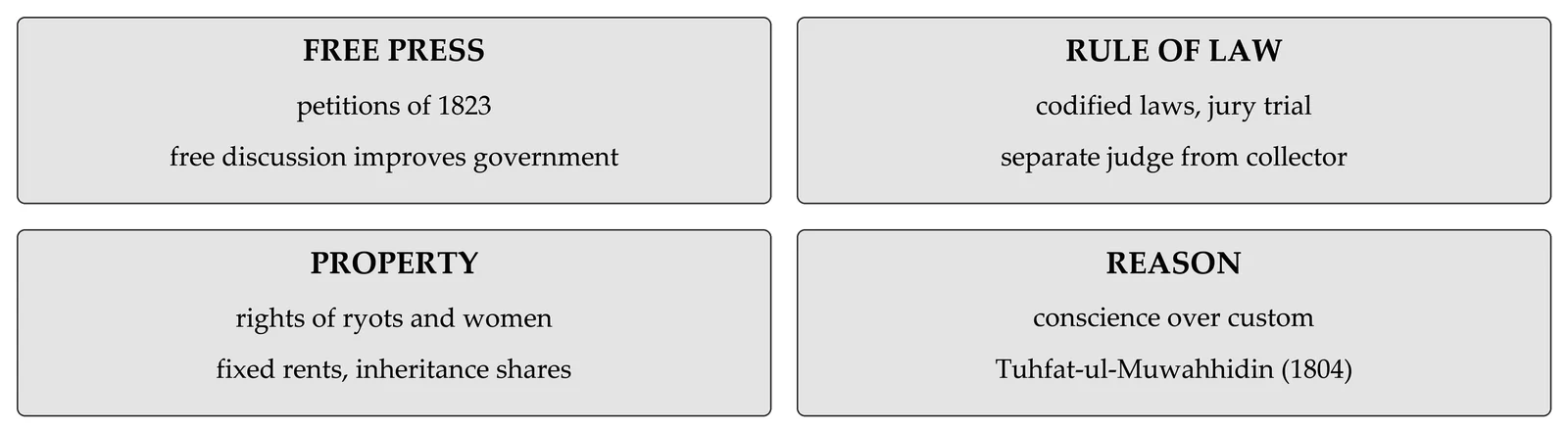
Rammohan Roy was a scholar of Persian, Arabic, Sanskrit and English who worked for the East India Company before settling in Calcutta in 1814–15. His first major work, Tuhfat-ul-Muwahhidin (A Gift to Monotheists, 1804), written in Persian, defended reason and monotheism against superstition. He founded newspapers, the Bengali Sambad Kaumudi (1821) and the Persian Mirat-ul-Akhbar (1822), and used petitions, pamphlets and evidence to the British Parliament to argue for the rights of Indians under colonial rule.
C.A. Bayly, in ‘Rammohan Roy and the Advent of Constitutional Liberalism in India, 1800–30’, argues that Rammohan was India’s first constitutional liberal. He demanded freedom of the press, trial by jury without religious distinction, the rule of law through codified laws, the separation of judicial from revenue functions, secure property for ryots and women, and the employment of Indians in government. Bayly places him in a global liberal moment: Rammohan celebrated the liberal revolutions of Spain and Latin America and drew on Indian as well as European sources.
4.2 Rammohan Roy: Social Reform and the Rights of Women
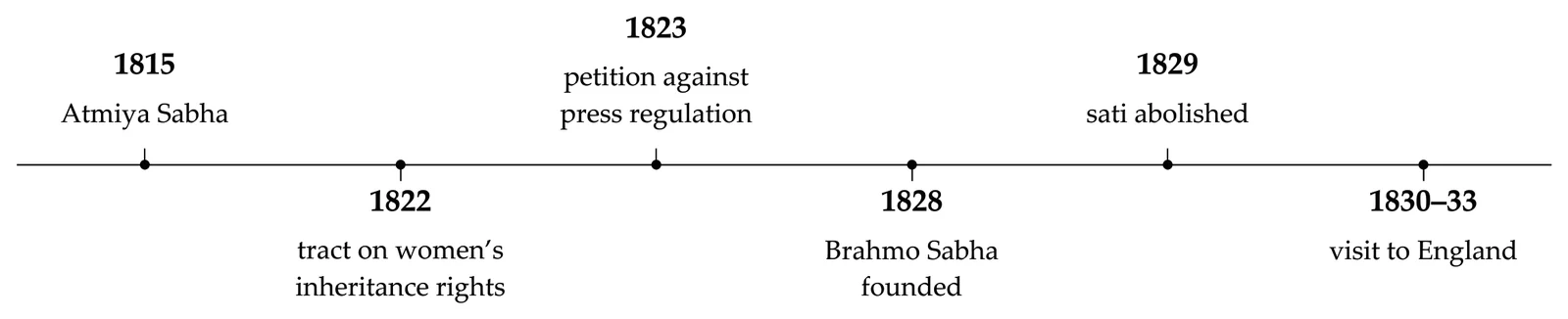
For Rammohan, political rights required social reform. He attacked idolatry, priestly authority and caste rigidity, and argued from the Upanishads that true Hinduism was rational monotheism. He campaigned against sati, writing tracts in 1818 and 1820 that showed the shastras did not require it; Lord William Bentinck abolished the practice by Regulation XVII of 1829. In Brief Remarks Regarding Modern Encroachments on the Ancient Rights of Females (1822), he argued that ancient Hindu law gave widows and daughters a share of property, which later practice had taken away.
He also supported modern education. In his letter to Lord Amherst (1823), he urged the government to teach mathematics, natural philosophy and chemistry rather than found a Sanskrit college. S. Mukherjee examines the social implications of his political thought, and Thomas Pantham studies his socio-religious thought: reason and individual conscience were to replace custom as the test of social practice. Critics note that his reform remained largely elitist and that he accepted British rule as beneficial for India.
4.3 Tarabai Shinde: A Comparison between Women and Men
Tarabai Shinde (c. 1850–1910) was born in Buldhana in Berar. Her father, Bapuji Hari Shinde, was a member of Jotirao Phule’s Satyashodhak Samaj and educated her at home. In 1882 she published Stri Purush Tulana (A Comparison between Women and Men) in Marathi. The occasion was the case of Vijayalakshmi, a young Brahmin widow in Surat sentenced to death in 1881 for killing her newborn child; the sentence was later commuted. Newspapers blamed the widow’s wickedness. Tarabai asked why women alone were blamed, when men committed the same vices more often and created the conditions of widows’ misery.

Rosalind O’Hanlon, who translated the text, argues in her introduction that it is one of the first modern Indian texts to criticise patriarchy as a general system across all castes, not just a single custom such as sati or child marriage. Tarabai used satire and examples from the epics to expose the double standards of virtue, attacked the treatment of widows and the ideal of the pativrata, and mocked English-educated men who preached reform but behaved badly at home. Phule praised the book, but it was otherwise ignored for decades.
4.4 Important Questions
- Question 1 Discuss Rammohan Roy’s ideas on rights and constitutional liberalism.
- Question 2 Examine the social implications of Rammohan Roy’s political thought.
- Question 3 Discuss Tarabai Shinde’s critique of gender relations in colonial India.
DU asks the same idea in different words. So learn one broad answer for each question below; the same answer works for every question joined by OR.
Important Question 1
Discuss Rammohan Roy’s ideas on rights and constitutional liberalism.
OR
Examine C.A. Bayly’s view of Rammohan Roy as a constitutional liberal.
OR
Discuss Rammohan Roy’s arguments for the freedom of the press.
Model Answer
“Every good Ruler, who is convinced of the imperfection of human nature, and reverences the Eternal Governor of the world, must be conscious of the great liability to error in managing the affairs of a vast empire.”
— Rammohan Roy and others, Memorial to the Supreme Court against the Press Regulation (1823)
Introduction. Rammohan Roy was the first major Indian thinker to use the language of rights against the colonial state. Through petitions, newspapers and evidence to the British Parliament, he demanded freedom of the press, equality before the law, jury trial, secure property and a share for Indians in government. C.A. Bayly describes him as the founder of constitutional liberalism in India.
1. Life and Context
Rammohan was born in 1772 into a Brahmin family of Bengal. He learnt Persian and Arabic, then Sanskrit and English, and worked for the East India Company until about 1814. In Calcutta he became a reformer, writer and public figure, at a time when the Company was consolidating its rule and Christian missionaries and Orientalists were debating Indian society.
2. Reason as the Foundation
His Persian work Tuhfat-ul-Muwahhidin (1804) argued that reason, not custom or authority, should judge beliefs and practices. This rationalism, shaped by Islamic theology, Vedanta and European Enlightenment thought, underpinned his politics: individuals have a conscience and a capacity to reason that the state and society must respect.
3. Freedom of the Press
When the acting Governor-General John Adam issued the Press Ordinance of 1823, requiring newspapers to obtain licences, Rammohan and other Calcutta citizens petitioned the Supreme Court and then the King in Council. They argued that a free press informs the rulers of abuses, prevents rebellion and improves government. When the petitions failed, he closed Mirat-ul-Akhbar in protest. The memorial has often been compared to Milton’s Areopagitica.
4. Rule of Law
Rammohan wanted the rule of law to replace arbitrary power. He argued for codified, published laws known to all subjects, independent courts, and the separation of the judge from the revenue collector, so that the same official would not both collect taxes and decide disputes about them.
5. Equality before Law and Jury Trial
Rammohan opposed the Jury Act of 1826, which introduced religious distinctions in the selection of jurors and denied Hindus and Muslims equal status with Christians. He organised petitions to Parliament, arguing that subjects of the same government must be equal before its courts whatever their religion.
6. Property Rights
In his evidence to the Select Committee of the House of Commons (1831–32), Rammohan criticised the effects of the Permanent Settlement on the ryots. He urged that their rents be fixed so that cultivators, not only zamindars, would enjoy secure property. He also defended women’s rights of inheritance.
7. Indians in Government
Rammohan asked that Indians be employed in higher offices and that native assessors sit with judges. He believed that participation would make government better informed and more just, and would prepare Indians for a larger share in governing their own country.
8. A Global Liberal
Bayly shows that Rammohan saw himself as part of a worldwide struggle for constitutional freedom. He celebrated the liberal revolutions in Spain and Latin America, followed Irish and British reform debates, and supported the Reform Bill in Britain. India’s rights were, for him, part of universal human rights.
9. Indian Sources of Liberalism
Bayly stresses that Rammohan’s liberalism was not simply borrowed from Europe. He drew on Vedantic monotheism, Islamic rationalism and Indian ideas of just rule, and argued that ancient Indian law had protected rights, such as women’s property, that later custom had destroyed.
10. Liberalism under Colonial Rule
Rammohan accepted British rule as, on the whole, beneficial, and sought rights within it rather than independence. He hoped that British connection would bring modern knowledge and constitutional government. This made his liberalism moderate and reformist, a model later followed by the early Congress moderates.
11. Limitations
Critics argue that Rammohan spoke mainly for the educated Bengali elite and propertied classes. His demands did not extend to universal political rights, and his faith in British justice was later questioned by nationalists who saw colonial rule as exploitative.
12. Evaluation
Rammohan Roy introduced the idea that Indians possess rights that even a foreign government must respect. His demands for a free press, equality before law, the rule of law and secure property anticipated the fundamental rights of the Indian Constitution, which is why he is often called the father of modern India.
Conclusion. Thus, Rammohan Roy combined reason, Indian traditions and global liberal ideas to demand freedom of the press, equality before law, jury trial, property rights and Indian participation in government. As Bayly argues, he was the founder of constitutional liberalism in India, though within the limits of his time.
Important Question 2
Examine the social implications of Rammohan Roy’s political thought.
OR
Discuss Rammohan Roy’s views on the rights of women.
OR
Assess Rammohan Roy as a social and religious reformer.
Model Answer
“The practice of Suttee, or of burning or burying alive the widows of Hindoos, is hereby declared illegal, and punishable by the criminal courts.”
— Bengal Regulation XVII of 1829, Section II
Introduction. Rammohan Roy believed that political freedom and good government required a reformed society. His political ideas of reason, conscience and rights had direct social implications: the reform of religion, the abolition of sati, the property rights of women, modern education and the questioning of caste. S. Mukherjee and Thomas Pantham study these social dimensions of his thought.
1. Link between Politics and Society
Rammohan argued that superstition, idolatry and caste divisions had weakened Indian society and made it unfit for political progress. He once wrote that the Hindu religious system was not well calculated to promote their political interest, because caste divided the people. Social reform was therefore the precondition of political advance.
2. Religious Reform
Rammohan translated the Upanishads into Bengali and English to show that the original Hindu scriptures taught the worship of one formless God. He criticised idolatry and the authority of priests. His Atmiya Sabha (1815) and Brahmo Sabha (1828) promoted rational, monotheistic worship open to all. He also wrote The Precepts of Jesus (1820), which presented the moral teachings of Christianity while rejecting miracles and the Trinity, and led to a controversy with the missionaries of Serampore. He respected the ethical core of every religion and believed that reason could identify it.
3. Reason and Conscience
Pantham shows that Rammohan made individual reason and conscience the test of religious and social practice. Customs that caused suffering, however old, had no moral authority. This principle gave reformers a weapon against practices defended in the name of tradition.
4. Campaign against Sati
Rammohan’s tracts of 1818 and 1820, written as a conference between an advocate and an opponent of sati, argued that the shastras did not require widows to burn and that the practice was often forced. His campaign helped Bentinck abolish sati by Regulation XVII of 4 December 1829. In England he opposed the orthodox appeal against abolition, which the Privy Council rejected in 1832.
5. Women’s Property Rights
In his 1822 tract on the ancient rights of females, Rammohan argued that the ancient lawgivers had given widows and daughters a share of family property. Modern practice had taken this away, leaving widows dependent and helpless, and this dependence was one reason why some were pushed into sati. Restoring property rights would give women security and dignity.
6. Other Rights of Women
Rammohan criticised polygamy and the sale of girls in marriage, supported women’s education and condemned the denial of women’s intelligence. He argued that women were not inferior in understanding; they lacked only the opportunities that men enjoyed.
7. Modern Education
In his letter to Lord Amherst of 11 December 1823, Rammohan opposed the founding of a Sanskrit college and urged the government to promote mathematics, natural philosophy, chemistry and anatomy. He helped establish schools in Calcutta and believed that scientific education would free minds from superstition.
8. Caste
Rammohan criticised caste for dividing Indians and blocking unity and patriotism. He did not, however, launch a direct movement against caste, and his reform remained focused on religious belief and the condition of high-caste women. The trust deed of the Brahmo Sabha’s building (1830) opened worship to all sorts and descriptions of people without distinction, a small but real challenge to caste exclusion in religious life.
9. Mukherjee’s Assessment
S. Mukherjee argues that the significance of Rammohan’s political thought lies in its social implications: by making reason and individual rights the test of custom, it opened the way for later reform movements, the questioning of patriarchy and the growth of a public sphere of debate through newspapers and associations.
10. Influence
Rammohan inspired the Brahmo Samaj under Debendranath Tagore and Keshub Chandra Sen, the reform movements of Bengal and western India, and later campaigns for widow remarriage and women’s education. Reformers such as Ishwar Chandra Vidyasagar continued his method of reinterpreting scripture to justify reform.
11. Criticisms
Critics argue that Rammohan’s reform was elitist, confined to upper-caste Bengali society, and that it relied on colonial legislation, which allowed the British to present themselves as saviours of Indian women. Feminist scholars note that the sati debate often treated women as objects of the debate rather than as speakers.
12. Evaluation
Despite these limits, Rammohan was the first to connect religious reform, women’s rights, education and political liberty in a single programme. His thought gave modern Indian reform its basic method: reason and humanity as the tests of tradition.
Conclusion. Thus, Rammohan Roy’s political thought had far-reaching social implications. He reformed religion, campaigned against sati, defended women’s property rights, promoted modern education and criticised caste, laying the foundations of social reform in modern India.
Important Question 3
Discuss Tarabai Shinde’s critique of gender relations in colonial India.
OR
Examine the significance of Tarabai Shinde’s Stri Purush Tulana.
OR
How did Tarabai Shinde expose the double standards of patriarchy? Discuss with reference to Rosalind O’Hanlon.
Model Answer
“The State shall not discriminate against any citizen on grounds only of religion, race, caste, sex, place of birth or any of them.”
— Constitution of India, Article 15(1)
Introduction. Tarabai Shinde’s Stri Purush Tulana (1882) is one of the earliest and boldest feminist texts in modern India. Written in Marathi by a woman from a small town in Berar, it attacked not a single custom but the whole structure of male power and its double standards. Rosalind O’Hanlon’s translation and introduction brought this forgotten text to wide attention.
1. Life of Tarabai Shinde
Tarabai was born around 1850 in Buldhana in Berar, in a Maratha family. Her father, Bapuji Hari Shinde, an official and a member of Phule’s Satyashodhak Samaj, taught her Marathi, Sanskrit and English at home. She married young, and her husband lived in her father’s household. She had no children and lived in Buldhana until her death in 1910.
2. Context: Reform in Maharashtra
Nineteenth-century Maharashtra saw intense debate on the condition of women, especially high-caste widows, who could not remarry, were often tonsured and lived in hardship. Jotirao Phule’s Satyashodhak Samaj (1873) attacked Brahmin domination, while reformers debated widow remarriage and women’s education.
3. The Occasion
In 1881 Vijayalakshmi, a young Brahmin widow from Surat, was convicted of killing her newborn child and sentenced to death, later commuted to transportation for life. Newspapers used the case to condemn the immorality of women. Tarabai responded that the real culprits were the men who seduced and abandoned widows and the customs that left widows helpless.
4. The Central Argument
Tarabai turned the usual charge against women upside down. Men accused women of deceit, lust and wickedness, but men themselves were more often deceitful, unfaithful, drunk and cruel. Society punished women for faults that it excused in men. Her aim was to show that the vices blamed on women were in fact male vices. The book is organised as a sustained comparison of the conduct of women and men, setting each accusation made against women beside the record of men.
5. Double Standards
Tarabai showed how men made rules that bound women but not themselves. A widower could remarry at once, but a widow had to live a life of mourning and was blamed if she fell. A husband could be unfaithful, but a wife was expected to worship him as a god. A man could drink, gamble and visit prostitutes and still be respected, while a woman suspected of a single lapse lost her honour and her family’s protection. The same act was judged by two moralities, one for each sex.
6. Critique of Religious Authority
Tarabai questioned the shastras and the epics, which she said were written by men to serve men. Using stories of gods, sages and heroes, she showed that male figures behaved worse than the women they condemned, and she rejected the ideal of the pativrata, the wife whose only duty is devotion to her husband. If women were really as wicked as these texts claimed, she argued, the fault lay with the men who wrote the texts and controlled women’s lives.
7. Across Castes
O’Hanlon emphasises that Tarabai’s critique applied to men of all castes, not only Brahmins. While the Satyashodhak movement attacked Brahmin power, Tarabai showed that non-Brahmin men also oppressed women. She thus treated women as a group with common interests, a step towards a general critique of patriarchy.
8. Critique of the New Men
Tarabai mocked English-educated men who adopted Western dress and talked of reform but continued to dominate women at home. She also criticised the colonial courts for punishing women while letting men escape. Reform, for her, had to change men’s conduct, not only women’s condition.
9. Widows and the Family
Tarabai described the life of a high-caste widow vividly: her head shaved, her ornaments removed, she was made to labour in the house and treated as inauspicious. Young widows, denied every pleasure and protection, were exposed to the advances of men in their own households. When such a widow became pregnant, she alone was condemned and punished while the man walked free. Society, not the widow, bore the guilt.
10. Comparison with Other Reformers
Male reformers in Maharashtra argued for widow remarriage by citing the shastras and appealing to men’s compassion. Tarabai did not ask men for permission or seek scriptural support; she put men themselves on trial. Unlike Phule, she made gender rather than caste her central theme. Jayant Lele places her within an emerging gender consciousness in mid-nineteenth-century Maharashtra, but her direct attack on men as a group was unusual.
11. Style
The text is satirical, angry and witty, written in colloquial Marathi and addressed directly to men. O’Hanlon notes that this polemical style was itself radical: a woman claimed the right to speak in public and judge men, at a time when women were expected to be silent.
12. Reception
The book provoked hostile reviews. Phule praised it in his journal Satsar (1885) and defended Tarabai, but the text was largely forgotten until scholars rediscovered it in the twentieth century. O’Hanlon’s translation made it a classic of Indian feminist thought.
13. Significance for Rights
Tarabai’s argument implies equal moral standards and equal dignity for women and men. It anticipates later demands for equal rights in marriage, property and law, and the constitutional guarantee against discrimination on grounds of sex. Pandita Ramabai’s The High-Caste Hindu Woman (1887) carried similar concerns.
14. Evaluation
Tarabai Shinde moved the debate from pity for women to a critique of men’s power. Though limited in circulation in her time, her text is now recognised as a pioneering statement of feminist political thought in India and a reminder that rights must extend into the household.
Conclusion. Thus, Tarabai Shinde’s Stri Purush Tulana exposed the double standards of patriarchy, questioned religious authority, criticised men of all castes and claimed for women the right to judge men. As O’Hanlon shows, it marks a turning point in the history of gender and rights in India.
Short Notes
(a) Brahmo Samaj
A reform society that grew out of the Brahmo Sabha founded by Rammohan Roy in Calcutta in 1828. It taught the worship of one formless God, rejected idolatry and priestly ritual, and supported women’s education and social reform. Debendranath Tagore and Keshub Chandra Sen later led it, and it influenced reform across India.
(b) Press Regulation of 1823
An ordinance issued by the acting Governor-General John Adam requiring every newspaper to obtain a government licence. Rammohan Roy and other citizens of Calcutta petitioned the Supreme Court and the King in Council against it, arguing that a free press improves government. Both petitions were rejected, and Rammohan closed his Persian paper Mirat-ul-Akhbar.
(c) Satyashodhak Samaj
The Truth-Seekers’ Society founded by Jotirao Phule in Pune in 1873. It opposed Brahmin domination, priestly ritual and caste inequality, and promoted education for the lower castes and women. Tarabai Shinde’s father was a member, and Phule defended her book.
(d) Pandita Ramabai
Ramabai (1858–1922), a Sanskrit scholar from Maharashtra, wrote The High-Caste Hindu Woman (1887) on the oppression of child brides and widows. She founded the Sharada Sadan, a home and school for widows, in 1889, and later the Mukti Mission at Kedgaon. Uma Chakravarti and Gail Omvedt study her as a radical critic of Brahmanical patriarchy.
More notes: MDSC-5B Modern Indian Political Thought
These notes are prepared by PADHO TO AISE for study help. They are not an official University of Delhi publication.