
Semester VII DSC-19 Themes in Western Political Philosophy
Unit III · 22 min read · Updated 24 Nov 2026
As per the University of Delhi (DU) BA (Hons) Political Science syllabus
Contents
- 4.1 Liberal Utilitarianism
- 4.2 Liberty
- 4.3 Suffrage and the Defence of Democracy
- 4.4 The Subjection of Women
- 4.5 Important Questions
- How did J.S. Mill revise Bentham’s utilitarianism?
- Examine Mill’s defence of liberty in On Liberty.
- Discuss Mill’s views on representative government, suffrage and democracy.
- Discuss Mill’s arguments in The Subjection of Women.
- Short Notes
अपने ऊपर, अपने शरीर और मन पर, व्यक्ति संप्रभु है।
Over himself, over his own body and mind, the individual is sovereign.
— John Stuart Mill, On Liberty (1859)
JOHN Stuart Mill (1806–1873) was the most influential English philosopher of the nineteenth century and a founder of modern liberalism. Brought up by his father James Mill and Jeremy Bentham to be a champion of utilitarianism, he transformed it into a philosophy of human development. In On Liberty (1859) he defended individual freedom against the state and against the tyranny of social opinion; in Considerations on Representative Government (1861) he argued for representative democracy and an extended suffrage; and in The Subjection of Women (1869) he called for perfect equality between the sexes. This unit studies his liberal utilitarianism, his ideas of liberty, suffrage and democracy, and his feminism, drawing on John Rawls, H.B. Acton, Henry Magid and Paul Kelly.
4.1 Liberal Utilitarianism
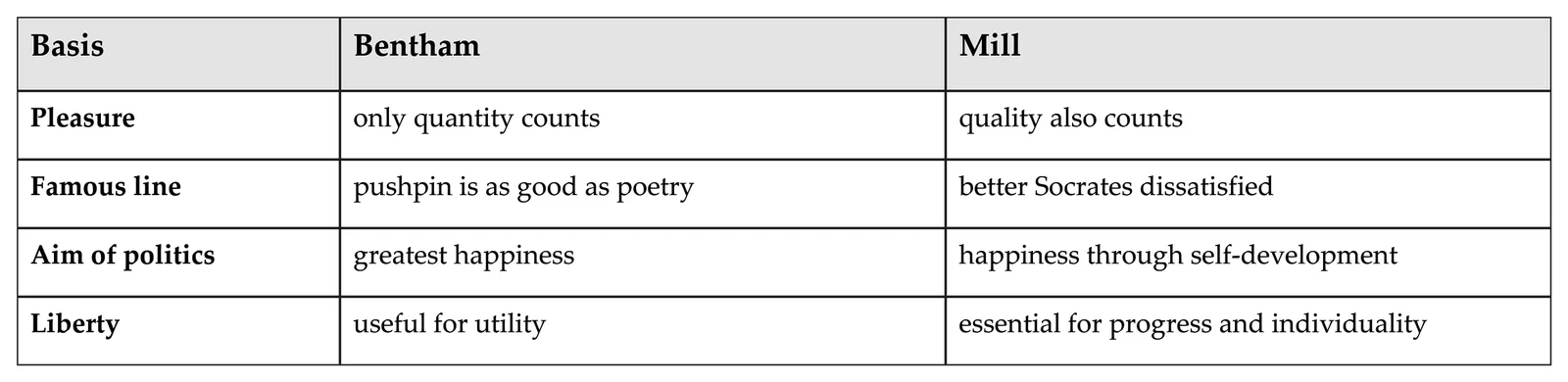
Utilitarianism, as developed by Jeremy Bentham, held that actions are right in so far as they promote the greatest happiness of the greatest number, and that happiness means pleasure and the absence of pain. Bentham measured pleasures only by quantity: pushpin, a simple game, was as good as poetry if it gave equal pleasure. Mill, after a mental crisis in his twenties, came to value poetry, feeling and individual development, and in Utilitarianism (1861) he revised Bentham’s doctrine.
Mill distinguished higher pleasures, of the intellect, feelings, imagination and moral sentiments, from lower bodily pleasures, and argued that quality as well as quantity matters: it is better to be a human being dissatisfied than a pig satisfied, better to be Socrates dissatisfied than a fool satisfied. Competent judges who have experienced both prefer the higher. John Rawls reads Mill’s view as a liberal utilitarianism grounded in the permanent interests of human beings as progressive beings, which explains why liberty and self-development are so central to it.
4.2 Liberty
In On Liberty, Mill feared not only government oppression but the tyranny of the majority and of social opinion, which can enslave the soul more deeply than law. He proposed the harm principle: the only purpose for which power can rightfully be exercised over any member of a civilised community, against his will, is to prevent harm to others. A person’s own good is not sufficient warrant. In self-regarding conduct, the individual is sovereign; only other-regarding conduct that harms others may be restricted.

Mill defended freedom of thought and discussion on the grounds that a silenced opinion may be true, may contain part of the truth, and that even a true opinion, if unchallenged, becomes a dead dogma. He defended individuality, the free development of each person’s character, as essential to human well-being and social progress. Paul Kelly shows how Mill grounded liberty in utility, and critics debate whether the harm principle is clear and whether Mill’s liberalism excluded colonised peoples, whom he considered not yet ready for liberty.
4.3 Suffrage and the Defence of Democracy
In Considerations on Representative Government (1861), Mill argued that the ideally best form of government is representative government, in which sovereignty rests with the whole community and every citizen has a voice and occasionally takes part in government. Good government should both use the existing good qualities of the people and improve them; participation educates citizens, making them active, intelligent and public-spirited.

Mill favoured an extended suffrage, including women, but with qualifications: voters should be able to read, write and do arithmetic and pay taxes, and the more educated should have plural votes. He supported proportional representation through Thomas Hare’s system to protect minorities, and preferred open to secret voting, as a public trust. He feared class legislation by an uneducated majority and the tyranny of the majority, and sought institutions that would combine democracy with competence.
4.4 The Subjection of Women
In The Subjection of Women (1869), influenced by his wife Harriet Taylor, Mill argued that the legal subordination of one sex to the other is wrong in itself and one of the chief obstacles to human improvement, and should be replaced by perfect equality. Married women were in a condition of legal slavery: they could not own property, had no rights over their children and could not escape abusive husbands. What is called the nature of women is an artificial product of their education and circumstances.

Mill demanded equal rights in marriage, property, education, professions and the vote. As an MP in 1867, he moved to give women the vote by changing ‘man’ to ‘person’ in the Reform Bill; the amendment was defeated, but it launched the parliamentary campaign for women’s suffrage. Feminist critics note that he still assumed most women would choose domestic life.
4.5 Important Questions
- Question 1 How did J.S. Mill revise Bentham’s utilitarianism?
- Question 2 Examine Mill’s defence of liberty in On Liberty.
- Question 3 Discuss Mill’s views on representative government, suffrage and democracy.
- Question 4 Discuss Mill’s arguments in The Subjection of Women.
DU asks the same idea in different words. So learn one broad answer for each question below; the same answer works for every question joined by OR.
Important Question 1
How did J.S. Mill revise Bentham’s utilitarianism?
OR
Examine Mill’s liberal utilitarianism.
OR
‘It is better to be Socrates dissatisfied than a fool satisfied.’ Discuss.
Model Answer
“It is better to be a human being dissatisfied than a pig satisfied; better to be Socrates dissatisfied than a fool satisfied.”
— John Stuart Mill, Utilitarianism (1861)
Introduction. Utilitarianism, founded by Jeremy Bentham, judged actions and institutions by their contribution to happiness. John Stuart Mill, raised as Bentham’s disciple, came to find his teacher’s version too narrow. In Utilitarianism, he reformulated the doctrine to include the quality of pleasures and the development of human character, creating a liberal utilitarianism.
1. Bentham’s Utilitarianism
Bentham held that nature has placed humanity under two sovereign masters, pain and pleasure. The right action is the one that produces the greatest happiness of the greatest number, and pleasures can be measured by intensity, duration, certainty and other dimensions in a felicific calculus.
2. Quantity Only
For Bentham, pleasures differ only in quantity. A simple game such as pushpin is as valuable as poetry if it gives the same pleasure. Critics called this a doctrine worthy only of swine.
3. Mill’s Education and Crisis
Mill was educated intensively by his father James Mill and the Benthamites. At twenty he suffered a mental crisis, finding that the reforms he had worked for would not make him happy. Poetry, especially Wordsworth, helped him recover, teaching him the importance of feeling and inner culture.
4. The Greatest Happiness Principle
Mill accepted the principle that actions are right in proportion as they tend to promote happiness and wrong as they tend to produce the reverse. Happiness means pleasure and the absence of pain.
5. Higher and Lower Pleasures
Mill argued that some kinds of pleasure are more valuable than others. Pleasures of the intellect, feelings, imagination and moral sentiments are higher than bodily pleasures, and quality as well as quantity matters.
6. The Test of Competent Judges
How do we know which pleasures are higher? Those who have experienced both kinds prefer the higher, even if it brings more discontent. A being of higher faculties would not exchange them for a larger quantity of lower pleasures.
7. Socrates and the Fool
Mill wrote that it is better to be a human being dissatisfied than a pig satisfied, better to be Socrates dissatisfied than a fool satisfied. If the fool or the pig thinks otherwise, it is because they know only their own side.
8. The Proof of Utility
Mill argued that the only proof that something is desirable is that people actually desire it, and since each desires his own happiness, the general happiness is a good to all. Critics found this proof weak.
9. Justice and Rights
In the final chapter, Mill argued that justice and rights are grounded in utility: rights protect the most vital human interests, such as security, and so deserve special protection.
10. Progressive Beings
In On Liberty Mill appealed to utility in the largest sense, grounded on the permanent interests of man as a progressive being. Rawls emphasises that this makes self-development and liberty central to Mill’s utilitarianism.
11. Liberal Utilitarianism
By emphasising higher pleasures, individuality and progress, Mill made utilitarianism a foundation for liberal values such as freedom of thought, education and representative government.
12. Acton’s Assessment
H.B. Acton notes that Mill’s revision raised a problem: if quality of pleasure matters, utilitarianism appeals to a standard other than pleasure itself, so Mill may have departed from strict utilitarianism.
13. Criticisms
Critics argue that the distinction between higher and lower pleasures is elitist, that the test of competent judges is unreliable, and that utilitarianism can still sacrifice individuals for the general good.
14. Influence
Mill’s utilitarianism influenced welfare economics, public policy and liberal reform, and remains a central reference in moral philosophy.
15. Evaluation
Mill humanised utilitarianism, making it a theory of human flourishing rather than mere pleasure. In doing so he strengthened its liberal content but also introduced tensions that critics continue to debate.
Conclusion. Thus, Mill revised Bentham’s utilitarianism by distinguishing higher and lower pleasures, judging quality as well as quantity, and grounding utility in the permanent interests of progressive beings. This liberal utilitarianism made liberty and self-development central to the greatest happiness principle.
Important Question 2
Examine Mill’s defence of liberty in On Liberty.
OR
Explain Mill’s harm principle and its limitations.
OR
Discuss Mill’s arguments for freedom of thought and expression and for individuality.
Model Answer
“The only purpose for which power can be rightfully exercised over any member of a civilised community, against his will, is to prevent harm to others.”
— John Stuart Mill, On Liberty (1859)
Introduction. On Liberty (1859) is one of the most famous defences of individual freedom. Mill worried that in democratic societies the greatest threat to liberty came not only from government but from the tyranny of the majority and of public opinion. He proposed a simple principle to protect individual freedom and defended freedom of thought and individuality as essential to human progress.
1. The Tyranny of the Majority
Mill, influenced by Tocqueville, argued that in democracies the majority may oppress minorities through law and, even more, through social pressure that enslaves the soul. Protection against the tyranny of prevailing opinion is as necessary as protection against political despotism.
2. The Harm Principle
The only purpose for which power can rightfully be exercised over anyone against his will is to prevent harm to others. His own good, physical or moral, is not sufficient warrant. Over himself, over his own body and mind, the individual is sovereign.
3. Self-regarding and Other-regarding
Mill distinguished self-regarding conduct, which affects mainly oneself, from other-regarding conduct, which affects others. Society may regulate only the latter, and only when it harms others’ interests.
4. Three Spheres of Liberty
Mill identified three spheres of liberty: liberty of conscience, thought and expression; liberty of tastes and pursuits, to frame one’s own plan of life; and liberty of association for any purpose not harmful to others.
5. Freedom of Thought and Discussion
Mill argued that if all mankind minus one held one opinion, mankind would be no more justified in silencing that one person than he would be in silencing mankind. Silencing an opinion robs humanity of the chance to exchange error for truth.
6. Four Arguments
A silenced opinion may be true, since we are fallible; it may contain part of the truth; even if false, it forces us to understand the truth better; and without challenge, true beliefs become dead dogma, held without understanding.
7. Individuality
Mill argued that individuality, the free development of one’s own character, is one of the elements of well-being. A person who lets the world choose his plan of life needs only the ape-like faculty of imitation.
8. Experiments in Living
Society benefits from different experiments in living, which show what ways of life are best. Eccentricity and originality are signs of a healthy society, while conformity leads to stagnation, as Mill believed had happened in China.
9. Limits of Society’s Authority
Society may require people not to harm others and to bear their share of common burdens. It may advise, persuade or avoid someone whose self-regarding conduct it dislikes, but not punish him.
10. Applications
Mill discussed applications such as trade, which may be regulated for others’ protection, and the sale of poisons. He argued that one cannot freely sell oneself into slavery, since that destroys liberty itself.
11. Liberty and Utility
Paul Kelly shows that Mill grounded liberty not on abstract rights but on utility in the largest sense, the long-term interests of humanity as progressive beings.
12. Exclusion of the Colonised
Mill limited the harm principle to people in the maturity of their faculties and excluded backward states of society, writing that despotism is legitimate in dealing with barbarians if the end is their improvement. This justified British rule in India, where he worked for the East India Company.
13. Criticisms
Critics argue that the line between self-regarding and other-regarding conduct is unclear, since almost all conduct affects others. Conservatives such as James Fitzjames Stephen argued that society may enforce morality.
14. Relevance
The harm principle remains central to debates on free speech, drugs, sexuality, hate speech and public health, and to the Indian Constitution’s protection of free expression.
15. Mill and Negative Liberty
Isaiah Berlin, in ‘Two Concepts of Liberty’ (1958), treated Mill as a classic defender of negative liberty, freedom from interference within a protected private sphere. Yet Mill also valued positive self-development and individuality, so his liberalism combines non-interference with an ideal of human flourishing, which is why it remains influential and debated.
16. Evaluation
On Liberty is a powerful defence of individual freedom against both state and society. Its harm principle, arguments for free discussion and praise of individuality remain foundations of liberal thought, though its colonial exclusions and vagueness are rightly criticised.
Conclusion. Thus, Mill defended liberty through the harm principle, which permits interference only to prevent harm to others, and through arguments for freedom of thought and individuality. Grounded in utility, his defence of liberty remains influential, despite criticisms of its vagueness and colonial limits.
Important Question 3
Discuss Mill’s views on representative government, suffrage and democracy.
OR
Why did Mill favour plural voting and proportional representation? Discuss.
OR
Examine Mill’s defence of democracy and his fear of the tyranny of the majority.
Model Answer
“The ideally best form of government is that in which the sovereignty, or supreme controlling power in the last resort, is vested in the entire aggregate of the community.”
— John Stuart Mill, Considerations on Representative Government (1861)
Introduction. Mill wrote at a time when Britain was debating the extension of the vote to the working class. In Considerations on Representative Government (1861), he defended representative democracy as the best form of government, but sought safeguards against ignorance and the tyranny of the majority. His views combine democratic and elitist elements.
1. Criteria of Good Government
Mill judged governments by two criteria: how far they promote the virtue and intelligence of the people, and how well they organise the existing good qualities of the people for public purposes.
2. Representative Government Is Best
The ideally best form of government is one in which sovereignty rests with the entire community, every citizen has a voice and at least occasionally takes an active part in government. Since all cannot participate directly in a large state, it must be representative.
3. Participation Educates
Participation in politics and local affairs educates citizens, widening their interests, developing their intelligence and making them active rather than passive. Benevolent despotism, by contrast, makes people passive.
4. Functions of Parliament
Mill argued that a representative assembly is not suited to drafting laws or administering, which require expertise. Its proper functions are to control and criticise the government, to debate and to express public opinion, a congress of opinions. Laws should be drafted by a commission of experts.
5. Extended Suffrage
Mill supported extending the vote to all adults who could read, write and do simple arithmetic and who paid taxes, including women. Those who received poor relief or could not read would be excluded.
6. Plural Voting
To prevent the uneducated majority from dominating, Mill proposed plural voting: more educated or skilled persons would have more than one vote, though not enough to outvote the rest.
7. Proportional Representation
Mill strongly supported Thomas Hare’s system of proportional representation, which would allow minorities, including educated minorities, to be represented in proportion to their numbers rather than being swamped by majorities.
8. Open Ballot
Mill opposed the secret ballot, arguing that voting is a public trust exercised for the common good, and should be open so that voters feel responsible to the public.
9. Dangers of Democracy
Mill identified two dangers of representative democracy: low intelligence in the representative body and class legislation, where a majority class, such as manual workers, passes laws in its own interest.
10. Tyranny of the Majority
Mill feared that democratic majorities could oppress minorities and stifle individuality, a concern shared with Tocqueville. Proportional representation, plural voting and liberty of opinion were safeguards.
11. Local Government
Mill valued local self-government as a school of political education, where citizens could participate directly in public affairs.
12. Representative Government and Colonies
Mill argued that representative government suited only peoples prepared for it, and that dependencies such as India should be ruled by a more advanced country until ready, a view that reflects the colonial assumptions of his time.
13. Magid’s Assessment
Henry Magid shows that Mill tried to combine the democratic principle of equal participation with the liberal concern for competence and minority rights, producing a balanced but tension-filled theory.
14. Criticisms
Critics see plural voting and literacy tests as elitist and undemocratic. Others praise his support for women’s suffrage and proportional representation as ahead of his time.
15. Mill and Tocqueville
Mill reviewed both volumes of Alexis de Tocqueville’s Democracy in America (1835 and 1840) and was deeply influenced by them. He accepted Tocqueville’s view that democracy was the irresistible tendency of modern societies, but shared his fear of mediocrity, conformity and majority tyranny. His proposals for representative government were attempts to enjoy democracy’s benefits while guarding against these dangers.
16. Evaluation
Mill’s theory of representative government defends democracy as educative and participatory while seeking to protect minorities and competence. Its elitist elements reflect his fear of the tyranny of the majority.
Conclusion. Thus, Mill held that representative government is the ideally best form, because participation educates citizens. He favoured extended suffrage including women, but with plural voting, proportional representation and an open ballot to guard against ignorance, class legislation and majority tyranny.
Important Question 4
Discuss Mill’s arguments in The Subjection of Women.
OR
‘The legal subordination of one sex to the other is wrong in itself.’ Discuss.
OR
Compare the feminism of Mill and Wollstonecraft.
Model Answer
“The legal subordination of one sex to the other … is wrong in itself, and now one of the chief hindrances to human improvement; and … it ought to be replaced by a principle of perfect equality.”
— John Stuart Mill, The Subjection of Women (1869)
Introduction. The Subjection of Women (1869), written with the influence of his wife Harriet Taylor Mill, is one of the classic texts of liberal feminism. Mill argued that the legal subordination of women was unjust, harmful to society and contrary to the principles of modern civilisation, and he demanded perfect equality between the sexes.
1. Harriet Taylor’s Influence
Mill’s long partnership with Harriet Taylor, whom he married in 1851, shaped his views. Her essay ‘The Enfranchisement of Women’ (1851) argued for women’s equal rights, and Mill acknowledged her contribution to his work.
2. The Central Thesis
Mill argued that the legal subordination of one sex to the other is wrong in itself and one of the chief hindrances to human improvement, and should be replaced by a principle of perfect equality, admitting no power or privilege on one side nor disability on the other.
3. Subordination Rests on Force
Women’s subordination did not arise from reason or experiment but from the physical strength of men. It survived because custom made it seem natural, just as slavery once did.
4. Marriage as Legal Slavery
Under English law, a married woman could not own property, had no legal rights over her children and could not leave an abusive husband. Mill described her condition as legal slavery, worse in some respects than that of slaves.
5. The Nature of Women
Mill argued that what is called the nature of women is an eminently artificial thing, the result of forced repression in some directions and unnatural stimulation in others. No one can know women’s true capacities until they are free.
6. Education and Opinion
Women are taught from childhood that their ideal is submission and self-sacrifice for others. Men want not only obedience but the sentiments of their wives, so they shape women’s minds.
7. Equality in Marriage
Mill wanted marriage to be a partnership of equals, like a business partnership in which duties are divided by agreement, with equal rights over property and children.
8. Opening the Professions
Women should be free to enter all occupations and offices. Competition would decide who is fit, and society would gain from doubling the mental resources available for its service.
9. The Vote
Mill demanded the vote for women. As an MP in 1867, he proposed changing ‘man’ to ‘person’ in the Reform Bill; it was defeated, but it was the first parliamentary vote on women’s suffrage.
10. Benefits to Society
Equality would benefit everyone: it would end the corrupting effect of power on men, improve marriages, increase talent available to society and advance justice, which Mill saw as the principle of modern civilisation.
11. Comparison with Wollstonecraft
Like Wollstonecraft, Mill argued that women’s weakness is a product of education and custom and demanded education and rights. Mill went further in demanding the vote and legal equality in marriage, and grounded his argument in utility and progress rather than religion.
12. Limits
Feminist critics note that Mill assumed most married women would choose domestic duties, did not challenge the division of household labour and focused on middle-class women.
13. Influence
The Subjection of Women became a text of the international women’s movement, translated widely and influencing campaigns for property rights and suffrage in Britain and elsewhere.
14. Relevance
Mill’s argument that gender roles are socially constructed and that equality benefits all remains central to feminist and liberal thought.
15. Reforms That Followed
Mill’s campaign helped launch the organised movement for women’s suffrage in Britain, with suffrage societies founded from 1867. Parliament passed Married Women’s Property Acts in 1870 and 1882, allowing wives to own property, and women gained the vote partially in 1918 and on equal terms in 1928, long after Mill’s death, vindicating his arguments.
16. Evaluation
Mill’s feminism applied liberal principles of liberty, equality and utility to the family and to women, making a powerful case for perfect equality, though limited by assumptions about domestic roles.
Conclusion. Thus, Mill argued that the legal subordination of women rests on force and custom, that women’s nature is artificial, and that marriage, professions and the vote should be governed by perfect equality. With Harriet Taylor, he made one of the strongest liberal cases for women’s rights.
Short Notes
(a) Harm principle
Mill’s principle in On Liberty (1859) that the only justification for interfering with a person’s liberty against his will is to prevent harm to others. A person’s own good is not sufficient warrant; in self-regarding matters the individual is sovereign.
(b) Higher and lower pleasures
Mill’s distinction in Utilitarianism between pleasures of the intellect, feelings and imagination, which are higher, and bodily pleasures, which are lower. Competent judges who have experienced both prefer the higher, so quality as well as quantity matters.
(c) Tyranny of the majority
The danger, emphasised by Tocqueville and Mill, that democratic majorities may oppress minorities through law and, more subtly, through the pressure of public opinion, which stifles individuality and dissent.
(d) Plural voting
Mill’s proposal in Considerations on Representative Government (1861) that more educated or skilled citizens should have more than one vote, to balance the numbers of the uneducated majority, while ensuring that the educated could not outvote the rest.
(e) Proportional representation
An electoral system in which parties or groups win seats in proportion to their votes. Mill championed Thomas Hare’s scheme of the single transferable vote (1859), arguing that it would give minorities, including educated minorities, a fair voice and prevent majorities from monopolising representation.
More notes: DSC-19 Themes in Western Political Philosophy
These notes are prepared by PADHO TO AISE for study help. They are not an official University of Delhi publication.