
Semester V MDSC-5A Introduction to International Relations
Unit IV · 19 min read · Updated 24 Nov 2026
As per the University of Delhi (DU) BA (Hons) Political Science syllabus
Contents
- 4.1 The Problem of Eurocentrism
- 4.2 Non-Western Perspectives
- 4.3 Indian Contributions to International Relations
- 4.4 Important Questions
- ‘Why is there no non-Western International Relations theory?’ Discuss with reference to Acharya and Buzan.
- Discuss the idea of International Relations from below and the critique of Western IR.
- Discuss India’s contributions to the study and practice of International Relations.
- Short Notes
जब तक शेरों के अपने इतिहासकार नहीं होंगे, तब तक शिकार का इतिहास शिकारी का ही गुणगान करता रहेगा।
Until the lions have their own historians, the history of the hunt will always glorify the hunter.
— African proverb, cited by Chinua Achebe
INTERNATIONAL Relations was born in Britain and grew up mainly in the United States. Its main theories, realism, liberalism and Marxism, were built on European history: the Westphalian state, the balance of power in Europe, two world wars and the Cold War. Most of the world’s people, in Asia, Africa and Latin America, appeared in IR mainly as objects of great-power politics, colonies or the ‘Third World’. This Eurocentrism has been challenged by scholars who ask why there is so little non-Western IR theory, who call for an IR seen from below, and who propose a truly Global IR. This unit studies these non-Western perspectives and the Indian contributions to IR, with readings from Amitav Acharya and Barry Buzan, David Blaney and Naeem Inayatullah, Pinar Bilgin and Navnita Chadha Behera.
4.1 The Problem of Eurocentrism
Eurocentrism means treating European history, ideas and experience as universal and as the standard by which the rest of the world is judged. In IR, it appears in the story that the discipline began at Westphalia in 1648 and at Aberystwyth in 1919; in theories that generalise from the European balance of power; and in the neglect of colonialism, race and empire. Stanley Hoffmann called IR an American social science, and A.K. Ramakrishnan, drawing on Edward Said, describes an orientalist gaze in IR that treats the non-West as backward, irrational or dangerous.
Critics argue that this bias makes IR less able to explain the world. Most states today are postcolonial; most people live outside the West; and the rise of China, India and other powers is changing the international order. Dipesh Chakrabarty called for provincialising Europe: treating European ideas as one tradition among many rather than as universal truth.
4.2 Non-Western Perspectives
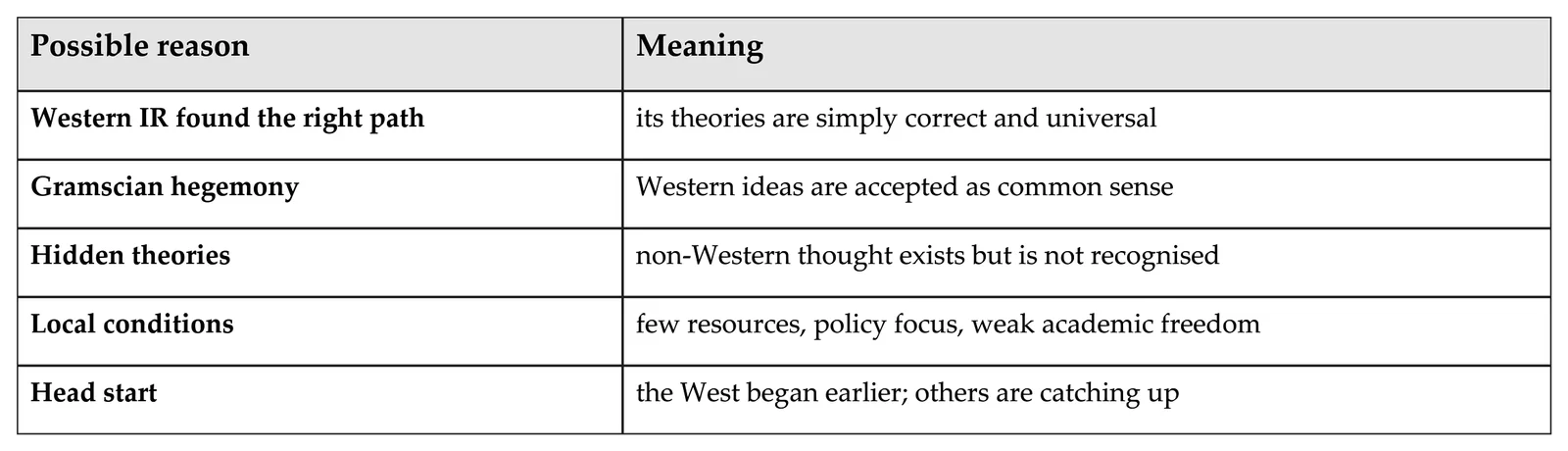
Amitav Acharya and Barry Buzan, in ‘Why is there no non-Western international relations theory?’ (2007), suggest five possible reasons: Western IR has found the right path; it enjoys hegemony in Antonio Gramsci’s sense; non-Western theories exist but are hidden by language and access barriers; local conditions, such as limited resources and a focus on policy, discourage theory; and the West simply had a head start. They argue that non-Western sources, such as the ideas of leaders like Nehru, regional practices and classical traditions, can enrich IR theory. Acharya later proposed Global IR, based on pluralistic universalism and world history.
David Blaney and Naeem Inayatullah, in ‘International Relations from Below’ (2008), argue that IR should be seen from the standpoint of the colonised, the poor and the marginalised, not only of great powers. IR, they say, has treated difference as a threat to be managed rather than as an opportunity to learn. Pinar Bilgin argues that the line between Western and non-Western IR is blurred, since colonial encounters shaped both, and that non-Western thought may be almost the same but not quite. Decolonial scholars such as Z. Capan call for questioning the colonial foundations of IR’s knowledge itself.

4.3 Indian Contributions to International Relations
India offers rich resources for IR. Kautilya’s Arthashastra set out the mandala theory of circles of friends and enemies and a six-fold policy (shadgunya) of peace, war, neutrality, marching, alliance and dual policy. In modern times, Gandhi’s non-violence, Tagore’s critique of nationalism and Nehru’s non-alignment, Panchsheel (1954) and leadership of Asian and African solidarity, from the Asian Relations Conference (1947) to Bandung (1955) and the Non-Aligned Movement (1961), shaped global politics. K.M. Panikkar’s Asia and Western Dominance (1953) offered an Asian view of world history.

Navnita Chadha Behera, in her introduction to India Engages the World (2013), reviews IR scholarship in India. Institutions such as the Indian Council of World Affairs (1943) and the Indian School of International Studies (1955), later part of JNU, developed strong area studies and foreign policy research but little theory. Behera argues that Indian IR has been derivative, borrowing Western concepts, and calls for re-imagining IR from India’s own experiences and traditions. Kanti Bajpai and Siddharth Mallavarapu examine how India has related to the Western-led international order, accepting some norms, contesting others and seeking reform.
4.4 Important Questions
- Question 1 ‘Why is there no non-Western International Relations theory?’ Discuss with reference to Acharya and Buzan.
- Question 2 Discuss the idea of International Relations from below and the critique of Western IR.
- Question 3 Discuss India’s contributions to the study and practice of International Relations.
DU asks the same idea in different words. So learn one broad answer for each question below; the same answer works for every question joined by OR.
Important Question 1
‘Why is there no non-Western International Relations theory?’ Discuss with reference to Acharya and Buzan.
OR
Examine the problem of Eurocentrism in International Relations.
OR
Discuss Amitav Acharya’s idea of Global IR.
Model Answer
“‘Europe’ remains the sovereign, theoretical subject of all histories, including the ones we call ‘Indian,’ ‘Chinese,’ ‘Kenyan,’ and so on.”
— Dipesh Chakrabarty, ‘Postcoloniality and the Artifice of History’ (1992)
Introduction. International Relations claims to study the whole world, yet its theories have been developed almost entirely in the West, especially in the United States and Britain. Amitav Acharya and Barry Buzan asked in 2007 why there is no non-Western IR theory. Their question opened a major debate about Eurocentrism and led to Acharya’s proposal for a Global IR.
1. Eurocentrism in IR
IR’s founding stories, such as Westphalia in 1648 and Aberystwyth in 1919, are European. Its main theories generalise from European history and the Cold War. The experiences of colonialism, anti-colonial struggle and development in Asia, Africa and Latin America have been treated as marginal.
2. An American Social Science
Stanley Hoffmann (1977) described IR as an American social science, shaped by American power, universities and foundations after 1945. The dominance of American journals, methods and debates has continued, making it hard for scholars elsewhere to be heard.
3. The Question
Acharya and Buzan, in a special issue of International Relations of the Asia-Pacific (2007), noted that Asia has rich traditions of thought and practice in international affairs, yet virtually no recognised IR theory. They examined possible explanations, drawing on the experience of Asia.
4. Western IR Found the Right Path
One possible reason is that Western IR theory has simply discovered the right way to understand international relations, so there is no need for alternatives. Acharya and Buzan reject this complacent view, since Western theories fail to explain much of non-Western experience.
5. Gramscian Hegemony
A second reason is that Western IR has acquired hegemony in Gramsci’s sense: its ideas are accepted as common sense even by non-Western scholars, who are trained in Western universities and seek recognition in Western journals.
6. Hidden Theories
A third reason is that non-Western theories exist but are hidden by language barriers, lack of access to global publishing, or because they are not presented in the form of formal theory. Ideas in Chinese, Japanese or Indian traditions may not be recognised as IR theory.
7. Local Conditions and Head Start
A fourth reason is that local conditions discourage theory: limited resources, heavy teaching loads, close ties to government and a focus on policy. A fifth is that the West had a big head start, and the rest of the world is catching up as its universities and scholars grow.
8. Sources of Non-Western Theory
Acharya and Buzan suggest several sources for non-Western theory: classical religious and political traditions, such as Confucianism or Kautilya; the ideas of leaders such as Nehru, Sun Yat-sen and Aung San; the work of non-Western scholars; and regional practices, such as the ASEAN way of consensus and non-interference.
9. Global IR
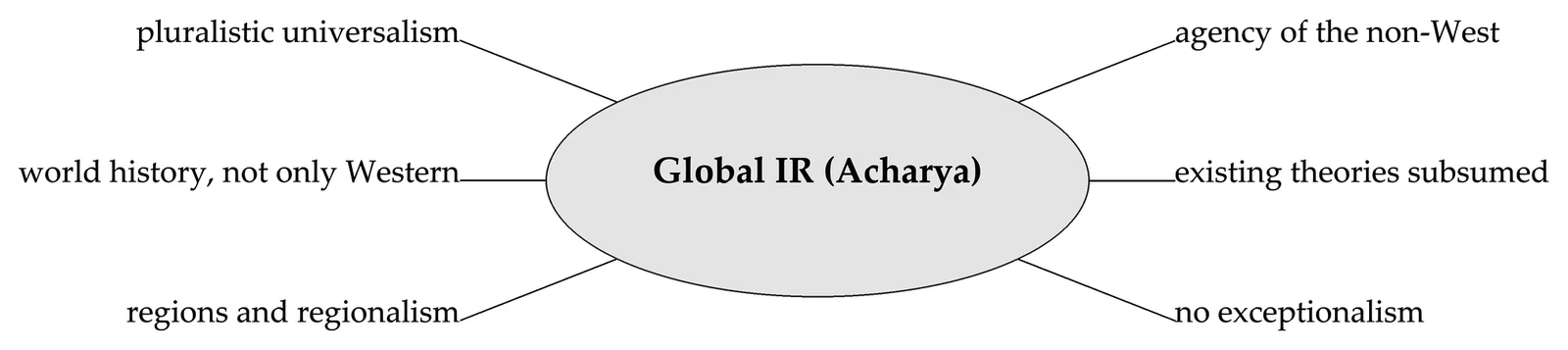
In his 2014 presidential address to the International Studies Association, Acharya proposed Global IR. It rests on pluralistic universalism, grounding in world history rather than only Western history, the subsuming rather than supplanting of existing theories, attention to regions, the rejection of exceptionalism and recognition of multiple forms of agency, including that of the non-West.
10. Avoiding Exceptionalism
Acharya warns that the answer to Western bias is not to create Chinese or Indian exceptionalism, claiming that one civilisation is uniquely virtuous. Non-Western theories must also be open, critical and capable of general relevance.
11. Chinese Perspectives
Since the 2000s, Chinese scholars have developed distinctive approaches. Zhao Tingyang revived the classical idea of tianxia, all-under-heaven, as a world order built on inclusion rather than rival sovereign states. Qin Yaqing proposed a relational theory in which relations, not individual actors, are the basic unit. Yan Xuetong’s moral realism draws on ancient Chinese thinkers to argue that political leadership and morality shape a state’s rise.
12. The ASEAN Way
Regional practices can also be a source of theory. The Association of Southeast Asian Nations (1967) developed the ASEAN way of consensus, informal consultation and non-interference, which helped keep peace among diverse states without strong institutions. Acharya’s studies of such practices show how norms are localised, adapted by regions to their own needs rather than simply copied from the West.
13. Criticisms
Critics argue that the call for non-Western theory may reproduce the West–non-West binary and treat civilisations as fixed. Bilgin suggests that Western and non-Western ideas are already intertwined, and decolonial scholars argue that adding non-Western voices is not enough without questioning IR’s colonial foundations.
14. Evaluation
Acharya and Buzan’s question has transformed debates in IR, encouraging scholars across the world to draw on their own histories and traditions. Global IR aims not to reject Western theory but to make IR genuinely global.
Conclusion. Thus, Acharya and Buzan explain the absence of non-Western IR theory by Western hegemony, hidden theories, local conditions and the West’s head start, rather than Western superiority. Their critique of Eurocentrism led to Acharya’s Global IR, which seeks a pluralistic discipline grounded in world history.
Important Question 2
Discuss the idea of International Relations from below and the critique of Western IR.
OR
Examine Blaney and Inayatullah’s argument about IR from below.
OR
Discuss Pinar Bilgin’s idea of thinking past ‘Western’ IR.
Model Answer
“Orientalism as a Western style for dominating, restructuring, and having authority over the Orient.”
— Edward Said, Orientalism (1978)
Introduction. Mainstream IR has largely seen the world from above, from the viewpoint of great powers and their concerns with order and security. Critical scholars argue that this view hides the experiences of most of humanity. David Blaney and Naeem Inayatullah propose an IR from below, while Pinar Bilgin and decolonial scholars ask how to think past Western IR.
1. IR from Above
Traditional IR focuses on great powers, wars among them, alliances and the balance of power. It treats states as the main actors and order as the main value. The colonised, the poor, migrants and indigenous peoples appear, if at all, as problems to be managed.
2. IR from Below
Blaney and Inayatullah argue that IR should be studied from the standpoint of those at the bottom of the global hierarchy: colonised peoples, the global poor and marginalised communities. From below, the international system looks less like an arena of equal sovereign states and more like a hierarchy shaped by empire and capitalism.
3. The Problem of Difference
Blaney and Inayatullah argue that IR has treated cultural difference as a threat, to be contained through anarchy, conversion or development. Early modern Europeans saw other peoples as savages or as backward, and these attitudes shaped IR’s foundations. They call for engaging with difference as a source of learning and self-criticism.
4. Political Economy from Below
They also criticise liberal political economy, which promises that markets will bring prosperity to all. From below, global capitalism has produced deep inequality and dispossession. IR must take seriously the voices of those who bear its costs.
5. Said and Orientalism
Edward Said’s Orientalism (1978) showed how Western scholarship constructed the Orient as exotic, irrational and inferior, justifying domination. A.K. Ramakrishnan argues that IR shares this orientalist gaze, treating the non-West as a place of chaos, fundamentalism and failed states.
6. Postcolonial IR
Postcolonial scholars emphasise that colonialism was central to the making of the modern international system. The sovereign state system expanded through empire; international law distinguished civilised from uncivilised peoples; and racial hierarchy shaped world order.
7. Bilgin: Thinking Past Western IR
Pinar Bilgin argues that the distinction between Western and non-Western IR is not as clear as it seems. Colonial encounters shaped both, and non-Western thinkers have long engaged with Western ideas. Non-Western IR may therefore look almost the same as Western IR but not quite, a phrase she borrows from Homi Bhabha’s idea of mimicry.
8. Hidden Differences
For Bilgin, the task is not only to search for completely different non-Western theories but to notice the subtle differences in how non-Western actors adopt and adapt Western ideas, such as sovereignty or security, to their own purposes.
9. Decolonising IR
Decolonial scholars such as Z. Capan go further, arguing that IR’s knowledge itself is shaped by coloniality. Decolonising IR requires questioning its founding myths, recognising the violence of empire and including the knowledge of colonised peoples, not merely adding non-Western cases.
10. Implications
These critiques change the questions IR asks: not only how great powers maintain order, but how hierarchy, race and empire shape the world; not only how states seek security, but how ordinary people experience insecurity.
11. Race and the Origins of IR
W.E.B. Du Bois wrote in 1903 that the problem of the twentieth century is the problem of the colour line. Robert Vitalis has shown that early American IR was closely concerned with race and imperial administration; the journal Foreign Affairs grew out of the Journal of Race Development, founded in 1910. Seen from below, race was not marginal to IR but central to its birth.
12. Bandung and the Global South
The Asian–African Conference at Bandung in 1955 brought together twenty-nine newly independent states to oppose colonialism and racism and to promote peaceful coexistence. It is often seen as a moment when the global South spoke for itself in world politics, and its principles influenced the Non-Aligned Movement and later demands for a new international economic order.
13. Criticisms
Critics argue that such approaches can be abstract and offer few practical answers, and that they sometimes romanticise the non-West or ignore the agency of postcolonial elites who also exercise power.
14. Evaluation
IR from below and postcolonial critiques have made the discipline more self-aware and inclusive. They show that how we see the world depends on where we stand, and that a global discipline must include those who have been on the receiving end of world politics.
Conclusion. Thus, Blaney and Inayatullah call for an IR seen from below, engaging with difference and the experiences of the colonised and poor, while Bilgin shows that Western and non-Western IR are intertwined and decolonial scholars question IR’s colonial foundations. Together they challenge Eurocentrism in IR.
Important Question 3
Discuss India’s contributions to the study and practice of International Relations.
OR
Examine the development of IR as a discipline in India with reference to Navnita Chadha Behera.
OR
Discuss Indian resources for non-Western IR theory.
Model Answer
“Where freedom is menaced or justice threatened or where aggression takes place, we cannot be and shall not be neutral.”
— Jawaharlal Nehru, address at Columbia University (1949)
Introduction. India has a long tradition of thought about statecraft and a modern history of distinctive engagement with world politics. Yet IR as an academic discipline in India has been criticised for borrowing Western concepts. Navnita Chadha Behera, Kanti Bajpai and Siddharth Mallavarapu examine India’s contributions and the prospects for an Indian perspective in IR.
1. Kautilya’s Arthashastra
Kautilya’s Arthashastra is one of the oldest treatises on statecraft. Its mandala theory describes circles of states in which the immediate neighbour is a natural enemy and the neighbour’s neighbour a natural friend. Its six-fold policy covers peace, war, neutrality, marching, alliance and dual policy. Scholars compare it with realism but also note its distinctive ethical framework.
2. Other Classical Traditions
The Mahabharata, Ashoka’s policy of dhamma after the Kalinga war, and Mughal and Maratha statecraft offer further resources. Scholars such as Deepshikha Shahi have explored concepts such as dharma and advaita as foundations for a non-Western IR.
3. Gandhi and Tagore
Gandhi’s non-violence and satyagraha influenced movements across the world, from the American civil rights movement to anti-apartheid struggles. Tagore’s critique of aggressive nationalism and his vision of a meeting of East and West offered a cosmopolitan alternative.
4. Nehru’s Non-alignment
Nehru’s policy of non-alignment kept India independent of the Cold War blocs while engaging both. As Nehru put it, non-alignment did not mean neutrality in the face of aggression. It was a major contribution to the practice of postcolonial states and became the basis of the Non-Aligned Movement in 1961.
5. Panchsheel and Asian Solidarity
The Panchsheel principles of 1954 emphasised mutual respect for sovereignty, non-aggression, non-interference, equality and peaceful coexistence. India hosted the Asian Relations Conference in 1947 and played a leading role at Bandung in 1955, promoting decolonisation and Afro-Asian solidarity.
6. Early Indian Scholarship
The Indian Council of World Affairs (1943) and the Indian School of International Studies (1955), led by scholars such as A. Appadorai, laid the foundations of IR in India. K.M. Panikkar’s Asia and Western Dominance (1953) offered an Asian reading of the Vasco da Gama epoch.
7. Behera’s Survey
Behera’s survey shows that Indian IR developed strong area studies and policy research but remained theory-averse and state-centric, closely tied to the government’s foreign policy concerns. Theory was largely imported from the West.
8. Re-imagining IR in India
Behera argues that Indian IR has been a derivative discourse and calls for re-imagining it by drawing on India’s historical experiences, intellectual traditions and lived realities, such as porous frontiers, plural identities and postcolonial state-building, to generate new concepts.
9. India and International Order
Bajpai and Mallavarapu examine how India has engaged with the Western-led international order. India accepted multilateralism and international law but contested the nuclear non-proliferation regime as discriminatory, and it seeks reform of institutions such as the UN Security Council.
10. Schools of Strategic Thought
Kanti Bajpai has identified competing streams in Indian strategic thinking, such as Nehruvianism, which values cooperation and restraint; neoliberalism, which emphasises economic strength and interdependence; and hyperrealism, which stresses military power. These debates shape India’s grand strategy.
11. Strategic Autonomy Today
India today pursues strategic autonomy and multi-alignment, engaging with the United States, Russia, Europe and the global South, and presenting itself as a voice of the global South, as during its G20 presidency in 2023, when the African Union became a permanent member.
12. Ramakrishnan on the Orientalist Gaze
A.K. Ramakrishnan argues that IR often looks at India and South Asia through an orientalist lens, as a region of irrational conflict, religious passion and failed states. Linking postcolonial theory with IR, he calls for Indian scholars to examine how such representations are produced and to develop their own frameworks, rather than accepting categories framed elsewhere.
13. Indian Ideas in Diplomacy
Indian diplomacy has also drawn on its own traditions. The theme of India’s G20 presidency in 2023, One Earth, One Family, One Future, came from the ancient idea of vasudhaiva kutumbakam, the world as one family. Such ideas show how cultural traditions can inform the language and goals of foreign policy, though scholars debate how far they shape actual behaviour.
14. Evaluation
India has contributed to IR through ancient statecraft, anti-colonial thought and the practice of non-alignment. The challenge, as Behera argues, is to turn these resources into theory that speaks to the world while remaining rooted in Indian experience.
Conclusion. Thus, India’s contributions to IR range from Kautilya’s mandala to Gandhi’s non-violence and Nehru’s non-alignment and Panchsheel. Behera shows that Indian IR has been derivative and theory-averse, and calls for re-imagining it from India’s own experiences as part of a truly global discipline.
Short Notes
(a) Mandala theory
Kautilya’s model of interstate relations in the Arthashastra. Around the vijigishu, the king seeking conquest, lie circles of states: the immediate neighbour is a natural enemy, the neighbour’s neighbour a natural ally, with middle and neutral kings beyond. It is often compared to the realist balance of power.
(b) Non-alignment
India’s foreign policy, developed by Nehru, of not joining either Cold War bloc while engaging with both and judging issues on their merits. It was not neutrality but independence of judgement. The Non-Aligned Movement, founded at Belgrade in 1961 by leaders including Nehru, Nasser and Tito, spread it among newly independent states.
(c) Orientalism
Edward Said’s term, in Orientalism (1978), for the Western tradition of representing the East as exotic, backward, irrational and inferior, a body of knowledge that served Western domination. Postcolonial IR scholars argue that IR shares this gaze when it portrays the non-West as a zone of chaos and danger.
(d) Global IR
Amitav Acharya’s proposal (2014) for an inclusive discipline based on pluralistic universalism, world history, the study of regions, the rejection of exceptionalism and recognition of the agency of non-Western peoples. It seeks to broaden IR rather than replace existing theories.
More notes: MDSC-5A Introduction to International Relations
These notes are prepared by PADHO TO AISE for study help. They are not an official University of Delhi publication.