

Semester VII DSC-19 Themes in Western Political Philosophy
Unit I · 21 min read · Updated 24 Nov 2026
As per the University of Delhi (DU) BA (Hons) Political Science syllabus
Contents
- 1.1 Modernity and Its Discourses
- 1.2 Kant as an Enlightenment Thinker: Faith in Reason
- 1.3 Autonomy and the Moral Law
- 1.4 Ethics and Politics
- 1.5 Important Questions
- Examine Kant’s understanding of Enlightenment.
- Discuss Kant’s ideas of autonomy and the moral law.
- Examine the relationship between ethics and politics in Kant’s thought.
- What is modernity? Discuss the main discourses of modernity.
- Short Notes
प्रबोधन मनुष्य का अपनी स्वयं-आरोपित अपरिपक्वता से बाहर निकलना है।
Enlightenment is man’s emergence from his self-incurred immaturity.
— Immanuel Kant, ‘An Answer to the Question: What is Enlightenment?’ (1784)
WHAT does it mean to be modern? From the seventeenth and eighteenth centuries, Europe experienced a series of transformations, scientific, political, economic and cultural, that together produced modernity. The Enlightenment placed its faith in reason, believing that human beings could understand the world, govern themselves and improve society without relying on tradition or authority. Immanuel Kant (1724–1804) gave the Enlightenment its most famous definition and built a philosophy of autonomy, morality and politics on the power of reason. This unit studies modernity and its discourses through Kant’s thought and Stuart Hall’s account of the formations of modernity, along with Brian Nelson and John Rawls.
1.1 Modernity and Its Discourses
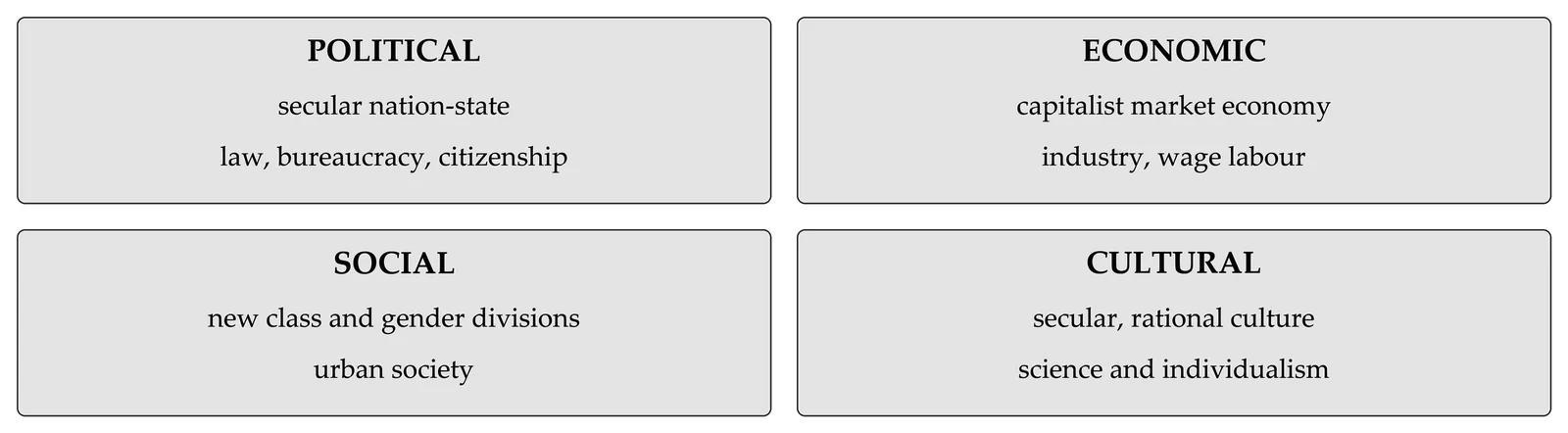
Stuart Hall, in his introduction to Formations of Modernity (1992), explains that modern societies emerged through four interconnected processes: political, the rise of the secular, sovereign nation-state; economic, the growth of a capitalist market economy based on private property and wage labour; social, new divisions of labour, class and gender; and cultural, the spread of a secular, rational and individualist culture. Modernity was also shaped by Europe’s encounter with the rest of the world through colonialism, so that the idea of the modern West was defined in contrast to others.
Brian Nelson shows that Enlightenment thinkers believed reason could replace tradition, superstition and arbitrary authority as the basis of knowledge and politics. Yet modernity produced its own critics: Romantics such as Rousseau, who feared that civilisation corrupted human nature; radicals such as Hegel and Marx, who saw new forms of alienation and domination; and later thinkers such as Max Horkheimer and Theodor Adorno, who argued in Dialectic of Enlightenment (1947) that reason itself could become an instrument of domination.
1.2 Kant as an Enlightenment Thinker: Faith in Reason
In ‘What is Enlightenment?’ (1784), Kant defined Enlightenment as humanity’s emergence from its self-incurred immaturity, the inability to use one’s own understanding without the guidance of another. Immaturity is self-incurred when it results from lack of courage rather than lack of intelligence. The motto of the Enlightenment is therefore sapere aude: have courage to use your own understanding. Kant distinguished the public use of reason, by a scholar addressing the reading public, which must always be free, from the private use of reason in an office, which may be restricted.

Kant’s faith in reason was critical, not naive. In the Critique of Pure Reason (1781) he examined the limits of reason, showing that we can know the world only as it appears to us and cannot prove claims about God, freedom or the soul. But he held that practical reason, reason applied to action, gives us the moral law and grounds our freedom. Enlightenment, for Kant, was a gradual process, an age of enlightenment rather than an enlightened age, which depended on freedom of public discussion.
1.3 Autonomy and the Moral Law
In the Groundwork of the Metaphysics of Morals (1785), Kant argued that the only thing good without qualification is a good will, one that acts from duty. Moral duties are expressed in the categorical imperative, a command that binds unconditionally, unlike hypothetical imperatives that depend on desires. Its formulations include: act only on a maxim that you could will to become a universal law; and treat humanity, in yourself and others, always as an end and never merely as a means.

At the centre of Kant’s ethics is autonomy: a rational will gives the moral law to itself, rather than receiving it from nature, desire, society or God, which would be heteronomy. Every rational being is therefore a member of a kingdom of ends, both legislator and subject. This idea of human dignity, the equal worth of every person as a self-legislating being, became a foundation of modern ideas of human rights.
1.4 Ethics and Politics
For Kant, politics must respect right, which concerns external freedom: an action is right if it can coexist with everyone’s freedom under a universal law. The state exists to secure this rightful condition. In ‘Theory and Practice’ (1793), he stated three principles of a civil state: the freedom of every member as a human being, the equality of each as a subject, and the independence of each as a citizen. He favoured a republican constitution, with separation of powers and laws to which citizens could consent, though he denied any right of revolution.
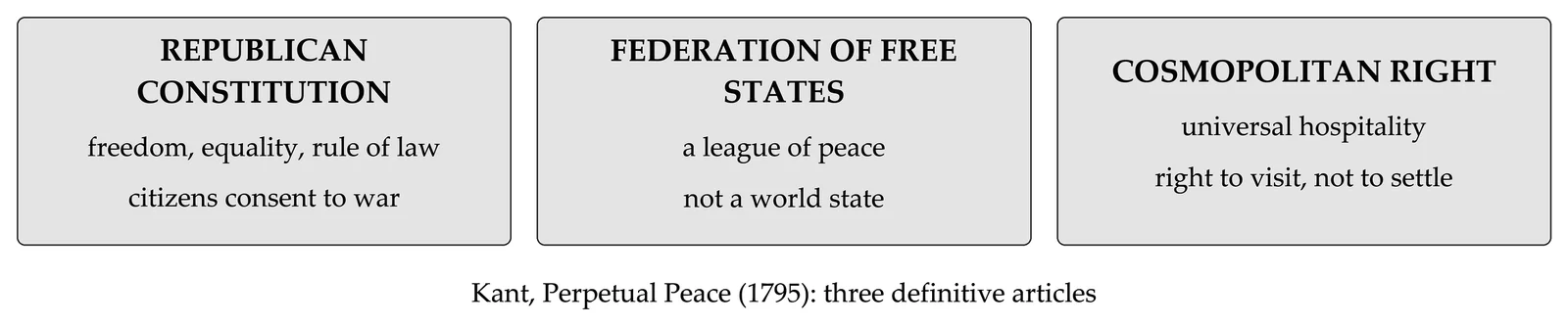
In Perpetual Peace (1795), Kant proposed that lasting peace requires republican constitutions, a federation of free states and a cosmopolitan right of universal hospitality. He contrasted the moral politician, who makes politics conform to morality, with the political moralist, who twists morality to serve power. Kant’s ideas influenced the League of Nations, the democratic peace thesis and modern human rights.
1.5 Important Questions
- Question 1 Examine Kant’s understanding of Enlightenment.
- Question 2 Discuss Kant’s ideas of autonomy and the moral law.
- Question 3 Examine the relationship between ethics and politics in Kant’s thought.
- Question 4 What is modernity? Discuss the main discourses of modernity.
DU asks the same idea in different words. So learn one broad answer for each question below; the same answer works for every question joined by OR.
Important Question 1
Examine Kant’s understanding of Enlightenment.
OR
‘Sapere aude: have courage to use your own understanding.’ Discuss Kant as an Enlightenment thinker.
OR
Discuss Kant’s distinction between the public and private use of reason.
Model Answer
“Sapere aude! Have courage to use your own understanding! That is the motto of enlightenment.”
— Immanuel Kant, ‘What is Enlightenment?’ (1784)
Introduction. The Enlightenment was an intellectual movement of the eighteenth century that placed reason at the centre of knowledge, morality and politics. In 1784 a Berlin journal asked, What is Enlightenment? Kant’s famous answer defined it as humanity’s emergence from self-incurred immaturity and made the courage to think for oneself its motto. His essay remains the classic statement of Enlightenment ideals.
1. Context
Kant wrote in Prussia under Frederick the Great, an enlightened absolutist who allowed relative freedom of religion and publication. The Enlightenment had spread from Britain and France to Germany, where it was called the Aufklärung, challenging religious authority and tradition.
2. Definition of Enlightenment
Kant defined Enlightenment as man’s emergence from his self-incurred immaturity. Immaturity, or tutelage, means the inability to use one’s own understanding without the guidance of another, such as a priest, a book or a doctor who thinks for us.
3. Self-incurred Immaturity
Immaturity is self-incurred when its cause is not lack of understanding but lack of resolution and courage. People remain immature because it is comfortable: it is easy to let others think for us, and guardians encourage this dependence.
4. Sapere Aude
Kant took the Latin motto sapere aude, dare to know, as the motto of Enlightenment: have courage to use your own understanding. Enlightenment is a matter of intellectual courage and independence.
5. Laziness and Cowardice
Kant blamed laziness and cowardice for the persistence of immaturity. Guardians make people afraid of thinking for themselves by exaggerating its dangers, so few individuals succeed in freeing themselves alone.
6. Enlightenment of the Public
While individuals find it hard to enlighten themselves, a public can enlighten itself gradually if it is given freedom. Enlightenment is a collective, historical process that depends on open discussion.
7. Freedom as the Condition
The only freedom Enlightenment requires is the freedom to make public use of one’s reason in all matters. Kant noted that rulers often say, argue as much as you like, but obey, and he accepted this compromise of free thought with civil obedience.
8. Public and Private Use of Reason
The public use of reason is the use a person makes of it as a scholar before the entire reading public; this must always be free. The private use of reason is its use in a particular civil post or office; this may be restricted without hindering Enlightenment.
9. Examples
An officer must obey orders while on duty but may publicly criticise military policy as a scholar. A clergyman must teach according to his church’s doctrine in his office but may publish criticisms of it. A citizen must pay taxes but may publicly argue that they are unjust.
10. Religion
Kant emphasised religious matters because immaturity in religion is the most harmful and degrading. No generation may bind future generations to unchangeable creeds, since that would be a crime against human nature, whose destiny lies in progress.
11. An Age of Enlightenment
Kant said that his was not yet an enlightened age but an age of enlightenment, in which obstacles to thinking for oneself were gradually being removed. He credited Frederick the Great with allowing freedom of thought.
12. Faith in Reason
Kant’s faith in reason was critical: his Critiques examined the limits of theoretical reason while affirming the power of practical reason to give the moral law. Reason, rightly used, enables autonomy and progress.
13. Criticisms
Critics note that Kant accepted obedience to authority and limited political freedom. Michel Foucault, in his own essay ‘What is Enlightenment?’ (1984), saw Enlightenment as an ongoing critical attitude rather than a finished achievement, while Horkheimer and Adorno warned that reason could become domination.
14. Relevance
Kant’s call to think for oneself remains central to education, democracy and free speech. His distinction between public and private reason still informs debates on the freedom of public servants to criticise policy.
15. Evaluation
Kant’s essay captures the spirit of the Enlightenment: confidence in human reason, the value of free public debate and the hope of gradual progress. Its compromises with authority also reveal the limits of eighteenth-century liberalism.
Conclusion. Thus, Kant defined Enlightenment as emergence from self-incurred immaturity through the courage to use one’s own understanding. He made the free public use of reason its essential condition, while allowing restrictions on its private use, expressing both the promise and the limits of Enlightenment thought.
Important Question 2
Discuss Kant’s ideas of autonomy and the moral law.
OR
Explain Kant’s categorical imperative.
OR
‘Act in such a way that you treat humanity always as an end and never merely as a means.’ Discuss.
Model Answer
“Act in such a way that you treat humanity, whether in your own person or in the person of any other, never merely as a means to an end, but always at the same time as an end.”
— Immanuel Kant, Groundwork of the Metaphysics of Morals (1785)
Introduction. Kant’s moral philosophy is one of the most influential in the Western tradition. He argued that morality is grounded not in happiness, feeling or divine command but in reason. The moral law is the law that a rational will gives itself, and this autonomy is the source of human dignity. His ideas shaped modern thinking about rights, equality and respect for persons.
1. The Good Will
Kant began the Groundwork by arguing that the only thing good without qualification is a good will. Talents, wealth and even happiness can be misused; a good will is good in itself, regardless of its consequences.
2. Acting from Duty
A good will acts from duty, out of respect for the moral law, not merely in accordance with duty for selfish reasons. A shopkeeper who is honest only to keep customers acts in accordance with duty but not from duty.
3. Hypothetical and Categorical Imperatives
Hypothetical imperatives command actions as means to ends we happen to want: if you want to be healthy, exercise. The categorical imperative commands unconditionally, whatever our desires, and is the form of moral obligation.
4. The Formula of Universal Law
The first formulation states: act only according to that maxim through which you can at the same time will that it become a universal law. Lying promises fail this test, because if everyone made them, promising would become impossible.
5. The Formula of Humanity
The second formulation requires us to treat humanity always as an end and never merely as a means. Persons have dignity, an absolute worth, while things have only a price. Using others merely as tools, as in slavery or deception, violates their dignity.
6. Autonomy
The third idea is autonomy: the rational will is self-legislating. The moral law is not imposed from outside but given by reason itself, so in obeying it we obey ourselves. This makes moral agents free.
7. Heteronomy
When the will is determined by desire, custom, authority or the pursuit of happiness, it is heteronomous. Kant rejected moral theories based on happiness or divine command because they make morality depend on something outside reason.
8. The Kingdom of Ends
Kant imagined a kingdom of ends, a community of rational beings each of whom is both legislator and subject of universal moral laws. It is an ideal of mutual respect among free and equal persons.
9. Freedom and Morality
In the Critique of Practical Reason (1788), Kant argued that the moral law reveals our freedom: because we ought to act morally, we must be able to. Freedom cannot be proved by theoretical reason but is a necessary postulate of practical reason.
10. Dignity and Equality
Because every rational being is autonomous, all persons have equal dignity. This idea underlies modern conceptions of human rights and the principle that persons must never be treated merely as objects.
11. Influence on Political Thought
Kant’s ideas influenced liberal political philosophy, especially John Rawls, whose theory of justice is built on respect for persons as free and equal moral agents. They also shaped debates on bioethics and human rights.
12. Criticisms: Formalism
Hegel criticised Kant’s ethics as empty formalism: the universal law test, he argued, cannot by itself tell us what our concrete duties are, which depend on social institutions.
13. Other Criticisms
Critics also argue that Kant’s ethics is too rigid, as in his claim that one may not lie even to a murderer, and that it neglects emotions, care and consequences. Feminist critics note his low view of women’s capacity for autonomy.
14. Relevance
Despite criticisms, Kant’s idea that persons must be respected as ends in themselves remains central to moral and political thought, from medical consent to human rights law.
15. Evaluation
Kant grounded morality in autonomous reason and derived from it the equal dignity of all persons. His ethics is demanding and formal, but its core principle of respect for persons remains one of the great achievements of modern thought.
Conclusion. Thus, Kant held that morality rests on the good will acting from duty, expressed in the categorical imperative: universal law, respect for humanity as an end, and autonomy. Autonomy, the self-legislation of reason, is the source of human dignity and a foundation of modern rights.
Important Question 3
Examine the relationship between ethics and politics in Kant’s thought.
OR
Discuss Kant’s ideas on the state, republicanism and perpetual peace.
OR
Explain Kant’s principles of freedom, equality and independence.
Model Answer
“Any action is right if it can coexist with everyone’s freedom in accordance with a universal law.”
— Immanuel Kant, The Metaphysics of Morals: Doctrine of Right (1797)
Introduction. Kant applied his philosophy of reason and freedom to politics and law. He argued that the state exists to secure a rightful condition in which each person’s freedom can coexist with that of others, that the best constitution is republican, and that perpetual peace among states is a duty of reason. His political thought links morality and politics without reducing one to the other.
1. Right and Ethics
Kant distinguished ethics, which concerns inner motives and virtue, from right, which concerns external actions that can be enforced. The state cannot make people virtuous, but it can secure the external conditions of freedom.
2. The Universal Principle of Right
An action is right if it can coexist with everyone’s freedom according to a universal law. Coercion is justified when it hinders a hindrance to freedom, such as theft or violence.
3. The State of Nature
In a state of nature, even if people are not wicked, rights are insecure, because each person judges for himself. Reason therefore requires people to leave the state of nature and enter a civil condition under public law.
4. The Original Contract
Kant treated the social contract not as a historical event but as an idea of reason: laws are legitimate if they could have been agreed to by the whole people. This is a test for legislators rather than a right of citizens to resist.
5. Freedom, Equality, Independence
In ‘Theory and Practice’ (1793), Kant set out three principles of a civil state: the freedom of every member as a human being, the equality of each as a subject before the law, and the independence of each as a citizen who shares in making laws.
6. Active and Passive Citizens
Kant limited independence, and so voting rights, to economically self-sufficient men, excluding women, servants and apprentices, whom he called passive citizens. This shows the limits of his egalitarianism.
7. Republicanism
Kant favoured a republican constitution, based on the separation of executive and legislative powers and on laws that citizens could consent to. He distinguished republicanism from democracy, which he feared could become despotic if the people both made and executed laws.
8. No Right of Revolution
Kant denied a right of revolution, arguing that it would destroy the rightful condition itself. Yet he welcomed the French Revolution as a sign of humanity’s moral progress, and he insisted on freedom of the pen to criticise rulers.
9. Moral Politician and Political Moralist
In Perpetual Peace, Kant contrasted the moral politician, who adapts political prudence to morality, with the political moralist, who bends morality to suit political interests. True politics must bow before right.
10. Perpetual Peace
Kant’s Perpetual Peace (1795) set out preliminary articles, such as no secret reservations in peace treaties and no standing armies over time, and three definitive articles: republican constitutions, a federation of free states and cosmopolitan right.
11. Federation of Free States
Kant rejected a world state, which could become a soulless despotism, and proposed a voluntary federation of free states to prevent war. This idea influenced the League of Nations and the United Nations.
12. Cosmopolitan Right
Cosmopolitan right is limited to universal hospitality: strangers have a right not to be treated with hostility when they visit, but not a right to settle. Kant criticised European colonial conquests that abused this right.
13. Republics and Peace
Kant argued that republics are less likely to go to war, because citizens who bear its costs must consent. Michael Doyle later developed this into the democratic peace thesis.
14. Criticisms
Critics point to the exclusion of women and dependants from citizenship, the denial of a right of revolution, and the gap between his cosmopolitan ideals and the realities of power politics.
15. Evaluation
Kant built a political philosophy on freedom, right and reason, linking the rightful state, republicanism and international peace. His ideas remain foundational for liberal constitutionalism and cosmopolitan thought.
Conclusion. Thus, Kant held that politics must secure right, the coexistence of everyone’s freedom under universal law. He favoured a republican constitution based on freedom, equality and independence, and proposed perpetual peace through republics, a federation of free states and cosmopolitan right.
Important Question 4
What is modernity? Discuss the main discourses of modernity.
OR
Discuss Stuart Hall’s account of the formations of modernity.
OR
Examine the critiques of the Enlightenment and modernity.
Model Answer
“All that is solid melts into air, all that is holy is profaned.”
— Karl Marx and Friedrich Engels, The Communist Manifesto (1848)
Introduction. Modernity refers to the forms of social life, institutions and ideas that emerged in Europe from about the sixteenth century and spread across the world. Stuart Hall explains modernity as the outcome of political, economic, social and cultural processes. Modernity has been celebrated as progress and criticised for its costs, producing a variety of discourses about its meaning.
1. Meaning of Modernity
Modernity denotes a break with traditional, religious and agrarian society. It is associated with science, reason, the nation-state, capitalism, industry, cities, individualism and the belief in progress.
2. Hall’s Approach
Hall argues that modern society was formed by the interaction of several processes rather than by a single cause. No single factor, whether economic, political or cultural, explains it alone.
3. Political Process
The first process is the rise of the secular, sovereign nation-state with a defined territory, a centralised administration and law, replacing the fragmented authority of feudalism and the Church.
4. Economic Process
The second is the emergence of a capitalist market economy based on private property, wage labour and production for profit, which eventually led to industrialisation.
5. Social Process
The third is the formation of new social structures: a complex division of labour, new classes such as the bourgeoisie and the working class, and changing gender relations between public and private spheres.
6. Cultural Process
The fourth is the rise of a secular, rational and individualist culture, in which science replaced religion as the source of knowledge and individuals claimed the right to think for themselves.
7. The West and the Rest
Hall also shows that the idea of the modern West was constructed through Europe’s encounter with other societies, which were represented as backward or traditional. Modernity was thus bound up with colonialism.
8. The Enlightenment Discourse
The Enlightenment, represented by Kant, celebrated reason, freedom and progress. It promised liberation from superstition and arbitrary power through knowledge and self-government.
9. The Liberal Discourse
Liberals such as Locke, Kant and Mill saw modernity as the expansion of individual rights, constitutional government and free markets, through which individuals could pursue their own good.
10. The Romantic Critique
Romantics such as Rousseau argued that civilisation and the arts and sciences corrupted natural goodness, created inequality and made people dependent on others’ opinions. They valued feeling, nature and community.
11. The Radical Critique
Hegel sought to reconcile individual freedom with ethical community, while Marx argued that capitalist modernity, though revolutionary, produced exploitation and alienation. As the Manifesto put it, all that is solid melts into air.
12. The Frankfurt School
Max Horkheimer and Theodor Adorno, in Dialectic of Enlightenment (1947), argued that Enlightenment reason had become instrumental, a tool for domination of nature and people, culminating in fascism and mass culture.
13. Postmodern and Postcolonial Critiques
Postmodern thinkers questioned grand narratives of progress, and postcolonial thinkers showed how modernity’s universal claims concealed European domination over colonised peoples.
14. Defenders of Modernity
Jürgen Habermas defended modernity as an unfinished project, arguing that the Enlightenment’s ideals of reason, democracy and communication should be completed rather than abandoned.
15. Evaluation
Modernity brought science, rights and democracy but also exploitation, alienation and domination. Its discourses, from celebration to critique, provide the framework within which the thinkers of this paper, Kant, Rousseau, Wollstonecraft, Mill, Hegel and Marx, can be understood.
Conclusion. Thus, modernity, as Hall explains, emerged from political, economic, social and cultural processes, and was defined in contrast to the non-Western world. Its discourses range from the Enlightenment and liberal celebration of reason to Romantic, radical, Frankfurt School and postcolonial critiques.
Short Notes
(a) Sapere aude
Latin for ‘dare to know’, a phrase from the Roman poet Horace that Kant adopted as the motto of the Enlightenment in 1784: have courage to use your own understanding. It expresses the Enlightenment ideal of intellectual independence from authority and tradition.
(b) Categorical imperative
Kant’s supreme principle of morality, a command that binds unconditionally, whatever one’s desires. Its formulations require acting only on maxims that could be universal laws and treating humanity always as an end, never merely as a means.
(c) Autonomy
For Kant, the capacity of a rational will to give the moral law to itself, rather than being governed by desire, custom or external authority, which is heteronomy. Autonomy is the ground of human dignity and freedom.
(d) Public and private use of reason
Kant’s distinction in ‘What is Enlightenment?’. The public use of reason is that of a scholar addressing the reading public and must be free; the private use is that of a person in a civil post and may be restricted. Enlightenment depends on freedom of public reason.
More notes: DSC-19 Themes in Western Political Philosophy
These notes are prepared by PADHO TO AISE for study help. They are not an official University of Delhi publication.