
Semester V MDSC-5A Introduction to International Relations
Unit I · 19 min read · Updated 24 Nov 2026
As per the University of Delhi (DU) BA (Hons) Political Science syllabus
Contents
- 1.1 The Meaning and Scope of International Relations
- 1.2 The Birth of a Discipline
- 1.3 The First Debate: Idealism and Realism
- 1.4 The Second Debate: Classical and Scientific Methods
- 1.5 The Inter-paradigm Debate
- 1.6 Important Questions
- What is International Relations? Discuss its nature, scope and evolution as a discipline.
- Discuss the first great debate between idealism and realism in International Relations.
- Discuss the second great debate and the inter-paradigm debate in International Relations.
- Short Notes
शक्तिशाली वही करते हैं जो वे कर सकते हैं, और कमज़ोर वही सहते हैं जो उन्हें सहना पड़ता है।
The strong do what they can and the weak suffer what they must.
— Thucydides, History of the Peloponnesian War, the Melian Dialogue
WAR, trade, migration, climate change, pandemics and terrorism all cross state borders. International Relations (IR) is the discipline that studies such cross-border politics. Thinkers from Thucydides and Kautilya to Machiavelli and Kant reflected on relations among political communities, but IR became a separate university subject only after the First World War, when the first chair of International Politics was created at Aberystwyth in 1919 to study how to prevent war. Since then the discipline has grown through a series of great debates: idealism against realism, classical against scientific methods, and the inter-paradigm debate among realism, pluralism and structuralism. This unit studies what IR is and how these debates shaped the discipline.

1.1 The Meaning and Scope of International Relations
In a narrow sense, International Relations studies relations among states: diplomacy, war, alliances and foreign policy. In a broader sense, often called global politics, it studies all political interactions that cross borders, involving states, international organisations, multinational companies, NGOs, social movements and individuals. Joseph Grieco, John Ikenberry and Michael Mastanduno, in Introduction to International Relations (2014), organise the subject around enduring questions, such as why wars happen, whether states can cooperate and how global wealth is distributed, and they study these questions through theories, history and different levels of analysis.
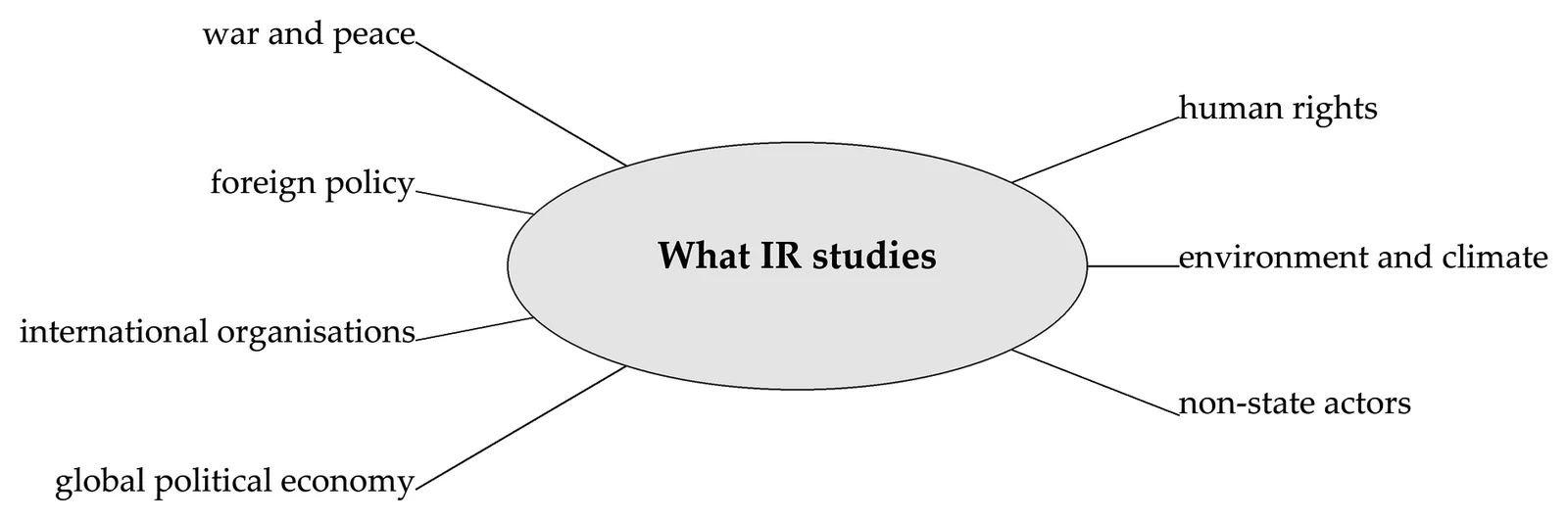
Richard Devetak, Anthony Burke and Jim George, in An Introduction to International Relations (2007), stress that IR is concerned with the international, the realm beyond the borders of any single state, where there is no world government. This condition of anarchy, meaning the absence of a central authority rather than chaos, distinguishes international from domestic politics. Today IR covers security, international political economy, international law and organisations, human rights, environment, gender and the relations between the global North and South.
1.2 The Birth of a Discipline
The horrors of the First World War (1914–18) convinced many that war resulted from secret diplomacy, the balance of power and militarism, and that it could be prevented through knowledge, law and international institutions. In 1919 the Welsh philanthropist David Davies founded the Woodrow Wilson Chair of International Politics at Aberystwyth; its first holder was Alfred Zimmern. Institutes such as Chatham House in London (1920) and the Council on Foreign Relations in New York (1921) followed. The new discipline was thus born with a normative purpose: to make war less likely.
Many scholars have questioned the traditional story that IR began in 1919. They point to earlier traditions of thought, such as Kautilya’s Arthashastra, Thucydides and the European theorists of international law, and to the fact that early IR was closely tied to questions of empire and race. Cynthia Weber shows that IR theories rest on myths, such as the claim that anarchy causes war, which shape how we see the world.
1.3 The First Debate: Idealism and Realism
The first great debate, in the 1930s and 1940s, set idealists (or liberal internationalists) against realists. Idealists, such as Woodrow Wilson, whose Fourteen Points (1918) called for open diplomacy, free trade, disarmament, self-determination and a League of Nations, and Norman Angell, author of The Great Illusion (1910), believed that war could be prevented by international law, institutions, public opinion and economic interdependence. The failure of the League to prevent aggression in the 1930s and the outbreak of the Second World War discredited these hopes.
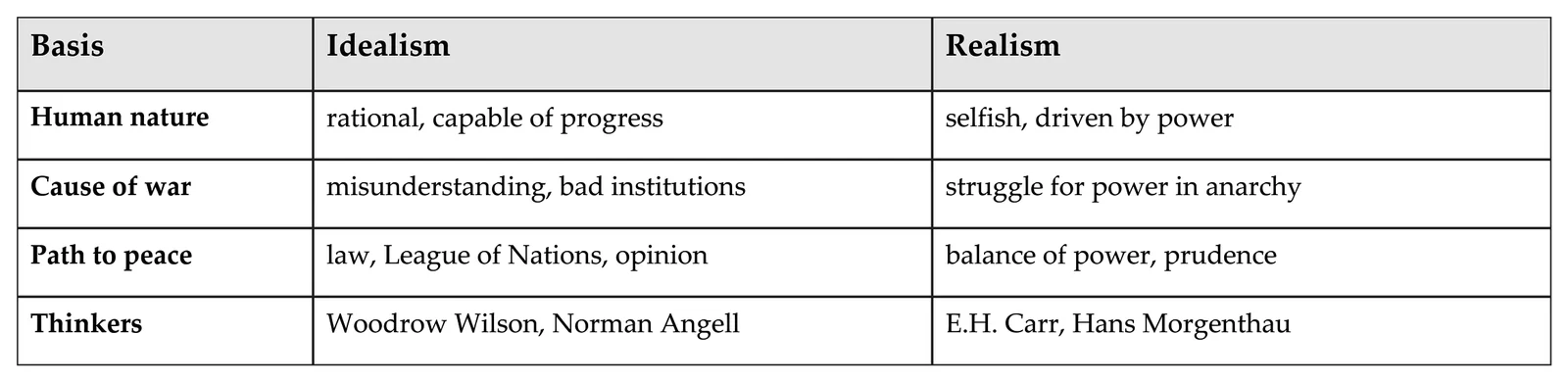
E.H. Carr, in The Twenty Years’ Crisis, 1919–1939 (1939), attacked idealism as utopianism: it ignored power and assumed a natural harmony of interests that in fact served the satisfied great powers. Hans Morgenthau, in Politics Among Nations (1948), argued that international politics, like all politics, is a struggle for power. Realism became the dominant approach of the Cold War. John Mearsheimer (2005) argues that this battle still rages, since much of British IR has returned to idealist assumptions that Carr rejected.
1.4 The Second Debate: Classical and Scientific Methods
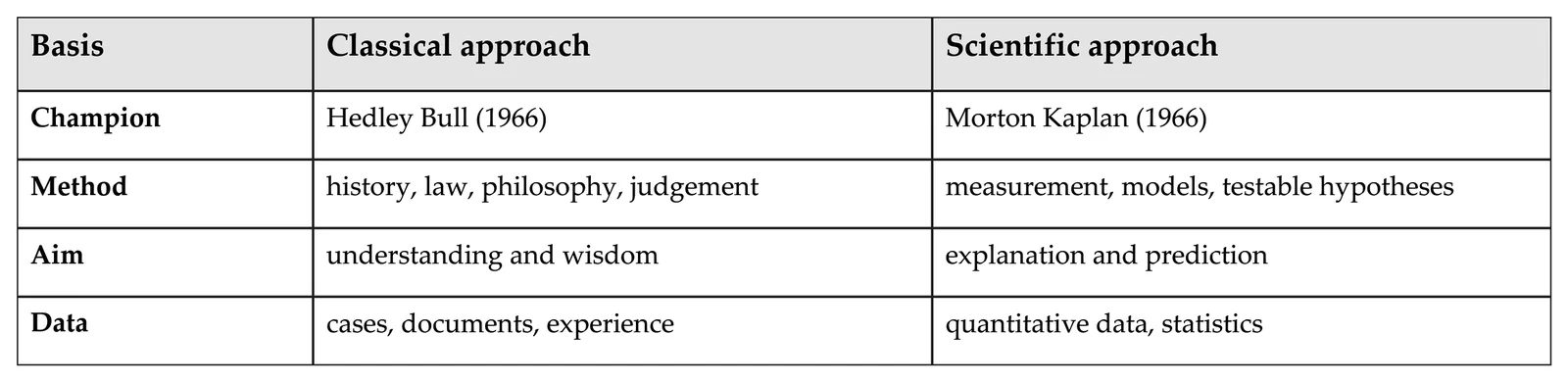
The second debate, in the 1960s, concerned method. Influenced by the behavioural revolution in American social science, scholars such as Morton Kaplan, Karl Deutsch and J. David Singer sought to make IR a science, using quantitative data, systems models and testable hypotheses. Singer’s Correlates of War project (1963) collected data on wars to identify their causes. Hedley Bull, in ‘International Theory: The Case for a Classical Approach’ (1966), defended the classical approach, based on history, philosophy, law and the exercise of judgement, and argued that the scientific approach could not capture the moral and historical character of international politics.
1.5 The Inter-paradigm Debate
In the 1970s and 1980s, IR was described as divided among three paradigms: realism, which saw states struggling for power; pluralism or liberalism, which emphasised many actors, interdependence and cooperation; and structuralism or Marxism, which emphasised the global capitalist economy and the exploitation of the periphery by the core. Ole Wæver, in ‘The Rise and Fall of the Inter-paradigm Debate’ (1996), shows how this debate presented the paradigms as incommensurable, in Thomas Kuhn’s sense, and how it gave way in the 1980s to a neo-neo synthesis between neo-realism and neo-liberalism, which shared rationalist assumptions.

From the late 1980s a new debate emerged between rationalist theories and reflectivist or post-positivist approaches, such as critical theory, post-structuralism, feminism and constructivism, which questioned whether IR could be a neutral science. Tim Dunne, Milja Kurki and Steve Smith note that the story of great debates simplifies a more complex history, but it remains a useful way of understanding how IR has developed and diversified.
1.6 Important Questions
- Question 1 What is International Relations? Discuss its nature, scope and evolution as a discipline.
- Question 2 Discuss the first great debate between idealism and realism in International Relations.
- Question 3 Discuss the second great debate and the inter-paradigm debate in International Relations.
DU asks the same idea in different words. So learn one broad answer for each question below; the same answer works for every question joined by OR.
Important Question 1
What is International Relations? Discuss its nature, scope and evolution as a discipline.
OR
Explain the meaning and scope of International Relations.
OR
Trace the evolution of International Relations as an academic discipline.
Model Answer
“International politics, like all politics, is a struggle for power.”
— Hans J. Morgenthau, Politics Among Nations (1948)
Introduction. International Relations is the study of political relations that cross the borders of states. It examines war and peace, cooperation and conflict, trade and inequality, and the institutions and ideas that shape world politics. As an academic discipline it is relatively young, having emerged after the First World War, but it draws on ancient traditions of thought about relations among political communities.
1. Meaning
In a narrow sense, IR studies relations among sovereign states, especially diplomacy, war and foreign policy. In a broader sense, it studies global politics, including the activities of international organisations, multinational corporations, NGOs, social movements, terrorist networks and individuals. The term world politics or global politics is often used for this broader view.
2. Anarchy as the Defining Condition
Devetak, Burke and George explain that the international realm has no world government above states. This condition of anarchy, the absence of a central authority, does not mean chaos, but it means that states must rely on themselves, on alliances or on institutions for security. Anarchy distinguishes international politics from domestic politics.
3. Enduring Questions
Grieco, Ikenberry and Mastanduno organise IR around enduring questions: why do wars occur, and how can peace be achieved; can states cooperate despite anarchy; why are some countries rich and others poor; and how should the world deal with global problems such as climate change and human rights? These questions recur across history.
4. Levels of Analysis
IR scholars explain events at different levels: the individual level, such as leaders’ beliefs and personalities; the state level, such as regime type and domestic politics; and the system level, such as the distribution of power. Kenneth Waltz’s three images of the causes of war, human nature, the state and the international system, are the classic example.
5. Scope
The scope of IR includes international security and strategic studies, foreign policy analysis, international political economy, international law and organisations, human rights, environmental politics, gender, migration and the study of regions. It also includes normative questions about justice, intervention and global ethics.
6. Ancient Roots
Long before IR became a discipline, thinkers reflected on international politics. Thucydides analysed power in the Peloponnesian War; Kautilya’s Arthashastra set out the mandala theory of states; Machiavelli and Hobbes wrote on power and the state of nature; and Kant’s Perpetual Peace (1795) imagined a federation of free states.
7. Birth after the First World War
The First World War, which killed millions, led to the creation of IR as a separate discipline. The first Chair of International Politics was founded at Aberystwyth in 1919, named after Woodrow Wilson, with the explicit aim of understanding and preventing war.
8. Idealist Phase
In its early years, IR was dominated by liberal internationalists or idealists, who believed that war could be prevented through the League of Nations, international law, disarmament and public opinion. Wilson’s Fourteen Points expressed this vision.
9. Realist Phase
The failure of the League and the Second World War led to the rise of realism. E.H. Carr and Hans Morgenthau argued that international politics is a struggle for power among states. During the Cold War, realism dominated the discipline, especially in the United States.
10. Scientific Turn and Diversification
From the 1960s, behaviouralists tried to make IR scientific, and from the 1970s new approaches emerged, including interdependence theory, Marxist world-system theory and, later, feminism, constructivism and critical theory. IR became a field of competing paradigms.
11. Global and Non-Western IR
Recently, scholars such as Amitav Acharya have criticised IR for its Western bias and called for a Global IR that includes the histories, ideas and experiences of Asia, Africa and Latin America. Indian scholars have also examined the development of IR in India.
12. Evaluation
IR has grown from a narrow study of diplomacy and war into a broad discipline of global politics. Its history of debates shows that there is no single way to understand the world, and that theories, methods and perspectives continue to evolve.
Conclusion. Thus, International Relations studies cross-border politics in a world without a central government. Born after the First World War with the aim of preventing war, it evolved through idealism, realism, the scientific turn and the rise of new paradigms, and is now becoming more global in scope.
Important Question 2
Discuss the first great debate between idealism and realism in International Relations.
OR
Examine E.H. Carr’s critique of idealism.
OR
Compare the idealist and realist approaches to International Relations.
Model Answer
“A general association of nations must be formed under specific covenants for the purpose of affording mutual guarantees of political independence and territorial integrity to great and small states alike.”
— Woodrow Wilson, Fourteen Points (8 January 1918)
Introduction. The first great debate in International Relations took place between the two world wars and after. It set idealists, who believed that reason, law and institutions could abolish war, against realists, who saw international politics as a struggle for power. The debate shaped the identity of the discipline, and John Mearsheimer argues that it continues today.
1. Context
The First World War killed around twenty million people and destroyed empires. Many blamed secret diplomacy, alliances, arms races and the balance of power. They hoped that a new international order based on law and cooperation could prevent another war.
2. Wilson’s Fourteen Points
On 8 January 1918, President Woodrow Wilson presented his Fourteen Points, including open diplomacy, freedom of the seas, removal of trade barriers, reduction of armaments, adjustment of colonial claims, self-determination for European peoples and a general association of nations. The League of Nations was created in 1920.
3. Assumptions of Idealism
Idealists believed that human beings are rational and capable of progress; that war results from misunderstanding, bad institutions and undemocratic governments; that states share a common interest in peace; and that international law, collective security, disarmament and public opinion can create a peaceful order.
4. Norman Angell
Norman Angell’s The Great Illusion (1910) argued that in an interdependent economy, war does not pay even for the victor, because conquest destroys the trade and credit on which prosperity depends. War was therefore irrational, though Angell did not claim it was impossible.
5. The Failure of Idealism
The League failed to stop Japan in Manchuria (1931), Italy in Ethiopia (1935) and Germany’s expansion. The United States never joined, and the Kellogg–Briand Pact of 1928, which renounced war, proved powerless. The Second World War seemed to prove the idealists wrong.
6. Carr’s Critique
E.H. Carr, in The Twenty Years’ Crisis (1939), called idealism utopianism. He argued that it confused what ought to be with what is, ignored the role of power, and assumed a harmony of interests among states. In reality, the idea of a common interest in peace served the satisfied powers, such as Britain and France, who wanted to preserve the status quo.
7. Carr’s Balance
Carr was not a crude realist. He argued that pure realism was sterile and that sound political thought must combine utopia and reality, power and morality. But he insisted that any new order must take account of power.
8. Morgenthau’s Realism
Hans Morgenthau, in Politics Among Nations (1948), argued that politics is governed by objective laws rooted in human nature, that states pursue interest defined in terms of power, and that universal moral principles cannot be applied directly to state action. Statesmen must act prudently in the national interest.
9. Realism Triumphant
During the Cold War, realism became dominant, explaining the rivalry of the superpowers, nuclear deterrence and alliances. Idealism was often dismissed as naive, though liberal ideas continued in the United Nations and European integration.
10. The Myth of the First Debate
Historians of the discipline, such as Brian Schmidt and Lucian Ashworth, argue that the first great debate was partly a myth constructed later. Many so-called idealists were more realistic than the label suggests, and there was no single organised exchange between two camps.
11. Mearsheimer: The Battle Rages On
John Mearsheimer (2005) argues that the battle between Carr and idealism still continues. He claims that British IR has become dominated by idealist approaches, such as the English School and critical theory, which neglect power, while realism remains marginal there.
12. Liberal Internationalism Revived
Liberal internationalist ideas returned strongly after the Cold War: the democratic peace thesis, the expansion of international institutions, the International Criminal Court and humanitarian intervention. Realists criticised this revival. Mearsheimer, in The Great Delusion (2018), argued that the American attempt to spread liberal democracy after 1991 was a policy of liberal hegemony that produced costly wars and failed, repeating the errors Carr had identified.
13. Evaluation
The first debate defined the central questions of IR: the role of power and morality, the possibility of cooperation, and the value of institutions. Both traditions survive today as realism and liberalism, and each captures part of the truth.
Conclusion. Thus, the first great debate set idealists, who trusted law, institutions and interdependence to prevent war, against realists such as Carr and Morgenthau, who emphasised power and national interest. The failure of the League gave realism the upper hand, but as Mearsheimer argues, the debate continues.
Important Question 3
Discuss the second great debate and the inter-paradigm debate in International Relations.
OR
Examine the debate between the classical and scientific approaches in International Relations.
OR
Discuss Ole Wæver’s account of the rise and fall of the inter-paradigm debate.
Model Answer
“Theory is always for someone and for some purpose.”
— Robert W. Cox, ‘Social Forces, States and World Orders’ (1981)
Introduction. After the debate between idealism and realism, IR went through further debates about how it should study the world and which theory best explains it. The second great debate of the 1960s was about method, classical or scientific. The inter-paradigm debate of the 1970s and 1980s was about competing theories. Ole Wæver traces their rise and fall.
1. The Behavioural Revolution
In the 1950s and 1960s, American social science underwent a behavioural revolution. Scholars sought to study observable behaviour scientifically, using quantitative methods and general theories, in the manner of the natural sciences. IR was strongly influenced by this movement.
2. The Scientific Approach
Scholars such as Morton Kaplan, author of System and Process in International Politics (1957), Karl Deutsch and J. David Singer used systems theory, statistics and data. Singer’s Correlates of War project, begun in 1963, collected data on wars to test hypotheses about their causes. They aimed at explanation and prediction.
3. Bull’s Classical Approach
Hedley Bull, in his 1966 article, defended the classical approach based on history, philosophy, law and the exercise of judgement. He argued that the important questions of international politics, about order, justice and morality, cannot be answered by measurement alone, and that scientific models were often trivial or misleading.
4. Kaplan’s Reply
Kaplan replied in ‘The New Great Debate’ (1966) that the classical approach was vague and untestable, and that scientific methods could make IR knowledge more rigorous. Both sides agreed that IR should be systematic but disagreed about how.
5. Outcome of the Second Debate
In the United States, the scientific approach became dominant, while in Britain the classical approach remained strong, especially in the English School. The debate left IR with a lasting division between quantitative and qualitative methods.
6. Rise of New Paradigms
In the 1970s, realism was challenged by two new paradigms. Pluralism, developed by Robert Keohane and Joseph Nye’s Power and Interdependence (1977), stressed transnational actors and complex interdependence. Structuralism, including dependency theory and Immanuel Wallerstein’s world-system theory, stressed the inequalities of global capitalism.
7. The Inter-paradigm Debate
Scholars such as Michael Banks described IR in the 1980s as an inter-paradigm debate among realism, pluralism and structuralism. Each paradigm had different views of the main actors, the main issues and the nature of the international system.
8. Incommensurability
Drawing on Thomas Kuhn’s The Structure of Scientific Revolutions (1962), the paradigms were seen as incommensurable: they asked different questions and used different concepts, so they could not be directly compared. Wæver argues that this view encouraged tolerance of pluralism in the discipline.
9. The Neo-neo Synthesis
Wæver shows that in the 1980s the inter-paradigm debate gave way to a convergence between neo-realism, based on Kenneth Waltz’s Theory of International Politics (1979), and neo-liberal institutionalism, based on Keohane’s After Hegemony (1984). Both accepted anarchy, rational states and a scientific method, differing mainly on the prospects for cooperation.
10. Rationalism and Reflectivism
In 1988 Keohane distinguished rationalist theories from reflectivist approaches that emphasise ideas, history and interpretation. Yosef Lapid (1989) called the debate between positivism and post-positivism the third debate. Feminism, critical theory, post-structuralism and constructivism challenged the claim that IR could be a neutral science.
11. Cox’s Insight
Robert Cox argued that theory is always for someone and for some purpose. Problem-solving theories accept the existing order, while critical theories ask how that order came about and how it might change. This insight questioned the neutrality claimed by scientific IR.
12. Evaluation
The second and inter-paradigm debates diversified IR, making it more methodologically sophisticated and theoretically plural. Dunne, Kurki and Smith suggest that the story of great debates simplifies history, but it shows how IR continually questions its own foundations.
Conclusion. Thus, the second debate set Bull’s classical approach against Kaplan’s scientific approach, while the inter-paradigm debate set realism, pluralism and structuralism against one another. As Wæver shows, this gave way to the neo-neo synthesis and then to the challenge of reflectivist approaches.
Short Notes
(a) Fourteen Points
President Woodrow Wilson’s programme for peace, announced on 8 January 1918. It called for open diplomacy, freedom of the seas, free trade, disarmament, adjustment of colonial claims, self-determination for European nationalities and a general association of nations, which became the League of Nations. It is the classic statement of liberal internationalism.
(b) Behaviouralism
A movement in social science in the 1950s and 1960s that sought to study observable political behaviour scientifically, using quantitative data, systematic observation and testable hypotheses. In IR it led to the scientific approach of Kaplan, Deutsch and Singer, challenged by Hedley Bull’s classical approach.
(c) Neo-neo synthesis
The convergence in the 1980s between neo-realism and neo-liberal institutionalism. Both accepted that the international system is anarchic, that states are rational actors and that IR should be studied scientifically. They disagreed mainly on whether states care about relative or absolute gains and how far institutions can promote cooperation.
(d) Anarchy
In IR, anarchy means the absence of a central government or authority above sovereign states, not disorder or chaos. Realists see it as forcing states to rely on self-help; liberals believe institutions can soften it; and constructivists argue that its meaning depends on how states understand it.
More notes: MDSC-5A Introduction to International Relations
These notes are prepared by PADHO TO AISE for study help. They are not an official University of Delhi publication.