
Semester IV MDSE-2a Gandhi and the Contemporary World
Unit II · 24 min read · Updated 24 Nov 2026
As per the University of Delhi (DU) BA (Hons) Political Science syllabus
Contents
- 2.1 The Theory of Satyagraha
- Satyagraha and Passive Resistance
- Principles of Satyagraha
- Techniques
- Rules for Satyagrahis
- 2.2 Satyagraha in Action: Peasants, Caste and Temple Entry
- Peasant Satyagraha
- Critique of Caste and Untouchability
- Temple Entry
- Poona Pact and the Debate with Ambedkar
- 2.3 Social Harmony and Communal Unity
- Efforts for Communal Unity
- Hardiman: Fighting Religious Hatreds
- Assessment
- Satyagraha after Gandhi
- 2.4 Important Questions
- Explain Gandhi’s theory of satyagraha and distinguish it from passive resistance.
- Discuss the peasant satyagrahas led by Gandhi.
- Examine Gandhi’s critique of caste and untouchability with reference to temple entry movements.
- Discuss Gandhi’s efforts for social harmony and communal unity.
- Short Notes
मैंने भारतीय आंदोलन को ‘सत्याग्रह’ कहना शुरू किया, अर्थात् वह बल जो सत्य और प्रेम या अहिंसा से उत्पन्न होता है।
I thus began to call the Indian movement Satyagraha, that is to say, the Force which is born of Truth and Love or non-violence.
— M.K. Gandhi, Satyagraha in South Africa (1928)
GGANDHI did not only write about truth and non-violence; he turned them into a method of collective action called satyagraha. First developed in South Africa, satyagraha became the main weapon of India’s freedom struggle. Gandhi used it to defend peasants against exploitation, to challenge untouchability and caste discrimination, and to build harmony between religious communities. This chapter explains the theory of satyagraha and then examines satyagraha in action: peasant satyagrahas, temple entry and the critique of caste, and the struggle for social harmony and communal unity.
2.1 The Theory of Satyagraha
The word satyagraha was coined in South Africa. When Indians resisted the Asiatic Law Amendment Ordinance of 1906, which required them to register and give fingerprints, Gandhi first used the English phrase passive resistance. Dissatisfied, he invited suggestions through his newspaper Indian Opinion; his cousin Maganlal Gandhi suggested sadagraha (firmness in a good cause), which Gandhi changed to satyagraha, combining satya (truth) and agraha (firmness), the force born of truth and love. The struggle in South Africa, including the burning of registration certificates in 1908 and the great march of 1913, led to the Indian Relief Act of 1914.
Satyagraha and Passive Resistance
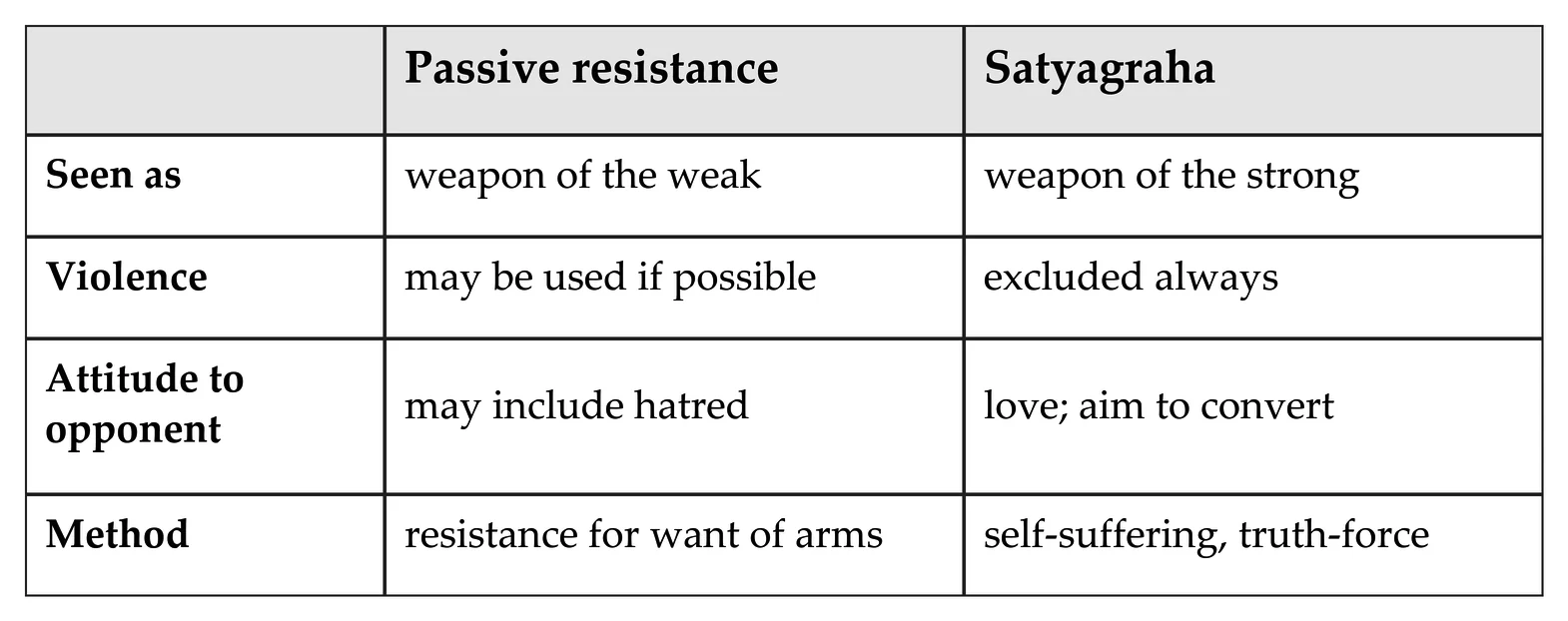
Gandhi distinguished satyagraha from passive resistance. R.R. Diwakar, in Saga of Satyagraha (1969), and Pyarelal and Sushila Nayar, in The Birth of Satyagraha: From Petitioning to Passive Resistance, trace how Gandhi moved from petitions to mass resistance and then to a distinctive method. Passive resistance, Gandhi said, was regarded as a weapon of the weak, adopted for want of arms; it did not exclude violence if the opportunity arose and might be combined with hatred of the opponent. Satyagraha was a weapon of the strong, excluding violence in all circumstances and based on love for the opponent. In Hind Swaraj (1909) he described it as a method of securing rights by personal suffering, the reverse of resistance by arms.
Principles of Satyagraha
- Truth. The satyagrahi holds firmly to what he or she believes to be true, but remains open to persuasion, since human truth is partial.
- Non-violence. No violence in thought, word or deed is permitted against the opponent.
- Self-suffering. The satyagrahi accepts suffering, such as imprisonment, loss of property or blows, instead of inflicting it, to appeal to the opponent’s conscience.
- Conversion. The aim is to convert the opponent, not to defeat or humiliate him, and to reach a just settlement.
- Openness. Satyagraha avoids secrecy and informs the opponent of its plans.
- Fearlessness and discipline. The satyagrahi must be free from fear, obey the leaders of the campaign and, under the rules Gandhi published in 1930, never insult the opponent or retaliate.
- Readiness to compromise. Satyagraha is willing to accept honourable compromise on non-essentials.
Techniques
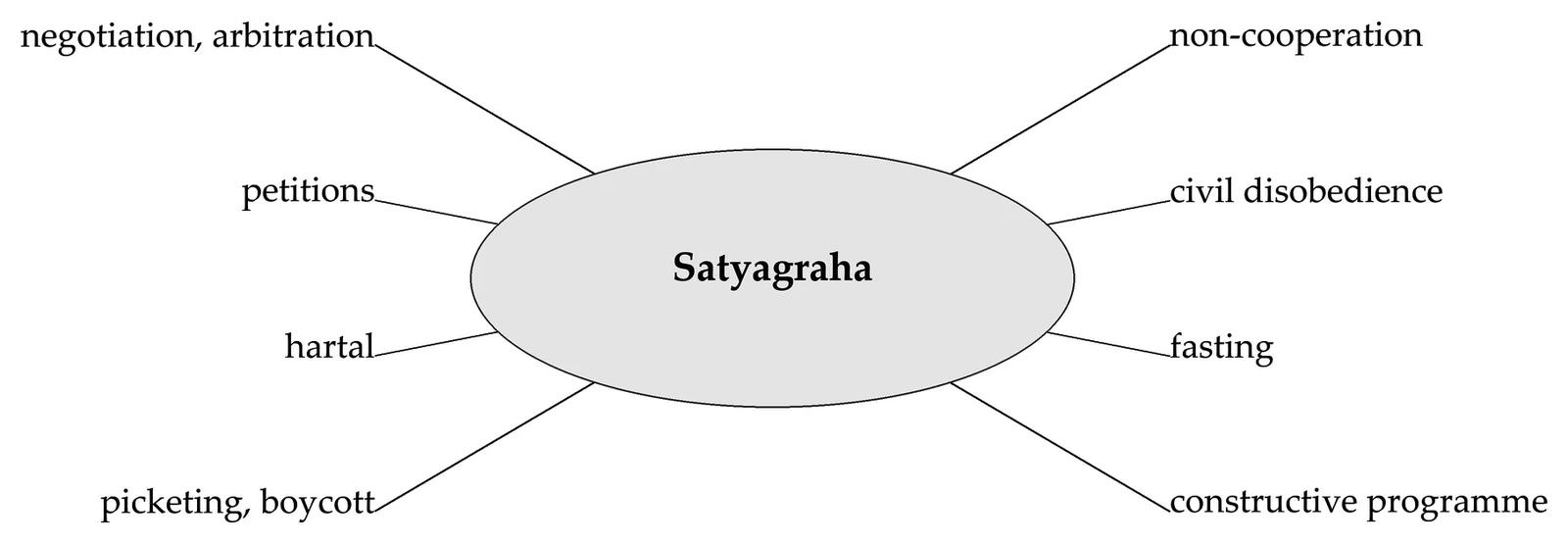
Gandhi used a graded series of techniques: negotiation and arbitration; petitions and public appeals; hartal (suspension of work); picketing; boycott of foreign goods and institutions; non-cooperation with the government, such as surrendering titles and leaving schools and courts; civil disobedience, the deliberate and open breaking of unjust laws; fasting to purify oneself and appeal to others; and hijrat, voluntary migration from a place of oppression. These were combined with the constructive programme of khadi, village industries, removal of untouchability, communal unity and basic education, which built the moral and social strength needed for satyagraha.
Rules for Satyagrahis
In 1930, before the Salt Satyagraha, Gandhi published rules for satyagrahis. As individuals, they must harbour no anger, suffer the opponent’s anger, never retaliate or curse, submit to arrest, and not resist the confiscation of property except where they hold it in trust. As members of a campaign, they must obey orders, protect officials from insult or attack and accept the hardships of the struggle. These rules show how strictly Gandhi tied satyagraha to self-discipline.
2.2 Satyagraha in Action: Peasants, Caste and Temple Entry
Peasant Satyagraha
- Champaran (1917). Indigo cultivators in Bihar were forced under the tinkathia system to grow indigo on part of their land for European planters. Invited by Raj Kumar Shukla, Gandhi defied an order to leave the district, recorded thousands of peasants’ statements and secured an inquiry; the Champaran Agrarian Act of 1918 abolished the system. In his autobiography Gandhi wrote that in meeting the peasants he was face to face with God, ahimsa and truth.
- Ahmedabad (1918). Gandhi supported mill workers demanding higher wages and undertook his first fast in India, leading to arbitration and a wage increase.
- Kheda (1918). Peasants in Gujarat, facing crop failure, demanded suspension of land revenue; with Vallabhbhai Patel, Gandhi organised a no-revenue campaign that won partial relief.
- Bardoli (1928). Under Patel’s leadership, peasants resisted an increase in land revenue; the government appointed an inquiry that reduced the increase, and Patel earned the title Sardar.
Sushila Nayar, in Satyagraha at Work, shows how these campaigns trained ordinary people in disciplined non-violent action and brought peasants into the national movement, linking local grievances with the struggle for swaraj.
Critique of Caste and Untouchability
Gandhi regarded untouchability as a sin and a blot on Hinduism, and campaigned against it throughout his life. In 1921 he said that if he were to be reborn, he would wish to be born an untouchable so that he could share their sorrows. He called the untouchables Harijans (people of God), founded the Harijan Sevak Sangh in 1932 and started the weekly Harijan in 1933, travelling across India in a Harijan tour to raise funds and opinion. His early views, however, defended varnashrama as a hereditary division of labour without hierarchy; only later did he openly support inter-caste marriages.
Temple Entry
- Vaikom Satyagraha (1924–25). In Travancore, satyagrahis led by T.K. Madhavan and K.P. Kesava Menon demanded that avarnas be allowed to use roads around the Vaikom temple; Gandhi visited in 1925, and three of the four roads were opened.
- Guruvayur Satyagraha (1931–32). K. Kelappan fasted for temple entry at Guruvayur; Gandhi asked him to end the fast, and a referendum among caste Hindus showed majority support for entry.
- Temple Entry Proclamation (1936). The Maharaja of Travancore opened state temples to all Hindus, a step Gandhi hailed as a miracle of modern times.
Poona Pact and the Debate with Ambedkar
When the Communal Award of 1932 granted separate electorates to the Depressed Classes, Gandhi began a fast unto death in Yerwada jail, arguing that separate electorates would permanently divide Hindu society. The Poona Pact (September 1932) between Gandhi and B.R. Ambedkar replaced separate electorates with reserved seats in joint electorates. Ambedkar criticised Gandhi’s approach as paternalistic, arguing in Annihilation of Caste (1936) that caste could not be reformed without destroying the authority of the scriptures; Gandhi replied in Harijan. Bhikhu Parekh, in Discourse on Unsociability, shows that Gandhi attacked untouchability as a sin while trying to reform Hinduism from within, and P. Rao, in Gandhi, Untouchability and the Postcolonial Predicament (2009), argues that Gandhi’s reformist and paternal approach left little room for Dalit self-assertion, a tension that continues in postcolonial India.

2.3 Social Harmony and Communal Unity
Gandhi regarded Hindu-Muslim unity as essential for swaraj. In Hind Swaraj he argued that India cannot cease to be one nation because people of different religions live in it. He believed that religions were different roads to the same goal and practised sarva dharma samabhava, equal respect for all religions, in his prayer meetings, which included readings from the Gita, the Quran and the Bible.
Efforts for Communal Unity
- Khilafat and Non-Cooperation (1920). Gandhi supported the Khilafat movement of Indian Muslims, linking it with Non-Cooperation to build a united front against British rule.
- The 1924 fast. After communal riots, including at Kohat, Gandhi undertook a twenty-one-day fast in Delhi in 1924 for Hindu-Muslim unity.
- Constructive programme. Communal unity was a central item of his constructive programme, alongside khadi and the removal of untouchability.
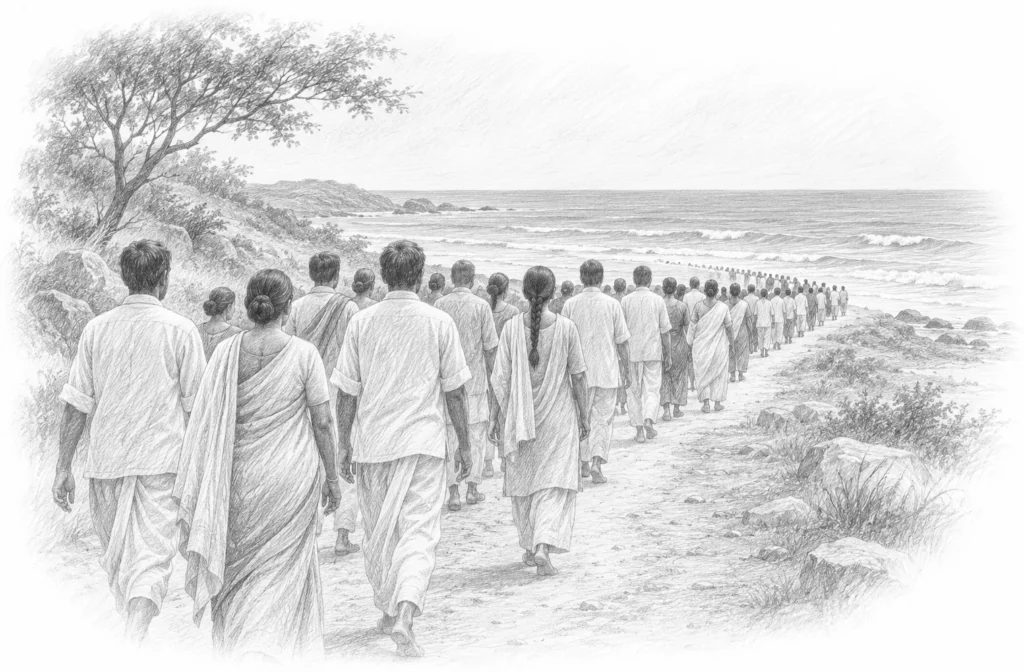
- Noakhali (1946–47). After communal violence in Noakhali in eastern Bengal, Gandhi walked barefoot from village to village for months, trying to restore trust and peace.
- Calcutta (1947). In August and September 1947, Gandhi’s fast helped end rioting in Calcutta; Lord Mountbatten called him a one-man boundary force.
- Delhi (1948). His last fast, in January 1948, sought peace in Delhi and fair treatment of Muslims and Pakistan; days later, on 30 January 1948, he was assassinated by Nathuram Godse.
Hardiman: Fighting Religious Hatreds
David Hardiman, in Fighting Religious Hatreds (2003), shows how Gandhi tried to combat communalism through moral persuasion, personal example, fasting and dialogue, and how he insisted that each community should take responsibility for protecting minorities. Hardiman notes the limits of his approach: religious language in politics could also deepen communal identities, and Gandhi’s influence declined in the violence of the 1940s. Yet his efforts in Noakhali, Calcutta and Delhi remain powerful examples of non-violent peace-making.
Assessment
Satyagraha in action showed both the power and the limits of Gandhian methods. It mobilised peasants, challenged untouchability and mobilised millions in the freedom struggle, and it demonstrated the moral force of self-suffering. But critics argue that Gandhi’s gradual, reformist approach to caste did not satisfy Dalit demands for equality, that his religious idiom was misunderstood or misused, and that non-violence could not prevent the violence of Partition.

Satyagraha after Gandhi
After independence, Vinoba Bhave’s Bhoodan movement (from 1951) used Gandhian persuasion to ask landowners to donate land to the landless, and Jayaprakash Narayan’s movement of 1974–75 used satyagraha against corruption. Later movements, from Chipko to the Narmada Bachao Andolan and anti-corruption protests in 2011, adopted fasts, marches and civil disobedience, showing the lasting influence of satyagraha on Indian democracy.
2.4 Important Questions
- Question 1 Explain Gandhi’s theory of satyagraha and distinguish it from passive resistance.
- Question 2 Discuss the peasant satyagrahas led by Gandhi.
- Question 3 Examine Gandhi’s critique of caste and untouchability with reference to temple entry movements.
- Question 4 Discuss Gandhi’s efforts for social harmony and communal unity.
DU asks the same idea in different words. So learn one broad answer for each question below; the same answer works for every question joined by OR.
Important Question 1
Explain Gandhi’s theory of satyagraha and distinguish it from passive resistance.
OR
Discuss the principles and techniques of satyagraha.
OR
Satyagraha is the weapon of the strong. Discuss.
Model Answer
“Passive resistance is a method of securing rights by personal suffering; it is the reverse of resistance by arms.”
— M.K. Gandhi, Hind Swaraj (1909)
Introduction. Satyagraha was Gandhi’s distinctive method of resisting injustice through truth and non-violence. Developed in South Africa and applied in India, it turned moral principles into a technique of mass political action. Gandhi carefully distinguished it from passive resistance, insisting that satyagraha was a weapon of the strong based on love rather than a tactic of the weak.
1. Origin of the Term
In South Africa, Indians resisting the registration law of 1906 first called their struggle passive resistance. Maganlal Gandhi suggested sadagraha, which Gandhi changed to satyagraha, combining satya, truth, and agraha, firmness, to mean the force born of truth and love.
2. Meaning
Satyagraha means holding firmly to truth and resisting injustice through non-violent means and self-suffering, with the aim of converting the opponent rather than defeating him.
3. Passive Resistance as Weapon of the Weak
Gandhi said passive resistance was regarded as a weapon of the weak, adopted for want of arms, which might turn to violence when possible and could be combined with hatred.
4. Satyagraha as Weapon of the Strong
Satyagraha excludes violence in all circumstances and is based on love for the opponent. It requires courage and moral strength, not merely lack of arms.
5. Truth
The satyagrahi holds firmly to what he believes to be true, but remains open to persuasion, since human truth is partial and the opponent may also see part of the truth.
6. Non-violence
No violence in thought, word or deed is permitted. Gandhi suspended campaigns, as after Chauri Chaura in 1922, when violence broke out.
7. Self-Suffering
The satyagrahi accepts suffering instead of inflicting it, appealing to the opponent’s conscience and to public opinion through visible sacrifice.
8. Conversion
The aim is to convert the opponent and reach a just settlement, not to humiliate him, so that relations can be rebuilt after the struggle.
9. Openness and Discipline
Satyagraha avoids secrecy, informs the opponent of its plans and requires disciplined obedience to its leaders and rules, such as never insulting the opponent.
10. Techniques: Non-cooperation
Non-cooperation involves withdrawing support from unjust authority, through surrendering titles, boycotting schools, courts and foreign goods, and hartals.
11. Techniques: Civil Disobedience
Civil disobedience is the open and deliberate breaking of unjust laws, accepting the penalty, as in the Salt Satyagraha of 1930.
12. Fasting
Gandhi used fasts to purify himself and to appeal to the conscience of others, as in 1918 at Ahmedabad and 1924 for communal unity.
13. Constructive Programme
Satyagraha was linked to the constructive programme of khadi, village industries, removal of untouchability and communal unity, which built the people’s strength.
14. Diwakar and Nayar
Diwakar’s Saga of Satyagraha and the works of Pyarelal and Sushila Nayar trace how Gandhi moved from petitioning to passive resistance and then to satyagraha.
15. Criticisms
Critics argue that fasting could be coercive, that satyagraha needs a relatively humane opponent and that strict discipline was hard to maintain in mass movements.
16. The Satyagrahi’s Qualities
Gandhi required satyagrahis to have faith in truth and non-violence, purity of life, freedom from fear, readiness to suffer, and freedom from hatred. In 1930 he published rules forbidding anger, retaliation, cursing and resistance to arrest, and requiring obedience to leaders, which show how much self-discipline satyagraha demanded.
17. Satyagraha and Democracy
Gandhi saw satyagraha as a democratic weapon, since it allows ordinary people without arms or wealth to resist injustice. Yet after independence he and others debated whether satyagraha was still justified against a democratically elected government, a debate that continues in India today.
18. Evaluation
Satyagraha was a creative fusion of ethics and politics that mobilised millions and influenced movements worldwide.
Conclusion. Thus, satyagraha, born in South Africa, is truth-force: firm, non-violent resistance through self-suffering aimed at converting the opponent. Unlike passive resistance, which Gandhi saw as a weapon of the weak, satyagraha is a weapon of the strong, securing rights, as he said, by personal suffering rather than arms.
Important Question 2
Discuss the peasant satyagrahas led by Gandhi.
OR
Examine the significance of the Champaran, Kheda and Bardoli satyagrahas.
OR
How did satyagraha bring peasants into the national movement. Discuss.
Model Answer
“It is no exaggeration, but the literal truth, to say that in this meeting with the peasants I was face to face with God, Ahimsa and Truth.”
— M.K. Gandhi, An Autobiography, on Champaran
Introduction. Gandhi’s first campaigns in India after his return from South Africa in 1915 were local struggles of peasants and workers. In Champaran, Kheda and later Bardoli, satyagraha defended peasants against exploitation by planters and the colonial revenue system. These campaigns tested Gandhi’s methods, built his leadership and brought the peasantry into the national movement.
1. Return to India
After returning in 1915, Gandhi travelled across India on the advice of Gopal Krishna Gokhale to understand its conditions before entering politics.
2. The Tinkathia System
In Champaran, Bihar, peasants were forced by European planters to grow indigo on three-twentieths of their land under the tinkathia system and faced illegal dues and oppression.

3. Champaran, 1917
Invited by Raj Kumar Shukla, Gandhi went to Champaran in 1917. Ordered to leave, he refused, accepting the penalty, and the government withdrew the case, a first demonstration of civil disobedience in India.
4. Inquiry and Reform
Gandhi and his colleagues, including Rajendra Prasad, recorded thousands of statements from peasants. An inquiry committee followed, and the Champaran Agrarian Act of 1918 abolished the tinkathia system.
5. Face to Face with Truth
Gandhi wrote that in meeting the peasants he was face to face with God, ahimsa and truth, showing how he saw service of the poor as part of his spiritual search.
6. Ahmedabad Mill Strike, 1918
In Ahmedabad, Gandhi supported mill workers’ demand for higher wages and undertook his first fast in India, leading to arbitration and a wage increase.
7. Kheda, 1918
When crops failed in Kheda, Gujarat, peasants sought suspension of land revenue. Gandhi and Vallabhbhai Patel led a no-revenue campaign that won partial relief for poorer peasants.
8. Bardoli, 1928
In Bardoli, peasants led by Patel refused to pay an increased land revenue. An inquiry reduced the increase, and Patel earned the title Sardar.
9. Methods Used
These campaigns used investigation, negotiation, non-payment of revenue, disciplined non-violence and acceptance of penalties, the core methods of satyagraha.
10. Training in Non-violence
Sushila Nayar shows in Satyagraha at Work that these campaigns trained ordinary people in disciplined non-violent action and built confidence among them.
11. Emergence of Leaders
The campaigns brought forward leaders such as Rajendra Prasad, Vallabhbhai Patel and J.B. Kripalani, who later became national figures.
12. Peasants and Nationalism
By linking local grievances with the demand for justice and swaraj, the campaigns brought peasants into the national movement, transforming it into a mass struggle.
13. Limits
Historians note that Gandhi avoided campaigns against Indian landlords and sought to reconcile classes rather than promote class struggle, which radical critics questioned.
14. Later Peasant Movements
Peasant participation in Non-Cooperation, Civil Disobedience and Quit India drew on the experience and confidence built in these early satyagrahas.
15. Relevance
Farmers’ movements in contemporary India, including the protests of 2020–21 against the farm laws, have used Gandhian methods of disciplined non-violent protest.
16. Investigation as Method
In Champaran, Gandhi insisted on recording facts carefully before acting, collecting thousands of signed statements from peasants. This showed that satyagraha relied on truth in the sense of accurate information, and the evidence strengthened the peasants’ case before the government inquiry.
17. Constructive Work in Champaran
Gandhi also started schools, sanitation work and health services in Champaran villages with volunteers, linking resistance with constructive work to improve village life, a pattern he later developed into the constructive programme.
18. Evaluation
The peasant satyagrahas proved the effectiveness of Gandhian methods and made Gandhi the leader of a mass national movement.
Conclusion. Thus, the satyagrahas of Champaran, Ahmedabad, Kheda and Bardoli defended peasants and workers through investigation, non-violence and acceptance of penalties, abolishing the tinkathia system and reducing revenue. In Champaran, Gandhi felt face to face with truth and ahimsa, and these campaigns brought the peasantry into the national movement.
Important Question 3
Examine Gandhi’s critique of caste and untouchability with reference to temple entry movements.
OR
Discuss the debate between Gandhi and Ambedkar on caste.
OR
Critically evaluate Gandhi’s campaign against untouchability.
Model Answer
“I do not want to be reborn. But if I have to be reborn, I should be born an untouchable, so that I may share their sorrows, sufferings and the affronts levelled at them.”
— M.K. Gandhi, speech at Ahmedabad, Young India (1921)
Introduction. Gandhi regarded untouchability as a sin and a blot on Hinduism, and made its removal part of his life’s work. He supported temple entry movements, founded the Harijan Sevak Sangh and travelled across India against untouchability. Yet his approach, which sought to reform Hinduism from within, was criticised by B.R. Ambedkar and later scholars as paternalistic and insufficiently radical.
1. Untouchability as Sin
Gandhi called untouchability a sin against God and humanity and a blot on Hinduism, which had no sanction in true religion and had to be removed for Hinduism to survive.
2. Identification with Untouchables
In 1921 he said that if reborn he would wish to be born an untouchable to share their sufferings, expressing his moral identification with the oppressed.
3. Vaikom Satyagraha
In 1924–25, satyagrahis at Vaikom in Travancore demanded that avarnas be allowed to use roads around the temple. Gandhi visited in 1925, and three of the four roads were opened.
4. Guruvayur Satyagraha
In 1931–32, K. Kelappan fasted for temple entry at Guruvayur. Gandhi asked him to end the fast and supported a referendum that showed majority support for entry among caste Hindus.
5. Temple Entry Proclamation
In 1936, the Maharaja of Travancore opened state temples to all Hindus, a step Gandhi hailed as a miracle of modern times.
6. Harijan Sevak Sangh
After the Poona Pact, Gandhi founded the Harijan Sevak Sangh in 1932 and the weekly Harijan in 1933, and toured India to raise funds and opinion against untouchability.
7. Views on Varna
Gandhi initially defended varnashrama as a hereditary division of labour without hierarchy, while rejecting untouchability; later he supported inter-caste marriages and moved closer to rejecting caste.
8. The Poona Pact
Gandhi’s fast in 1932 against separate electorates for the Depressed Classes led to the Poona Pact with Ambedkar, replacing separate electorates with reserved seats in joint electorates.
9. Ambedkar’s Critique
Ambedkar argued in Annihilation of Caste (1936) that caste could not be reformed without destroying the authority of the scriptures, and criticised Gandhi’s paternalism and defence of varna.
10. Gandhi’s Reply
Gandhi replied in Harijan that the scriptures must be interpreted by reason and conscience, and that varna, properly understood, implied no superiority, a view Ambedkar rejected.
11. Parekh’s Analysis
Bhikhu Parekh shows that Gandhi attacked untouchability as a sin while seeking to reform Hinduism from within, avoiding a direct attack on the religion of the majority.
12. Rao’s Critique
P. Rao argues that Gandhi’s reformist and paternal approach left little room for Dalit self-assertion, a tension that persists in postcolonial India.
13. Achievements
Gandhi’s campaign made the removal of untouchability part of the national agenda, contributing to Article 17 of the Constitution, which abolished untouchability.
14. Limits
Critics argue that Gandhi relied on the change of heart of caste Hindus rather than on rights and political power for Dalits, which Ambedkar saw as essential.
15. Contemporary Relevance
Continuing caste discrimination and debates on temple entry, such as for women at Sabarimala, show that the questions Gandhi and Ambedkar debated remain alive.
16. Self-Purification of Caste Hindus
Gandhi saw the removal of untouchability as the duty and penance of caste Hindus, who had to purify themselves of the sin. This placed the burden of change on the oppressors, but critics argued that it treated Dalits as objects of reform rather than agents of their own liberation.
17. Gandhi and Ambedkar Compared
Both opposed untouchability, but Gandhi sought a change of heart within Hinduism, while Ambedkar demanded legal rights, political representation and, finally, conversion to Buddhism in 1956. Their debate remains central to understanding caste politics in India.
18. Evaluation
Gandhi made untouchability a moral and national issue, but Ambedkar’s critique shows that reform from above needed to be complemented by Dalit self-assertion and rights.
Conclusion. Thus, Gandhi attacked untouchability as a sin, supported temple entry at Vaikom and Guruvayur, and founded the Harijan Sevak Sangh, identifying himself with untouchables. Yet Ambedkar and scholars such as Rao criticised his paternalism and defence of varna, showing the limits of reform from within.
Important Question 4
Discuss Gandhi’s efforts for social harmony and communal unity.
OR
Examine Gandhi’s approach to Hindu-Muslim unity.
OR
Discuss Gandhi’s role in Noakhali and in the fasts of 1947–48.
Model Answer
“India cannot cease to be one nation because people belonging to different religions live in it.”
— M.K. Gandhi, Hind Swaraj (1909)
Introduction. Gandhi regarded communal harmony as essential for swaraj. He believed that people of different religions could form one nation and worked throughout his life for Hindu-Muslim unity, through alliances, fasts, prayer meetings and personal journeys into riot-torn areas. His efforts reached their peak in 1946–48, when he struggled against the violence of Partition and paid with his life.
1. One Nation of Many Faiths
In Hind Swaraj, Gandhi argued that India cannot cease to be one nation because people of different religions live in it, rejecting the idea that religion defines nationhood.
2. Equal Respect for Religions
Gandhi practised sarva dharma samabhava, equal respect for all religions, seeing them as different roads to the same goal.
3. Prayer Meetings
His prayer meetings included readings from the Gita, the Quran and the Bible, symbolising the unity of faiths.
4. The Khilafat Alliance
In 1920, Gandhi supported the Khilafat movement and linked it with Non-Cooperation to build a united Hindu-Muslim front against British rule.
5. The 1924 Fast
After communal riots, including at Kohat, Gandhi undertook a twenty-one-day fast in Delhi in 1924 for Hindu-Muslim unity.
6. Constructive Programme
Communal unity was a central item of the constructive programme, alongside khadi and the removal of untouchability, reflecting its importance for swaraj.
7. Noakhali
After communal violence in Noakhali in 1946, Gandhi walked barefoot from village to village for months, trying to restore trust and protect the minority.
8. Calcutta, 1947
In August and September 1947, Gandhi’s fast helped end rioting in Calcutta, and Mountbatten called him a one-man boundary force.
9. Delhi, 1948
His last fast in January 1948 sought peace in Delhi and fair treatment of Muslims; days later, on 30 January 1948, he was assassinated.
10. Hardiman’s Analysis
David Hardiman shows that Gandhi fought religious hatreds through persuasion, personal example and fasting, insisting that each community protect its minorities.
11. Responsibility of the Majority
Gandhi argued that the majority community had a special duty to win the trust of minorities, a principle relevant to democratic pluralism.
12. Religion in Politics
Critics argue that Gandhi’s use of religious language in politics may have deepened communal identities, even though he sought unity.
13. The Failure to Prevent Partition
Despite his efforts, Gandhi could not prevent Partition and its violence, showing the limits of moral persuasion against organised communal politics.
14. Legacy
Gandhi’s commitment to equal citizenship regardless of religion influenced the secular principles of the Indian Constitution.
15. Relevance
In times of communal tension, Gandhi’s example of courage, dialogue and protection of minorities remains a powerful model of peace-making.
16. The Cow and the Language Questions
Gandhi tried to address sources of communal tension, such as cow slaughter and the Hindi-Urdu dispute, through persuasion rather than law, opposing the use of force to protect cows and proposing Hindustani in both scripts as a common language.
17. Gandhi’s Assassination
Gandhi was killed on 30 January 1948 by Nathuram Godse, who blamed him for Partition and for his concern for Muslims. His death shocked the nation and briefly strengthened the commitment to communal harmony and a secular state.
18. Evaluation
Gandhi’s efforts for communal unity were among his bravest acts, though they could not overcome the forces that led to Partition.
Conclusion. Thus, Gandhi worked for communal unity through the Khilafat alliance, fasts, prayer meetings and his journeys in Noakhali, Calcutta and Delhi, believing, as he wrote in Hind Swaraj, that India cannot cease to be one nation because of different religions. Though he could not prevent Partition, his example endures.
Short Notes
(a) Vaikom Satyagraha
A satyagraha in Travancore in 1924–25 demanding that avarnas be allowed to use roads around the Vaikom temple; Gandhi visited in 1925 and three of the four roads were opened.
(b) Poona Pact
The 1932 agreement between Gandhi and Ambedkar, after Gandhi’s fast against separate electorates, that gave the Depressed Classes reserved seats in joint electorates.
(c) Tinkathia system
The system in Champaran under which peasants were forced to grow indigo on three-twentieths of their land for European planters, abolished after Gandhi’s satyagraha of 1917.
More notes: MDSE-2a Gandhi and the Contemporary World
These notes are prepared by PADHO TO AISE for study help. They are not an official University of Delhi publication.