
Semester IV MDSC-4A Comparative Government and Politics
Unit V · 25 min read · Updated 24 Nov 2026
As per the University of Delhi (DU) BA (Hons) Political Science syllabus
Contents
- 5.1 Power and its Structures
- 5.2 Classical Elite Theory
- 5.3 The Power Elite
- 5.4 Pluralism
- 5.5 The Theory of the Ruling Class
- 5.6 Important Questions
- Discuss the classical elite theory with reference to Pareto, Mosca and Michels.
- Discuss C. Wright Mills’s theory of the power elite.
- Explain the pluralist theory of power with reference to Robert Dahl. What are its criticisms?
- Explain the theory of the ruling class. How does it differ from elite theory?
- Short Notes
सभी समाजों में लोगों के दो वर्ग दिखाई देते हैं: एक वर्ग जो शासन करता है और एक वर्ग जिस पर शासन किया जाता है।
In all societies two classes of people appear: a class that rules and a class that is ruled.
— Gaetano Mosca, The Ruling Class (1896)
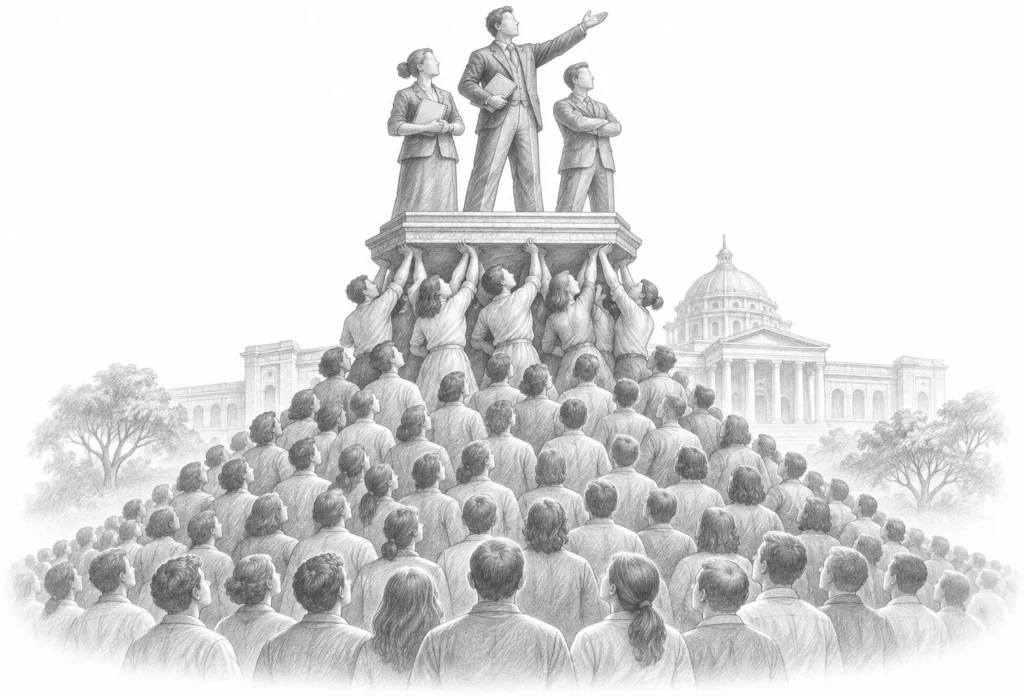
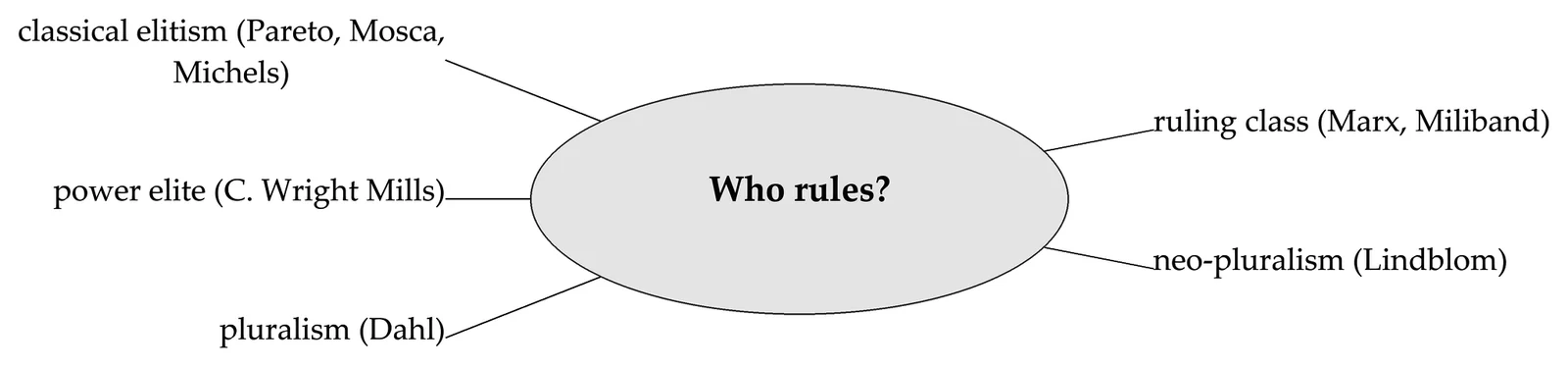
WHO really rules in a society? Democracies proclaim that power belongs to the people, but in every society some people have far more influence than others. A small number of politicians, business leaders, bureaucrats and military officers seem to make the most important decisions. Are they a closed elite, a set of competing groups, or the representatives of a dominant economic class? This unit studies four theories of the structure of power in society: classical elite theory (Pareto, Mosca and Michels), the power elite (C. Wright Mills), pluralism (Robert Dahl) and the theory of the ruling class (Marx and his followers), drawing on Geraint Parry’s Political Elites.
5.1 Power and its Structures
Power is the ability to get others to do what they would not otherwise do, as Robert Dahl defined it, or more broadly the capacity to shape decisions and outcomes. The question of how power is distributed in society is central to comparative politics. Is power concentrated in a small group or dispersed among many? Is it based on organisation, wealth, institutional position or class? Geraint Parry, in Political Elites, explains that the answers fall into three broad families: elite theories, which hold that a minority always rules; pluralist theories, which hold that power is dispersed among competing groups; and Marxist theories, which hold that a ruling class based on ownership of the means of production dominates society.
5.2 Classical Elite Theory
Classical elite theory was developed in Italy and Germany around 1900 as a reaction against both democratic and Marxist ideas. Its founders argued that rule by a minority is inevitable in every society, whatever its constitution. Parry notes that James Meisel summed up the elite as having the three Cs: group consciousness, coherence and conspiracy, i.e. a common will to act.
- Vilfredo Pareto (1848–1923), in his Treatise on General Sociology (1916), divided society into the elite, those with the highest ability in their field, and the masses. The elite is split into a governing elite and a non-governing elite. Borrowing from Machiavelli, he distinguished elites who rule by cunning, the foxes, from those who rule by force, the lions. Elites decay and are replaced by new ones, a process he called the circulation of elites; history, he wrote, is a graveyard of aristocracies.
- Gaetano Mosca (1858–1941), in The Ruling Class (1896), argued that in all societies a minority rules and a majority is ruled. The minority dominates because it is organised, while the majority is disorganised. The ruling class justifies its power through a political formula, such as divine right or popular sovereignty, and relies on a large sub-elite of officials and professionals. Mosca later accepted that representative government could make the ruling class more open.
- Robert Michels (1876–1936), studying the German Social Democratic Party in Political Parties (1911), formulated the iron law of oligarchy: large organisations require leaders and experts, who gain control of information and resources, so even democratic parties become oligarchies. Who says organisation, he wrote, says oligarchy.
Classical elitists were sceptical of democracy, and some, such as Pareto and Michels, later sympathised with Italian fascism. Democratic elitists such as Joseph Schumpeter (1942) accepted that elites rule but argued that democracy means competition among elites for the people’s votes.
5.3 The Power Elite
The American sociologist C. Wright Mills, in The Power Elite (1956), argued that in post-war America power had become concentrated in three great institutional hierarchies: the corporations, the military and the federal executive. The heads of these institutions formed a power elite. They shared similar social backgrounds, attended the same elite schools and clubs, and moved between corporate boardrooms, military commands and government posts, creating an interlocking directorate. The Cold War permanent war economy united their interests, an idea President Eisenhower echoed in 1961 when he warned against the military-industrial complex.
Below the power elite were the middle levels of power, Congress, interest groups and local elites, which pluralists studied but which, Mills argued, dealt mainly with lesser issues. At the bottom was a mass society of passive, media-influenced citizens rather than an active public. Unlike classical elitists, Mills did not believe elite rule was inevitable; he saw it as a historical product of American institutions and criticised it from a radical democratic standpoint. Unlike Marxists, he located power in institutional positions rather than only in class ownership.
5.4 Pluralism
Pluralism holds that power in liberal democracies is dispersed among many competing groups, such as business associations, trade unions, professional bodies, religious organisations and consumer groups. Arthur Bentley (1908) and David Truman (The Governmental Process, 1951) saw politics as the interaction of groups, with government acting as a referee. Robert Dahl, in Who Governs? (1961), studied decision-making in New Haven, Connecticut. He examined three issue areas, urban redevelopment, public education and political nominations, and found that different people and groups were influential in different areas, and that elected leaders responded to many interests. He concluded that New Haven had moved from oligarchy to pluralism, with dispersed inequalities of resources.
Dahl called real-world democracies polyarchies, rule by many minorities. Critics challenged pluralism. Peter Bachrach and Morton Baratz (1962) argued that power has a second face: the ability to keep issues off the agenda through non-decision-making. Steven Lukes, in Power: A Radical View (1974), added a third dimension, the shaping of people’s preferences so that they do not recognise their real interests. Later, Charles Lindblom and Dahl himself developed neo-pluralism, recognising that business enjoys a privileged position in market democracies.
5.5 The Theory of the Ruling Class
Marxist theory holds that power is rooted in the ownership of the means of production. In capitalist societies the bourgeoisie, which owns capital, is the ruling class, and the state protects its interests. Marx and Engels wrote that the ideas of the ruling class are in every epoch the ruling ideas. Ralph Miliband, in The State in Capitalist Society (1969), showed that the state elite in Western democracies came largely from the same classes as the business elite and shared its outlook. Nicos Poulantzas argued that the state serves capital because of its structural position, with relative autonomy from particular capitalists. Antonio Gramsci explained that the ruling class maintains power not only by force but by hegemony, the consent produced through culture, education and the media.
Parry contrasts the two minority theories: elite theorists see rule by a minority as inevitable and based on organisation or ability, while Marxists see it as based on class ownership and believe it can be ended through a classless society. Pluralists reject both, arguing that elections and group competition disperse power.
5.6 Important Questions
- Question 1 Discuss the classical elite theory with reference to Pareto, Mosca and Michels.
- Question 2 Discuss C. Wright Mills’s theory of the power elite.
- Question 3 Explain the pluralist theory of power with reference to Robert Dahl. What are its criticisms?
- Question 4 Explain the theory of the ruling class. How does it differ from elite theory?
DU asks the same idea in different words. So learn one broad answer for each question below; the same answer works for every question joined by OR.
Important Question 1
Discuss the classical elite theory with reference to Pareto, Mosca and Michels.
OR
‘Every society is ruled by a minority.’ Discuss with reference to classical elite theorists.
OR
Explain Michels’s iron law of oligarchy.
Model Answer
“History is a graveyard of aristocracies.”
— Vilfredo Pareto, The Mind and Society (1916)
Introduction. Classical elite theory emerged in Europe at the turn of the twentieth century, when mass democracy and socialism were rising. Its founders, Vilfredo Pareto, Gaetano Mosca and Robert Michels, argued that, whatever the form of government, power is always exercised by a small minority. Geraint Parry explains that their theory was both a description of how all societies work and a challenge to democratic and Marxist hopes of equality.
1. Meaning of Elite
An elite is a small group that holds a disproportionate share of power, wealth or prestige. Elite theorists argue that society is always divided into a ruling minority and a ruled majority. James Meisel summarised the elite’s defining features as the three Cs: group consciousness, coherence and conspiracy, meaning that elite members are aware of their position, act together and share a common purpose. Parry notes that elite theory is not only a claim that inequality exists, which few would deny, but that the minority is a cohesive group that consistently controls the most important decisions.
2. Historical Context
The classical elitists wrote when universal suffrage, mass parties and socialist movements were spreading in Europe. Disillusioned with parliamentary corruption in Italy and with the bureaucratisation of socialist parties, they set out to show that democracy and socialism could not deliver rule by the people. Their ideas were partly a conservative response to these movements.
3. Pareto’s Elite and Masses
Vilfredo Pareto, an Italian economist and sociologist, argued that people are unequal in their abilities and that those with the highest abilities in any field form an elite. The elite divides into a governing elite, which directly or indirectly holds political power, and a non-governing elite. The rest of the population forms the masses, who have little power. Pareto believed that the masses are moved more by sentiments, which he called residues, than by reason, which made them easy for skilful elites to manipulate.
4. Lions, Foxes and Circulation
Borrowing from Machiavelli, Pareto distinguished elites who rule by cunning and manipulation, the foxes, from those who rule by force and conviction, the lions. No elite lasts forever: as it decays, it is replaced by individuals from the masses or by a new elite, a process Pareto called the circulation of elites. Revolutions occur when the circulation is blocked. History, he wrote, is a graveyard of aristocracies.
5. Mosca’s Ruling Class
Gaetano Mosca argued in The Ruling Class that in all societies two classes appear, a class that rules and a class that is ruled. The ruling minority performs all political functions, monopolises power and enjoys its advantages. Its power comes not from superior ability alone but from organisation: an organised minority acting in unison will always triumph over a disorganised majority.
6. Political Formula and Sub-elite
Mosca argued that every ruling class justifies its rule through a political formula, a moral or legal principle such as divine right or the sovereignty of the people, which makes power appear legitimate. He also emphasised the importance of a sub-elite, a large middle class of officials, managers and intellectuals, on which the ruling class depends. In later work he accepted that representative institutions could make the ruling class more open and accountable.
7. Michels and the Iron Law of Oligarchy
Robert Michels studied the German Social Democratic Party, which was committed to democracy and equality. He found that it was controlled by a small group of leaders and officials. Large organisations need specialised leaders, who gain expertise, control over information and resources, and the loyalty of members, while the masses are apathetic and grateful to their leaders. He concluded that who says organisation says oligarchy, an iron law that applies even to democratic organisations.
8. Common Themes
All three theorists argued that minority rule is inevitable, that the masses are incapable of ruling themselves, that elites are cohesive and conscious of their interests, and that changes of regime replace one elite with another rather than establishing rule by the people. They rejected both the liberal democratic claim of popular sovereignty and the Marxist hope of a classless society.
9. Democratic Elitism
Later thinkers adapted elite theory to democracy. Joseph Schumpeter, in Capitalism, Socialism and Democracy (1942), argued that democracy is simply a method by which elites compete for the people’s votes. Competitive elitism accepts that elites rule but sees elections as a way of making them accountable.
10. Criticisms
Critics argue that classical elitists exaggerated the cohesion of elites, which are often divided; ignored the real influence of elections, parties and movements; and offered a theory that is hard to test, since any society can be described as elite-ruled. Their contempt for the masses also led Pareto and Michels to sympathise with fascism. Yet their insights into organisation and oligarchy remain influential.
Conclusion. Thus, classical elite theory, developed by Pareto, Mosca and Michels, holds that every society is ruled by an organised minority. While it underestimates democratic institutions, it remains a powerful reminder that power tends to concentrate even in organisations committed to equality.
Important Question 2
Discuss C. Wright Mills’s theory of the power elite.
OR
‘America is ruled by a power elite.’ Discuss.
OR
Compare the power elite theory with classical elite theory.
Model Answer
“The power elite is composed of men whose positions enable them to transcend the ordinary environments of ordinary men and women; they are in positions to make decisions having major consequences.”
— C. Wright Mills, The Power Elite (1956)
Introduction. In the 1950s, the United States presented itself as a model of democratic pluralism. The radical sociologist C. Wright Mills challenged this view in The Power Elite (1956), arguing that the most important decisions in American society were made by a small, interconnected elite at the top of the major institutions. His work gave elite theory a new, critical and democratic form.
1. Context
Mills wrote during the early Cold War, when the USA had a large permanent military establishment, giant corporations and a powerful federal government. Decisions about war, nuclear weapons and the economy seemed to be made by small groups beyond public control. Mills, influenced by Weber and by radical traditions, set out to show where power really lay. He was also influenced by Franz Neumann’s analysis of Nazi Germany as a coalition of party, army, industry and bureaucracy.
2. Institutional Basis of Power
Unlike classical elitists who emphasised personal qualities or organisation, Mills located power in institutional positions. In modern America, he argued, three institutional orders had become dominant and centralised: the economy, controlled by a few hundred giant corporations; the military, which had grown enormously; and the political order, centred on the federal executive.
3. The Three Hierarchies
The power elite consisted of the corporate rich and chief executives, the warlords at the top of the military, and the political directorate of the executive branch. The heads of these hierarchies made decisions with major consequences, such as decisions on war and peace, the economy and nuclear weapons.
4. Interlocking and Social Unity
The members of the power elite were connected by similar social backgrounds, attendance at elite schools and universities, membership of the same clubs and family ties. They moved between corporate, military and governmental positions, creating an interlocking directorate. A shared outlook and coinciding interests, especially in the permanent war economy of the Cold War, made them a unified elite. Mills described the exchange of personnel among these hierarchies as a revolving door, with generals joining corporate boards and executives taking cabinet posts.
5. The Military-Industrial Link
Mills stressed the growing role of the military and its alliance with corporations that produced weapons. In his farewell address of 1961, President Eisenhower warned against the acquisition of unwarranted influence by the military-industrial complex, echoing Mills’s concerns.
6. Middle Levels of Power
Below the power elite were the middle levels of power: Congress, political parties, interest groups and local elites. Pluralists studied these levels and found competition and balance, but Mills argued that they dealt mainly with secondary issues and that the major decisions were taken at the top.
7. Mass Society
At the bottom was a mass society. Mills distinguished a public, in which people discuss issues and act on their opinions, from a mass, in which people passively receive opinions from the media and have little ability to act. He believed that America was moving from a society of publics towards a mass society, which allowed the power elite to rule without effective democratic control. He blamed the mass media for turning citizens into spectators rather than participants in public debate.
8. Comparison with Classical Elitism
Like Pareto and Mosca, Mills argued that a minority makes the key decisions. But he did not see elite rule as inevitable or natural; he saw it as the result of specific historical developments in American institutions. He criticised it as a betrayal of democracy rather than justifying it, and he based it on institutional position rather than on superior ability.
9. Comparison with Marxism
Mills shared the Marxist concern with concentrated power but rejected the idea of a single ruling class based on ownership. He emphasised the autonomy of military and political institutions, not only economic ones, and preferred the term power elite to ruling class. Marxists criticised him for underestimating the dominance of capital.
10. Relevance Today
Mills’s ideas remain relevant to debates on the influence of large corporations, defence contractors and wealthy donors on policy, and on the movement of officials between government and business. Studies of the role of money in American elections and of close ties between technology companies and governments echo his concern that major decisions are made by a small, interconnected elite.
11. Criticisms
Pluralists such as Robert Dahl argued that Mills had not demonstrated that the power elite actually prevailed on key decisions against opposition; a proper test required studying specific decisions. Others noted divisions within the elite. Yet later studies, such as G. William Domhoff’s Who Rules America? (1967), found evidence of a cohesive upper class influencing policy.
Conclusion. Thus, Mills argued that power in modern America was concentrated in a power elite at the top of corporate, military and political hierarchies. His theory offered a critical, institution-based account of elite power that remains relevant to debates on democracy and the military-industrial complex.
Important Question 3
Explain the pluralist theory of power with reference to Robert Dahl. What are its criticisms?
OR
‘Power in democracies is dispersed among competing groups.’ Discuss.
OR
Compare the pluralist and elitist theories of power.
Model Answer
“In a political system where nearly every adult may vote but where knowledge, wealth, social position, access to officials, and other resources are unequally distributed, who actually governs?”
— Robert A. Dahl, Who Governs? (1961)
Introduction. Pluralism is the theory that power in liberal democracies is dispersed among many competing groups rather than concentrated in a single elite or class. It was the dominant theory of American political science in the 1950s and 1960s and was developed most fully by Robert Dahl. It offered an optimistic answer to elite theorists, but it has been strongly criticised.
1. Meaning of Pluralism
Pluralism holds that society contains many groups, such as business associations, trade unions, professional bodies, ethnic and religious organisations, and civic groups, which compete to influence government. No single group dominates all decisions, and the government acts as an arbiter or broker among them. Power is therefore fragmented and dispersed.
2. Group Theory
Arthur Bentley’s The Process of Government (1908) and David Truman’s The Governmental Process (1951) saw politics as the interaction of groups. Truman argued that overlapping memberships, since people belong to many groups, moderate conflict, and that potential groups would organise if their interests were threatened, so all significant interests could be represented.
3. Dahl’s Study of New Haven
In Who Governs? (1961) Dahl asked who actually governs in a democracy where resources are unequal. He studied decision-making in New Haven, Connecticut, in three issue areas: urban redevelopment, public education and political party nominations. He found that different individuals and groups were influential in different areas, and that few people were influential across all of them.
4. Dispersed Inequalities
Dahl found that New Haven had changed from rule by a patrician elite in the early nineteenth century to rule by business entrepreneurs and then to rule by a variety of leaders drawn from different backgrounds. Resources such as money, knowledge, popularity and votes were unequally distributed but dispersed: those lacking one resource often had another. He called this a system of dispersed rather than cumulative inequalities.
5. Polyarchy
Dahl described modern democracies as polyarchies, rule by many minorities, characterised by competition and participation. Elections force leaders to respond to voters, and competition among groups prevents any one from dominating. In his view, this was the realistic form of democracy in large societies.
6. Pluralism versus Elitism
Pluralists criticised elite theorists such as Mills for assuming rather than demonstrating elite control. Dahl argued that to prove that a ruling elite exists, one must identify a well-defined group whose preferences regularly prevail over others on key political issues. Pluralists studied actual decisions and found competition rather than domination.
7. The Second Face of Power
Peter Bachrach and Morton Baratz argued in 1962 that pluralists studied only the first face of power, decision-making on visible issues. Power also has a second face: the ability to keep issues off the agenda, which they called non-decision-making. Groups with power can prevent challenging issues from being raised at all, which pluralist studies cannot detect.
8. The Third Dimension
Steven Lukes, in Power: A Radical View (1974), added a third dimension: the power to shape people’s preferences and perceptions so that they accept the existing order and do not recognise their real interests. This links to Gramsci’s idea of hegemony and shows that the absence of conflict may itself be a sign of power.
9. Neo-pluralism
In response to criticism, Charles Lindblom’s Politics and Markets (1977) and Dahl’s later works recognised that business occupies a privileged position in market democracies, since governments depend on business investment and confidence. This neo-pluralism accepts that group competition is unequal and that economic power can distort democracy.
10. Pluralism and Democracy
Pluralists linked their theory to a defence of liberal democracy. A free society with many independent associations, a free press and regular elections prevents tyranny, because power is checked by power, as James Madison had argued in The Federalist No. 10. Tocqueville similarly praised the American habit of forming associations as a school of democracy. For pluralists, the existence of many centres of power is the best protection of liberty.
11. Evaluation
Pluralism captures the real competition among groups in democracies and the importance of elections and civil society. But it underestimates structural inequalities, the agenda-setting power of elites and the influence of business. In India, the influence of caste, regional and business groups shows both pluralist competition and unequal access to power.
Conclusion. Thus, pluralism, developed by Dahl, holds that power in democracies is dispersed among competing groups. Its critics have shown hidden faces of power and the privileged position of business, leading to a more realistic neo-pluralist view.
Important Question 4
Explain the theory of the ruling class. How does it differ from elite theory?
OR
Discuss the Marxist view of the distribution of power in capitalist society.
OR
Compare the ruling class theory with elitist and pluralist theories of power.
Model Answer
“The ideas of the ruling class are in every epoch the ruling ideas.”
— Karl Marx and Friedrich Engels, The German Ideology (1846)
Introduction. The theory of the ruling class, developed by Marx and later Marxists, holds that political power in class societies is rooted in economic power. The class that owns the means of production dominates the state, culture and ideas. This theory offers a third answer to the question of who rules, different from both elite theory and pluralism, and has been developed by thinkers such as Gramsci, Miliband and Poulantzas.
1. Class and Power
Marx argued that every class society is divided between those who own the means of production and those who must work for them. In ancient society these were masters and slaves, in feudalism lords and serfs, and in capitalism the bourgeoisie and the proletariat. The owning class controls economic resources and therefore political power.
2. The State as an Instrument
In the Communist Manifesto, Marx and Engels described the executive of the modern state as a committee for managing the common affairs of the bourgeoisie. The state, with its army, police, courts and bureaucracy, protects private property and maintains the conditions for capitalist exploitation, even in democracies where workers have the vote.
3. The Ruling Ideas
Marx and Engels argued that the class which controls material production also controls mental production: the ideas of the ruling class are the ruling ideas. Religion, law, education and the media spread ideas that make the existing order seem natural and just, producing what later Marxists called false consciousness among the workers.
4. Gramsci and Hegemony
Antonio Gramsci, writing in Mussolini’s prisons in the 1930s, explained why workers in the West did not rise in revolution. The ruling class rules not only through coercion by the state but through hegemony, the consent of the ruled organised through civil society: churches, schools, newspapers and political parties. Changing society requires a counter-hegemonic struggle in culture as well as politics.
5. Miliband’s Instrumentalism
Ralph Miliband, in The State in Capitalist Society (1969), showed that in Western democracies the state elite, senior officials, judges, military officers and ministers, came largely from the upper and middle classes, shared the outlook of business and moved between government and corporations. Business also had superior resources for influence. The state therefore served the capitalist class.
6. Poulantzas’s Structuralism
Nicos Poulantzas argued that the capitalist state serves capital because of its structural position, not because of the class background of officials. It maintains the cohesion of capitalist society and has relative autonomy from particular capitalists, which allows it to make concessions to workers in order to protect the long-term interests of capitalism.
7. Ruling Class versus Elite Theory
Both theories agree that a minority holds power, but they differ in its basis and permanence. Elite theorists such as Mosca and Pareto base minority rule on organisation, ability or psychological traits and regard it as inevitable. Marxists base it on ownership of the means of production and believe it can be abolished through a classless society. Mosca used the term ruling class but meant the political class, not an economic class.
8. Ruling Class versus Pluralism
Pluralists argue that power is dispersed among competing groups and that elections and interest groups give all sections influence. Marxists reply that group competition takes place within limits set by capitalism, that business has a structural advantage and that formal political equality coexists with deep economic inequality.
9. The Ruling Class in Comparative Perspective
Comparative studies of capitalist democracies show that the influence of business varies. In social democratic countries such as Sweden, strong trade unions and labour parties built extensive welfare states, limiting business dominance, while in liberal market economies such as the USA, business influence over parties and policy is greater. Such variations suggest that the balance of class forces, not only ownership, shapes the structure of power.
10. Criticisms
Critics argue that the ruling class theory reduces politics to economics, ignores the autonomy of the state and political institutions, and cannot explain reforms such as the welfare state, labour rights and progressive taxation won by workers. The experience of communist states also showed that abolishing private property did not end minority rule, as Milovan Djilas argued in The New Class (1957).
11. Relevance Today
The theory remains influential in debates on the power of global capital, corporate lobbying, media ownership and rising inequality. In India, scholars have analysed the influence of industrial capital, rich farmers and the professional classes on the state, as in Pranab Bardhan’s idea of a dominant coalition of proprietary classes.
Conclusion. Thus, the theory of the ruling class explains power through ownership of the means of production and the hegemony of ruling ideas. It differs from elite theory in seeing minority rule as rooted in class and not inevitable, and from pluralism in denying that group competition makes power equal.
Short Notes
(a) Circulation of elites
Vilfredo Pareto’s idea that elites rise, decay and are replaced over time. When a governing elite loses vitality or fails to absorb capable individuals from below, it is overthrown or replaced by a new elite. History, Pareto wrote, is a graveyard of aristocracies. Blocked circulation leads to revolution.
(b) Iron law of oligarchy
Robert Michels’s thesis (1911) that all large organisations, including democratic parties and trade unions, inevitably come under the control of a small group of leaders. The need for organisation, expertise and quick decisions, together with the apathy of members, concentrates power. His summary was: who says organisation, says oligarchy.
(c) Non-decision-making
Peter Bachrach and Morton Baratz’s concept (1962) of the second face of power. Powerful groups prevent issues that threaten their interests from reaching the political agenda, through rules, procedures, threats or the mobilisation of bias. Studying only visible decisions, as pluralists did, therefore misses an important form of power.
More notes: MDSC-4A Comparative Government and Politics
These notes are prepared by PADHO TO AISE for study help. They are not an official University of Delhi publication.