
Semester IV MDSC-4A Comparative Government and Politics
Unit II · 20 min read · Updated 24 Nov 2026
As per the University of Delhi (DU) BA (Hons) Political Science syllabus
Contents
- 2.1 Classifying Political Systems
- 2.2 Parliamentary and Presidential Systems
- 2.3 The Debate on Presidentialism and Parliamentarism
- 2.4 Federal and Unitary Systems
- 2.5 Important Questions
- Distinguish between parliamentary and presidential systems of government.
- Critically examine the debate on presidentialism versus parliamentarism.
- Distinguish between federal and unitary systems. Discuss their merits and demerits.
- Short Notes
विधायी, कार्यपालिका और न्यायिक सभी शक्तियों का एक ही हाथ में संचय, अत्याचार की सही परिभाषा कहा जा सकता है।
The accumulation of all powers, legislative, executive, and judiciary, in the same hands may justly be pronounced the very definition of tyranny.
— James Madison, The Federalist No. 47 (1788)
POLITICAL systems can be classified in many ways. Two of the most important classifications concern how power is organised. The first looks at the horizontal relationship between the executive and the legislature: in parliamentary systems the government emerges from and is responsible to the legislature, while in presidential systems a separately elected president heads the executive for a fixed term. The second looks at the vertical division of power between the centre and the regions: in federal systems power is constitutionally divided, while in unitary systems sovereignty rests with the central government. This unit studies these classifications, their features, merits and debates, with examples from Britain, the USA, France, Germany and India.
2.1 Classifying Political Systems
Classification is a basic task of comparative politics. Since Aristotle classified constitutions by the number of rulers and whether they ruled for the common good, scholars have grouped political systems to compare them. Modern classifications distinguish regimes, such as democratic and authoritarian, from forms of government, which concern how institutions are arranged within a regime. Kenneth Newton and Jan van Deth explain that democracies are commonly classified by the relationship between the executive and the legislature (parliamentary, presidential and semi-presidential) and by the territorial division of power (federal and unitary).
2.2 Parliamentary and Presidential Systems
A. Parliamentary system
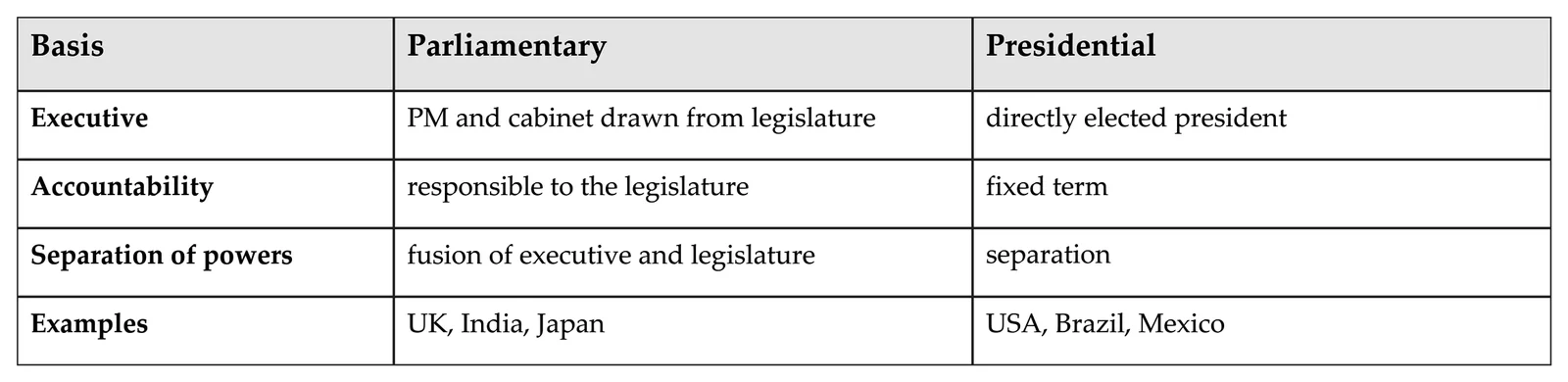
- Fusion of powers: the executive, the prime minister and cabinet, is drawn from the legislature and remains part of it. Walter Bagehot called the cabinet a hyphen which joins the legislative and executive parts of the state.
- Responsibility: the government stays in office only as long as it has the confidence of the lower house and can be removed by a vote of no confidence; in India, Article 75(3) makes the Council of Ministers collectively responsible to the Lok Sabha.
- Dual executive: a nominal head of state (monarch or president) and a real head of government (prime minister).
- No fixed term: the government may fall earlier, and the prime minister can often advise dissolution of the legislature and early elections.
- Party discipline and collective responsibility: ministers act as a team, and parties are usually disciplined.
- Examples: the UK, India, Japan, Germany, Canada and Australia.
B. Presidential system
- Separate election: the president is elected by the people (directly or through an electoral college) and is both head of state and head of government.
- Fixed term: the president serves a fixed term and cannot be removed by a vote of no confidence, only by impeachment for serious misconduct.
- Separation of powers: ministers are not members of the legislature, and each branch has its own mandate.
- Checks and balances: the US president can veto legislation, Congress can override vetoes and controls the budget, the Senate confirms appointments and treaties, and courts can review laws.
- Examples: the USA, Brazil, Mexico, Indonesia and most of Latin America.
C. Semi-presidential system
Maurice Duverger (1980) described semi-presidential systems, in which a directly elected president with significant powers coexists with a prime minister and cabinet responsible to the legislature. France’s Fifth Republic (1958) is the classic case; when the president and the parliamentary majority belong to different parties, they must share power, a situation called cohabitation. Patrick O’Neil and his co-authors note that Russia, Poland and Sri Lanka have also used variants.
2.3 The Debate on Presidentialism and Parliamentarism
Juan Linz, in ‘The Perils of Presidentialism’ (1990), argued that presidential systems are more prone to democratic breakdown, especially in Latin America. Their problems include dual democratic legitimacy, since both the president and the legislature are elected and may claim to represent the people; rigidity, because fixed terms make it hard to remove a failing president without a crisis; a winner-take-all logic that excludes losers for the whole term; and the danger of populist outsiders. Parliamentary systems, by contrast, are more flexible, encourage coalition and allow governments to be replaced peacefully.
Joel Robbins reviews the critics of Linz. Scott Mainwaring and Matthew Shugart (1997) argued that the performance of presidentialism depends on the president’s constitutional powers and the party system, and that it offers advantages such as direct choice of the executive and checks on power. José Antonio Cheibub (2007) found that presidential democracies broke down more often mainly because they were adopted in countries with a legacy of military rule. Most scholars now agree that institutional design interacts with social conditions and party systems.
2.4 Federal and Unitary Systems

In a unitary state, sovereignty lies with the central government, which may create, change or abolish sub-national governments. Rod Hague, Martin Harrop and John McCormick note that most states are unitary, including the UK, France, Japan, China and Sri Lanka. Unitary states may still be decentralised through deconcentration (relocating central officials to the regions), delegation (giving tasks to regional agencies) and devolution (transferring powers to elected regional bodies), as with the devolution of power to Scotland, Wales and Northern Ireland in 1998–99. France’s decentralisation laws of 1982 created elected regional councils. Spain and Italy have strong regions within formally unitary constitutions.
In a federal state, the constitution divides power between the central government and regional units, each with its own sphere of authority that the other cannot remove unilaterally. Federations usually have a written constitution, a second chamber representing the units and a court to resolve disputes. Rekha Saxena shows the variety of federal governance: coming-together federations such as the USA and Switzerland, and holding-together federations such as India, which combine a strong centre with linguistic states. India’s Constitution describes it as a Union of States, and the 73rd and 74th Amendments (1992) added a third tier of local government.
2.5 Important Questions
- Question 1 Distinguish between parliamentary and presidential systems of government.
- Question 2 Critically examine the debate on presidentialism versus parliamentarism.
- Question 3 Distinguish between federal and unitary systems. Discuss their merits and demerits.
DU asks the same idea in different words. So learn one broad answer for each question below; the same answer works for every question joined by OR.
Important Question 1
Distinguish between parliamentary and presidential systems of government.
OR
Discuss the main features, merits and demerits of the parliamentary system.
OR
Compare the presidential system of the USA with the parliamentary system of India.
Model Answer
“The efficient secret of the English Constitution may be described as the close union, the nearly complete fusion, of the executive and legislative powers.”
— Walter Bagehot, The English Constitution (1867)
Introduction. Democracies organise the relationship between the executive and the legislature in different ways. The two main models are the parliamentary system, developed in Britain, and the presidential system, created by the US Constitution of 1787. The difference lies in how the executive is chosen, to whom it is accountable and how power is shared between branches. Many countries have adopted one of these models or a hybrid.
1. Meaning of the Parliamentary System
In a parliamentary system the executive is drawn from and accountable to the legislature. The head of government, the prime minister, is usually the leader of the majority party or coalition in the lower house, and ministers are members of parliament. The government remains in office only as long as it enjoys the confidence of the legislature. Britain’s Westminster model is the classic example.
2. Features of the Parliamentary System
Its features include fusion of executive and legislative powers; a dual executive, with a nominal head of state and a real head of government; collective responsibility of the cabinet to the legislature; individual responsibility of ministers; leadership of the prime minister; the power of the government to advise dissolution of the lower house; and the absence of a fixed term. In India, Articles 74 and 75 provide for a Council of Ministers headed by the Prime Minister, collectively responsible to the Lok Sabha.
3. Meaning of the Presidential System
In a presidential system the chief executive, the president, is elected separately from the legislature for a fixed term and is both head of state and head of government. The executive and legislature are separate branches, each with its own mandate. The US system, designed by the founders to prevent tyranny, is the model, and it has been adopted widely in Latin America.
4. Features of the Presidential System
Its features include a single executive; election of the president by the people or an electoral college; a fixed term; separation of personnel, since ministers cannot be members of the legislature; and checks and balances, such as the presidential veto, legislative control over budgets, Senate confirmation of appointments and treaties, impeachment, and judicial review.
5. Merits of the Parliamentary System
The parliamentary system ensures close cooperation between the executive and legislature, so governments can pass their programmes. It makes the government continuously accountable through question hour, debates and votes of no confidence. It is flexible, since an unpopular or failing government can be replaced without waiting for the end of a term, and it can represent diverse groups through coalitions.
6. Demerits of the Parliamentary System
Critics argue that the parliamentary system can be unstable when no party has a majority, as in Italy or in India in the late 1990s. A government with a large majority may dominate parliament, producing what Lord Hailsham called an elective dictatorship. The separation of powers is weak, and ministers may lack specialised expertise.
7. Merits of the Presidential System
The presidential system provides stability, since the president serves a fixed term; a clear separation of powers that protects liberty; direct choice of the chief executive by voters; and freedom for the president to appoint experts as ministers. Checks and balances prevent any branch from becoming too powerful.
8. Demerits of the Presidential System
Its critics point to deadlock between the president and the legislature, especially under divided government, as in US government shutdowns; rigidity, since a failing president is hard to remove; weaker accountability between elections; and the concentration of power in one person. Juan Linz argued that these features make presidential democracies more likely to break down.
9. Semi-presidential Systems
Many countries combine the two models. In semi-presidential systems, such as France’s Fifth Republic, a directly elected president shares power with a prime minister responsible to the legislature. When the president’s party lacks a parliamentary majority, cohabitation occurs, as in France in 1986–88, 1993–95 and 1997–2002.
10. Comparing India and the USA
In India, the President is the nominal head of state elected indirectly, while the Prime Minister and Council of Ministers exercise real power and must command a majority in the Lok Sabha. In the USA, the President is both head of state and head of government, elected for four years, and cannot be removed by Congress except through impeachment. Indian ministers sit in Parliament and answer questions daily, while American cabinet secretaries are outside Congress and appear only before its committees.
11. India’s Choice
The Constituent Assembly chose the parliamentary system because of familiarity with British institutions and because, as Ambedkar explained, it preferred more responsibility to more stability. Some later commentators suggested a presidential system for India, but most argue that the parliamentary system has helped accommodate India’s diversity through coalitions and accountability.
Conclusion. Thus, parliamentary and presidential systems differ in how the executive is chosen and held accountable. The parliamentary system offers responsibility and flexibility, the presidential system stability and separation of powers, and the best choice depends on a country’s history, party system and social structure.
Important Question 2
Critically examine the debate on presidentialism versus parliamentarism.
OR
Discuss Juan Linz’s argument on the perils of presidentialism.
OR
What is a semi-presidential system? Discuss with reference to France.
Model Answer
“The Draft Constitution in recommending the Parliamentary system of Executive has preferred more responsibility to more stability.”
— B.R. Ambedkar, Constituent Assembly (4 November 1948)
Introduction. Which form of government best sustains democracy, the parliamentary or the presidential? This question became urgent in the 1980s and 1990s, when many countries in Latin America, Eastern Europe, Africa and Asia were designing new democratic constitutions. Juan Linz’s argument that presidentialism is dangerous for democracy started a major debate in comparative politics, reviewed by Joel Robbins and others.
1. The Context of the Debate
Many Latin American presidential democracies broke down in military coups in the 1960s and 1970s, as in Brazil (1964), Chile (1973) and Argentina (1976), while parliamentary democracies in Western Europe were stable. When democracy returned to Latin America in the 1980s, scholars asked whether presidentialism itself was part of the problem. The new democracies of Eastern Europe after 1989 faced the same choice, and most adopted parliamentary or semi-presidential constitutions.
2. Linz’s Argument
Juan Linz argued in ‘The Perils of Presidentialism’ (1990) that presidential systems have inherent features that make democratic breakdown more likely. Parliamentary systems, in contrast, have mechanisms for resolving conflicts and changing governments without threatening the regime itself.
3. Dual Democratic Legitimacy
In a presidential system both the president and the legislature are directly elected and both can claim to represent the people. When they disagree, especially when they are controlled by different parties, there is no democratic principle to decide who should prevail. Linz argued that such deadlocks may tempt presidents or the military to break the constitutional order.
4. Rigidity and Winner-take-all
Fixed terms make presidential systems rigid: a president who loses popular support or proves incompetent cannot easily be replaced, except through impeachment, which is difficult and divisive. The presidency is a winner-take-all prize, since only one party can win it, so losers are excluded from executive power for the whole term, raising the stakes of elections.
5. Style and Outsiders
Linz also argued that presidents, elected by the whole nation, may see themselves as embodying the people and become impatient with opposition and legislative checks. Presidential elections also allow outsiders without party support to win, such as Alberto Fujimori in Peru, who later closed Congress in 1992.
6. Advantages of Parliamentarism
Linz and Alfred Stepan argued that parliamentary systems are more flexible, as governments can be replaced through votes of no confidence; encourage coalition and compromise; avoid dual legitimacy, since the executive depends on the legislature; and integrate opposition parties into the political process. Stepan and Cindy Skach found that parliamentary democracies survived longer than presidential ones.
7. The Critics of Linz
Scott Mainwaring and Matthew Shugart argued that presidentialism has advantages: voters choose the executive directly, there are checks on power, and fixed terms provide predictability. They argued that problems arise mainly when presidents have excessive legislative powers and when fragmented party systems prevent them from building majorities. José Antonio Cheibub showed that presidential democracies failed more often mainly because they emerged in countries with military legacies, not because of presidentialism itself.
8. Semi-presidentialism
Maurice Duverger identified semi-presidential systems, which combine a directly elected president with a prime minister responsible to parliament. France’s Fifth Republic, created by de Gaulle in 1958, gives the president strong powers, especially in foreign affairs and defence, while the prime minister runs domestic policy. Cohabitation, when the president and prime minister come from opposing parties, has worked in France but can create conflict elsewhere.
9. Lessons from Experience
The US presidential system has endured since 1787, partly because of its two-party system and federalism, while many parliamentary systems have also faced instability. Robbins concludes that the performance of each system depends on details of design, such as presidential powers, electoral rules and party systems, and on social and historical conditions. Comparative studies also show that coalition presidentialism, as in Brazil, where presidents build multi-party coalitions in Congress, can make presidential systems workable.
10. Relevance to India
India’s Constituent Assembly chose parliamentarism, with Ambedkar arguing that daily accountability was more important than stability. Periods of coalition instability in the 1990s led some to propose a presidential system, but India’s experience shows that parliamentary government can provide both accountability and, through stable coalitions and majorities, effective governance.
Conclusion. Thus, Linz argued that presidentialism endangers democracy through dual legitimacy, rigidity and winner-take-all politics, while his critics showed that its effects depend on institutional design and context. The debate has made constitution-makers more aware that forms of government must fit their societies.
Important Question 3
Distinguish between federal and unitary systems. Discuss their merits and demerits.
OR
What is devolution? How does it differ from federalism?
OR
Is India a federal or a unitary state? Discuss.
Model Answer
“India, that is Bharat, shall be a Union of States.”
— Article 1(1), Constitution of India
Introduction. Every state must decide how power is distributed between the national government and regional or local governments. The main distinction is between unitary systems, in which sovereignty rests with the central government, and federal systems, in which the constitution divides power between two orders of government. Hague, Harrop and McCormick show that in practice both types increasingly involve multilevel governance.
1. Meaning of Unitary System
In a unitary system, sovereignty is concentrated in the central government. Regional and local governments exist, but they are created by the centre and derive their powers from it, so the centre can change or abolish them. Most states in the world are unitary, including the UK, France, Japan, China, Sri Lanka and Bangladesh.
2. Features of Unitary Systems
Unitary systems usually have a single legislature with full legislative authority, a constitution that may be flexible or unwritten, no constitutional division of powers, uniform laws and policies across the country, and sub-national units that act as agents of the centre. Many unitary states have unicameral legislatures.
3. Decentralisation in Unitary States
Unitary states may decentralise in three ways. Deconcentration relocates central government officials to regions while keeping decisions at the centre; delegation gives responsibilities to regional agencies; and devolution transfers powers to elected regional bodies. The UK devolved powers to Scotland, Wales and Northern Ireland in 1998–99, and France created elected regional councils after 1982. Unlike federal units, devolved bodies can in principle be abolished by the centre.
4. Meaning of Federal System
In a federal system, the constitution divides power between a central government and regional units, each supreme in its own sphere. Neither can abolish the other, and changes to the division of powers require a special amendment procedure involving both levels. About twenty-five countries are federations, including the USA, Canada, Australia, Germany, Switzerland, Brazil and India.
5. Features of Federal Systems
Federal systems usually have a written and rigid constitution; a division of legislative, executive and financial powers; a bicameral legislature with a second chamber representing the units, such as the US Senate or India’s Rajya Sabha; an independent judiciary to resolve disputes between levels; and dual government, with citizens subject to both central and regional laws.
6. Merits and Demerits of Unitary Systems
Unitary systems provide strong and uniform government, clear lines of authority, quick decisions in emergencies and lower costs. They suit small and homogeneous countries. Their demerits include excessive centralisation, neglect of regional diversity and local needs, overburdened central governments and weaker opportunities for local participation.
7. Merits and Demerits of Federal Systems
Federal systems accommodate diversity of language, religion and culture, bring government closer to citizens, prevent the concentration of power and allow policy experiments in different units. Their demerits include complexity, duplication and cost, conflicts between levels of government, unequal standards across regions and, in some cases, encouragement of separatism.
8. Varieties of Federalism
Rekha Saxena shows that federations differ widely. Coming-together federations, such as the USA and Switzerland, were formed by independent units, while holding-together federations, such as India, Belgium and Spain, decentralised to preserve unity. Federations also differ in the strength of the centre, the role of second chambers and the degree of asymmetry among units.
9. The Indian Case
India combines federal and unitary features. It has a written constitution, division of powers in three lists, a Supreme Court and a Rajya Sabha, but also a strong Union with power to reorganise states (Article 3), emergency provisions, President’s Rule (Article 356), single citizenship and All India Services. K.C. Wheare called it quasi-federal, while the Supreme Court in S.R. Bommai (1994) declared federalism part of the basic structure.
10. Local Government in Both Systems
Both unitary and federal states rely on local government for services close to citizens. In Britain, local councils are creatures of Parliament, which has repeatedly reorganised them. In India, the 73rd and 74th Amendments (1992) gave constitutional status to panchayats and municipalities, with regular elections, reserved seats for women and disadvantaged groups and State Finance Commissions, creating a third tier of government within the federal structure.
11. Convergence in Practice
Hague, Harrop and McCormick note that the distinction is less sharp in practice. Many unitary states have devolved substantial powers, while many federations have become more centralised through central finance and national policies. Both increasingly involve multilevel governance, with power shared among local, regional, national and supranational levels, such as the European Union.
Conclusion. Thus, unitary systems concentrate sovereignty at the centre while federal systems divide it constitutionally. Each has merits and demerits, and in practice most states combine elements of both to balance unity with diversity, as India does in its union of states.
Short Notes
(a) Cohabitation
A situation in semi-presidential systems, especially France, in which the directly elected president and the prime minister, who depends on the majority in the National Assembly, belong to opposing parties. The president then concentrates on foreign affairs and defence, while the prime minister directs domestic policy. France experienced cohabitation in 1986–88, 1993–95 and 1997–2002.
(b) Devolution
The transfer of powers from the central government of a unitary state to elected regional or local bodies, while sovereignty remains with the centre. The UK devolved powers to the Scottish Parliament, the Welsh Assembly and the Northern Ireland Assembly in 1998–99. Unlike federal units, devolved bodies can in principle be altered or abolished by the central legislature.
(c) Collective responsibility
A principle of parliamentary government under which the cabinet acts as a team and is jointly accountable to the legislature for its decisions. Ministers must publicly support cabinet decisions or resign, and the whole government must resign if it loses the confidence of the lower house. In India, Article 75(3) makes the Council of Ministers collectively responsible to the Lok Sabha.
More notes: MDSC-4A Comparative Government and Politics
These notes are prepared by PADHO TO AISE for study help. They are not an official University of Delhi publication.