
Semester IV DSC-12 Global Politics
Unit III · 30 min read · Updated 24 Nov 2026
As per the University of Delhi (DU) BA (Hons) Political Science syllabus
Contents
- 3.1 Ecological Issues: Climate Change and Environmental Agreements
- 3.2 Proliferation of Nuclear Weapons in the Post-Cold War Era
- 3.3 Global Terrorism and Its Impact
- 3.4 Migration
- 3.5 Human Security
- 3.6 Important Questions
- Discuss climate change as a global issue. Trace the evolution of international environmental agreements.
- Discuss the problem of nuclear proliferation in the post-Cold War era.
- What is terrorism? Examine the causes and impact of global terrorism.
- Discuss migration as a global issue. What are its causes and consequences?
- What is human security? How does it differ from traditional security?
- Short Notes
सतत विकास वह विकास है जो भावी पीढ़ियों की अपनी आवश्यकताएँ पूरी करने की क्षमता से समझौता किए बिना वर्तमान की आवश्यकताओं को पूरा करता है।
Sustainable development is development that meets the needs of the present without compromising the ability of future generations to meet their own needs.
— World Commission on Environment and Development, Our Common Future (1987)
SOME of the gravest challenges of our time cannot be solved by any single state. Rising temperatures melt glaciers and flood coasts regardless of borders; nuclear weapons threaten all of humanity; terrorist networks operate across continents; millions of people move in search of work or safety; and hunger, disease and violence threaten individuals even in states at peace. This unit studies five contemporary global issues: climate change and international environmental agreements, nuclear proliferation after the Cold War, global terrorism, migration and human security. Each shows how global politics has expanded beyond the traditional concerns of interstate war and diplomacy.
3.1 Ecological Issues: Climate Change and Environmental Agreements
Environmental problems such as climate change, ozone depletion, biodiversity loss and pollution are global commons problems: the atmosphere and oceans belong to no one, so each state has an incentive to pollute and leave the costs to others, the ‘tragedy of the commons’ described by Garrett Hardin (1968). Andrew Heywood and John Vogler explain that environmental issues entered global politics from the 1970s and that solutions require international cooperation through regimes, sets of rules and institutions. Robert Falkner (2012) argues that environmental stewardship has become a fundamental norm of international society, part of what states are expected to do.
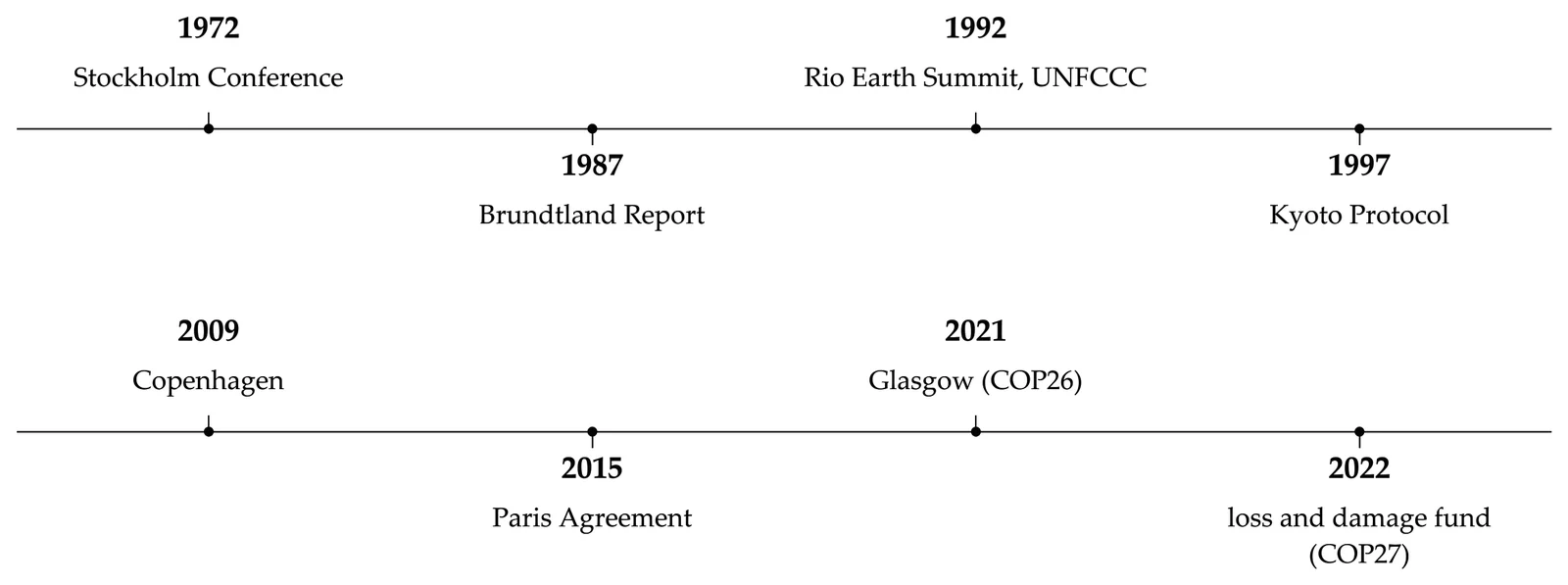
- Stockholm (1972) created the UN Environment Programme; the Brundtland Report (1987) defined sustainable development; the Montreal Protocol (1987) successfully phased out ozone-depleting substances.
- Rio Earth Summit (1992) adopted the UN Framework Convention on Climate Change (UNFCCC), the Convention on Biological Diversity and Agenda 21, and the principle of common but differentiated responsibilities (CBDR).
- Kyoto Protocol (1997) set binding emission targets for developed countries only; the USA never ratified it, and emissions from emerging economies grew rapidly.
- Copenhagen (2009) failed to produce a binding successor, exposing North–South divisions.
- Paris Agreement (2015) set the goal of keeping warming well below 2°C and pursuing 1.5°C, through nationally determined contributions (NDCs) from all countries, reviewed through a global stocktake.
- Later meetings: Glasgow (2021) agreed to ‘phase down’ coal; Sharm el-Sheikh (2022) agreed a loss and damage fund; Dubai (2023) called for transitioning away from fossil fuels; Baku (2024) set a new climate finance goal.
Jana Kreienkamp traces this long road to Paris, from top-down binding targets to a bottom-up system of national pledges. Carl Death asks whether we can save the planet and contrasts technocratic and market solutions with radical calls for changing consumption and challenging capitalism. The central debates concern climate justice: developed countries are historically responsible for most emissions, while developing countries such as India insist on their right to development and demand finance and technology. India has pledged net-zero emissions by 2070 and co-founded the International Solar Alliance (2015).
3.2 Proliferation of Nuclear Weapons in the Post-Cold War Era
Nuclear proliferation is the spread of nuclear weapons to more states (horizontal proliferation) or the growth of arsenals of existing nuclear powers (vertical proliferation). Darryl Howlett explains that the NPT (1968) recognised five nuclear-weapon states, the USA, USSR (now Russia), UK, France and China, and required others to renounce nuclear weapons in return for access to peaceful nuclear technology and a promise of disarmament under Article VI. India rejected the treaty as discriminatory.
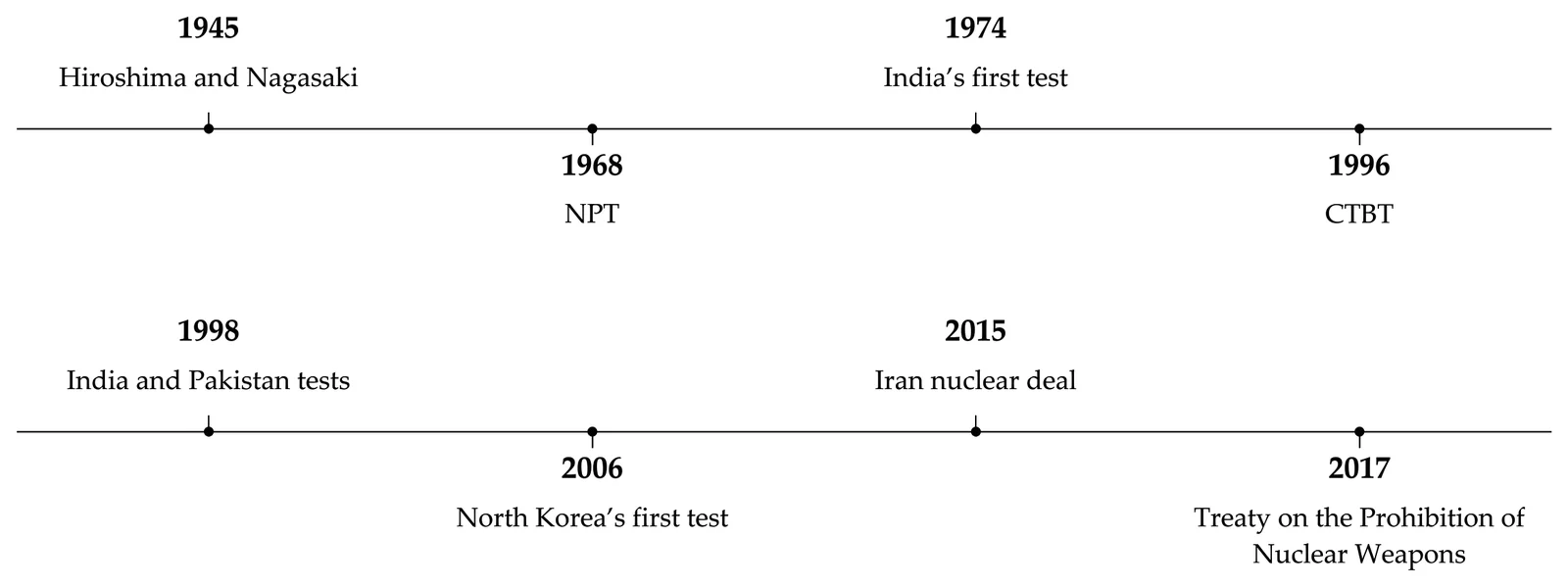
- Post-Cold War successes: South Africa dismantled its weapons and joined the NPT (1991); Ukraine, Belarus and Kazakhstan gave up Soviet weapons; the NPT was extended indefinitely in 1995; the CTBT was signed in 1996 but has not entered into force.
- New nuclear states: India and Pakistan tested in 1998; North Korea left the NPT in 2003 and tested in 2006.
- Proliferation networks: the A.Q. Khan network, exposed in 2004, supplied technology to Libya, Iran and North Korea.
- Iran: the Joint Comprehensive Plan of Action (2015) limited Iran’s programme; the USA withdrew in 2018, and tensions escalated, including Israeli and US strikes on Iranian nuclear facilities in June 2025.
- Disarmament pressure: the Treaty on the Prohibition of Nuclear Weapons (2017) entered into force in 2021, though no nuclear-armed state has joined.
Vipin Narang (2017) shows that states pursue the bomb through different strategies: hedging, developing the capacity to build weapons without immediately doing so; sprinting, racing openly to a weapon; sheltered pursuit, building weapons under the protection of a major power; and hiding, pursuing weapons secretly. The strategy chosen depends on a state’s security environment and its relations with great powers. Priya Chacko and Alexander Davis (2018) show how India resignified responsibility, presenting itself as a responsible nuclear power with a no-first-use doctrine and a strong non-proliferation record, which helped it win the Indo-US nuclear deal and the Nuclear Suppliers Group waiver (2008).
3.3 Global Terrorism and Its Impact
Terrorism is the use or threat of violence, usually against civilians, to create fear and achieve political goals. There is no agreed international definition, partly because, as the saying goes, one person’s terrorist is another’s freedom fighter. Kanti Bajpai emphasises the definitional and political disputes over terrorism, including the question of state terrorism, and the need for a perspective from the Global South, which has suffered most terrorist violence. David Rapoport identified four waves of modern terrorism: anarchist (from the 1880s), anti-colonial (from the 1920s), new left (from the 1960s) and religious (from 1979).
Fawaz Gerges, in The Far Enemy (2005), explains why jihad went global. In the 1970s–80s, jihadist groups focused on the near enemy, secular regimes in Muslim countries such as Egypt. After failing at home, a faction led by Osama bin Laden and Ayman al-Zawahiri shifted in the mid-1990s to attacking the far enemy, the USA and its allies, culminating in the attacks of 11 September 2001. Gerges stresses that most jihadists opposed this shift. Bruce Hoffman argued that 9/11 required rethinking terrorism and counterterrorism, as new terrorism is transnational, networked, religiously motivated and aimed at mass casualties.
The impact of terrorism includes loss of life, the US-led ‘war on terror’ and wars in Afghanistan (2001) and Iraq (2003), expanded surveillance and security laws, Islamophobia, and the rise of ISIS, which declared a caliphate in 2014 before losing its territory by 2019. Achin Vanaik’s Masks of Empire (2007) criticises the war on terror as a mask for American imperial power, while Benjamin Barber argued that interdependence requires a new democratic realism of global cooperation. India has faced cross-border terrorism, from the Mumbai attacks (2008) to the Pahalgam attack (April 2025), which was followed by Operation Sindoor.
3.4 Migration
Migration is the movement of people from one place to another to live or work. The International Organization for Migration estimated about 281 million international migrants in 2020, about 3.6 per cent of the world’s population, and the UNHCR reported more than 120 million forcibly displaced people by 2024. Stephen Castles argues that migration is an integral part of globalisation and social transformation, driven by inequalities between North and South, and that most migration from the South is actually to other Southern countries.

- Causes: push factors such as poverty, conflict, persecution and environmental disaster; pull factors such as jobs and safety; and networks of family and recruiters, which Castles calls the migration industry.
- Inequality: JoAnn Chirico treats inequality and migration as transborder threats to human well-being, since global inequality drives migration and migrants often face exploitation.
- Vagabonds and tourists: Ritzer, following Zygmunt Bauman, contrasts tourists, the privileged who move freely, with vagabonds, the poor whose movement is restricted and treated as a threat.
- Virtual migration: A. Aneesh shows how Indian software workers serve US clients through networks without physically migrating.
- Governance: the 1951 Refugee Convention protects refugees through the principle of non-refoulement; the Global Compacts on migration and refugees were adopted in 2018. Jonathon Moses calls migration globalisation’s last frontier, since capital moves freely while labour does not.
- India: the largest recipient of remittances, over 120 billion dollars a year, and a host of refugees from Tibet, Sri Lanka and Myanmar, though not a party to the 1951 Convention.
3.5 Human Security
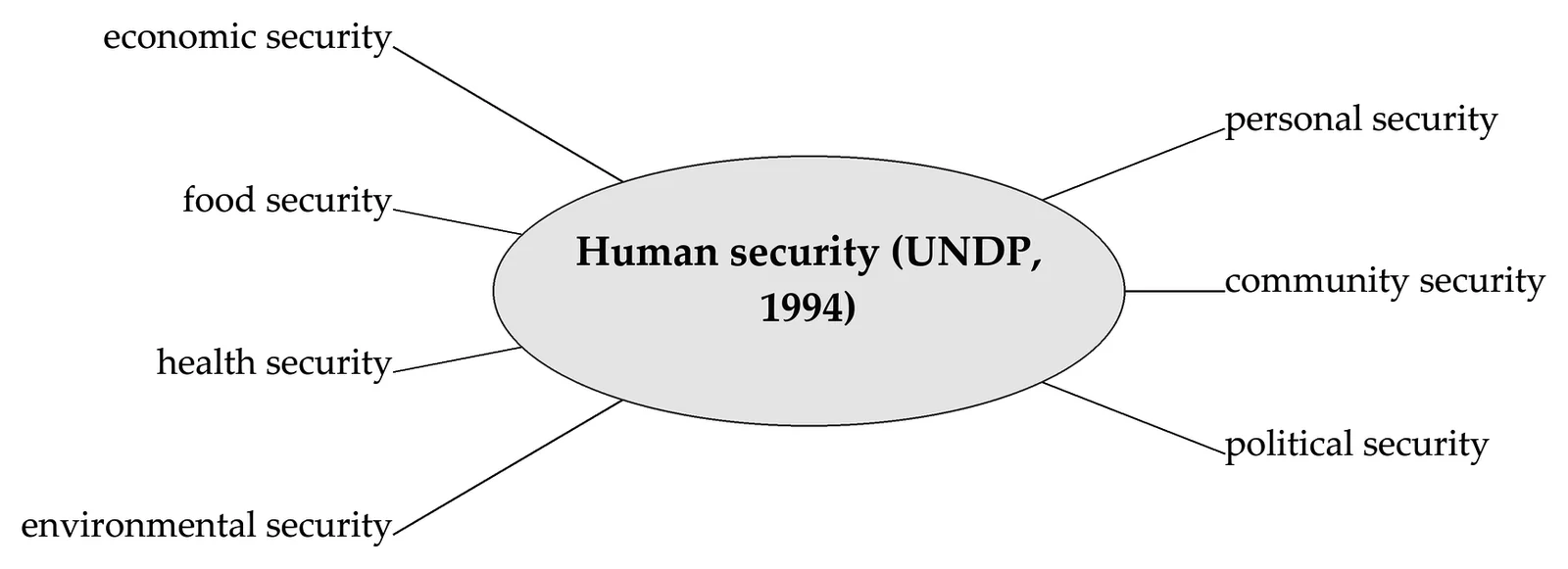
Human security shifts the focus of security from the state to the individual. The UNDP’s Human Development Report (1994), inspired by Mahbub ul Haq, defined it as freedom from fear and freedom from want, and identified seven dimensions: economic, food, health, environmental, personal, community and political security. Amitav Acharya distinguishes a broad approach, favoured by Japan, focusing on development and freedom from want, and a narrow approach, favoured by Canada and Norway, focusing on protection from violence, as in the Ottawa Treaty banning landmines (1997).
Shahrbanou Tadjbakhsh and Anuradha Chenoy (2007) describe human security as people-centred, multidimensional, interconnected and universal, and add freedom to live in dignity. The Commission on Human Security led by Sadako Ogata and Amartya Sen (2003) linked protection and empowerment. Acharya’s ‘Human Security: East versus West’ (2001) shows that many Asian states were sceptical of the concept, fearing intervention, but accepted its developmental dimension. Alistair Cook links it to non-traditional security threats such as pandemics, climate change and transnational crime. Critics argue that the concept is too broad to guide policy and can justify intervention, as in debates on the Responsibility to Protect (2005).
3.6 Important Questions
- Question 1 Discuss climate change as a global issue. Trace the evolution of international environmental agreements.
- Question 2 Discuss the problem of nuclear proliferation in the post-Cold War era.
- Question 3 What is terrorism? Examine the causes and impact of global terrorism.
- Question 4 Discuss migration as a global issue. What are its causes and consequences?
- Question 5 What is human security? How does it differ from traditional security?
DU asks the same idea in different words. So learn one broad answer for each question below; the same answer works for every question joined by OR.
Important Question 1
Discuss climate change as a global issue. Trace the evolution of international environmental agreements.
OR
Examine the North–South debate on climate change.
OR
Critically evaluate the Paris Agreement as a response to climate change.
Model Answer
“Holding the increase in the global average temperature to well below 2°C above pre-industrial levels and pursuing efforts to limit the temperature increase to 1.5°C above pre-industrial levels.”
— Article 2, Paris Agreement (2015)
Introduction. Climate change is perhaps the defining global issue of the twenty-first century. The burning of fossil fuels and deforestation have increased greenhouse gases in the atmosphere, raising global temperatures and causing extreme weather, rising seas and threats to food and water. Because the atmosphere is a global commons, no state can solve the problem alone, and the history of climate negotiations reveals the difficulties of global cooperation.
1. Climate Change as a Global Problem
The Intergovernmental Panel on Climate Change (IPCC), set up in 1988, has concluded that human activities have unequivocally caused global warming of about 1.1°C above pre-industrial levels. The effects include heatwaves, floods, droughts, glacier melt and sea-level rise, which threaten small island states, coastal cities and agricultural livelihoods. Heywood describes climate change as the clearest example of a collective action problem in global politics.
2. The Tragedy of the Commons
Garrett Hardin argued that when a resource is open to all, each user has an incentive to overuse it, leading to collective ruin. In climate change, each state gains from emitting while the costs are shared globally, so states are tempted to free-ride on others’ efforts. International agreements try to overcome this through rules, monitoring and incentives.
3. Early Environmental Diplomacy
The Stockholm Conference (1972) placed the environment on the international agenda and created UNEP. Indira Gandhi famously argued there that poverty is the greatest polluter, expressing developing countries’ concern that environmental protection should not block development. The Brundtland Report (1987) reconciled the two through the concept of sustainable development, and the Montreal Protocol (1987) showed that effective environmental treaties were possible.
4. Rio and the UNFCCC
The Rio Earth Summit (1992) adopted the UNFCCC, which aims to stabilise greenhouse gas concentrations at a level that prevents dangerous interference with the climate system. It established the principle of common but differentiated responsibilities and respective capabilities, recognising that developed countries had caused most emissions and should take the lead, and divided countries into Annex I (developed) and non-Annex I (developing).
5. The Kyoto Protocol
The Kyoto Protocol (1997) set legally binding targets for developed countries to cut emissions by an average of about 5 per cent below 1990 levels in 2008–12, with market mechanisms such as emissions trading and the Clean Development Mechanism. Its weaknesses were that the USA never ratified it and that it imposed no obligations on rapidly growing emitters such as China and India.
6. Copenhagen and the Road to Paris
The Copenhagen summit (2009) failed to agree a binding successor to Kyoto, producing only a non-binding accord. Jana Kreienkamp shows how negotiators then shifted from a top-down approach with binding targets to a bottom-up approach based on national pledges, which made agreement possible by respecting sovereignty.
7. The Paris Agreement
The Paris Agreement (2015) committed all countries to limit warming to well below 2°C and to pursue 1.5°C. Each country submits nationally determined contributions, updated every five years with increasing ambition, and a global stocktake reviews collective progress; the first was completed in 2023. Developed countries promised climate finance of 100 billion dollars a year. The agreement is universal but its targets are not legally binding.
8. After Paris
Subsequent conferences agreed to phase down coal at Glasgow (2021), to create a loss and damage fund for vulnerable countries at Sharm el-Sheikh (2022), to transition away from fossil fuels at Dubai (2023) and to set a new climate finance goal at Baku (2024). The USA withdrew from the Paris Agreement under President Trump, rejoined in 2021 and announced its withdrawal again in 2025, showing the fragility of commitments.
9. The North–South Debate
Developing countries argue that the North bears historical responsibility for emissions, has much higher per capita emissions and must provide finance and technology. Developed countries point out that China is now the largest emitter and that emerging economies must also act. India stresses equity and climate justice, has pledged net-zero emissions by 2070 and leads the International Solar Alliance. Vulnerable small island states demand faster action.
10. Evaluation
Falkner argues that environmental stewardship has become a norm of international society, and renewable energy is expanding rapidly. Yet current pledges are insufficient to meet the 1.5°C goal, finance falls short and fossil fuel interests remain powerful. Carl Death notes that more radical thinkers call for changes in consumption and economic systems, not only technical fixes.
Conclusion. Thus, climate change is a global collective action problem that has produced a long series of agreements from Rio to Paris. The bottom-up Paris model achieved universal participation, but meeting its goals requires greater ambition, finance and justice between North and South.
Important Question 2
Discuss the problem of nuclear proliferation in the post-Cold War era.
OR
Examine the strategies by which states pursue nuclear weapons, with reference to Vipin Narang.
OR
Discuss India’s position on the NPT and its idea of a responsible nuclear power.
Model Answer
“Each of the Parties to the Treaty undertakes to pursue negotiations in good faith on effective measures relating to cessation of the nuclear arms race at an early date and to nuclear disarmament.”
— Article VI, Treaty on the Non-Proliferation of Nuclear Weapons (1968)
Introduction. Nuclear weapons are the most destructive weapons ever created. During the Cold War the main danger was a war between the superpowers. After 1991 the danger shifted to the spread of nuclear weapons to new states and possibly to terrorists, the erosion of arms control and new regional rivalries. Nuclear proliferation remains one of the most serious issues in global politics.
1. Meaning
Proliferation means the spread of nuclear weapons. Horizontal proliferation refers to more states acquiring them, and vertical proliferation to the growth and modernisation of existing arsenals. Today nine states possess nuclear weapons: the USA, Russia, the UK, France, China, India, Pakistan, North Korea and, undeclared, Israel.
2. The Non-Proliferation Regime
Howlett explains that the regime is built around the NPT (1968), which recognised five nuclear-weapon states that had tested before 1967 and obliged all others to renounce weapons. In return, non-nuclear states were promised access to peaceful nuclear technology, and nuclear states promised to pursue disarmament under Article VI. The International Atomic Energy Agency verifies compliance through safeguards, and export control groups such as the Nuclear Suppliers Group regulate trade.
3. Post-Cold War Successes
The end of the Cold War brought important successes. South Africa dismantled its arsenal and joined the NPT in 1991; Ukraine, Belarus and Kazakhstan transferred Soviet weapons to Russia; Argentina and Brazil abandoned their programmes; the NPT was extended indefinitely in 1995; and the CTBT was signed in 1996. Libya gave up its programme in 2003.
4. New Challenges
India and Pakistan conducted nuclear tests in 1998, creating a nuclear rivalry in South Asia. North Korea withdrew from the NPT in 2003 and tested its first device in 2006, followed by more tests and missile development. The A.Q. Khan network revealed how technology could spread through illicit markets. Iran’s enrichment programme raised fears of a new nuclear state in the Middle East.
5. Why States Seek Nuclear Weapons
Scott Sagan identified three models: the security model, in which states build weapons to counter threats; the domestic politics model, in which bureaucracies and politicians benefit; and the norms model, in which weapons symbolise status and modernity. Kenneth Waltz argued that more nuclear states may bring stability through deterrence, while Sagan warned that organisational failures make proliferation dangerous.
6. Narang’s Strategies of Proliferation
Vipin Narang argues that states pursuing nuclear weapons choose among four strategies. Hedging means developing the technical capacity to build weapons without crossing the threshold. Sprinting means racing openly to build a bomb as quickly as possible. Sheltered pursuit means developing weapons under the protection of a major power that shields the state from pressure. Hiding means pursuing weapons in secret. The choice depends on a state’s security threats, domestic politics and relations with great powers.
7. The Iran Case
The Joint Comprehensive Plan of Action (2015) limited Iran’s enrichment in exchange for sanctions relief. After the USA withdrew in 2018 and reimposed sanctions, Iran expanded enrichment, and in June 2025 Israeli and US strikes targeted Iranian nuclear facilities. The case shows the difficulty of managing a hedging state through diplomacy and force.
8. India’s Position
India rejected the NPT as discriminatory, dividing the world into nuclear haves and have-nots without real commitment to disarmament. It conducted a peaceful nuclear explosion in 1974 and weapons tests in 1998, then declared a doctrine of credible minimum deterrence and no first use. Chacko and Davis show that India resignified responsibility, presenting itself as a responsible nuclear power with a clean non-proliferation record, which helped it obtain the Indo-US civil nuclear agreement and an NSG waiver in 2008.
9. Disarmament and Arms Control
Non-nuclear states have grown frustrated with slow disarmament. The Treaty on the Prohibition of Nuclear Weapons, adopted in 2017 and in force from 2021, bans nuclear weapons outright, but no nuclear-armed state has joined. Arms control between the USA and Russia has weakened, with the collapse of the INF Treaty in 2019 and uncertainty over strategic arms limits.
10. Evaluation
The non-proliferation regime has slowed the spread of nuclear weapons, since far fewer states have them than was feared in the 1960s. But the discriminatory structure of the NPT, regional rivalries, great-power tensions and new technologies continue to challenge it. Progress requires both non-proliferation and genuine disarmament by nuclear states.
Conclusion. Thus, nuclear proliferation after the Cold War has combined important successes with serious challenges from South Asia, North Korea and Iran. Narang’s strategies explain how states pursue the bomb, while India’s case shows how states negotiate their place in an unequal nuclear order.
Important Question 3
What is terrorism? Examine the causes and impact of global terrorism.
OR
Why did jihad go global? Discuss with reference to Fawaz Gerges.
OR
Critically examine the global war on terror.
Model Answer
“Terrorists want a lot of people watching and a lot of people listening and not a lot of people dead.”
— Brian Jenkins, International Terrorism (1975)
Introduction. Terrorism has existed for centuries, but since the attacks of 11 September 2001 it has become one of the central concerns of global politics. Terrorist networks operate across borders, use modern communication and target civilians to spread fear. The response to terrorism has also transformed global politics, through wars, security laws and surveillance.
1. Meaning and Definition
Terrorism generally means the use or threat of violence against civilians or non-combatants to create fear and achieve political, religious or ideological goals. There is no agreed international definition. The UN has adopted many conventions against specific acts, and India proposed a Comprehensive Convention on International Terrorism in 1996, but disagreements over national liberation movements and state terrorism have blocked agreement. Scholars usually distinguish terrorism from guerrilla warfare, which mainly targets military forces, and from ordinary crime, which lacks political aims.
2. A Southern Perspective
Kanti Bajpai emphasises that the definition of terrorism is political: states label their opponents terrorists, while ignoring violence by states. He notes that the Global South has suffered most from terrorism and counterterrorism, and that Western-centred approaches often neglect local causes and the violence of states themselves.
3. Waves of Terrorism
David Rapoport identified four waves: the anarchist wave from the 1880s, which assassinated rulers; the anti-colonial wave from the 1920s; the new left wave of the 1960s, including groups like the Red Brigades; and the religious wave from 1979, triggered by the Iranian revolution and the Soviet invasion of Afghanistan.
4. New Terrorism
Bruce Hoffman and Andrew Heywood describe new terrorism as transnational and networked rather than hierarchical, inspired by religion rather than secular nationalism, aiming at mass casualties rather than limited violence, and using modern technology and media. Al-Qaeda and ISIS are the main examples.
5. Why Jihad Went Global
Fawaz Gerges explains that jihadist groups in the 1970s and 1980s fought the near enemy, secular regimes in countries such as Egypt and Algeria. Having failed and been repressed, some leaders, notably Ayman al-Zawahiri and Osama bin Laden, decided in the mid-1990s to attack the far enemy, the USA, which they saw as propping up these regimes. Bin Laden’s declarations of 1996 and 1998 led to attacks on US embassies (1998) and 9/11. Gerges stresses that most jihadists opposed this strategy.
6. Causes of Terrorism
Causes include political grievances such as occupation and repression, the failure of states, religious and ideological radicalisation, the legacy of Cold War interventions such as the arming of mujahideen in Afghanistan, state sponsorship, and the spread of extremist ideas online. No single cause explains all terrorism.

7. The War on Terror
After 9/11 the USA launched a global war on terror, invading Afghanistan (2001) and Iraq (2003), detaining suspects at Guantánamo Bay and expanding surveillance. Achin Vanaik criticises it as a mask for American imperial power, and the Iraq war in particular created instability that later helped the rise of ISIS, which declared a caliphate in 2014 before losing its territory by 2019. US forces left Afghanistan in 2021, and the Taliban returned to power.
8. Impact on Global Politics
Terrorism and counterterrorism have caused huge loss of life, especially in Iraq, Afghanistan, Syria, Pakistan, Nigeria and the Sahel. They expanded state surveillance and anti-terror laws, sometimes undermining civil liberties, increased Islamophobia and shaped migration debates. Benjamin Barber argued that interdependence requires a new democratic realism of global cooperation rather than unilateral force.
9. India and Terrorism
India has faced terrorism in Jammu and Kashmir, Punjab and the North-East, and attacks such as Mumbai (2008), Pulwama (2019) and Pahalgam (2025), which India links to groups based in Pakistan. India has pressed for global action against cross-border terrorism, including through the FATF and the UN, and responded militarily after Pulwama and Pahalgam.
10. Terrorism and Technology
Modern terrorist groups exploit technology for propaganda, recruitment and financing. ISIS used social media and online magazines to attract thousands of foreign fighters from over eighty countries, and lone actors radicalised online have carried out attacks in Europe and elsewhere. Encrypted messaging, cryptocurrencies and drones create new challenges for states, while governments respond with online content removal, financial intelligence and surveillance, raising further debates about privacy and free expression.
11. Responses
Effective responses combine intelligence, international cooperation, financial controls, addressing political grievances, countering radicalisation and respecting human rights, since abuses can fuel further terrorism. UN Security Council Resolution 1373 (2001) requires states to criminalise terrorist financing and cooperate against terrorism.
Conclusion. Thus, terrorism is a contested concept and a serious global threat. Its globalisation, explained by Gerges’s shift from the near to the far enemy, transformed global politics, while the war on terror showed that force alone cannot defeat terrorism without addressing its causes.
Important Question 4
Discuss migration as a global issue. What are its causes and consequences?
OR
Examine the relationship between globalisation, inequality and migration.
OR
‘Migration is globalisation’s last frontier.’ Discuss.
Model Answer
“Everyone has the right to leave any country, including his own, and to return to his country.”
— Article 13(2), Universal Declaration of Human Rights (1948)
Introduction. Human beings have always migrated, but globalisation has increased the scale, speed and diversity of migration. Millions move for work, education or family, while others flee war, persecution and disaster. Migration connects societies through remittances and diasporas, but it also generates political controversy, restrictive border policies and humanitarian crises.
1. Meaning and Scale
Migration is the movement of people from one place to another to settle temporarily or permanently. International migrants number about 281 million (2020), and forcibly displaced people more than 120 million. Migration may be internal or international, voluntary or forced, regular or irregular, and permanent or temporary.
2. Types of Migrants
Economic migrants move mainly for work; refugees flee persecution or war and are protected by the 1951 Refugee Convention; asylum seekers request refugee status; internally displaced persons are forced from their homes but remain within their own country; and climate migrants are displaced by environmental change, though they lack a specific legal status.
3. Causes
Push factors include poverty, unemployment, conflict, persecution and environmental disaster; pull factors include jobs, higher wages, security and education. Stephen Castles argues that migration is part of broader social transformation caused by globalisation, and that networks of families, communities and recruitment agencies, the migration industry, sustain migration flows. Climate change is becoming an important driver, as droughts, floods and rising seas displace people, especially in vulnerable regions such as the Sahel and low-lying Bangladesh.
4. Inequality and Migration
JoAnn Chirico shows that global inequality is a major driver of migration, as people move from poorer to richer regions. Migrants, especially irregular ones, often face exploitation, low wages and lack of rights. Castles also notes that most migration from the Global South goes to other Southern countries, such as the Gulf states, which host large numbers of South Asian workers.
5. Vagabonds and Tourists
George Ritzer, drawing on Zygmunt Bauman, contrasts tourists, wealthy and skilled people who travel freely and are welcomed, with vagabonds, poor migrants whose movement is restricted and treated as a threat. Globalisation thus creates unequal mobility: freedom of movement for capital and elites, restrictions for the poor.
6. Virtual Migration
A. Aneesh describes virtual migration, in which Indian software programmers work for American firms through computer networks without physically moving. Labour crosses borders while workers stay home, governed by code and software systems rather than immigration laws. This shows how technology is changing the meaning of migration.
7. Consequences for Origin Countries
Migration brings remittances, which in India exceed 120 billion dollars a year, the highest in the world; skills and investments brought back by returning migrants; and diaspora networks that support trade and diplomacy. It can also cause brain drain, the loss of skilled workers such as doctors and nurses, and family separation.
8. Consequences for Destination Countries
Migrants fill labour shortages, support ageing populations and contribute to economic growth and cultural diversity. Yet migration also provokes fears about jobs, welfare, security and identity, which populist parties exploit. Responses include border walls, detention and deportation, and the externalisation of border control to transit countries. In Europe, the arrival of over a million refugees and migrants in 2015, many fleeing the war in Syria, provoked sharp political divisions and strengthened anti-immigration parties.
9. Governing Migration
Unlike trade or finance, migration lacks a strong global regime. The 1951 Refugee Convention and its 1967 Protocol protect refugees through non-refoulement, and the Global Compacts for Migration and on Refugees (2018) offer non-binding frameworks. Jonathon Moses argues that migration is globalisation’s last frontier, since capital and goods move freely while labour remains restricted, and he makes the case for freer movement of people.
10. Gender and Migration
Migration has become increasingly feminised, as women migrate independently as domestic workers, nurses and care workers, for example from the Philippines, Sri Lanka and Kerala to the Gulf and Europe. Women migrants often face specific risks of abuse, trafficking and confinement in households beyond the reach of labour laws, such as under the kafala sponsorship systems of some Gulf states. At the same time, their remittances support families and can increase their independence.
11. India and Migration
India has the world’s largest diaspora, a major source of remittances and soft power. It also hosts refugees from Tibet, Sri Lanka, Afghanistan and Myanmar without being a party to the 1951 Convention, and internal migration from rural to urban areas is massive, as the plight of migrant workers during the COVID-19 lockdown in 2020 revealed.
Conclusion. Thus, migration is a central global issue driven by inequality, conflict and globalisation. It brings benefits to both origin and destination societies but also creates exploitation and political conflict, so it requires fair and cooperative global governance.
Important Question 5
What is human security? How does it differ from traditional security?
OR
Discuss the broad and narrow conceptions of human security.
OR
Examine the debate on human security between East and West.
Model Answer
“Human security is not a concern with weapons — it is a concern with human life and dignity.”
— UNDP, Human Development Report (1994)
Introduction. Traditionally, security meant the protection of the state from external military threats. After the Cold War, it became clear that most people face threats from poverty, hunger, disease, environmental disaster and violence within states rather than from foreign armies. The concept of human security, introduced by the UNDP in 1994, placed the individual at the centre of security.
1. Traditional Security
Realists define security as the survival and territorial integrity of the state, protected through military power, alliances and deterrence. The referent object is the state, and threats are mainly military and external. This view dominated the Cold War, when security meant nuclear deterrence and the balance of power. Yet in many states the greatest threats to people have come from their own governments or from civil war, which the state-centred view ignores.
2. The Emergence of Human Security
The UNDP’s Human Development Report (1994), inspired by the Pakistani economist Mahbub ul Haq, argued that the concept of security had been interpreted too narrowly. It defined human security as freedom from fear and freedom from want, and as safety from chronic threats such as hunger, disease and repression, and protection from sudden disruptions in daily life. The report argued that for most people, a feeling of insecurity arises more from worries about daily life than from the dread of a cataclysmic world event.
3. Seven Dimensions
The UNDP identified seven dimensions: economic security (assured basic income), food security, health security, environmental security, personal security (from physical violence), community security (of cultural and ethnic groups) and political security (respect for human rights). These threats are interconnected and often cross borders.
4. Broad and Narrow Approaches
Amitav Acharya distinguishes a broad approach, emphasising freedom from want and development, championed by Japan and the UNDP, from a narrow approach, emphasising freedom from fear and protection from violence, championed by Canada and Norway. The narrow approach produced the Ottawa Treaty banning landmines (1997), support for the International Criminal Court and campaigns against small arms and child soldiers.
5. Tadjbakhsh and Chenoy
Shahrbanou Tadjbakhsh and Anuradha Chenoy describe human security as people-centred, multidimensional, interconnected and universal. They add freedom to live in dignity and stress that human security requires both protection from threats and empowerment of people to act on their own behalf, as also argued by the Commission on Human Security led by Sadako Ogata and Amartya Sen (2003).
6. Human Security: East versus West
Acharya’s ‘Human Security: East versus West’ (2001) shows that many Asian governments were initially suspicious of human security, fearing that it would justify Western intervention and criticism of their political systems. They preferred the developmental, freedom-from-want version, consistent with ideas of comprehensive security in Japan and ASEAN. Over time, crises such as the Asian financial crisis (1997) increased Asian acceptance of the concept.
7. Non-traditional Security
Alistair Cook links human security to non-traditional security threats, which are transnational, non-military and often caused by non-state actors or natural forces: pandemics, climate change, food and water scarcity, migration, drug trafficking and cybercrime. COVID-19 showed how a health crisis could become a security issue for all states and individuals.
8. Human Security and Intervention
Human security influenced the Responsibility to Protect, adopted at the UN World Summit in 2005, which holds that states must protect their populations from genocide, war crimes, ethnic cleansing and crimes against humanity, and that the international community may act if they fail. Its use in Libya (2011) revived fears that human security could justify regime change.
9. Criticisms
Critics argue that human security is too broad to guide policy, since if everything is a security threat, the concept loses meaning. Others warn that securitising development or migration may lead to militarised responses. Defenders reply that its value lies in shifting attention to the real threats people face and in linking security, development and human rights. Roland Paris famously described human security as being like sustainable development: everyone is for it, but few people have a clear idea of what it means.
10. Relevance for India
For India, human security connects with challenges such as poverty, malnutrition, health, disasters, communal violence and climate vulnerability. Rights-based welfare laws, disaster management and public health systems can be seen as contributions to human security, alongside traditional defence.
Conclusion. Thus, human security shifts the focus of security from the state to individuals and from military threats to the full range of threats to human life and dignity. Despite debates about its breadth and use, it has broadened global politics to include development, rights and non-traditional threats.
Short Notes
(a) Common but differentiated responsibilities
A principle of international environmental law adopted at the Rio Earth Summit (1992) and in the UNFCCC. All states share responsibility for protecting the environment, but developed countries, which caused most historical emissions and have greater resources, should take the lead and assist developing countries with finance and technology.
(b) Non-refoulement
The core principle of refugee protection in Article 33 of the 1951 Refugee Convention: no state shall expel or return a refugee to a territory where their life or freedom would be threatened on account of race, religion, nationality, membership of a particular social group or political opinion. It is widely regarded as part of customary international law.
(c) No first use
A nuclear doctrine under which a state pledges not to use nuclear weapons first, but only in retaliation against a nuclear attack. India adopted it as part of its doctrine of credible minimum deterrence in 2003, presenting itself as a responsible nuclear power.
More notes: DSC-12 Global Politics
These notes are prepared by PADHO TO AISE for study help. They are not an official University of Delhi publication.