
Semester V DSC-14 Modern Indian Political Thought
Unit VI · 19 min read · Updated 24 Nov 2026
As per the University of Delhi (DU) BA (Hons) Political Science syllabus
Contents
- 6.1 Savarkar: Life and Context
- 6.2 The Essentials of Hindutva
- 6.3 Hindutva and Hinduism
- 6.4 Social Reform and a Contested Legacy
- 6.5 Important Questions
- Explain Savarkar’s concept of Hindutva as set out in Essentials of Hindutva.
- Distinguish between Hindutva and Hinduism in Savarkar’s thought.
- Discuss Savarkar’s views on caste and social reform and assess his legacy.
- Short Notes
हिंदू वह व्यक्ति है जो सिंधु से समुद्र तक फैली इस भारतभूमि को अपनी पितृभूमि और पुण्यभूमि, अर्थात अपने धर्म की जन्मभूमि, मानता है।
A Hindu means a person who regards this land of Bharatvarsha, from the Indus to the Seas, as his Father-Land as well as his Holy-Land.
— V.D. Savarkar, Essentials of Hindutva (1923)
WHAT makes a people a nation, and what is the relationship between religion and national identity? Vinayak Damodar Savarkar (1883–1966) gave one of the most influential and most debated answers in modern India. In Essentials of Hindutva (1923), he coined a distinction between Hinduism, a set of religious beliefs and practices, and Hindutva, Hindu-ness, a wider identity based on a shared land, shared descent and a shared culture. Hindutva became the foundation of Hindu nationalism. Savarkar was also a revolutionary, a prisoner of the Andamans, a rationalist and a campaigner against untouchability. This unit studies his ideas, with the reading by Vikram Sampath, and the main criticisms of them.

6.1 Savarkar: Life and Context
As a young man Savarkar founded the revolutionary society Abhinav Bharat (1904) and, while studying law in London, wrote The Indian War of Independence of 1857 (1909), which presented the revolt as a national war. Arrested in 1910, he attempted a famous escape at Marseilles, was sentenced to two terms of transportation for life and spent ten years in the Cellular Jail of the Andamans. Released in 1924, he was confined to Ratnagiri district until 1937. He then led the Hindu Mahasabha. Vikram Sampath’s Savarkar: A Contested Legacy, 1924–1966 (2021) studies these later years.
6.2 The Essentials of Hindutva
Essentials of Hindutva asks who a Hindu is. Savarkar answers that a Hindu is not defined by belief in any particular doctrine, god or scripture. A Hindu is a person who regards Bharatvarsha, from the Indus to the seas, as both pitribhu, the fatherland, the land of his ancestors, and punyabhu, the holy land, the land where his religion was born. He identified three bonds of Hindutva: a common nation (rashtra), the attachment to a shared territory; a common race (jati), the bond of common blood and descent; and a common culture (sanskriti), shared history, language, literature, law, festivals and heroes.

By this definition, Sikhs, Jains and Buddhists are Hindus, because their religions were born in India. Indian Muslims and Christians share the fatherland and often the descent, but their holy lands lie outside India, so in Savarkar’s view they do not fully share Hindutva. This is the most debated part of his theory.
6.3 Hindutva and Hinduism
Savarkar insisted that Hindutva is not identical with Hinduism. Hinduism, he wrote, is only a part of Hindutva: it refers to the religious systems of the Hindus, while Hindutva embraces their whole history, culture and national life. Hindutva therefore includes atheists and followers of many sects, since it is defined by land, descent and culture rather than by faith. Savarkar was himself a rationalist who disliked ritual and superstition.
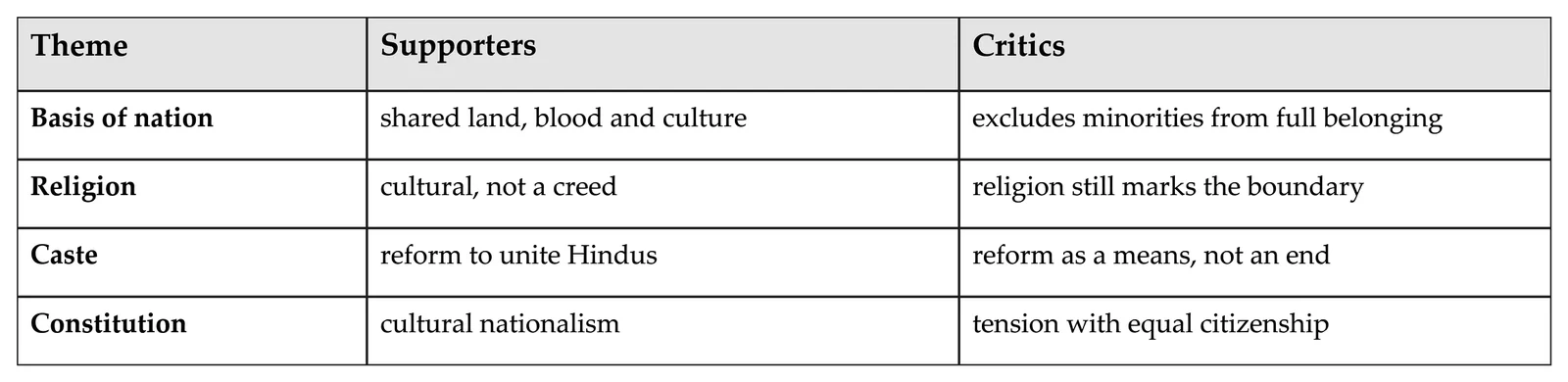
This distinction is central to later debates. Supporters argue that Hindutva is a cultural nationalism, not a theocracy, and that it unites a diverse people. Critics, such as Jyotirmaya Sharma, argue that religion still marks the boundary of belonging in Savarkar’s definition, because the test of punyabhu excludes those whose faiths arose elsewhere. Gandhi, by contrast, understood Hinduism as a religion of truth and non-violence open to all faiths, and rejected the idea of a nation defined by religion.
6.4 Social Reform and a Contested Legacy
During his Ratnagiri years (1924–37), Savarkar campaigned against untouchability and caste restrictions, which he saw as dividing and weakening Hindu society. He attacked the seven shackles (saptabandi) of caste: restrictions on reading the Vedas, on occupations, on touch, on sea travel, on reconversion, on inter-dining and on inter-marriage. He supported inter-caste dining, mixed schools and the Patit Pavan Mandir (1931), a temple open to all Hindus. He also criticised cow-worship as superstition, arguing that the cow was a useful animal to be protected, not a deity.

Savarkar’s legacy remains deeply contested. Sampath documents his social reform, rationalism and support for science and industry, and discusses the controversies over his mercy petitions from the Andamans and his trial in the Gandhi murder case, in which he was acquitted in 1949. Admirers see him as a patriot, revolutionary and reformer; critics see his Hindutva as exclusionary and his reform as a means of uniting Hindus politically rather than an end in itself.
6.5 Important Questions
- Question 1 Explain Savarkar’s concept of Hindutva as set out in Essentials of Hindutva.
- Question 2 Distinguish between Hindutva and Hinduism in Savarkar’s thought.
- Question 3 Discuss Savarkar’s views on caste and social reform and assess his legacy.
DU asks the same idea in different words. So learn one broad answer for each question below; the same answer works for every question joined by OR.
Important Question 1
Explain Savarkar’s concept of Hindutva as set out in Essentials of Hindutva.
OR
Discuss the essentials of Hindutva according to V.D. Savarkar.
OR
Examine Savarkar’s definition of a Hindu.
Model Answer
“Hindutva is not a word but a history.”
— V.D. Savarkar, Essentials of Hindutva (1923)
Introduction. V.D. Savarkar’s Essentials of Hindutva (1923) is the founding text of Hindu nationalism. Written while he was a prisoner, it set out to define who a Hindu is and what binds Hindus together as a nation. Savarkar answered with the concept of Hindutva, Hindu-ness, based on a shared land, descent and culture rather than on religious belief.
1. Context of the Text
Savarkar wrote the text in prison after his return from the Andamans, and it was published in 1923 under the pen-name ‘A Maratha’. It appeared at a time of the Khilafat movement, communal riots and debates about Indian nationhood, when Savarkar believed that Hindus needed a clear sense of their identity and unity. Later editions appeared under the title Hindutva: Who is a Hindu?
2. Hindutva and History
Savarkar opened by saying that Hindutva is not a word but a history. It is not only the spiritual or religious history of the people, but their history in full. The word Hindu, he argued, came from Sindhu, the river Indus, and named the people who lived in the land around and beyond it.
3. Definition of a Hindu
A Hindu, according to Savarkar, is a person who regards the land of Bharatvarsha, from the Indus to the seas, as his fatherland and his holy land, the cradle of his religion. He expressed this in a Sanskrit verse naming the land as both pitribhu and punyabhu.
4. The First Bond: Rashtra
The first essential of Hindutva is territorial. Hindus share attachment to a common land, Hindusthan, with natural boundaries of the Himalayas, the Indus and the seas. Love of this land is the basis of patriotism.
5. The Second Bond: Jati
The second essential is jati, common descent or blood. Savarkar argued that despite caste divisions, Hindus are descended from common ancestors and that intermarriage over centuries had made them one people. Caste, in his view, had regulated rather than destroyed this common blood.
6. The Third Bond: Sanskriti
The third essential is sanskriti, a common culture: shared history, heroes, literature, art, law, festivals, rites and the Sanskrit language. Savarkar considered this the most important bond, since it gives a people its distinct character. Sanskrit, in his view, was the mother of Indian languages, and the epics, the Puranas and the stories of heroes such as Rama, Krishna and Shivaji formed a shared memory that bound Hindus together.
7. Pitribhu and Punyabhu
Savarkar combined these bonds in the test of fatherland and holy land. Those for whom India is both the land of their ancestors and the cradle of their religion fully possess Hindutva. This test includes followers of all religions born in India.
8. Who Is Included
Sikhs, Jains, Buddhists, followers of tribal faiths and even atheists of Hindu origin are Hindus in Savarkar’s sense. Hindutva is therefore broader than Hinduism and does not require belief in the Vedas or any god.
9. The Question of Muslims and Christians
Savarkar argued that Indian Muslims and Christians, though they share the fatherland and often the blood of Hindus, have their holy lands in Arabia or Palestine, so their loyalty is divided. He held that they could share Hindutva only if they adopted India as their holy land too.
10. Political Implications
Hindutva provided the basis for a Hindu nation. As president of the Hindu Mahasabha, Savarkar called on Hindus to unite and to Hinduise politics and militarise Hindudom. In 1937 he said that there were in the main two nations in India, Hindus and Muslims, though he opposed Partition and favoured a single state with equal votes for all citizens.
11. The Name Hindu
Savarkar traced the name to the Vedic Sapta Sindhu, the land of the seven rivers. Since Persians pronounced s as h, Sindhu became Hindu. He argued that the name was territorial and national long before it acquired a religious meaning, and that Hindusthan simply meant the land of the Hindus. This history supported his claim that Hindutva was older and wider than any religion.
12. A Nation of Blood and Memory
Savarkar’s nation combined territory, descent and culture, much like the ethnic nationalisms of Germany and Italy that he admired. He rejected a purely territorial or civic idea of nationhood in which everyone living within the borders was equally a member. For him a nation needed deeper bonds of shared ancestry, memory and sentiment, which only Hindutva could supply in India.
13. Criticisms
Critics argue that the holy-land test makes religion the real criterion of belonging and treats Muslims and Christians as less than full members of the nation, in tension with the equal citizenship of the Indian Constitution. Others note that the idea of common blood rests on a racial idea of nationhood popular in Europe at the time.
14. Evaluation
Essentials of Hindutva is one of the most influential texts of modern Indian political thought. It offered a powerful, territorial and cultural idea of nationhood that united diverse Hindu communities, but its definition of who fully belongs to the nation has made it a subject of lasting controversy.
Conclusion. Thus, Savarkar defined Hindutva through three bonds, a common nation, race and culture, summed up in the test of India as both fatherland and holy land. His concept laid the foundations of Hindu nationalism, while its treatment of minorities remains deeply debated.
Important Question 2
Distinguish between Hindutva and Hinduism in Savarkar’s thought.
OR
‘Hindutva is not identical with Hinduism.’ Discuss.
OR
Examine the relationship between religion and nationalism in the thought of Savarkar.
Model Answer
“Hindutva is not identical with what is vaguely indicated by the term Hinduism.”
— V.D. Savarkar, Essentials of Hindutva (1923)
Introduction. A central claim of Savarkar’s Essentials of Hindutva is that Hindutva and Hinduism are different. Hinduism is a religion, or rather a family of religious systems; Hindutva is a national and cultural identity. Understanding this distinction is the key to Savarkar’s thought and to the debates about Hindu nationalism and secularism in India.
1. Meaning of Hinduism
For Savarkar, Hinduism means the religious beliefs and practices of the Hindus: the Vedic and other sects, schools of philosophy, rituals and modes of worship. It is a set of religions, the dharmas of the Hindu people, varied and often contradictory. He preferred to speak of Hindu dharma, or the dharmas of the Hindus, since there was no single church, prophet or creed.
2. Meaning of Hindutva
Hindutva means Hindu-ness: the totality of the life of the Hindu people, their history, culture, language, territory and descent. Savarkar called Hinduism only a derivative, a part of Hindutva. Hindutva is a national identity, not a creed.
3. Why the Distinction
Savarkar wanted to unite all Hindus despite their many sects, castes and beliefs. A religious definition would divide them, since no single doctrine is shared by all. A cultural and territorial definition could include Vaishnavas and Shaivas, Sikhs and Jains, believers and atheists alike.
4. A Secular Hindutva
Savarkar himself was a rationalist and an atheist in religious matters. He rejected the authority of scriptures over social life, criticised superstition and favoured science and machines. In this sense his Hindutva was a modern, secular nationalism, not a call for rule by priests or scripture.
5. Religion in Hindutva
Yet religion still plays a role. The test of punyabhu, the holy land, asks where a person’s religion was born. This means that religious origin determines whether a person fully belongs to the nation, which is why critics argue that Hindutva is not entirely separate from religion.
6. Cultural Nationalism
Supporters describe Hindutva as cultural nationalism: the nation is defined by a shared civilisation rather than by a state or a religion. They argue that this culture, though Hindu in origin, can be shared by all who live in India and respect its heritage.
7. Gandhi’s Hinduism
Gandhi offered a different understanding. In writings collected in What is Hinduism, he described Hinduism as a relentless search for truth through non-violence, tolerant of all faiths. For him, religion was a personal and moral matter, and the Indian nation included all religions equally. He rejected a nation defined by any religion.
8. Religion and the Nation
For Savarkar, the nation came first and religion was one of its expressions. He wanted to Hinduise politics, meaning to make Hindu national interests the basis of policy. For Gandhi, religion meant ethics in politics; for Nehru, the state had to be separate from all religions.
9. Hindutva and the State
Savarkar’s ideal state was formally non-religious. He proposed one person, one vote, equal citizenship and protection for the religion, language and culture of minorities, but no special privileges or separate electorates. Supporters see this as a secular state; critics reply that a state built on a Hindu national identity cannot treat minorities as equal members of the nation, whatever their legal rights.
10. Later Development
Hindutva was developed further by M.S. Golwalkar of the Rashtriya Swayamsevak Sangh, who gave it a more organic and cultural character, and later by the Bharatiya Jana Sangh and the BJP, which adopted cultural nationalism. The meaning of Hindutva has therefore changed as different organisations have interpreted Savarkar’s original concept.
11. Judicial View
In the 1995 case of Ramesh Yeshwant Prabhoo, the Supreme Court observed that the terms Hindutva and Hinduism ordinarily refer to a way of life of the people of the subcontinent rather than to narrow religious fundamentalism. The judgment remains debated, since critics argue that Hindutva is a political ideology.
12. Critics’ View
Jyotirmaya Sharma, in Hindutva: Exploring the Idea of Hindu Nationalism (2003), argues that Savarkar’s Hindutva emptied Hinduism of its spiritual content and turned it into a political identity defined against others. Other critics argue that the distinction allows religious majoritarianism to present itself as culture.
13. Supporters’ View
Sampath and other sympathetic writers argue that Savarkar’s Hindutva was inclusive within its terms, rationalist and reformist, and that it sought equal citizenship in a single state rather than a theocracy. They stress his opposition to caste and superstition.
14. Evaluation
The distinction between Hindutva and Hinduism was Savarkar’s most original conceptual move. It allowed Hindu nationalism to present itself as a cultural rather than religious movement. Whether that cultural identity can include all Indians equally remains the central question in Indian debates on nationalism and secularism.
Conclusion. Thus, for Savarkar, Hinduism is a religion while Hindutva is the whole national and cultural identity of the Hindus, defined by land, descent and culture. The distinction made Hindu nationalism appear secular and cultural, but its holy-land test keeps religion at the boundary of the nation, which is why it remains contested.
Important Question 3
Discuss Savarkar’s views on caste and social reform and assess his legacy.
OR
Examine Savarkar’s critique of the caste system.
OR
‘Savarkar remains a contested figure.’ Discuss with reference to Vikram Sampath.
Model Answer
“‘Untouchability’ is abolished and its practice in any form is forbidden.”
— Constitution of India, Article 17
Introduction. Savarkar is often remembered only for Hindutva, but he was also a radical critic of caste, untouchability and superstition. During his years of internment at Ratnagiri, he led a campaign of social reform. His life and legacy, however, remain intensely contested. Vikram Sampath’s biography studies these later years in detail.
1. Ratnagiri Years
Released from prison in 1924 on condition that he stay in Ratnagiri district and avoid politics, Savarkar turned to social reform until the restrictions were lifted in 1937. He wrote extensively, organised meetings and worked to bring castes together.
2. Critique of Caste
Savarkar argued that caste divided Hindus into thousands of mutually hostile groups, weakened them and made them easy to conquer. Caste, he held, had no basis in reason, and birth could not determine a person’s worth. The removal of caste was therefore necessary for national strength.
3. The Seven Shackles
He identified seven shackles of caste: vedoktabandi, the ban on the lower castes hearing the Vedas; vyavasayabandi, restrictions on occupation; sparshabandi, untouchability; samudrabandi, the ban on sea voyages; shuddhibandi, the ban on reconversion; rotibandi, the ban on inter-dining; and betibandi, the ban on inter-marriage. All seven had to be broken.
4. Practical Reform
Savarkar organised inter-caste dinners, encouraged children of all castes to study together, supported temple entry and inspired the Patit Pavan Mandir (1931) in Ratnagiri, open to all Hindus including former untouchables. He supported inter-caste marriage.
5. Rationalism
Savarkar attacked superstition and blind faith in scripture. He argued that the cow was a useful animal to be protected for economic reasons, not a mother or deity to be worshipped. He favoured science, technology and industry and criticised Gandhi’s rejection of machinery.
6. Women
He supported women’s education and opposed some restrictions on women, though his writing on women was shaped by the national purpose, valuing them mainly as mothers and members of the Hindu nation.
7. Reform as Unity
Critics note that Savarkar justified reform mainly as a means of uniting and strengthening Hindus against others, especially in the context of conversion. Unlike Ambedkar, he did not ground his critique of caste chiefly in the dignity and rights of the oppressed.
8. Comparison with Ambedkar
Ambedkar acknowledged Savarkar’s reform efforts in Ratnagiri, but his own critique of caste went further: he rejected the Hindu scriptures that sanctioned caste and in 1956 converted to Buddhism. For Savarkar, caste had to be reformed to save Hindu society; for Ambedkar, Hindu society had to be transformed to free its victims.
9. Political Career
As president of the Hindu Mahasabha (1937–43), Savarkar opposed the Congress, supported recruitment of Hindus into the army during the Second World War and stayed away from the Quit India movement. His critics see these choices as weakening the national movement; his admirers see them as practical politics.
10. Sampath’s Contested Legacy
Sampath presents Savarkar as a complex figure: a revolutionary who suffered long imprisonment, a rationalist and a reformer. He also discusses the controversies, including the mercy petitions Savarkar wrote from the Andamans and his trial in the Gandhi murder case, in which the court acquitted him in 1949.
11. Competing Views
For his admirers, Savarkar was a patriot and visionary whose ideas of a strong, united, modern Hindu society were ahead of his time. For his critics, his Hindutva laid the foundation of majoritarian politics that sits uneasily with the secular and pluralist Constitution.
12. Shuddhi and Conversion
Savarkar supported shuddhi, the reconversion of those who had left Hinduism, and attacked the rule that a person who left the fold could never return. He saw conversion to other religions as a loss to the Hindu nation and argued that removing untouchability would stop the lower castes from leaving Hinduism. This shows how closely his reform was linked to the strength and numbers of Hindus.
13. Scientific Outlook
In his essays on the scientific outlook, Savarkar argued that the modern age must be guided by reason and experiment, not by ancient texts, and that rules made for earlier times could be changed. He praised machines as a force of progress and urged Hindus to adopt modern industry and military technology in order to become strong.
14. Evaluation
Savarkar’s campaign against caste and superstition was genuine and radical for its time, and it complicates any simple picture of him. Yet his reform served a vision of Hindu national unity, and his legacy, like his idea of Hindutva, continues to divide scholars and citizens.
Conclusion. Thus, Savarkar attacked caste, untouchability and superstition and promoted inter-caste dining, temple entry and modern science. His reform aimed above all at Hindu unity. As Sampath’s biography shows, he remains one of the most contested figures in modern Indian political thought.
Short Notes
(a) Pitribhu and Punyabhu
Savarkar’s two tests of Hindutva. Pitribhu is the fatherland, the land of one’s ancestors; punyabhu is the holy land, where one’s religion was born. A Hindu, for Savarkar, regards Bharatvarsha as both. The punyabhu test includes Sikhs, Jains and Buddhists but places Muslims and Christians outside full Hindutva.
(b) Hindu Mahasabha
An organisation formed in the 1910s to represent Hindu interests. Under Savarkar’s presidency (1937–43), it became a political party opposed to the Congress’s policy towards the Muslim League and promoted Hindu unity and militarisation. Its influence declined after independence.
(c) Patit Pavan Mandir
A temple in Ratnagiri opened in 1931 with Savarkar’s inspiration and the support of a local philanthropist. It was open to all Hindus, including those then treated as untouchables, and hosted inter-caste dinners. It symbolised Savarkar’s campaign against caste restrictions.
(d) Abhinav Bharat
A secret revolutionary society founded by Savarkar and his elder brother Ganesh in Nashik in 1904, growing out of the Mitra Mela of 1899. It aimed at armed revolution against British rule and had branches in Maharashtra and London. The assassination of the Nashik collector A.M.T. Jackson in 1909 by a member led to Savarkar’s trial and transportation for life.
More notes: DSC-14 Modern Indian Political Thought
These notes are prepared by PADHO TO AISE for study help. They are not an official University of Delhi publication.