
Semester IV DSC-12 Global Politics
Unit II · 26 min read · Updated 24 Nov 2026
As per the University of Delhi (DU) BA (Hons) Political Science syllabus
Contents
- 2.1 Globalisation, De-globalisation and Post-globalisation
- 2.2 Geo-politics, Geo-economics and Geo-strategy
- 2.3 Territorialisation and De-territorialisation
- 2.4 Cultural Frames of Global Politics
- 2.5 Important Questions
- Discuss the shift from globalisation to de-globalisation and post-globalisation.
- Explain the concepts of geo-politics, geo-economics and geo-strategy. How are they relevant to contemporary global politics?
- Discuss the processes of territorialisation and de-territorialisation in global politics.
- Discuss the cultural frames of global politics. Is the ‘clash of civilisations’ an adequate explanation of conflict?
- Short Notes
नई इलेक्ट्रॉनिक परस्पर-निर्भरता संसार को एक वैश्विक गाँव की छवि में फिर से रचती है।
The new electronic interdependence recreates the world in the image of a global village.
— Marshall McLuhan, The Gutenberg Galaxy (1962)
THE world of the 1990s seemed to be moving steadily towards a borderless global village, with free trade, the internet and global finance. Three decades later the picture is more complicated. The financial crisis of 2008, Brexit, trade wars between the USA and China, the COVID-19 pandemic and the war in Ukraine have revived borders, tariffs and national interests. This unit studies how global politics is changing: the movement from globalisation to de-globalisation and post-globalisation; the return of geo-politics, geo-economics and geo-strategy; the processes of territorialisation and de-territorialisation; and the cultural frames through which identities and civilisations are understood in global politics.
2.1 Globalisation, De-globalisation and Post-globalisation
Globalisation is the process by which the world becomes increasingly interconnected through flows of goods, capital, people, information and ideas. Manfred Steger, in Globalization: A Very Short Introduction (2009), defines it as a multidimensional set of social processes that create, multiply, stretch and intensify worldwide social interdependencies and exchanges, while fostering a growing awareness of connections between the local and the distant. He compares scholars of globalisation to blind men touching different parts of an elephant: each sees only one dimension, economic, political, cultural or ecological. George Ritzer describes globalisation as a set of flows and the barriers that try to block them.
David Held and Anthony McGrew identified the great globalisation debate among hyperglobalists, who believe globalisation has created a borderless world and made the nation-state obsolete (Kenichi Ohmae); sceptics, who argue that today’s economy is less open than before 1914 and remains dominated by states and regional blocs (Paul Hirst and Grahame Thompson); and transformationalists, who see globalisation as a powerful but uneven force that transforms rather than abolishes state power.
De-globalisation
De-globalisation refers to a reversal or slowing of global integration. Harold James (2017) reminds us that the first great wave of globalisation before 1914 collapsed into war, protectionism and depression between 1914 and 1945. Since the 2008 financial crisis, world trade has grown more slowly, a trend dubbed ‘slowbalisation’. Markus Kornprobst and T.V. Paul (2021) link de-globalisation to rising protectionism, populist nationalism, Brexit, US–China trade and technology wars, supply-chain disruptions during COVID-19 and sanctions after Russia’s invasion of Ukraine. They argue that these trends challenge the liberal international order, and Paul suggests that the order must adapt through a more inclusive re-globalisation.
Post-globalisation
Terry Flew (2020) argues that we are entering a phase of post-globalisation marked by the return of the national. Globalisation has not ended, since digital platforms, finance and global value chains remain, but nation-states are reasserting control over borders, data, trade and culture, and populist movements challenge global elites. He also speaks of neo-globalisation, a reshaped globalisation in which states play a stronger role. Common forms include ‘friend-shoring’, regional trade blocs, national industrial policies and data localisation.
2.2 Geo-politics, Geo-economics and Geo-strategy

A. Geo-politics
Geo-politics studies the relationship between geography and power. The term was coined by the Swedish scholar Rudolf Kjellén in 1899, building on Friedrich Ratzel’s view of the state as an organism needing living space. Alfred Thayer Mahan (The Influence of Sea Power upon History, 1890) argued that sea power determines world power. Halford Mackinder’s Heartland theory (1904, 1919) held that whoever rules Eastern Europe commands the Heartland, whoever rules the Heartland commands the World-Island, and whoever rules the World-Island commands the world. Nicholas Spykman replied that the Rimland of coastal Eurasia was more important. Karl Haushofer’s geopolitik was used by Nazi Germany, discrediting the field for decades.
Critical geopolitics, developed by Gearóid Ó Tuathail, Simon Dalby and John Agnew, treats geopolitics as a discourse: a way in which states and intellectuals represent the world, dividing it into friends and enemies, centres and peripheries. Sanjay Chaturvedi examines geopolitics from the Global South, showing how imperial cartography, colonial boundaries and Western strategic discourses shaped the world, and how post-colonial states have sought new geopolitical visions. Brian Blouet shows how Mackinder’s ideas influenced Western Cold War strategy of containing the Soviet Union.
B. Geo-economics
Edward Luttwak argued in 1990 that after the Cold War rivalry among states would increasingly take economic forms, following the logic of conflict in the grammar of commerce: investment, trade, technology and market share would replace military force. Mikael Wigell and his co-authors (2019) define geo-economics as the geostrategic use of economic power and speak of the revival of economic statecraft. Examples include sanctions, export controls on semiconductors, China’s Belt and Road Initiative (2013), energy pipelines such as Nord Stream and the weaponisation of interdependence. John M. Hobson warns against Western-centric accounts that ignore the long history of non-Western economic power.
C. Geo-strategy
Geo-strategy is the long-term planning of a state’s use of power, military, economic and diplomatic, in geographic terms to secure its interests. Zbigniew Brzezinski’s The Grand Chessboard (1997) treated Eurasia as the key arena for American primacy. Contemporary geo-strategies include the US and Indian concept of the Indo-Pacific, the Quad of India, the USA, Japan and Australia, China’s maritime expansion, and India’s SAGAR (Security and Growth for All in the Region, 2015) and Act East policies. Energy security is a major geo-strategic concern, as André Dorsman and others show.
2.3 Territorialisation and De-territorialisation

The modern state is territorial: it claims sovereign authority over a bounded area. De-territorialisation refers to processes that weaken the link between social relations and territory. Jan Aart Scholte argued that globalisation is the rise of supraterritoriality, relations that are not tied to territorial location, such as the internet, global finance and satellite television. Arjun Appadurai (1990) described global cultural flows as five ‘scapes’: ethnoscapes (people), mediascapes (media), technoscapes (technology), financescapes (money) and ideoscapes (ideas), which move in disjunctive ways across borders.
Saskia Sassen, in Losing Control? Sovereignty in an Age of Globalization (1996), argued that economic globalisation produces a new geography of power. Parts of national territory, such as global cities and financial centres, are partly denationalised; new private and transnational legal regimes, such as international commercial arbitration and credit-rating agencies, govern economic activity; and the state itself participates in creating these arrangements. Sovereignty is not disappearing but being transformed and partly relocated.
Stuart Elden (2005) criticises the deterritorialisation thesis for ‘missing the point’. Territory, he argues, is not a fixed container but a political technology that is constantly reshaped. Globalisation involves a reterritorialisation, a reorganisation of space, not the end of territory. The US-led ‘war on terror’ after 2001, with its claims to act anywhere in the world, shows a new understanding of the space of the world rather than a borderless one. Today re-territorialisation is visible in border walls, migration controls, Brexit’s promise to take back control, data localisation laws and territorial disputes in the South China Sea and Ukraine.
2.4 Cultural Frames of Global Politics
For much of the Cold War, culture was neglected in International Relations, which focused on power and material interests. Yosef Lapid (1996) described the return of culture and identity to IR theory after the Cold War, linked to constructivism and to ethnic and religious conflicts. Rajen Harshe (2006) argues that culture and identity are dynamic and contested, shaped by history and power, and that essentialist views of culture can justify domination and conflict.
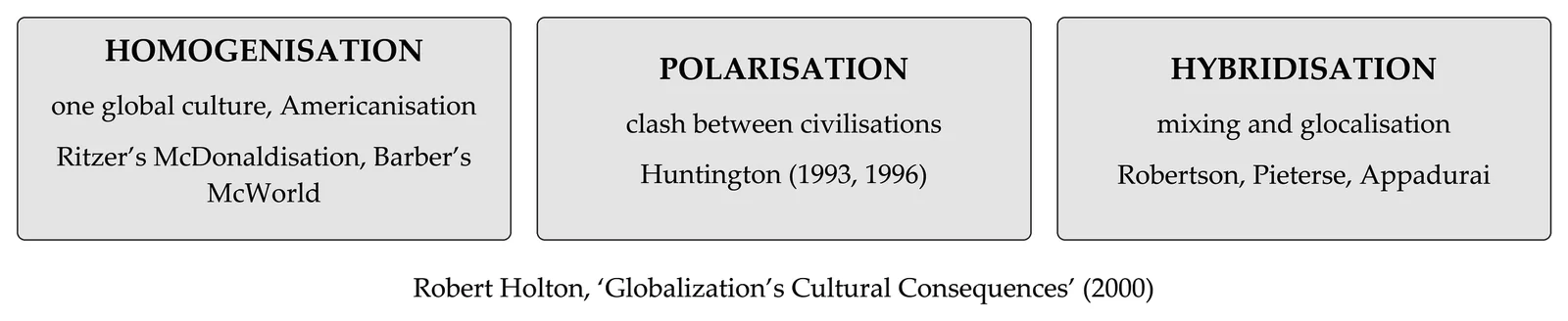
- Homogenisation: globalisation spreads a uniform consumer culture dominated by Western, especially American, brands and media; George Ritzer calls it McDonaldisation, and Benjamin Barber’s Jihad vs. McWorld (1995) described the clash between global consumerism and tribal reaction.
- Polarisation: Samuel Huntington’s ‘The Clash of Civilizations?’ (1993) argued that after the Cold War the main source of conflict would be cultural, along the fault lines between civilisations such as Western, Islamic, Sinic and Hindu.
- Hybridisation: cultures mix and adapt global influences to local contexts, as in Roland Robertson’s glocalisation and Jan Nederveen Pieterse’s idea of global mélange.
Robert Holton (2000) uses these three theses to analyse globalisation’s cultural consequences, concluding that hybridisation and resistance coexist with homogenising pressures. Hugh Gusterson, in ‘The Seven Deadly Sins of Samuel Huntington’ (2005), criticises Huntington for treating civilisations as homogeneous and unchanging, ignoring conflicts within civilisations, using selective evidence and producing a self-fulfilling prophecy. Edward Said called the thesis a ‘clash of ignorance’. JoAnn Chirico shows that global culture combines change and continuity. Joseph Nye’s concept of soft power, the ability to attract through culture and values, shows how culture is also a resource of states.
2.5 Important Questions
- Question 1 Discuss the shift from globalisation to de-globalisation and post-globalisation.
- Question 2 Explain the concepts of geo-politics, geo-economics and geo-strategy. How are they relevant to contemporary global politics?
- Question 3 Discuss the processes of territorialisation and de-territorialisation in global politics.
- Question 4 Discuss the cultural frames of global politics. Is the ‘clash of civilisations’ an adequate explanation of conflict?
DU asks the same idea in different words. So learn one broad answer for each question below; the same answer works for every question joined by OR.
Important Question 1
Discuss the shift from globalisation to de-globalisation and post-globalisation.
OR
Is globalisation in retreat? Discuss with reference to recent developments.
OR
Examine the impact of de-globalisation on the liberal international order.
Model Answer
“Globalisation can thus be defined as the intensification of worldwide social relations which link distant localities in such a way that local happenings are shaped by events occurring many miles away and vice versa.”
— Anthony Giddens, The Consequences of Modernity (1990)
Introduction. For three decades after the end of the Cold War, globalisation seemed unstoppable. Trade, investment, migration and digital communication grew rapidly, and many believed that national borders would become irrelevant. Since 2008, however, a series of shocks has slowed or reversed some forms of integration. Scholars now debate whether the world is experiencing de-globalisation, a reshaped globalisation or a new phase of post-globalisation.
1. Meaning of Globalisation
Steger defines globalisation as a multidimensional set of processes that intensify worldwide interdependence and awareness of connections between the local and the distant. It has economic dimensions such as trade, finance and production networks; political dimensions such as global governance and international organisations; cultural dimensions such as global media and consumer culture; and ecological dimensions such as climate change. Ritzer describes it as a world of flows of goods, people, money and information, and of barriers that seek to channel or block them.
2. Waves of Globalisation
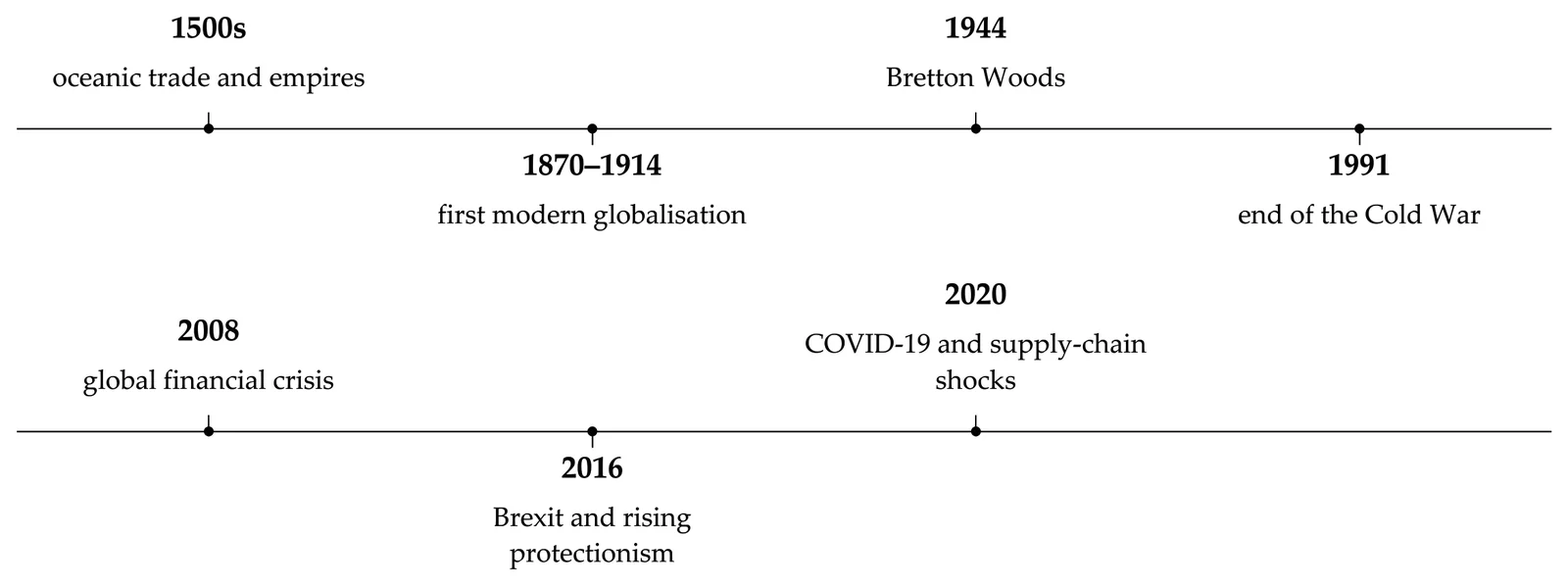
Globalisation is not entirely new. Oceanic trade and empires from the sixteenth century connected continents, and the period from about 1870 to 1914 saw massive flows of trade, capital and migration. After 1945 the Bretton Woods system and the GATT rebuilt the world economy, and after 1991 the collapse of communism, the WTO (1995), the internet and China’s integration produced an unprecedented wave of globalisation.
3. The Globalisation Debate
Held and McGrew identified three positions. Hyperglobalists such as Kenichi Ohmae argued that a borderless economy had made the nation-state obsolete. Sceptics such as Hirst and Thompson argued that the world economy was no more open than before 1914 and remained dominated by states and regional blocs. Transformationalists such as Held and Giddens argued that globalisation was transforming state power and creating new patterns of inequality without abolishing the state.
4. The Lesson of History
Harold James points out that the first age of globalisation collapsed after 1914, as the First World War, protectionism, the Great Depression and nationalism produced a long period of de-globalisation until 1945. This shows that globalisation can be reversed when it generates insecurity, inequality and geopolitical rivalry, and that political choices sustain or undermine it.
5. Causes of De-globalisation
Kornprobst and Paul identify several causes of recent de-globalisation. The 2008 financial crisis exposed the risks of global finance; growth of world trade slowed; populist nationalism grew among those who felt left behind; the UK voted for Brexit in 2016; the USA imposed tariffs on China from 2018, and both countries began a technology rivalry; COVID-19 exposed fragile supply chains; and the war in Ukraine from 2022 led to sweeping sanctions and energy disruption.
6. Forms of De-globalisation
De-globalisation appears as tariffs and trade barriers, restrictions on foreign investment in sensitive sectors, export controls on technology, reshoring and friend-shoring of production, migration restrictions, data localisation laws and the weaponisation of interdependence through sanctions. The WTO’s dispute settlement system has been paralysed since 2019 because the USA blocked appointments to its Appellate Body.
7. Impact on the Liberal International Order
The liberal international order built after 1945 rested on open markets, multilateral institutions and American leadership. Kornprobst and Paul argue that de-globalisation challenges its economic foundations, while great-power rivalry and populism challenge its political consensus. T.V. Paul suggests that the order can survive only by adapting, through more inclusive governance that gives a greater voice to rising powers and addresses inequality, a process he calls re-globalisation.
8. Post-globalisation and the Return of the National
Terry Flew argues that we are in a phase of post-globalisation, in which globalisation continues in some areas, such as digital platforms and finance, while the nation-state reasserts itself in others. Populism represents a demand for the return of national sovereignty, borders and identity, and governments increasingly regulate global technology firms, media and data.
9. Neo-globalisation and Reglobalisation
Flew also speaks of neo-globalisation, a reshaped globalisation led more by states and regions. Supply chains are being reorganised rather than abandoned, regional agreements such as the RCEP (2020) continue to expand trade in Asia, and countries such as India and Vietnam seek to benefit from diversification away from China. Services, data flows and digital trade continue to grow.
10. Evaluation
Most evidence suggests that globalisation is not ending but changing: it is becoming more regional, more politicised and more shaped by security concerns. The key question is whether states can manage interdependence cooperatively or whether rivalry will fragment the world economy into competing blocs.
Conclusion. Thus, the world has moved from the confident globalisation of the 1990s to a period of de-globalisation and post-globalisation marked by the return of the national. Globalisation persists in new forms, but its future depends on reforming the international order to make it more inclusive and secure.
Important Question 2
Explain the concepts of geo-politics, geo-economics and geo-strategy. How are they relevant to contemporary global politics?
OR
Discuss Mackinder’s Heartland theory and its relevance today.
OR
‘Geo-economics is the new geopolitics.’ Discuss.
Model Answer
“Who rules East Europe commands the Heartland; who rules the Heartland commands the World-Island; who rules the World-Island commands the World.”
— Halford Mackinder, Democratic Ideals and Reality (1919)
Introduction. Geography has always shaped the power and strategies of states. After the end of the Cold War, some believed that geography would matter less in a globalised world. Yet rivalry between the USA and China, Russia’s wars, competition in the Indo-Pacific and the use of trade and technology as weapons show that geo-politics, geo-economics and geo-strategy have returned to the centre of global politics.
1. Meaning of Geo-politics
Geo-politics is the study of how geography, location, resources, terrain and access to seas, shapes the power and policies of states. The term was coined by Rudolf Kjellén in 1899. Classical geopolitics treated geography as a fixed influence on international politics and tried to identify the regions whose control would bring world power. In practice geopolitics also refers to the actual rivalry of states over territory, resources and strategic positions, as in the competition over the Arctic as its ice melts.
2. Classical Theorists
Friedrich Ratzel saw the state as a living organism that needs living space to grow. Alfred Thayer Mahan argued that sea power, navies, merchant fleets and naval bases, determined national greatness, influencing the naval expansion of the USA, Germany and Japan. Nicholas Spykman argued that the Rimland, the coastal belt of Eurasia, was the key to world power. These theories reflected the age of imperial rivalry among European powers and the United States, when control of colonies, sea lanes and coaling stations seemed the key to greatness.
3. Mackinder’s Heartland
Halford Mackinder argued in 1904 that the Eurasian interior, the pivot area or Heartland, inaccessible to sea power, could become the base of world domination with the spread of railways. In 1919 he warned that whoever ruled Eastern Europe would command the Heartland and ultimately the world. Brian Blouet shows that Mackinder’s ideas influenced Western strategy, including the Cold War containment of the Soviet Union. Many analysts see echoes of his ideas in today’s competition over Central Asia, Eastern Europe and Eurasian transport corridors.
4. Critical Geopolitics
Critical geopolitics, developed by Ó Tuathail, Dalby and Agnew, argues that geopolitics is not an objective science but a discourse through which states represent the world, dividing it into friends and enemies and justifying policies. Sanjay Chaturvedi shows how colonial cartography and Western strategic discourse shaped the Global South, and calls for geopolitical thinking that reflects the experiences of post-colonial societies.
5. Meaning of Geo-economics
Edward Luttwak argued that after the Cold War competition among states would follow the logic of conflict in the grammar of commerce. Wigell and his co-authors define geo-economics as the use of economic instruments, trade, investment, sanctions, aid and technology, to achieve geopolitical goals. It is the revival of economic statecraft in an interdependent world. Unlike classical liberal economics, which sees trade as mutually beneficial, geo-economics treats economic relations as a field of power and relative gains.
6. Geo-economics in Practice
Examples include China’s Belt and Road Initiative, which finances infrastructure across Asia, Africa and Europe; US export controls on advanced semiconductors to China; Western sanctions on Russia after 2022, including the freezing of central bank reserves; Russia’s use of gas supplies as leverage; and India’s Production Linked Incentive schemes to reduce dependence on imports. Scholars speak of the weaponisation of interdependence.
7. Meaning of Geo-strategy
Geo-strategy is a state’s long-term plan for using its power in particular geographic regions to secure its interests. It combines geography with military, economic and diplomatic means. Zbigniew Brzezinski’s The Grand Chessboard (1997) argued that the USA must prevent the rise of a hostile power dominating Eurasia.
8. The Indo-Pacific
The Indo-Pacific has become the central geo-strategic arena, linking the Indian and Pacific Oceans. The Quad of India, the USA, Japan and Australia, revived in 2017, the AUKUS pact (2021) and China’s naval expansion and island-building in the South China Sea reflect competing geo-strategies. India’s SAGAR vision and Act East Policy aim to strengthen its role in the Indian Ocean and Southeast Asia.
9. Energy and Geo-strategy
Energy security shapes geo-strategy, as Dorsman and others show. Control of oil and gas routes, maritime chokepoints such as the Strait of Hormuz and the Strait of Malacca, and critical minerals for clean energy, such as lithium and rare earths, are now major strategic concerns.
10. Evaluation
Classical geopolitics has been criticised for geographic determinism and for justifying imperialism, as with Nazi geopolitik. Yet the three concepts remain useful for understanding contemporary rivalries, provided they are combined with attention to ideas, institutions and the perspectives of the Global South, as Chaturvedi and Hobson suggest.
Conclusion. Thus, geo-politics, geo-economics and geo-strategy explain how geography, economic power and long-term planning shape global politics. Their revival in the twenty-first century reflects intensified great-power rivalry and the weaponisation of economic interdependence.
Important Question 3
Discuss the processes of territorialisation and de-territorialisation in global politics.
OR
Examine Saskia Sassen’s idea of the new geography of power.
OR
‘Globalisation has not ended territoriality but reconfigured it.’ Discuss with reference to Stuart Elden.
Model Answer
“All Members shall refrain in their international relations from the threat or use of force against the territorial integrity or political independence of any state.”
— Article 2(4), Charter of the United Nations (1945)
Introduction. Territory has been the foundation of the modern state system: each state claims exclusive sovereignty over a bounded area. Globalisation seemed to challenge this, as capital, information and people moved across borders and new forms of authority emerged above and below the state. Scholars debate whether the world is being de-territorialised or whether territory is simply being reorganised.
1. Territory and the Modern State
The modern state is defined by sovereignty over a fixed territory, a principle associated with the Peace of Westphalia and enshrined in the UN Charter. Territorialisation is the process by which political authority, identity and economic activity become organised within bounded national spaces, with borders, passports, national markets and national cultures. Colonial expansion exported this territorial model to the rest of the world, often drawing borders that cut across communities, as in Africa and South Asia.
2. Meaning of De-territorialisation
De-territorialisation refers to the weakening of the connection between social relations and territorial location. Capital flows instantly across borders, multinational firms organise production globally, diasporas maintain links across continents, and the internet creates communities that are not tied to place. Hyperglobalists such as Kenichi Ohmae even predicted the end of the nation-state and the rise of region-states defined by economic flows.
3. Supraterritoriality
Jan Aart Scholte argued that globalisation means the spread of supraterritorial relations, connections that transcend territorial geography, such as global finance, satellite communications, global brands and transnational organisations. In his view, territorial space no longer exhausts social geography.
4. Appadurai’s Scapes
Arjun Appadurai described the global cultural economy through five dimensions of flow: ethnoscapes of moving people, mediascapes of images, technoscapes of technology, financescapes of capital and ideoscapes of political ideas. These flows are disjunctive, moving at different speeds and directions, and create imagined worlds that cross national boundaries.
5. Sassen’s New Geography of Power
Saskia Sassen argued that economic globalisation produces a new geography of power. Global cities such as New York, London and Tokyo become command centres of the global economy, and parts of national territory are partly denationalised. New private legal regimes, such as international commercial arbitration and credit-rating agencies, govern transnational economic activity alongside state law.
6. The State’s Role
Sassen insists that the state is not simply a victim of globalisation. States themselves create the legal frameworks that allow global markets to operate, through deregulation and international agreements. Sovereignty is not lost but transformed and partly relocated to supranational and private institutions, which is why she asks whether states are losing control.
7. Elden’s Critique
Stuart Elden argues that the deterritorialisation thesis misses the point. Territory is not a static container but a political technology, a way of measuring, controlling and ordering space. Globalisation does not abolish territory; it reconfigures it. The US-led war on terror, with its claims to strike anywhere and its contested treatment of state sovereignty, shows a new conception of the space of the world rather than its disappearance.
8. Re-territorialisation Today
Recent developments confirm that territory remains central. States have built border walls and fences, as between the USA and Mexico and in parts of Europe after 2015; Brexit promised to take back control of borders; COVID-19 led to sudden border closures; and many countries require data to be stored locally. Territorial conflicts in Ukraine, the South China Sea and the India–China border show that land and sea still matter.
9. Digital Territoriality
The internet was once imagined as a borderless space, but states increasingly assert digital sovereignty through national firewalls, as in China, data protection laws such as the EU’s GDPR and India’s Digital Personal Data Protection Act (2023), and bans on foreign apps. Cyberspace is being territorialised. Debates on regulating global platforms show that states now seek to extend territorial authority over flows that once seemed beyond their reach.
10. Evaluation
De-territorialisation and re-territorialisation occur together. Global flows challenge the exclusive territoriality of states, but states respond by reorganising borders and authority. The result is a complex geography of overlapping spaces, global, regional, national and local, rather than a borderless world.
Conclusion. Thus, globalisation has loosened some ties between social life and territory, as Scholte, Appadurai and Sassen show, but, as Elden argues, it has reconfigured rather than ended territoriality. Global politics today combines flows across borders with the reassertion of territorial control.
Important Question 4
Discuss the cultural frames of global politics. Is the ‘clash of civilisations’ an adequate explanation of conflict?
OR
Critically examine Huntington’s thesis of the clash of civilisations.
OR
Discuss the role of culture and identity in International Relations.
Model Answer
“The great divisions among humankind and the dominating source of conflict will be cultural.”
— Samuel P. Huntington, ‘The Clash of Civilizations?’ (1993)
Introduction. For much of the twentieth century, International Relations explained world politics through power, security and economic interests, treating culture as marginal. After the Cold War, ethnic wars, religious movements and debates about Western values brought culture and identity back to the centre. Cultural frames are the ways in which actors understand themselves, others and the world through ideas of civilisation, religion, nation and identity.
1. The Return of Culture
Yosef Lapid argued in 1996 that culture and identity were returning to IR theory after decades of neglect. The end of the Cold War, the wars in Yugoslavia and Rwanda, the rise of religious movements and the growth of constructivist theory all showed that identities shape interests and conflicts. Lapid also warned against treating culture as a fixed and unified thing. Constructivists such as Alexander Wendt argued that anarchy is what states make of it, meaning that shared ideas and identities define how states see threats and friends.
2. Culture as Dynamic
Rajen Harshe argues that culture and identity are dynamic, plural and historically constructed, shaped by power relations, colonialism and globalisation. Essentialist views that treat cultures as fixed can be used to justify domination, as in colonial ideas of civilising missions, or exclusion, as in contemporary cultural nationalism.
3. Huntington’s Thesis
Samuel Huntington argued in 1993 and in his 1996 book that after the Cold War the main source of conflict would be cultural rather than ideological or economic. The world was divided into civilisations, Western, Sinic, Japanese, Islamic, Hindu, Orthodox, Latin American and possibly African, and the most dangerous conflicts would occur along the fault lines between them. He warned of conflict between the West and Islamic and Sinic civilisations. He argued that civilisational identity would become more important as modernisation weakened local identities and as non-Western societies reasserted their cultures against Western dominance.
4. Criticisms of Huntington
Hugh Gusterson identifies seven deadly sins in Huntington’s argument, including treating civilisations as homogeneous and unchanging, ignoring conflicts within civilisations, which are more frequent than conflicts between them, drawing arbitrary boundaries, using selective evidence and producing a self-fulfilling prophecy that encourages hostility. Edward Said called it a clash of ignorance, and Amartya Sen criticised the reduction of people to a single civilisational identity.
5. Homogenisation
Another cultural frame holds that globalisation is homogenising cultures. George Ritzer’s McDonaldisation describes the spread of efficiency, calculability, predictability and control, and Benjamin Barber’s Jihad vs. McWorld describes global consumer culture provoking tribal and religious reaction. Critics of cultural imperialism point to the dominance of American media and brands.
6. Hybridisation
Many scholars argue that cultures mix rather than simply converge or clash. Roland Robertson’s glocalisation describes how global products and ideas are adapted to local contexts, as when global fast-food chains change their menus in India. Jan Nederveen Pieterse speaks of global mélange, and Appadurai shows that global flows are indigenised in different ways.
7. Holton’s Synthesis
Robert Holton examines the three theses of homogenisation, polarisation and hybridisation, concluding that all capture something but none is sufficient. Globalisation produces both convergence and difference, and cultural resistance and adaptation coexist with homogenising pressures.
8. Culture and Power
Culture is also a resource of power. Joseph Nye’s concept of soft power describes the ability to shape others’ preferences through attraction rather than coercion, through culture, values and policies. States promote their cultures through films, education, language institutes and diaspora networks, as India does through yoga and Bollywood.
9. Identity Politics and Populism
Cultural frames shape contemporary politics through debates on immigration, religion and national identity. Populist movements often frame politics as a struggle to protect national culture from globalisation and migration, while transnational movements frame issues such as climate change and human rights as universal concerns. The debate on Islamophobia in Europe and on religious nationalism in several countries shows how cultural frames influence both domestic politics and foreign policy.
10. Evaluation
Culture clearly matters in global politics, but it is not a fixed cause of conflict. Conflicts usually arise from political, economic and strategic factors that leaders frame in cultural terms. Understanding culture as dynamic and contested, as Harshe and Lapid suggest, offers a better guide than Huntington’s static civilisations.
Conclusion. Thus, culture and identity have returned to the centre of global politics. Huntington’s clash of civilisations captures the salience of culture but oversimplifies it, while the theses of homogenisation and hybridisation show that globalisation produces both convergence and diversity.
Short Notes
(a) Slowbalisation
A term popularised in 2019 for the slowing of globalisation after the 2008 financial crisis. World trade as a share of GDP stopped growing, cross-border investment declined, and protectionism, supply-chain reorganisation and geopolitical rivalry reduced the pace of integration, though without fully reversing it.
(b) Supraterritoriality
Jan Aart Scholte’s term for social relations that transcend territorial geography, such as global finance, the internet, satellite communications and global brands. He argued that globalisation is essentially the spread of supraterritoriality, so that territorial space no longer defines the whole of social life.
(c) Soft power
Joseph Nye’s concept (1990) of the ability of a country to obtain the outcomes it wants through attraction rather than coercion or payment. Its sources are culture, political values and foreign policies seen as legitimate. Examples include American films and universities and India’s yoga, cinema and diaspora.
(d) Heartland theory
Halford Mackinder’s theory, first presented in ‘The Geographical Pivot of History’ (1904) and restated in Democratic Ideals and Reality (1919). The interior of Eurasia, the Heartland, was protected from sea power and rich in resources; with railways, a land power controlling it could dominate the World-Island of Europe, Asia and Africa, and hence the world. The theory influenced Western strategies of containing Germany and later the Soviet Union.
(e) Glocalisation
Roland Robertson’s term for the interpenetration of the global and the local: global products, ideas and practices are adapted to local cultures, while local cultures are reshaped by global influences. Menus of global food chains adapted to Indian tastes and regional versions of global television formats are common examples.
More notes: DSC-12 Global Politics
These notes are prepared by PADHO TO AISE for study help. They are not an official University of Delhi publication.