
Semester IV DSC-12 Global Politics
Unit I · 25 min read · Updated 24 Nov 2026
As per the University of Delhi (DU) BA (Hons) Political Science syllabus
Contents
- 1.1 From International to Global Politics
- 1.2 The Eurocentric Account and its Critics
- 1.3 The Eastern Origins of Western Civilisation
- 1.4 Bandung and the Southern Sources of Global Norms
- 1.5 Worldmaking after Empire
- 1.6 Important Questions
- What is global politics? Why is it necessary to locate global politics beyond Eurocentric accounts?
- Discuss John Hobson’s argument about the Eastern origins of Western civilisation.
- Who are the norm makers in global politics? Discuss with reference to the Bandung Conference.
- Discuss Adom Getachew’s idea of anti-colonial worldmaking. How did it transform self-determination?
- Short Notes
मानव इतिहास में यह रंगीन लोगों का पहला अंतरमहाद्वीपीय सम्मेलन है।
This is the first intercontinental conference of coloured peoples in the history of mankind.
— Sukarno, Opening address, Bandung Conference (1955)
WHERE does global politics begin, and whose story does it tell? Most textbooks locate the origins of the modern world in Europe: the Peace of Westphalia (1648), the voyages of discovery, the scientific and industrial revolutions and the spread of European states across the world. In this story, Asia, Africa and Latin America appear only as passive recipients of Western ideas and power. This unit questions that Eurocentric account. Drawing on John M. Hobson, Jan Nederveen Pieterse, Amitav Acharya and Adom Getachew, it shows that the East contributed decisively to the rise of the West, that globalisation has deep non-Western roots, and that the peoples of the Global South have been makers, not merely takers, of global norms and orders.
1.1 From International to Global Politics
International politics traditionally meant relations between sovereign states, especially great powers, centred on war, diplomacy and the balance of power. Global politics is a wider idea. Andrew Heywood explains that it includes not only states but international organisations, multinational corporations, NGOs, social movements and terrorist networks, and not only the interstate level but the interconnection of local, national, regional and global arenas. Globalisation has made distant events, such as a financial crisis, a pandemic or a war, affect people everywhere.
To locate global politics is to ask where and when it began, whose experiences it reflects and from which places it is studied. Critics argue that the discipline of International Relations (IR) was built mainly in the West and reflects Western history and interests. As Robert Cox put it, theory is always for someone and for some purpose. Amitav Acharya and Barry Buzan asked in 2007 why there is no non-Western IR theory, and Acharya later called for a Global IR that recognises the histories, ideas and agency of all regions of the world.
1.2 The Eurocentric Account and its Critics
Eurocentrism is the tendency to treat Europe as the centre and the norm of world history, and to explain the rise of the West through qualities supposedly unique to Europe. Its main claims are:
- European exceptionalism: Europe alone developed rationality, science, capitalism, democracy and the sovereign state, as in Max Weber’s or E.L. Jones’s The European Miracle (1981).
- The pristine West: the West rose by its own efforts, without borrowing from others.
- The passive East: Asian and African societies were stagnant, despotic or traditional until Europe brought them into modern history.
- Westphalian origin: the modern international system was born in Europe in 1648 and then spread outward through colonialism.
Critics have challenged each claim. Andre Gunder Frank’s ReOrient (1998) argued that Asia, especially China and India, was the centre of the world economy until about 1800. Kenneth Pomeranz’s The Great Divergence (2000) showed that the most advanced regions of China were comparable with England until the late eighteenth century, and that Europe’s lead owed much to coal and colonies. Janet Abu-Lughod described a world system linking Europe, the Middle East, India and China between 1250 and 1350, before European hegemony.
1.3 The Eastern Origins of Western Civilisation
John M. Hobson, in The Eastern Origins of Western Civilisation (2004), rejects the ‘myth of the pristine West’. He argues that the East was more advanced than the West between about 500 and 1800, and that the West rose by drawing on Eastern achievements through two processes:
- Diffusion and assimilation: through oriental globalisation, a global economy pioneered by Middle Eastern, African, Indian and Chinese traders and states, Eastern ‘resource portfolios’, technologies, ideas and institutions, spread westwards and were assimilated by Europe.
- Appropriation: from about 1492, Europeans used imperialism to seize the land, labour and resources of the East and the Americas.
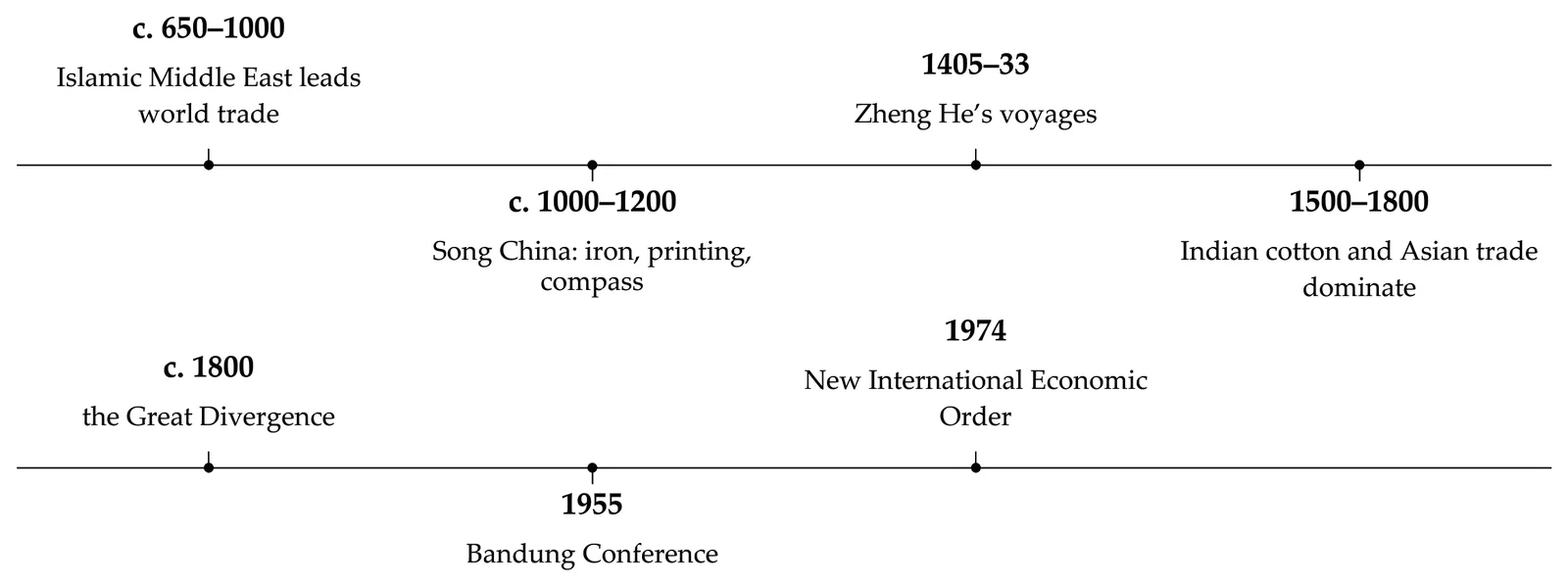
Hobson traces the leadership of the global economy: the Islamic Middle East after about 650, with its trade networks, banking and science; China after about 1000, where the Song dynasty pioneered iron production, printing, paper money, gunpowder and the compass; and India, whose cotton textiles dominated world trade. Europe borrowed numerals and algebra, navigational instruments, crops and financial techniques. Its later advantage came largely from colonial resources, slavery and Asian technologies. Hobson also shows that European identity, first Christian and later racist, constructed the East as inferior and justified imperial appropriation.
Jan Nederveen Pieterse, in ‘Oriental Globalization: Past and Present’ (2017), argues that for most of history globalisation was centred in the East, along the Silk Roads and Indian Ocean trade, and that the rise of China, India and East Asia today represents a re-orientation of the world economy. Hobson’s later essay on globalisation (2020) argues that the global economy has multicultural origins and that Eurocentric accounts hide the agency of non-Western peoples.
1.4 Bandung and the Southern Sources of Global Norms
Conventional accounts treat global norms, such as sovereignty, human rights and development, as Western ideas diffused to the rest of the world. Amitav Acharya, in ‘Who Are the Norm Makers? The Asian-African Conference in Bandung and the Evolution of Norms’ (2014), argues that countries of the Global South were also norm makers. The Bandung Conference of April 1955, convened by Burma, Ceylon, India, Indonesia and Pakistan and attended by 29 Asian and African countries, adopted ten principles in its Final Communiqué.
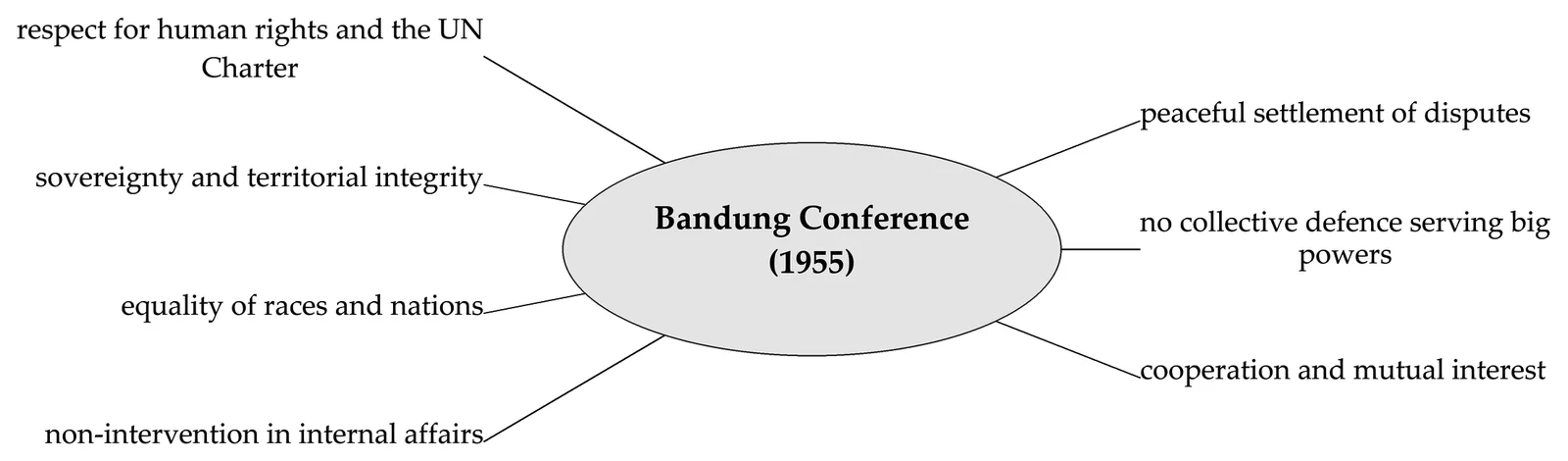
- Universal sovereignty and non-intervention: Bandung extended these principles to newly independent states and condemned colonialism in all its manifestations.
- Human rights and self-determination: the conference declared its support for the Universal Declaration of Human Rights and linked self-determination to human rights.
- Non-alignment: the principle of abstaining from collective defence arrangements that served the interests of big powers laid the foundation of the Non-Aligned Movement (1961).
- Norm subsidiarity: Acharya’s concept for the way weaker states create or reinforce norms to protect their autonomy from domination by powerful states.
- Racial equality and cooperation: the equality of races and nations and economic and cultural cooperation among Asian and African states.
Bandung drew on India and China’s Panchsheel (1954), and its legacy can be seen in the ‘ASEAN way’ of non-interference and consensus. Other Southern contributions include Latin American doctrines of non-intervention, the idea of human development developed by Mahbub ul Haq and Amartya Sen, and Francis Deng’s idea of sovereignty as responsibility, which shaped the Responsibility to Protect.
1.5 Worldmaking after Empire
Adom Getachew, in Worldmaking after Empire: The Rise and Fall of Self-Determination (2019), argues that anti-colonial leaders such as Kwame Nkrumah, Julius Nyerere, Nnamdi Azikiwe, W.E.B. Du Bois, Eric Williams and Michael Manley were not only nation-builders but worldmakers. They saw that colonialism was an international structure of racial hierarchy and that independence alone would not end domination. They therefore tried to remake the international order.
- Self-determination as non-domination: they turned self-determination from a limited Wilsonian principle, which had excluded colonised peoples under the League of Nations, into a universal right, recognised in UN General Assembly Resolution 1514 (1960).
- Regional federations: projects such as the West Indies Federation and plans for African unity sought to overcome the weakness of small post-colonial states.
- New International Economic Order: the NIEO declaration of 1974 demanded fairer terms of trade, control over natural resources and reform of global economic institutions.
- Fall: debt crises and the neo-liberal turn of the 1980s defeated these projects, narrowing self-determination to formal sovereignty.
1.6 Important Questions
- Question 1 What is global politics? Why is it necessary to locate global politics beyond Eurocentric accounts?
- Question 2 Discuss John Hobson’s argument about the Eastern origins of Western civilisation.
- Question 3 Who are the norm makers in global politics? Discuss with reference to the Bandung Conference.
- Question 4 Discuss Adom Getachew’s idea of anti-colonial worldmaking. How did it transform self-determination?
DU asks the same idea in different words. So learn one broad answer for each question below; the same answer works for every question joined by OR.
Important Question 1
What is global politics? Why is it necessary to locate global politics beyond Eurocentric accounts?
OR
Distinguish between international politics and global politics.
OR
Critically examine Eurocentrism in the study of global politics.
Model Answer
“Theory is always for someone and for some purpose.”
— Robert W. Cox, ‘Social Forces, States and World Orders’ (1981)
Introduction. Global politics studies the processes and actors that shape political life across the world. Its conventional story begins in Europe and treats the rise of the West as the beginning of modern world history. In recent decades, scholars from both the Global South and the West have argued that this story is partial and distorted. Locating global politics beyond Eurocentrism means recognising the contributions, histories and agency of non-Western peoples.
1. International Politics
International politics traditionally refers to relations among sovereign states. Realist scholars such as Hans Morgenthau focused on power, national interest, war and diplomacy among great powers. The state was treated as the main actor, and domestic politics and non-state actors received little attention. The starting point of the modern system was usually placed at the Peace of Westphalia (1648). Historians such as Andreas Osiander have argued that this Westphalian story is itself a myth, since sovereignty developed gradually and unevenly long after 1648.
2. Global Politics
Global politics, as Andrew Heywood explains, includes a much wider range of actors, such as international organisations, multinational corporations, NGOs, social movements and terrorist networks, and recognises that political processes now operate at local, national, regional and global levels at once. Issues such as climate change, migration, pandemics and financial crises cross borders and require collective action.
3. The Impact of Globalisation
Globalisation has intensified flows of goods, money, people, information and ideas, creating what Anthony Giddens called the intensification of worldwide social relations which link distant localities. As a result, the boundary between domestic and international politics has blurred, and global politics has become the study of this interconnected world.
4. Meaning of Eurocentrism
Eurocentrism is the view that Europe is the centre and model of world history. It explains the rise of the West through supposedly unique European qualities, such as rationality, individualism, science and democracy, and presents non-Western societies as backward and passive. It treats the European state system, capitalism and international law as universal standards that the rest of the world had to adopt.
5. Eurocentrism in IR
The discipline of International Relations developed mainly in Britain and the United States after 1919. Its theories, realism and liberalism, were drawn from European history and the experience of great powers. Acharya and Buzan asked why there is no non-Western IR theory, pointing to the dominance of Western scholars, journals and concepts. Colonialism, race and the struggles of colonised peoples were largely ignored. Even the origins of the discipline were tied to empire: early IR scholars wrote about race relations and colonial administration, a history that later textbooks forgot.

6. Challenging the Myth of the Pristine West
John Hobson argues that the West did not rise on its own. Through oriental globalisation, Eastern technologies, ideas and institutions, such as Chinese printing, gunpowder and the compass, Indian cotton textiles and Arab mathematics and banking, diffused to Europe. Later, Europe appropriated the resources of the East through imperialism. Frank, Pomeranz and Abu-Lughod similarly show that Asia was central to the world economy until about 1800.
7. Recognising Southern Agency
Acharya argues that states of the Global South were not passive recipients but makers of global norms. The Bandung Conference (1955) shaped norms of non-intervention, self-determination, human rights and non-alignment. Adom Getachew shows that anti-colonial nationalists tried to remake the world order through self-determination, regional federations and the New International Economic Order.
8. Global IR
In 2014 Acharya called for a Global IR, based on pluralistic universalism, world history rather than only Western history, the incorporation of existing theories and new ones from different regions, attention to regions and regionalism, and recognition of the agency of non-Western actors. Arlene Tickner and Karen Smith’s International Relations from the Global South (2020) reflects this agenda.
9. Why it Matters
Locating global politics beyond Eurocentrism corrects historical errors, explains the rise of China, India and other emerging powers as a return rather than a novelty, and gives voice to the majority of the world’s population. It also exposes how Eurocentric ideas justified colonialism and continue to shape global inequality in institutions such as the UN Security Council and the IMF. For students in India, it also means recognising traditions such as Kautilya’s Arthashastra, Asoka’s dhamma diplomacy and Nehru’s non-alignment as resources for thinking about world politics.
10. Limits of the Critique
Some scholars warn against replacing Eurocentrism with an equally simplistic Sinocentrism or Asia-centrism, or romanticising non-Western traditions. The aim is not to deny European achievements but to understand world history as interconnected, with many centres and mutual borrowing.
Conclusion. Thus, global politics extends beyond relations among states to an interconnected world of many actors and levels. Locating it beyond Eurocentrism reveals the Eastern contributions to the rise of the West and the agency of the Global South, producing a more accurate and inclusive understanding of world politics.
Important Question 2
Discuss John Hobson’s argument about the Eastern origins of Western civilisation.
OR
What is oriental globalisation? How did it contribute to the rise of the West?
OR
‘The West did not rise by itself.’ Discuss.
Model Answer
“These three have changed the whole face and state of things throughout the world.”
— Francis Bacon on printing, gunpowder and the compass, Novum Organum (1620)
Introduction. The conventional story of world history holds that Western civilisation rose through its own unique genius, while the East remained stagnant. John M. Hobson’s The Eastern Origins of Western Civilisation (2004) challenges this ‘myth of the pristine West’. He argues that the East was more advanced than the West for over a thousand years and that the West rose by assimilating Eastern innovations and appropriating Eastern resources.
1. The Eurocentric Myth
Hobson identifies the Eurocentric view in thinkers from Marx and Weber to modern historians. It claims that Europe’s rise was due to internal factors such as rationality, Protestant ethics, property rights and democracy, and that the East was characterised by Oriental despotism and stagnation. In this story, the West was pristine, owing nothing to others, and the East was passive. Hobson calls this a ‘logic of immanence’, in which the West is assumed to carry the seeds of its own success from ancient Greece onwards, while the East is defined by what it lacks.
2. Hobson’s Central Argument
Hobson argues that the East actively pioneered its own economic development after about 500 and played a crucial role in enabling the rise of the West. This happened through two main processes: the diffusion and assimilation of Eastern resource portfolios, and European appropriation of Eastern resources through imperialism.
3. Oriental Globalisation
From about 500, a global economy linked the Middle East, Africa, India, China and Southeast Asia through overland and maritime routes. Hobson calls this oriental globalisation. It was pioneered by Persians, Arabs, Africans, Jews, Indians, Javanese and Chinese, not Europeans, who joined it later as peripheral participants. The Indian Ocean was the hub of this economy, connecting East Africa, Arabia, India, Southeast Asia and China through monsoon trade long before Vasco da Gama reached Calicut in 1498 with the help of a local pilot.
4. The Islamic Middle East
After about 650 the Islamic world led the global economy. Muslim merchants traded from Spain to China, developed commercial institutions such as partnerships, cheques and credit, and preserved and expanded Greek, Indian and Persian knowledge in mathematics, astronomy, medicine and philosophy. Europe later absorbed this knowledge through Spain and Sicily.
5. China’s Achievements
From about 1000, Song China experienced what Hobson calls the first industrial miracle, producing iron and steel on a scale Europe reached only centuries later. China pioneered printing, paper money, gunpowder, the compass, the sternpost rudder and advanced agriculture. Zheng He’s voyages (1405–33) used ships far larger than those of Columbus.
6. India’s Contribution
India was a centre of manufacturing and trade, and its cotton textiles dominated world markets until the eighteenth century. Indian numerals, transmitted through the Arabs, transformed European mathematics and accounting. The British cotton industry, central to the Industrial Revolution, first imitated Indian textiles and then destroyed their competition through colonial policies.
7. Diffusion and Assimilation
Hobson argues that Europe’s key innovations, in navigation, warfare, printing, agriculture and finance, were largely borrowed from the East. The Renaissance, the scientific revolution and the voyages of discovery depended on Eastern knowledge and technologies that diffused through oriental globalisation. Even the Atlantic voyages relied on the lateen sail, the astrolabe and maps that drew on Arab and Asian knowledge.
8. Appropriation through Imperialism
From 1492 Europeans used imperialism to appropriate land, labour and resources: silver from the Americas bought Asian goods, slave labour produced sugar and cotton, and colonial rule extracted wealth from India and elsewhere. These resources, together with borrowed technologies, financed Europe’s rise and the Industrial Revolution. Pomeranz similarly argued that the ‘ghost acres’ of the Americas, supplying food, cotton and timber, relieved Europe of ecological limits that constrained advanced regions of Asia.
9. Identity and Racism
Hobson argues that European identity was constructed against an inferior Other: first as Christendom against Islam, and later through scientific racism that divided the world into civilised, barbaric and savage peoples. This identity justified imperial appropriation and produced the Eurocentric narrative that erased Eastern contributions.
10. Evaluation
Hobson’s argument, supported by Frank, Pomeranz and Pieterse, has helped decolonise world history and explains the rise of Asia today as a return to its historical position. Critics argue that he sometimes overstates Eastern achievements and underplays genuine European innovations, such as institutions of scientific inquiry. Yet his central claim, that civilisations are interconnected and that the West owes much to the East, is widely accepted.
Conclusion. Thus, Hobson shows that the West did not rise in isolation. Through oriental globalisation and imperial appropriation, the East enabled the rise of the West, and recognising this is essential to locating global politics in a truly global history.
Important Question 3
Who are the norm makers in global politics? Discuss with reference to the Bandung Conference.
OR
Examine Amitav Acharya’s argument on the Southern sources of global norms.
OR
Discuss the significance of the Bandung Conference (1955) for global politics.
Model Answer
“Colonialism in all its manifestations is an evil which should speedily be brought to an end.”
— Final Communiqué of the Asian-African Conference, Bandung (1955)
Introduction. Global norms are shared standards of appropriate behaviour, such as respect for sovereignty, human rights or the prohibition of aggression. Most accounts treat them as Western creations spread to the rest of the world. Amitav Acharya argues that the Global South has also been a source of norms, and that the Asian-African Conference held at Bandung in 1955 played an important role in shaping the post-war international order.
1. Meaning of Norms
Constructivist scholars define norms as collective expectations about proper behaviour for actors with a given identity. Martha Finnemore and Kathryn Sikkink described a norm life cycle of emergence, cascade and internalisation, led by norm entrepreneurs. Most studies focused on Western entrepreneurs and treated non-Western states as norm takers. Norms matter because they define what states consider legitimate, shaping behaviour even without enforcement.
2. Acharya’s Challenge
Acharya argues that this view ignores how non-Western actors create, localise and reshape norms. In earlier work he developed the idea of norm localisation, in which local actors adapt global norms to fit their own beliefs, and norm subsidiarity, in which weaker states create norms to protect their autonomy from dominant powers. Bandung is a key example of Southern norm-making.
3. The Bandung Conference
The conference met in Bandung, Indonesia, from 18 to 24 April 1955. It was convened by Burma, Ceylon, India, Indonesia and Pakistan and attended by 29 Asian and African countries representing over half of humanity. Leaders included Nehru, Sukarno, Zhou Enlai, Nasser and U Nu. It was the first major gathering of newly independent states without the participation of colonial powers.
4. The Ten Principles
The Final Communiqué adopted ten principles, including respect for fundamental human rights and the UN Charter, respect for sovereignty and territorial integrity, recognition of the equality of all races and nations, non-intervention in internal affairs, the right of self-defence in conformity with the Charter, abstention from collective defence arrangements serving the particular interests of big powers, refraining from aggression, peaceful settlement of disputes, promotion of mutual cooperation, and respect for justice and international obligations.
5. Universalising Sovereignty
Acharya argues that Bandung helped universalise sovereignty and non-intervention, which had been European norms applied only to European states. By condemning colonialism in all its manifestations, the conference demanded that these norms protect the newly independent states, strengthening the delegitimisation of colonialism.
6. Human Rights and Self-determination
Contrary to the view that the Third World rejected human rights, Bandung declared its full support for the Universal Declaration of Human Rights and treated self-determination as a prerequisite of the full enjoyment of all fundamental human rights. This contributed to the later recognition of self-determination as a human right in UN resolutions and covenants.
7. Non-alignment
The principle of abstaining from collective defence arrangements that served the interests of the big powers was a response to Cold War alliances such as SEATO. It laid the foundation for the Non-Aligned Movement, founded in Belgrade in 1961, and expressed the desire of new states to preserve their autonomy, an example of norm subsidiarity.
8. Regional Legacies
Bandung’s norms of non-intervention, consensus and peaceful coexistence influenced regional organisations, especially ASEAN, whose Treaty of Amity and Cooperation (1976) and ‘ASEAN way’ echo the Bandung principles. They also drew on the Panchsheel agreed by India and China in 1954.
9. Other Southern Norm Makers
Southern contributions extend beyond Bandung: Latin American states developed doctrines of non-intervention and diplomatic asylum; Mahbub ul Haq and Amartya Sen developed human development; and Francis Deng’s idea of sovereignty as responsibility shaped the Responsibility to Protect adopted in 2005. These show that global norms have plural origins.
10. Limitations
Critics note that Bandung’s solidarity was limited: participants were divided between aligned and non-aligned states, India and China went to war in 1962, and many states later violated the human rights principles they had endorsed. Yet Acharya’s point is that the Global South contributed to the content and spread of norms, not that it always lived up to them.
Conclusion. Thus, Acharya shows that the Global South has been a norm maker as well as a norm taker. The Bandung Conference universalised sovereignty, linked self-determination with human rights and laid the basis of non-alignment, making it a key moment in locating global politics beyond the West.
Important Question 4
Discuss Adom Getachew’s idea of anti-colonial worldmaking. How did it transform self-determination?
OR
‘Decolonisation was a project of remaking the world, not just building nations.’ Discuss.
OR
Examine the rise and fall of self-determination in the post-colonial world.
Model Answer
“All peoples have the right to self-determination; by virtue of that right they freely determine their political status and freely pursue their economic, social and cultural development.”
— UN General Assembly Resolution 1514 (1960)
Introduction. Decolonisation is usually understood as the process by which colonies became independent nation-states and joined an existing international order. Adom Getachew’s Worldmaking after Empire (2019) offers a different view. She argues that anti-colonial nationalists in Africa and the Caribbean saw colonialism as an international system of domination and sought to remake the world order itself, a project she calls worldmaking.
1. The Conventional View
In the conventional account, decolonisation completed the expansion of international society from Europe to the whole world. New states adopted the European model of sovereignty and joined the United Nations, and nationalism meant building a nation within existing borders. Scholars of the English School, such as Hedley Bull and Adam Watson, described this as the expansion of international society.
2. Colonialism as International Hierarchy
Getachew argues that anti-colonial thinkers understood empire as a structure of racial hierarchy embedded in international institutions and the global economy. The League of Nations, for example, placed colonised peoples under mandates and treated them as not yet able to stand by themselves. Independence alone would therefore not end domination. Ethiopia’s experience was telling: although a League member, it was invaded by Italy in 1935 while the League imposed only weak sanctions.
3. The Worldmakers
Getachew focuses on figures such as Nnamdi Azikiwe, W.E.B. Du Bois, George Padmore, Kwame Nkrumah, Julius Nyerere, Eric Williams and Michael Manley. They were political theorists as well as leaders, who imagined new international institutions to secure the freedom of post-colonial states.
4. Reinventing Self-determination
Self-determination had earlier been a principle associated with Woodrow Wilson and Lenin, but in the Wilsonian version it applied mainly to European peoples and coexisted with racial hierarchy. Anti-colonial nationalists turned it into a universal right of all peoples to non-domination. At the UN, Resolution 1514 (1960) declared colonialism a denial of fundamental human rights and self-determination a right of all peoples.
5. Regional Federations
Recognising that small post-colonial states would remain weak and dependent, worldmakers proposed regional federations. Nkrumah promoted African unity and the Union of African States, while Eric Williams and others supported the West Indies Federation (1958–62). These projects aimed to create larger political and economic units capable of resisting domination.
6. The New International Economic Order
Political independence left economic dependence intact. In 1974 the UN General Assembly adopted the Declaration on the Establishment of a New International Economic Order, demanding fair prices for primary commodities, sovereignty over natural resources, regulation of multinational corporations, technology transfer and a greater voice in global economic institutions. Michael Manley of Jamaica was a leading advocate.

7. The Fall of Self-determination
Getachew argues that these projects failed. Regional federations collapsed due to national rivalries, and the NIEO was defeated by the opposition of Western states, the debt crisis of the 1980s and the rise of neo-liberalism, which imposed structural adjustment. Self-determination was reduced to formal sovereignty within an unequal world economy. Its legacy survived, however, in the language of permanent sovereignty over natural resources and in later demands for debt relief.
8. Relationship with Bandung and Non-alignment
The worldmaking projects shared the spirit of Bandung and the Non-Aligned Movement: the demand for racial equality, sovereignty and a fair global order. Together they show that the Global South actively shaped twentieth-century international politics.
9. Significance for Global Politics
Getachew’s work recovers the global ambitions of anti-colonialism and shows that the post-war international order was contested and shaped by the colonised. It also helps explain contemporary demands from the Global South for reform of the UN Security Council, the IMF and the World Bank, climate justice and a fairer trade system.
10. Relevance Today
Getachew’s account helps explain why contemporary groupings such as the G77, BRICS and the voice of the Global South at climate negotiations raise similar demands: fairer representation in global institutions, development finance, debt relief and control over resources. India’s emphasis on the Global South during its G20 presidency in 2023, when the African Union became a permanent member, reflects the continuing appeal of a more equal world order.
11. Evaluation
Critics note that some worldmakers became authoritarian rulers at home and that national interests often undermined regional unity. Yet Getachew’s argument corrects the view that the Global South merely joined an existing order, showing that it tried to build a more just one.
Conclusion. Thus, Getachew shows that decolonisation was a project of worldmaking that transformed self-determination into a universal right and sought regional federations and a New International Economic Order. Its partial failure explains the persistent inequalities of the global order, while its legacy informs the Global South’s continuing demands for justice.
Short Notes
(a) Oriental globalisation
John Hobson’s term for the global economy that emerged after about 500, pioneered by Middle Eastern, African, Indian and Chinese traders and states. Through its networks of trade, Eastern technologies, ideas and institutions diffused to Europe. Pieterse similarly argues that globalisation was historically centred in the East and that the rise of Asia today marks a re-orientation of the world economy.
(b) Panchsheel
The Five Principles of Peaceful Coexistence agreed by India and China in 1954: mutual respect for each other’s territorial integrity and sovereignty, mutual non-aggression, mutual non-interference in internal affairs, equality and mutual benefit, and peaceful coexistence. They influenced the Bandung principles and the Non-Aligned Movement.
(c) Global IR
An approach proposed by Amitav Acharya in 2014 that seeks to make International Relations truly global. It calls for pluralistic universalism, grounding in world history, incorporation of ideas from all regions, attention to regionalism, rejection of exceptionalism and recognition of the agency of non-Western actors.
More notes: DSC-12 Global Politics
These notes are prepared by PADHO TO AISE for study help. They are not an official University of Delhi publication.