
Semester V DSC-14 Modern Indian Political Thought
Unit II · 22 min read · Updated 24 Nov 2026
As per the University of Delhi (DU) BA (Hons) Political Science syllabus
Contents
- 2.1 Nationalism in Colonial India
- 2.2 Vivekananda: Cultural and Spiritual Nationalism
- 2.3 Tagore: The Critique of Nationalism
- 2.4 Gandhi: A Moral and Inclusive Nation
- 2.5 Important Questions
- Discuss Swami Vivekananda’s idea of cultural nationalism.
- Examine Rabindranath Tagore’s critique of nationalism.
- Discuss Gandhi’s idea of the nation and nationalism.
- Compare the ideas of nation and nationalism of Vivekananda, Tagore and Gandhi.
- Short Notes
राष्ट्रवाद एक बड़ा ख़तरा है। यही वह चीज़ है जो वर्षों से भारत की परेशानियों की जड़ में रही है।
Nationalism is a great menace. It is the particular thing which for years has been at the bottom of India’s troubles.
— Rabindranath Tagore, ‘Nationalism in India’, Nationalism (1917)
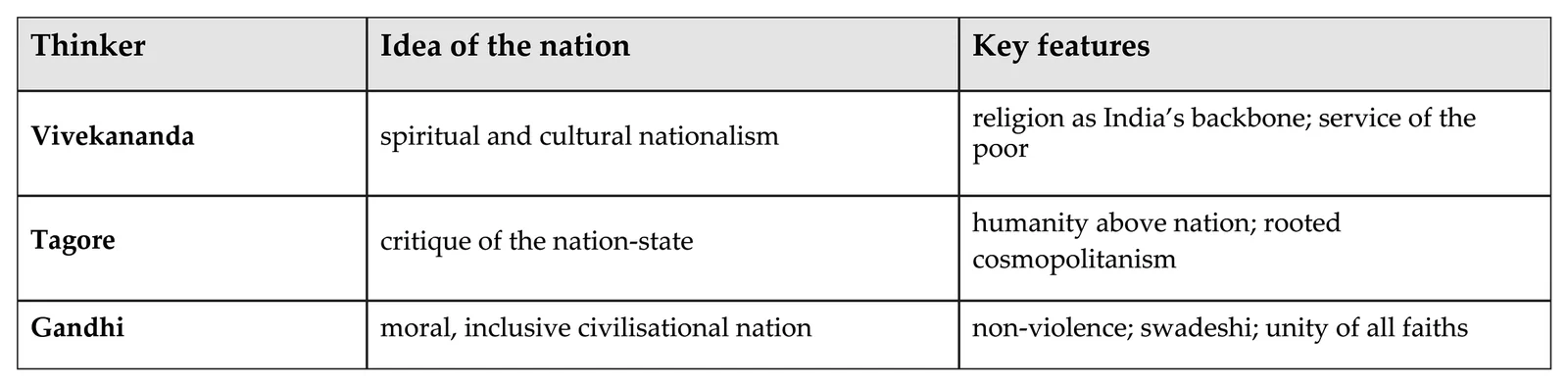
WHAT kind of nation is India? A land of many languages, religions and castes, ruled by a foreign power, had to imagine itself as a nation in order to win freedom. Three of the most influential answers came from Swami Vivekananda, who saw India as a spiritual and cultural nation whose religion was its backbone; Rabindranath Tagore, who warned that the Western idea of the nation-state was a menace and placed humanity above nationalism; and Mahatma Gandhi, who imagined India as an ancient civilisation united by moral and cultural bonds, inclusive of all faiths and committed to non-violence. This unit studies their ideas, drawing on Amiya P. Sen, Ramachandra Guha, and M. Radhakrishnan and Devasmita.
2.1 Nationalism in Colonial India
Indian nationalism grew in the late nineteenth century as Western-educated Indians, newspapers and organisations such as the Indian National Congress (1885) began to imagine India as a nation entitled to self-government. Colonial writers claimed that India was not a nation but a collection of castes, religions and languages. Indian thinkers responded with different ideas of the nation: some stressed a shared culture and spirituality, some a territorial and civilisational unity, and some a civic community of citizens. Others questioned nationalism itself.
2.2 Vivekananda: Cultural and Spiritual Nationalism
Swami Vivekananda (1863–1902), a disciple of Ramakrishna, became famous after his speech at the Parliament of the World’s Religions in Chicago in 1893 and founded the Ramakrishna Mission in 1897. Amiya P. Sen describes his nationalism as cultural nationalism. Vivekananda believed that every nation has a central theme, and that India’s is religion and spirituality, the backbone of its national life. India’s regeneration, therefore, had to come through a revival of its spiritual heritage, especially Vedanta, not through imitation of the West.
Vivekananda gave Vedanta a practical and social meaning. Since the divine is present in every being, serving the poor is serving God, an idea later expressed as daridra narayana. He condemned the neglect of the masses by the educated, criticised caste rigidity and what he called ‘don’t-touchism’, and called for education, strength and self-confidence: India needed ‘muscles of iron and nerves of steel’. In ‘The Nature of British Rule in India’ he criticised colonial exploitation and predicted the rise of the labouring classes. His message inspired later nationalists such as Aurobindo, Tilak and Subhas Chandra Bose, though critics note that his identification of India with Hindu spirituality could be read in exclusive ways.
2.3 Tagore: The Critique of Nationalism
Rabindranath Tagore (1861–1941), poet and Nobel laureate (1913), initially supported the Swadeshi movement of 1905, writing songs that became anthems, but he withdrew when it turned to coercion and violence against those who did not join the boycott. His novel Ghare Baire (The Home and the World, 1916) portrays the dangers of a nationalism that sacrifices truth and humanity. In his lectures on Nationalism (1917), he distinguished society, a spontaneous expression of human cooperation, from the nation, the political and economic union of a people organised for power and profit, a mechanical apparatus that suppresses humanity.

Tagore warned that India’s real problem was social, caste and division, not political, and that copying Western nationalism would bring militarism, greed and the worship of the nation. M. Radhakrishnan and Devasmita’s essay ‘Nationalism is a Great Menace’ shows how he saw the nation-state as a source of war and domination. Ramachandra Guha calls Tagore a rooted cosmopolitan: deeply attached to Bengal and India, yet committed to humanity and to the meeting of East and West, symbolised by Visva-Bharati (1921). He debated Gandhi in 1921, criticising the burning of foreign cloth and the narrowness of non-cooperation, while Gandhi called him the great sentinel.
2.4 Gandhi: A Moral and Inclusive Nation
In Hind Swaraj (1909), Gandhi rejected the British claim that India became a nation only under British rule. India, he argued, was one nation long before the British came, united by pilgrimages to holy places from Rameshwaram to Hardwar and by a shared civilisation. This nation was not defined by religion: India cannot cease to be one nation because people of different religions live in it. Hindus and Muslims share a common ancestry and land, and nationalism must rest on Hindu–Muslim unity and respect for all faiths.
Gandhi’s nationalism was moral and non-violent. He rejected the aggressive, militaristic nationalism of the West, linked to modern civilisation and the machine. For him, patriotism was the same as humanity, and India’s freedom should serve the welfare of the whole world. He combined swadeshi, reliance on one’s own community and products, with openness to the culture of all lands. Ashis Nandy, in The Illegitimacy of Nationalism (1994), argues that Gandhi and Tagore both resisted the Western idea of the nation-state, offering a civilisational and humane alternative.
2.5 Important Questions
- Question 1 Discuss Swami Vivekananda’s idea of cultural nationalism.
- Question 2 Examine Rabindranath Tagore’s critique of nationalism.
- Question 3 Discuss Gandhi’s idea of the nation and nationalism.
- Question 4 Compare the ideas of nation and nationalism of Vivekananda, Tagore and Gandhi.
DU asks the same idea in different words. So learn one broad answer for each question below; the same answer works for every question joined by OR.
Important Question 1
Discuss Swami Vivekananda’s idea of cultural nationalism.
OR
Examine Vivekananda’s contribution to Indian nationalism.
OR
‘Religion is the backbone of Indian national life.’ Discuss with reference to Vivekananda.
Model Answer
“Arise, awake, and stop not till the goal is reached.”
— Swami Vivekananda, quoting the Katha Upanishad
Introduction. Swami Vivekananda (1863–1902) was one of the most influential figures of modern India. Though he was a monk rather than a politician, his message of spiritual pride, social service and national regeneration inspired generations of nationalists. Amiya P. Sen describes his nationalism as cultural nationalism, rooted in the belief that India’s national identity lies in its spiritual and religious heritage.
1. Life and Context
Born Narendranath Datta in Calcutta, Vivekananda became a disciple of the mystic Ramakrishna. He travelled across India as a wandering monk and saw the poverty and degradation of the masses. His speech at the Parliament of the World’s Religions in Chicago in 1893 won international fame, and in 1897 he founded the Ramakrishna Mission for spiritual and social service.
2. Religion as the Backbone
Vivekananda believed that each nation has a central theme in its life: for some it is politics, for others commerce. India’s theme is religion and spirituality. If India abandoned its spirituality to imitate Western materialism, it would die as a nation. National regeneration must therefore come through a revival of its spiritual heritage.
3. Practical Vedanta
Vivekananda reinterpreted Vedanta as practical and socially engaged. Since Brahman is present in every being, all are divine and equal. Spiritual realisation must express itself in service to humanity, especially the poor. This gave Hinduism a social mission and linked religion with national and social reform.
4. Service of the Poor
Vivekananda insisted that the poor and the masses are the real India. He wrote that so long as the millions live in hunger and ignorance, he held every educated person a traitor who paid no heed to them. Serving the poor as God, later called daridra narayana, became a central idea of his mission.
5. Strength and Self-confidence
He believed that centuries of foreign rule had made Indians weak and fearful. India needed strength of body and mind, muscles of iron and nerves of steel, and self-confidence based on pride in its heritage. His call to arise and awake inspired a sense of national dignity.
6. Critique of Social Evils
Vivekananda criticised caste rigidity, untouchability, which he called don’t-touchism, priestcraft and the neglect of women. He argued that social reform must come from within Indian tradition and through education, rather than through imitation of the West or condemnation of Hinduism.
7. Critique of Colonialism
In writings such as ‘The Nature of British Rule in India’, Vivekananda criticised British rule for exploiting India and humiliating Indians. He predicted that power, which had passed from priests to warriors and then to merchants, would ultimately pass to the labouring classes, the Shudras.
8. Universalism
Vivekananda’s nationalism was not narrowly exclusive. He preached the harmony of religions and believed that India had a spiritual message for the whole world, just as the West had material and scientific achievements to share. He combined national pride with universal humanism.
9. Influence on Nationalism
B.G. Gokhale and others show that Vivekananda inspired the extremist nationalists, Aurobindo, Tilak and later Subhas Chandra Bose, as well as Gandhi. His emphasis on pride, strength and service gave the national movement a spiritual and moral energy.
10. Cultural Nationalism
Amiya Sen describes Vivekananda’s nationalism as cultural because it defined the nation through a shared culture and spiritual tradition rather than through the state or politics. It aimed at regenerating society and character rather than capturing political power.
11. Criticisms
Critics argue that Vivekananda’s identification of Indian national life with Hindu spirituality could exclude Muslims, Christians and others, and that later Hindu nationalists appropriated his ideas. Others defend him by pointing to his universalism, respect for all religions and critique of caste. His views on women and caste also mixed reform with tradition.
12. Evaluation
Vivekananda’s cultural nationalism restored self-confidence to colonised Indians and linked spirituality with social service. Its strength was its moral energy and concern for the poor; its weakness was the risk of equating the nation with one religious tradition.
Conclusion. Thus, Vivekananda’s cultural nationalism saw religion and spirituality as the backbone of Indian life and called for national regeneration through practical Vedanta, service of the poor and self-confidence. It inspired the national movement, though its association of nationhood with Hindu spirituality remains debated.
Important Question 2
Examine Rabindranath Tagore’s critique of nationalism.
OR
‘Nationalism is a great menace.’ Discuss with reference to Tagore.
OR
Why does Ramachandra Guha call Tagore a ‘rooted cosmopolitan’?
Model Answer
“Patriotism cannot be our final spiritual shelter; my refuge is humanity. I will not buy glass for the price of diamonds, and I will never allow patriotism to triumph over humanity as long as I live.”
— Rabindranath Tagore, letter to A.M. Bose (1908)
Introduction. At the height of the national movement, Rabindranath Tagore, India’s greatest poet and the first Asian Nobel laureate, became one of the sharpest critics of nationalism. In his lectures Nationalism (1917) and in novels such as Ghare Baire, he warned that the Western idea of the nation-state was a menace to humanity, and he called for a society based on cooperation, creativity and openness to the world.
1. Tagore and Swadeshi
During the Swadeshi movement against the partition of Bengal in 1905, Tagore wrote patriotic songs and supported self-reliance. But he soon withdrew, disturbed by the coercion of poor traders and peasants who could not afford Indian goods, and by communal tensions and violence. This experience shaped his critique of nationalism.
2. Nation and Society
Tagore distinguished society from the nation. Society is the spontaneous expression of people’s social and spiritual life, based on cooperation. The nation, in the Western sense, is the political and economic union of a people organised for a mechanical purpose: power and profit. It is an organisation, a machine that turns human beings into instruments.
3. The Nation as a Machine
Tagore argued that the nation-state, with its bureaucracy, army and commerce, crushes the moral and spiritual life of people. It demands that individuals sacrifice their conscience to its interests and treats other peoples as enemies or markets. He saw the First World War as the result of competing nationalisms.
4. Nationalism in the West
In his lectures, Tagore described Western nationalism as organised selfishness that had brought great power but also imperialism, greed and war. He warned Japan, which was imitating the West, against adopting this nationalism, and he warned India against building its freedom on the same foundations.
5. India’s Real Problem
Tagore argued that India’s real problem was not political but social. Caste divisions, the oppression of untouchables and the exclusion of women and minorities were deeper problems than foreign rule. Until India solved them, political freedom would be hollow. Nationalism that ignored these divisions would be a mere imitation of the West.
6. Humanity above Nation
For Tagore, patriotism could not be the final shelter; humanity was his refuge. He would not allow patriotism to triumph over humanity. This universalism led him to oppose hatred of foreigners and to seek a meeting of East and West.
7. Ghare Baire
In Ghare Baire (The Home and the World, 1916), the charismatic nationalist Sandip uses slogans and violence for selfish ends, while the landlord Nikhil represents humane, truthful patriotism. The novel dramatises Tagore’s fear that nationalism can become a passion that destroys truth and morality.
8. Rooted Cosmopolitanism
Ramachandra Guha calls Tagore a rooted cosmopolitan. He was deeply rooted in Bengali language and Indian culture, and he loved his country, yet he was open to the world and committed to universal humanity. His university, Visva-Bharati, founded in 1921, aimed to be a place where the world makes its home in a single nest.
9. The Debate with Gandhi
In 1921 Tagore criticised Gandhi’s non-cooperation movement, the burning of foreign cloth and the emphasis on the charkha, fearing that they encouraged blind obedience and narrow nationalism. Gandhi replied respectfully, calling Tagore the great sentinel, and defended non-cooperation as a non-violent assertion of self-respect. Their debate shows two humane but different approaches to freedom.
10. Renunciation of Knighthood
Tagore’s critique of nationalism did not mean acceptance of colonial rule. In 1919, after the Jallianwala Bagh massacre, he renounced his knighthood in protest, showing that he opposed injustice whether colonial or national.
11. Criticisms
Critics argue that Tagore’s idealism was impractical in the struggle against colonialism, which required political organisation and mass mobilisation. Others note that his distinction between society and nation romanticised traditional Indian society. Sabyasachi Bhattacharya speaks of the antinomies, the tensions, in his thought on nationalism.
12. Visva-Bharati
Tagore’s positive alternative to nationalism was cultural meeting. He founded a school at Santiniketan in 1901 and Visva-Bharati University in 1921, whose motto speaks of a place where the world makes its home in a single nest. It brought together scholars from Asia and Europe, expressing his belief that nations should learn from one another rather than compete for power.
13. Evaluation
Tagore’s critique remains prophetic in a world troubled by aggressive nationalism, xenophobia and war. His insistence on humanity, social reform and openness offers a humane alternative, though combining it with effective political action remains a challenge.
Conclusion. Thus, Tagore criticised nationalism as a menace that turns societies into machines for power and profit, sacrificing humanity and truth. As a rooted cosmopolitan, he placed humanity above the nation, emphasised social reform and sought a meeting of East and West.
Important Question 3
Discuss Gandhi’s idea of the nation and nationalism.
OR
‘For me patriotism is the same as humanity.’ Discuss with reference to Gandhi.
OR
How did Gandhi respond to the claim that India was not a nation?
Model Answer
“For me patriotism is the same as humanity. I am patriotic because I am human and humane.”
— M.K. Gandhi, Young India (16 March 1921)
Introduction. Mahatma Gandhi led the largest mass movement of the national struggle, yet his idea of the nation differed sharply from the Western nation-state. In Hind Swaraj (1909) and later writings, he presented India as an ancient civilisation united by moral and cultural bonds, inclusive of all religions, and committed to non-violence and the welfare of all humanity.
1. The Colonial Claim
British writers claimed that India was not a nation but a collection of peoples, and that only British rule had given it unity through railways, law and administration. Some Indians accepted this view. Gandhi rejected it firmly in Hind Swaraj.
2. India as an Ancient Nation
Gandhi argued that India was one nation before the British came. Its unity was shown by pilgrimages to holy places at the four corners of the country, such as Rameshwaram, Jagannath and Hardwar, established by people who saw India as one land. Its unity was cultural and civilisational, not political.
3. Not Based on Religion
Gandhi insisted that India cannot cease to be one nation because people of different religions live in it. The introduction of foreigners does not destroy a nation; they merge into it. Hindus, Muslims, Parsis and Christians who have made India their country are all fellow countrymen.
4. Hindu–Muslim Unity
Hindu–Muslim unity was central to Gandhi’s nationalism. He supported the Khilafat movement in 1920 to unite Muslims with the national movement and worked throughout his life for communal harmony, finally giving his life for it in 1948. He saw the two communities as sharing common ancestors and a common land.
5. Critique of Western Nationalism
Gandhi rejected the aggressive, militaristic and imperialist nationalism of the West, which he associated with modern civilisation, industrialism and greed. Driving out the English but keeping their system would mean English rule without the Englishman.
6. Nationalism as Humanism
For Gandhi, patriotism was the same as humanity. India should rise so that the whole world might benefit, not to dominate others. His nationalism was non-violent and universalist, seeking freedom for India as part of the moral progress of humanity.
7. Swadeshi and Openness
Gandhi’s swadeshi meant serving one’s immediate neighbours and using local products, but it was not hostility to others. He wanted the cultures of all lands to blow about his house as freely as possible, while refusing to be blown off his feet by any.
8. A Mass Nationalism
Gandhi turned nationalism into a mass movement of peasants, workers, women and the poor, using simple symbols such as salt and khadi. He linked national freedom with the removal of untouchability, communal harmony and village regeneration, making nationalism a moral reform movement.
9. Means and Ends
Gandhi insisted that a free nation could only be built through truthful and non-violent means. Violence, even for national freedom, would corrupt the nation that it produced. Satyagraha was therefore both a political method and a way of building a moral community.
10. Nandy’s Interpretation
Ashis Nandy argues that Gandhi, like Tagore, resisted the Western nation-state model and sought a civilisational idea of India based on plurality and tolerance. For Nandy, Gandhi’s anti-modern critique protected India from the worst forms of nationalism.
11. Criticisms
Critics argue that Gandhi’s use of Hindu religious idioms, such as Ram Rajya, alienated some Muslims, and that his idea of an ancient nation romanticised the past. Ambedkar criticised him for neglecting caste oppression within the nation. Yet his inclusive vision shaped the secular and plural idea of India.
12. Gandhi’s Last Struggle
Gandhi’s idea of a nation of all faiths was tested by Partition. In 1946–48 he walked through riot-hit Noakhali and fasted in Calcutta in September 1947 and in Delhi in January 1948 to stop communal violence. He was assassinated on 30 January 1948 by a Hindu extremist who opposed his defence of Muslims, a death that showed both the power and the cost of his inclusive nationalism.
13. Evaluation
Gandhi’s idea of the nation combined deep roots in Indian civilisation with inclusiveness, non-violence and universal humanism. It offered an alternative to both colonial denial of Indian nationhood and exclusive religious nationalism.
Conclusion. Thus, Gandhi saw India as an ancient civilisational nation not defined by religion, built on Hindu–Muslim unity, swadeshi and non-violence, and committed to humanity. His nationalism was moral and inclusive, an alternative to aggressive Western nationalism.
Important Question 4
Compare the ideas of nation and nationalism of Vivekananda, Tagore and Gandhi.
OR
Discuss the diversity of ideas of nationalism in modern Indian political thought.
OR
How did Indian thinkers respond to the Western idea of the nation-state?
Model Answer
“India cannot cease to be one nation because people belonging to different religions live in it.”
— M.K. Gandhi, Hind Swaraj (1909)
Introduction. Vivekananda, Tagore and Gandhi were three of the most influential thinkers on the Indian nation. All three rejected the colonial claim that India lacked unity, and all were critical of Western materialism. But they differed on what made India a nation and on the value of nationalism itself. Comparing them shows the diversity of modern Indian thought on the nation.
1. Common Context
All three wrote under colonial rule, in response to British claims of Indian backwardness and disunity. They sought to restore Indian self-respect and to define India’s place in the world without imitating the West.
2. Vivekananda’s Spiritual Nation
Vivekananda saw religion and spirituality as the backbone of India’s national life. The nation would be regenerated through a revival of Vedanta, service of the poor and the building of strength and self-confidence. His nationalism was cultural and spiritual.
3. Tagore’s Critique
Tagore distinguished society from the nation and criticised the Western nation-state as a machine for power and profit. He placed humanity above patriotism and argued that India’s real problems were social, especially caste. He was a rooted cosmopolitan rather than a nationalist.
4. Gandhi’s Civilisational Nation
Gandhi saw India as an ancient civilisational nation united by culture and pilgrimage, not by religion. His nationalism was inclusive of all faiths, non-violent, linked to swadeshi and village regeneration, and equated with humanity.
5. Role of Religion
Vivekananda made religion the core of national identity; Gandhi used religious and moral language but insisted that the nation was not defined by any one religion; Tagore valued spirituality but distrusted the use of religion for nationalist mobilisation. Their positions show different relations between religion and nation.
6. Attitude to the West
Vivekananda believed India should give spirituality to the West and learn science and organisation from it. Tagore sought a meeting of East and West through Visva-Bharati. Gandhi was the most critical of Western modern civilisation, though he too drew on Western thinkers such as Ruskin and Tolstoy.
7. Social Reform
All three criticised caste and social evils. Vivekananda condemned don’t-touchism and neglect of the masses; Tagore saw caste as India’s central problem; Gandhi campaigned against untouchability. But they differed in method: spiritual regeneration, education and cultural renewal, or mass moral action.
8. Universalism
All three combined love of India with universalism. Vivekananda preached the harmony of religions, Tagore placed humanity above nation and Gandhi equated patriotism with humanity. None supported aggressive or imperialist nationalism.
9. Political Action
Vivekananda did not take part in politics but inspired political nationalists. Tagore withdrew from organised politics after Swadeshi and criticised mass movements. Gandhi was the most political, leading mass movements while seeking to moralise politics.
10. Legacy
Vivekananda’s cultural nationalism has been claimed by Hindu nationalists as well as by liberal and spiritual traditions. Tagore’s critique inspires cosmopolitans and critics of xenophobia. Gandhi’s inclusive nationalism shaped the secular and plural idea of India embodied in the Constitution.
11. Nandy’s Reading
Ashis Nandy argues that Tagore and Gandhi offered a civilisational, non-statist alternative to the nation-state, while later Indian nationalism increasingly adopted the Western model of a centralised, militarised state. Their ideas remain resources for questioning that model.
12. Relevance Today
All three thinkers are invoked in current debates. Supporters of cultural nationalism draw on Vivekananda’s pride in Hindu civilisation; critics of aggressive nationalism draw on Tagore’s warnings; and defenders of a plural, civic nation draw on Gandhi’s idea of India as a home for all faiths. Their debate is therefore not only historical but part of continuing arguments about what kind of nation India should be.
13. Evaluation
The comparison shows that modern Indian thought on the nation was rich and plural. It ranged from cultural nationalism to critique of nationalism and inclusive civilisational nationhood, offering different answers to the continuing question of what holds India together.
Conclusion. Thus, Vivekananda saw India as a spiritual nation, Tagore warned against nationalism and placed humanity above the nation, and Gandhi imagined an inclusive, non-violent civilisational nation. Together they reveal a rich and plural tradition of thinking about Indian nationhood.
Short Notes
(a) Daridra Narayana
The idea, associated with Vivekananda and later popularised by C.R. Das and Gandhi, that the poor are God, so serving the poor is the highest form of worship. It expressed Vivekananda’s practical Vedanta, which saw the divine in every human being, and inspired the Ramakrishna Mission’s social service.
(b) Rooted cosmopolitan
Ramachandra Guha’s description of Tagore, who was deeply rooted in Bengali language and Indian culture yet open to the world and committed to universal humanity. He rejected both narrow nationalism and rootless imitation of the West, seeking a meeting of cultures through institutions such as Visva-Bharati.
(c) Tagore–Gandhi debate
An exchange in 1921 in which Tagore, in ‘The Call of Truth’, criticised the non-cooperation movement, the burning of foreign cloth and the emphasis on the charkha as encouraging blind obedience and narrowness. Gandhi replied in ‘The Great Sentinel’, defending non-cooperation as a non-violent assertion of self-respect while honouring Tagore’s concern for freedom of mind.
More notes: DSC-14 Modern Indian Political Thought
These notes are prepared by PADHO TO AISE for study help. They are not an official University of Delhi publication.