
Semester V DSC-14 Modern Indian Political Thought
Unit I · 18 min read · Updated 24 Nov 2026
As per the University of Delhi (DU) BA (Hons) Political Science syllabus
Contents
- 1.1 Meaning and Context of Modern Indian Political Thought
- 1.2 Main Themes
- 1.3 Approaches: Mehta and Pantham, Dalton and Guha
- 1.4 The Debate on Indian Political Theory
- 1.5 Important Questions
- Discuss the nature and main themes of modern Indian political thought.
- Examine Dennis Dalton’s idea of ‘continuity of innovation’ in the Indian idea of freedom.
- Is there an Indian political theory? Discuss with reference to Parekh and Guha.
- Short Notes
जहाँ मन भय से मुक्त हो और सिर ऊँचा हो; जहाँ ज्ञान मुक्त हो।
Where the mind is without fear and the head is held high; where knowledge is free.
— Rabindranath Tagore, Gitanjali (1912)
MODERN Indian political thought refers to the political ideas developed in India from the early nineteenth century to the decades after independence. It arose from the encounter between Indian traditions and colonial rule, Western liberalism, nationalism and socialism. Thinkers such as Rammohan Roy, Tarabai Shinde, Vivekananda, Tagore, Tilak, Gandhi, Savarkar, Nehru, Ambedkar, Lohia and Deendayal Upadhyay asked how Indians should reform their society, win freedom, build a nation and organise a just state. This unit introduces the nature, sources and themes of modern Indian political thought and the approaches of V.R. Mehta and Thomas Pantham, Dennis Dalton and Ramachandra Guha, along with debates on whether India produced political theory at all.
1.1 Meaning and Context of Modern Indian Political Thought
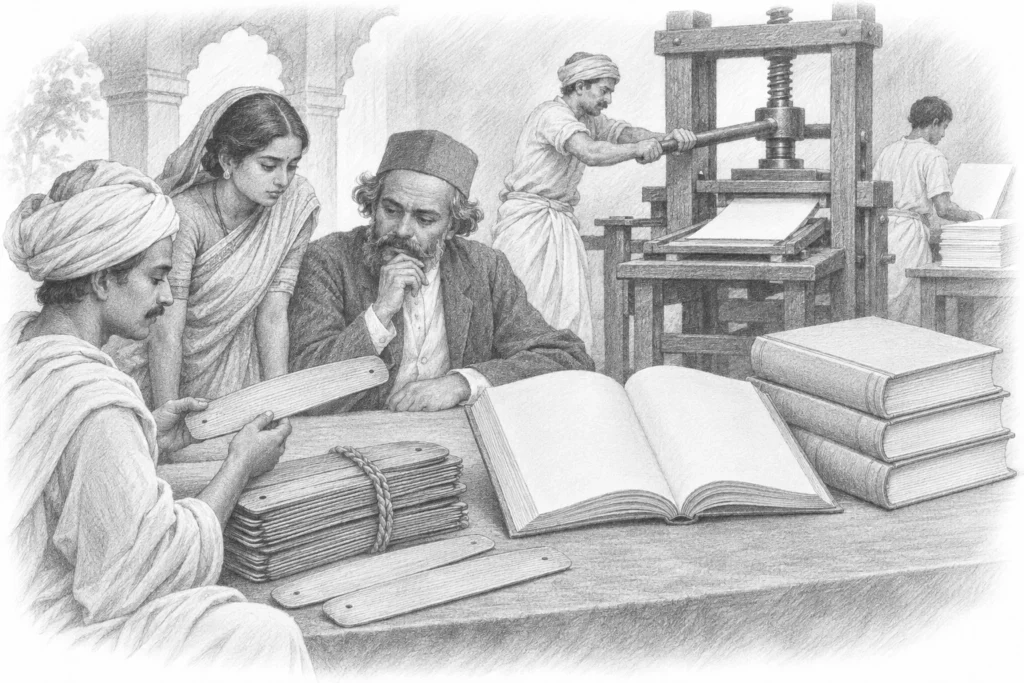
Modern Indian political thought is the body of political ideas developed by Indian thinkers in response to the conditions of colonial and post-colonial India. Unlike ancient Indian political thought, which centred on dharma, kingship and statecraft, modern thought was shaped by colonialism, the introduction of Western education, print and the public sphere, Christian missionary criticism of Indian society, and new ideas of liberty, equality, nationalism and democracy. Indian thinkers did not simply imitate Western ideas: they reinterpreted Indian traditions and adapted Western concepts to Indian conditions.
Most modern Indian thinkers were thinker-activists. They wrote not academic treatises but speeches, newspaper articles, petitions, letters, autobiographies and manifestos, because they were engaged in movements for social reform, national freedom, caste equality and women’s rights. Their ideas therefore have to be read in relation to their practice. They also wrote in many languages, Bengali, Marathi, Hindi, Tamil and English among them, and their thought was plural, ranging from liberal and socialist to conservative, Hindu nationalist and anti-caste positions.
1.2 Main Themes
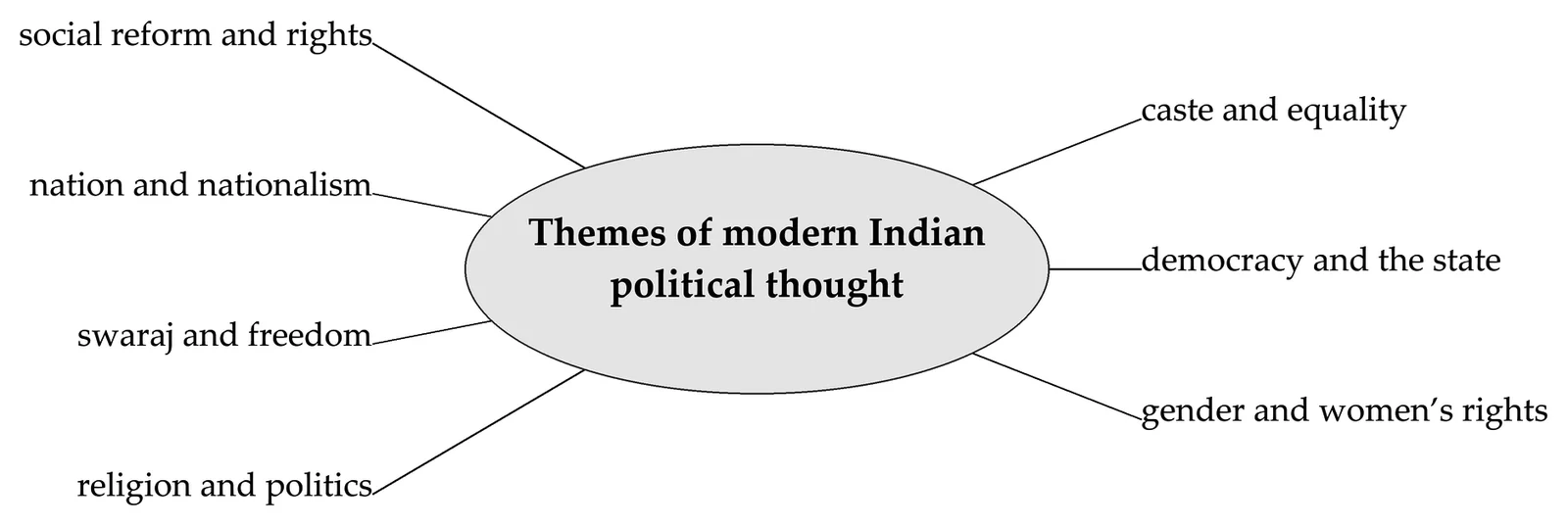
- Social reform and rights: reformers such as Rammohan Roy, Jotirao Phule and Tarabai Shinde attacked sati, caste and the oppression of women, using reason, scripture and liberal ideas of rights.
- Nation and nationalism: thinkers debated what kind of nation India was, cultural and spiritual (Vivekananda), civilisational and moral (Gandhi), or whether nationalism itself was dangerous (Tagore).
- Swaraj: from Tilak’s demand for self-government to Gandhi’s idea of self-rule over the self, swaraj was the central concept of the freedom struggle.
- Religion and politics: Gandhi spiritualised politics, Savarkar developed Hindutva as a political identity, and Nehru advocated a secular state.
- Caste and equality: Ambedkar, Phule, Periyar and Lohia made caste a central political question.
- State and democracy: after independence, Nehru, Ambedkar, Lohia and Upadhyay offered different visions of the state, democracy and development.
- Gender: thinkers from Tarabai Shinde to Pandita Ramabai exposed patriarchy within Indian society.
1.3 Approaches: Mehta and Pantham, Dalton and Guha
V.R. Mehta and Thomas Pantham, in their thematic introduction to Political Ideas in Modern India (2006), argue that modern Indian political thought is best studied thematically, by following debates on reform, nationalism, religion, caste, gender, democracy and development across many thinkers. They emphasise that Indian thinkers engaged in a dialogue with Western modernity, neither simply imitating nor rejecting it, and that they creatively reinterpreted Indian traditions to meet modern challenges. Modern Indian thought is thus marked by hybridity and creative synthesis.
Dennis Dalton, in Indian Idea of Freedom (1982), studied Vivekananda, Aurobindo, Tagore and Gandhi and found a continuity of innovation: these thinkers drew on old concepts such as swaraj and moksha, spiritual liberation, but gave them new political and social meanings. Freedom for them meant not only national independence but inner self-rule, moral regeneration and the freedom of the individual within a harmonious community. Ramachandra Guha, in the prologue to Makers of Modern India (2010), ‘Thinking Through India’, argues that India’s thinkers were thinker-activists responding to several revolutions happening at once, national, democratic, social, urban and industrial, which in the West occurred over centuries. Their debates make India a laboratory of political ideas.

1.4 The Debate on Indian Political Theory
Bhikhu Parekh, in ‘The Poverty of Indian Political Theory’, argued that modern India produced remarkably little systematic political theory, despite a rich political life and many great political figures. Indian thinkers were mostly activists responding to immediate problems; they often borrowed Western categories; India lacked independent academic institutions and a tradition of sustained philosophical debate about the state; and the struggle against colonialism absorbed intellectual energy. Gandhi, in Parekh’s view, was a rare original theorist.
Silika Mohapatra and Akash Singh, in ‘What is Indian Political Thought’, reply that the question depends on what counts as theory. If theory includes reflective thinking expressed in speeches, letters, autobiographies and movements, then modern India produced a rich political thought. They and others call for recovering Indian thought in its own terms rather than measuring it against Western academic models. The debate shows the importance of reading Indian thinkers seriously as theorists, while recognising the practical and dialogical form their thought took.
1.5 Important Questions
- Question 1 Discuss the nature and main themes of modern Indian political thought.
- Question 2 Examine Dennis Dalton’s idea of ‘continuity of innovation’ in the Indian idea of freedom.
- Question 3 Is there an Indian political theory? Discuss with reference to Parekh and Guha.
DU asks the same idea in different words. So learn one broad answer for each question below; the same answer works for every question joined by OR.
Important Question 1
Discuss the nature and main themes of modern Indian political thought.
OR
What is distinctive about modern Indian political thought?
OR
Examine the thematic approach to modern Indian political thought with reference to Mehta and Pantham.
Model Answer
“At the stroke of the midnight hour, when the world sleeps, India will awake to life and freedom.”
— Jawaharlal Nehru, ‘Tryst with Destiny’, Constituent Assembly (14 August 1947)
Introduction. Modern Indian political thought developed between the early nineteenth century and the decades after independence, in response to colonial rule and the challenge of building a free, democratic India. It includes a wide range of thinkers, from liberal reformers and nationalists to socialists, Hindu nationalists and anti-caste radicals. V.R. Mehta and Thomas Pantham suggest that it is best understood through its major themes and debates.
1. The Colonial Context
British rule transformed Indian society through Western education, the English language, print, railways and new legal institutions. It also brought economic exploitation and racial humiliation. Missionaries and colonial officials criticised Indian customs such as sati, caste and child marriage. Indian thinkers responded by defending, reforming and reinterpreting their traditions while engaging with Western ideas.
2. Dialogue with the West
Modern Indian thinkers engaged critically with Western liberalism, nationalism, socialism and science. Rammohan Roy drew on Bentham and liberal ideas of rights; Nehru on socialism and science; Ambedkar on John Dewey’s pragmatism; Gandhi on Ruskin, Tolstoy and Thoreau. But none simply copied; each adapted Western ideas to Indian conditions.
3. Reinterpreting Tradition
Equally, Indian thinkers reinterpreted their own traditions. Vivekananda presented Vedanta as practical and socially engaged, Tilak read the Gita as a call to action, Gandhi reinterpreted ahimsa, swaraj and satyagraha, and Ambedkar turned to Buddhism. Dennis Dalton calls this a continuity of innovation: old concepts were given new meanings.
4. Thinker-activists
Most modern Indian thinkers were also political actors. Their ideas appeared in speeches, newspapers, petitions, letters and movements rather than formal treatises. Ramachandra Guha calls them thinker-activists whose thought must be read alongside their practice.
5. Social Reform and Rights
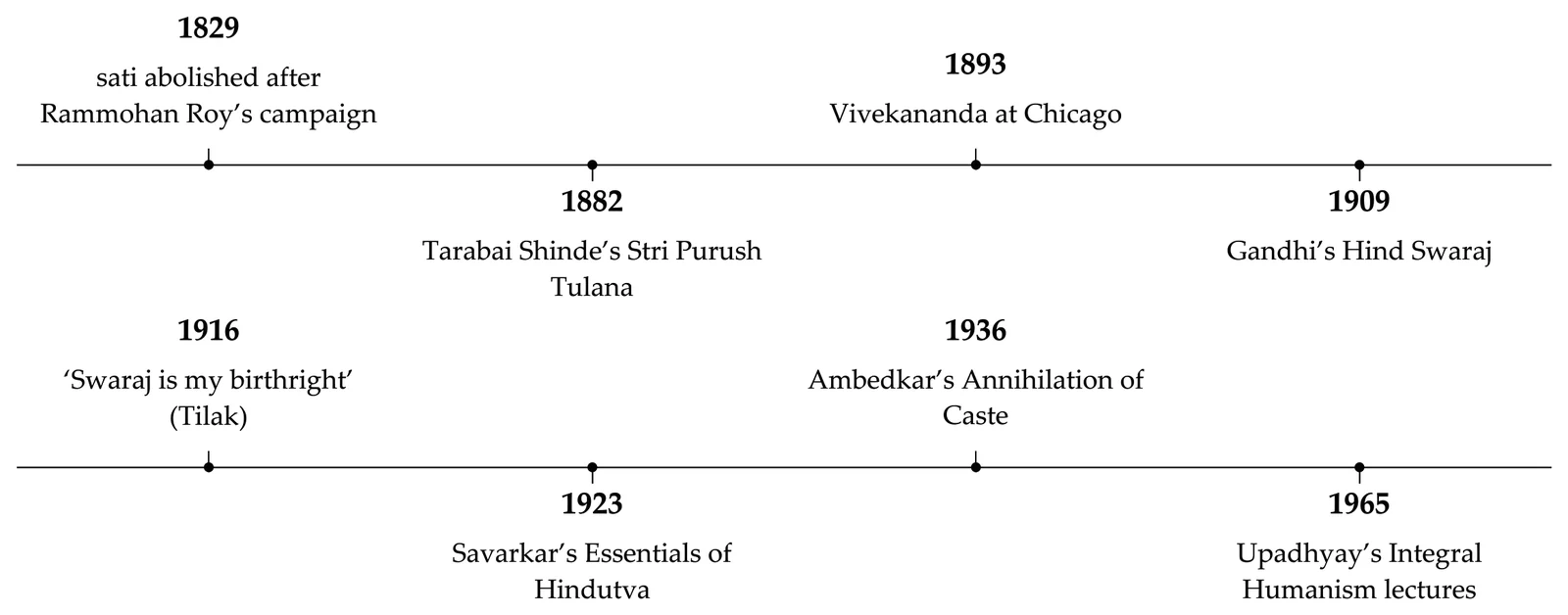
The first major theme was social reform. Rammohan Roy campaigned against sati and for women’s property rights and freedom of the press; Tarabai Shinde exposed patriarchal double standards; and Phule attacked caste and Brahmin domination. Reformers used reason, scripture and the language of rights to argue for change.
6. Nation and Nationalism
Thinkers debated the nature of the Indian nation. Vivekananda saw it as a spiritual and cultural unity, Gandhi as a moral, inclusive civilisation, Savarkar as a Hindu nation, and Tagore warned against nationalism itself as a menace. These debates continue in contemporary politics.
7. Swaraj
Swaraj was the central concept of the freedom struggle. Tilak declared it a birthright, meaning self-government. Gandhi deepened it into self-rule over the self, village self-reliance and moral regeneration. Swaraj connected political freedom with individual and social transformation.
8. Religion and Politics
Religion played a major role. Gandhi sought to spiritualise politics on the basis of truth and non-violence, Savarkar developed Hindutva as a cultural and political identity, and Nehru and Ambedkar favoured a secular state. The relationship between religion, nation and state remains one of the most contested questions in Indian politics.
9. Caste, Gender and Equality
Ambedkar made caste a central question of democracy, arguing that political equality was meaningless without social and economic equality. Lohia linked caste, class, gender and colour. Women thinkers such as Tarabai Shinde and Pandita Ramabai exposed patriarchy within Indian society.
10. State, Democracy and Development
After independence, debates turned to the nature of the state and development. Nehru advocated a secular, democratic and socialist state with planning; Lohia an Indian socialism with decentralised power; Upadhyay Integral Humanism and Antyodaya; and Ambedkar a constitutional democracy based on social equality.
11. Plurality and Hybridity
Mehta and Pantham stress that modern Indian thought is plural and hybrid. It contains liberal, socialist, Gandhian, Hindu nationalist and anti-caste strands, each combining Indian and Western elements. This diversity reflects the complexity of Indian society and the many paths to modernity.
12. Significance
Modern Indian political thought shaped the national movement, the Constitution and post-independence politics. It offers resources for thinking about pluralism, non-violence, social justice and alternative modernities, and it challenges the assumption that political theory is only Western.
Conclusion. Thus, modern Indian political thought arose from the colonial encounter and combined dialogue with the West and reinterpretation of Indian traditions. Its main themes, reform, nationalism, swaraj, religion, caste, gender and democracy, continue to shape Indian public life, making it a rich and plural tradition of thought.
Important Question 2
Examine Dennis Dalton’s idea of ‘continuity of innovation’ in the Indian idea of freedom.
OR
How did modern Indian thinkers reinterpret the idea of freedom?
OR
Discuss the relationship between tradition and modernity in modern Indian political thought.
Model Answer
“Swaraj has to be experienced by each one for himself.”
— M.K. Gandhi, Hind Swaraj (1909)
Introduction. In Indian Idea of Freedom (1982), Dennis Dalton studied four major modern Indian thinkers, Swami Vivekananda, Aurobindo Ghose, Rabindranath Tagore and Mahatma Gandhi. He argued that their ideas of freedom show a continuity of innovation: they drew on concepts from Indian traditions but transformed them to meet the needs of a colonised society seeking freedom. His thesis helps explain the relationship between tradition and modernity in Indian thought.
1. The Problem
Colonial rule raised the question of whether Indians should imitate the West to become free and modern, or return to their own traditions. Dalton argued that the most creative Indian thinkers did neither. They reinterpreted Indian concepts in innovative ways, combining continuity with change.
2. Meaning of Continuity of Innovation
Continuity of innovation means that new ideas were developed through old concepts. Thinkers used traditional terms such as swaraj, moksha, dharma and ahimsa, giving them continuity with Indian culture, but invested them with new meanings relevant to national freedom, social reform and individual dignity.
3. Swaraj and Moksha
In classical Indian thought, moksha meant spiritual liberation from the cycle of rebirth, and swaraj could mean self-rule or mastery over oneself. Modern thinkers connected these spiritual ideas with political freedom, arguing that national independence must be accompanied by inner freedom and moral regeneration.
4. Vivekananda
Vivekananda reinterpreted Vedanta as a philosophy of strength and service. Freedom meant the realisation of the divine in every person, which required removing poverty, ignorance and fear. He called on Indians to serve the poor as God and to regain self-confidence, linking spiritual freedom to national regeneration.
5. Aurobindo
Aurobindo Ghose, a leader of extremist nationalism before turning to spiritual philosophy, saw the nation as a manifestation of the divine and freedom as the realisation of the spiritual potential of the nation and the individual. He moved from political to spiritual freedom while retaining a vision of human unity.
6. Tagore
Tagore emphasised the freedom of the creative individual and criticised nationalism that suppressed individuality and humanity. Freedom meant the free growth of personality in harmony with others and with nature, and a cosmopolitan openness to the world.
7. Gandhi
Gandhi transformed swaraj into a comprehensive idea of self-rule: control over one’s own desires, freedom of the individual and the village, and independence from British rule achieved through non-violent means. He reinterpreted ahimsa as an active political method and satyagraha as the force of truth.
8. Common Features
Dalton found common features among these thinkers: freedom as both inner and outer; the connection between individual and national freedom; the priority of moral and spiritual regeneration; a critique of Western materialism; and a vision of harmony rather than conflict. Their ideas were neither purely traditional nor purely Western.
9. Tradition and Modernity
Dalton’s thesis challenges the view that tradition and modernity are opposites. Indian thinkers showed that traditions can be resources for modern change. This idea is echoed by Lloyd and Susanne Rudolph’s The Modernity of Tradition (1967), which argued that Indian traditions adapted to modern politics.
10. Criticisms
Critics argue that Dalton focused on a few Hindu, upper-caste, Bengali and Gujarati thinkers, neglecting anti-caste thinkers such as Phule and Ambedkar, Muslim thinkers and women. Ambedkar, for example, saw Hindu tradition as a source of oppression and turned to Buddhism. Others note that reinterpretation of tradition can also be used for conservative purposes.
11. Relevance of Dalton’s Thesis
Despite these limits, Dalton’s idea helps explain the creativity of Indian thought. Gandhi’s non-violence, which influenced Martin Luther King Jr. and others, is an example of how a traditional idea, reinterpreted, can become a globally significant political innovation.
12. Freedom in Action
In his later book Mahatma Gandhi: Nonviolent Power in Action (1993), Dalton studied how Gandhi turned the Indian idea of freedom into a method of mass politics. Campaigns such as the Salt March of 1930 joined personal self-discipline with collective resistance, showing continuity of innovation not only in ideas but in practice: an old ideal of self-rule became a modern technique of political struggle.
13. Evaluation
Continuity of innovation captures a key feature of modern Indian political thought: its creative engagement with tradition. It shows that Indian thinkers produced original ideas of freedom, though a fuller picture must include thinkers who broke with tradition as well as those who reinterpreted it.
Conclusion. Thus, Dalton showed that modern Indian thinkers such as Vivekananda, Aurobindo, Tagore and Gandhi developed an Indian idea of freedom by reinterpreting traditional concepts like swaraj and moksha in innovative ways. Their continuity of innovation linked spiritual and political freedom, though it must be balanced by attention to thinkers who challenged tradition.
Important Question 3
Is there an Indian political theory? Discuss with reference to Parekh and Guha.
OR
Critically examine Bhikhu Parekh’s argument on the ‘poverty of Indian political theory’.
OR
Discuss Ramachandra Guha’s idea of ‘thinking through India’.
Model Answer
“Our real problem in India is not political. It is social.”
— Rabindranath Tagore, ‘Nationalism in India’, Nationalism (1917)
Introduction. India has produced many great political leaders and debates, but scholars disagree about whether it has produced political theory in the academic sense. Bhikhu Parekh argued that modern Indian political theory is poor, while others, including Ramachandra Guha, Silika Mohapatra and Akash Singh, emphasise the richness of Indian political thought expressed through thinker-activists and public debate.
1. Meaning of Political Theory
Political theory in the Western academic sense means systematic, reflective and general argument about the nature of politics, the state, justice and rights, usually written as treatises, such as Hobbes’s Leviathan or Rawls’s A Theory of Justice. The question is whether Indian thinkers produced comparable work.
2. Parekh’s Argument
Bhikhu Parekh argued that modern India, despite its political creativity, produced little systematic political theory. Indian thinkers rarely wrote sustained philosophical treatises on the state, rights or justice; their ideas were scattered in speeches, articles and letters responding to immediate problems.
3. Reasons Given by Parekh
Parekh suggested several reasons: most thinkers were activists absorbed by the struggle for reform and independence; they often borrowed Western categories without developing them; India lacked independent universities and a tradition of philosophical debate about politics; and traditional Indian thought focused on dharma and society rather than the state. Colonialism also undermined intellectual self-confidence.
4. Exceptions
Parekh recognised Gandhi as a major original theorist, whose ideas of swaraj, non-violence and critique of modern civilisation form a coherent political philosophy. Some scholars add Ambedkar, whose writings on caste, democracy and social justice are systematic and theoretically rich.
5. Guha’s Thinking through India
Ramachandra Guha, in the prologue to Makers of Modern India (2010), argues that India’s modern history produced a remarkable body of political thought. Its makers were thinker-activists, from Rammohan Roy to Ambedkar, who wrote in order to act, and whose ideas shaped institutions and movements.
6. Many Revolutions at Once
Guha observes that India experienced several revolutions simultaneously: a national revolution against colonial rule, a democratic revolution, a social revolution against caste and patriarchy, and urban and industrial revolutions. In the West these occurred over centuries; in India they happened together, generating intense debate and original thinking.
7. Mohapatra and Singh’s Reply
Silika Mohapatra and Akash Singh argue that asking whether India has political theory often assumes Western academic standards. If we recognise reflective political thought in speeches, autobiographies, poetry, religious texts and movements, then India has a rich tradition. They call for studying Indian political thought on its own terms.
8. Forms of Indian Political Thought
Indian political thought took forms such as Gandhi’s Hind Swaraj written as a dialogue, Tagore’s lectures and novels, Ambedkar’s undelivered speech Annihilation of Caste, Tilak’s commentary on the Gita and Savarkar’s Essentials of Hindutva. These texts are theoretical in substance even if not academic in form.
9. Original Contributions
Indian thinkers made original contributions to political thought: satyagraha as a theory of non-violent resistance, Ambedkar’s analysis of graded inequality and social democracy, Tagore’s critique of nationalism, Lohia’s intersectional socialism and the idea of a secular state based on principled distance.
10. Comparative Political Theory
The growing field of comparative political theory studies non-Western thinkers alongside Western ones, recognising that political thought exists in many traditions. Indian thinkers are increasingly read in this light, challenging the Eurocentrism of the discipline.
11. Limits of the Optimistic View
Parekh’s critique remains a useful warning against treating every political statement as theory. Serious study requires reconstructing the arguments of Indian thinkers rigorously, examining their consistency and assumptions, rather than merely celebrating them.
12. Concepts that Travel
Several concepts from modern Indian thought have travelled far beyond India. Gandhi’s satyagraha inspired Martin Luther King Jr. and Nelson Mandela; Ambedkar’s analysis of caste informs global debates on descent-based discrimination; and later Indian scholars have offered concepts such as principled distance and political society that are used to study other societies. Such concepts suggest that Indian thought is a source of political theory, not merely a field for applying Western ideas.
13. Evaluation
The answer depends on how theory is defined. India may have produced fewer academic treatises, but it produced a rich and original body of political thought through thinker-activists responding to multiple revolutions. Studying it carefully enriches both Indian self-understanding and global political theory.
Conclusion. Thus, Parekh argued that modern India produced little systematic political theory, while Guha and others show a rich tradition of thinker-activists responding to many simultaneous revolutions. A broader understanding of theory recognises Indian political thought as original and significant, though it must be studied with rigour.
Short Notes
(a) Continuity of innovation
Dennis Dalton’s phrase (1982) for the way modern Indian thinkers such as Vivekananda, Aurobindo, Tagore and Gandhi drew on traditional concepts like swaraj, moksha and ahimsa but gave them new meanings suited to colonial India. Their idea of freedom combined inner, spiritual self-rule with political independence and social regeneration.
(b) Thinker-activists
Ramachandra Guha’s description of the makers of modern India, who were not academic philosophers but reformers, nationalists and politicians whose writings were tied to their practice. Their ideas were expressed in speeches, newspapers, petitions, letters and movements, and must be read in relation to the struggles in which they were engaged.
(c) Colonial modernity
The form of modernity introduced in India under colonial rule, through Western education, law, print, railways and administration, combined with economic exploitation and racial hierarchy. Indian thinkers responded by selectively adopting, adapting or rejecting its elements, producing hybrid ideas and institutions.
More notes: DSC-14 Modern Indian Political Thought
These notes are prepared by PADHO TO AISE for study help. They are not an official University of Delhi publication.