
Semester I MDSC-1A Introduction to Political Theory
Unit II · 27 min read · Updated 24 Nov 2026
As per the University of Delhi (DU) BA (Hons) Political Science syllabus
Contents
- 2.1 Liberty
- Negative and Positive Liberty
- Mill’s Harm Principle
- Other Views of Liberty
- Liberty in the Indian Constitution
- 2.2 Equality
- Types of Equality
- Opportunity, Condition and Outcome
- Thinkers on Equality
- 2.3 Justice
- Classical Theories
- John Rawls: Justice as Fairness
- Other Theories
- 2.4 Rights
- Types of Rights
- 2.5 How the Four Concepts Are Connected
- 2.6 Important Questions
- What is liberty? Distinguish between negative and positive liberty.
- What is equality? Discuss its various dimensions.
- Critically examine Rawls’s theory of justice.
- What are rights? Discuss the main theories of rights.
- Short Notes
हम भारत के लोग… सभी नागरिकों को न्याय, स्वतंत्रता, समता… प्राप्त कराने के लिए…
We, the people of India… to secure to all its citizens: Justice… Liberty… Equality…
— Preamble, Constitution of India
THE PREAMBLE of the Indian Constitution promises every citizen justice, liberty and equality, and Part III guarantees Fundamental Rights. These four ideas, liberty, equality, justice and rights, are the basic concepts of political theory. In Chapter 1 we saw that political theory clarifies concepts; this chapter does exactly that. For each concept we study its meaning, its types, the main thinkers and theories, and how it appears in the Indian Constitution. Notice that the four concepts are connected: rights protect liberty, equality limits privilege, and justice is the principle that tells us how liberty and equality should be balanced.
2.1 Liberty
In simple words, liberty means the freedom of individuals to think, speak and act as they choose. But no society can allow unlimited freedom, because one person’s freedom may harm another’s. Political theory therefore asks: what does liberty mean, and what are its proper limits? Political theorists explain that liberty has been understood in two main ways, as the absence of restraint and as the presence of real opportunities to develop oneself.
Negative and Positive Liberty
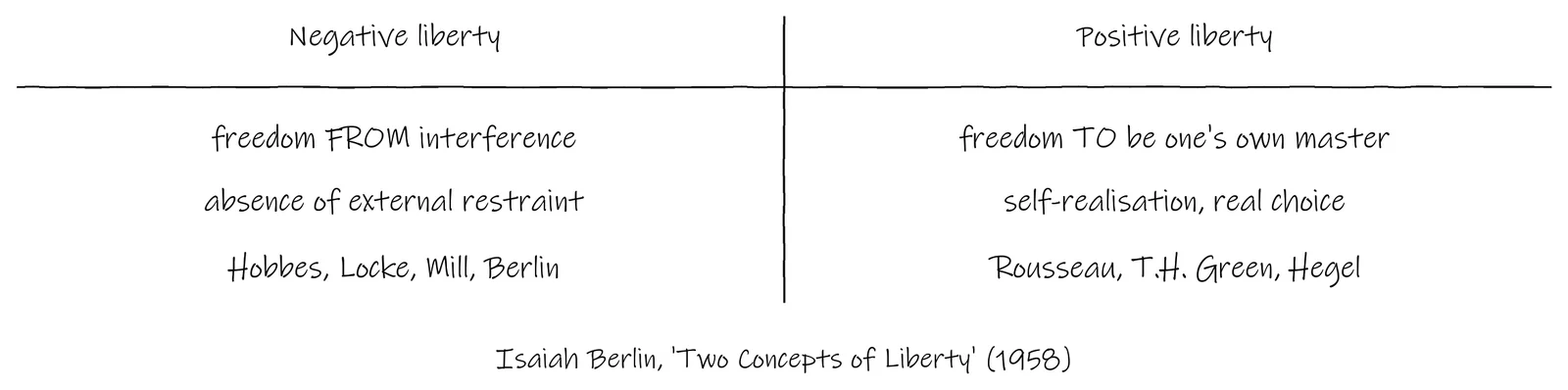
Isaiah Berlin, in his lecture ‘Two Concepts of Liberty’ (1958), distinguished negative liberty from positive liberty (Figure 2.2). Negative liberty means freedom from interference: I am free to the extent that no one prevents me from doing what I want. Thomas Hobbes, John Locke and J.S. Mill held this view, and it is associated with a limited state. Positive liberty means freedom to be one’s own master and to realise one’s capacities. Rousseau, Hegel and T.H. Green held this view; Green argued that freedom is ‘a positive power of doing something worth doing’, so the state must remove obstacles such as poverty, ignorance and disease. Berlin defended negative liberty, warning that positive liberty could be abused by rulers who claim to know people’s ‘true’ interests better than they do.
Mill’s Harm Principle
J.S. Mill, in On Liberty (1859), written in Victorian England against social conformity and the ‘tyranny of the majority’, argued that ‘the only purpose for which power can be rightfully exercised over any member of a civilised community, against his will, is to prevent harm to others’. He distinguished self-regarding actions, which affect only the individual and should be free, from other-regarding actions, which may be restricted. He gave special importance to freedom of thought and discussion, because even false opinions help us discover the truth.
Other Views of Liberty
- Marxist view: liberty in capitalist society is formal, since workers who must sell their labour to survive are not really free; true freedom requires the end of class exploitation.
- Republican view: Philip Pettit (1997) defines liberty as non-domination, i.e. not living under another’s arbitrary power.
- Feminist view: freedom in public life means little if women are dominated in the family.
- Indian thought: Gandhi linked freedom (swaraj) with self-rule over one’s own desires; Ambedkar insisted that liberty cannot be separated from equality and fraternity.
Liberty in the Indian Constitution
The Preamble promises ‘liberty of thought, expression, belief, faith and worship’. Article 19 guarantees six freedoms, including speech and expression, assembly, association, movement, residence and profession, subject to reasonable restrictions; Article 21 protects life and personal liberty, which the Supreme Court in Maneka Gandhi v. Union of India (1978) held can be restricted only by a fair, just and reasonable procedure; and Articles 25–28 protect freedom of religion.
2.2 Equality
Equality does not mean that everyone is the same or should be treated identically in every respect. It means that all human beings are of equal moral worth and should not be treated differently on irrelevant grounds such as caste, sex, race or birth. As Ashok Acharya explains, the central question is: equality of what? Equal rights, equal opportunities, equal resources or equal outcomes?
Types of Equality
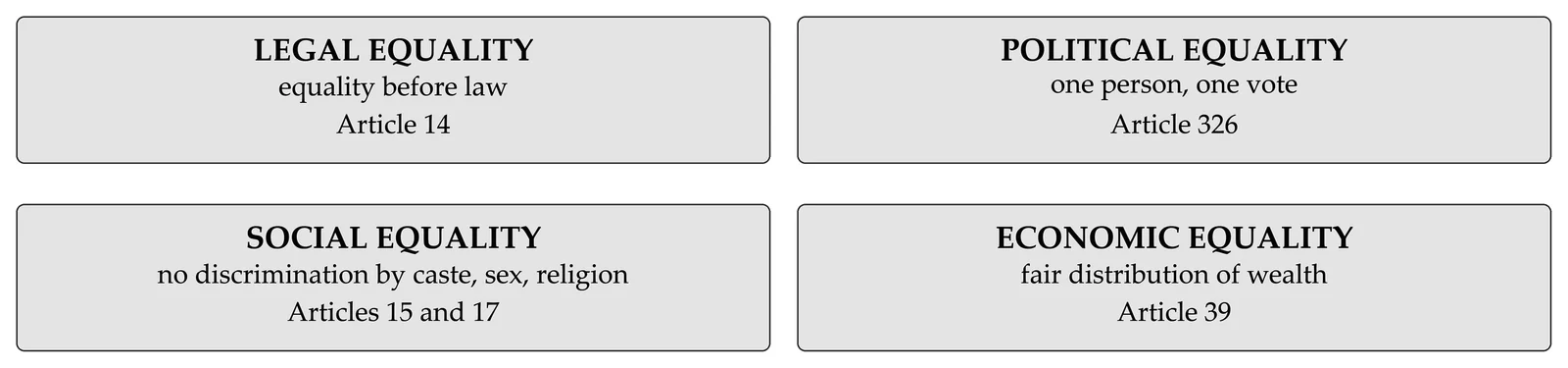
Equality has several dimensions (Figure 2.3):
- Legal equality: equality before the law and equal protection of the laws, guaranteed by Article 14.
- Political equality: every adult has an equal vote and the right to contest elections; universal adult franchise is provided by Article 326.
- Social equality: no discrimination on grounds of religion, race, caste, sex or place of birth (Article 15), and the abolition of untouchability (Article 17).
- Economic equality: a fair distribution of wealth and income; the Directive Principles (Article 39) ask the state to prevent the concentration of wealth.
Opportunity, Condition and Outcome
A major debate concerns three ideas of equality (Figure 2.4). Equality of opportunity means that everyone should have the same starting line, for example equal access to education and jobs on the basis of merit. Equality of condition means that people should have similar resources to start with. Equality of outcome means that results, such as income, should be more equal. Liberals usually favour equality of opportunity; socialists argue that without greater equality of condition and outcome, opportunities remain unequal, because a child born into poverty cannot compete fairly with a rich child. Formal equality treats everyone the same; substantive equality treats people differently in order to make them really equal, which is the basis of reservations.

Thinkers on Equality
- Rousseau, in the Discourse on Inequality (1755), argued that inequality arose with private property.
- R.H. Tawney, in Equality (1931), defended social and economic equality as the condition of real freedom.
- John Rawls (1971) allowed inequalities only if they benefit the least advantaged.
- B.R. Ambedkar warned on 25 November 1949 that India was entering ‘a life of contradictions’: equality in politics but inequality in social and economic life.
2.3 Justice
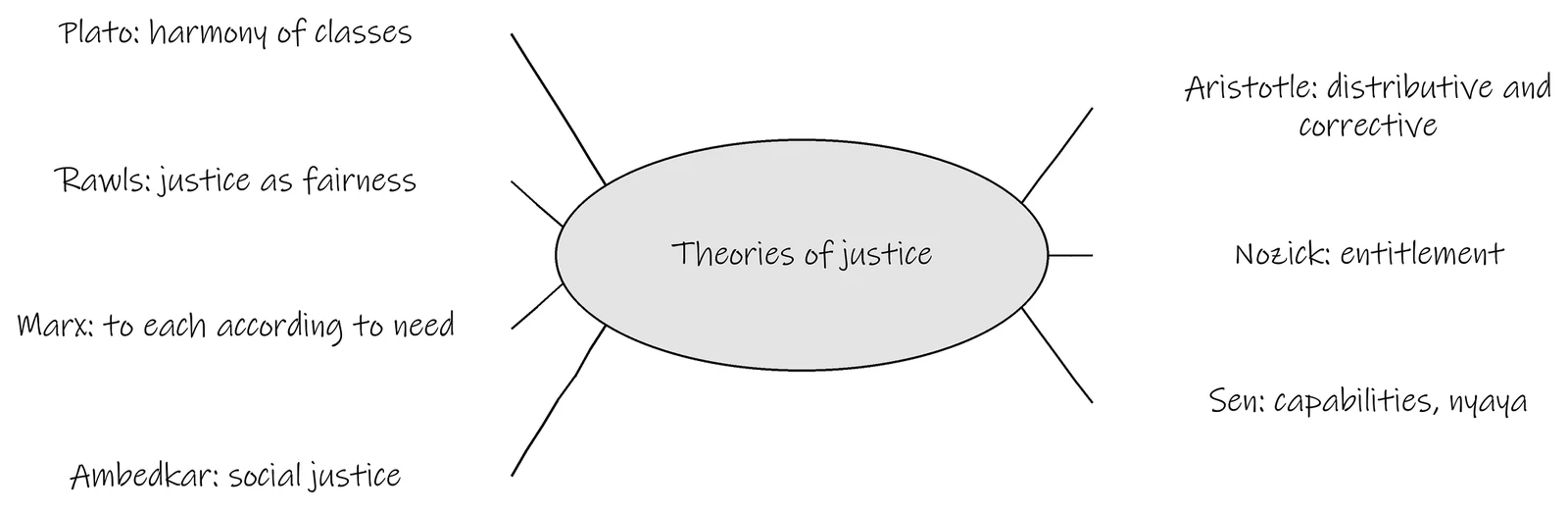
Justice means giving each person what is due to them. The Roman jurist Ulpian defined it as ‘the constant and perpetual will to give to each his due’. But what is due to each person? Merit, need, effort, or equal shares? This question has been answered differently in different traditions (Figure 2.5).
Classical Theories
For Plato (Republic), justice means harmony: each class, rulers, guardians and producers, performs its own function without interfering with others. Aristotle distinguished distributive justice, the fair distribution of goods and honours according to merit, from corrective justice, the correction of wrongs in transactions and crimes.
John Rawls: Justice as Fairness
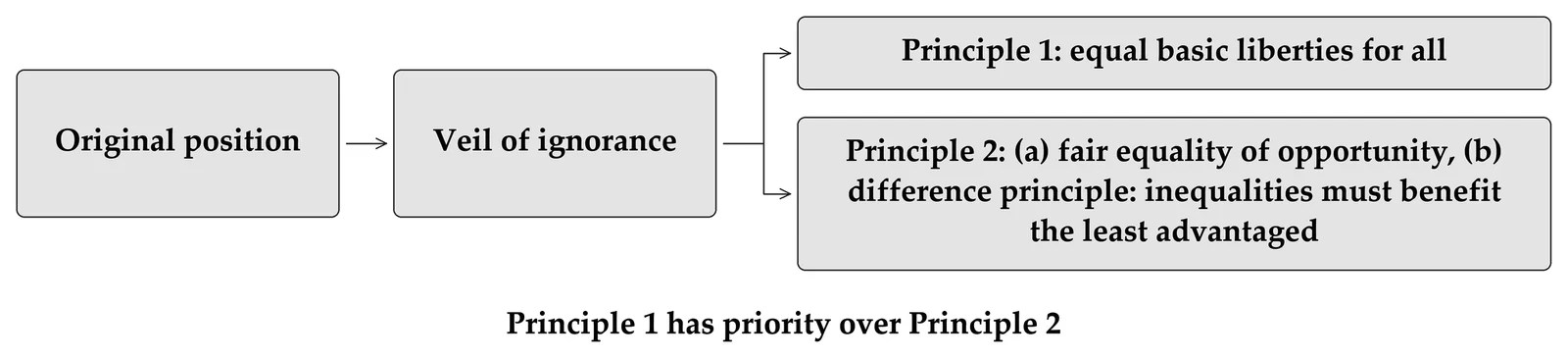
John Rawls, in A Theory of Justice (1971), written in an America divided by the civil rights movement, revived the theory of justice. He asked us to imagine people choosing principles of justice in an original position, behind a veil of ignorance, i.e. without knowing whether they would be rich or poor, male or female, talented or not (Figure 2.6). Such people, he argued, would choose two principles: first, equal basic liberties for all; second, social and economic inequalities are allowed only if (a) they are attached to positions open to all under fair equality of opportunity, and (b) they benefit the least advantaged (the difference principle). The first principle has priority over the second.
Other Theories
- Robert Nozick (Anarchy, State, and Utopia, 1974): justice is about how goods are acquired and transferred; if holdings are acquired justly, redistribution through taxation violates rights. He defended a minimal state.
- Marx: justice in a communist society means ‘from each according to his ability, to each according to his needs’.
- Amartya Sen (The Idea of Justice, 2009): instead of designing perfect institutions, we should remove manifest injustices and expand people’s capabilities, i.e. what they are actually able to do and be.
- Communitarians such as Michael Sandel argue that justice depends on the shared values of a community.
- Ambedkar and social justice: justice must remove caste and gender hierarchies, which is the basis of reservations and other protective measures.
The Indian Constitution promises social, economic and political justice in the Preamble, and the Directive Principles (Articles 38 and 39) ask the state to reduce inequalities of income and status.
2.4 Rights
A right is a justified claim that a person can make on others and on the state, recognised by society and usually protected by law. Rights protect individuals’ freedom and well-being, and every right has a corresponding duty on others. Harold Laski wrote that ‘rights are those conditions of social life without which no man can seek, in general, to be himself at his best’. There are several theories of rights (Figure 2.7).
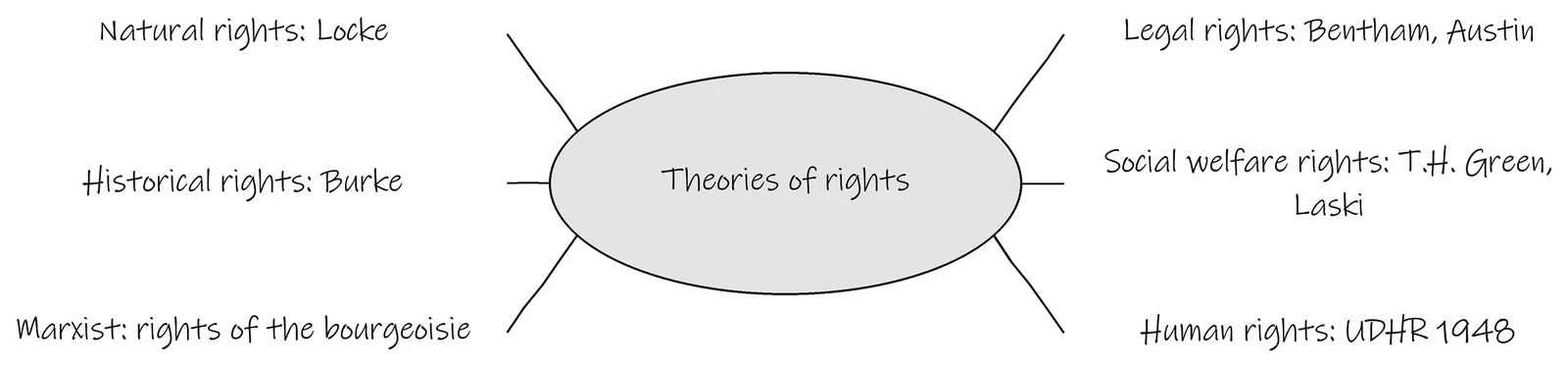
- Natural rights theory. Rights belong to human beings by nature, before the state. John Locke (1690) named life, liberty and property, and governments exist to protect them.
- Legal rights theory. Jeremy Bentham called natural rights ‘nonsense upon stilts’; rights exist only when created and enforced by law.
- Historical theory. Edmund Burke argued that rights grow out of the customs and traditions of a people.
- Social welfare theory. T.H. Green and Harold Laski linked rights to the common good: rights are the conditions needed for individuals to develop themselves.
- Marxist theory. Rights in capitalist society protect the property of the bourgeoisie; real rights require economic equality.
- Human rights. After the Second World War, the Universal Declaration of Human Rights (10 December 1948) recognised rights belonging to all human beings everywhere.
Types of Rights
Rights are usually classified as civil rights (life, liberty, property, speech, religion), political rights (to vote, contest elections and hold office), economic and social rights (to work, education, health and social security) and cultural rights (to language, culture and minority institutions) (Figure 2.8). In the Indian Constitution, Part III guarantees Fundamental Rights, often called the Magna Carta of India, enforceable in courts through Article 32, which Ambedkar called ‘the very soul of the Constitution’; many social and economic rights appear in the Directive Principles in Part IV.

2.5 How the Four Concepts Are Connected
The four concepts depend on one another. Rights give legal protection to liberty. Equality ensures that liberty is not the privilege of a few, since freedom means little without the resources to use it. Justice decides how liberty and equality should be balanced: Rawls gives priority to equal liberties while allowing only those inequalities that help the worst-off, whereas Nozick gives priority to liberty and property. Ambedkar summed up the connection when he said that liberty, equality and fraternity form ‘a union of trinity’, and that to divorce one from the other is to defeat the very purpose of democracy.
2.6 Important Questions
- Question 1 What is liberty? Distinguish between negative and positive liberty.
- Question 2 What is equality? Discuss its various dimensions.
- Question 3 Critically examine Rawls’s theory of justice.
- Question 4 What are rights? Discuss the main theories of rights.
DU asks the same idea in different words. So learn one broad answer for each question below; the same answer works for every question joined by OR.
Important Question 1
What is liberty? Distinguish between negative and positive liberty.
OR
Discuss J.S. Mill’s views on liberty.
OR
Examine the different conceptions of liberty.
Model Answer
“Over himself, over his own body and mind, the individual is sovereign.”
— J.S. Mill, On Liberty (1859)
Introduction. Liberty means the freedom of individuals to think, speak and act as they choose. It is one of the central values of political theory and of modern democracies, but its meaning and limits have been widely debated.
1. Meaning of Liberty
From the Latin liber (free), liberty can mean the absence of restraint or the presence of real opportunities to develop oneself. No society can allow unlimited freedom, so every theory of liberty also explains its limits. It has been a central value of modern political thought since the English, American and French revolutions. It is closely linked with autonomy, choice and self-development.
2. Negative Liberty
Negative liberty is freedom from interference. Hobbes defined a free man as one who is not hindered from doing what he wills; Locke saw liberty as freedom from the arbitrary will of another; Mill’s harm principle protected the individual’s own sphere. On this view, the larger the area of non-interference, the greater the freedom, and the state should be limited. Locke and Mill developed the idea that individuals should be free in matters that do not harm others. Its supporters see the state as a necessary evil whose powers must be limited.
3. Positive Liberty
Positive liberty is freedom to be one’s own master and to realise one’s capacities. Rousseau found freedom in obedience to the general will; T.H. Green defined freedom as a positive power of doing something worth doing, so the state should provide education, health and protection against poverty. This view justified the welfare state. T.H. Green defined freedom as a positive power or capacity of doing or enjoying something worth doing or enjoying.
4. Berlin’s Distinction
Isaiah Berlin (1958) defended negative liberty, warning that positive liberty could be turned into a justification for coercion by rulers who claim to know people’s real interests, as in totalitarian states. He feared that rulers might claim to know people’s ‘true’ interests and coerce them in the name of freedom, as totalitarian regimes did.
5. Mill’s Harm Principle
Mill held that power may be used against an individual only to prevent harm to others, distinguishing self-regarding from other-regarding actions, and defended freedom of thought and discussion because truth emerges from the clash of opinions. He defended liberty of thought and discussion because silencing an opinion may suppress the truth.
6. Other Views
Marxists call liberal liberty merely formal; republicans such as Philip Pettit define liberty as non-domination; feminists extend it to the family; and Ambedkar insisted that liberty must be joined with equality and fraternity.
7. Liberty and Equality
Liberals such as Hayek fear that equality threatens liberty, while socialists and egalitarian liberals such as Rawls argue that without a fair share of resources, liberty is empty for the poor.
8. Gandhi and Ambedkar on Freedom
Gandhi’s swaraj meant rule over oneself as well as national independence, while Ambedkar insisted that liberty must be joined with equality and fraternity, as in the Preamble.
9. Marxist and Feminist Views
Marxists argue that workers who must sell their labour to survive are not truly free, and feminists show that women’s liberty is limited by domestic burdens and social norms as much as by law.
10. Liberty in India
Articles 19–22 guarantee the right to freedom, subject to reasonable restrictions, and Maneka Gandhi (1978) required that any restriction on personal liberty be fair, just and reasonable. In Maneka Gandhi (1978) the Supreme Court held that any law depriving a person of liberty must be fair, just and reasonable.
11. Institutions of Liberty
Liberty is protected by institutions such as an independent judiciary, a free press, the rule of law and constitutional rights, without which declarations of freedom remain empty.
12. Liberty and Law
Liberty is not the absence of all rules. Locke wrote that ‘where there is no law, there is no freedom’, because laws protect individuals from interference by others. The question is which laws enlarge freedom and which restrict it unnecessarily. Laws against theft protect liberty; laws that ban criticism of government destroy it.
13. Limits of Liberty
Every society limits liberty to protect others and the community. The Indian Constitution allows ‘reasonable restrictions’ on the freedoms of Article 19 on grounds such as public order, security, decency and defamation, and the courts decide whether a restriction is reasonable and proportionate. The challenge is to protect liberty from both anarchy and tyranny. The challenge is to draw these limits narrowly, so that freedom remains the rule and restriction the exception.
Conclusion. Thus, liberty has both a negative side, freedom from interference, and a positive side, the real capacity to act. A free society must protect individuals from interference while also providing the conditions in which they can use their freedom.
Important Question 2
What is equality? Discuss its various dimensions.
OR
Distinguish between equality of opportunity and equality of outcome.
OR
Discuss the relationship between liberty and equality.
Model Answer
“We are going to enter into a life of contradictions. In politics we will have equality and in social and economic life we will have inequality.”
— B.R. Ambedkar, 25 November 1949
Introduction. Equality means that all human beings are of equal moral worth and should not be treated differently on irrelevant grounds such as caste, sex or birth. It does not mean identical treatment in every respect. The central question, as Ashok Acharya explains, is: equality of what?
1. Meaning and Growth of the Idea
The idea of equality grew from the French Revolution’s slogan ‘liberty, equality, fraternity’, from socialist movements and from struggles against caste, race and gender discrimination. Rousseau (1755) traced inequality to private property. The American Declaration of Independence (1776) proclaimed that all men are created equal.
2. Dimensions of Equality
Legal equality (Article 14), political equality (one person, one vote, Article 326), social equality (Articles 15 and 17) and economic equality (Article 39) are its main dimensions. Each dimension addresses a different inequality: before the law, in the vote, in social status, in wealth and in opportunity.
3. Opportunity, Condition and Outcome
Equality of opportunity gives everyone the same starting line; equality of condition gives similar resources; equality of outcome seeks more equal results. Liberals favour opportunity; socialists argue that unequal conditions make opportunities unequal. Most democracies seek fair equality of opportunity supported by some equality of condition through public education and welfare. Rawls’s fair equality of opportunity requires that people of similar talent have similar life chances, whatever their class.
4. Formal and Substantive Equality
Formal equality treats everyone the same; substantive equality takes account of disadvantage and may treat people differently to make them equal in fact. Protective discrimination for Scheduled Castes, Scheduled Tribes and backward classes rests on substantive equality. Reservations, maternity benefits and ramps for disabled people are examples of substantive equality.
5. Gender Equality
Feminists show that formal legal equality has not removed inequality between men and women in work, wages, property and politics, which is why measures such as women’s reservation and laws against discrimination are needed.
6. Liberty and Equality
Some liberals, such as Hayek, see equality as a threat to liberty, since redistribution requires state interference. Others, such as Tawney and Rawls, argue that liberty and equality support each other, because freedom is meaningless without the resources to use it. Ambedkar called liberty, equality and fraternity a ‘union of trinity’. R.H. Tawney argued that equality is the condition of real liberty for most people.
7. Thinkers on Equality
Rousseau, in the Discourse on Inequality (1755), traced inequality to private property. R.H. Tawney, in Equality (1931), argued that social and economic equality is the condition of real freedom. John Rawls (1971) allowed inequalities only if they benefit the least advantaged. Ambedkar warned in 1949 that political equality would be endangered if social and economic inequality continued. Ambedkar warned that political equality (one person, one vote) would be undermined by social and economic inequality. Dworkin argued that government must show equal concern and respect for every citizen.
8. Global Inequality
Equality is also a global issue: the gap between rich and poor countries, and within them, has grown in recent decades, as Thomas Piketty’s work on wealth shows.
9. Criticisms of Equality
Libertarians such as Friedrich Hayek and Robert Nozick argue that attempts to equalise outcomes require heavy state interference, destroy incentives and violate liberty and property rights. Supporters reply that extreme inequality itself makes liberty meaningless for the poor. The debate shows that equality must be balanced with liberty. Others argue that equality ignores differences of talent and effort and may reduce incentives.
10. Equality and Caste
In India the struggle for equality has above all been a struggle against caste hierarchy; Phule, Periyar and Ambedkar argued that social equality is the foundation of democracy.
11. Equality in the Indian Constitution
The Preamble promises equality of status and opportunity; Articles 14–18 guarantee the right to equality, including equality of opportunity in public employment (Article 16) and the abolition of titles (Article 18); and the Directive Principles seek economic equality. Special provisions for disadvantaged groups are treated by the courts as part of equality, not exceptions to it. Article 17 abolishes untouchability and Article 18 abolishes titles.
12. Evaluation
Equality does not mean identical treatment or identical outcomes; it means equal concern and respect for every person, which requires removing unjust advantages and disadvantages. Equality, liberty and justice are therefore complementary values.
Conclusion. Thus, equality has many dimensions, legal, political, social and economic. A democracy must go beyond formal equality to create the conditions in which all citizens can live with equal dignity.
Important Question 3
Critically examine Rawls’s theory of justice.
OR
Discuss the various theories of justice.
OR
What is justice? Compare the views of Rawls and Nozick.
Model Answer
“Justice is the first virtue of social institutions.”
— John Rawls, A Theory of Justice (1971)
Introduction. Justice means giving each person what is due to them. John Rawls’s A Theory of Justice (1971) is the most influential modern theory, and it revived normative political theory.
1. Earlier Theories
Plato saw justice as harmony among classes; Aristotle distinguished distributive and corrective justice; utilitarians sought the greatest happiness of the greatest number, which Rawls criticised for allowing the interests of some to be sacrificed for others. Utilitarians such as Bentham defined justice as the greatest happiness of the greatest number, which Rawls criticised for sacrificing individuals to total welfare.
2. Context
A Theory of Justice (1971) appeared amid the civil rights movement and debates on poverty in the United States, when the justice of social institutions was being questioned; Rawls called justice the first virtue of social institutions.
3. The Original Position and the Veil of Ignorance
Rawls imagined rational people choosing principles of justice behind a veil of ignorance, not knowing their class, talents, sex or beliefs. Because no one could design principles to favour himself, the choice would be fair: hence ‘justice as fairness’. Behind the veil, people do not know their class, talents, race, sex or idea of the good life, so they choose principles fair to all. It is a hypothetical device, not a historical event.
4. Primary Goods and Maximin
The parties seek primary goods, such as rights, liberties, opportunities, income, wealth and the bases of self-respect, and reason by ‘maximin’: they choose the arrangement whose worst outcome is best.
5. The Two Principles
First, each person has an equal right to the most extensive basic liberties compatible with similar liberties for all. Second, social and economic inequalities must be attached to positions open to all under fair equality of opportunity, and must benefit the least advantaged (the difference principle). The first principle has priority. The first principle has priority over the second, so basic liberties cannot be traded for economic gain.
6. The Priority of Liberty
Rawls insisted that basic liberties cannot be sacrificed even for greater economic benefits, which distinguishes his theory from utilitarianism and from socialist planning.
7. Significance
Rawls gave a philosophical defence of the welfare state, combined liberty with equality, and supported policies that help the worst-off, an idea close to protective discrimination. It provided a liberal justification for reducing inequality without abolishing the market. It revived normative political philosophy after decades of neglect.
8. Criticisms
Nozick (1974) argued that justice depends on how holdings are acquired, and that redistributive taxation violates rights. Communitarians such as Michael Sandel (1982) criticised Rawls’s ‘unencumbered self’, cut off from community. Feminists such as Susan Moller Okin argued that he ignored justice within the family. Amartya Sen (2009) criticised the search for perfectly just institutions and proposed comparing real lives and capabilities. Marxists argue that Rawls leaves the class structure of capitalism intact. Communitarians such as Sandel criticised his ‘unencumbered self’, and Sen argued that primary goods ignore differences in people’s capacity to use them. Walzer argued that different goods should be distributed by different principles.
9. Feminist and Marxist Criticisms
Susan Okin argued that Rawls neglected justice within the family, and Marxists argued that his theory accepts capitalist inequalities that a socialist society would abolish.
10. Rawls and the Welfare State
Rawls’s theory provides a philosophical justification for the welfare state: public education, health care, social security and progressive taxation can be defended as ways of improving the position of the least advantaged. It also supports policies such as protective discrimination, which aim at fair equality of opportunity for disadvantaged groups. Progressive taxation, public health and education and unemployment benefits can all be justified by the difference principle.
11. Rawls and India
Rawls’s ideas have been used to defend reservations and welfare for the worst-off in India, since the Constitution’s commitment to social justice resembles the difference principle.
12. Political Liberalism
In Political Liberalism (1993), Rawls revised his theory for societies divided by different religions and moral doctrines. Citizens who disagree deeply about the good life can still agree on basic principles of justice through an ‘overlapping consensus’, and public decisions must be justified by ‘public reason’ that all can accept. This idea is relevant to diverse societies such as India. He sought an ‘overlapping consensus’ in which citizens of different religions and philosophies could all accept the principles of justice.
13. Evaluation
Despite the criticisms, Rawls’s theory remains the most influential modern account of justice: it combines liberty and equality, gives priority to the worst-off and offers a method of reasoning about fairness.
Conclusion. Thus, Rawls’s theory remains the most important modern account of justice. Its critics show its limits, but its central idea, that a just society must be fair to the least advantaged, continues to guide democratic politics.
Important Question 4
What are rights? Discuss the main theories of rights.
OR
Distinguish between natural rights and legal rights.
OR
Write a note on human rights.
Model Answer
“Rights are those conditions of social life without which no man can seek, in general, to be himself at his best.”
— Harold Laski, A Grammar of Politics (1925)
Introduction. A right is a justified claim that a person can make on others and on the state, recognised by society and usually protected by law. Rights protect liberty and dignity, and each right implies a duty on others.
1. Features of Rights
Rights are claims of individuals, recognised by society, usually enforced by the state, universal within a community, and linked with duties. Laski described rights as those conditions of social life without which no one can seek to be himself at his best.
2. Natural Rights Theory
Locke (1690) held that people have natural rights to life, liberty and property, which the state must protect; this idea inspired the American and French revolutions. The American and French declarations drew on this theory.
3. Legal Rights Theory
Bentham rejected natural rights as ‘nonsense upon stilts’; rights exist only when created and enforced by law. It explains enforceability but cannot explain why unjust laws should be changed. John Austin’s theory of law as the command of the sovereign supported this view.
4. Historical and Social Welfare Theories
Burke traced rights to tradition; T.H. Green and Laski argued that rights are the conditions needed for individuals to realise themselves and contribute to the common good. Green held that rights are recognised by society for the common good.
5. Marxist Theory
Marx argued that liberal rights protect the property of the bourgeoisie and that real rights require economic equality. Socialist states emphasised economic rights such as work and housing over civil liberties.
6. Will and Interest Theories
Analytical philosophers distinguish the will theory, which sees a right as control over another’s duty (H.L.A. Hart), from the interest theory, which sees rights as protecting important interests (Joseph Raz).
7. Human Rights and Fundamental Rights
The Universal Declaration of Human Rights (1948) recognised civil, political, economic, social and cultural rights for all. India’s Fundamental Rights (Part III) are enforceable through Article 32, while many social and economic rights appear in the Directive Principles. The International Covenants of 1966 turned the declaration into binding treaties.
8. Types of Rights
Rights are commonly classified as civil (life, liberty, property, speech, religion), political (vote, contest elections, hold office), economic and social (work, education, health, social security) and cultural (language, culture, minority institutions). T.H. Marshall described how civil, political and social rights developed in successive centuries. Third-generation rights include the rights to development, peace and a clean environment.
9. Rights as Trumps
Ronald Dworkin argued that rights are ‘trumps’ protecting individuals against decisions made for the general welfare, which is why courts may strike down popular laws that violate rights.
10. Expansion of Rights in India
Indian courts have expanded rights through Article 21, recognising rights to livelihood, education, health, a clean environment and privacy, while laws such as the RTI Act (2005) and the Right to Education Act (2009) created new rights.
11. Group Rights
Multicultural theorists such as Kymlicka defend group-differentiated rights for minorities, as in Articles 29 and 30 of the Indian Constitution, which protect the cultural and educational rights of minorities.
12. Rights and Duties
Every right implies a duty: my right to life imposes a duty on others not to harm me, and on the state to protect me. Gandhi stressed that rights flow from duties well performed. The Indian Constitution added Fundamental Duties (Article 51A) through the 42nd Amendment (1976). The 42nd Amendment (1976) added Fundamental Duties (Article 51A) to the Constitution.
13. Rights in the Indian Constitution
Part III guarantees six groups of Fundamental Rights: equality (Articles 14–18), freedom (19–22), against exploitation (23–24), religion (25–28), cultural and educational rights (29–30) and constitutional remedies (32). Article 32 allows citizens to approach the Supreme Court directly through writs such as habeas corpus and mandamus, and Ambedkar called it ‘the very soul of the Constitution’. Social and economic rights such as work, education and health appear mainly in the Directive Principles, though courts have read some of them into Article 21. Ambedkar called Article 32 the heart and soul of the Constitution.
14. Evaluation
Each theory captures part of the truth: rights rest on human dignity, are recognised by society and enforced by law, and need a social and economic base. Rights and duties together make democratic citizenship possible.
Conclusion. Thus, rights have been explained as natural, legal, historical and social. Today they are understood as universal conditions of human dignity that the state must protect and promote.
Short Notes
(a) Mill’s Harm Principle
In On Liberty (1859), J.S. Mill argued that the only legitimate reason for using power against an individual’s will is to prevent harm to others. Actions that affect only oneself (self-regarding) should be free; actions that harm others (other-regarding) may be restricted. Mill especially defended freedom of thought and discussion, arguing that suppressing any opinion robs humanity of the chance to correct error or to understand truth better. Critics say the line between self- and other-regarding actions is hard to draw.
(b) The Difference Principle
Part of Rawls’s second principle of justice (1971), it holds that social and economic inequalities are justified only if they benefit the least advantaged members of society. Inequality in income may be allowed if, for example, higher pay for doctors encourages them to provide services that improve the position of the poor. It is a principle of fairness that combines efficiency with concern for the worst-off.
(c) The capability approach
An approach to justice and well-being developed by Amartya Sen and Martha Nussbaum. It judges societies not by income or resources alone but by people’s capabilities, their real freedom to do and be what they have reason to value, such as being healthy, educated and able to take part in community life. Sen’s Development as Freedom (1999) applied it to development, and it influenced the UNDP’s Human Development Index.
More notes: MDSC-1A Introduction to Political Theory
These notes are prepared by PADHO TO AISE for study help. They are not an official University of Delhi publication.