

Semester I MDSC-1A Introduction to Political Theory
Unit I · 18 min read · Updated 24 Nov 2026
As per the University of Delhi (DU) BA (Hons) Political Science syllabus
Contents
- 1.1 Politics and Political Theory
- 1.2 Nature and Features of Political Theory
- 1.3 Approaches to Political Theory
- 1.4 Decline and Revival of Political Theory
- 1.5 Relevance of Political Theory
- 1.6 Important Questions
- What is political theory? Discuss its nature and relevance.
- Discuss the normative and empirical approaches to political theory.
- Short Notes
मनुष्य स्वभाव से ही एक राजनीतिक प्राणी है।
Man is by nature a political animal.
— Aristotle, Politics
EVERY DAY we make political judgements. When we say that a law is unfair, that a government should help the poor, or that people should be free to say what they think, we are using ideas such as justice, equality and freedom. Political theory is the careful study of such ideas. It asks what they mean, how they are connected, and how they can be used to judge our laws, institutions and governments. This chapter explains what political theory is, how political theorists work, and why political theory is still relevant to every citizen. The concepts studied in the next chapter (liberty, equality, justice and rights) and the debates in Chapter 3 all build on this foundation.
1.1 Politics and Political Theory
To understand political theory we must first understand politics. The word comes from the Greek polis, the small city-state such as Athens, so politics originally meant the affairs of a self-governing community. Today politics means the activity through which people with different interests and values make decisions that bind the whole group. Two features are always present: disagreement, because people want different things and resources are limited, and the need for a collective decision that applies to everyone. Politics is found in government and Parliament, but also, in a wider sense, wherever power is exercised, for example in the family, the workplace and society.
Political theory is the systematic reflection on politics. The word theory comes from the Greek theoria, meaning to look at or contemplate. David Held describes political theory as a network of concepts and generalisations about political life: ideas about the nature, purpose and key features of government, state and society, and about the political capabilities of human beings. In simple words, political theory is thinking carefully and in an organised way about politics.
| Basis | Politics | Political theory |
|---|---|---|
| Nature | An activity: making collective decisions | A form of knowledge about that activity |
| Questions | Who gets what? Who decides? | What is just? Why should we obey? What is freedom? |
| Example | A debate in Parliament on reservations | An argument about what equality and fairness require |
| Actors | Citizens, parties, governments | Thinkers, students, citizens who reflect |
1.2 Nature and Features of Political Theory
Rajeev Bhargava explains that political theory has several characteristic features. Each is illustrated by a thinker and the context in which he wrote.
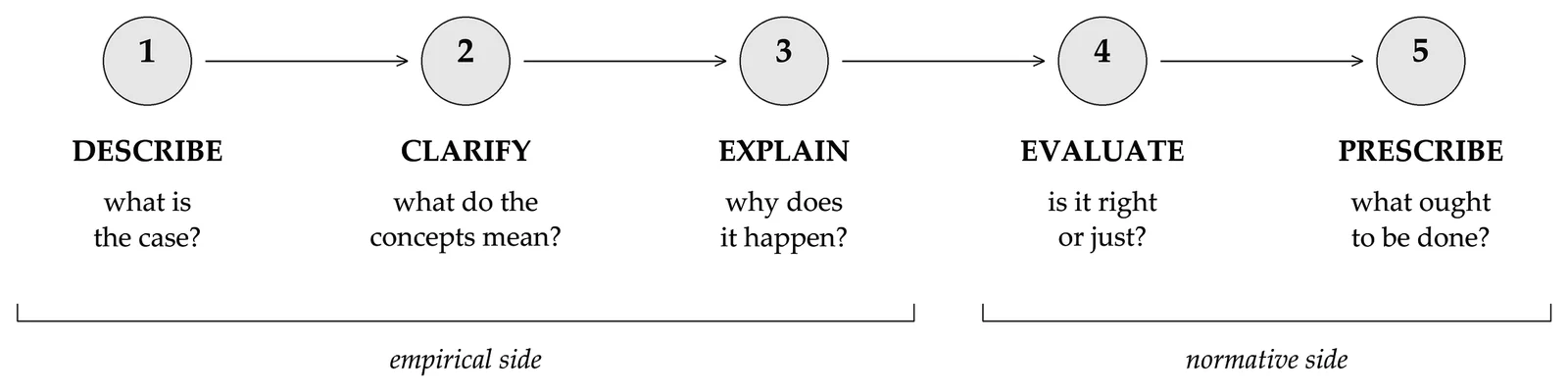
- It explains political life. Political theory tries to understand why things happen, for example why people obey the state. Aristotle compared the constitutions of 158 Greek city-states to explain why some were stable and others fell into revolution.
- It evaluates and prescribes. Political theory asks what ought to be. Plato’s Republic (c. 375 BCE), written after democratic Athens executed his teacher Socrates, asked what a just city would look like.
- It clarifies concepts. Political theory examines the meaning of concepts such as liberty, equality, justice, rights, democracy and power, which are used loosely in everyday speech. Isaiah Berlin’s ‘Two Concepts of Liberty’ (1958) is a classic example.
- It is critical. Political theory questions existing institutions and beliefs. Karl Marx criticised capitalism in the nineteenth century, and B.R. Ambedkar’s Annihilation of Caste (1936) criticised caste hierarchy.
- It is both universal and contextual. It asks general questions, but each thinker writes in a particular time and place; Thomas Hobbes wrote Leviathan (1651) during the English Civil War, which explains his fear of disorder.
- It guides action. Political theory has shaped revolutions, constitutions and movements: John Locke’s idea of natural rights influenced the American Declaration of Independence (1776), and liberal and socialist ideas shaped the Indian Constitution.
Political theory is closely related to, but different from, political thought (the ideas of a particular thinker or tradition in history, such as Kautilya or Gandhi), political philosophy (the most abstract reflection on the good life and the just order) and political science (the empirical, often statistical study of institutions and behaviour). Political theory stands between them, combining conceptual analysis and moral argument with knowledge of how politics actually works.
1.3 Approaches to Political Theory
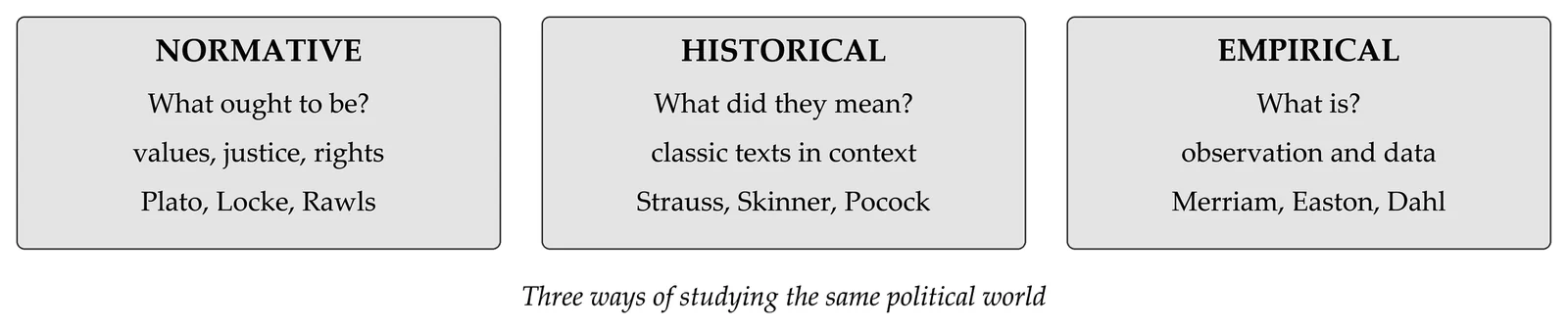
An approach is a way of studying politics, i.e. the questions we ask and the method we use. Three approaches are especially important (Figure 1.3).
A. The normative approach
The normative approach asks what ought to be. It sets standards, such as justice, liberty and equality, by which laws and governments can be judged. Plato, Hobbes, Locke, Rousseau, J.S. Mill and John Rawls are normative thinkers. They use conceptual analysis, reasoned argument and thought experiments, such as Rawls’s veil of ignorance. The approach is essential because politics is always about choices, but its critics say that values cannot be tested like facts.
B. The empirical approach
The empirical approach studies what is, through observation, surveys and statistics. It began with Aristotle’s study of constitutions and Machiavelli’s observation of how rulers actually behave, and in the twentieth century took the form of behaviouralism, led by Charles Merriam and David Easton, which tried to build a value-free science of politics. It made political study more precise, but critics argued that a completely value-free study is impossible. In 1969 Easton himself called for a post-behavioural revolution that would make research relevant to society’s problems.
C. The historical approach
The historical approach studies the ideas of great thinkers of the past in their historical context. George Sabine’s A History of Political Theory (1937) is a classic example, and Quentin Skinner argued that a text can be understood only by recovering what its author was doing in the debates of his time. The approach shows where our concepts come from, but it can become a study of the past for its own sake.
Today most scholars see the three approaches as complementary: the empirical approach tells us where we are, the normative approach tells us where we should go, and the historical approach tells us how we got here.
D. Other approaches
Besides these three, political theory today includes critical approaches. The Marxist approach studies politics through class and the economy; the feminist approach examines how gender shapes power in the family, work and the state; and postmodern and postcolonial approaches question claims to universal truth and show how knowledge is tied to power. These approaches have widened the questions political theory asks, i.e. not only ‘what is the best state?’ but also ‘whose interests do existing institutions serve?’
1.4 Decline and Revival of Political Theory
- 1950s: the behavioural revolution in American political science treated values as unscientific. Alfred Cobban (1953) wrote of the ‘decline of political theory’ and David Easton called for a scientific study of politics.
- 1956: Peter Laslett wrote that “for the moment, anyway, political philosophy is dead”.
- 1962: Isaiah Berlin replied in ‘Does Political Theory Still Exist?’ that political theory will survive as long as people disagree about the ends of life.
- 1971: John Rawls’s A Theory of Justice revived normative political theory, followed by Robert Nozick (1974), communitarians, feminists and multiculturalists.
The revival shows that facts alone cannot answer political questions. Empirical research can tell us that inequality is rising, but only normative argument can tell us whether it is unjust and what should be done about it.
1.5 Relevance of Political Theory
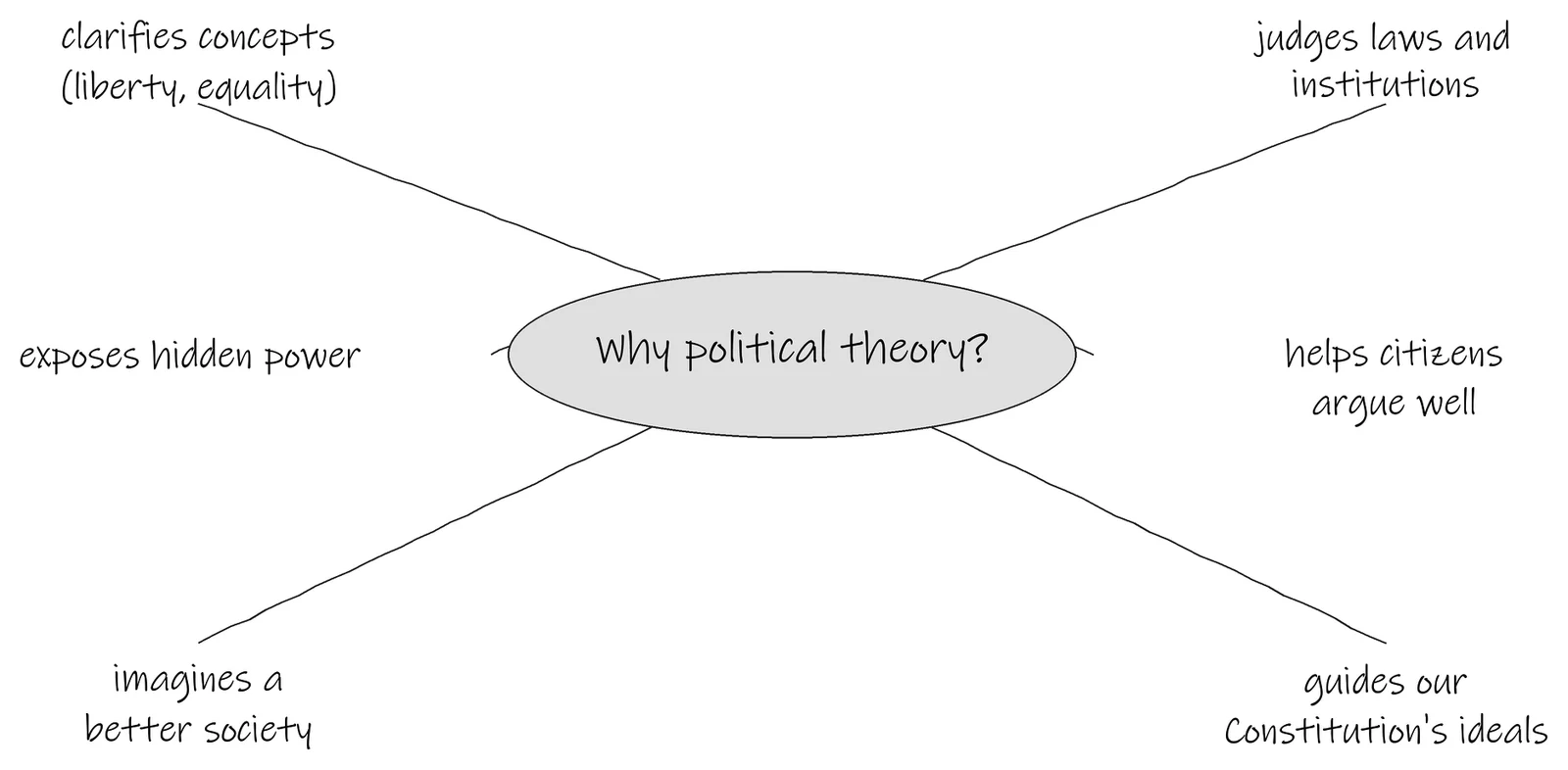
Why do we need political theory? Rajeev Bhargava, in ‘Why Do We Need Political Theory’, gives several reasons. Political theory is relevant because:
- It clarifies concepts. Words such as equality and freedom are used loosely; theory distinguishes, for example, formal equality (the same rules for all) from substantive equality (fair outcomes for the disadvantaged).
- It helps us judge laws and institutions. Theory supplies standards of justice and rights by which any law or government can be evaluated, and helps us decide when obedience is owed and when protest is justified.
- It exposes hidden power. Marxist, feminist and anti-caste thought reveal domination in arrangements that look natural, such as class, patriarchy and caste.
- It makes thoughtful citizens. Democracy needs citizens who can argue with reasons, respect opponents and resist propaganda.
- It helps us imagine alternatives. From Plato’s ideal state to Gandhi’s Hind Swaraj (1909), theory pictures a better society and gives direction to change.
- It explains our Constitution. The Preamble’s ideals of justice, liberty, equality and fraternity are concepts of political theory, and debates about reservations, free speech or secularism are debates in political theory.
- It connects facts and values. It links empirical knowledge of how politics works with judgements about how it should work.
Political theory in India
Indian political theory draws on ancient texts such as the Arthashastra, on nineteenth-century reformers such as Rammohan Roy, Phule and Vivekananda, and on modern thinkers such as Gandhi, Ambedkar, Nehru and Lohia. Contemporary Indian theorists such as Rajeev Bhargava, Bhikhu Parekh and Gopal Guru have contributed to global debates on secularism, multiculturalism and humiliation. Their work shows that political theory need not be only Western: Indian experiences of caste, religious diversity, colonialism and democracy raise questions that enrich theory everywhere.
1.6 Important Questions
- Question 1 What is political theory? Discuss its nature and relevance.
- Question 2 Discuss the normative and empirical approaches to political theory.
DU asks the same idea in different words. So learn one broad answer for each question below; the same answer works for every question joined by OR.
Important Question 1
What is political theory? Discuss its nature and relevance.
OR
What is political theory and why do we need it?
OR
Explain the meaning and significance of political theory.
Model Answer
“Justice is the first virtue of social institutions, as truth is of systems of thought.”
— John Rawls, A Theory of Justice (1971)
Introduction. Political theory is the systematic reflection on politics: on its concepts, institutions and purposes. It seeks both to explain political life and to evaluate it, asking not only what is but also what ought to be. Although it was declared ‘dead’ in the 1950s, it remains essential for understanding and improving political life.
1. Meaning of Politics and Political Theory
Politics, from the Greek polis, is the activity through which people with different interests make decisions that bind the whole group. Political theory, from theoria (contemplation), is careful and organised thinking about this activity. David Held describes it as a network of concepts and generalisations about government, state and society. David Held describes political theory as a network of concepts and generalisations about political life, involving ideas, assumptions and statements about the nature, purpose and key features of government, state and society.
2. Nature of Political Theory
Political theory is explanatory, as when Aristotle compared 158 constitutions; normative and prescriptive, as in Plato’s Republic; conceptual, clarifying ideas such as liberty and justice; critical, questioning institutions, as Marx and Ambedkar did; contextual, since every theorist writes in a particular historical situation; and action-guiding, influencing revolutions and constitutions. It is also critical, questioning existing institutions, and it always rests on assumptions about human nature.
3. Empirical and Normative Sides
Its empirical side explains what is, for example why people vote as they do; its normative side asks what ought to be, for example whether the state should reduce inequality. Good political theory joins the two: values without facts are empty, and facts without values are blind.
4. Political Theory and Related Fields
Political theory differs from political thought, which studies the ideas of a thinker or tradition in history, from political philosophy, which is more abstract, and from political science, which is more empirical. It draws on all of them.
5. Traditions of Political Theory
Political theory includes several traditions, liberal, Marxist, conservative, feminist and others, each with its own view of human nature, society and the state; studying them helps us see political questions from different angles.
6. Relevance of Political Theory
Political theory clarifies concepts, such as formal and substantive equality; supplies standards for judging laws and governments; exposes hidden power in class, caste and gender; creates reflective citizens who argue with reasons; helps us imagine alternatives; and helps us understand the values of our Constitution, whose Preamble promises justice, liberty, equality and fraternity. It helps citizens judge laws and policies, imagine alternatives and take part in public debate with reasons rather than slogans.
7. Decline and Revival
In the 1950s behaviouralists and logical positivists dismissed normative theory as unscientific, and Peter Laslett declared political philosophy ‘dead’ (1956). Isaiah Berlin replied that theory lives as long as people disagree about ends, and John Rawls’s A Theory of Justice (1971) revived it. Alfred Cobban (1953) wrote of its decline and Peter Laslett (1956) declared that political philosophy was, for the moment, dead; Rawls’s A Theory of Justice (1971) revived it.
8. Political Theory and Ideology
An ideology is a set of beliefs that guides political action, while political theory examines such beliefs critically, asking whether their claims are coherent and justified.
9. Limitations
Political theory is sometimes criticised as too abstract and as largely Western in origin. It must therefore stay connected with real problems and with the experience of societies such as India. Indian scholars therefore call for a theory rooted in Indian experience, drawing on thinkers such as Gandhi and Ambedkar.
10. Political Theory and Political Practice
Political theory is not separate from practice. Locke’s idea of government by consent shaped the American Declaration of Independence (1776); the French Revolution’s ideals of liberty, equality and fraternity entered the Preamble of the Indian Constitution; and Marx’s ideas inspired revolutions in Russia and China. In India, Gandhi’s theory of satyagraha and Ambedkar’s theory of social democracy shaped the freedom struggle and the Constitution. Theory thus both explains politics and changes it. Marx’s theory inspired revolutions, Gandhi’s ideas guided the freedom struggle and Ambedkar’s thought shaped the Constitution.
11. Political Theory in the Indian Context
Political theory in India must engage with Indian realities: caste, religious diversity, secularism, federalism and poverty. Indian thinkers have contributed their own ideas, from Kautilya’s statecraft to Gandhi’s swaraj, Ambedkar’s annihilation of caste and Nehru’s secularism. Debates on reservations, free speech, minority rights and the uniform civil code are debates in political theory, which is why every citizen benefits from understanding it.
Conclusion. Thus, political theory is the careful study of political concepts and values. As long as people disagree about how they should live together, it remains relevant to every citizen and every democracy.
Important Question 2
Discuss the normative and empirical approaches to political theory.
OR
Distinguish between normative and empirical political theory.
OR
Write a note on behaviouralism.
Model Answer
“Substance must precede technique.”
— David Easton, ‘The New Revolution in Political Science’ (1969)
Introduction. The normative and empirical approaches are the two main ways of studying politics. The normative approach asks what ought to be; the empirical approach studies what is. Their relationship, and the tension between them, has shaped the development of political theory.
1. The Normative Approach
The word normative comes from norm, a standard. Normative theory judges political life by values such as justice, liberty and equality, and recommends what should be done. Plato’s Republic, Locke’s Two Treatises (1690), Rousseau’s Social Contract (1762), Mill’s On Liberty (1859) and Rawls’s A Theory of Justice (1971) are normative works. Plato’s Republic, Hobbes’s Leviathan, Locke’s Second Treatise and Rawls’s A Theory of Justice are classic examples. It asks what ought to be: what makes a state legitimate, what justice requires and when citizens may disobey.
2. Features and Methods of Normative Theory
It is value-based, prescriptive, philosophical and critical. Its methods are conceptual analysis, reasoned argument and thought experiments such as Rawls’s veil of ignorance. It also uses thought experiments, such as the state of nature or Rawls’s original position, to test principles.
3. The Empirical Approach
The empirical approach studies political behaviour through observation and evidence. It goes back to Aristotle and Machiavelli, and to Auguste Comte’s positivism, and in the twentieth century took the form of behaviouralism, led by Charles Merriam and David Easton. Aristotle’s study of 158 constitutions and Machiavelli’s realistic study of power are early examples.
4. Features of Behaviouralism
David Easton (1962) listed its eight foundations: regularities, verification, techniques, quantification, separation of values and facts, systematisation, pure science and integration with other social sciences. Behaviouralists used surveys and statistics to study voters, parties and groups. Behaviouralists used surveys, statistics and models to study voting, public opinion and interest groups. Its ambition was a political science as rigorous as the natural sciences.
5. Criticism and Post-behaviouralism
Critics argued that value-free science is impossible, that behaviouralism ignored important questions and supported the status quo, and that it was irrelevant to the crises of the 1960s. In 1969 Easton announced a post-behavioural revolution with a ‘credo of relevance’: substance before technique, and research that serves human needs. Easton’s ‘credo of relevance’ (1969) demanded that research address urgent social problems such as war, poverty and racial injustice.
6. The Historical Approach
A third approach studies ideas in their historical context: Sabine traced their development, Strauss read the classics for timeless truths, and Skinner’s Cambridge School read them as responses to the debates of their times.
7. Indian Examples
Normative arguments shaped the Constituent Assembly’s debates on rights and reservations, while empirical studies such as those of Lokniti–CSDS analyse Indian voting behaviour and political attitudes.
8. Comparison
Normative theory deals with values and ends, empirical theory with facts and means. Normative theory is tested by argument, empirical theory by evidence. Yet each needs the other: we study voting because we value democracy, and a theory of justice must know how institutions actually work. Normative theory often reasons deductively from principles, while empirical theory generalises inductively from observations.
9. Strengths and Weaknesses
The normative approach gives purpose and direction but can be abstract and impossible to prove; the empirical approach gives precision and evidence but can ignore values and become narrow.
10. The Fact–Value Problem
The debate between the two approaches goes back to David Hume (1739), who argued that an ‘ought’ cannot be derived from an ‘is’: facts alone cannot tell us what we should do. Logical positivists such as A.J. Ayer (1936) went further, claiming that value statements merely express feelings, which encouraged the behavioural attempt to keep values out of political science. Most scholars today accept that facts and values can be distinguished but not completely separated. The logical positivists of the Vienna Circle later held that value statements merely express emotion, which led to the neglect of normative theory.
11. Examples of Each Approach
A normative question is: Should the state reserve seats for disadvantaged groups? An empirical question is: Have reservations increased the representation of Scheduled Castes in government jobs? The first needs arguments about justice and fairness; the second needs data and surveys. A complete answer to any policy question needs both. A full answer to a policy question usually needs both: facts about effects and values about what is desirable.
12. Combining the Approaches
Most political theorists today combine the two: empirical research on poverty or discrimination informs normative arguments about justice, and normative ideals guide what researchers choose to study.
Conclusion. Thus, the normative and empirical approaches are complementary. Together they allow political theory to understand political life as it is and to judge how it ought to be.
Short Notes
(a) Decline of Political Theory
In the 1950s many scholars believed that political theory, especially normative theory, was in decline. Alfred Cobban (1953) wrote of its ‘decline’; David Easton (1953) complained that it had become a mere history of ideas; and Peter Laslett (1956) declared political philosophy ‘dead’. The reasons were the rise of behaviouralism and logical positivism, which treated values as unscientific, and the end-of-ideology mood after the Second World War. Isaiah Berlin (1962) rejected this view, and Rawls’s A Theory of Justice (1971) brought about a revival.
(b) Normative Theory
Normative theory is the branch of political theory that asks what ought to be. It sets standards, such as justice, liberty, equality and rights, for judging political institutions and actions. It is prescriptive and value-based, using conceptual analysis and argument. Classic examples are Plato’s Republic and Rawls’s A Theory of Justice. It is criticised because values cannot be tested like facts, but it remains essential, since every political choice involves values.
More notes: MDSC-1A Introduction to Political Theory
These notes are prepared by PADHO TO AISE for study help. They are not an official University of Delhi publication.