
Semester I DSC-3 Colonialism and Nationalism in India
Unit V · 25 min read · Updated 24 Nov 2026
As per the University of Delhi (DU) BA (Hons) Political Science syllabus
Contents
- 5.1 Peasant Movements
- 5.2 Tribal Movements
- 5.3 The Working-Class Movement
- 5.4 The Women’s Movement
- 5.5 Anti-Caste Movements
- 5.6 Important Questions
- Discuss the contribution of women in India’s freedom movement.
- Write an essay on anti-caste movements in colonial India.
- Discuss the nature of peasant and tribal movements in colonial India.
- Discuss the growth of the working-class movement in colonial India.
- Short Notes
शिक्षित बनो, संगठित रहो और संघर्ष करो।
Educate, agitate and organise.
— B.R. Ambedkar
THE NATIONAL MOVEMENT fought for freedom from British rule. But for many Indians, freedom also meant freedom from landlords and moneylenders, from forest officials, from factory owners, from patriarchy and from caste. Alongside the national movement, and sometimes within it, there arose powerful social movements of peasants, tribals, workers, women and the lower castes. A.R. Desai, in Social Background of Indian Nationalism (1948), described their ‘crusades’ against caste, untouchability and the subordination of women as part of the making of modern India. In this chapter we study each movement, its causes, leaders and achievements, and its relationship with the national movement.
5.1 Peasant Movements
Colonial land revenue systems, high rents, debt and the commercialisation of agriculture made peasants the most exploited section of colonial society, and they rose many times (Figure 5.2). The movements passed through two broad phases: early movements (1850s–1910s), directed against particular grievances such as indigo planters or moneylenders; and later movements (from 1917), linked with the national movement and later with organised Kisan Sabhas.
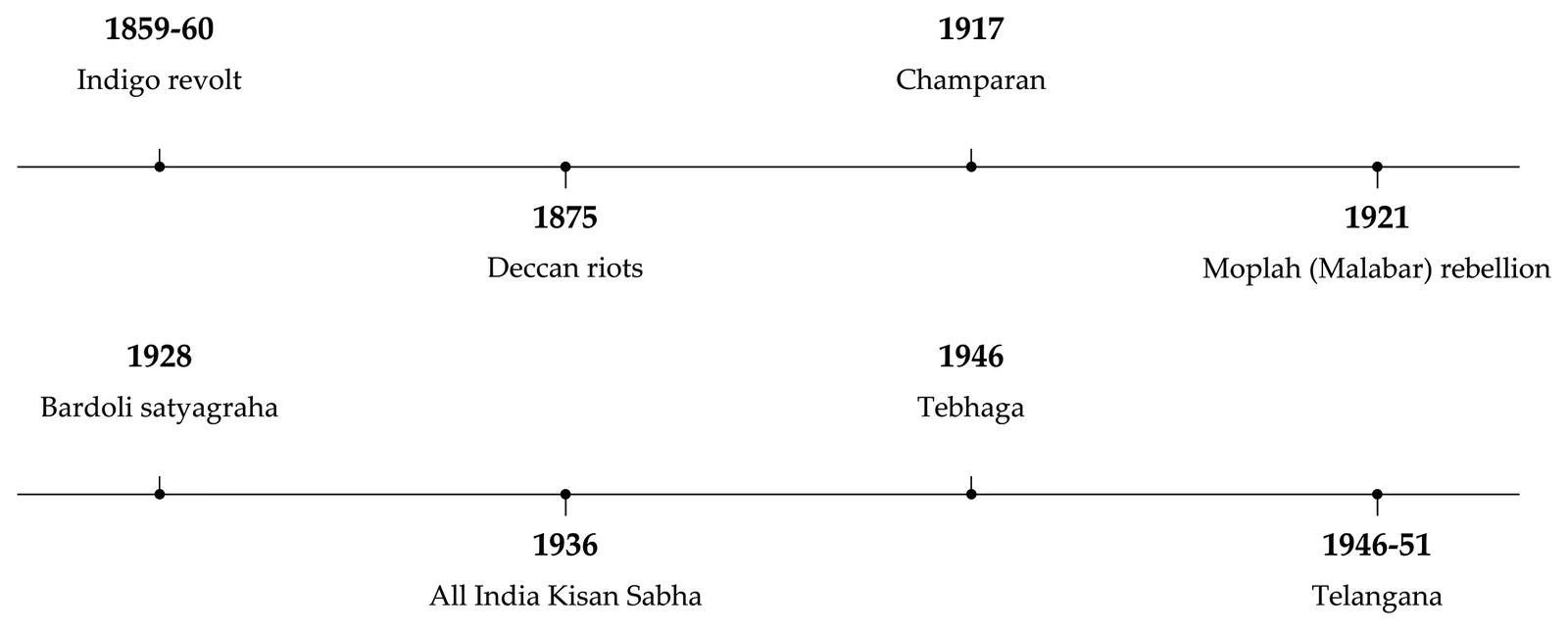
- Indigo revolt (1859–60). Bengal peasants refused to grow indigo for European planters; Dinabandhu Mitra’s play Nil Darpan (1860) exposed the planters’ oppression.
- Pabna (1873) and Deccan riots (1875). Peasants organised against high rents in Pabna and attacked the moneylenders of Poona and Ahmednagar in the Deccan, leading to the Deccan Agriculturists’ Relief Act (1879).
- Champaran (1917) and Kheda (1918). Gandhi’s first satyagrahas, for indigo cultivators and for peasants facing revenue after crop failure.
- Awadh Kisan Sabha and the Eka movement (1920–22). Led by Baba Ramchandra and Madari Pasi against eviction and illegal levies by talukdars.
- Moplah rebellion (1921). Muslim tenants of Malabar rose against Hindu landlords and the British, linked with the Khilafat agitation; it took a communal turn.
- Bardoli satyagraha (1928). Under Vallabhbhai Patel, who earned the title ‘Sardar’, Gujarat peasants successfully resisted a revenue increase.
- All India Kisan Sabha (1936). Founded at Lucknow with Swami Sahajanand Saraswati as president and N.G. Ranga as a leading organiser, it demanded the abolition of zamindari.
- Tebhaga (1946–47) and Telangana (1946–51). Sharecroppers in Bengal demanded two-thirds of the crop; in Telangana peasants led by communists rose against the Nizam and the landlords.
Features of the peasant movements. They grew from local grievances against particular planters, landlords and moneylenders into an all-India organisation; they moved from appeals to courts and officials to mass action and no-rent campaigns; they were linked with the national movement from 1917 and with the left from the 1930s; and they made land reform and the abolition of zamindari central demands of independent India. Their weakness was that the Congress leadership, anxious to keep landlords within the national movement, often restrained their radical demands.
5.2 Tribal Movements
Tribal communities suffered from colonial forest laws (Chapter 2), the loss of their land to outsiders, whom they called dikus (moneylenders, traders and landlords), forced labour and missionary interference. Their movements were often led by charismatic leaders and combined religious renewal with resistance:
- Santhal Hul (1855–56). Led by the brothers Sidhu and Kanhu against moneylenders, zamindars and the police; after its suppression the Santhal Parganas district was created.
- Munda Ulgulan (1899–1900). Led by Birsa Munda, who called for the end of Queen Victoria’s rule and the restoration of Munda land rights; it led to the Chotanagpur Tenancy Act (1908).
- Bhil movements. Govind Guru led a reform and resistance movement among the Bhils, which ended in the Mangarh massacre (1913).
- Rampa rebellion (1922–24). Alluri Sitarama Raju led the hill tribes of the Andhra region against forest restrictions and forced labour.
- Naga resistance. Rani Gaidinliu led the Heraka movement against British rule in the 1930s and was imprisoned until 1947.
Features of the tribal movements. They were directed against outsiders (dikus) and the colonial state that protected them; they defended community control over land and forests; they were often led by charismatic religious figures who combined social reform with resistance, as Birsa did; they used traditional weapons and were brutally suppressed; and they led to protective tenancy laws and the later idea of special constitutional protection for Scheduled Areas.
5.3 The Working-Class Movement
Modern industry created a new working class in textile mills, jute mills, railways, mines and plantations, suffering from long hours, low wages and harsh conditions. Its movement developed in stages. Early efforts were philanthropic: N.M. Lokhande founded the Bombay Mill Hands’ Association (1890), and the Factory Acts of 1881 and 1891 regulated child labour. During the Swadeshi movement, workers struck in support of nationalism, and the Bombay strike against Tilak’s conviction (1908) was praised by Lenin. The All India Trade Union Congress (AITUC) was founded in 1920, with Lala Lajpat Rai as president and N.M. Joshi as a leading figure, and Gandhi and Anasuya Sarabhai built the Ahmedabad Textile Labour Association (1920). In the late 1920s the communist-led Girni Kamgar Union organised great strikes in Bombay. The government responded with the Trade Disputes Act (1929) and the Meerut Conspiracy Case (1929–33). Workers took part in the Civil Disobedience and Quit India movements, and the movement strengthened the left wing of nationalism.
5.4 The Women’s Movement
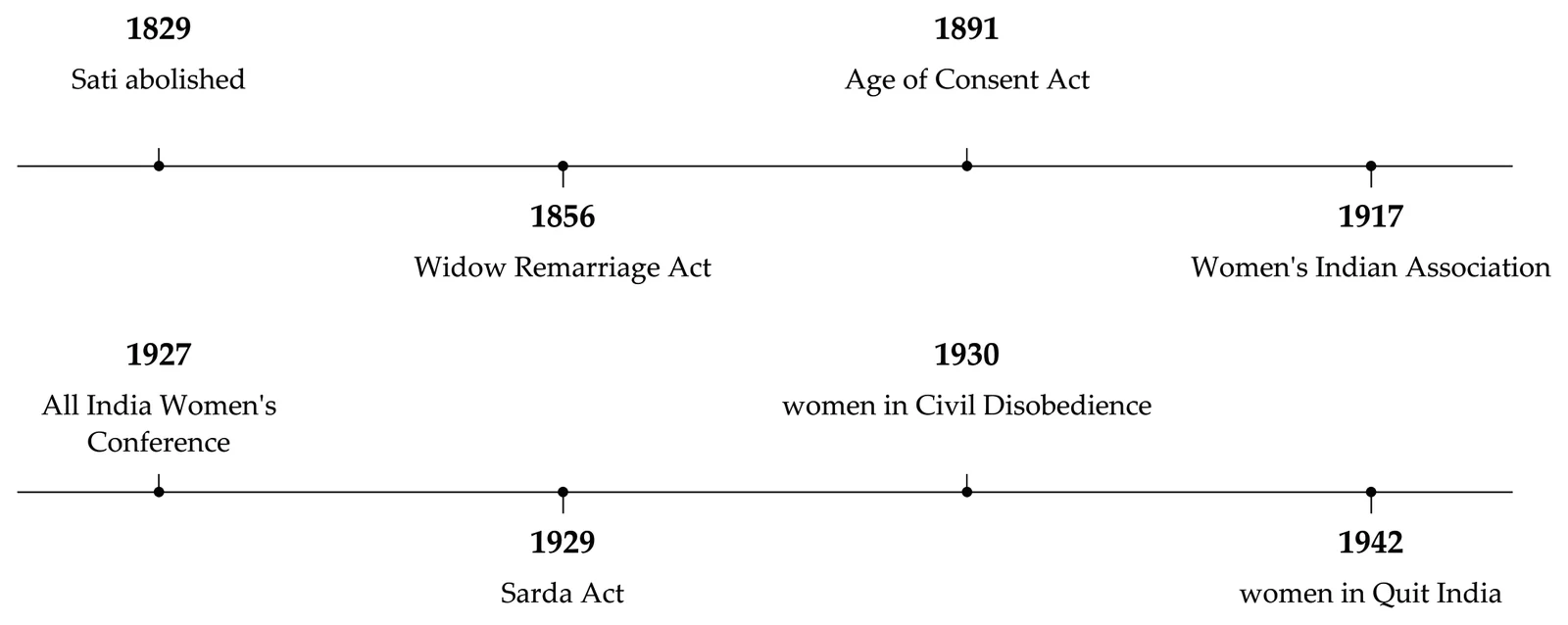
The women’s movement developed in three stages (Figure 5.3).
A. Social reform for women (nineteenth century)
Male reformers led early campaigns: the abolition of sati (1829, Rammohan Roy), the Widow Remarriage Act (1856, Vidyasagar) and the Age of Consent Act (1891), which raised the age of consent to twelve after the Phulmani case and the Rakhmabai controversy. Women soon spoke for themselves: Savitribai Phule taught in the girls’ school she and Jyotirao Phule opened in Pune in 1848; Pandita Ramabai founded the Arya Mahila Samaj (1882) and the Sharada Sadan for widows; Tarabai Shinde wrote Stri Purush Tulana (1882), a sharp critique of patriarchy; and Rokeya Sakhawat Hossain wrote Sultana’s Dream (1905) and worked for Muslim girls’ education.
B. Women’s organisations (from 1917)
Women formed their own organisations: the Women’s Indian Association (1917), founded by Annie Besant, Margaret Cousins and others; the National Council of Women in India (1925); and the All India Women’s Conference (1927), which campaigned for education, the vote and legal reform, including the Sarda Act (1929) against child marriage.
C. Women in the freedom struggle
Women joined the Swadeshi movement, and in large numbers the Non-Cooperation, Civil Disobedience and Quit India movements: picketing shops, making salt, leading processions and going to jail. Sarojini Naidu became the first Indian woman president of the Congress (1925); Kamaladevi Chattopadhyay, Aruna Asaf Ali, Usha Mehta and Matangini Hazra became symbols of courage; revolutionaries such as Pritilata Waddedar and Kalpana Dutt took part in armed actions; and Lakshmi Sahgal led the Rani of Jhansi Regiment of the INA. Partha Chatterjee argued that nationalism ‘resolved’ the women’s question by placing women as guardians of the spiritual ‘inner domain’, while Kumkum Sangari and Sudesh Vaid (Recasting Women, 1989) showed how colonial and nationalist ideas reshaped patriarchy.
5.5 Anti-Caste Movements
The anti-caste movements, described by A.R. Desai as the ‘crusade against caste and untouchability’, challenged Brahmanical dominance and demanded dignity and equal rights (Figure 5.4).
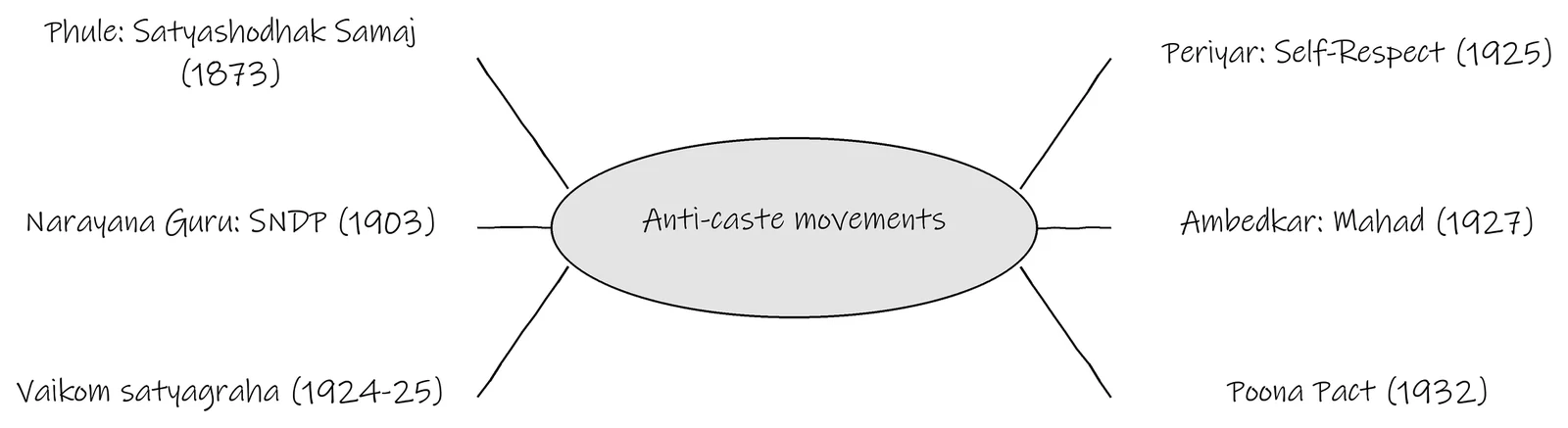
- Jyotirao Phule and the Satyashodhak Samaj (1873). Phule’s Gulamgiri (1873) described caste as slavery imposed by Brahmins; he opened schools for girls and lower castes and founded the Satyashodhak Samaj.
- Sree Narayana Guru and the SNDP Yogam (1903). In Kerala, Narayana Guru preached ‘one caste, one religion, one God for man’, consecrated temples for the Ezhavas and inspired social uplift; Ayyankali fought for Dalit access to roads and schools.
- Vaikom Satyagraha (1924–25). A struggle in Travancore for the right of lower castes to use the roads around the Vaikom temple, supported by Gandhi and E.V. Ramasamy.
- Periyar and the Self-Respect Movement (1925). E.V. Ramasamy (Periyar) attacked Brahmanical religion, caste and the subordination of women, laying the foundations of the Dravidian movement; the Justice Party (1916) had already challenged Brahmin dominance in Madras.
- B.R. Ambedkar. He founded the Bahishkrit Hitakarini Sabha (1924), led the Mahad Satyagraha (1927) for the right to draw water from the Chavdar tank, publicly burnt the Manusmriti (25 December 1927), and led the Kalaram temple entry movement (1930).
- The Poona Pact (1932). When the Communal Award gave separate electorates to the depressed classes, Gandhi fasted in protest; the Poona Pact between Gandhi and Ambedkar replaced them with reserved seats in joint electorates.
Ambedkar went on to found the Independent Labour Party (1936) and the Scheduled Castes Federation (1942), and as chairman of the Drafting Committee shaped the Constitution, which abolished untouchability (Article 17). Gandhi’s Harijan Sevak Sangh (1932) worked against untouchability within the Hindu fold, but Ambedkar criticised Gandhi’s defence of varna.
5.6 Important Questions
- Question 1 Discuss the contribution of women in India’s freedom movement.
- Question 2 Write an essay on anti-caste movements in colonial India.
- Question 3 Discuss the nature of peasant and tribal movements in colonial India.
- Question 4 Discuss the growth of the working-class movement in colonial India.
DU asks the same idea in different words. So learn one broad answer for each question below; the same answer works for every question joined by OR.
Important Question 1
Discuss the contribution of women in India’s freedom movement.
OR
Trace the emergence of the women’s movement in colonial India.
OR
Write a note on the emancipation of women in colonial India.
Model Answer
“When woman, whom we call abala, becomes sabala, all those who are helpless will become powerful.”
— Mahatma Gandhi
Introduction. Women played a vital role in India’s freedom movement, and the movement in turn opened public life to women. Their contribution combined two struggles: the struggle for national freedom from colonial rule and the struggle for their own emancipation from social restrictions. A.R. Desai described the ‘movement for the emancipation of women’ as one of the major social movements of modern India.
1. The Nineteenth-Century Background
Male reformers first raised the ‘women’s question’: Rammohan Roy campaigned against sati (abolished 1829), Vidyasagar for widow remarriage (Act of 1856), and reformers for the Age of Consent Act (1891) and female education. Women soon spoke for themselves. Savitribai Phule taught at the girls’ school opened in Pune in 1848; Pandita Ramabai founded the Arya Mahila Samaj (1882) and the Sharada Sadan for widows; Tarabai Shinde’s Stri Purush Tulana (1882) attacked patriarchy; and Rokeya Sakhawat Hossain’s Sultana’s Dream (1905) imagined a world ruled by women.
2. Women’s Organisations
From 1917 women formed their own organisations: the Women’s Indian Association (1917), founded by Annie Besant, Margaret Cousins and Dorothy Jinarajadasa, which demanded the vote; the National Council of Women in India (1925); and the All India Women’s Conference (1927), which campaigned for education, franchise and legal reform, including the Sarda Act (1929) that raised the age of marriage. Women gained limited voting rights in the provinces from the 1920s and wider rights under the 1935 Act. The All India Women’s Conference (1927) campaigned for education, for the Sarda Act (1929) against child marriage and for women’s legal rights.
3. Swadeshi and Non-Cooperation
During the Swadeshi movement women boycotted foreign goods, spun yarn and observed arandhan (not cooking) as a protest on 16 October 1905. In Non-Cooperation (1920–22), women such as Basanti Devi and Urmila Devi in Bengal joined picketing and processions, and many donated their jewellery to the Tilak Swaraj Fund.
4. Civil Disobedience
Civil Disobedience (1930–34) saw the largest participation of women. They made salt, picketed liquor and foreign-cloth shops, led processions and courted arrest in thousands. Sarojini Naidu led the raid on the Dharasana salt works after Gandhi’s arrest, Kamaladevi Chattopadhyay broke the salt law in Bombay, and in many towns women’s committees organised the boycott. Kamaladevi Chattopadhyay was among the first women arrested for breaking the salt law.
5. Quit India
In 1942 Aruna Asaf Ali hoisted the national flag at Gowalia Tank and led the underground movement; Usha Mehta ran the secret Congress Radio; Sucheta Kripalani organised underground work; and Matangini Hazra, aged seventy-three, was shot dead leading a procession in Tamluk with the flag in her hand. Usha Mehta ran the underground Congress Radio in Bombay.
6. Revolutionaries and the INA
Women also took part in armed struggle: Pritilata Waddedar died leading an attack on the Pahartali European Club (1932), Kalpana Dutt joined Surya Sen’s Chittagong group, Bina Das fired at the Governor of Bengal (1932), and Lakshmi Sahgal commanded the Rani of Jhansi Regiment of the Indian National Army. The Rani of Jhansi Regiment of the INA was commanded by Lakshmi Swaminathan (later Sahgal).
7. Leadership and Political Rights
Annie Besant (1917) and Sarojini Naidu (1925) became presidents of the Congress; women entered legislatures after the 1937 elections; and women such as Hansa Mehta, Durgabai Deshmukh and Rajkumari Amrit Kaur later sat in the Constituent Assembly, which guaranteed equal rights and universal adult franchise.
8. Women in the Constituent Assembly
Fifteen women sat in the Constituent Assembly, among them Hansa Mehta, Rajkumari Amrit Kaur, Durgabai Deshmukh and Ammu Swaminathan, and helped secure equal citizenship and universal adult franchise.
9. Evaluation
Participation gave women confidence, a public role and political rights, and helped secure legal equality in the Constitution. But most leaders came from the middle and upper classes, and nationalism often expected women to act as guardians of tradition; Partha Chatterjee argued that nationalism ‘resolved’ the women’s question by assigning women to the spiritual ‘inner domain’, while Kumkum Sangari and Sudesh Vaid (Recasting Women, 1989) showed how both colonial and nationalist ideas reshaped patriarchy. Issues such as personal law and the division of household labour remained largely unchallenged. Yet much of women’s participation was guided by male leaders and framed in terms of their roles as mothers and wives.
Conclusion. Thus, women were not only participants but leaders of the freedom struggle, and their fight for national freedom became a fight for their own equality, whose results were written into the Constitution of India.
Important Question 2
Write an essay on anti-caste movements in colonial India.
OR
Discuss Ambedkar’s role in the anti-caste movement.
OR
Write a short note on anti-caste movements.
Model Answer
“Caste is not a physical object like a wall of bricks. It is a notion; it is a state of the mind.”
— B.R. Ambedkar, Annihilation of Caste (1936)
Introduction. Anti-caste movements challenged the hierarchy of caste and the practice of untouchability, demanding dignity, equal rights and access to education, temples, water sources, public roads and political power. A.R. Desai described them as a ‘crusade against caste’ and a ‘crusade against untouchability’ that formed an essential part of the making of modern India.
1. Background
Caste hierarchy and untouchability denied millions basic rights. Colonial rule brought new opportunities, such as English education, the army, missionary schools and modern occupations, but also new rigidities, since the census classified and ranked castes. The new opportunities allowed lower castes to organise and protest. Colonial education, the census and new courts gave lower castes both new opportunities and new forms of organisation.
2. Jyotirao Phule
Phule’s Gulamgiri (1873) described caste as a form of slavery imposed by Brahmins, comparing the condition of Shudras and Ati-Shudras to that of slaves in America. With Savitribai Phule he opened schools for girls and lower castes (from 1848), and founded the Satyashodhak Samaj (1873), which conducted marriages without Brahmin priests. He founded the Satyashodhak Samaj (1873) and, with Savitribai Phule, opened schools for girls and lower castes from 1848.
3. Kerala: Narayana Guru and Ayyankali
Sree Narayana Guru preached ‘one caste, one religion, one God for man’, consecrated temples for the Ezhavas (Aruvippuram, 1888) and founded the SNDP Yogam (1903). Ayyankali fought for the right of Dalits to use public roads and send their children to schools. The Vaikom Satyagraha (1924–25), supported by Gandhi and E.V. Ramasamy, won lower castes the right to use the roads around the Vaikom temple, and the Temple Entry Proclamation of Travancore followed in 1936. The Vaikom Satyagraha (1924–25) for the right to use roads near the temple drew support from Gandhi and Periyar.
4. Periyar and the Self-Respect Movement
In Madras Presidency the Justice Party (1916) challenged Brahmin dominance in education and jobs. E.V. Ramasamy (Periyar) founded the Self-Respect Movement (1925), attacking Brahmanical religion, caste and the subordination of women, promoting self-respect marriages, and laying the foundations of the Dravidian movement. He promoted self-respect marriages and attacked Brahmin dominance in religion and politics.
5. Non-Brahmin Movements
In Maharashtra and Madras, non-Brahmin movements of peasants and middle castes challenged Brahmin dominance in education, jobs and politics, leading to communal reservation in Madras government jobs from the 1920s.
6. B.R. Ambedkar
Ambedkar founded the Bahishkrit Hitakarini Sabha (1924) with the motto ‘Educate, agitate and organise’. He led the Mahad Satyagraha (1927) to assert the right of untouchables to draw water from the Chavdar tank, publicly burnt the Manusmriti on 25 December 1927, and led the Kalaram temple entry movement at Nashik (1930). At the Round Table Conferences he demanded separate electorates for the depressed classes. He founded the Independent Labour Party (1936) and the Scheduled Castes Federation (1942), and in Annihilation of Caste (1936) argued that caste could not be reformed but must be destroyed. He led the Mahad Satyagraha (1927), burned the Manusmriti, and founded the Independent Labour Party (1936) and the Scheduled Castes Federation (1942).
7. The Poona Pact and Gandhi
When the Communal Award (1932) gave the depressed classes separate electorates, Gandhi began a fast unto death in Yerawada jail. The Poona Pact (September 1932) between Gandhi and Ambedkar replaced separate electorates with a larger number of reserved seats within joint electorates. Gandhi then founded the Harijan Sevak Sangh (1932) to work against untouchability, but Ambedkar criticised his defence of varna and his view of untouchability as a matter of Hindu self-purification rather than of rights.
8. Temple Entry and the Harijan Campaign
Temple entry movements, such as Guruvayur (1931–32), and Gandhi’s Harijan campaign after 1932 tried to reform Hinduism from within, though Ambedkar thought such reform inadequate.
9. Adi Dharm and Adi Hindu Movements
The Adi Dharm movement in Punjab, led by Mangoo Ram, and the Adi Hindu movement in Uttar Pradesh claimed that Dalits were the original inhabitants of India with their own religion and history.
10. Achievements and Limitations
The movements created self-respect, education and political organisation among lower castes, won access to roads, wells, schools and temples, and shaped the Constitution, which abolished untouchability (Article 17), prohibited caste discrimination (Article 15) and provided reservations. But they were often regionally confined, divided among themselves, and opposed by upper-caste conservatism. Their legacy shaped the constitutional abolition of untouchability and reservations.
Conclusion. Thus, the anti-caste movements extended the meaning of freedom from freedom from foreign rule to freedom from social domination, and their vision of equality shaped the Constitution of India.
Important Question 3
Discuss the nature of peasant and tribal movements in colonial India.
OR
Examine the role of the Kisan Sabha in the national movement.
OR
Write a note on tribal resistance to colonial rule.
Model Answer
“Abua raj seter jana, maharani raj tundu jana. (Let our rule come, let the queen’s rule end.)”
— Slogan of Birsa Munda’s Ulgulan
Introduction. Peasants and tribals were the most exploited groups under colonial rule, and they rose repeatedly against landlords, moneylenders, planters, forest officials and the colonial state. Their movements were among the most powerful forms of resistance in colonial India.
1. Causes
High land revenue and rents, illegal levies, debt and eviction; forced cultivation of indigo; the commercialisation of agriculture; forest laws that destroyed customary rights; and the loss of tribal land to outsiders (dikus) such as moneylenders, traders and landlords. Colonial forest laws, the loss of tribal land to outsiders (dikus) and the power of moneylenders and police also provoked revolts.
2. Early Peasant Movements
The Indigo revolt (1859–60) in Bengal, the Pabna agrarian league (1873) and the Deccan riots (1875) targeted particular oppressors such as planters, landlords and moneylenders, and generally accepted the legitimacy of colonial rule while appealing to the courts and the government. The Indigo Revolt won support from the Bengali intelligentsia, including Dinabandhu Mitra’s play Nil Darpan (1860).
3. Peasants and the National Movement
From 1917, peasant movements became linked with nationalism: Champaran (1917), Kheda (1918), the Awadh Kisan Sabha and Eka movements (1920–22) led by Baba Ramchandra and Madari Pasi, the Moplah rebellion (1921), which took a communal turn, the Bardoli satyagraha (1928) under Vallabhbhai Patel, and no-tax campaigns during Civil Disobedience. The Malabar rebellion (1921) and the Bardoli Satyagraha (1928) under Vallabhbhai Patel showed both the radical and the disciplined sides of peasant action.
4. Organised Kisan Movements
The All India Kisan Sabha (1936), with Swami Sahajanand Saraswati as president and N.G. Ranga and others as organisers, demanded the abolition of zamindari, reduction of rent and cancellation of debts. Its Kisan Manifesto influenced the Congress’s Faizpur programme (1936). The most radical struggles came at the end of colonial rule: Tebhaga (1946–47), in which Bengal sharecroppers demanded two-thirds of the crop, and Telangana (1946–51), an armed peasant struggle against the Nizam and the landlords. The Tebhaga movement (1946–47) in Bengal demanded two-thirds of the crop for sharecroppers, and the Telangana struggle (1946–51) fought against landlords and the Nizam.
5. Tribal Movements
The Santhal Hul (1855–56) led by Sidhu and Kanhu, Birsa Munda’s Ulgulan (1899–1900), Govind Guru’s Bhil movement (ending in the Mangarh massacre, 1913), Alluri Sitarama Raju’s Rampa rebellion (1922–24) and Rani Gaidinliu’s Heraka movement combined religious renewal with resistance to land loss, forced labour and forest laws. They led to protective laws such as the Chotanagpur Tenancy Act (1908) and the Santhal Parganas Tenancy Act. Birsa Munda led the Mundas against landlords, missionaries and the British, and is remembered as Dharti Aba, father of the earth.
6. Religion and Prophetic Leadership
Many tribal and peasant movements used religious language and prophetic leaders, as with Birsa Munda and the Santhal leaders who spoke of divine command, which gave them unity and courage.
7. Nature and Interpretations
Subaltern historians such as Ranajit Guha, in Elementary Aspects of Peasant Insurgency in Colonial India (1983), emphasised the autonomy of peasant consciousness, expressed through rumour, religion and community solidarity. Marxist historians stressed their class character and their link with the Kisan Sabhas and communists. Nationalist historians saw them as part of the broader anti-colonial struggle. Nationalist historians stressed peasants’ contribution to the freedom struggle, Marxists their class consciousness and subaltern historians their autonomous politics and religious idiom.
8. The Colonial Response
The British responded with repression but also with laws such as the Chotanagpur Tenancy Act (1908) and the Santhal Parganas tenancy laws, which restricted the transfer of tribal land.
9. Significance
These movements forced tenancy and forest reforms, widened the social base of nationalism, and placed land reform and the abolition of zamindari on the agenda of independent India.
10. Evaluation
Peasant and tribal movements show that the struggle against colonialism was also a struggle against landlords, moneylenders and the colonial state’s control over land and forests. Their demands shaped land reforms and tribal protections in independent India.
Conclusion. Thus, peasant and tribal movements were a powerful, often autonomous part of India’s struggle against colonial exploitation, and they gave the idea of freedom a social and economic meaning.
Important Question 4
Discuss the growth of the working-class movement in colonial India.
OR
Write a note on trade unions and the national movement.
Model Answer
“Workers of the world, unite!”
— Marx and Engels, The Communist Manifesto (1848)
Introduction. Modern industry created an Indian working class in textile mills, jute mills, railways, mines and plantations. Facing long hours, low wages and harsh conditions, workers gradually organised, and their movement became linked with nationalism and socialism.
1. Early Phase
Early efforts were philanthropic: Sasipada Banerjee in Bengal and N.M. Lokhande, who founded the Bombay Mill Hands’ Association (1890). The Factory Acts of 1881 and 1891 regulated child labour and hours, partly under pressure from Lancashire mill-owners. The Factory Acts of 1881 and 1891 limited working hours for children and women, partly under pressure from Lancashire mill owners who feared Indian competition.
2. Swadeshi and the War Years
During the Swadeshi movement workers struck in railways and printing presses; the Bombay workers’ strike against Tilak’s conviction (1908) was praised by Lenin. Price rises during the First World War led to a strike wave (1918–20). Lenin described the Bombay workers’ strike of 1908 against Tilak’s conviction as a sign of the political awakening of the Indian proletariat.
3. The Ahmedabad Mill Strike, 1918
Gandhi led the textile workers of Ahmedabad in 1918, using a fast to secure a wage increase through arbitration, and the Textile Labour Association (1920) that grew from it favoured negotiation over class struggle.
4. Post-War Upsurge
After the First World War, rising prices and the influence of the Russian Revolution led to a wave of strikes in mills, railways and plantations between 1918 and 1921.
5. Organisation
The All India Trade Union Congress was founded in 1920 with Lala Lajpat Rai as president; Gandhi and Anasuya Sarabhai built the Ahmedabad Textile Labour Association (1920); and the Trade Unions Act (1926) gave unions legal recognition. The Trade Unions Act (1926) gave legal recognition to unions. N.M. Joshi was among its moderate leaders.
6. Plantation and Railway Workers
Workers in the Assam tea gardens, recruited on harsh contracts, faced brutal conditions, and in the Chargola exodus of 1921 thousands left the gardens; railway strikes were among the largest of the period.
7. Left Influence and Repression
In the late 1920s the communist-led Girni Kamgar Union organised massive strikes in Bombay. The government responded with the Trade Disputes Act (1929) and the Meerut Conspiracy Case (1929–33) against communist and trade union leaders. In the Meerut Conspiracy Case (1929–33) the government tried thirty-one labour leaders, including British communists, to crush the left-led unions.

8. Divisions and Splits
The trade union movement split between communists, socialists and moderates: the AITUC divided in 1929, and the Indian National Trade Union Congress was formed in 1947 under Congress leadership.
9. Workers and the National Movement
Nationalist leaders were cautious about supporting strikes against Indian employers, which created tension between nationalism and labour; the left argued that the freedom struggle must also fight capitalism.
10. Competing Ideologies
Gandhian unions sought cooperation and arbitration, socialists sought reforms within democracy, and communists aimed at class struggle and revolution, so the movement was shaped by competing ideas of workers’ freedom.
11. Ambedkar and Labour
Ambedkar’s Independent Labour Party (1936) linked caste and class, arguing that Dalit workers faced discrimination even in mills and unions; as Labour Member of the Viceroy’s Council (1942–46) he shaped labour legislation.
12. Evaluation
Workers took part in Civil Disobedience and Quit India, and strengthened the left wing of nationalism, but the movement was divided between moderate, nationalist and communist unions. But the working class remained small, divided by caste, religion and region, and dependent on outside leaders.
13. Features of the Working-Class Movement
The movement grew from philanthropic welfare to organised trade unions; it linked economic demands with nationalism, as in the 1908 Bombay strike and participation in Civil Disobedience and Quit India; it was influenced by Gandhian methods in Ahmedabad and by communist leadership in Bombay and Calcutta; and it won legal recognition through the Trade Unions Act (1926). Its weaknesses were divisions between unions, the small size of the industrial workforce and repression by the colonial state. Women workers in textile mills and plantations also took part in strikes, though their issues were often neglected.
14. Legacy
The colonial working-class movement laid the foundations of trade unionism and labour law in independent India, and its struggles contributed to the Constitution’s commitment to workers’ rights in the Directive Principles.
Conclusion. Thus, the working-class movement linked national freedom with economic justice and gave Indian politics a lasting socialist dimension.
Short Notes
(a) Anti-caste Movements
Anti-caste movements challenged caste hierarchy and untouchability in colonial India. Jyotirao Phule’s Satyashodhak Samaj (1873) attacked Brahmanical dominance; Sree Narayana Guru’s SNDP Yogam (1903) and Ayyankali fought for the dignity of Ezhavas and Dalits in Kerala; the Vaikom Satyagraha (1924–25) won access to temple roads; Periyar’s Self-Respect Movement (1925) built the Dravidian movement; and B.R. Ambedkar led the Mahad Satyagraha (1927) and the Kalaram temple entry (1930). The Poona Pact (1932) secured reserved seats. These movements shaped the Constitution’s abolition of untouchability (Article 17).
(b) The Poona Pact (1932)
The Communal Award (August 1932) of the British Prime Minister Ramsay MacDonald gave separate electorates to the depressed classes. Gandhi, then in Yerawada jail, began a fast unto death on 20 September 1932, arguing that separate electorates would divide Hindu society. The Poona Pact, signed on 24 September 1932 by Ambedkar and Madan Mohan Malaviya on behalf of caste Hindus, replaced separate electorates with 148 reserved seats for the depressed classes in joint electorates, roughly double the 71 seats of the Award. Ambedkar accepted it under great pressure and later criticised it.
(c) Birsa Munda and the Ulgulan
Birsa Munda (1875–1900) led the Ulgulan (great tumult) of the Mundas of Chotanagpur in 1899–1900 against landlords, moneylenders, missionaries and the colonial state, which had destroyed the khuntkatti system of community land rights. He presented himself as a messenger of God, preached reform of Munda society and called for the end of the Queen’s rule. He died in Ranchi jail in 1900. The rebellion led to the Chotanagpur Tenancy Act (1908), and Birsa is remembered as Dharti Aba (father of the earth).
More notes: DSC-3 Colonialism and Nationalism in India
These notes are prepared by PADHO TO AISE for study help. They are not an official University of Delhi publication.