
Semester I DSC-3 Colonialism and Nationalism in India
Unit IV · 27 min read · Updated 24 Nov 2026
As per the University of Delhi (DU) BA (Hons) Political Science syllabus
Contents
- 4.1 Phases of the National Movement
- 4.2 Liberal Constitutionalists: The Moderates (1885–1905)
- 4.3 Swadeshi and the Radicals (1905–1918)
- Features of the Swadeshi Movement
- The Radicals (Extremists)
- The Formation of the Muslim League
- 4.4 Gandhi and Mass Mobilisation
- Early Satyagrahas
- Non-Cooperation and Khilafat (1920–22)
- Civil Disobedience (1930–34)
- Quit India (1942)
- Features of Gandhian Mass Mobilisation
- 4.5 Revolutionaries, Socialists and Communists
- 4.6 Communalism, the Two-Nation Theory and the Partition
- The Negotiations over Partition
- 4.7 Important Questions and Short Notes
- Evaluate the strategies of Liberal constitutionalist and Swadeshi in nationalist politics during the freedom movement.
- Discuss the role of Gandhi in mass mobilisation of the freedom struggle with special reference to the Civil Disobedience Movement.
- Discuss the factors that led to the rise of communal politics in colonial India. How far did it impact the negotiation over the partition of India?
- Short Notes
करो या मरो।
Do or die.
— Mahatma Gandhi, Quit India speech, 8 August 1942
WHEN THE INDIAN NATIONAL CONGRESS met for the first time in 1885, it was a gathering of seventy-two educated men who politely petitioned the British government. Sixty years later, the national movement had drawn in millions of peasants, workers, women and students across the subcontinent. This chapter tells how nationalist politics expanded its social base. We study the three phases of the movement, liberal constitutionalism, Swadeshi and radicalism, and the Gandhian era of mass satyagraha, together with the formation of the Muslim League; the revolutionaries, socialists and communists who offered alternatives; and the rise of communal politics, the two-nation theory and the negotiations that ended in the partition of 1947.
4.1 Phases of the National Movement
Historians usually divide the national movement into three phases (Figure 4.2). Each phase widened the social base of nationalism: from the educated middle class to the lower middle class and students, and finally to the masses of peasants, workers and women.

4.2 Liberal Constitutionalists: The Moderates (1885–1905)
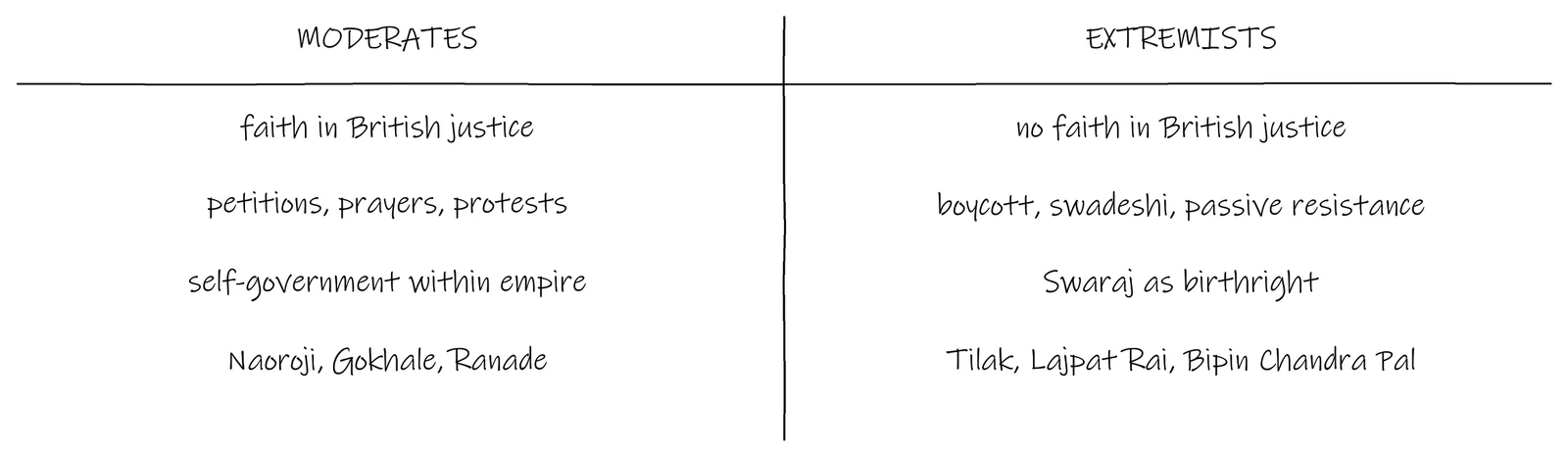
The early leaders of the Congress are called the Moderates or liberal constitutionalists. They were influenced by British liberalism and believed that British rule, though unjust in many ways, could be reformed by appealing to the British sense of justice. Their features were these:
- Faith in British justice. They believed that the British people, once properly informed, would grant Indians their rights; Naoroji called the injustices of British rule ‘un-British’.
- Constitutional methods. They used petitions, resolutions, memoranda, speeches and deputations, sometimes summed up as ‘prayer, petition and protest’.
- Gradual reform. They demanded the expansion of legislative councils with elected Indians, simultaneous ICS examinations in India, separation of the judiciary from the executive, and more Indians in higher services, aiming at self-government within the empire.
- Economic critique. Their most lasting contribution was the analysis of colonial exploitation: Naoroji’s drain theory, R.C. Dutt’s Economic History of India and Ranade’s writings on Indian economics.
- Secular and inclusive nationalism. They tried to unite Indians of all regions and religions on common political and economic demands.
- Political education. Through the press and the annual Congress sessions they created a national public opinion.
Their achievements included the Indian Councils Act of 1892 and the spread of nationalist ideas. Their limitations were a narrow social base among the educated elite, excessive faith in British justice, and failure to involve the masses. These limitations led younger nationalists to demand more militant methods.
4.3 Swadeshi and the Radicals (1905–1918)
The Partition of Bengal, announced by Lord Curzon in July 1905 and effective from 16 October 1905, divided the province into a Muslim-majority east and a Hindu-majority west, officially for administrative convenience but widely seen as an attempt to weaken Bengali nationalism. It gave birth to the Swadeshi movement. Sumit Sarkar, in The Swadeshi Movement in Bengal, 1903–1908 (1973), identified four trends within it: moderate politics, constructive swadeshi (self-help through industry, education and village work, associated with Tagore), political extremism (boycott and passive resistance) and revolutionary terrorism.
Features of the Swadeshi Movement
- Boycott. Foreign goods, especially Manchester cloth, were boycotted and publicly burnt; boycott later extended to government schools, courts and titles.
- Swadeshi enterprise. Indian textile mills, soap and match factories, banks and insurance companies were promoted; Bengal Chemicals of P.C. Ray became a symbol.
- National education. The National Council of Education (1906) and the Bengal National College, with Aurobindo Ghose as principal, offered an alternative to colonial education.
- Mass mobilisation. Samitis, such as Ashwini Kumar Dutta’s Swadesh Bandhab Samiti in Barisal, organised volunteers; Tagore’s songs, such as Amar Sonar Bangla, and the tying of rakhi expressed unity.
- Passive resistance. Aurobindo’s ‘Doctrine of Passive Resistance’ (1907) called for non-cooperation with the colonial government.
- Swaraj as the goal. The Calcutta Congress of 1906 under Naoroji declared swaraj to be its aim.
The Radicals (Extremists)
The leaders of this phase, known as the Extremists or Radicals, were Bal Gangadhar Tilak in Maharashtra, Lala Lajpat Rai in Punjab, Bipin Chandra Pal in Bengal (together ‘Lal-Bal-Pal’) and Aurobindo Ghose. They had no faith in British justice, considered swaraj a birthright, relied on self-reliance, boycott and mass action, and used religious symbols, such as Tilak’s Ganapati (1893) and Shivaji (1895) festivals, to reach the people (Figure 4.3).
The two groups split at the Surat Congress (1907). The government responded with repression, the deportation of Tilak to Mandalay (1908) and the Morley-Minto Reforms (1909) to win over the Moderates; the partition was annulled in 1911. The Swadeshi movement’s main weakness was its failure to win over the Muslim peasantry of eastern Bengal, partly because of its Hindu religious idiom. After 1914 the two wings came together again in the Home Rule Leagues of Tilak (April 1916) and Annie Besant (September 1916) and the Lucknow Pact (1916) between the Congress and the Muslim League.
The Formation of the Muslim League
On 1 October 1906 a deputation of Muslim leaders led by the Aga Khan met the Viceroy, Lord Minto, at Simla and asked for separate electorates. On 30 December 1906 the All-India Muslim League was founded at Dacca under the leadership of Nawab Salimullah and others. Its aims were to promote loyalty to the British government, to protect the political rights of Muslims and to prevent hostility towards other communities. The separate electorates granted in 1909 gave it a lasting basis, and its formation marks the beginning of organised Muslim politics separate from the Congress.
4.4 Gandhi and Mass Mobilisation
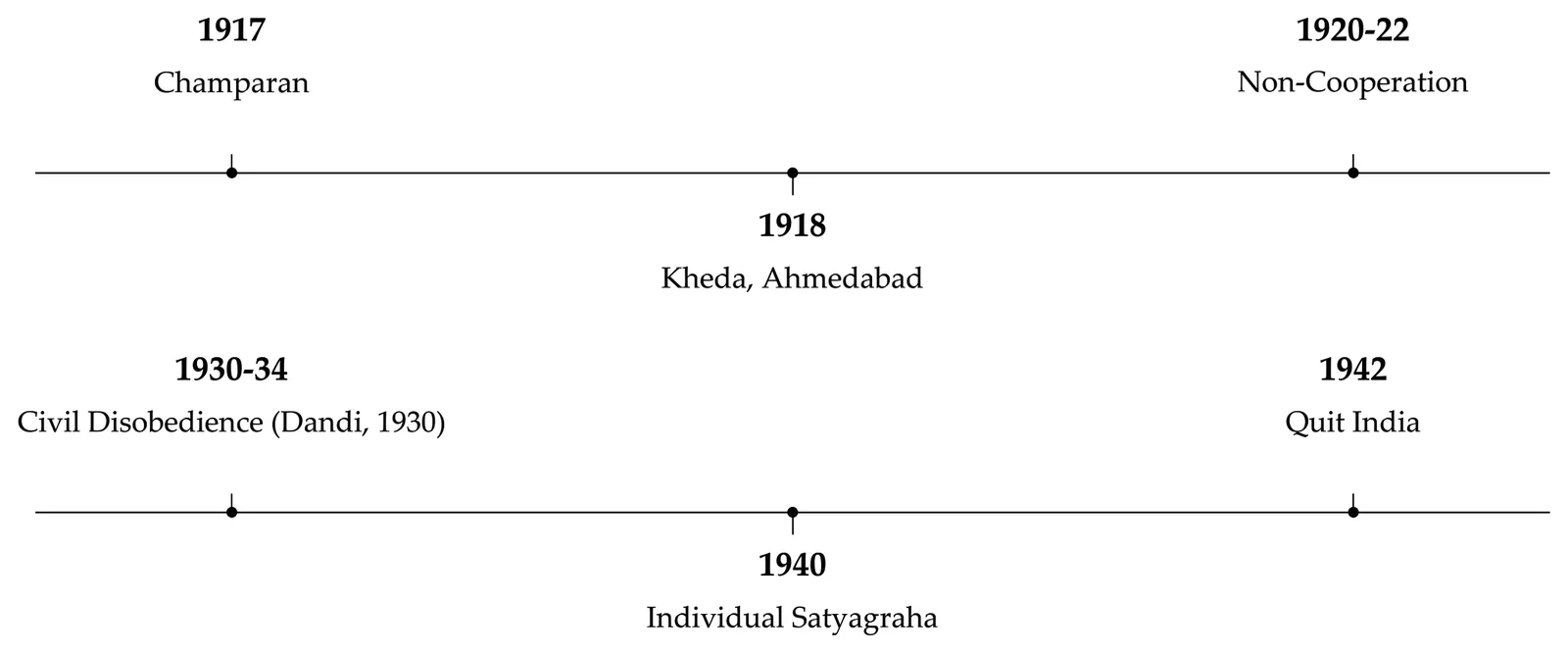
Mahatma Gandhi returned from South Africa in 1915 with a new method, satyagraha, i.e. non-violent resistance based on truth and the willingness to suffer, developed in his struggle against racial laws in South Africa and explained in Hind Swaraj (1909). He turned the national movement into a mass movement (Figure 4.4).
Early Satyagrahas
Gandhi first applied satyagraha to local grievances: at Champaran (1917) in Bihar for indigo cultivators forced to grow indigo under the tinkathia system; at Kheda (1918) in Gujarat for peasants unable to pay revenue after crop failure; and at Ahmedabad (1918) for mill workers demanding higher wages. These struggles made him a national leader.
Non-Cooperation and Khilafat (1920–22)
After the Rowlatt Act and the Jallianwala Bagh massacre at Amritsar on 13 April 1919, Gandhi joined the Khilafat cause of Indian Muslims to the demand for swaraj. The Nagpur Congress (December 1920) adopted non-cooperation: boycott of councils, courts, schools, titles and foreign cloth, and the building of national schools such as Jamia Millia Islamia and Kashi Vidyapith. The movement drew in peasants, workers, students and women on an unprecedented scale, and Hindu–Muslim unity reached its height. Gandhi withdrew it after the violence at Chauri Chaura (5 February 1922).
Civil Disobedience (1930–34)
The Lahore Congress of December 1929 declared Purna Swaraj (complete independence) the goal, and 26 January 1930 was celebrated as Independence Day. Gandhi then chose salt, a necessity of every household, as the symbol of colonial oppression. On 12 March 1930 he set out from Sabarmati Ashram with seventy-eight followers and, after a march of about 240 miles, broke the salt law at Dandi on 6 April 1930. Civil disobedience spread across India: salt laws were broken, foreign cloth and liquor shops were picketed, forest laws were defied in Maharashtra, Karnataka and the Central Provinces, peasants refused to pay taxes, and in the North-West Frontier Province the Khudai Khidmatgars of Khan Abdul Ghaffar Khan joined the movement. Thousands of women came out of their homes to take part. The movement was suspended after the Gandhi-Irwin Pact (March 1931) so that Gandhi could attend the Second Round Table Conference, resumed in 1932 and withdrawn in 1934.
Quit India (1942)
After the failure of the Cripps Mission (1942), the Congress passed the Quit India resolution at Bombay on 8 August 1942, and Gandhi gave the call ‘Do or die’. The leaders were arrested the next morning, and the movement became a spontaneous, leaderless uprising: attacks on railways, police stations and telegraph lines, parallel governments in Ballia, Tamluk and Satara, and underground activity led by Jayaprakash Narayan, Aruna Asaf Ali and Ram Manohar Lohia, with Usha Mehta’s secret Congress Radio. The British suppressed it with great force, but it showed that British rule could no longer continue without the consent of the people.
Why did Gandhi succeed in mobilising the masses? He used simple symbols (salt, khadi, the charkha) and the language of the people; his methods allowed peasants, women and the poor to participate without violence; he joined political demands to constructive work (khadi, Hindu–Muslim unity, removal of untouchability); and his saintly image, as Shahid Amin showed in ‘Gandhi as Mahatma’ (1984), inspired peasants to act in his name, sometimes in ways he had not intended.
Features of Gandhian Mass Mobilisation
- Non-violence as a mass method. Satyagraha allowed people without arms or training to resist; Gandhi withdrew Non-Cooperation after Chauri Chaura (1922) to keep it non-violent.
- Struggle–truce–struggle. Bipan Chandra described Gandhi’s strategy as phases of mass struggle followed by truce and constructive work, which allowed the movement to rest and rebuild.
- Constructive programme. Khadi, village industries, Hindu–Muslim unity, removal of untouchability, prohibition and basic education kept workers active between movements.
- Symbols of everyday life. Salt, the charkha and khadi turned ordinary acts into political protest.
- Inclusion of women. Picketing and salt-making gave women a role suited to the social conditions of the time.
- Organisation. The Congress constitution of 1920 created linguistic provincial committees and a mass membership.
Limitations. Gandhi’s leadership was criticised from several sides: by the left for protecting landlords and capitalists and for calling off movements; by Ambedkar for his defence of varna; and by the Muslim League for using Hindu religious idiom. Yet no other leader drew so many Indians into politics.
4.5 Revolutionaries, Socialists and Communists
A. The revolutionaries
Revolutionary nationalists believed that only armed struggle could end British rule. In Bengal, the Anushilan Samiti (1902) and the Jugantar group organised secret societies; Khudiram Bose was hanged in 1908. Abroad, the Ghadar Party (1913) was founded in San Francisco by Lala Har Dayal and others. In the 1920s the Hindustan Republican Association (1924) carried out the Kakori train action (1925), and in 1928 it became the Hindustan Socialist Republican Association, joining revolution with socialism. Bhagat Singh and Batukeshwar Dutt threw bombs in the Central Legislative Assembly on 8 April 1929 to ‘make the deaf hear’; Bhagat Singh, Rajguru and Sukhdev were hanged on 23 March 1931. In 1930 Surya Sen led the Chittagong armoury raid. Later, Subhas Chandra Bose led the Indian National Army (1943–45).
B. The socialists
In the 1930s socialist ideas spread among younger Congressmen influenced by the Russian Revolution and the Great Depression. The Congress Socialist Party was founded in 1934 by Jayaprakash Narayan, Acharya Narendra Dev, Ram Manohar Lohia, Minoo Masani and others, working within the Congress to give it a radical programme of land reform and workers’ rights. Jawaharlal Nehru, in his presidential address at Lucknow (1936), declared socialism the only solution to India’s problems, and Subhas Bose, elected president in 1938 and 1939, formed the Forward Bloc (1939). The socialists pushed the Congress towards the Karachi resolution on fundamental rights and economic policy (1931) and towards peasant and labour issues, and led the underground struggle in 1942.
C. The communists
The Communist Party of India was founded at Tashkent in 1920 under M.N. Roy (a conference at Kanpur in 1925 is also counted as its founding). Communists organised workers and peasants through the All India Trade Union Congress (1920), the Girni Kamgar Union of Bombay and the All India Kisan Sabha (1936). The government repressed them in the Meerut Conspiracy Case (1929–33). In 1942, after the German invasion of the Soviet Union, the CPI called the war a ‘People’s War’ and opposed the Quit India Movement, which isolated it from the national mainstream, though it later led the Tebhaga and Telangana struggles.
4.6 Communalism, the Two-Nation Theory and the Partition
Communalism is the belief that people who follow the same religion share common political, economic and social interests, which are different from and opposed to those of other religious communities. Bipan Chandra, in Communalism in Modern India (1984), described three stages: the belief in common interests of a religious community; the belief that these interests differ from those of others (liberal communalism); and the belief that they are opposed and hostile (extreme communalism). Several factors caused its rise (Figure 4.5).
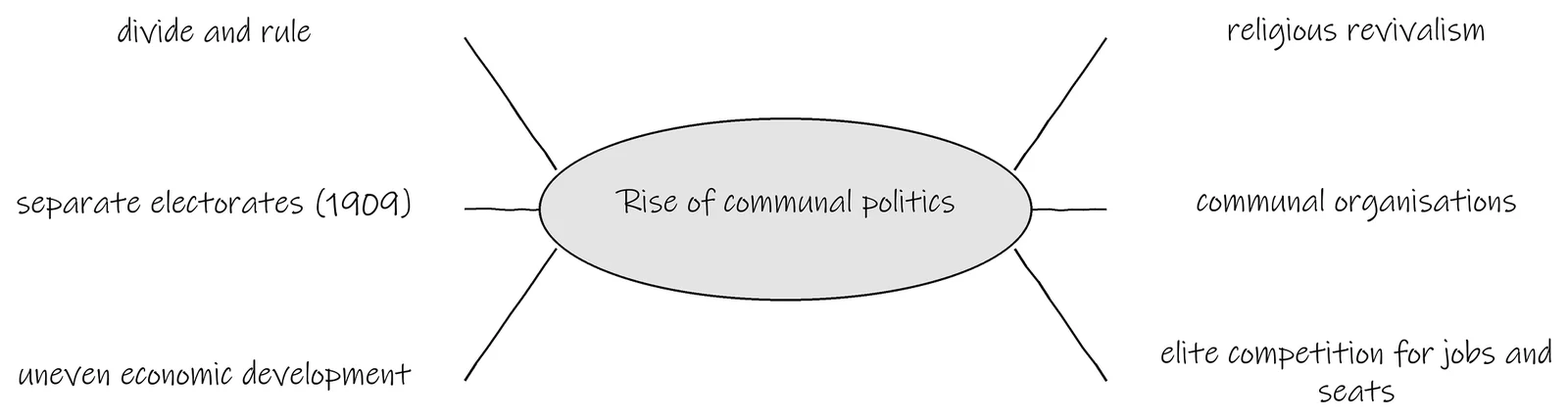
- Colonial divide and rule. The British encouraged separate identities through the census, separate electorates (1909) and the Communal Award (1932).
- Uneven development. Muslims in many regions lagged behind in modern education and employment, and competition for jobs and seats among the middle classes took communal forms.
- Religious revivalism. Movements such as cow protection, shuddhi and tabligh, and the use of religious symbols in politics, sharpened differences.
- Communal organisations. The Muslim League (1906), the Hindu Mahasabha (1915) and the Rashtriya Swayamsevak Sangh (1925) organised politics on religious lines.
- Elite politics. Leaders of both communities used religious identity to mobilise support.
The two-nation theory held that Hindus and Muslims were two separate nations. Sir Syed Ahmad Khan had warned in the 1880s that the Congress would serve Hindu interests; Muhammad Iqbal, in his Allahabad address (1930), proposed a consolidated Muslim state in the north-west; Choudhary Rahmat Ali coined the name ‘Pakistan’ (1933); V.D. Savarkar declared at the Hindu Mahasabha session at Ahmedabad (1937) that there were ‘two nations in the main’ in India; and in his Lahore address of March 1940 M.A. Jinnah argued that Hindus and Muslims were two nations, leading to the Lahore Resolution (23 March 1940), which demanded independent states for Muslim-majority areas.
The Negotiations over Partition
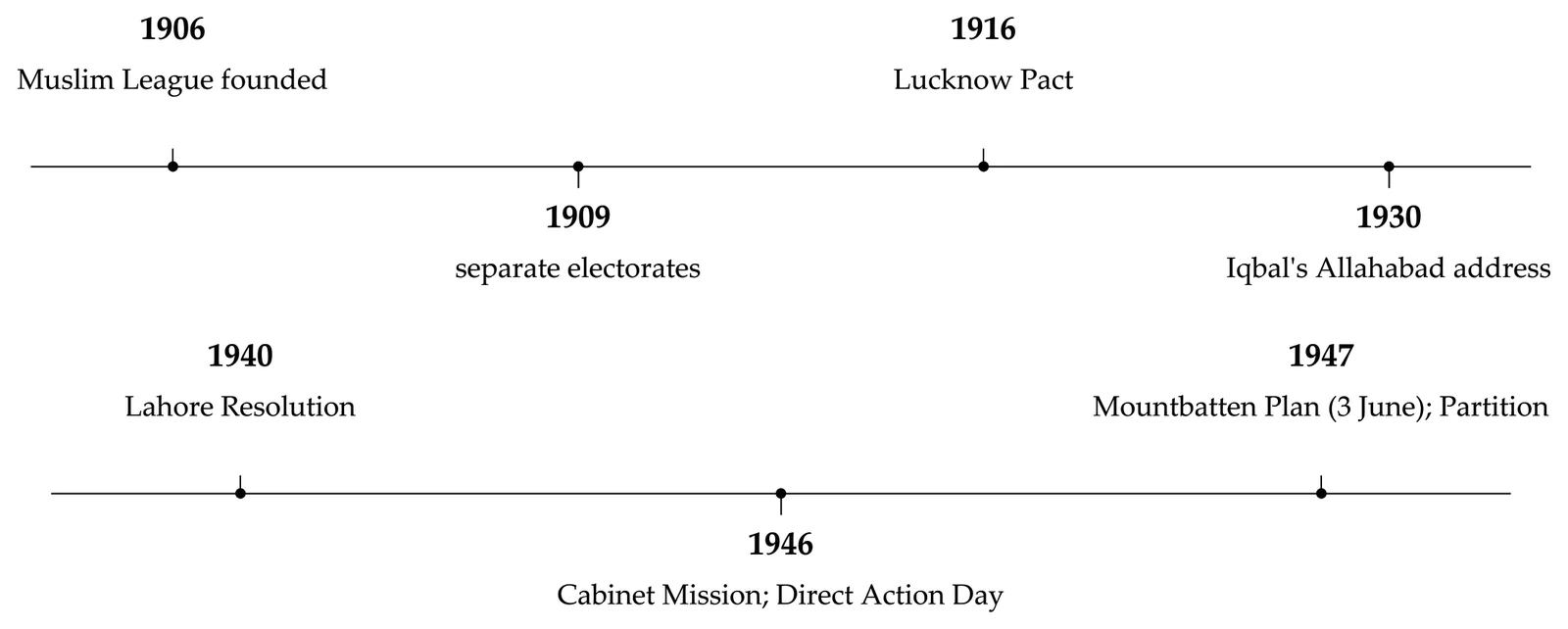
The Cripps Mission (1942) offered dominion status after the war but allowed provinces to stay out of the union, implicitly accepting partition. The Rajaji formula (1944) and the Gandhi–Jinnah talks (1944) failed, as did the Simla Conference (1945). In the 1945–46 elections the League won almost all the Muslim seats. The Cabinet Mission (1946) proposed a loose union with three groups of provinces, but disagreements over grouping led the League to withdraw and call for Direct Action on 16 August 1946, which led to mass killings in Calcutta and riots elsewhere. Prime Minister Attlee announced on 20 February 1947 that Britain would leave by June 1948, and the Mountbatten Plan of 3 June 1947 provided for partition; India and Pakistan became independent on 14–15 August 1947. Ayesha Jalal, in The Sole Spokesman (1985), argued that Jinnah used the demand for Pakistan as a bargaining counter for parity within a united India, and that partition was not his original aim.
4.7 Important Questions and Short Notes
- Question 1 Evaluate the strategies of Liberal constitutionalist and Swadeshi in nationalist politics during the freedom movement.
- Question 2 Discuss the role of Gandhi in mass mobilisation of the freedom struggle with special reference to the Civil Disobedience Movement.
- Question 3 Discuss the factors that led to the rise of communal politics in colonial India. How far did it impact the negotiation over the partition of India?
DU asks the same idea in different words. So learn one broad answer for each question below; the same answer works for every question joined by OR.
Important Question 1
Evaluate the strategies of Liberal constitutionalist and Swadeshi in nationalist politics during the freedom movement.
OR
Distinguish between the Moderates and the Extremists.
OR
Discuss the significance of the Swadeshi movement.
Model Answer
“Swaraj is my birthright, and I shall have it.”
— Bal Gangadhar Tilak
Introduction. The first two phases of the Indian national movement followed very different strategies. The liberal constitutionalists, or Moderates (1885–1905), sought gradual reform through constitutional methods and appeals to British justice. The Swadeshi nationalists, or Radicals (1905–1918), turned to boycott, self-reliance and mass action, with swaraj as their goal. Both strategies contributed to the growth of nationalism, and both had limitations.
1. The Liberal Constitutionalists
The early Congress was led by Dadabhai Naoroji, Pherozeshah Mehta, Surendranath Banerjea, Badruddin Tyabji, M.G. Ranade and G.K. Gokhale. Trained in Western liberal thought, they admired British institutions and believed that British rule, once properly informed, would grant Indians their rights. Naoroji called the injustices of British rule ‘un-British’.
2. Strategy of the Moderates
They relied on constitutional agitation: petitions, resolutions, memoranda, speeches, deputations to Britain and the press, sometimes summed up as ‘prayer, petition and protest’. Their demands were moderate: expansion of the legislative councils with elected Indian members, simultaneous ICS examinations in India and England, more Indians in higher services, separation of the judiciary from the executive, reduction of military expenditure and land revenue, and protection of Indian industry, aiming at self-government within the British Empire. They trusted British justice and hoped to persuade British public opinion through deputations to London.
3. Achievements of the Moderates
Their greatest achievement was the economic critique of colonialism: Naoroji’s drain theory, R.C. Dutt’s Economic History of India and Ranade’s writings showed that British rule impoverished India. They created a national public opinion through the Congress and the press, built a secular, all-India platform, and won the Indian Councils Act of 1892. Gokhale’s Servants of India Society (1905) trained dedicated public workers.
4. Limitations of the Moderates
Their social base was narrow, confined to the educated middle class; they did not mobilise the masses; and their faith in British justice was disappointed by measures such as the partition of Bengal. Aurobindo Ghose, in ‘New Lamps for Old’ (1893), ridiculed their methods as ‘political mendicancy’. Their demands were limited to reforms within the empire, not independence.
5. The Swadeshi Movement
Curzon’s Partition of Bengal (announced July 1905, effective 16 October 1905) was seen as an attempt to divide Bengali Hindus and Muslims and weaken nationalism. It provoked the Swadeshi movement. Sumit Sarkar identified four trends within it: the moderate trend; constructive swadeshi, i.e. self-help through industry, national education and village work, associated with Tagore and Satish Chandra Mukherjee; political extremism, i.e. boycott and passive resistance; and revolutionary terrorism.
6. Strategy of Swadeshi and the Radicals
Led by Tilak, Lajpat Rai, Bipin Chandra Pal and Aurobindo, the Radicals rejected faith in British justice and declared swaraj a birthright. Their methods were the boycott of foreign goods, courts, schools and titles; swadeshi enterprise such as textile mills, banks and Bengal Chemicals; national education through the National Council of Education (1906); samitis and volunteers; mass meetings, songs such as Amar Sonar Bangla and the use of religious and cultural festivals; and Aurobindo’s doctrine of passive resistance (1907). The Calcutta Congress of 1906 adopted swaraj as the goal. Tilak declared that swaraj is our birthright and we shall have it.
7. Constructive Swadeshi
Swadeshi also created national schools, such as the Bengal National College (1906), and Indian enterprises such as textile mills, banks and stores, showing the constructive side of the movement.
8. Achievements and Limitations of Swadeshi
Swadeshi widened the social base of nationalism to students, women and the lower middle class, encouraged Indian industry and national culture, introduced boycott and passive resistance, which Gandhi later developed, and forced the annulment of the partition in 1911. But it failed to win over the Muslim peasantry of eastern Bengal, partly because of its Hindu religious idiom and the fact that many landlords were Hindu; the Surat split (1907) weakened the Congress; and repression, including Tilak’s deportation to Mandalay (1908), crushed it. Tagore’s songs and the tying of rakhis on 16 October 1905 symbolised the unity of the two Bengals.
9. The Surat Split
Differences between Moderates and Extremists led to the split at the Surat session of 1907, after which the British repressed the Extremists and offered the Morley-Minto reforms to win over the Moderates.
10. Evaluation
The two strategies were complementary rather than simply opposed. The Moderates supplied the economic critique and political education, the Radicals supplied mass methods, self-reliance and the goal of swaraj. The two wings reunited at Lucknow in 1916, and Gandhi later combined the discipline of constitutional politics with mass non-violent action. Gandhi later combined the Moderates’ non-violence and constitutional sense with the Extremists’ mass action.
Conclusion. Thus, the national movement grew from petition to protest. Liberal constitutionalism laid its intellectual foundations, and Swadeshi gave it its first mass base and methods.
Important Question 2
Discuss the role of Gandhi in mass mobilisation of the freedom struggle with special reference to the Civil Disobedience Movement.
OR
How did Gandhi transform the national movement into a mass movement?
OR
Discuss the significance of the Civil Disobedience Movement.
Model Answer
“I want world sympathy in this battle of Right against Might.”
— Gandhi at Dandi, 5 April 1930
Introduction. Gandhi transformed the national movement from a campaign of the educated middle class into a mass struggle of peasants, workers, women, students and traders across India. His method of satyagraha, his simple symbols and his constructive programme made ordinary people the actors of nationalism. The Civil Disobedience Movement (1930–34) was the most dramatic example of this mass mobilisation.
1. The Method of Satyagraha
Developed in South Africa against racial laws and explained in Hind Swaraj (1909), satyagraha means ‘holding firmly to truth’. It combined non-violence, the willingness to suffer and the attempt to change the opponent’s heart. Because it required no arms, it allowed women, peasants and the poor to take part in the struggle.
2. Early Struggles
At Champaran (1917) Gandhi took up the cause of indigo cultivators; at Kheda (1918) of peasants facing revenue after crop failure; and at Ahmedabad (1918) of mill workers. These struggles linked him with the rural masses. Non-Cooperation and Khilafat (1920–22) turned the Congress into a mass organisation with a new constitution, provincial committees based on languages, and a four-anna membership.
3. Background of Civil Disobedience
The all-white Simon Commission (1927) was boycotted across India; the Nehru Report (1928) proposed dominion status; and the Lahore Congress (December 1929), under Jawaharlal Nehru, declared Purna Swaraj the goal and authorised civil disobedience. Independence Day was celebrated on 26 January 1930. Gandhi’s eleven demands to the Viceroy, including the abolition of the salt tax, were ignored.
4. The Salt March
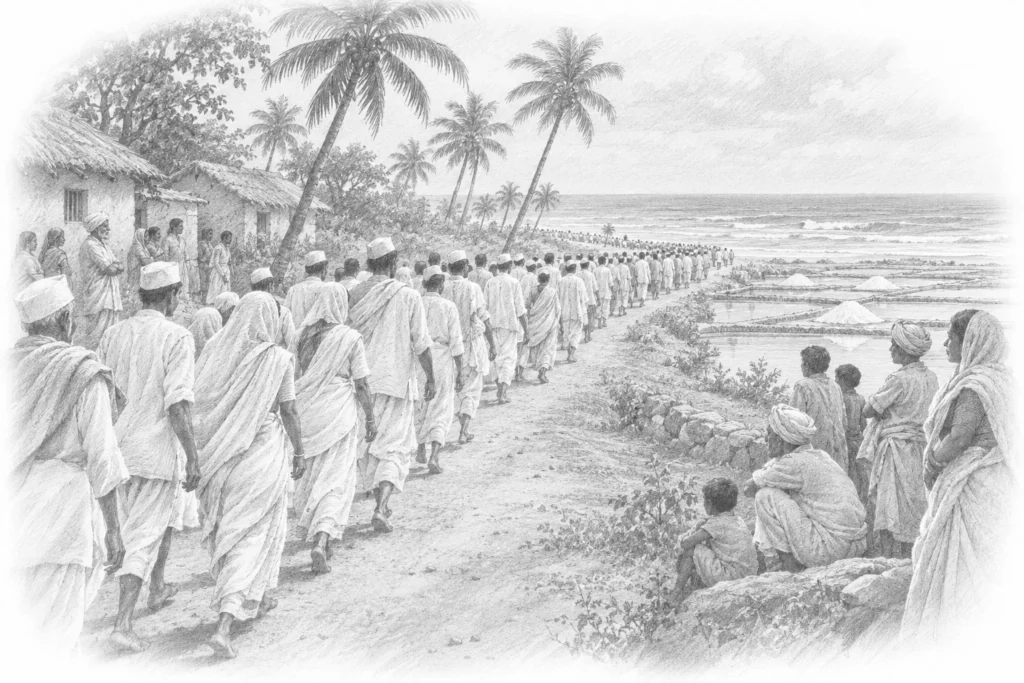
Gandhi chose salt, a necessity of every household on which the government held a monopoly and levied a tax, as the symbol of colonial injustice. On 12 March 1930 he left Sabarmati Ashram with seventy-eight followers and, after a march of about 240 miles through Gujarat’s villages, broke the salt law at Dandi on 6 April 1930. The march drew enormous attention in India and abroad. The 240-mile march from Sabarmati to Dandi (12 March to 6 April 1930) captured national and international attention.
5. Spread and Forms of the Movement
Salt laws were broken along the coasts; C. Rajagopalachari led a salt march in Tamil Nadu and K. Kelappan in Malabar; Sarojini Naidu led the non-violent raid on the Dharasana salt works; foreign cloth and liquor shops were picketed; forest laws were defied in Maharashtra, Karnataka and the Central Provinces; peasants refused to pay revenue and rent in Gujarat and the United Provinces; and in the North-West Frontier Province the Khudai Khidmatgars of Khan Abdul Ghaffar Khan joined, leading to the Peshawar firing. Merchants supported the boycott, and imports of British cloth fell sharply.
6. Participation of Women and the Masses
Thousands of women, many for the first time, made salt, picketed shops and went to jail. Peasants, tribals, students and traders took part, showing how far the social base of nationalism had widened since Non-Cooperation.
7. Course and Outcome
The Gandhi-Irwin Pact (March 1931) released prisoners and allowed salt-making for personal use, and Gandhi attended the Second Round Table Conference in London, which failed. The movement resumed in 1932, faced severe repression, and was withdrawn in 1934. The Communal Award and the Poona Pact (1932) also belong to this period.
8. The Constructive Programme
Gandhi combined struggle with constructive work, khadi, village industries, Hindu–Muslim unity, the removal of untouchability and basic education, which built a base for mass politics between movements.
9. Why Gandhi Succeeded in Mass Mobilisation
He used simple, universal symbols such as salt, khadi and the charkha; spoke the language of the people; joined political struggle with constructive work, khadi, Hindu–Muslim unity, removal of untouchability and village uplift; and his saintly image, as Shahid Amin showed in ‘Gandhi as Mahatma’ (1984), inspired peasants to act in his name, sometimes beyond his intentions.
10. Limits of Mobilisation
Some groups remained outside: many Muslims, the depressed classes under Ambedkar and sections of industrial workers, and Gandhi’s withdrawal of movements, as after Chauri Chaura in 1922, disappointed many.
11. Evaluation
Civil Disobedience did not win independence, and Muslim participation was lower than in 1920–22. Critics on the left accused Gandhi of protecting propertied interests and withdrawing movements at crucial moments. Yet it made Purna Swaraj the goal of millions, brought women into public life, and destroyed the moral authority of British rule.
Conclusion. Thus, through satyagraha, simple symbols and constructive work, Gandhi turned Indian nationalism into a mass movement, and the Civil Disobedience Movement was its most powerful expression.
Important Question 3
Discuss the factors that led to the rise of communal politics in colonial India. How far did it impact the negotiation over the partition of India?
OR
Examine the two-nation theory and its role in the partition of India.
OR
Trace the events that led to the partition of India.
Model Answer
“Hindus and Muslims belong to two different religious philosophies, social customs and literatures.”
— M.A. Jinnah, Lahore address, March 1940
Introduction. Communalism is the belief that people who follow the same religion share common political, economic and social interests, which are different from, and finally opposed to, those of other religious communities. It grew steadily in colonial India, gave rise to the two-nation theory, and shaped every stage of the negotiations that ended in the partition of 1947.
1. Meaning and Stages
Bipan Chandra, in Communalism in Modern India (1984), described three stages: the belief that members of a religion share common secular interests; liberal communalism, the belief that these interests differ from those of other communities but can be accommodated; and extreme communalism, the belief that they are mutually hostile and cannot coexist.
2. Colonial Policy
The British encouraged separate identities through the census, which counted and ranked communities; separate electorates for Muslims (1909), extended in 1919 and by the Communal Award (1932); and the patronage of communal leaders as a counterweight to the Congress. Nationalists called this a policy of divide and rule.
3. Separate Electorates
Separate electorates, introduced in 1909 and extended in 1919 and 1935, made religion the basis of political representation and encouraged politicians to appeal to religious identity.
4. Socio-economic Factors
Uneven development meant that Muslims in many regions lagged behind in modern education and government employment, and competition among the middle classes for jobs, seats and patronage took communal forms. In some regions, such as eastern Bengal and Punjab, conflicts between landlords and peasants or creditors and debtors coincided with religious divisions.
5. Religious Revivalism and Organisations
Cow protection movements (1890s), the Arya Samaj’s shuddhi, the Muslim tabligh and tanzim, and the use of religious symbols in politics sharpened boundaries. Communal organisations, the Muslim League (1906), the Hindu Mahasabha (1915) and the RSS (1925), organised politics on religious lines. The Khilafat–Non-Cooperation unity of 1920–22 was followed by widespread riots in the 1920s.
6. Hindu Communal Organisations
Organisations such as the Hindu Mahasabha (1915) and the RSS (1925) promoted Hindu nationalism, while the Muslim League claimed to speak for all Muslims; each strengthened the other.
7. The Two-Nation Theory
Sir Syed Ahmad Khan warned in the 1880s that the Congress would serve Hindu interests. Muhammad Iqbal, at Allahabad (1930), proposed a consolidated Muslim state in the north-west; Choudhary Rahmat Ali coined the name ‘Pakistan’ (1933); V.D. Savarkar spoke of ‘two nations in the main’ (1937); and Jinnah’s Lahore address of March 1940 declared Hindus and Muslims two nations, leading to the Lahore Resolution of 23 March 1940. The Congress ministries of 1937–39, which did not share power with the League in the United Provinces, were used by the League to claim that Muslims would be dominated in a united India.
8. Impact on the Negotiations
The Cripps Mission (1942) offered dominion status after the war but allowed provinces to stay out of the union, implicitly conceding partition. The Rajaji formula and the Gandhi–Jinnah talks (1944) failed over the League’s claim. At the Simla Conference (1945) Jinnah insisted that the League alone could nominate Muslim members. In the 1945–46 elections the League won almost all the Muslim seats, strengthening its claim. The Cabinet Mission plan (May 1946) proposed a loose union with three groups of provinces; it broke down over the question of compulsory grouping, and the League called for Direct Action on 16 August 1946, which led to the Great Calcutta Killings and riots in Noakhali, Bihar and Punjab. The Mountbatten Plan of 3 June 1947 accepted partition, and India and Pakistan became independent in August 1947. Direct Action Day (16 August 1946) and the Calcutta killings made partition seem inevitable to many leaders.
9. Interpretations
Nationalist historians stress British divide and rule; others emphasise the League’s separatism and the Hindu Mahasabha’s majoritarianism; and Ayesha Jalal, in The Sole Spokesman (1985), argued that Jinnah used the Pakistan demand as a bargaining counter for parity within a loose federation, and that the Congress leadership’s preference for a strong centre made partition more likely. Ayesha Jalal, in The Sole Spokesman (1985), argued that Jinnah used the demand for Pakistan partly as a bargaining counter for parity.
Conclusion. Thus, communal politics, nourished by colonial policy, social competition and religious mobilisation, shaped every stage of the final negotiations and made partition the price of independence.
Short Notes
(a) Socialists in Nationalist Politics
In the 1930s, influenced by the Russian Revolution and the Great Depression, younger Congressmen formed the Congress Socialist Party (1934) under Jayaprakash Narayan, Acharya Narendra Dev, Ram Manohar Lohia and Minoo Masani. Working within the Congress, they demanded the abolition of zamindari, workers’ rights and economic planning, and organised peasants and workers. Nehru’s presidential address at Lucknow (1936) declared socialism the solution to India’s problems, and Subhas Bose, president in 1938 and 1939, set up the National Planning Committee and later the Forward Bloc. The socialists influenced the Karachi resolution (1931) and led the underground struggle in 1942. Their contribution was to give the freedom movement a social and economic programme.
(b) The Quit India Movement
After the failure of the Cripps Mission, the Congress passed the Quit India resolution at Bombay on 8 August 1942, and Gandhi gave the call ‘Do or die’. The leaders were arrested on 9 August, and the movement became a spontaneous mass uprising: students, peasants and workers attacked railways, police stations and telegraph lines; parallel governments were set up in Ballia, Tamluk and Satara; and Jayaprakash Narayan, Aruna Asaf Ali, Lohia and Usha Mehta (with her secret Congress Radio) led underground resistance. The Muslim League and the Communist Party stayed away. It was crushed with severe repression, but it showed that British rule could not continue without the consent of the people.
(c) The Lucknow Pact (1916)
At their sessions in Lucknow in December 1916, the Congress and the Muslim League agreed on a joint scheme of reforms: elected majorities in the councils, more Indian members in the executive councils, and the acceptance of separate electorates with weightage for Muslims in provinces where they were a minority. It marked the reunion of Moderates and Extremists and the high point of Congress–League cooperation, led by Tilak and Jinnah, but its acceptance of separate electorates also gave communal representation formal recognition.
More notes: DSC-3 Colonialism and Nationalism in India
These notes are prepared by PADHO TO AISE for study help. They are not an official University of Delhi publication.