
Semester I DSC-3 Colonialism and Nationalism in India
Unit II · 26 min read · Updated 24 Nov 2026
As per the University of Delhi (DU) BA (Hons) Political Science syllabus
Contents
- 2.1 The Colonial State and Constitutional Developments
- Features of the Colonial State
- Company Rule (1773–1858)
- Crown Rule and the Councils (1858–1919)
- The Government of India Act, 1935
- 2.2 The Civilising Mission: Utilitarians and Missionaries
- 2.3 Impact on Agriculture and Land Relations
- 2.4 Impact on Industry
- 2.5 Impact on Ecology
- 2.6 Important Questions
- Discuss the major constitutional developments in colonial India with reference to the Government of India Act, 1935.
- Examine the impact of colonial rule on ecology in India.
- Discuss the impact of colonial rule on agriculture, land relations and industry in India.
- Short Notes
एक ऐसी मशीन जिसमें ब्रेक तो मज़बूत हैं पर इंजन नहीं है।
A machine with strong brakes but no engine.
— Jawaharlal Nehru, on the Government of India Act, 1935
IN CHAPTER 1 we studied colonialism as a concept. In this chapter we see how it actually worked in India. We study three things. First, the colonial state and its constitutional development, from the Regulating Act of 1773 to the Government of India Act of 1935, which shaped the Constitution of independent India. Second, the ideology of the civilising mission, through which the Utilitarians and the missionaries justified British rule. Third, the impact of colonial rule on agriculture, land relations, industry and ecology.
2.1 The Colonial State and Constitutional Developments
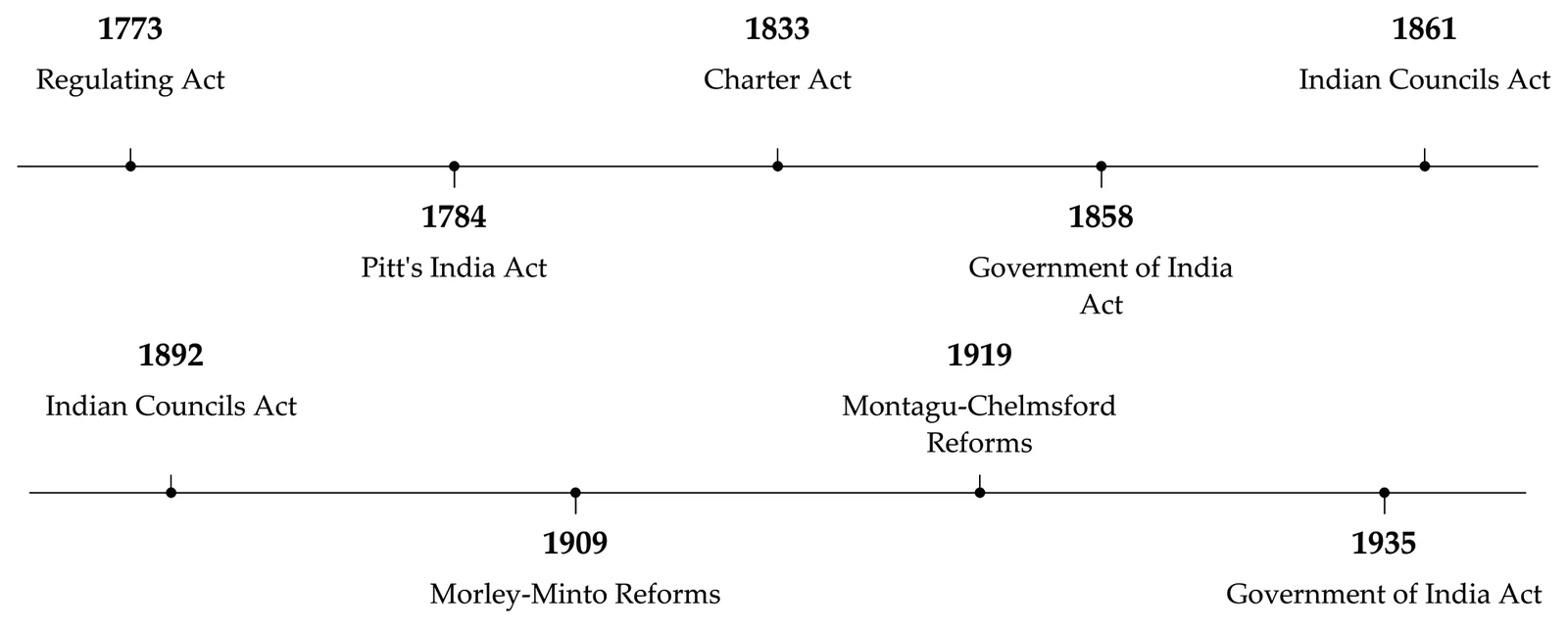
The colonial state in India was built step by step through Acts of the British Parliament (Figure 2.2). At each stage Britain tried to strengthen its control while, from the late nineteenth century, slowly admitting Indians into legislative bodies in order to win the loyalty of moderate sections. In simple words, constitutional development in colonial India was a mixture of control and concession.
Features of the Colonial State
- A powerful bureaucracy. The Indian Civil Service, the ‘steel frame’ of British rule, was recruited by open competition from 1853 but held in London, so that it remained almost entirely British for decades; Indians such as Satyendranath Tagore (1863) entered only slowly.
- A large army. The Indian army defended the empire across Asia and Africa, and after 1857 was reorganised to keep a higher proportion of British troops and to recruit from groups regarded as ‘martial races’.
- Police and law. A uniform police system (from 1861) and codified laws, the Indian Penal Code (1860) and the Codes of Civil (1859) and Criminal (1861) Procedure, created the ‘rule of law’, but laws such as the Vernacular Press Act (1878) and the Rowlatt Act (1919) also curbed freedom.
- Revenue-centred administration. Land revenue was the main source of income, so the district collector, responsible for revenue and order, became the key official.
- Divide and rule. Through the census, separate electorates and alliances with princes and landlords, the state used social divisions to weaken opposition.
- Autocracy with limited representation. Real power lay with the Viceroy and the Secretary of State; Indian representation in councils was introduced only gradually and without responsibility until 1919.
Company Rule (1773–1858)
- Regulating Act, 1773. Made the Governor of Bengal the Governor-General (Warren Hastings), created a council of four, and set up a Supreme Court at Calcutta (1774); it was the first step in parliamentary control over the Company.
- Pitt’s India Act, 1784. Created a Board of Control in London to supervise the Company’s civil and military affairs, beginning a system of ‘dual government’.
- Charter Act, 1813. Ended the Company’s trade monopoly in India (except in tea and trade with China), allowed missionaries to work in India, and set aside one lakh rupees a year for education.
- Charter Act, 1833. Made the Governor-General of Bengal the Governor-General of India, ended the Company’s commercial functions, added a law member (Macaulay) to the council, and declared that no Indian should be barred from office by religion, birth or colour.
Crown Rule and the Councils (1858–1919)
- Government of India Act, 1858. After the revolt of 1857, the Crown took over; a Secretary of State for India with a Council of India in London controlled the administration, and the Governor-General became the Viceroy. Queen Victoria’s Proclamation (1858) promised non-interference in religion and equal treatment.
- Indian Councils Act, 1861. Added nominated non-official members, including Indians, to the Viceroy’s legislative council and restored legislative powers to Bombay and Madras.
- Indian Councils Act, 1892. Introduced the principle of indirect election (through nomination on the recommendation of local bodies), and allowed members to discuss the budget and ask questions.
- Morley-Minto Reforms, 1909 (Indian Councils Act). Enlarged the councils, allowed supplementary questions and resolutions, and introduced separate electorates for Muslims, which deepened communal divisions.
- Montagu-Chelmsford Reforms, 1919 (Government of India Act). Following the Montagu Declaration of August 1917, which promised the ‘progressive realisation of responsible government’, it introduced dyarchy in the provinces (subjects divided into ‘transferred’, under Indian ministers, and ‘reserved’, under the Governor), a bicameral central legislature, and extended separate electorates to Sikhs, Indian Christians, Anglo-Indians and Europeans.
The Government of India Act, 1935
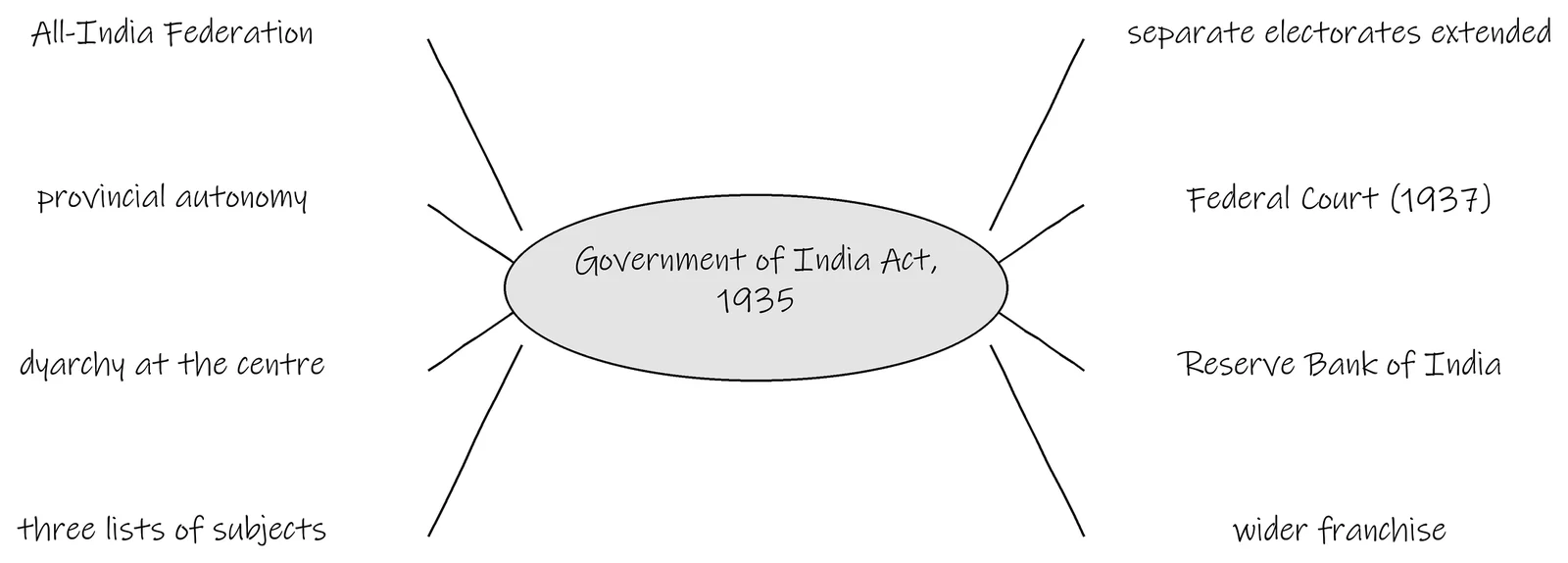
The 1935 Act, prepared after the Simon Commission (1927), the three Round Table Conferences (1930–32) and a White Paper (1933), was the last and most detailed constitutional reform before independence (Figure 2.3). Its main features were these:
- All-India Federation. A federation of British Indian provinces and the princely states was proposed, but it never came into being because the princes did not join.
- Provincial autonomy. Dyarchy in the provinces was abolished; provinces were governed by ministers responsible to elected legislatures, though Governors kept special powers.
- Dyarchy at the centre. Defence and foreign affairs were reserved for the Governor-General; this part never came into force.
- Division of powers. Three lists of subjects, Federal, Provincial and Concurrent, with residuary powers given to the Governor-General.
- Bicameralism and electorates. Six provinces got two houses; separate electorates were extended, including to the depressed classes in a modified form after the Poona Pact (1932).
- Wider franchise. About ten per cent of the population got the vote.
- New institutions. A Federal Court (set up in 1937) and the Reserve Bank of India (1935); Burma was separated from India.
In the elections of 1937 the Congress formed ministries in most provinces. Nehru called the Act ‘a machine with strong brakes but no engine’, because the Governors and the Governor-General kept overriding powers. Yet the Constitution of India later borrowed much of its administrative structure, such as the federal scheme, the three lists, the emergency powers and the office of Governor, from the 1935 Act.
2.2 The Civilising Mission: Utilitarians and Missionaries
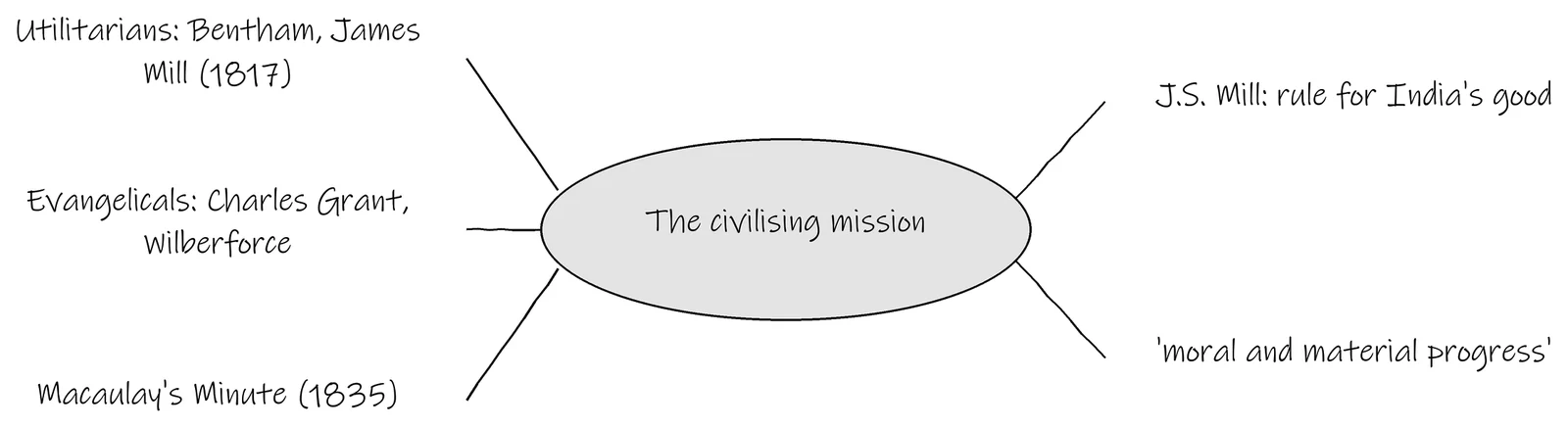
Why did the British believe they had a right to rule India? From the late eighteenth century, a powerful ideology presented British rule as a civilising mission: the duty of an advanced nation to raise a backward people. Michael Mann, in ‘Torchbearers upon the Path of Progress’ (2004), shows that from 1859 the government even presented annual reports to Parliament on the ‘Moral and Material Progress and Condition of India’. Two groups shaped this ideology (Figure 2.4).
A. The Evangelicals and missionaries
Evangelical Christians such as Charles Grant, in his Observations on the State of Society among the Asiatic Subjects of Great Britain (1792), and William Wilberforce described Indian society as morally degraded and argued that Christianity and Western education would redeem it. Their campaign led the Charter Act of 1813 to open India to missionaries. Missionaries such as William Carey at Serampore (from 1800) translated the Bible, set up schools and printing presses, and campaigned against practices such as sati.
B. The Utilitarians
The Utilitarians, followers of Jeremy Bentham, believed that good laws and efficient administration could reform any society. James Mill’s The History of British India (1817) divided Indian history into Hindu, Muslim and British periods and condemned Indian civilisation as backward; it became a textbook for British officials. Lord William Bentinck’s reforms, such as the abolition of sati (1829), and the work of Macaulay on the Indian Penal Code (drafted 1837, enacted 1860) reflected this belief in reform through law. Macaulay’s Minute (1835) made English the medium of higher education.
Earlier, Orientalists such as William Jones, who founded the Asiatic Society in 1784, had admired India’s classical past; the Anglicists and Utilitarians rejected this admiration. The civilising mission was sincere for some reformers, but it also justified foreign rule, racial hierarchy and economic exploitation, which is why nationalists such as Naoroji called British rule ‘un-British’.
2.3 Impact on Agriculture and Land Relations
Land revenue was the largest source of income of the colonial state, so the British introduced new systems of land settlement (Figure 2.5).

- Permanent Settlement (1793). Introduced by Lord Cornwallis in Bengal, Bihar and Orissa, it made the zamindars owners of the land and fixed their revenue permanently. Many old zamindars failed to pay and lost their estates under the ‘sunset law’, while the peasants became tenants at the mercy of the zamindars.
- Ryotwari Settlement (from 1820). Associated with Thomas Munro in Madras and later Bombay, it collected revenue directly from the peasant (ryot), who was recognised as owner, but the revenue was high and periodically revised.
- Mahalwari Settlement (1822 and 1833). In the North-Western Provinces and Punjab, revenue was settled with the village community (mahal) as a whole.
These settlements turned land into a commodity that could be bought, sold and mortgaged. High revenue demands drove peasants into the hands of moneylenders, and land passed to non-cultivating owners. The commercialisation of agriculture, i.e. the growing of cash crops such as indigo, cotton, jute and opium for export, made peasants dependent on world prices. Frequent famines, such as the Great Famine of 1876–78 and the Bengal Famine of 1943, showed the vulnerability of the rural economy, while the government continued to export grain and collect revenue.
2.4 Impact on Industry
India had been one of the world’s great manufacturing regions, famous for its cotton textiles. Under colonial rule this changed. British machine-made goods, entering India almost duty-free after 1813, while Indian goods faced high duties in Britain, ruined many traditional handicrafts; the decline of the fine muslins of Dhaka became a symbol of this de-industrialisation. The collapse of court patronage after the decline of Indian rulers added to the crisis. Displaced artisans fell back on agriculture, increasing pressure on the land.
Modern industry developed slowly and unevenly. Railways began with the line from Bombay to Thane in 1853, mainly to carry raw materials to the ports and British goods inland. The first cotton mill was set up in Bombay in 1854, jute mills near Calcutta from 1855, and the Tata Iron and Steel Company at Jamshedpur in 1907. British capital dominated plantations, jute, mining and banking, and Indian industry grew mainly during the World Wars and with the protection of Indian businessmen. Nationalist economists such as Naoroji and R.C. Dutt saw this pattern as proof that British rule had made India poorer.
Nationalists also exposed the drain of wealth: a large part of India’s revenue and savings flowed to Britain every year without any return (Figure 2.6).

2.5 Impact on Ecology
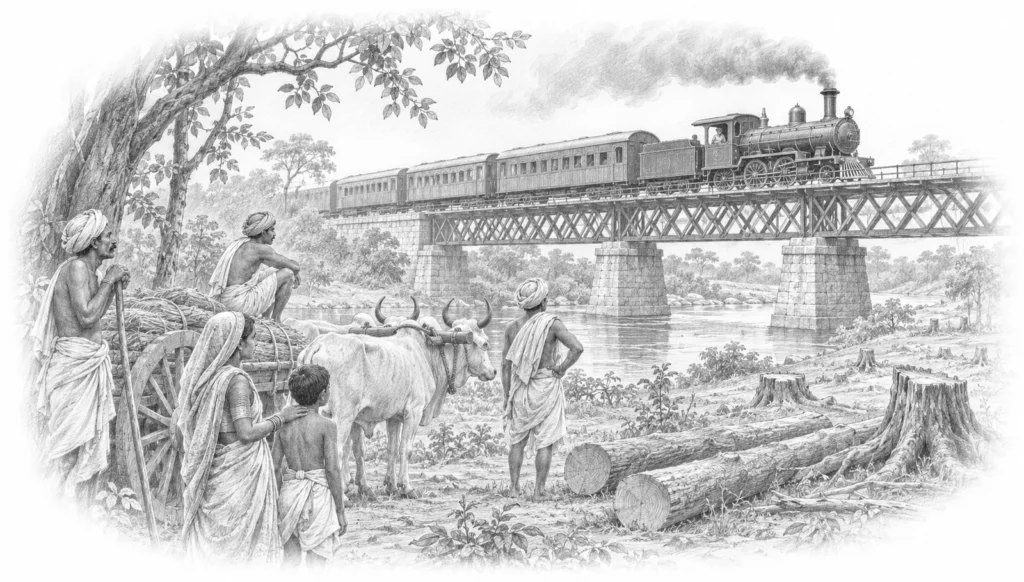
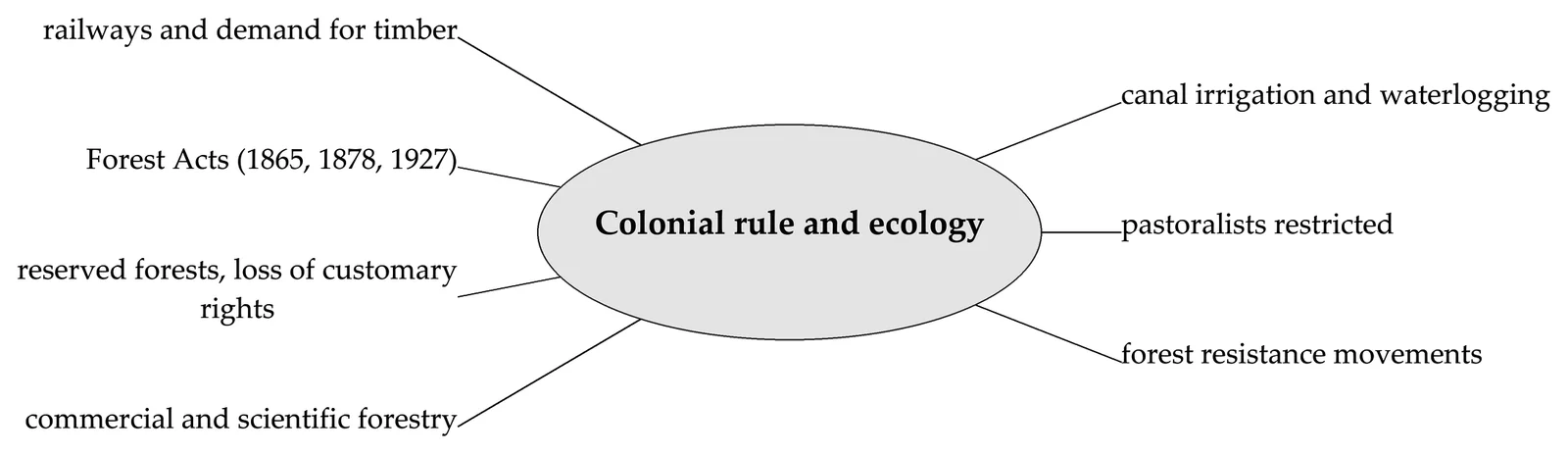
Colonial rule also transformed India’s environment. In ‘State Forestry and Social Conflict in British India’ (1989), Madhav Gadgil and Ramachandra Guha argued that colonial forest policy marked an ecological watershed. The main features of colonial ecological policy were these:
- Commercial exploitation of forests. The expansion of railways from the 1850s created a huge demand for timber for sleepers; teak, sal and deodar forests were cut on a large scale.
- State control of forests. The Forest Department was created in 1864 under the German forester Dietrich Brandis, and the Indian Forest Acts of 1865 and 1878 brought vast forest areas under state control, classifying them as reserved, protected and village forests.
- Loss of customary rights. Rights of forest communities to collect wood, graze cattle, gather produce and practise shifting cultivation (jhum, podu) were turned into privileges that could be withdrawn.
- Scientific forestry for revenue. Mixed forests were replaced by commercially valuable single species.
- Hunting and wildlife. Large-scale hunting and rewards for killing ‘dangerous’ animals reduced wildlife.
- Irrigation and agriculture. Canal irrigation in Punjab increased output but also caused waterlogging and salinity in some areas.
These policies provoked resistance: tribal and peasant forest movements, such as the Bastar rising of 1910, the Rampa rebellion of 1922–24 and forest satyagrahas during the Civil Disobedience Movement. Gadgil and Guha trace the roots of later environmental movements, such as Chipko in the 1970s, to this long conflict over forests.
2.6 Important Questions
- Question 1 Discuss the major constitutional developments in colonial India with reference to the Government of India Act, 1935.
- Question 2 Examine the impact of colonial rule on ecology in India.
- Question 3 Discuss the impact of colonial rule on agriculture, land relations and industry in India.
DU asks the same idea in different words. So learn one broad answer for each question below; the same answer works for every question joined by OR.
Important Question 1
Discuss the major constitutional developments in colonial India with reference to the Government of India Act, 1935.
OR
Trace the constitutional development of India from 1858 to 1935.
OR
Examine the main features of the Government of India Act, 1935.
Model Answer
“A machine with strong brakes but no engine.”
— Jawaharlal Nehru on the Government of India Act, 1935
Introduction. Constitutional development in colonial India was a process of control and concession. Britain steadily tightened its control over the Indian administration, while from the late nineteenth century it gradually admitted Indians into legislative bodies in order to win over moderate opinion and divide the national movement. The process culminated in the Government of India Act, 1935, which deeply influenced the Constitution of independent India.
1. Parliamentary Control over the Company (1773–1833)
The Regulating Act (1773) was Parliament’s first attempt to control the East India Company after its conquest of Bengal: it made the Governor of Bengal the Governor-General (Warren Hastings) with a council of four, and set up a Supreme Court at Calcutta. Pitt’s India Act (1784) created a Board of Control in London, beginning ‘dual government’ by the Company and the Crown. The Charter Act of 1813 ended the Company’s trade monopoly, opened India to missionaries and set aside money for education. The Charter Act of 1833 made the Governor-General of Bengal the Governor-General of India, ended the Company’s commercial functions and declared that no Indian should be barred from office by religion, birth or colour.
2. Crown Rule: The Act of 1858
After the revolt of 1857, the Government of India Act, 1858 transferred power from the Company to the Crown. A Secretary of State for India, advised by a Council of India in London, controlled the administration, and the Governor-General became the Viceroy. Queen Victoria’s Proclamation promised religious toleration and equal treatment, but power was now more centralised than ever. Queen Victoria’s Proclamation (1858) promised religious non-interference and equal access to public office regardless of race or creed.
3. The Councils Acts of 1861 and 1892
The Indian Councils Act, 1861 added a few nominated non-official members, including Indians, to the Viceroy’s legislative council and restored legislative powers to Bombay and Madras; it also introduced the portfolio system. The Indian Councils Act, 1892, a response to the demands of the early Congress, enlarged the councils, introduced indirect election through recommendations by local bodies and universities, and allowed members to discuss the budget and ask questions.
4. Morley-Minto Reforms, 1909
The Indian Councils Act, 1909 enlarged the councils, allowed supplementary questions and resolutions, and admitted an Indian, S.P. Sinha, to the Viceroy’s Executive Council. Most importantly, it introduced separate electorates for Muslims, in which only Muslims could vote for Muslim candidates. Nationalists saw this as a deliberate policy of divide and rule, and it laid the foundation of communal politics. It introduced separate electorates for Muslims, which nationalists saw as a step towards division.
5. Montagu-Chelmsford Reforms, 1919
After the Montagu Declaration (August 1917) promised the ‘progressive realisation of responsible government’, the Government of India Act, 1919 introduced dyarchy in the provinces, dividing subjects into ‘transferred’ subjects, such as education and health, under Indian ministers responsible to the legislature, and ‘reserved’ subjects, such as finance and law and order, under the Governor. It created a bicameral central legislature, separated central and provincial subjects, extended separate electorates to Sikhs, Indian Christians, Anglo-Indians and Europeans, and gave the vote to a small propertied electorate. The Congress rejected it as inadequate.
6. The Government of India Act, 1935
Prepared after the Simon Commission (1927), three Round Table Conferences (1930–32) and a White Paper (1933), the Act had 321 sections and 10 schedules. Its main features were: a proposed All-India Federation of provinces and princely states, which never came into being because the princes did not join; provincial autonomy, ending dyarchy in the provinces and giving them responsible ministries; dyarchy at the centre, with defence and foreign affairs reserved, which was never implemented; three lists of subjects, Federal, Provincial and Concurrent; bicameral legislatures in six provinces; separate electorates extended, with reserved seats for the depressed classes after the Poona Pact; a franchise of about ten per cent of the population; a Federal Court (1937); and the Reserve Bank of India. Burma was separated from India.
7. Working of the 1935 Act
In the 1937 elections the Congress won majorities in most provinces and formed ministries in eight of them. These ministries released political prisoners, passed tenancy and debt-relief laws and gave Indians real experience of administration. They resigned in 1939 when Britain declared India a party to the Second World War without consulting Indians.
8. Evaluation
The 1935 Act expanded Indian participation and introduced federal institutions. But the Governors and the Governor-General retained special responsibilities, discretionary powers and the power to suspend the constitution; separate electorates deepened communal division; and sovereignty remained British. Hence Nehru’s description of it as a machine with strong brakes but no engine. Its lasting importance is that the Constitution of India adopted much of its framework: the federal scheme, the three lists, the emergency provisions, the office of Governor and the Public Service Commissions. Its federal scheme, emergency powers and much of its administrative structure later shaped the Constitution of India.
Conclusion. Thus, constitutional development under colonial rule slowly widened Indian participation while keeping real power in British hands. The 1935 Act was its high point and became a bridge between colonial rule and the Constitution of independent India.
Important Question 2
Examine the impact of colonial rule on ecology in India.
OR
Discuss colonial forest policy and its consequences.
OR
Write a note on state forestry and social conflict in British India.
Model Answer
“If an entire nation of 300 millions took to similar economic exploitation, it would strip the world bare like locusts.”
— M.K. Gandhi, Young India (20 December 1928)
Introduction. Colonial rule transformed not only India’s economy and politics but also its environment. In ‘State Forestry and Social Conflict in British India’ (1989), Madhav Gadgil and Ramachandra Guha argued that colonial forest policy marked an ecological watershed: for the first time the state claimed vast forests as its own property and managed them for commercial and imperial purposes, which generated a long conflict with the communities that depended on them.
1. Pre-colonial Use of Nature
Before colonial rule, forests were used by local communities under customary rules. Sacred groves, community controls on hunting and grazing, and the needs of local subsistence often limited over-use, though pre-colonial rulers too had cleared forests for agriculture and hunted for sport. Forests were a common resource for fuel, fodder, food, medicine and shifting cultivation. Madhav Gadgil and Ramachandra Guha, in This Fissured Land (1992), described the ‘prudent’ use of resources by many communities.
2. Railways and the Demand for Timber
From the 1850s the rapid expansion of railways created an enormous demand for wooden sleepers and fuel. Sal, teak and deodar forests were felled on a large scale; Gadgil and Guha describe this phase as one of reckless destruction, which alarmed officials into creating a forest administration. Forests in the Himalayas, the Western Ghats and central India were cut to supply sleepers and fuel.
3. State Control: The Forest Department and Forest Acts
The Imperial Forest Department was established in 1864 under the German forester Dietrich Brandis. The Indian Forest Act of 1865 and the more stringent Act of 1878 asserted state ownership over forests and classified them as reserved forests, where almost all local use was forbidden, protected forests, where some use was allowed, and village forests. The Act of 1927 consolidated these laws. Customary rights were turned into privileges that the state could withdraw. The Indian Forest Acts of 1865, 1878 and 1927 classified forests as reserved, protected and village forests and extinguished many customary rights.
4. Scientific and Commercial Forestry
‘Scientific forestry’ aimed at a sustained yield of commercially valuable timber. Mixed natural forests were replaced by single species such as teak and later eucalyptus, which reduced biodiversity and the usefulness of forests to local people. Forests were valued for revenue rather than for the needs of those who lived in them. Teak, sal and deodar were favoured, while oak and mixed species used by villagers were neglected.
5. Impact on Forest Communities
Restrictions on grazing, collection of fuel and minor forest produce, hunting and shifting cultivation (jhum, podu, bewar) hurt tribal and peasant communities. Many were forced into wage labour, debt or migration, and forest officials and guards became a new source of oppression. Tribal societies lost control over the resources on which their way of life depended. Shifting cultivators such as the Baigas were confined to small areas, and forced labour (begar) for forest officials was common.
6. Irrigation and Agriculture
Large canal systems in Punjab and the Ganga–Yamuna doab increased production but also caused waterlogging and salinity, and the spread of cash crops altered local ecologies.
7. Other Ecological Changes
Large-scale hunting by officials and rewards for killing ‘vermin’ such as tigers and wolves reduced wildlife. Canal irrigation in Punjab and the Ganga–Yamuna doab increased agricultural output but caused waterlogging and salinity in some areas. The spread of cash crops and plantations of tea and coffee in Assam and the Nilgiris cleared further forests. Tea, coffee and rubber plantations cleared large hill forests in Assam and the Western Ghats.
8. Pastoralists and Grazing
Pastoral communities such as the Gujjars and Raikas lost access to grazing lands as forests were reserved, and grazing taxes disrupted their seasonal migrations.
9. Resistance
Forest communities resisted in many ways: everyday non-cooperation, arson and illegal grazing, and open rebellions such as the Bastar rising (1910) and the Rampa rebellion (1922–24) under Alluri Sitarama Raju. During the Non-Cooperation and Civil Disobedience movements, forest satyagrahas were organised in Maharashtra, Karnataka and the Central Provinces. Gadgil and Guha see this long conflict as the root of later environmental movements such as Chipko in the 1970s. In Kumaon villagers set reserved forests on fire in protest in 1921, and forest satyagrahas became part of the national movement.
10. The Colonial Legacy Today
The colonial approach shaped independent India’s forest laws until the Forest Rights Act (2006) recognised the rights of forest dwellers, and movements such as Chipko drew on the memory of colonial forest struggles.
11. Evaluation
Colonial forestry did introduce systematic management and conservation laws, and some officials genuinely feared deforestation. But its main aim was revenue and imperial needs, not conservation or the welfare of forest people, and it criminalised communities that had long depended on the forests. Independent India continued much of this framework until the Forest Rights Act of 2006 began to recognise community rights. Ramachandra Guha calls colonial forestry an ecological watershed, replacing community control with state control.
Conclusion. Thus, colonial rule commercialised and centralised India’s forests, damaged ecosystems and dispossessed forest communities, leaving a legacy of conflict that still shapes environmental politics in India.
Important Question 3
Discuss the impact of colonial rule on agriculture, land relations and industry in India.
OR
Examine the colonial land revenue systems and their impact on peasants.
OR
What do you understand by de-industrialisation? Discuss.
Model Answer
“The misery hardly finds a parallel in the history of commerce. The bones of the cotton-weavers are bleaching the plains of India.”
— Governor-General William Bentinck (1834), quoted by Marx in Capital
Introduction. Colonial rule reorganised India’s economy to serve British needs. It transformed land relations through new revenue settlements, commercialised agriculture, and destroyed much of India’s traditional industry while permitting only limited and dependent modern industrial growth.
1. Land Revenue Settlements
The Permanent Settlement (1793) of Lord Cornwallis in Bengal, Bihar and Orissa made the zamindars owners of the land with a permanently fixed revenue. The Ryotwari system, introduced by Thomas Munro in Madras (from 1820) and later in Bombay, collected revenue directly from the peasant, who was recognised as owner but faced high and periodically revised demands. The Mahalwari system (1822, 1833) in the North-Western Provinces and Punjab settled revenue with the village community as a whole. Thomas Munro’s Ryotwari Settlement in Madras and Bombay dealt directly with cultivators, and the Mahalwari system in the north-west with village communities.
2. Impact on Land Relations
Land became a commodity that could be sold or mortgaged. High revenue demands, payable in cash on fixed dates, forced peasants to borrow from moneylenders, and land passed to non-cultivating owners. Under the Permanent Settlement, many old zamindari families lost their estates under the ‘sunset law’, and new owners, often urban merchants, created chains of intermediaries. The number of tenants-at-will and landless labourers grew steadily. Moneylenders and absentee landlords gained land, and tenancy and landless labour grew.
3. Rural Indebtedness
High revenue and the need for cash pushed peasants into debt to moneylenders, whose power grew under colonial courts that enforced contracts; the Deccan riots of 1875 were directed against moneylenders.
4. Commercialisation of Agriculture
Peasants were pushed to grow cash crops such as indigo, cotton, jute, opium and sugarcane for export. This tied them to world prices: the cotton boom during the American Civil War (1861–65) was followed by a crash that contributed to the Deccan riots of 1875. Food production lagged behind population growth. Indigo planters in Bengal and Bihar forced peasants to grow indigo on unfavourable terms, provoking the Indigo Revolt (1859–60) and Champaran (1917).
5. Famines
Frequent famines, such as those of 1876–78, 1896–97 and 1899–1900, and the Bengal Famine of 1943, which killed about three million people, revealed the insecurity of the rural economy. Grain continued to be exported and revenue collected even during famines, and relief was often inadequate. Amartya Sen showed that the Bengal Famine of 1943 resulted from a collapse of people’s entitlements to food, not from a shortage of food. Famine Commissions after 1880 produced famine codes, but relief was often inadequate.
6. De-industrialisation
India had been a leading manufacturer of cotton textiles. After 1813, cheap British machine-made goods entered India almost duty-free, while Indian goods faced high duties in Britain. The loss of court patronage after the decline of Indian rulers added to the crisis. The fine muslins of Dhaka declined, and displaced artisans were pushed back on to the land, increasing pressure on agriculture. Historians such as Amiya Bagchi have estimated a sharp fall in the share of the population engaged in industry in Bihar in the nineteenth century. Towns such as Dhaka, Murshidabad and Surat declined as artisans lost their markets.
7. Limited Modern Industry
Modern industry grew slowly: railways from 1853, cotton mills in Bombay from 1854, jute mills near Calcutta from 1855, coal mines, and the Tata Iron and Steel Company at Jamshedpur in 1907. British capital dominated plantations, jute, mining, shipping and banking, while Indian capitalists grew mainly in cotton textiles and expanded during the World Wars. Railway rates favoured the movement of raw materials to ports and of imported goods inland. Indian entrepreneurs such as the Tatas founded the Tata Iron and Steel Company (1907) despite colonial obstacles.
8. The Drain of Wealth
Naoroji and R.C. Dutt showed that Home Charges, salaries, pensions, interest and profits drained India’s wealth to Britain, reducing the capital available for Indian development. Naoroji’s Poverty and Un-British Rule in India (1901) became the foundation of economic nationalism.
9. Peasant Response
Peasants resisted high revenue and forced cultivation through petitions, rent strikes and revolts, from the Indigo Revolt and the Pabna movement to Gandhi’s Champaran and Bardoli campaigns.
10. Evaluation
Some historians point to the railways, irrigation and integration into world markets as positive legacies. Nationalist and Marxist historians reply that these served colonial needs, and that colonial India suffered slow growth, stagnant agriculture and recurring famines. The economic critique of colonialism became central to Indian nationalism and shaped planning after independence.
Conclusion. Thus, colonial rule turned India into a supplier of raw materials and a market for British goods, impoverishing peasants and artisans. This economic critique became the foundation of Indian nationalism.
Short Notes
(a) The Permanent Settlement
Introduced by Lord Cornwallis in 1793 in Bengal, Bihar and Orissa, it made the zamindars hereditary owners of land and fixed the revenue they paid to the government permanently, at about ninety per cent of the rent they collected. The British hoped to secure a stable revenue, create a loyal landlord class and encourage agricultural improvement. In practice, many old zamindars failed to pay on time and lost their estates under the ‘sunset law’; new absentee owners and chains of intermediaries emerged; and the peasants, with no protection of their rights, were exploited through high rents and illegal levies. The government also lost the chance of increasing revenue as land values rose.
(b) Macaulay’s Minute (1835)
In his Minute on Education of 2 February 1835, Thomas Babington Macaulay argued in the Orientalist–Anglicist controversy that government funds should be spent on English education rather than on Sanskrit and Arabic learning, claiming that ‘a single shelf of a good European library was worth the whole native literature of India and Arabia’. He wanted to create ‘a class of persons Indian in blood and colour, but English in taste, in opinions, in morals and in intellect’. Bentinck’s English Education Act (1835) accepted his view. The policy produced the English-educated middle class that, ironically, led the national movement.
(c) De-industrialisation
De-industrialisation refers to the decline of India’s traditional handicraft industries, especially cotton textiles, under colonial rule in the nineteenth century. Its causes were the import of cheap British machine-made goods, unequal tariffs, the loss of court patronage and the Company’s monopoly practices. Its effects were the ruin of artisans, increased dependence on agriculture and greater rural poverty. Nationalist economists made it a central part of their critique of colonialism.
(d) Indian Forest Act, 1878
A colonial law that greatly expanded state control over Indian forests. It divided forests into reserved, protected and village forests, curtailed the customary rights of forest communities to collect wood, graze cattle and practise shifting cultivation, and turned forests into a source of timber and revenue for the colonial state, especially for railways. It provoked many forest protests and shaped the later Indian Forest Act of 1927.
More notes: DSC-3 Colonialism and Nationalism in India
These notes are prepared by PADHO TO AISE for study help. They are not an official University of Delhi publication.