
Semester I DSC-3 Colonialism and Nationalism in India
Unit I · 25 min read · Updated 24 Nov 2026
As per the University of Delhi (DU) BA (Hons) Political Science syllabus
Contents
- 1.1 Colonialism
- Features of Colonialism
- Stages of Colonialism
- 1.2 Perspectives on Colonialism
- 1.3 Nationalism
- Features of Anti-colonial Nationalism
- 1.4 Approaches to the Study of Nationalism in India
- 1.5 Important Questions
- What do you understand by colonialism? Critically analyse the Marxist perspective on colonialism in India.
- Define nationalism. Evaluate the Nationalist and Imperialist approaches to the study of nationalism in India.
- Examine the postcolonial perspective on colonialism.
- Short Notes
स्वराज मेरा जन्मसिद्ध अधिकार है और मैं इसे लेकर रहूँगा।
Swaraj is my birthright, and I shall have it.
— Bal Gangadhar Tilak, 1916
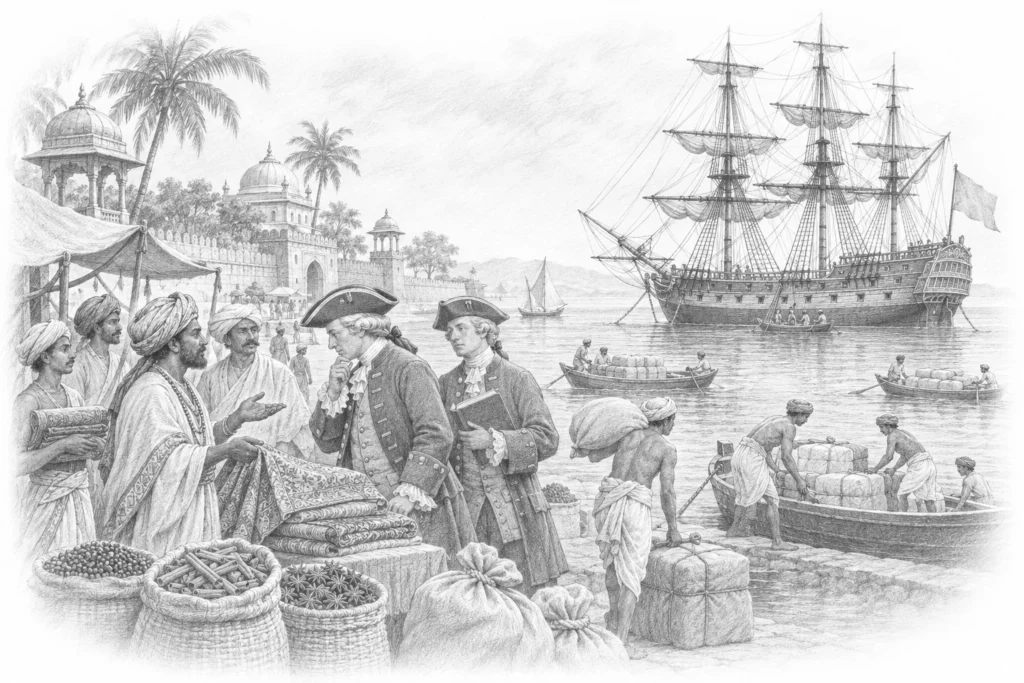
IN 1600 a company of London merchants received a charter to trade with the East. Within two centuries that company, the East India Company, had become the ruler of most of India, and in 1858 the British Crown took over its empire. For nearly two hundred years India was a colony: a land ruled by a foreign power for the benefit of that power. The struggle against this rule gave birth to Indian nationalism. This first unit gives us the concepts and the debates we need for the whole paper. What exactly is colonialism, and how have liberals, Marxists and postcolonial thinkers understood it? What is nationalism, and how have different schools of historians explained Indian nationalism? Every later chapter, on colonial rule, reform, the national movement and social movements, applies these ideas.
1.1 Colonialism
In simple words, colonialism is the domination of one country by another, in which the colonising power rules the colonised people politically, exploits them economically and dominates them culturally. Imperialism is the wider idea of building an empire through conquest or control; colonialism is its most direct form, in which the foreign power actually governs the territory. Bipan Chandra insisted that colonialism is not merely foreign rule but a structure: the whole economy, society and politics of the colony are reorganised to serve the needs of the colonising country.
Features of Colonialism
- Political subjugation. Power lies with a foreign ruler, and the colonised people have no share in sovereignty; in India, power passed from the Company to the Crown under the Government of India Act of 1858.
- Economic exploitation. The colony’s resources are used for the benefit of the colonial power. Dadabhai Naoroji, who in 1892 became the first Indian elected to the British House of Commons, showed that wealth was drained from India through Home Charges, salaries, pensions and profits.
- Subordinate integration into world capitalism. The colony becomes a supplier of raw materials and a market for manufactured goods. R.C. Dutt’s Economic History of India (1902) documented the ruin of Indian handicrafts under this system.
- Racial and cultural hierarchy. Colonial rule rested on a belief in the superiority of the rulers. Macaulay’s Minute on Education (1835) declared that ‘a single shelf of a good European library was worth the whole native literature of India and Arabia’.
- The colonial state. A powerful bureaucracy, army and police serve the interests of the colonial power, not of the people.
- Collaborating classes. Colonial rule depends on local allies, such as zamindars and princes, who benefit from it.
Stages of Colonialism
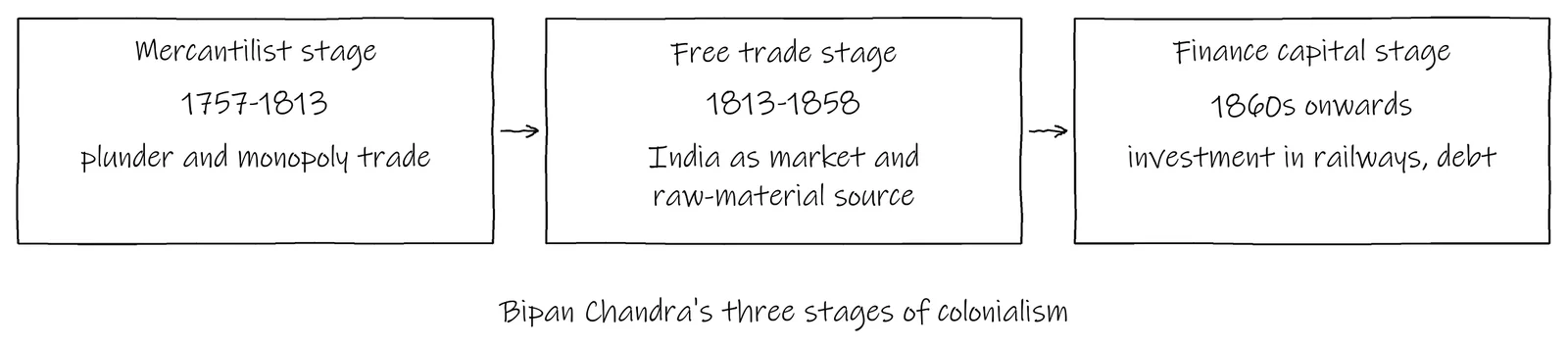
Bipan Chandra identified three stages of British colonialism in India (Figure 1.2). In the mercantilist stage (1757–1813) the Company used its monopoly of trade and its political power to obtain goods cheaply and to collect revenue, which amounted to direct plunder. In the free trade stage (1813–1858), after the Charter Act of 1813 ended the Company’s trade monopoly, India was turned into a market for British manufactured goods and a source of raw materials, and its handicrafts declined. In the stage of finance capital (from the 1860s), British capital was invested in railways, plantations, mines and government loans, and India paid interest and profits to Britain.
1.2 Perspectives on Colonialism
How should colonialism be understood and judged? Three broad perspectives exist (Figure 1.3). Each was developed by particular thinkers in a particular context.

A. The liberal perspective: the civilising mission
Liberal thinkers of the nineteenth century often defended empire as a means of progress. James Mill, in The History of British India (1817), described Indian civilisation as backward and argued that good laws and government could improve it. His son J.S. Mill, who worked for the East India Company for thirty-five years, wrote in On Liberty (1859) that ‘despotism is a legitimate mode of government in dealing with barbarians, provided the end be their improvement’. Thomas Macaulay wanted to create, through English education, ‘a class of persons Indian in blood and colour, but English in taste, in opinions, in morals and in intellect’. Thomas Metcalf, in Ideologies of the Raj (1995), shows how this liberal belief in reform and progress became an ideology that justified British rule. Its features were the belief in progress, the rule of law, education and reform, and the claim that colonial rule was temporary trusteeship. Critics reply that the ‘civilising mission’ hid exploitation behind the language of improvement.
B. The Marxist perspective: colonialism as exploitation
Karl Marx wrote two famous articles in the New York Daily Tribune in 1853, ‘The British Rule in India’ and ‘The Future Results of British Rule in India’. He condemned the brutality of British rule but argued that it had a double mission: ‘one destructive, the other regenerating, the annihilation of old Asiatic society, and the laying of the material foundations of Western society in Asia’. Railways and modern industry, he believed, would break the stagnant village economy. Later Marxists, writing after the experience of colonial underdevelopment, rejected the idea that colonialism was progressive. Lenin (1916) linked imperialism to monopoly capitalism; R. Palme Dutt’s India Today (1940) described the exploitation of India in each stage; Bipan Chandra showed that colonialism created a distorted, dependent economy; and dependency theorists such as Andre Gunder Frank spoke of the ‘development of underdevelopment’. The Marxist perspective stresses economic exploitation, the drain of wealth, de-industrialisation, the alliance of the colonial state with landlords, and colonialism as a stage of world capitalism.
C. The postcolonial perspective: colonialism of the mind
Postcolonial theory, developed from the 1970s, argues that colonialism was not only political and economic but also a matter of knowledge, culture and identity. Frantz Fanon, writing during the Algerian war of independence in The Wretched of the Earth (1961), described the psychological violence of colonialism. Edward Said’s Orientalism (1978) showed how Western scholarship constructed ‘the Orient’ as irrational, unchanging and inferior, and how this knowledge served colonial power. Gayatri Chakravorty Spivak asked ‘Can the Subaltern Speak?’ (1988), and Homi Bhabha (The Location of Culture, 1994) studied the mimicry and hybridity of colonised elites. Ashis Nandy’s The Intimate Enemy (1983) described colonialism as a ‘loss and recovery of self’. Robert Young (Postcolonialism, 2003) and Sobhanlal Datta Gupta show that postcolonialism shifts attention from economics to discourse, representation and the colonised mind. Critics say that it neglects the material exploitation stressed by Marxists.
1.3 Nationalism
Nationalism is the belief that a people who share a sense of common identity form a nation, and that this nation should have its own sovereign state, or at least govern itself. As we saw in DSC-2, scholars such as Ernest Gellner and Benedict Anderson argue that nations are modern, ‘imagined communities’ made possible by print, education and the modern state. In colonies, nationalism took the form of anti-colonial nationalism: the struggle of a colonised people to end foreign rule. Indian nationalism grew from the late nineteenth century, through the Indian National Congress (1885), the Swadeshi movement and the Gandhian mass movements, to independence in 1947.
Features of Anti-colonial Nationalism
- Opposition to foreign rule. Its central aim was self-government; Tilak’s ‘Swaraj is my birthright’ (1916) and the Lahore Congress’s demand for Purna Swaraj (1929) expressed this.
- Economic critique. Nationalists exposed the drain of wealth and the ruin of Indian industry, as in Naoroji’s Poverty and Un-British Rule in India (1901).
- Cultural revival. Nationalists recovered pride in India’s past and culture; Bankim Chandra’s Anandamath (1882), with its song Vande Mataram, and Vivekananda’s speeches inspired a new self-confidence.
- Mass mobilisation. From the Swadeshi movement and especially under Gandhi, nationalism drew in peasants, workers, women and students.
- Unity in diversity. It tried to unite people of many languages, religions and castes, though communal and caste divisions remained.
- Modern political ideals. It adopted democracy, civil liberties and, later, social justice, which shaped the Constitution of 1950.
Partha Chatterjee, in The Nation and Its Fragments (1993), adds that Indian nationalism divided the world into an outer material domain of politics, economy and science, where the West was superior and had to be imitated, and an inner spiritual domain of culture, religion and family, where India claimed superiority and allowed no colonial interference. This explains why nationalists often opposed colonial social reform while demanding political rights.
1.4 Approaches to the Study of Nationalism in India
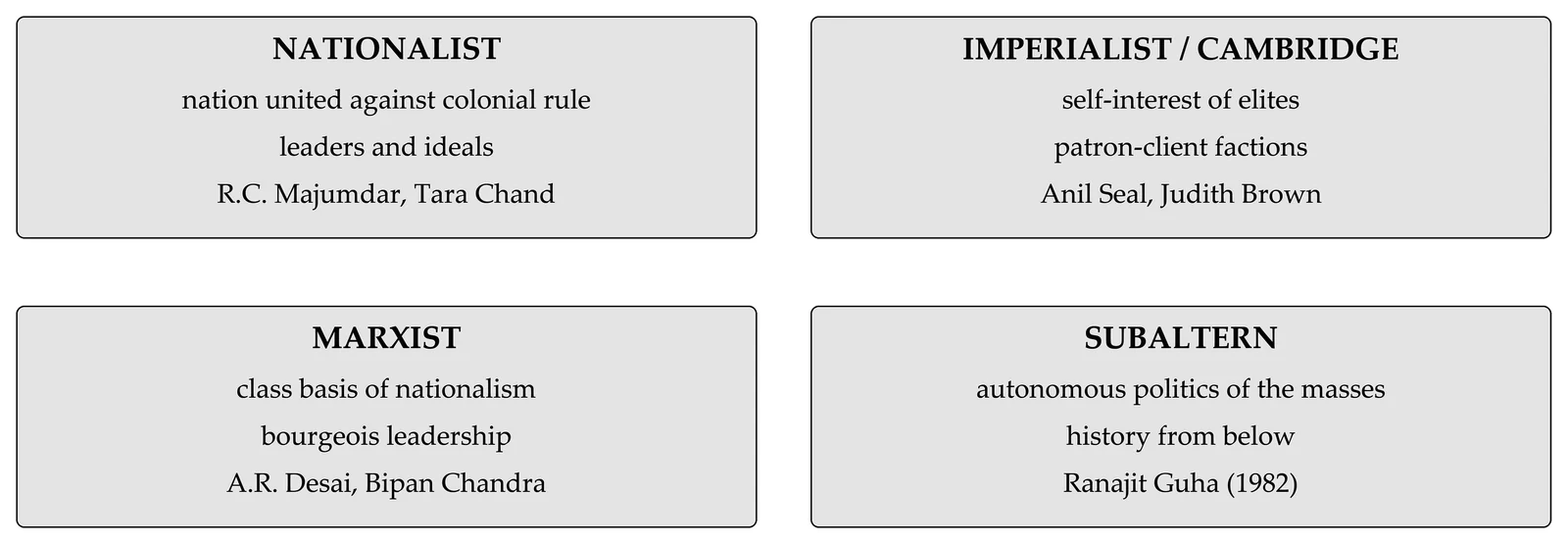
Historians have explained Indian nationalism in very different ways. Romila Thapar, in ‘Interpretations of Colonial History’ (2000), shows that each interpretation reflects its own time and politics. Four main approaches exist (Figure 1.4).
A. The nationalist approach
Nationalist historians, writing during and after the freedom struggle, saw Indian nationalism as the awakening of a united people against foreign rule, led by great leaders and inspired by ideals of freedom. Works such as Pattabhi Sitaramayya’s The History of the Indian National Congress (1935), Tara Chand’s History of the Freedom Movement in India and R.C. Majumdar’s volumes celebrated the sacrifices of the movement and its leaders. Strengths: it recognises the genuine idealism and mass support of the movement. Weaknesses: it tends to ignore internal divisions of class, caste, religion and region, and to treat the Congress leadership as the whole nation.
B. The imperialist (colonial and Cambridge) approach
Colonial writers denied that India was a nation at all. Sir John Strachey (India, 1888) declared that there was not and never had been an India in the sense of a nation, and Lord Dufferin dismissed the educated nationalists in 1888 as a ‘microscopic minority’. Valentine Chirol’s Indian Unrest (1910) treated nationalism as the work of disaffected Brahmins. In the 1960s and 1970s the Cambridge School, including Anil Seal (The Emergence of Indian Nationalism, 1968), John Gallagher and Judith Brown (Gandhi’s Rise to Power, 1972), argued that Indian politics was driven by the self-interest of elites competing for the patronage and resources of the colonial state, organised in patron-client networks at the local and provincial level. Nationalism, on this view, was a by-product of colonial reforms and elite rivalries. Criticism: the historian Tapan Raychaudhuri accused the Cambridge School of reducing nationalism to ‘animal politics’, ignoring ideals, emotions and the sacrifices of millions.
C. The Marxist approach
Marxist historians explain nationalism by its class basis. R. Palme Dutt’s India Today (1940) and A.R. Desai’s Social Background of Indian Nationalism (1948) argued that colonialism created new classes, the industrial bourgeoisie, the professional middle class, workers and peasants, and that the national movement was led by the bourgeoisie, which used the masses but limited their radical demands. Bipan Chandra, in India’s Struggle for Independence (1988), developed a more positive view: the national movement was a genuine popular anti-imperialist struggle, though it contained a contradiction between the interests of the people and those of the bourgeois leadership. Weaknesses: critics say it underestimates the role of religion, culture and caste.
D. The subaltern approach
In the first volume of Subaltern Studies (1982), Ranajit Guha declared that ‘the historiography of Indian nationalism has for a long time been dominated by elitism: colonialist elitism and bourgeois-nationalist elitism’. Both, he argued, ignored the politics of the people, i.e. the subaltern classes of peasants, tribals and workers, which formed an autonomous domain with its own ideas and forms of action, such as rumour, community solidarity and insurgency. Later, Partha Chatterjee’s Nationalist Thought and the Colonial World (1986) called Indian nationalism a ‘derivative discourse’ of Western ideas, and The Nation and Its Fragments (1993) distinguished its ‘outer’ domain of politics and economy from its ‘inner’ domain of culture, religion and family. Criticism: the approach has been accused of romanticising subaltern resistance and, in its later cultural turn, of neglecting material conditions.
1.5 Important Questions
- Question 1 What do you understand by colonialism? Critically analyse the Marxist perspective on colonialism in India.
- Question 2 Define nationalism. Evaluate the Nationalist and Imperialist approaches to the study of nationalism in India.
- Question 3 Examine the postcolonial perspective on colonialism.
DU asks the same idea in different words. So learn one broad answer for each question below; the same answer works for every question joined by OR.
Important Question 1
What do you understand by colonialism? Critically analyse the Marxist perspective on colonialism in India.
OR
Discuss the main perspectives on colonialism.
OR
Examine Marx’s views on British rule in India.
Model Answer
“England has to fulfil a double mission in India: one destructive, the other regenerating.”
— Karl Marx, ‘The Future Results of British Rule in India’ (1853)
Introduction. Colonialism is the domination of one country by another, in which the colonial power rules the colonised people politically, exploits their economy and dominates their culture. Bipan Chandra insisted that colonialism is not merely foreign rule but a structure: the whole economy, society and polity of the colony are reorganised to serve the needs of the colonising country. Among the many ways of understanding colonialism, the Marxist perspective has been the most influential in explaining its economic logic.
1. Meaning and Features of Colonialism
Colonialism differs from mere conquest because the colony is permanently integrated into the economy of the ruling country. Its main features are: political subjugation, since sovereignty lies with a foreign power; economic exploitation, through revenue, trade and the drain of wealth; subordinate integration into world capitalism as a supplier of raw materials and a market for manufactured goods; racial and cultural hierarchy, expressed in Macaulay’s contempt for Indian learning (1835); a powerful colonial state of bureaucracy, army and police; and collaborating classes such as zamindars and princes.
2. Stages of Colonialism
Bipan Chandra identified three stages. In the mercantilist stage (1757–1813) the East India Company used its monopoly of trade and its control of Bengal’s revenue to obtain Indian goods without paying for them, a form of direct plunder. In the free trade stage (1813–1858), after the Company’s monopoly was abolished, India became a market for British machine-made goods and a source of raw materials such as cotton, indigo and jute, and its handicrafts declined. In the stage of finance capital (from the 1860s), British capital was invested in railways, plantations, mines and government loans, and India paid interest and profits to Britain.
3. Marx on British Rule in India
In his articles in the New York Daily Tribune in 1853, Marx condemned the misery caused by British rule. He described how British steam and science had destroyed the Indian handloom and spinning wheel and broken up the self-sufficient village community. Yet he believed that British rule played an unconscious progressive role. India, he thought, had a stagnant ‘Asiatic mode of production’ without private property in land; by introducing railways, private property, a unified political order, a free press and modern industry, Britain would destroy this old society and lay the material foundations of a modern one. This was the ‘double mission’ of destruction and regeneration. Marx also predicted that Indians would not reap the benefits until they themselves threw off the English yoke.
4. Later Marxist Views
Later Marxists, writing after decades of colonial underdevelopment, rejected the view that colonialism was progressive. Lenin, in Imperialism, the Highest Stage of Capitalism (1916), argued that monopoly capitalism needed colonies for raw materials, markets and the export of capital, and supported national liberation movements. R. Palme Dutt, in India Today (1940), traced the exploitation of India through each stage. Bipan Chandra showed that colonialism created a distorted, dependent economy rather than capitalist development: India was industrialised only in limited sectors, while its agriculture stagnated. Dependency theorists such as Andre Gunder Frank described this as the ‘development of underdevelopment’.
5. Key Arguments of the Marxist Perspective
- Drain of wealth: Naoroji and R.C. Dutt showed that Home Charges, salaries, pensions, interest and profits transferred India’s wealth to Britain without return.
- De-industrialisation: cheap British goods and unequal tariffs ruined Indian handicrafts, pushing artisans on to the land.
- Commercialisation of agriculture: peasants were forced to grow cash crops for export, which made them vulnerable to price falls and famine.
- Colonial alliance with landlords: the Permanent Settlement created a class of zamindars loyal to British rule.
- Class basis of nationalism: colonialism created new classes, bourgeoisie, middle class, workers, whose conflicts shaped the national movement.
6. Critical Evaluation
Strengths: the Marxist perspective reveals the economic logic of colonialism, links Indian history to the world capitalist system, and explains the poverty, famines and de-industrialisation of the colonial period. It also gave nationalists their most powerful critique of British rule. Weaknesses: Marx’s early idea of an unchanging, stagnant Asia has been criticised as Eurocentric and historically wrong; the view of colonialism as ‘progressive’ ignores the human cost; Marxists are often accused of economic reductionism, neglecting caste, religion and culture; and postcolonial thinkers argue that the domination of knowledge and identity was as important as economic exploitation.
7. Other Perspectives in Brief
The liberal perspective of James Mill, J.S. Mill and Macaulay justified colonialism as a civilising mission that would bring law, education and progress. The postcolonial perspective of Said, Spivak and Nandy studies colonialism as the domination of knowledge and the colonised mind.
Conclusion. Thus, colonialism was a structure of political domination and economic exploitation. The Marxist perspective, especially in its later form, explains its economic logic most powerfully, but a complete understanding must also include its cultural and psychological dimensions.
Important Question 2
Define nationalism. Evaluate the Nationalist and Imperialist approaches to the study of nationalism in India.
OR
Discuss the different approaches to the study of Indian nationalism.
OR
Write a note on the subaltern approach to Indian nationalism.
Model Answer
“The historiography of Indian nationalism has for a long time been dominated by elitism: colonialist elitism and bourgeois-nationalist elitism.”
— Ranajit Guha, Subaltern Studies I (1982)
Introduction. Nationalism is the belief that a people who share a sense of common identity form a nation, and that this nation should govern itself. In colonies it took the form of anti-colonial nationalism, the struggle of a subject people against foreign rule. How Indian nationalism arose and what it meant has been explained very differently by different schools of historians, and, as Romila Thapar shows, each interpretation reflects its own time and politics.
1. Meaning of Nationalism
A nation, in Benedict Anderson’s phrase, is an ‘imagined community’: its members will never meet most of their fellow members, yet they feel a deep comradeship. Nationalism is both an ideology, which claims that the nation should be sovereign, and a movement, which struggles to achieve this. Indian nationalism grew from the late nineteenth century through the Congress (1885), the Swadeshi movement and the Gandhian mass movements to independence in 1947.
2. The Nationalist Approach
Nationalist historians, writing during and after the freedom struggle, presented nationalism as the awakening of a united Indian people against foreign domination. Pattabhi Sitaramayya’s History of the Indian National Congress (1935), Tara Chand’s History of the Freedom Movement in India and the works of R.C. Majumdar emphasised the idealism, sacrifices and leadership of the movement. They saw its roots in the economic exploitation of India, which the early nationalists exposed, in the spread of modern education and communications, and in the rediscovery of India’s past.
3. Evaluation of the Nationalist Approach
This approach rightly recognises the genuine anti-colonial character of the movement and its mass support. But it tends to treat the Congress as the whole nation and to celebrate leaders while ignoring internal conflicts of class, caste, religion and region. It has little to say about peasants, tribals and workers who acted on their own, or about those, such as many Muslims and Dalits, who felt excluded from the nationalist mainstream.
4. The Imperialist Approach
Colonial officials and writers denied that India was a nation at all. Sir John Strachey wrote in 1888 that there never had been an India possessing any sort of unity, and Lord Dufferin dismissed the nationalists as a ‘microscopic minority’. Valentine Chirol’s Indian Unrest (1910) blamed discontented Brahmins. In the 1960s and 1970s the Cambridge School, Anil Seal (The Emergence of Indian Nationalism, 1968), John Gallagher, Gordon Johnson and Judith Brown (Gandhi’s Rise to Power, 1972), argued that Indian politics was driven by the competition of self-interested elites for the resources and patronage of the colonial state. Politics was organised through patron-client networks at the local and provincial level, and nationalism was a by-product of colonial constitutional reforms, which created arenas for this competition. Anil Seal and John Gallagher of the Cambridge School explained nationalism as competition among Indian elites for patronage and power.
5. Evaluation of the Imperialist Approach
The Cambridge School drew useful attention to local and provincial politics, to the role of colonial institutions and to the self-interest that existed in politics. But it denied the anti-colonial character of nationalism, ignored the economic critique of colonialism and the role of ideas, and could not explain why millions of ordinary people went to jail or faced bullets. Tapan Raychaudhuri famously said that it reduced nationalism to ‘animal politics’, and Bipan Chandra criticised it for treating Indians as if they had no ideals.
6. Marxist and Subaltern Approaches
Marxist historians such as R. Palme Dutt and A.R. Desai explained nationalism by its class basis and its bourgeois leadership, while Bipan Chandra saw it as a genuine popular anti-imperialist movement. The subaltern school founded by Ranajit Guha (1982) criticised both colonialist and nationalist elitism and studied the autonomous politics of peasants, tribals and workers; Partha Chatterjee called Indian nationalism a ‘derivative discourse’ of Western ideas. Ranajit Guha argued that elite historiography ignored the independent politics of the people.
7. Modernist Explanations
Scholars such as Gellner and Anderson see nationalism as a modern product of industrialisation, print capitalism and mass education; in India, newspapers, railways and English education helped people from different regions imagine themselves as one nation.
8. The Distinctiveness of Indian Nationalism
Indian nationalism was anti-colonial, inclusive in its main current, and built on economic critique, constitutional demands and Gandhian mass action; it imagined a nation united in diversity rather than defined by one language or religion.
9. Comparative Assessment
The nationalist approach celebrates the unity and idealism of the struggle; the imperialist approach denies both. The Marxist approach supplies the economic and class dimension, and the subaltern approach recovers the voices of the masses. Each corrects the others, and a balanced understanding draws on all four.
Conclusion. Thus, neither the nationalist nor the imperialist approach is adequate alone. Indian nationalism was a genuine mass anti-colonial movement, shaped also by elite interests, class conflict and independent initiatives from below.
Important Question 3
Examine the postcolonial perspective on colonialism.
OR
Discuss the liberal justification of colonialism.
OR
Write a note on ‘Orientalism’.
Model Answer
“Despotism is a legitimate mode of government in dealing with barbarians, provided the end be their improvement.”
— J.S. Mill, On Liberty (1859)
Introduction. Colonialism has been understood in three main ways: liberals justified it as a civilising mission, Marxists exposed it as economic exploitation, and postcolonial theorists study it as the domination of knowledge, culture and identity. The postcolonial perspective, developed from the 1960s, argues that colonialism ruled minds as well as territories.
1. The Liberal Justification
James Mill’s The History of British India (1817) described Indian civilisation as backward; J.S. Mill argued that despotism over ‘barbarians’ was legitimate if it aimed at their improvement; and Macaulay (1835) wanted to create a class of Indians ‘English in taste, in opinions, in morals and in intellect’. Thomas Metcalf (1995) shows how this liberal faith in law, education and progress became an ideology that justified British rule. Macaulay’s Minute on Education (1835) claimed that a single shelf of a good European library was worth the whole native literature of India and Arabia.
2. Origins of Postcolonial Theory
Frantz Fanon, writing during the Algerian war of independence in Black Skin, White Masks (1952) and The Wretched of the Earth (1961), described how colonialism made the colonised feel inferior and how liberation required the decolonisation of the mind as well as the land. In The Wretched of the Earth (1961), Fanon argued that colonialism dehumanises both colonised and coloniser and that decolonisation requires a new consciousness.
3. Edward Said and Orientalism
Edward Said’s Orientalism (1978) argued that Western scholarship, literature and art constructed ‘the Orient’ as irrational, unchanging, sensual and inferior, in contrast to a rational and progressive West. Drawing on Foucault, he showed that this knowledge was a form of power: by claiming to know the East better than its own people, the West justified ruling it. Orientalism portrayed the East as irrational, despotic, unchanging and feminine, in contrast to a rational, progressive West, and this knowledge served colonial power.
4. Spivak, Bhabha and Nandy
Gayatri Chakravorty Spivak, in ‘Can the Subaltern Speak?’ (1988), argued that colonial and elite discourses speak for the subaltern, especially subaltern women, who are denied a voice of their own. Homi Bhabha (The Location of Culture, 1994) studied the mimicry and hybridity of colonised elites, which both copied and subtly undermined colonial authority. Ashis Nandy (The Intimate Enemy, 1983) showed how colonialism damaged the self-image of both coloniser and colonised. Ashis Nandy’s The Intimate Enemy (1983) showed how colonialism colonised minds as well as bodies, and Homi Bhabha described the ‘mimicry’ and ‘hybridity’ that colonialism produced.
5. Subaltern Studies
The Subaltern Studies collective, founded by Ranajit Guha in 1982, sought to recover the history of peasants, tribals and workers whose politics had been ignored by colonial and nationalist elites; later volumes turned towards postcolonial questions of discourse.
6. Provincialising Europe
Dipesh Chakrabarty’s Provincializing Europe (2000) argued that European categories such as history, modernity and the secular cannot simply be applied to India as universal standards; they must be ‘provincialised’, i.e. treated as one particular tradition among others.
7. Features of the Postcolonial Perspective
It emphasises discourse and representation, the link between knowledge and power, the colonised mind and identity, hybridity and resistance, and the continuing influence of colonial ideas after independence. It also questions the claim that Western modernity is the only path to progress.
8. Postcolonialism and India Today
Postcolonial ideas influence debates on the English language, the curriculum, development models and the image of India in global media, reminding us that colonial ways of thinking can outlive colonial rule.
9. Gandhi as a Postcolonial Thinker
Gandhi’s Hind Swaraj (1909) anticipated postcolonial theory by attacking not only British rule but modern Western civilisation itself, arguing that Indians must free their minds from its values; Nandy and Partha Chatterjee read him in this light.
10. Decolonising Knowledge
Postcolonial critics call for decolonising universities, curricula and research, so that knowledge from the Global South is not treated merely as raw material for Western theory.
11. Evaluation
Postcolonialism reveals the cultural and psychological dimensions of empire and the power hidden in knowledge. Critics such as Aijaz Ahmad (In Theory, 1992) argue that it neglects economic exploitation and class, focuses too much on texts, and uses difficult language. Critics such as Aijaz Ahmad, in In Theory (1992), argue that postcolonialism neglects class and the material economy of empire. Others argue that it sometimes romanticises pre-colonial traditions.
Conclusion. Thus, the postcolonial perspective shows that colonialism dominated not only territories but also minds. Together with the Marxist analysis, it gives a fuller understanding of colonial domination.
Short Notes
(a) Drain of Wealth
The drain theory was developed by Dadabhai Naoroji in Poverty and Un-British Rule in India (1901) and by R.C. Dutt. It held that a large part of India’s wealth flowed to Britain every year without any economic return: the Home Charges (the cost of the India Office, pensions, interest on debt and military expenses), the salaries and savings of British officials, and the profits of British investors. Naoroji estimated the drain at a large share of India’s revenue and argued that it was the main cause of Indian poverty. The theory was the foundation of the nationalist economic critique of colonialism and turned the early Congress against British economic policy.
(b) The Subaltern Approach
Founded by Ranajit Guha with the first volume of Subaltern Studies (1982), this approach criticised both colonialist and nationalist historiography as ‘elitist’. It argued that the subaltern classes, peasants, tribals and workers, had their own autonomous domain of politics, with their own ideas, forms of mobilisation and resistance, which elite leaders neither created nor controlled. Guha’s Elementary Aspects of Peasant Insurgency (1983) and later work by Partha Chatterjee, Shahid Amin and Dipesh Chakrabarty developed it. Critics say that it romanticised resistance and, in its later cultural turn, neglected material conditions.
(c) Orientalism
In Orientalism (1978), Edward Said argued that Western knowledge about ‘the Orient’ constructed it as irrational, unchanging and inferior, and that this knowledge served colonial power. In India, the eighteenth-century ‘Orientalists’ such as William Jones, who founded the Asiatic Society (1784), admired classical Indian learning, but even their scholarship fixed India in an image of a timeless, religious past. Said’s work founded postcolonial theory.
More notes: DSC-3 Colonialism and Nationalism in India
These notes are prepared by PADHO TO AISE for study help. They are not an official University of Delhi publication.