
Generic Electives (GE) GE-11 Election Commission and Process in India
Unit 4 · 24 min read · Updated 27 Nov 2026
As per the University of Delhi (DU) Generic Elective (GE) syllabus offered by the Department of Political Science
Contents
- 4.1 Registration, Recognition, Symbols and the Party System
- Registration of Parties
- Recognition as National or State Parties
- Election Symbols
- The Indian Party System
- 4.2 Electoral Malpractices, Legal Provisions and the Role of Media and Civil Society
- Electoral Malpractices
- Legal Provisions
- Role of the Media and Civil Society
- 4.3 Electoral Reforms: Past, Present and Recommendations
- Major Reform Committees
- Reforms Implemented
- Recommendations Still Debated
- 4.4 Important Questions
- Discuss the registration and recognition of political parties in India.
- Examine the role of election symbols and the evolution of the party system in India.
- Discuss electoral malpractices in India and the legal provisions to check them.
- Discuss the major electoral reforms in India and suggest further reforms.
- Short Notes
आधुनिक लोकतंत्र की कल्पना राजनीतिक दलों के बिना नहीं की जा सकती।
Modern democracy is unthinkable save in terms of the parties.
— E.E. Schattschneider, Party Government (1942)
PPOLITICAL parties are the main actors of electoral democracy: they choose candidates, present programmes, mobilise voters and form governments. In India, parties are registered and recognised by the Election Commission and compete using symbols that even illiterate voters recognise. Yet elections are also threatened by malpractices such as money power, criminalisation, communal appeals and paid news. This chapter studies the registration and recognition of parties, symbols and the party system, electoral malpractices and the laws against them, the role of the media and civil society, and the long history of electoral reforms in India.

4.1 Registration, Recognition, Symbols and the Party System
A political party is an organised group of people who share broad goals and seek to gain power through elections in order to implement them. Parties connect citizens with government, aggregate interests, recruit leaders, offer choices to voters and organise the government and the opposition. The political scientist E.E. Schattschneider wrote in 1942 that modern democracy is unthinkable without parties.
Registration of Parties
- Section 29A. Any association of Indian citizens calling itself a political party can apply to the Election Commission for registration within thirty days of its formation.
- Allegiance to the Constitution. Its constitution must state that it bears true faith and allegiance to the Constitution and to the principles of socialism, secularism and democracy, and will uphold the sovereignty, unity and integrity of India.
- Benefits. Registered parties can receive tax-exempt donations, field candidates with fewer proposers and get common symbols in some cases.
- No power to deregister. In Indian National Congress v. Institute of Social Welfare (2002), the Supreme Court held that the Commission cannot deregister a party except in limited circumstances such as fraud; however, in 2025 the Commission began removing from its list hundreds of registered parties that had not contested elections for years.
Recognition as National or State Parties
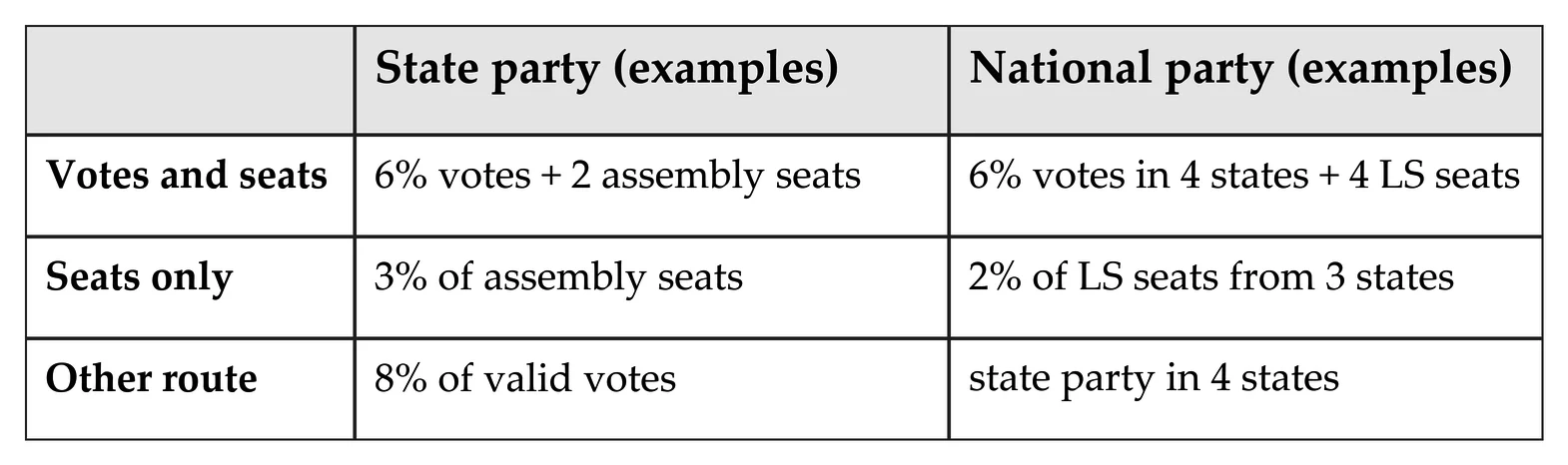
Under the Election Symbols Order of 1968, the Commission recognises some registered parties as state parties or national parties on the basis of their electoral performance. A party is recognised as a state party if, for example, it wins six per cent of the valid votes in a state election and two assembly seats, or three per cent of the assembly seats, or eight per cent of the votes. A party is recognised as a national party if it wins six per cent of the votes in four or more states and four Lok Sabha seats, or two per cent of Lok Sabha seats from at least three states, or is recognised as a state party in four states. In April 2023, the Commission recognised six national parties: the Bharatiya Janata Party, the Indian National Congress, the Bahujan Samaj Party, the Communist Party of India (Marxist), the Aam Aadmi Party and the National People’s Party.
Election Symbols
Symbols are essential in a country where many voters cannot read, since they identify parties on the ballot. Recognised parties have reserved symbols, such as the lotus and the hand, while other candidates choose from free symbols. When a party splits, the Commission decides which faction is entitled to the name and symbol, using tests such as the majority in the legislative and organisational wings, as in Sadiq Ali (1971), when the Congress split, and in the Shiv Sena (2023) and Nationalist Congress Party (2024) disputes.
The Indian Party System
- One-party dominance (1952–67). Rajni Kothari, in an essay of 1964, described the Congress system, in which the Congress dominated as a party of consensus, while opposition parties acted as parties of pressure.
- Decline of Congress (1967–89). After 1967, Congress lost power in several states, and in 1977 the Janata Party formed the first non-Congress government at the centre.
- Coalition era (1989–2014). No party won a majority in the Lok Sabha, and coalitions such as the National Democratic Alliance and the United Progressive Alliance governed, giving regional parties great influence.
- BJP dominance (since 2014). The BJP won majorities in 2014 and 2019, which some scholars, such as Suhas Palshikar, describe as a second dominant party system; in 2024 it formed a government with its allies.
- Regional parties. Parties based on regional, linguistic or caste identities, such as the DMK, Shiv Sena, TDP and BSP, remain central to Indian politics.
- Anti-defection law. The 52nd Amendment of 1985 added the Tenth Schedule to disqualify legislators who defect, tightened by the 91st Amendment of 2003.
4.2 Electoral Malpractices, Legal Provisions and the Role of Media and Civil Society
Electoral Malpractices
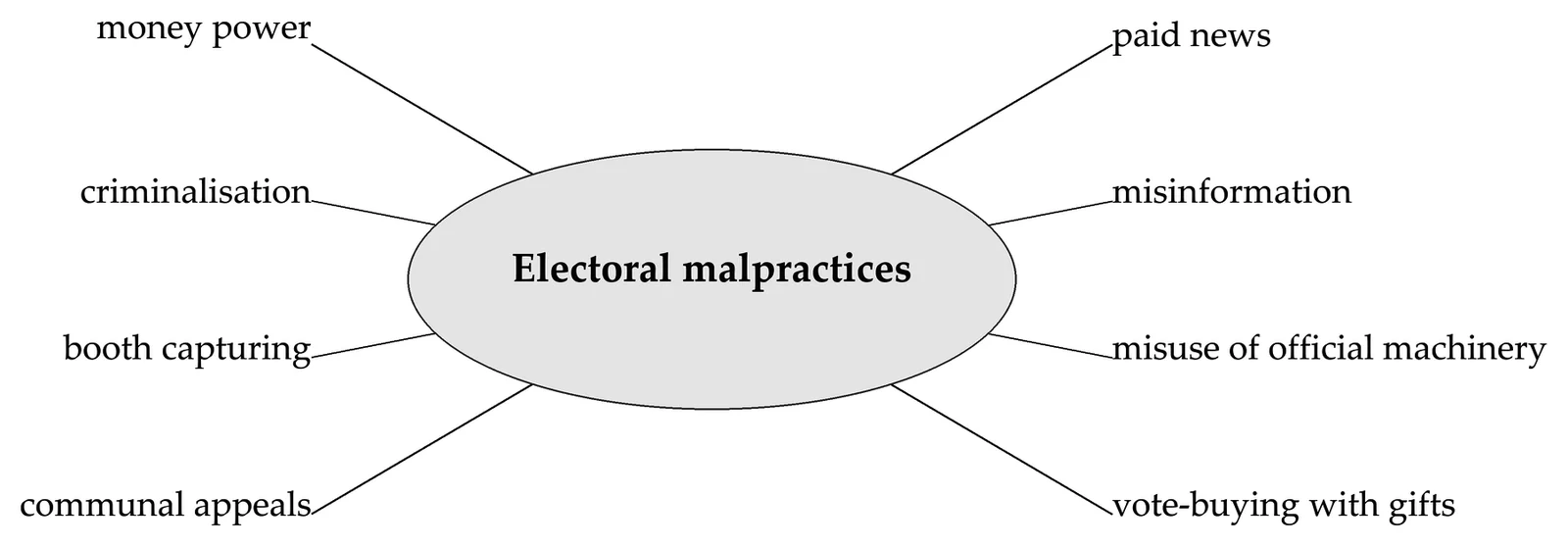
- Money power. Excessive spending, vote-buying with cash, liquor and gifts, and unaccounted donations distort elections; the Commission seizes large amounts of cash and goods in every election.
- Muscle power and criminalisation. Candidates with criminal backgrounds contest and win; reports by the Association for Democratic Reforms show that a large share of elected MPs declare criminal cases.
- Booth capturing and intimidation. Armed groups seizing polling booths was common in some states in the 1980s, though EVMs and security forces have reduced it.
- Communal and caste appeals. Appeals to religion, caste and language to win votes, and hate speech, divide society.
- Paid news and misinformation. Payments to media for favourable coverage and the spread of false information on social media mislead voters.
- Misuse of official machinery. Ruling parties may use government resources, advertisements and officials to gain advantage.
Legal Provisions
- Corrupt practices (Section 123, RPA 1951). Bribery, undue influence, appeals on grounds of religion, race, caste, community or language, promoting enmity, booth capturing and excess expenditure are corrupt practices, for which an election can be set aside and the candidate disqualified.
- Electoral offences. Sections 125 to 136 of the 1951 Act punish promoting enmity in connection with elections, campaigning during the silence period, booth capturing (Section 135A, added in 1989) and other offences; the Bharatiya Nyaya Sanhita of 2023 also contains a chapter on offences relating to elections.
- Disqualification on conviction (Section 8). Persons convicted of certain offences are disqualified; in Lily Thomas (2013), the Supreme Court held that sitting legislators convicted and sentenced to two years or more are disqualified immediately.
- Disclosure. In Union of India v. ADR (2002) and PUCL (2003), the Supreme Court required candidates to disclose criminal cases, assets and education.
- Expenditure limits. Candidates must keep accounts and stay within limits, and failure to file accounts can lead to disqualification under Section 10A.
Role of the Media and Civil Society
The media inform voters about candidates and issues, expose malpractices and monitor the conduct of elections, but they can also spread paid news and biased coverage; the Commission set up Media Certification and Monitoring Committees and, in 2011, disqualified a legislator for failing to account for paid news. Social media has become a powerful campaign tool, and in 2019 platforms adopted a voluntary code of ethics with the Commission. Civil society organisations, especially the Association for Democratic Reforms (ADR), founded in 1999 by professors of IIM Ahmedabad, have won landmark cases on candidate disclosure and electoral bonds, analysed candidates’ affidavits and run voter awareness campaigns. Election watch groups, academics and citizens using apps such as cVIGIL also help keep elections clean.
4.3 Electoral Reforms: Past, Present and Recommendations
Major Reform Committees
- Tarkunde Committee (1975). Set up by Jayaprakash Narayan, it recommended an independent Election Commission and measures against money power.
- Dinesh Goswami Committee (1990). It recommended a broad-based method of appointing Election Commissioners, state funding in kind, and measures against booth capturing.
- Vohra Committee (1993). It reported on the nexus between criminals, politicians and bureaucrats.
- Indrajit Gupta Committee (1998). It recommended partial state funding of elections in kind for recognised parties.
- Law Commission reports. The 170th report (1999) on electoral laws, the 244th (2014) on decriminalisation and the 255th (2015) on electoral reforms made many recommendations.
- Ram Nath Kovind Committee (2024). It recommended simultaneous elections to the Lok Sabha, state assemblies and local bodies.

Reforms Implemented
Many reforms have been implemented: the lowering of the voting age to eighteen (1989); the anti-defection law (1985 and 2003); a multi-member Election Commission (1993); photo identity cards (1993); electronic voting machines (from 1982, nationwide in 2004); disclosure of candidates’ backgrounds (2002–03); tax exemption and disclosure of donations above twenty thousand rupees (2003); a ban on publishing exit polls before the last phase (2009); NOTA and VVPAT (2013); and four qualifying dates for voter registration (2021). The electoral bonds scheme of 2018, which allowed anonymous donations to parties, was struck down by the Supreme Court in Association for Democratic Reforms v. Union of India on 15 February 2024 for violating voters’ right to information.
Recommendations Still Debated
- Decriminalisation. Barring persons charged with serious offences from contesting, once charges are framed by a court.
- Funding. State funding of elections, transparency in party finances and limits on party expenditure.
- Inner-party democracy. Regular elections within parties and transparency in candidate selection.
- Freebies. Regulating pre-election promises that strain public finances, a matter pending before the Supreme Court.
- Simultaneous elections. The Constitution (129th Amendment) Bill of 2024 on One Nation, One Election was referred to a joint parliamentary committee.
- Remote voting. Allowing migrant voters to vote from where they live.
- Independence of the Commission. A neutral appointment process and equal protection for all Commissioners.
4.4 Important Questions
- Question 1 Discuss the registration and recognition of political parties in India.
- Question 2 Examine the role of election symbols and the evolution of the party system in India.
- Question 3 Discuss electoral malpractices in India and the legal provisions to check them.
- Question 4 Discuss the major electoral reforms in India and suggest further reforms.
DU asks the same idea in different words. So learn one broad answer for each question below; the same answer works for every question joined by OR.
Important Question 1
Discuss the registration and recognition of political parties in India.
OR
Explain the criteria for recognition of national and state parties.
OR
Should the Election Commission have the power to deregister political parties? Discuss.
Model Answer
“Shall bear true faith and allegiance to the Constitution of India as by law established, and to the principles of socialism, secularism and democracy, and would uphold the sovereignty, unity and integrity of India.”
— Representation of the People Act, 1951, Section 29A(5)
Introduction. Political parties are central to Indian democracy, and their entry into the electoral arena is regulated by the Election Commission. Parties are first registered under Section 29A of the Representation of the People Act, 1951, and some are then recognised as national or state parties under the Election Symbols Order of 1968 on the basis of their electoral performance. Registration and recognition bring legal benefits and responsibilities.
1. Role of Political Parties
Parties aggregate interests, select candidates, present programmes, mobilise voters, form governments and act as opposition. Without them, elections in a vast country like India would be chaotic and representative government impossible.
2. Section 29A
Section 29A, added in 1989, allows any association of Indian citizens calling itself a political party to apply for registration within thirty days of its formation, submitting its constitution, office-bearers and membership details.
3. Allegiance to Constitutional Values
A party’s constitution must declare allegiance to the Constitution and to socialism, secularism and democracy and to the sovereignty, unity and integrity of India, linking party politics to constitutional values.
4. Benefits of Registration
Registered parties can receive donations that are exempt from income tax, nominate candidates with fewer proposers and seek common symbols, which encourages groups to register formally.
5. Number of Parties
Thousands of parties are registered, but most are unrecognised and many never contest elections, raising concerns that some exist only to receive tax-exempt donations.
6. Recognition
Under the Election Symbols Order of 1968, the Commission recognises registered parties as state or national parties according to their votes and seats, reviewing recognition after each general election.
7. State Party Criteria
A party becomes a state party if it wins, for example, six per cent of the votes and two seats in a state assembly election, or three per cent of the assembly seats, or one Lok Sabha seat for every twenty-five, or eight per cent of the votes.
8. National Party Criteria
A party becomes a national party if it wins six per cent of the votes in four or more states and four Lok Sabha seats, or two per cent of Lok Sabha seats from three states, or is recognised as a state party in four states.
9. Current National Parties
In April 2023, the Commission recognised six national parties, the BJP, Congress, BSP, CPI(M), AAP and NPP, while the NCP, CPI and Trinamool Congress lost national status after their performance declined.
10. Benefits of Recognition
Recognised parties get reserved symbols, free broadcast time on public media, copies of electoral rolls and the right to nominate star campaigners whose expenses are not counted in candidates’ accounts.
11. Deregistration
In 2002, the Supreme Court held that the Commission cannot deregister a party except in limited cases such as fraud. The Commission has asked for power to deregister parties that do not contest elections, and in 2025 it began removing inactive parties from its list.
12. Inner-Party Democracy
The law does not require parties to hold internal elections or follow democratic procedures, and many parties are controlled by families or leaders. The Law Commission’s 255th report recommended regulating inner-party democracy.
13. Transparency
Parties must report donations above twenty thousand rupees, but large amounts come from unknown sources. The Central Information Commission held in 2013 that national parties are public authorities under the RTI Act, but parties have not complied.
14. Evaluation
Registration and recognition give order to India’s crowded party system, but greater powers for the Commission, inner-party democracy and transparency in funding are needed.
Conclusion. Thus, parties are registered under Section 29A on declaring allegiance to constitutional values, and recognised as national or state parties under the Symbols Order of 1968 on the basis of votes and seats. Recognition brings reserved symbols and other benefits, but the lack of power to deregister, weak inner-party democracy and opaque funding call for reform.
Important Question 2
Examine the role of election symbols and the evolution of the party system in India.
OR
Discuss the changing nature of the party system in India since 1952.
OR
How does the Election Commission resolve disputes over party symbols? Discuss.
Model Answer
“If he has voluntarily given up his membership of such political party.”
— Constitution of India, Tenth Schedule, paragraph 2(1)(a), a ground of disqualification for defection
Introduction. Election symbols make it possible for millions of voters, many of whom cannot read, to identify parties and candidates. The party system, i.e. the pattern of competition among parties, has changed greatly since the first election of 1951–52, from one-party dominance to coalition politics and a new phase of dominance. Symbols, recognition and the anti-defection law together shape how parties compete.
1. Importance of Symbols
In a country with a large illiterate population in 1952, symbols such as the pair of bullocks of the Congress allowed voters to identify parties. Symbols remain important for brand recognition and voter mobilisation.
2. The Symbols Order of 1968
The Election Symbols (Reservation and Allotment) Order of 1968 classifies symbols as reserved, for recognised parties, and free, for other candidates, and gives the Commission power to decide disputes.
3. Symbol Disputes
When a recognised party splits, the Commission decides which faction gets the name and symbol, using tests such as the support of the legislative and organisational wings, as in Sadiq Ali (1971) and the Shiv Sena (2023) and NCP (2024) disputes.
4. The Congress System (1952–67)
Rajni Kothari described the Congress system, in which the Congress dominated as a broad party of consensus containing many factions, while opposition parties acted as parties of pressure influencing it from outside.
5. The Decline of Congress Dominance (1967–77)
In 1967, the Congress lost power in several states to coalitions, and after the Emergency the Janata Party formed the first non-Congress government at the centre in 1977, though it collapsed in 1979.
6. Congress Revival and Decline (1980–89)
The Congress returned to power in 1980 and won a huge majority in 1984, but lost in 1989, opening the era of coalition governments.
7. The Coalition Era (1989–2014)
No single party won a Lok Sabha majority, and coalitions such as the National Front, United Front, NDA and UPA governed, giving regional parties great bargaining power.
8. Rise of Regional and Caste-Based Parties
Regional parties such as the DMK, TDP and Trinamool Congress, and caste-based parties such as the BSP and Samajwadi Party, grew in the 1990s, reflecting the democratic upsurge of backward castes and Dalits.
9. BJP Dominance (since 2014)
The BJP won majorities in 2014 and 2019, which scholars such as Suhas Palshikar call a second dominant party system. In 2024, it fell short of a majority on its own and governs with allies in the NDA.
10. The Anti-Defection Law
The 52nd Amendment of 1985 added the Tenth Schedule, disqualifying legislators who voluntarily give up party membership or defy the whip. The 91st Amendment of 2003 removed the exemption for splits.
11. Effects of the Anti-Defection Law
The law reduced frequent defections, but critics argue that it weakened individual legislators’ independence and that Speakers sometimes delay decisions on disqualification for political reasons.
12. Party System and Federalism
Different parties often govern at the centre and in states, so the party system interacts with federalism, leading to cooperation in some areas and conflict in others.
13. Party Organisation
Many parties are dominated by leaders or families and lack internal democracy, which affects candidate selection and the quality of representation.
14. Symbols in the First Election
In 1951–52, the Commission allotted symbols such as the pair of bullocks to the Congress, the hut to the Kisan Mazdoor Praja Party and the lamp to the Bharatiya Jana Sangh, and placed a separate ballot box with each candidate’s symbol in the booth, allowing illiterate voters to vote without reading.
15. Factions and Fragmentation
The splitting of parties, such as the Congress in 1969, the Janata Party in 1979 and many regional parties since, has shaped the party system. Splits often lead to symbol disputes before the Commission and to the formation of new parties around leaders and regions.
16. Coalition Practices
During the coalition era, parties developed practices such as common minimum programmes, coordination committees and seat-sharing agreements, which made coalition governments more stable and gave regional parties a role in national policy.
17. Evaluation
Symbols and recognition give structure to Indian party competition, and the party system has evolved with social change, reflecting the vitality of Indian democracy.
Conclusion. Thus, election symbols, regulated by the Symbols Order of 1968, help voters identify parties, and the Commission settles disputes over them. India’s party system has moved from the Congress system through coalition politics to BJP dominance, shaped by regional and caste-based parties and the anti-defection law.
Important Question 3
Discuss electoral malpractices in India and the legal provisions to check them.
OR
Examine the problem of money power and criminalisation in Indian elections.
OR
Discuss the role of the media and civil society in checking electoral malpractices.
Model Answer
“Power tends to corrupt, and absolute power corrupts absolutely.”
— Lord Acton, letter to Bishop Mandell Creighton (1887)
Introduction. Free and fair elections are threatened by malpractices such as money power, muscle power, criminalisation, communal appeals, paid news and misuse of official machinery. India has developed a legal framework to check them, through the Representation of the People Act, criminal law, Supreme Court judgments and the Election Commission’s regulations. The media and civil society also play a vital role in exposing and preventing malpractices.
1. Money Power
Candidates and parties often spend far more than legal limits on rallies, advertisements and vote-buying with cash, liquor and gifts. The Commission seizes large amounts of cash and goods in every election, showing the scale of the problem.
2. Criminalisation of Politics
Many candidates have criminal cases against them, and analyses of affidavits by the Association for Democratic Reforms show that a large share of elected MPs declare such cases. The Vohra Committee (1993) reported on the nexus between criminals and politicians.
3. Booth Capturing and Intimidation
In some states, armed groups once captured polling booths and intimidated voters. Section 135A, added in 1989, made booth capturing an offence, and EVMs and central forces have reduced it.
4. Communal and Caste Appeals
Appeals to religion, caste, community or language and hate speech divide voters. In Abhiram Singh (2017), the Supreme Court held that any appeal on such grounds by a candidate or agent is a corrupt practice.
5. Paid News and Misinformation
Payments to media for favourable coverage disguised as news, and false information spread on social media, mislead voters and distort competition.
6. Corrupt Practices under Section 123
Section 123 of the 1951 Act defines corrupt practices, including bribery, undue influence, appeals on grounds of religion, race, caste, community or language, promoting enmity, booth capturing and excess expenditure, which can void an election.
7. Electoral Offences
Sections 125 to 136 of the 1951 Act punish offences such as promoting enmity, campaigning during the silence period and booth capturing, and the Bharatiya Nyaya Sanhita contains a chapter on offences relating to elections.
8. Disqualification on Conviction
Section 8 disqualifies persons convicted of certain offences, and in Lily Thomas (2013) the Supreme Court ended the protection that allowed convicted legislators to continue in office pending appeal.
9. Disclosure of Background
Following Union of India v. ADR (2002) and PUCL (2003), candidates must disclose criminal cases, assets, liabilities and education, and since 2020 parties must explain why they chose candidates with criminal records.
10. Expenditure Control
Candidates must maintain accounts within limits, and the Commission deploys expenditure observers and flying squads. Failure to file accounts can lead to disqualification under Section 10A.
11. Role of the Media
The media inform voters, expose malpractices and monitor elections. The Commission’s Media Certification and Monitoring Committees check paid news, and in 2011 it disqualified a legislator for failing to account for paid news expenses.
12. Role of Civil Society
The Association for Democratic Reforms and National Election Watch analyse candidates’ affidavits, publicise criminal and financial records and have won landmark cases on disclosure and electoral bonds.
13. Limits of the Legal Framework
Election petitions take years to decide, conviction rates are low, party expenditure is not capped and parties continue to field candidates with criminal records, showing the limits of existing laws.
14. Evaluation
India has an extensive legal framework against electoral malpractices, strengthened by courts, the media and civil society, but money power and criminalisation remain serious threats requiring further reform.
Conclusion. Thus, money power, criminalisation, booth capturing, communal appeals, paid news and misuse of official machinery threaten Indian elections. Section 123 on corrupt practices, electoral offences, disqualification on conviction, disclosure requirements and expenditure control provide legal checks, supported by the media and civil society, though gaps remain.
Important Question 4
Discuss the major electoral reforms in India and suggest further reforms.
OR
Examine the recommendations of the major committees on electoral reform.
OR
Discuss the debate on state funding of elections and simultaneous elections.
Model Answer
“Eternal vigilance is the price of liberty.”
— Wendell Phillips, speech to the Massachusetts Anti-Slavery Society (1852)
Introduction. Electoral reforms are changes in laws and practices that make elections freer, fairer, more inclusive and more transparent. Since independence, India has carried out many reforms, from adult franchise and EVMs to candidate disclosure and VVPATs, guided by committees, the Election Commission, courts and civil society. Yet problems such as money power, criminalisation and opaque party funding call for further reforms.
1. Need for Electoral Reforms
Reforms are needed because elections face challenges such as money power, criminalisation, communal appeals, misuse of official machinery, defects in rolls and concerns about the independence of the Election Commission.
2. Tarkunde Committee (1975)
Set up by Jayaprakash Narayan, the Tarkunde Committee recommended a multi-member Election Commission, curbs on money power and the lowering of the voting age, ideas later implemented in part.
3. Dinesh Goswami Committee (1990)
It recommended appointing Election Commissioners in consultation with the Chief Justice and the Leader of the Opposition, state funding in kind, measures against booth capturing and the use of EVMs.
4. Vohra and Indrajit Gupta Committees
The Vohra Committee (1993) exposed the criminal-political nexus, and the Indrajit Gupta Committee (1998) recommended partial state funding of elections in kind for recognised parties.
5. Law Commission Reports
The Law Commission’s 170th report (1999), 244th report (2014) on decriminalisation and 255th report (2015) on electoral reforms recommended measures such as barring candidates charged with serious offences and regulating inner-party democracy.
6. Reforms Implemented in the 1980s and 1990s
The voting age was lowered to eighteen, the anti-defection law was passed, booth capturing was made an offence, the Commission became multi-member and photo identity cards were introduced.
7. Reforms Implemented since 2000
EVMs were used nationwide from 2004, candidates had to disclose backgrounds from 2003, donations above twenty thousand rupees had to be reported, exit polls were restricted in 2009, and NOTA and VVPAT were introduced in 2013.
8. Electoral Bonds
The electoral bonds scheme of 2018 allowed anonymous donations to parties through bank bonds. On 15 February 2024, the Supreme Court struck it down in ADR v. Union of India for violating voters’ right to information.
9. Decriminalisation
Proposals include barring persons from contesting once a court frames charges for serious offences, fast-track courts for cases against legislators and requiring parties to justify candidates with criminal records.
10. State Funding
State funding of elections, in cash or in kind, has been proposed to reduce dependence on private money, but critics fear it would add to costs without stopping illegal spending unless combined with strict enforcement.
11. Simultaneous Elections
The Ram Nath Kovind Committee (2024) recommended simultaneous elections to the Lok Sabha, assemblies and local bodies, and a constitutional amendment bill was introduced in December 2024. Supporters cite reduced costs and governance disruption, while critics see threats to federalism and accountability.
12. Other Recommendations
Other proposals include inner-party democracy, transparency in party finances, bringing parties under RTI, regulating freebies, remote voting for migrants and a neutral appointment process for Election Commissioners.
13. Role of Courts and Civil Society
Many reforms, such as disclosure, NOTA and the end of electoral bonds, came through Supreme Court judgments in cases brought by civil society organisations like ADR and PUCL.
14. Reform through Technology
Technology has driven many reforms: EVMs ended invalid votes and booth capturing, VVPATs added verifiability, online registration widened access and apps such as cVIGIL let citizens report violations. Future technological reforms may include remote voting for migrants, though these require safeguards for secrecy and security.
15. Evaluation
India’s electoral reforms have made elections more inclusive and transparent, but money power, criminalisation and opaque funding show that reform must be continuous.
Conclusion. Thus, electoral reforms in India, guided by the Tarkunde, Goswami, Vohra and Indrajit Gupta committees and Law Commission reports, have brought adult suffrage at eighteen, EVMs, disclosure, NOTA, VVPAT and the end of electoral bonds. Further reforms on criminalisation, funding, inner-party democracy and the Commission’s independence remain necessary, since eternal vigilance is the price of democratic liberty.
Short Notes
(a) Association for Democratic Reforms
A civil society organisation founded in 1999 by professors of IIM Ahmedabad, which won cases on candidate disclosure and electoral bonds and analyses candidates’ backgrounds.
(b) Electoral bonds
A scheme introduced in 2018 allowing anonymous donations to political parties through bank bonds, struck down by the Supreme Court on 15 February 2024.
(c) Tenth Schedule
The anti-defection provisions added by the 52nd Amendment of 1985, which disqualify legislators who voluntarily give up party membership or defy the party whip.
More notes: GE-11 Election Commission and Process in India
These notes are prepared by PADHO TO AISE for study help. They are not an official publication.