
Generic Electives (GE) GE-8 Introduction to Public Policy
Unit 4 · 24 min read · Updated 27 Nov 2026
As per the University of Delhi (DU) Generic Elective (GE) syllabus offered by the Department of Political Science
Contents
- 4.1 Education: National Education Policy 2020
- School Education
- Higher Education
- Assessment
- 4.2 Health: National Health Mission
- Main Features
- Achievements
- Criticisms
- 4.3 Employment and Economic Empowerment: MGNREGA, PMJDY and DBT
- MGNREGA
- PMJDY
- DBT and the JAM Trinity
- 4.4 Important Questions
- Discuss the main features of the National Education Policy 2020 and examine its significance.
- Examine the objectives, features and achievements of the National Health Mission.
- Critically examine the Mahatma Gandhi National Rural Employment Guarantee Act as a policy for employment and rural development.
- Discuss the role of the Pradhan Mantri Jan-Dhan Yojana and Direct Benefit Transfer in the economic empowerment of the poor.
- Short Notes
शिक्षा पूर्ण मानव क्षमता को प्राप्त करने, एक न्यायसंगत और न्यायपूर्ण समाज के विकास और राष्ट्रीय विकास को बढ़ावा देने के लिए मूलभूत है।
Education is fundamental for achieving full human potential, developing an equitable and just society, and promoting national development.
— Government of India, National Education Policy 2020
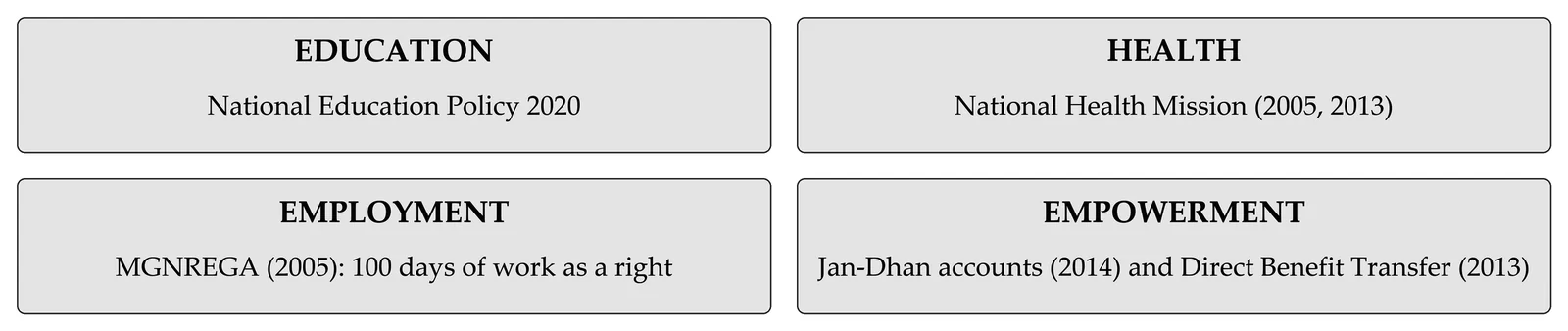
TTHEORIES of public policy become clearer when we study real policies. This chapter examines four major Indian policies named in the syllabus: the National Education Policy (NEP) 2020 in education, the National Health Mission (NHM) in health, the Mahatma Gandhi National Rural Employment Guarantee Act (MGNREGA) in employment, and the Pradhan Mantri Jan-Dhan Yojana (PMJDY) and Direct Benefit Transfer (DBT) in economic empowerment. For each, we study its background, objectives, main features, achievements and criticisms, and connect it to the stages of the policy process studied in Chapter 3.
4.1 Education: National Education Policy 2020
India’s earlier national education policies were adopted in 1968 and 1986 (revised in 1992). The Right of Children to Free and Compulsory Education Act, 2009, gave effect to Article 21A, added by the 86th Amendment of 2002. A committee chaired by the space scientist K. Kasturirangan submitted a draft policy in 2019, and after wide consultation the Union Cabinet approved the National Education Policy 2020 on 29 July 2020. It is the first education policy of the twenty-first century and aims at universal access, equity, quality, affordability and accountability.
School Education
- New structure. The 10+2 structure is replaced by a 5+3+3+4 structure: foundational stage (ages 3–8, including three years of pre-school), preparatory stage (8–11), middle stage (11–14) and secondary stage (14–18).
- Foundational literacy and numeracy. Achieving universal foundational literacy and numeracy by Grade 3 is made an urgent priority, implemented through the NIPUN Bharat mission of 2021.
- Mother tongue. Wherever possible, the medium of instruction until at least Grade 5, and preferably till Grade 8, should be the home language or mother tongue, with the three-language formula continued flexibly.
- Vocational education. Vocational education begins from Grade 6, with internships, so that every learner learns at least one vocation.
- Assessment reform. Board examinations are to test core competencies rather than rote learning, and a national assessment centre, PARAKH, has been set up.
- Universal access. The policy aims at a 100% gross enrolment ratio in school education by 2030 and bringing out-of-school children back.
Higher Education
- Enrolment target. It aims to raise the gross enrolment ratio in higher education to 50% by 2035.
- Multidisciplinary education. It promotes holistic, multidisciplinary undergraduate education with a four-year programme and multiple entry and exit options, supported by an Academic Bank of Credits.
- Regulation. It proposes a single regulator, the Higher Education Commission of India, in place of bodies such as the UGC and AICTE.
- Research. It proposes a National Research Foundation, set up by the Anusandhan National Research Foundation Act, 2023.
- Internationalisation. It allows top foreign universities to set up campuses in India.
- Funding. It reaffirms the goal of raising public spending on education to 6% of GDP.
Assessment
Supporters see NEP 2020 as a bold reform that addresses the learning crisis, gives flexibility to students and links education with skills. Critics raise several concerns. Education is in the Concurrent List, and some states, such as Tamil Nadu and Kerala, objected that the policy was adopted without parliamentary debate and centralises control. The three-language formula has revived old controversies over Hindi. Critics fear that the push for autonomy and foreign universities may encourage privatisation and make higher education costlier, and that multiple exits may lead to dropouts. Above all, the goal of 6% of GDP has never been met, and implementation depends on the capacity and cooperation of the states.

4.2 Health: National Health Mission
In the early 2000s, India’s public health system in rural areas was weak, with high maternal and infant mortality and heavy out-of-pocket spending on health. The National Rural Health Mission (NRHM) was launched on 12 April 2005 to provide accessible, affordable and quality health care to the rural population, especially vulnerable groups. The National Urban Health Mission (NUHM) was approved in 2013, and the two became sub-missions of the National Health Mission (NHM). Funding is shared between the Union and the states, generally in the ratio of 60:40, and 90:10 for north-eastern and Himalayan states.
Main Features
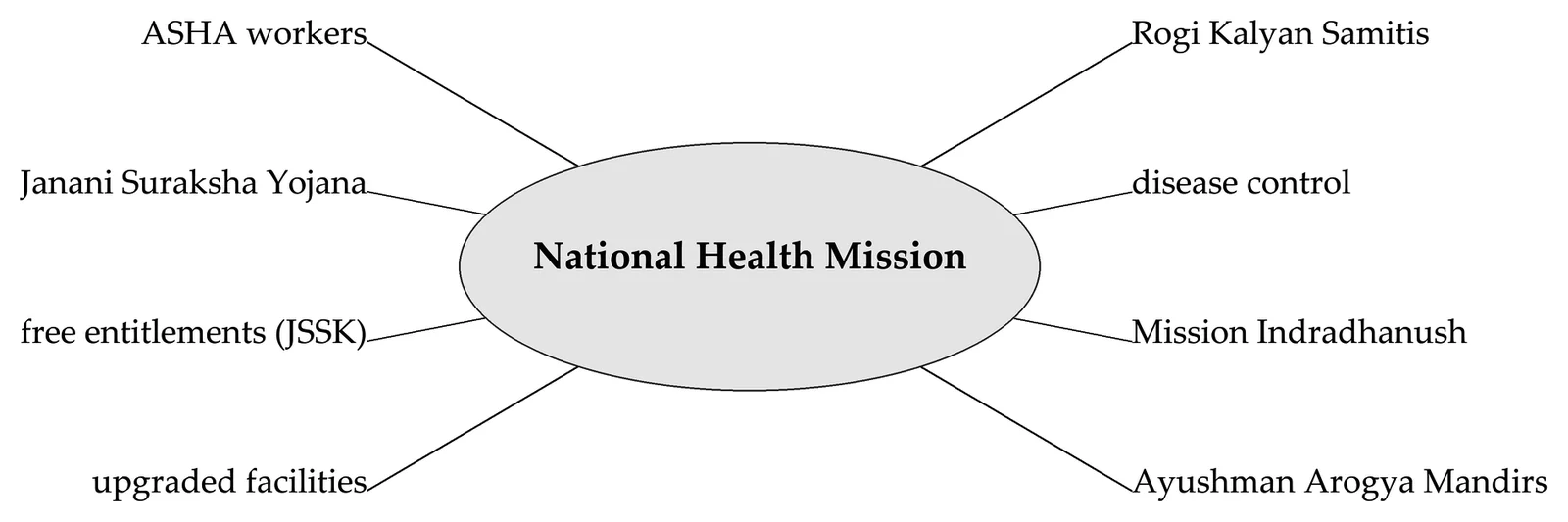
- ASHA workers. An Accredited Social Health Activist is selected from each village, generally one per thousand population, to link the community with the health system, promote institutional deliveries and immunisation, and provide basic care; there are around ten lakh ASHAs.
- Janani Suraksha Yojana (2005). A conditional cash transfer that encourages institutional deliveries among poor women.
- Janani Shishu Suraksha Karyakram (2011). Free delivery, drugs, diagnostics, diet and transport for pregnant women and sick infants in public facilities.
- Strengthening facilities. Upgrading sub-centres, primary health centres and community health centres to Indian Public Health Standards, and providing ambulances.
- Community participation. Village Health, Sanitation and Nutrition Committees and Rogi Kalyan Samitis (patient welfare committees) give communities a role in managing health services.
- Disease control programmes. National programmes against tuberculosis, malaria, leprosy and other diseases, and immunisation drives such as Mission Indradhanush (2014).
- Health and Wellness Centres. Under Ayushman Bharat (2018), sub-centres and primary health centres are being converted into Health and Wellness Centres, now called Ayushman Arogya Mandirs, offering comprehensive primary care.
Achievements
The NHM contributed to major improvements in maternal and child health. According to the National Family Health Surveys, institutional births rose from about 39% in 2005–06 to about 89% in 2019–21. The Sample Registration System shows the maternal mortality ratio falling from 254 per lakh live births in 2004–06 to 97 in 2018–20, and the infant mortality rate falling from 58 per thousand in 2005 to 28 in 2020. India was declared polio-free in 2014, and ASHAs played a vital role during the Covid-19 pandemic.
Criticisms
Public spending on health remains low, well below the target of 2.5% of GDP set by the National Health Policy, 2017, and out-of-pocket expenditure remains high. Rural facilities face shortages of doctors, specialists and nurses. ASHAs receive performance-based incentives rather than regular salaries and have protested for better pay. The focus on maternal and child health has been criticised for neglecting non-communicable diseases, which are now the main cause of death. Performance varies widely across states, reflecting differences in governance and capacity.
4.3 Employment and Economic Empowerment: MGNREGA, PMJDY and DBT
MGNREGA
The National Rural Employment Guarantee Act was passed in 2005, following a campaign by civil society groups and economists such as Jean Drèze, and the commitment of the UPA government’s Common Minimum Programme. It came into force on 2 February 2006 in 200 districts, was extended to all rural districts by 2008, and was renamed the Mahatma Gandhi NREGA on 2 October 2009. Unlike earlier schemes, it is a legal guarantee of work, giving effect to the right to work in Article 41.
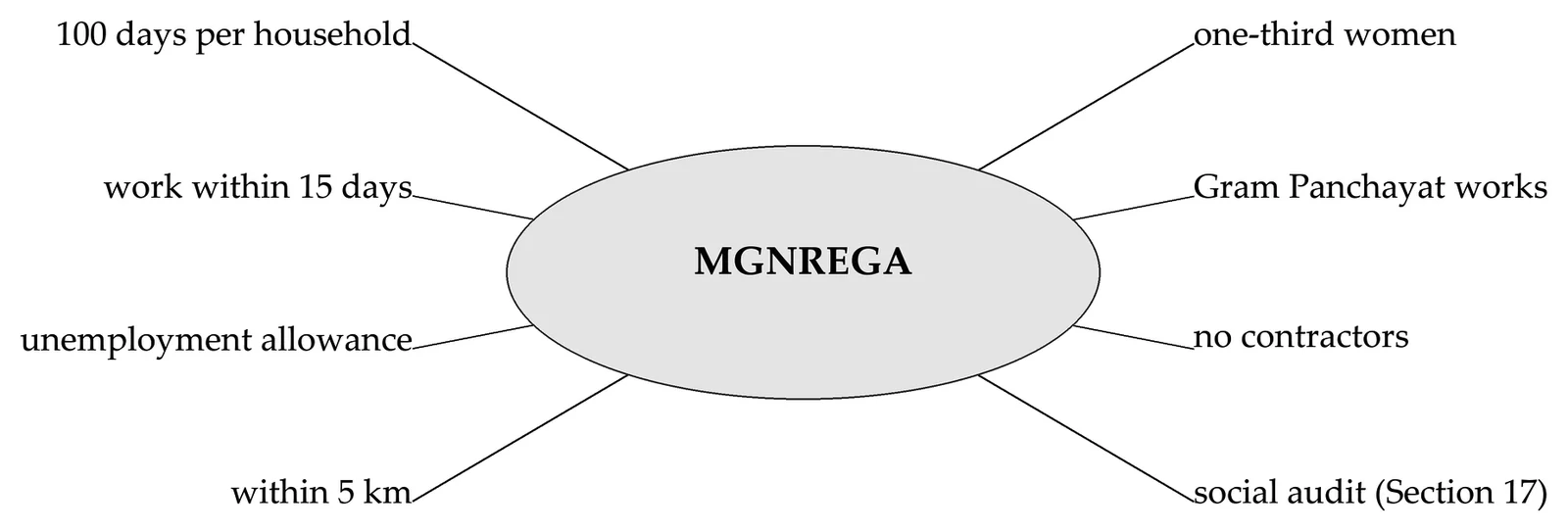
- Guarantee. Every rural household is entitled to at least 100 days of wage employment in a financial year for adult members willing to do unskilled manual work.
- Time limits. Work must be provided within 15 days of application, failing which an unemployment allowance is payable; wages must be paid within 15 days.
- Location and facilities. Work is to be provided within 5 km of the village, otherwise extra wages are paid, and worksites must have drinking water, shade and crèches.
- Women. At least one-third of beneficiaries should be women; in recent years, women have formed over half of the workers.
- Decentralisation. Gram Panchayats plan and execute at least half the works, and contractors are banned.
- Transparency. The Gram Sabha conducts regular social audits under Section 17, and records are open to the public.
- Funding. The Union pays the full cost of unskilled wages and three-fourths of material costs.
Studies show that MGNREGA raised rural wages, reduced distress migration, increased women’s earnings and independence, and created assets such as ponds, wells and roads. During the Covid-19 lockdown in 2020, it served as a lifeline for returning migrants, and its budget rose to over Rs 1 lakh crore. Critics point to delays in wage payments, wages below state minimum wages, inadequate funds leading to rationing of work, corruption in some states, and problems with Aadhaar-based payments. Some economists argue that the assets created are of poor quality.
PMJDY
At the time of its launch, a large share of Indian households had no bank account, leaving them dependent on moneylenders. The Pradhan Mantri Jan-Dhan Yojana, announced on 15 August 2014 and launched on 28 August 2014, is a National Mission for Financial Inclusion to provide every household with access to banking. It opened about 1.8 crore accounts in a single week, a world record.
- Zero-balance accounts. Accounts can be opened with no minimum balance.
- RuPay debit card. Each account holder gets a RuPay card with accident insurance cover, raised to Rs 2 lakh for accounts opened after August 2018.
- Overdraft. Eligible account holders can get an overdraft of up to Rs 10,000.
- Social security. The scheme is linked to the Pradhan Mantri Jeevan Jyoti Bima Yojana, the Pradhan Mantri Suraksha Bima Yojana and the Atal Pension Yojana, launched in 2015.
- Reach. By 2023, the number of accounts had crossed fifty crore, with more than half held by women.
DBT and the JAM Trinity
Direct Benefit Transfer was launched on 1 January 2013 to transfer subsidies and benefits directly into beneficiaries’ bank accounts, reducing leakages through intermediaries. The Economic Survey 2014–15 described the JAM trinity of Jan-Dhan accounts, Aadhaar identity and mobile phones as the foundation of this system. DBT now covers hundreds of schemes, including LPG subsidies under PAHAL, scholarships, pensions, MGNREGA wages and PM-KISAN (2019), which gives farmers Rs 6,000 a year. The government claims large savings by removing fake and duplicate beneficiaries. In Puttaswamy (2018), the Supreme Court upheld the use of Aadhaar for welfare benefits under Section 7 of the Aadhaar Act. Critics point to exclusion errors due to authentication failures and poor connectivity, reports of denial of rations to people without linked cards, long distances to banks in remote areas, and dormant Jan-Dhan accounts.

4.4 Important Questions
- Question 1 Discuss the main features of the National Education Policy 2020 and examine its significance.
- Question 2 Examine the objectives, features and achievements of the National Health Mission.
- Question 3 Critically examine the Mahatma Gandhi National Rural Employment Guarantee Act as a policy for employment and rural development.
- Question 4 Discuss the role of the Pradhan Mantri Jan-Dhan Yojana and Direct Benefit Transfer in the economic empowerment of the poor.
DU asks the same idea in different words. So learn one broad answer for each question below; the same answer works for every question joined by OR.
Important Question 1
Discuss the main features of the National Education Policy 2020 and examine its significance.
OR
Critically evaluate the National Education Policy 2020.
OR
Examine the reforms in school and higher education proposed by NEP 2020.
Model Answer
“The State shall provide free and compulsory education to all children of the age of six to fourteen years in such manner as the State may, by law, determine.”
— Constitution of India, Article 21A
Introduction. Education is the foundation of individual development and national progress. India’s education policies of 1968 and 1986 shaped the system for decades, and the Right to Education Act of 2009 made elementary education a fundamental right. The National Education Policy 2020, approved by the Union Cabinet on 29 July 2020, is a comprehensive attempt to transform school and higher education for the twenty-first century.
1. Background
Despite near-universal enrolment, surveys such as ASER showed low learning levels, high dropout rates at secondary level and low enrolment in higher education. The Kasturirangan Committee drafted a new policy in 2019 to address these problems.
2. Policy Formulation
The policy was formulated after wide consultation, including inputs from gram panchayats, states, experts and the public on the draft. Critics, however, noted that it was approved by the Cabinet without debate in Parliament.
3. New School Structure
The 10+2 structure is replaced by a 5+3+3+4 structure covering ages 3 to 18, bringing early childhood education into the formal system and recognising the importance of the early years for brain development.
4. Foundational Literacy and Numeracy
The policy makes universal foundational literacy and numeracy by Grade 3 an urgent national priority, implemented through the NIPUN Bharat mission launched in 2021.
5. Mother Tongue and Languages
It recommends the home language or mother tongue as the medium of instruction until at least Grade 5, and preferably Grade 8, while continuing the three-language formula with flexibility.
6. Curriculum and Assessment
It seeks to reduce curriculum load, promote critical thinking and experiential learning, and reform board examinations to test competencies rather than rote memory, with PARAKH as the national assessment centre.
7. Vocational Education
Vocational education begins from Grade 6 with internships, ending the hard separation between academic and vocational streams and preparing students for work.
8. Higher Education Reforms
It promotes four-year multidisciplinary undergraduate programmes with multiple entry and exit options, supported by an Academic Bank of Credits, and aims for a 50% gross enrolment ratio by 2035.
9. Regulation and Research
It proposes a single regulator, the Higher Education Commission of India, and a National Research Foundation, established by the Anusandhan National Research Foundation Act of 2023.
10. Equity and Inclusion
It focuses on socio-economically disadvantaged groups, including girls, Scheduled Castes, Scheduled Tribes and children with disabilities, and proposes a Gender Inclusion Fund and Special Education Zones.
11. Funding
It reaffirms the goal of public spending on education at 6% of GDP, first set in 1968, which has never been achieved.
12. Significance
The policy addresses the learning crisis, gives flexibility to students, links education with skills and research, and seeks to make Indian education globally competitive.
13. Federal Concerns
Education is in the Concurrent List, and states such as Tamil Nadu and Kerala objected to central direction, the language policy and the lack of consultation, showing the federal tensions in policy-making.
14. Fears of Privatisation
Critics fear that autonomy, foreign campuses and reduced regulation may increase privatisation and fees, making quality education less accessible to the poor.
15. Implementation Challenges
Implementation requires large investments, trained teachers, new curricula and the cooperation of states. Multiple exits may also increase dropouts if not supported.
16. Evaluation
NEP 2020 is an ambitious and forward-looking policy, but its success depends on adequate funding, federal cooperation and effective implementation on the ground.
Conclusion. Thus, NEP 2020 introduces a new school structure, prioritises foundational learning, promotes mother-tongue instruction, vocational and multidisciplinary education, and proposes regulatory and research reforms. It seeks to fulfil the promise of Article 21A and beyond, though federal concerns, funding gaps and fears of privatisation must be addressed.
Important Question 2
Examine the objectives, features and achievements of the National Health Mission.
OR
Discuss the role of ASHA workers and community participation in the National Health Mission.
OR
Critically evaluate public health policy in India with reference to the NHM.
Model Answer
“The State shall regard the raising of the level of nutrition and the standard of living of its people and the improvement of public health as among its primary duties.”
— Constitution of India, Article 47
Introduction. Health is essential for human development, and Article 47 makes the improvement of public health a primary duty of the state. The National Rural Health Mission, launched in 2005, and the National Urban Health Mission of 2013, now together forming the National Health Mission, are India’s largest public health programmes, aimed at accessible, affordable and quality health care.
1. Background
In the early 2000s, India had high maternal and infant mortality, weak rural health infrastructure and heavy out-of-pocket health spending, which pushed many families into poverty.
2. Objectives
The NHM aims to reduce maternal and infant mortality, achieve universal access to public health services, control communicable and non-communicable diseases, promote healthy lifestyles and integrate health with sanitation, nutrition and safe drinking water.
3. Structure and Funding
The NHM has two sub-missions, rural and urban. Funding is shared between the Union and the states, generally 60:40, and 90:10 for north-eastern and Himalayan states, with states preparing their own programme implementation plans.
4. ASHA Workers
An Accredited Social Health Activist, usually a woman from the village, links the community with the health system. Around ten lakh ASHAs promote institutional deliveries, immunisation and family planning and provide basic care.
5. Janani Suraksha Yojana
The JSY, launched in 2005, gives cash assistance to poor pregnant women for delivering in health facilities, which greatly increased institutional deliveries.
6. Free Entitlements
The Janani Shishu Suraksha Karyakram of 2011 provides free delivery, drugs, diagnostics, diet and transport for pregnant women and sick infants in public facilities.
7. Infrastructure
The mission upgraded sub-centres, primary health centres and community health centres to Indian Public Health Standards and introduced emergency ambulance services in many states.
8. Community Participation
Village Health, Sanitation and Nutrition Committees and Rogi Kalyan Samitis give communities a role in planning and monitoring, making health services more accountable to people.
9. Disease Control and Immunisation
National programmes against tuberculosis, malaria and other diseases work under the NHM, and Mission Indradhanush, launched in 2014, has expanded full immunisation coverage.
10. Ayushman Arogya Mandirs
Under Ayushman Bharat (2018), sub-centres and primary health centres are being upgraded into Health and Wellness Centres, now called Ayushman Arogya Mandirs, offering comprehensive primary care.
11. Achievements in Maternal Health
Institutional births rose from about 39% in 2005–06 to about 89% in 2019–21, and the maternal mortality ratio fell from 254 per lakh live births in 2004–06 to 97 in 2018–20.
12. Achievements in Child Health
The infant mortality rate fell from 58 per thousand live births in 2005 to 28 in 2020, and India was declared polio-free in 2014.
13. Low Public Spending
Public health spending remains well below the 2.5% of GDP target of the National Health Policy, 2017, and out-of-pocket spending remains high.
14. Human Resource Shortages
Rural facilities lack doctors, specialists and nurses, and ASHAs, paid through incentives rather than salaries, have demanded better pay and recognition as workers.
15. Changing Disease Burden
The focus on maternal and child health has left less attention for non-communicable diseases such as diabetes and heart disease, which are now the main cause of death in India.
16. Evaluation
The NHM is one of India’s most successful social policies in improving maternal and child health, but universal health care requires more funding, staff and attention to new disease burdens.
Conclusion. Thus, the National Health Mission, through ASHAs, the JSY, free entitlements, better facilities and community participation, has greatly reduced maternal and infant mortality, advancing the goal of Article 47. Low spending, staff shortages and the rise of non-communicable diseases remain challenges.
Important Question 3
Critically examine the Mahatma Gandhi National Rural Employment Guarantee Act as a policy for employment and rural development.
OR
Discuss the main features and impact of MGNREGA.
OR
MGNREGA is a rights-based approach to employment. Discuss.
Model Answer
“The State shall, within the limits of its economic capacity and development, make effective provision for securing the right to work, to education and to public assistance in cases of unemployment, old age, sickness and disablement, and in other cases of undeserved want.”
— Constitution of India, Article 41
Introduction. The Mahatma Gandhi National Rural Employment Guarantee Act of 2005 is one of the largest public works programmes in the world. Unlike earlier employment schemes, it gives rural households a legal right to work, making it a rights-based policy that gives effect to the right to work in Article 41.
1. Background
Earlier schemes such as the Jawahar Rozgar Yojana and the Food for Work Programme were limited by funds and discretion. Maharashtra’s Employment Guarantee Scheme of the 1970s showed that a guarantee could work.
2. Policy Formulation
A campaign by civil society groups and economists such as Jean Drèze, and the UPA’s Common Minimum Programme of 2004, led to the Act being passed in 2005. It came into force on 2 February 2006 in 200 districts and was extended to all rural districts by 2008.
3. The Guarantee
Every rural household is entitled to at least 100 days of wage employment in a financial year for adult members willing to do unskilled manual work, making work a legal entitlement rather than a favour.
4. Time-Bound Entitlements
Work must be provided within 15 days of application, failing which an unemployment allowance is payable, and wages must be paid within 15 days of work.
5. Worker-Friendly Provisions
Work is to be provided within 5 km of the village, and worksites must have drinking water, shade and crèche facilities. At least one-third of beneficiaries should be women.
6. Decentralisation
Gram Sabhas select works, and Gram Panchayats execute at least half of them. Contractors are banned, which aims to reduce corruption and ensure that wages go to workers.
7. Transparency and Social Audit
Section 17 requires regular social audits by the Gram Sabha, and records such as muster rolls are open to the public, making MGNREGA a pioneer in accountability.
8. Funding
The Union government pays the full cost of unskilled wages and three-fourths of material costs, while states pay the unemployment allowance. The Act is demand-driven, so funds should follow demand.
9. Impact on Wages and Poverty
Studies show that MGNREGA raised rural wages, provided income during the lean season and reduced poverty and distress migration in many areas.
10. Empowerment of Women
Women form over half of MGNREGA workers in recent years. Equal wages and work near home have increased their earnings, bank accounts and independence.
11. Rural Assets
MGNREGA has created assets such as ponds, wells, check dams, roads and land development works, improving water conservation and agricultural productivity in many regions.
12. A Safety Net in Crises
During droughts and the Covid-19 lockdown of 2020, MGNREGA served as a lifeline for rural households and returning migrants, and its budget rose to over Rs 1 lakh crore.
13. Delays and Low Wages
Delays in wage payments, wage rates below state minimum wages and inadequate funds that lead to rationing of work have weakened the guarantee.
14. Corruption and Technology
Fake job cards and inflated muster rolls have been reported in some states. Electronic payments reduced leakages, but Aadhaar-based payment systems have also caused exclusion.
15. Debate over Assets and Costs
Critics argue that many assets are of poor quality and that the programme distorts labour markets, while supporters argue that its social benefits far outweigh its costs.
16. Evaluation
MGNREGA is a landmark rights-based policy that has reduced rural distress and empowered women and panchayats, though its potential is limited by funding and implementation problems.
Conclusion. Thus, MGNREGA guarantees 100 days of wage employment as a legal right, with time-bound entitlements, decentralised planning and social audits, giving effect to Article 41. It has raised wages, empowered women and served as a safety net, though delays, low wages and fund shortages must be addressed.
Important Question 4
Discuss the role of the Pradhan Mantri Jan-Dhan Yojana and Direct Benefit Transfer in the economic empowerment of the poor.
OR
What is the JAM trinity? How has it changed welfare delivery in India?
OR
Critically evaluate financial inclusion policies in India.
Model Answer
“The State shall, in particular, strive to minimise the inequalities in income, and endeavour to eliminate inequalities in status, facilities and opportunities.”
— Constitution of India, Article 38(2) (abridged)
Introduction. Economic empowerment requires that the poor have access to financial services and receive welfare benefits without leakages. The Pradhan Mantri Jan-Dhan Yojana of 2014 and Direct Benefit Transfer, built on the JAM trinity of Jan-Dhan accounts, Aadhaar and mobile phones, have transformed financial inclusion and welfare delivery in India.
1. The Problem of Financial Exclusion
Before 2014, a large share of Indian households had no bank account. The poor depended on moneylenders at high interest rates, could not save safely and received welfare through intermediaries who took a share.
2. Launch of PMJDY
The PMJDY, announced on 15 August 2014 and launched on 28 August 2014, was a National Mission for Financial Inclusion. About 1.8 crore accounts were opened in a single week, a world record.
3. Features of PMJDY
It offers zero-balance accounts, RuPay debit cards with accident insurance cover of up to Rs 2 lakh and overdrafts of up to Rs 10,000, and is linked to insurance and pension schemes launched in 2015.
4. Reach of PMJDY
By 2023, the number of Jan-Dhan accounts had crossed fifty crore, with more than half held by women, bringing a large part of the population into the formal banking system.
5. Launch of DBT
Direct Benefit Transfer was launched on 1 January 2013 to transfer subsidies and benefits directly into bank accounts, bypassing intermediaries and reducing leakages.
6. The JAM Trinity
The Economic Survey 2014–15 described Jan-Dhan accounts, Aadhaar identity and mobile phones as the JAM trinity, which together make it possible to identify beneficiaries and transfer money to them directly.
7. Coverage of DBT
DBT now covers hundreds of schemes, including LPG subsidies under PAHAL, scholarships, pensions, MGNREGA wages and PM-KISAN, which gives farmers Rs 6,000 a year.
8. Reduction of Leakages
By removing fake and duplicate beneficiaries, DBT has reduced leakages, and the government claims large savings. Transfers during the Covid-19 pandemic reached women’s Jan-Dhan accounts quickly.
9. Empowerment of Women
Bank accounts in women’s names give them control over money and access to credit, insurance and savings, strengthening their position in the household.
10. Digital Payments
Financial inclusion laid the foundation for the rapid growth of digital payments through the Unified Payments Interface, launched in 2016, which has made India a world leader in digital transactions.
11. Legal Basis of Aadhaar
In Puttaswamy (2018), the Supreme Court upheld the use of Aadhaar for welfare benefits under Section 7 of the Aadhaar Act, while striking down its mandatory use by private companies.
12. Dormant Accounts
Many Jan-Dhan accounts have been dormant or held low balances, suggesting that opening accounts is easier than ensuring their regular use for savings and credit.
13. Exclusion Errors
Biometric authentication failures, poor connectivity and errors in records have excluded some genuine beneficiaries, and there have been reports of denial of rations to people whose cards were not linked to Aadhaar.
14. Access and Literacy
In remote areas, banks and correspondents are far away, and low financial and digital literacy limits the ability of the poor to use accounts and digital services.
15. Cash versus In-Kind Debate
Supporters argue that cash transfers give choice and reduce leakages, while critics argue that in-kind benefits such as food grains protect the poor better against inflation and market failures.
16. Financial Inclusion before 2014
Earlier efforts included bank nationalisation in 1969 and 1980, priority sector lending, regional rural banks from 1975, the self-help group–bank linkage programme of NABARD from 1992 and the no-frills accounts promoted by the Reserve Bank from 2005. PMJDY built on these efforts but pursued them in mission mode, with targets for every household.
17. Evaluation
PMJDY and DBT have made financial inclusion and welfare delivery more efficient and transparent, but their benefits depend on inclusion of the most vulnerable and on safeguards against exclusion.
Conclusion. Thus, PMJDY brought crores of households into the banking system, and DBT, built on the JAM trinity, has transformed welfare delivery by reducing leakages and empowering women, advancing the goal of Article 38(2). Dormant accounts, exclusion errors and limited access remain challenges for economic empowerment.
Short Notes
(a) ASHA
An Accredited Social Health Activist, usually a woman selected from the village under the National Health Mission, who links the community with the public health system.
(b) JAM trinity
The combination of Jan-Dhan bank accounts, Aadhaar identity and mobile phones, described in the Economic Survey 2014–15 as the foundation of Direct Benefit Transfer.
(c) Unemployment allowance
The allowance payable under MGNREGA when work is not provided within fifteen days of an application for employment, paid by the state government.
(d) Mission Indradhanush
An immunisation drive launched in December 2014 under the National Health Mission to reach children and pregnant women who were unvaccinated or partly vaccinated against preventable diseases, with intensified rounds in districts with low coverage.
(e) Academic Bank of Credits
A digital system proposed by NEP 2020 that stores the credits earned by students in higher education, allowing them to leave and re-enter programmes and to combine courses from different institutions.
More notes: GE-8 Introduction to Public Policy
These notes are prepared by PADHO TO AISE for study help. They are not an official publication.