
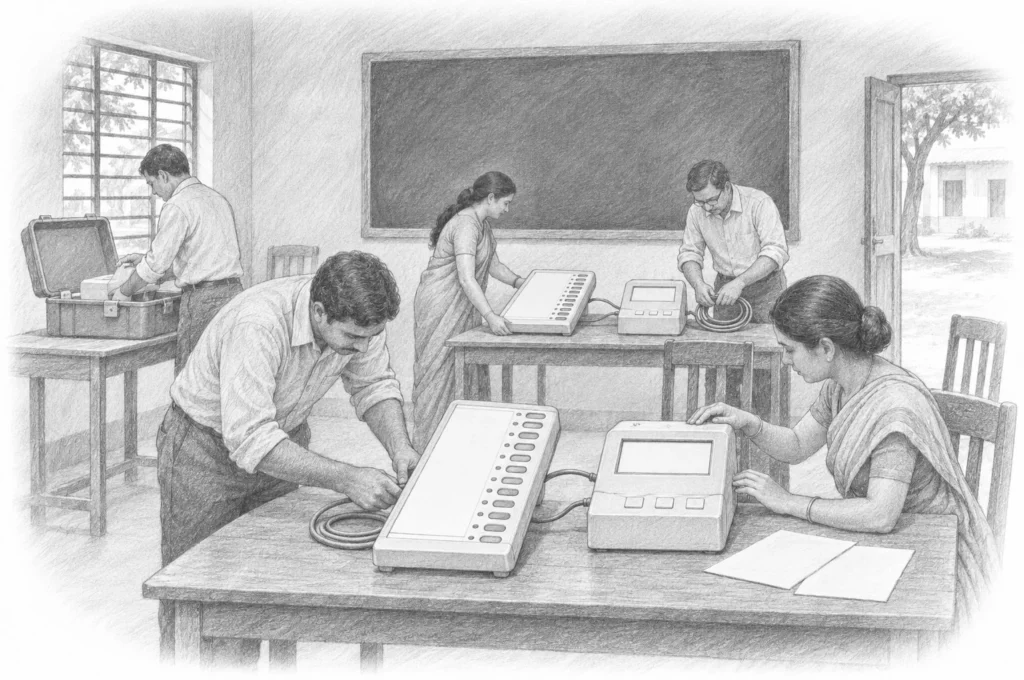
Generic Electives (GE) GE-11 Election Commission and Process in India
Unit 3 · 24 min read · Updated 27 Nov 2026
As per the University of Delhi (DU) Generic Elective (GE) syllabus offered by the Department of Political Science
Contents
- 3.1 Delimitation of Constituencies
- The Delimitation Commission
- The Freeze on Seats
- 3.2 Electoral Rolls and the Stages of an Election
- Preparation and Revision of Electoral Rolls
- From Notification to Nomination
- Scrutiny, Withdrawal and Campaign
- Polling, Counting and Declaration
- 3.3 The Model Code of Conduct and Its Enforcement
- Main Provisions of the Code
- Enforcement and Debates
- 3.4 Important Questions
- Discuss the process of delimitation of constituencies in India.
- How are electoral rolls prepared and revised in India? Discuss the challenges involved.
- Describe the stages of the election process in India from notification to the declaration of results.
- Discuss the Model Code of Conduct and its enforcement by the Election Commission.
- Short Notes
जो भी व्यक्ति किसी निर्वाचन क्षेत्र की निर्वाचक नामावली में दर्ज है, वह उस निर्वाचन क्षेत्र में मतदान का हकदार होगा।
Every person who is, for the time being, entered in the electoral roll of any constituency shall be entitled to vote in that constituency.
— Representation of the People Act, 1951, Section 62(1)
AA general election in India is the largest administrative operation in the world. Constituencies must be drawn, crores of voters registered, candidates nominated and checked, lakhs of polling stations staffed and secured, machines transported to remote areas and votes counted accurately and quickly. This chapter studies the main stages of this process: the delimitation of constituencies, the preparation and revision of electoral rolls, the steps from nomination to declaration of results, and the Model Code of Conduct that governs the behaviour of parties, candidates and governments during elections.

3.1 Delimitation of Constituencies
Delimitation means fixing the number and boundaries of territorial constituencies for the Lok Sabha and state assemblies. Its purpose is to ensure that each constituency has roughly the same population, so that every vote has approximately equal value, as Ambedkar’s principle of one person, one vote, one value requires. Under Article 82 and Article 170, the allocation of seats and the division of states into constituencies must be readjusted after each census by an authority determined by Parliament.
The Delimitation Commission
- Composition. A Delimitation Commission is usually chaired by a retired Supreme Court judge and includes the Chief Election Commissioner or an Election Commissioner and the State Election Commissioners of the states concerned; members of Parliament and state legislators are associated as non-voting members.
- Commissions so far. Commissions were set up under Acts of 1952, 1962, 1972 and 2002; the last, chaired by Justice Kuldip Singh, redrew constituencies on the basis of the 2001 Census, effective from 2008.
- Reserved seats. The Commission also identifies constituencies to be reserved for Scheduled Castes and Scheduled Tribes, based on their share of the population.
- Finality. Its orders have the force of law and, under Article 329(a), cannot be challenged in court, as the Supreme Court held in Meghraj Kothari (1967).
- Public participation. The Commission publishes draft proposals, invites objections and holds public sittings before finalising its orders.
The Freeze on Seats
In 1976, the 42nd Amendment froze the allocation of Lok Sabha seats among states on the basis of the 1971 Census until 2000, so that states which controlled population growth would not lose seats. The 84th Amendment of 2001 extended the freeze until after the first census taken after 2026, while allowing constituency boundaries within states to be redrawn on the basis of the 2001 Census. As a result, constituencies in fast-growing northern states now have far more voters than those in southern states. The coming delimitation after 2026 has raised a major debate: southern states fear losing representation, while others argue that equal value of votes requires readjustment.

3.2 Electoral Rolls and the Stages of an Election
Preparation and Revision of Electoral Rolls
The electoral roll is the list of persons entitled to vote in a constituency. Under Section 19 of the Representation of the People Act of 1950, every citizen aged eighteen or above on the qualifying date and ordinarily resident in a constituency is entitled to be registered there. The roll is prepared by the Electoral Registration Officer under the supervision of the Chief Electoral Officer and the Election Commission.
- Qualifying dates. Since a law of 2021, young people can register on four qualifying dates a year, 1 January, 1 April, 1 July and 1 October, instead of only once.
- Revision. Rolls are revised every year through a summary revision, and before major elections through special summary revisions; an intensive revision involves fresh house-to-house enumeration.
- Forms. Citizens apply for inclusion through Form 6, object to entries through Form 7 and correct or shift entries through Form 8, online or through Booth Level Officers.
- Booth Level Officers. They verify entries through house visits, remove the names of dead and shifted voters and help new voters register.
- Identity. Electors’ photo identity cards, introduced in 1993, help prevent impersonation, and since 2021 voters may voluntarily link their Aadhaar number with their registration.
- Debates. Errors, duplicate entries and exclusion of migrants, the homeless and marginalised groups remain problems; a special intensive revision begun in Bihar in 2025 and later extended to other states led to legal and political debate over the documents required to prove eligibility.

From Notification to Nomination
After the Election Commission announces the schedule, the President (for the Lok Sabha) or the Governor (for a state assembly) issues a notification on its recommendation, calling on the constituencies to elect members. Candidates then file nomination papers with the Returning Officer within seven days. A candidate must be qualified under the Constitution and the 1951 Act, be proposed by the required number of electors, make a security deposit of twenty-five thousand rupees for the Lok Sabha (half for Scheduled Caste and Scheduled Tribe candidates), and file an affidavit disclosing criminal cases, assets, liabilities and educational qualifications, as required since the Supreme Court’s judgments of 2002 and 2003.
Scrutiny, Withdrawal and Campaign
On the day after the last date of nomination, the Returning Officer holds the scrutiny of nomination papers and may reject those with defects. Candidates can withdraw within two days after scrutiny, after which the final list of contesting candidates is published and symbols are allotted. The campaign then continues, subject to the Model Code of Conduct, and ends forty-eight hours before the close of polling under Section 126 of the 1951 Act; exit polls cannot be published until the last phase of polling is over (Section 126A).
Polling, Counting and Declaration
- Polling stations. More than ten lakh polling stations were set up in 2024, each staffed by a presiding officer and polling officers, with security forces deployed according to sensitivity.
- Voting. Voters are identified, their finger is marked with indelible ink and they vote on an electronic voting machine; the VVPAT shows a paper slip for seven seconds to confirm the vote.
- Postal ballots. Service voters, officials on election duty and, under recent rules, elderly voters and persons with disabilities may vote by postal ballot.
- Counting. Votes are counted under the Returning Officer in the presence of candidates’ agents; postal ballots are counted first, and VVPAT slips of five randomly selected polling stations in each assembly segment are matched with EVM counts, as the Supreme Court directed in 2019.
- Declaration. The Returning Officer declares the candidate with the most votes elected; a candidate who receives less than one-sixth of the valid votes forfeits the deposit.
- Disputes. An election can be challenged by an election petition in the High Court within forty-five days of the result.
3.3 The Model Code of Conduct and Its Enforcement
The Model Code of Conduct (MCC) is a set of guidelines for political parties, candidates and governments during elections. It began in Kerala in 1960, when parties agreed on a code for the assembly elections, and the Election Commission issued a national code in 1968 and expanded it in later years. It comes into force when the Commission announces the election schedule and remains until the results are declared.
Main Provisions of the Code
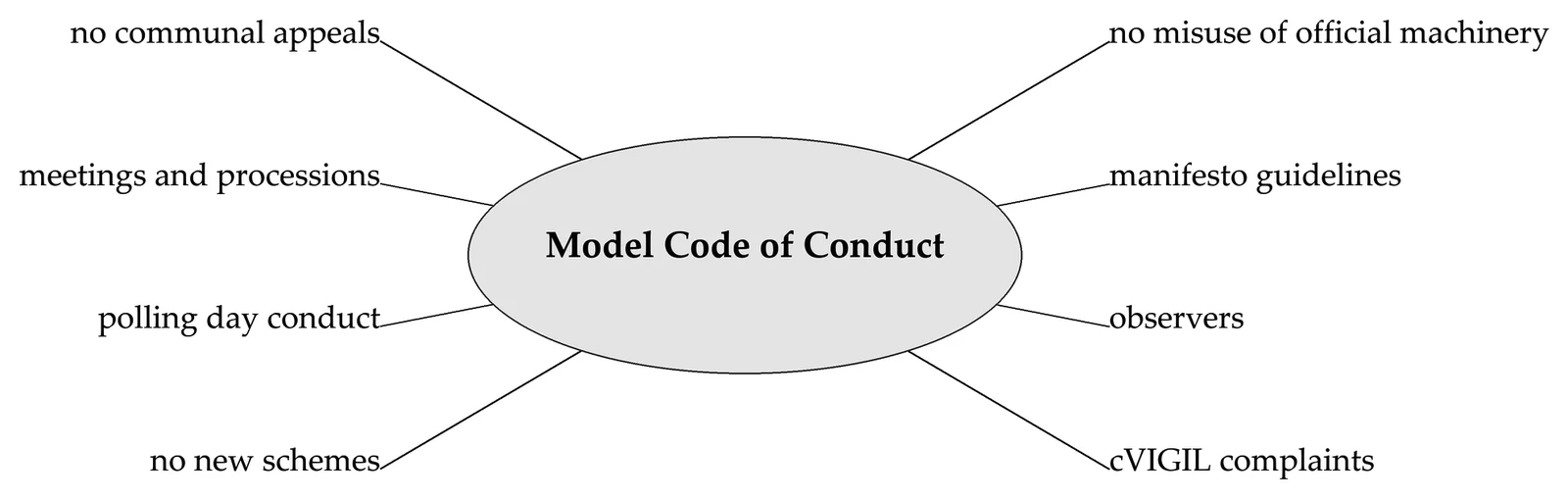
- General conduct. Parties and candidates must not aggravate differences between communities, appeal to caste or religious feelings for votes, use places of worship for campaigns or criticise private lives of opponents.
- Meetings and processions. Parties must inform the police of meetings and processions and avoid obstructing traffic or rival meetings.
- Polling day. Parties must cooperate with officials, avoid distributing liquor and money and keep camps away from polling stations.
- The party in power. Ministers must not combine official visits with campaigning, use government transport or machinery for party work, announce new schemes or projects, or advertise achievements at public expense.
- Manifestos. Since 2013, following the Supreme Court’s judgment in S. Subramaniam Balaji, manifestos must not contain promises that undermine the fairness of elections and must explain how promises will be financed.
- Observers and complaints. Observers report violations, and citizens can complain through the cVIGIL app, introduced in 2018.
Enforcement and Debates
The MCC is not a law, but it is enforced through the Election Commission’s authority under Article 324, and many of its provisions overlap with criminal law and the corrupt practices listed in Section 123 of the 1951 Act. The Commission can issue notices, censure leaders, ban them from campaigning for a period, transfer officials and order FIRs. T.N. Seshan made the code a powerful instrument in the 1990s. In 2013, a parliamentary standing committee recommended giving the MCC statutory status, but the Election Commission opposed this, arguing that court proceedings would be too slow during elections. Critics argue that the code delays government decisions for long periods and that its enforcement against powerful leaders is sometimes uneven, while supporters see it as essential for a level playing field.
3.4 Important Questions
- Question 1 Discuss the process of delimitation of constituencies in India.
- Question 2 How are electoral rolls prepared and revised in India? Discuss the challenges involved.
- Question 3 Describe the stages of the election process in India from notification to the declaration of results.
- Question 4 Discuss the Model Code of Conduct and its enforcement by the Election Commission.
DU asks the same idea in different words. So learn one broad answer for each question below; the same answer works for every question joined by OR.
Important Question 1
Discuss the process of delimitation of constituencies in India.
OR
Examine the role of the Delimitation Commission in India.
OR
Discuss the debate over the freeze on the allocation of Lok Sabha seats among states.
Model Answer
“Upon the completion of each census, the allocation of seats in the House of the People to the States and the division of each State into territorial constituencies shall be readjusted.”
— Constitution of India, Article 82 (abridged)
Introduction. Delimitation is the process of fixing the number and boundaries of constituencies for the Lok Sabha and state assemblies. It aims to ensure that constituencies have roughly equal populations so that every vote has equal value. In India, delimitation is carried out by an independent Delimitation Commission whose orders cannot be challenged in court. The freeze on seat allocation since 1976 and the coming delimitation after 2026 have made it a subject of intense debate.
1. Meaning of Delimitation
Delimitation means drawing the boundaries of territorial constituencies and deciding how many seats each state will have. It is necessary because population changes over time, and constituencies with very different populations would give voters unequal influence in choosing representatives.
2. Constitutional Basis
Articles 82 and 170 require the readjustment of seats and constituencies after each census by an authority and in a manner determined by Parliament. Under these articles, Parliament has passed Delimitation Acts in 1952, 1962, 1972 and 2002.
3. Principle of Equal Value of Votes
Delimitation rests on the democratic principle that each vote should carry equal weight. Ambedkar expressed this in the Constituent Assembly as one person, one vote, one value. Unequal constituencies would violate political equality.
4. Composition of the Commission
The Delimitation Commission is usually headed by a retired Supreme Court judge and includes an Election Commissioner and the State Election Commissioners of the states concerned, with legislators associated as non-voting members, so that the process is independent of the government.
5. Procedure
The Commission uses census data to work out the population of each area, prepares draft proposals, publishes them for objections, holds public sittings in the states and then issues final orders, which are published in the Gazette.
6. Reservation of Seats
The Commission identifies constituencies to be reserved for Scheduled Castes and Scheduled Tribes on the basis of their share of the population, ensuring their representation under Articles 330 and 332.
7. Finality of Orders
The Commission’s orders have the force of law and cannot be challenged in court under Article 329(a), as the Supreme Court held in Meghraj Kothari (1967), which prevents delays in elections.
8. Past Commissions
Commissions were set up in 1952, 1963 and 1973 and most recently in 2002 under Justice Kuldip Singh, whose orders, based on the 2001 Census, came into force in 2008 for the elections of that year onwards.
9. The Freeze of 1976
The 42nd Amendment of 1976 froze the allocation of Lok Sabha seats among states on the basis of the 1971 Census, so that states that controlled population growth would not lose seats and family planning would be encouraged.
10. The 84th Amendment
The 84th Amendment of 2001 extended the freeze until after the first census taken after 2026, while allowing boundaries within states to be redrawn on the basis of later census figures.
11. Effects of the Freeze
Because populations grew faster in northern states, constituencies there now have many more voters than in southern states, so a vote in some states carries less weight than in others.
12. The Coming Debate
Southern states fear that delimitation after 2026 will reduce their share of seats and political influence because they controlled population growth, while others argue that equal value of votes requires readjustment. Proposals include increasing the total number of seats or extending the freeze.
13. Special Cases
Delimitation in particular regions, such as Jammu and Kashmir in 2022 and Assam in 2023, has also been debated, with concerns about the representation of different communities and regions.
14. Evaluation
Delimitation is essential for equal representation, and India’s independent Commission has generally carried it out fairly, but the inter-state allocation of seats raises deep questions of federal balance that need political consensus.
Conclusion. Thus, delimitation fixes constituencies so that every vote has roughly equal value, carried out by an independent Commission whose orders cannot be challenged in court. The freeze on seat allocation since 1976, extended to after 2026, has created inequalities between states, making the next delimitation a major challenge for Indian federalism and democracy.
Important Question 2
How are electoral rolls prepared and revised in India? Discuss the challenges involved.
OR
Discuss the importance of accurate electoral rolls for free and fair elections.
OR
Examine the role of Booth Level Officers and voter registration reforms.
Model Answer
“Every person who is not less than eighteen years of age on the qualifying date and is ordinarily resident in a constituency shall be entitled to be registered in the electoral roll for that constituency.”
— Representation of the People Act, 1950, Section 19 (abridged)
Introduction. An electoral roll is the list of persons entitled to vote in a constituency. Accurate rolls are the foundation of free and fair elections: if eligible voters are left out, they are disenfranchised, and if ineligible or duplicate names remain, the elections may be manipulated. India’s rolls, covering nearly a hundred crore voters, are prepared and revised by a large administrative machinery under the Election Commission.
1. Meaning of the Electoral Roll
The electoral roll lists the names, ages, addresses and photographs of all registered voters in a constituency, organised by polling station. Only persons whose names appear on the roll can vote.
2. Legal Basis
Article 325 provides a single general roll for each constituency without discrimination, Article 326 sets the basis of adult suffrage, and the Representation of the People Act of 1950 and the Registration of Electors Rules of 1960 lay down the procedure for preparing rolls.
3. Eligibility
A person who is a citizen of India, at least eighteen years old on the qualifying date and ordinarily resident in a constituency is entitled to be registered, unless disqualified for unsoundness of mind declared by a court or for corrupt practices or certain offences.
4. The Electoral Registration Officer
Each constituency has an Electoral Registration Officer, usually a government official, who prepares and revises the roll under the supervision of the District Election Officer, the Chief Electoral Officer and the Election Commission.
5. Booth Level Officers
Booth Level Officers, introduced in 2006, are local officials such as teachers or anganwadi workers who verify entries through house-to-house visits, help people register and report dead or shifted voters.
6. Qualifying Dates
Earlier, only those who turned eighteen by 1 January could register in a year. The Election Laws (Amendment) Act of 2021 introduced four qualifying dates, so young people can register sooner after turning eighteen.
7. Summary and Intensive Revision
Rolls are updated every year through summary revision, when draft rolls are published and claims and objections invited. Intensive revision involves fresh enumeration from house to house and is undertaken less often.
8. Forms and Online Registration
Citizens apply for inclusion through Form 6, object to entries through Form 7 and correct or shift entries through Form 8. Applications can be filed online through the National Voters’ Service Portal and mobile apps.
9. Photo Identity Cards
Electors’ photo identity cards, introduced by T.N. Seshan in 1993, and photo electoral rolls have reduced impersonation and made voter identification easier at polling stations.
10. Aadhaar Linking
The 2021 law allowed voters to voluntarily link their Aadhaar number with their registration to remove duplicates. Critics raised concerns about privacy and the risk of wrongful deletions.
11. Problems in Rolls
Rolls suffer from errors, duplicate entries and names of dead voters, while migrants, the homeless, women after marriage and marginalised groups are often left out, especially in cities.
12. Recent Debates
A special intensive revision begun in Bihar in 2025 and later extended to other states led to legal and political debate over the documents required to prove eligibility and the risk of exclusion, showing how sensitive roll revision can be.
13. Reforms
Suggested reforms include better use of technology to remove duplicates, special drives for marginalised groups, remote registration for migrants and greater transparency in deletions.
14. Evaluation
India’s electoral roll machinery has registered a vast and growing electorate with reasonable accuracy, but ensuring that no eligible voter is left out remains a continuing challenge for democratic inclusion.
Conclusion. Thus, electoral rolls are prepared and revised by Electoral Registration Officers and Booth Level Officers under the Election Commission, through annual revisions, four qualifying dates, Forms 6, 7 and 8 and photo identity cards. Accurate and inclusive rolls are essential for free and fair elections, but errors and exclusions remain challenges.
Important Question 3
Describe the stages of the election process in India from notification to the declaration of results.
OR
Discuss the role of the Returning Officer in the conduct of elections.
OR
Explain the process of nomination, scrutiny, polling and counting in Indian elections.
Model Answer
“Democracy is all about choice.”
— Supreme Court of India, People’s Union for Civil Liberties v. Union of India (2013), on NOTA
Introduction. An election in India passes through a series of legally defined stages, from the announcement of the schedule and the formal notification to nomination, scrutiny, withdrawal, campaigning, polling, counting and the declaration of results. Each stage is governed by the Representation of the People Act of 1951 and the Conduct of Election Rules of 1961, and is supervised by the Election Commission through Returning Officers.
1. Announcement of the Schedule
The Election Commission announces the election schedule, including the dates of notification, nomination, scrutiny, withdrawal, polling and counting. The Model Code of Conduct comes into force immediately.
2. Notification
On the Commission’s recommendation, the President issues a notification for Lok Sabha elections (Section 14) and the Governor for state assembly elections (Section 15), formally calling upon constituencies to elect members.
3. The Returning Officer
Each constituency has a Returning Officer, usually a senior district official, who is responsible for conducting the election there, from receiving nominations to declaring the result, assisted by Assistant Returning Officers.
4. Filing of Nominations
Candidates file nomination papers within seven days of notification, proposed by the required number of electors. A recognised party’s candidate needs one proposer, while others need more.
5. Security Deposit and Affidavit
Candidates deposit twenty-five thousand rupees for the Lok Sabha, half for SC and ST candidates, and file an affidavit disclosing criminal cases, assets, liabilities and education, as required by Supreme Court judgments of 2002 and 2003.
6. Scrutiny
On the day after the last date for nominations, the Returning Officer scrutinises the nomination papers in the presence of candidates and may reject those that are defective or filed by ineligible persons.
7. Withdrawal and Allotment of Symbols
Candidates may withdraw within two days of scrutiny. The final list of contesting candidates is then published and symbols are allotted, reserved symbols for recognised parties and free symbols for others.
8. Campaign
Candidates and parties campaign through rallies, door-to-door visits, media and social media, subject to the Model Code and expenditure limits. The campaign ends forty-eight hours before polling ends, the silence period under Section 126.
9. Polling Arrangements
Lakhs of polling stations are set up, each with a presiding officer and polling officers, EVMs and VVPATs are distributed after randomisation, mock polls are held and security forces are deployed according to sensitivity.
10. Voting
Voters are identified from the roll, marked with indelible ink and vote on the EVM, with the VVPAT displaying a slip to confirm the vote. Voters can choose NOTA if they wish to reject all candidates.
11. Postal Ballots
Service voters, officials on election duty, elderly voters and persons with disabilities may vote by postal ballot under the rules, ensuring that those unable to reach polling stations can participate.
12. Counting
Counting takes place under the Returning Officer in the presence of candidates’ agents. Postal ballots are counted first, EVMs are counted round by round and VVPAT slips of five randomly selected polling stations per assembly segment are verified.
13. Declaration and Disputes
The Returning Officer declares the candidate with the most votes elected. Candidates with less than one-sixth of valid votes forfeit their deposit, and results can be challenged through an election petition in the High Court within forty-five days.
14. Security and Logistics
Elections in India require moving lakhs of EVMs and polling staff by road, boat, helicopter and even on foot to remote areas such as hill villages and forest hamlets, with central armed police forces deployed to sensitive booths. Phased polling allows security forces to move from one region to another, which is why national elections take several weeks.
15. Strong Rooms and Results
After polling, EVMs are sealed and stored in strong rooms guarded by security forces and watched by candidates’ agents until counting day. Results are uploaded round by round on the Commission’s website, allowing citizens and the media to follow the count in real time, which increases transparency.
16. Evaluation
India’s election process is detailed and transparent, allowing a huge electorate to vote efficiently and results to be declared quickly, though concerns about money power and trust in machines require continued vigilance.
Conclusion. Thus, Indian elections move from the announcement of the schedule and notification through nomination, scrutiny, withdrawal and campaign to polling with EVMs and VVPATs, counting and declaration of results, all supervised by Returning Officers under the Election Commission. This orderly process allows the world’s largest electorate to make its choice.
Important Question 4
Discuss the Model Code of Conduct and its enforcement by the Election Commission.
OR
Should the Model Code of Conduct be given statutory status? Discuss.
OR
Examine the effectiveness of the Model Code of Conduct in ensuring a level playing field.
Model Answer
“The appeal by a candidate or his agent … to vote or refrain from voting for any person on the ground of his religion, race, caste, community or language.”
— Representation of the People Act, 1951, Section 123(3), defining a corrupt practice
Introduction. The Model Code of Conduct is a set of guidelines issued by the Election Commission to regulate the behaviour of political parties, candidates and governments during elections. Though not a law, it has become one of the most important instruments for ensuring free and fair elections and a level playing field, especially by preventing the ruling party from misusing official power.
1. Meaning of the Model Code
The Model Code of Conduct is a set of norms agreed with political parties and enforced by the Election Commission, covering speeches, meetings, processions, polling day conduct, manifestos and the behaviour of the party in power.
2. Origin
The code began in Kerala in 1960, when parties agreed on a code for the assembly elections. The Election Commission circulated a national code in 1968 and expanded it in later elections, especially from 1979.
3. When It Applies
The code comes into force as soon as the Election Commission announces the election schedule and remains in force until the results are declared, applying to parties, candidates and governments at the centre and in states.
4. General Conduct
Parties and candidates must not aggravate tensions between communities, appeal to caste or religion for votes, use places of worship for campaigning, bribe or intimidate voters or attack opponents’ private lives.
5. Meetings and Processions
Parties must inform the police about meetings and processions, avoid obstructing traffic or rival events and follow restrictions such as the ban on loudspeakers at night.
6. The Party in Power
Ministers must not combine official visits with campaigning, use government vehicles, aircraft or staff for party work, announce new schemes, grants or projects, or advertise achievements at public expense during the code’s period.
7. Manifestos
Following the Supreme Court’s judgment in S. Subramaniam Balaji (2013) on freebies, the Commission added guidelines requiring manifestos to avoid promises that undermine fairness and to indicate how promises will be financed.
8. Enforcement Methods
The Commission enforces the code through notices, censure, bans on campaigning for leaders for a period, transfer of officials, directions to remove advertisements and recommendations for criminal cases under the law.
9. Technology and Complaints
The cVIGIL app, introduced in 2018, allows citizens to report violations with photographs or videos, which flying squads must respond to within a short time, increasing the speed of enforcement.
10. The Seshan Era
T.N. Seshan, Chief Election Commissioner from 1990 to 1996, enforced the code strictly against ministers and parties, transforming it from a moral appeal into a powerful instrument of regulation.
11. Legal Backing
Though the code is not a law, many of its provisions overlap with criminal law and the corrupt practices in Section 123 of the 1951 Act, and the Commission’s power to enforce it flows from Article 324.
12. The Statutory Status Debate
A parliamentary standing committee recommended in 2013 that the code be given statutory status. The Election Commission opposed this, arguing that legal processes would be too slow to deal with violations during short election periods.
13. Criticisms
Critics argue that the code freezes government decisions for long periods, that enforcement against powerful leaders is sometimes weak or delayed, and that it struggles to regulate social media campaigns and surrogate advertising.
14. The Code and Social Media
Since 2019, social media platforms have followed a voluntary code of ethics agreed with the Election Commission, under which they remove content flagged as violating election laws and label political advertisements. Regulating online campaigns, surrogate advertising and deepfakes is now one of the biggest challenges in enforcing the Model Code.
15. Evaluation
The Model Code of Conduct has become a vital instrument for a level playing field, but its effectiveness depends on the Election Commission’s impartial and timely enforcement.
Conclusion. Thus, the Model Code of Conduct, which began in Kerala in 1960 and was developed by the Election Commission, regulates the conduct of parties, candidates and governments during elections, especially restraining the party in power. Enforced through notices, bans, transfers and technology, it remains vital for fair elections, though its legal status and even-handed enforcement are debated.
Short Notes
(a) Delimitation Commission
An independent body, usually chaired by a retired Supreme Court judge, that fixes the boundaries of constituencies after a census; its orders cannot be challenged in court.
(b) Booth Level Officer
A local official who maintains the electoral roll for a polling station through house-to-house verification and helps citizens register as voters.
(c) cVIGIL
A mobile app introduced by the Election Commission in 2018 that allows citizens to report violations of the Model Code of Conduct with photographs or videos.
More notes: GE-11 Election Commission and Process in India
These notes are prepared by PADHO TO AISE for study help. They are not an official publication.