
Generic Electives (GE) GE-8 Introduction to Public Policy
Unit 3 · 23 min read · Updated 27 Nov 2026
As per the University of Delhi (DU) Generic Elective (GE) syllabus offered by the Department of Political Science
Contents
- 3.1 The Policy Cycle and Policy Formulation
- Problem Identification and Agenda-Setting
- Policy Formulation
- Actors in Formulation
- 3.2 Policy Implementation
- Top-Down and Bottom-Up Approaches
- Implementation in India
- Improving Implementation
- 3.3 Policy Evaluation
- Types of Evaluation
- Methods
- Agencies of Evaluation in India
- Problems of Evaluation
- 3.4 Important Questions
- Explain the process of policy formulation. What is the role of agenda-setting in it?
- What is policy implementation? Discuss the problems of policy implementation in India.
- What is policy evaluation? Discuss its types, methods and problems.
- Describe the policy cycle and the role of official and unofficial actors in public policy-making in India.
- Short Notes
इस भाग में दिए गए उपबंध किसी न्यायालय द्वारा प्रवर्तनीय नहीं होंगे, किंतु फिर भी इनमें अधिकथित तत्त्व देश के शासन में मूलभूत हैं और विधि बनाने में इन तत्त्वों को लागू करना राज्य का कर्तव्य होगा।
The provisions contained in this Part shall not be enforceable by any court, but the principles therein laid down are nevertheless fundamental in the governance of the country and it shall be the duty of the State to apply these principles in making laws.
— Constitution of India, Article 37
AA policy passes through several stages before it changes people’s lives. A problem must first catch the attention of government; then options are worked out and one is adopted; then the policy is put into practice; and finally its results are assessed. This sequence is called the policy cycle. This chapter explains the three main stages named in the syllabus, policy formulation, policy implementation and policy evaluation, along with agenda-setting, the actors involved at each stage and the problems faced in India.

3.1 The Policy Cycle and Policy Formulation
Scholars such as Harold Lasswell and James Anderson divided the policy process into stages. A common version has five stages: problem identification and agenda-setting, policy formulation, policy adoption (decision-making), policy implementation and policy evaluation, with evaluation feeding back into new rounds of policy-making. The stages model simplifies reality, since stages often overlap and policy-making is messy, but it is a useful way to study how policy is made.
Problem Identification and Agenda-Setting
Many problems exist in society, but only some reach the government’s agenda, the list of issues to which officials pay serious attention. Roger Cobb and Charles Elder distinguished the systemic agenda (issues the public considers worth attention) from the institutional agenda (issues taken up by decision-makers). Problems reach the agenda through crises and focusing events, data and indicators, media coverage, social movements, elections and the initiative of leaders. John Kingdon proposed the multiple streams model: a problem stream (issues recognised as problems), a policy stream (solutions developed by experts) and a political stream (public mood, elections, changes in government) flow separately, and when they come together, a policy window opens and policy entrepreneurs can push their proposals onto the agenda.
Policy Formulation
Policy formulation is the stage of developing proposed courses of action to deal with a problem. It involves defining the problem precisely, setting objectives, identifying alternatives, analysing their costs, benefits and feasibility, and recommending a course of action. Formulation is both technical, requiring data and expertise, and political, requiring bargaining among interests.
- Problem definition. How a problem is defined shapes the solutions considered; for example, poverty may be defined as lack of income, of capabilities or of rights.
- Setting objectives. Goals and targets are fixed, such as universal enrolment or reducing infant mortality to a given level.
- Identifying alternatives. Possible options are listed, such as cash transfers or in-kind subsidies, public provision or regulation.
- Analysis. Each alternative is assessed for costs, benefits, equity, administrative feasibility and political acceptability, using tools such as cost-benefit analysis.
- Consultation. Stakeholders, experts, state governments and the public are consulted, as through the Pre-Legislative Consultation Policy of 2014.
- Drafting. The chosen option is drafted into a bill, scheme guidelines or policy document.
Actors in Formulation
- Official actors. The Cabinet and ministries lead formulation; the bureaucracy provides expertise and drafts proposals; NITI Aayog acts as the government’s think tank; Parliament debates and passes laws; and the judiciary shapes policy through its judgments.
- Unofficial actors. Political parties bring manifestos; interest groups and social movements press demands; think tanks and experts provide research; the media shapes the agenda; and international organisations offer ideas and funding.
- Adoption. Policy adoption is the formal decision, by Cabinet approval, an Act of Parliament, an executive order or a judicial ruling, that gives the policy legitimacy.

3.2 Policy Implementation
Implementation is the stage at which policy is put into practice through the actions of administrators. It includes making rules, allocating funds and staff, setting up organisations, delivering services and enforcing laws. Jeffrey Pressman and Aaron Wildavsky, in Implementation (1973), studied a federal employment programme in Oakland, California, and showed that even a well-funded policy with wide support could fail because it depended on the agreement of many actors at many decision points; the more links in the chain, the greater the chance of failure. Their study began the systematic study of implementation, often called the missing link between policy and results.
Top-Down and Bottom-Up Approaches
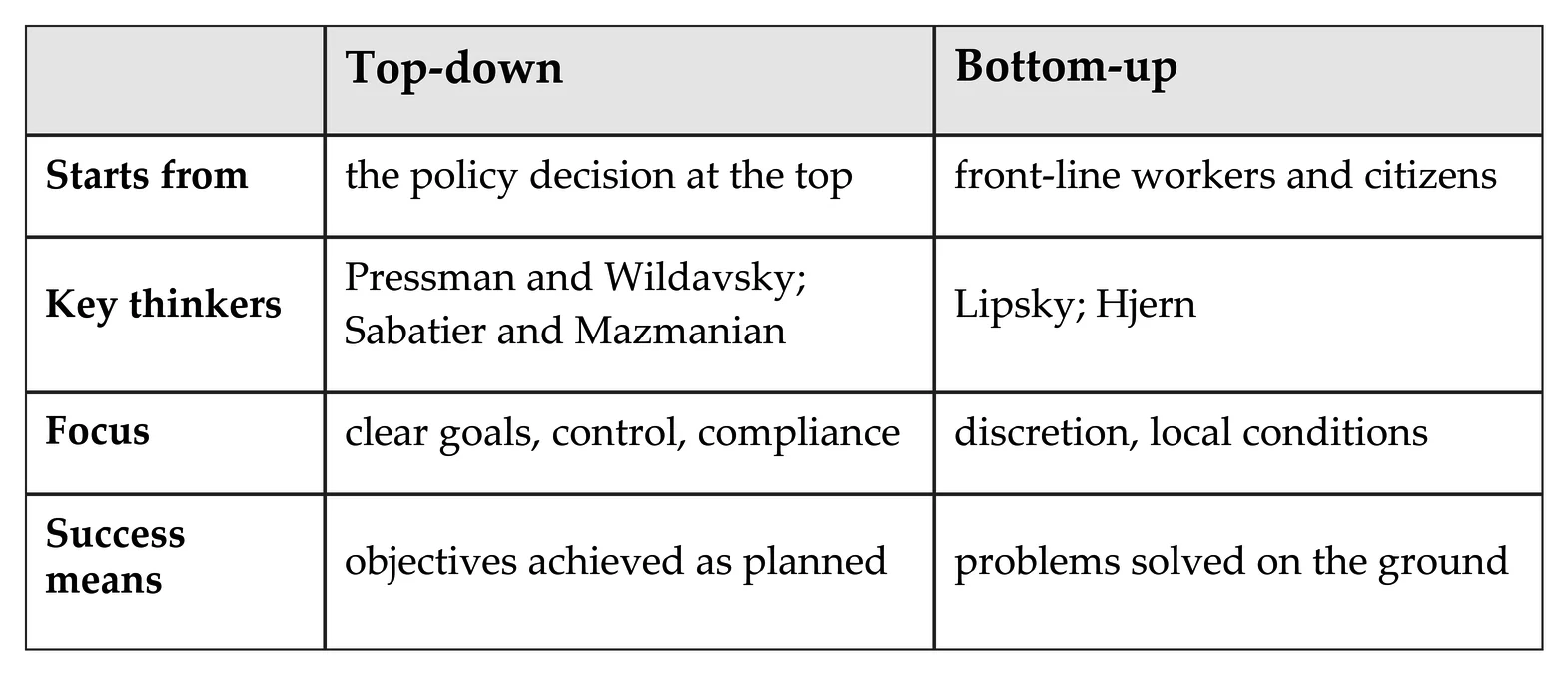
- Top-down approach. Associated with scholars such as Paul Sabatier and Daniel Mazmanian, it starts from the policy decision and asks how far the objectives were achieved. Success requires clear and consistent objectives, a valid causal theory, adequate resources, a well-structured implementing agency, committed officials and the support of interest groups and the legislature.
- Bottom-up approach. Associated with Michael Lipsky and Benny Hjern, it starts from the front-line workers and the target groups. Lipsky’s Street-Level Bureaucracy (1980) argued that teachers, police officers, health workers and welfare officials, who use discretion in daily dealings with citizens, effectively make policy as they carry it out.
- Synthesis. Later scholars combined the two, recognising that both central design and local discretion matter.
Implementation in India
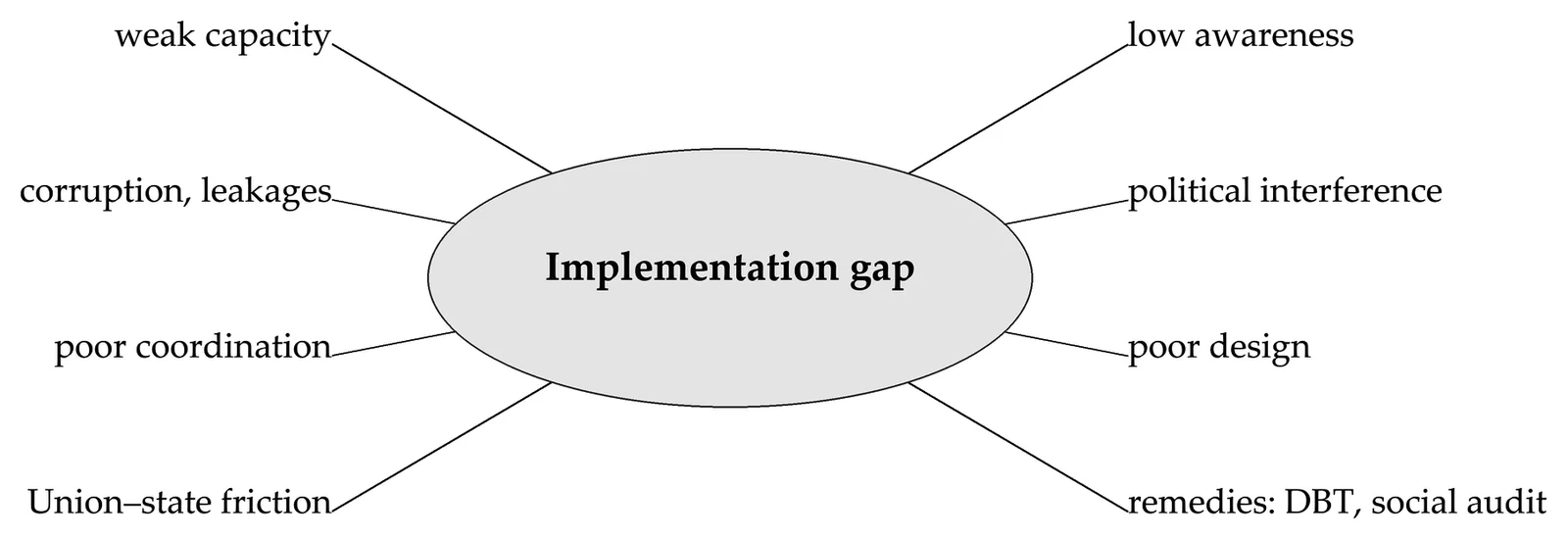
India has many well-designed policies but faces a large implementation gap. In 1985, Prime Minister Rajiv Gandhi famously remarked that only a small fraction of every rupee spent on welfare actually reached the intended beneficiaries. Implementation depends on state governments, district administrations and local bodies, since most central schemes are implemented by the states.
- Administrative capacity. Shortages of staff, such as doctors in rural health centres and teachers in schools, weaken delivery.
- Corruption and leakages. Funds and benefits are diverted, as in the past with ghost beneficiaries in the public distribution system.
- Coordination. Many ministries, departments and levels of government are involved, causing delays and duplication.
- Federal issues. Differences between the Union and the states over funding and design affect implementation of centrally sponsored schemes.
- Lack of awareness and participation. Beneficiaries often do not know their entitlements, and local communities are rarely involved.
- Political interference. Transfers of officials and favouritism in selecting beneficiaries undermine implementation.
- Poor design. Vague objectives, unrealistic targets and inadequate funding make implementation difficult from the start.
Improving Implementation
Recent reforms include Direct Benefit Transfer using the JAM trinity of Jan-Dhan accounts, Aadhaar and mobile phones, which reduced leakages; e-governance and dashboards for monitoring; social audits and the Right to Information, which empower citizens to check implementation; decentralisation to panchayats; and outcome-based monitoring through bodies such as NITI Aayog’s Development Monitoring and Evaluation Office. The Aspirational Districts Programme (2018) uses data rankings to improve outcomes in backward districts.
3.3 Policy Evaluation
Policy evaluation is the assessment of a policy’s content, implementation and effects, to judge whether it has achieved its objectives and how it can be improved. Evaluation provides feedback for continuing, modifying or ending a policy, ensures accountability for public money, and generates learning for future policies.
Types of Evaluation
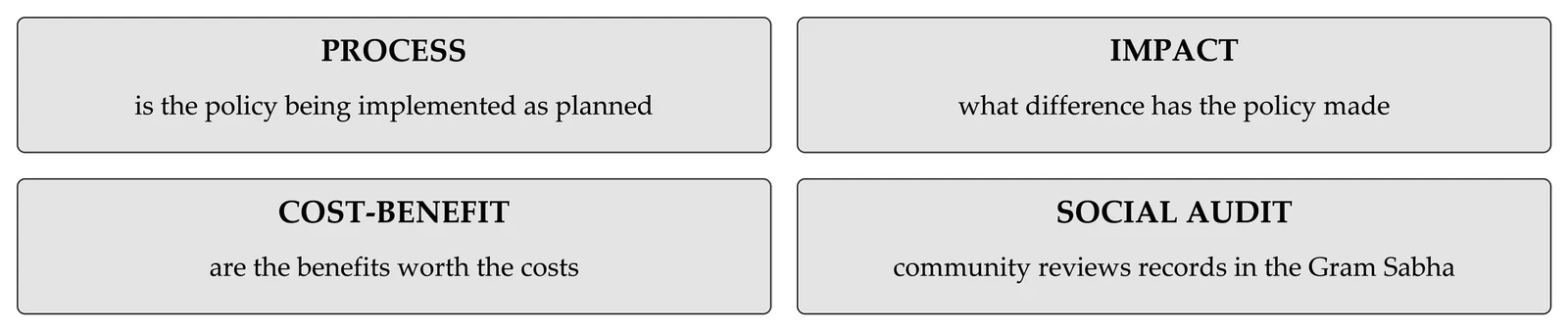
- Process evaluation. It examines how a policy is being implemented: whether resources reach the right people, whether procedures are followed and what problems arise.
- Impact or outcome evaluation. It examines whether the policy has achieved its intended results and what difference it has made compared with what would have happened without it.
- Formative and summative evaluation. Formative evaluation takes place during implementation to improve the policy, while summative evaluation takes place at the end to judge its overall success.
- Ex ante and ex post evaluation. Ex ante evaluation assesses likely effects before adoption, while ex post evaluation assesses actual effects afterwards.
- Economic evaluation. Cost-benefit and cost-effectiveness analysis compare the costs of a policy with its benefits.
Methods
Evaluation uses quantitative methods, such as surveys, statistical analysis and randomised controlled trials (popularised by Abhijit Banerjee, Esther Duflo and Michael Kremer, who won the Nobel Prize in Economics in 2019 partly for work in India), and qualitative methods, such as interviews, case studies and field observation. Participatory methods involve beneficiaries themselves, as in social audits, where the community publicly reviews records of a scheme. Section 17 of the MGNREGA requires the Gram Sabha to conduct regular social audits of works under the scheme.
Agencies of Evaluation in India
- Programme Evaluation Organisation (PEO). Set up in 1952 under the Planning Commission to evaluate development programmes; in 2015 it was merged with the Independent Evaluation Office to form the Development Monitoring and Evaluation Office (DMEO) of NITI Aayog.
- Comptroller and Auditor General. Its performance audits assess whether schemes achieve their objectives economically and efficiently.
- Parliamentary committees. The Public Accounts Committee, the Estimates Committee and the Departmentally Related Standing Committees scrutinise schemes.
- Independent researchers and civil society. Universities, think tanks and NGOs, such as Pratham through its ASER surveys of learning outcomes, provide independent evaluation.
- Courts and commissions. Courts and bodies such as the National Human Rights Commission examine policy failures affecting rights.
Problems of Evaluation
Evaluation faces many difficulties: policy goals are often vague or multiple; reliable data is lacking; it is hard to isolate the effects of a policy from other factors; results take years to appear; officials resist critical findings; and evaluations are often not used in decision-making. Evaluation is also political, since findings can embarrass governments. Strengthening evaluation requires independent agencies, good data, clear indicators and a culture of learning.
3.4 Important Questions
- Question 1 Explain the process of policy formulation. What is the role of agenda-setting in it?
- Question 2 What is policy implementation? Discuss the problems of policy implementation in India.
- Question 3 What is policy evaluation? Discuss its types, methods and problems.
- Question 4 Describe the policy cycle and the role of official and unofficial actors in public policy-making in India.
DU asks the same idea in different words. So learn one broad answer for each question below; the same answer works for every question joined by OR.
Important Question 1
Explain the process of policy formulation. What is the role of agenda-setting in it?
OR
How do issues get onto the policy agenda? Discuss with reference to Kingdon’s model.
OR
Discuss the role of various actors in the formulation of public policy in India.
Model Answer
“The agenda… is the list of subjects or problems to which governmental officials, and people outside of government closely associated with those officials, are paying some serious attention at any given time.”
— John W. Kingdon, Agendas, Alternatives, and Public Policies (1984)
Introduction. Policy formulation is the stage at which governments work out how to deal with a problem. Before that, the problem must reach the government’s agenda. Agenda-setting and formulation together decide which problems receive attention and what solutions are considered, so they shape the entire course of public policy.
1. The Policy Cycle
The policy process is often described as a cycle of agenda-setting, formulation, adoption, implementation and evaluation. Formulation comes after a problem is placed on the agenda and before a formal decision is taken.
2. Meaning of the Agenda
The agenda is the set of issues receiving serious attention from decision-makers at a given time. Since attention is limited, many problems never reach the agenda, which is why agenda-setting is a form of power.
3. Systemic and Institutional Agendas
Cobb and Elder distinguished the systemic agenda, the issues the public considers worth attention, from the institutional agenda, the issues taken up by decision-makers. Issues must move from the first to the second to become policy.
4. How Issues Reach the Agenda
Issues reach the agenda through crises and focusing events, data and indicators, media coverage, movements and protests, elections and the initiative of leaders. The Nirbhaya case of 2012 quickly put women’s safety on the agenda.
5. Kingdon’s Multiple Streams
Kingdon argued that the problem, policy and political streams flow separately. When they come together, often because of a crisis or a change in government, a policy window opens and an issue moves onto the agenda.
6. Policy Entrepreneurs
Policy entrepreneurs, such as activists, experts and politicians, invest time and resources to push their proposals and wait for windows to open. The campaign for the right to information by Aruna Roy and the MKSS is an Indian example.
7. Meaning of Formulation
Policy formulation is the development of proposed courses of action to address an agenda item. It involves both technical analysis and political bargaining among interests.
8. Problem Definition
How a problem is defined shapes the solutions considered. Defining hunger as a lack of food supply leads to production policies, while defining it as a lack of entitlements leads to rights-based policies such as the National Food Security Act.
9. Setting Objectives and Alternatives
Policy-makers set goals and identify alternatives, such as cash transfers or in-kind subsidies, public provision or regulation, and incentives or penalties.
10. Analysing Alternatives
Alternatives are analysed for costs, benefits, equity, administrative feasibility and political acceptability. Tools include cost-benefit analysis, pilot projects and simulations.
11. Consultation
Consultation with stakeholders, experts, states and the public improves policies. The Pre-Legislative Consultation Policy of 2014 requires draft bills to be published for comment, though it is not always followed.
12. Official Actors
The Cabinet and ministries lead formulation, the bureaucracy drafts proposals, NITI Aayog advises, Parliament debates and passes laws, and courts shape policy through public interest litigation.
13. Unofficial Actors
Parties, interest groups, social movements, think tanks, the media and international organisations influence formulation by raising issues, providing ideas and mobilising support or opposition.
14. Policy Adoption
Formulation ends in adoption, when the chosen option is approved by the Cabinet, enacted by Parliament or issued as an executive order, giving it legal authority.
15. Problems in India
Formulation in India is often top-down, with limited consultation, weak data and little use of evidence. Hasty formulation, as with the farm laws of 2020, can lead to resistance and failure.
16. Evaluation
Agenda-setting and formulation are the stages where the shape of a policy is decided. Inclusive, evidence-based formulation makes policies more legitimate and easier to implement.
Conclusion. Thus, agenda-setting decides which problems receive attention, and formulation develops and analyses the options for solving them, through problem definition, objectives, alternatives, analysis and consultation. Kingdon’s multiple streams model shows how problems, solutions and politics come together to open policy windows.
Important Question 2
What is policy implementation? Discuss the problems of policy implementation in India.
OR
Distinguish between the top-down and bottom-up approaches to policy implementation.
OR
Why do good policies fail at the stage of implementation? Discuss.
Model Answer
“The decisions of street-level bureaucrats, the routines they establish, and the devices they invent to cope with uncertainties and work pressures, effectively become the public policies they carry out.”
— Michael Lipsky, Street-Level Bureaucracy (1980)
Introduction. A policy on paper changes nothing until it is put into practice. Implementation is the stage at which administrators translate policy decisions into action. Pressman and Wildavsky’s study of 1973 showed that implementation is complex and often fails, and in India, the gap between policy goals and results has been a persistent concern.
1. Meaning of Implementation
Implementation includes making rules, allocating funds and staff, creating organisations, delivering services and enforcing laws. It is the link between policy decisions and policy outcomes.
2. Pressman and Wildavsky
In Implementation (1973), Pressman and Wildavsky studied a federal programme in Oakland that failed despite funding and support, because it depended on many actors and decision points. The more links in the chain, the greater the chance of failure.
3. The Top-Down Approach
The top-down approach starts from the policy decision and asks how far its objectives were achieved. Sabatier and Mazmanian listed conditions for success: clear objectives, a valid causal theory, adequate resources, committed officials and political support.
4. The Bottom-Up Approach
The bottom-up approach starts from front-line workers and target groups. Lipsky argued that street-level bureaucrats, such as teachers, police and health workers, use discretion and effectively make policy as they implement it.
5. Synthesis
Later scholars combined the two approaches, recognising that good central design and adequate local discretion are both needed for successful implementation.
6. Implementation Gap in India
India has many well-designed policies but weak results. In 1985, Rajiv Gandhi remarked that only a small part of every rupee spent on welfare reached the poor, highlighting the scale of leakages.
7. Administrative Capacity
Shortages of doctors, nurses, teachers and officials, especially in rural and remote areas, weaken service delivery. India has fewer public employees per head of population than many countries.
8. Corruption and Leakages
Funds and benefits are diverted through ghost beneficiaries, fake muster rolls and bribery, as reported in the public distribution system and employment schemes.
9. Coordination Problems
Many ministries, departments and levels of government are involved in implementing schemes, causing delays, duplication and conflicting priorities.
10. Federal Issues
Most central schemes are implemented by states. Disputes over funding shares, design and credit for schemes, and differences in state capacity, lead to uneven implementation across India.
11. Lack of Awareness and Participation
Many beneficiaries do not know their entitlements, and local communities are rarely consulted, so schemes fail to match local needs and lack public pressure for delivery.
12. Political Interference
Frequent transfers of officials, favouritism in choosing beneficiaries and pressure to show quick results distort implementation and discourage honest officials.
13. Poor Policy Design
Vague goals, unrealistic targets, inadequate funding and lack of attention to local conditions make implementation difficult from the start.
14. Technological Reforms
Direct Benefit Transfer through the JAM trinity of Jan-Dhan, Aadhaar and mobile phones has reduced leakages, while dashboards and geo-tagging improve monitoring, though technical failures can exclude the poor.
15. Accountability Reforms
Social audits, the RTI Act, citizen charters, decentralisation to panchayats and outcome monitoring, such as the Aspirational Districts Programme of 2018, strengthen accountability in implementation.
16. Evaluation
Implementation is where most policies succeed or fail. Strengthening capacity, accountability and participation is as important as designing good policies.
Conclusion. Thus, implementation translates policy into action, and it can be studied from the top down, focusing on objectives and control, or from the bottom up, focusing on street-level discretion. In India, weak capacity, corruption, poor coordination and limited participation cause an implementation gap, which technology and accountability reforms are trying to close.
Important Question 3
What is policy evaluation? Discuss its types, methods and problems.
OR
Examine the importance of policy evaluation in the policy process.
OR
Write a note on social audit as a tool of policy evaluation.
Model Answer
“The Gram Sabha shall conduct regular social audits of all the projects under the Scheme taken up within the Gram Panchayat.”
— Mahatma Gandhi National Rural Employment Guarantee Act, 2005, Section 17(2)
Introduction. Policy evaluation is the systematic assessment of a policy’s design, implementation and results. It completes the policy cycle by providing feedback on whether a policy is working and how it can be improved. In a democracy, evaluation is also essential for accountability, since citizens have the right to know whether public money is producing results.
1. Meaning
Policy evaluation assesses the content, implementation and effects of a policy to judge whether it has achieved its objectives, at what cost, and with what intended and unintended consequences.
2. Importance
Evaluation provides feedback for continuing, modifying or ending policies, ensures accountability for public money, improves the efficiency of spending and generates lessons for future policies.
3. Process Evaluation
Process evaluation examines how a policy is being implemented: whether funds are released on time, whether benefits reach the right people and what bottlenecks arise.
4. Impact Evaluation
Impact evaluation asks whether the policy achieved its intended results and what difference it made compared with what would have happened without it, which requires careful comparison.
5. Formative and Summative Evaluation
Formative evaluation takes place during implementation to improve a programme, while summative evaluation judges its overall success at the end, informing decisions to continue or end it.
6. Ex Ante and Ex Post Evaluation
Ex ante evaluation assesses the likely effects of a policy before it is adopted, as in regulatory impact assessment, while ex post evaluation assesses actual effects after implementation.
7. Economic Evaluation
Cost-benefit analysis compares the monetary value of costs and benefits, while cost-effectiveness analysis compares the costs of different ways of achieving the same goal.
8. Quantitative Methods
Surveys, statistical analysis and randomised controlled trials measure effects. Banerjee, Duflo and Kremer won the Nobel Prize in 2019 partly for experiments in India on education and health.
9. Qualitative Methods
Interviews, focus groups, case studies and field observation explain why a policy works or fails and capture the experiences of beneficiaries that numbers miss.
10. Social Audit
In a social audit, the community publicly reviews the records of a scheme. Section 17 of MGNREGA requires regular social audits by the Gram Sabha, and Andhra Pradesh pioneered their large-scale use.
11. Official Agencies
The Programme Evaluation Organisation was set up in 1952 and is now part of NITI Aayog’s Development Monitoring and Evaluation Office. The CAG conducts performance audits, and parliamentary committees scrutinise schemes.
12. Independent Evaluation
Universities, think tanks and NGOs provide independent evaluation. Pratham’s ASER surveys of learning outcomes have shaped the debate on school education.
13. Vague Goals and Weak Data
Many policies have vague or multiple goals, and reliable data is often lacking, making it difficult to measure success or failure accurately.
14. Attribution and Time
It is hard to separate a policy’s effects from those of other factors, and many effects, such as those of education, take years to appear.
15. Political Resistance
Officials and politicians may resist critical findings, and evaluation reports are often ignored in decision-making, limiting their value.
16. Evaluation
Policy evaluation turns experience into learning. Independent agencies, good data and a culture of using evidence are needed to make it effective in India.
Conclusion. Thus, policy evaluation assesses whether policies achieve their goals through process, impact, formative, summative and economic evaluation, using quantitative, qualitative and participatory methods such as social audits. Despite problems of data, attribution and political resistance, it is essential for accountability and better policy.
Important Question 4
Describe the policy cycle and the role of official and unofficial actors in public policy-making in India.
OR
Examine the stages model of the policy process. What are its limitations?
OR
Discuss the role of non-state actors in public policy in India.
Model Answer
“Policy sciences are concerned with knowledge of and in the decision processes of the public and civic order.”
— Harold D. Lasswell, A Pre-View of Policy Sciences (1971)
Introduction. The policy process is often described as a cycle of stages through which a policy passes, from the recognition of a problem to the evaluation of results. At each stage, many actors are involved, both official actors with legal authority and unofficial actors who influence decisions. Understanding the cycle and the actors helps explain how policies are actually made in India.
1. Origins of the Stages Model
Harold Lasswell proposed dividing the decision process into stages, and later scholars such as James Anderson refined this into the policy cycle, which became the standard framework for studying public policy.
2. Agenda-Setting
At the first stage, a problem is recognised and placed on the government’s agenda, through crises, data, media coverage, movements or the initiative of leaders.
3. Formulation and Adoption
Alternatives are developed and analysed, and one is chosen and given legal authority through a Cabinet decision, an Act of Parliament or an executive order.
4. Implementation
The policy is put into practice by ministries, state governments, district administrations and local bodies, through rules, funds, staff and service delivery.
5. Policy Networks and Communities
Scholars such as R.A.W. Rhodes describe policy as made within policy networks, relatively stable sets of official and unofficial actors who interact regularly on a subject. Tight policy communities, such as those around agriculture or defence, are closed and stable, while looser issue networks, such as those on the environment, include many changing participants.
6. Cooperative Federalism and the GST Council
The GST Council, created by the 101st Amendment of 2016, brings the Union Finance Minister and state finance ministers together to decide tax rates and rules. It shows how official actors from different levels of government now jointly formulate and adopt policy in India’s federal system.
7. Evaluation and Feedback
The results are assessed, and feedback leads to continuation, modification or termination of the policy, beginning a new cycle.
8. Value of the Model
The stages model simplifies a complex process, allows each stage to be studied separately and helps identify where policies succeed or fail.
9. Limitations of the Model
Real policy-making is messy: stages overlap, occur out of order or are skipped, and the model neglects power, ideas and the role of chance. It is a heuristic, not a description of reality.
10. The Political Executive
The Prime Minister, the Cabinet and ministers are the most important official actors. Major policies, such as the economic reforms of 1991 or demonetisation in 2016, originate in the executive.
11. The Bureaucracy and NITI Aayog
Civil servants provide expertise, draft policies and implement them. NITI Aayog, set up in 2015, acts as the government’s think tank and promotes cooperative federalism.
12. Parliament
Parliament debates and passes laws, approves budgets and scrutinises policies through questions and committees, though executive dominance limits its influence on formulation.
13. The Judiciary
Through public interest litigation, the Supreme Court has shaped policies on food, the environment, education and workplace harassment, making it an important policy actor.
14. State Governments and Local Bodies
States make policy on many subjects and implement most central schemes, while panchayats and municipalities plan and deliver local services under the 73rd and 74th Amendments.
15. Parties and Interest Groups
Parties shape policy through manifestos and elections, while business associations, trade unions, farmers’ organisations and professional bodies lobby for their interests.
16. Civil Society and Media
Social movements, NGOs and the media raise issues, provide information and mobilise opinion, as in the campaigns that led to the RTI Act and the National Food Security Act.
17. Think Tanks and International Actors
Think tanks provide research and ideas, while international organisations such as the World Bank, the WHO and UN agencies influence policy through funding, advice and global goals.
18. Evaluation
Policy-making in India involves many actors at every stage, and its quality depends on how well official institutions engage with citizens and experts.
Conclusion. Thus, the policy cycle moves from agenda-setting through formulation, adoption and implementation to evaluation and feedback, though real policy-making is less orderly. Official actors such as the executive, bureaucracy, Parliament and courts and unofficial actors such as parties, groups, movements and the media together shape public policy in India.
Short Notes
(a) Policy window
In Kingdon’s model, the moment when the problem, policy and political streams come together, giving policy entrepreneurs an opportunity to push their proposals onto the agenda.
(b) Street-level bureaucracy
Michael Lipsky’s term for front-line public workers, such as teachers, police and health workers, whose discretion in dealing with citizens effectively shapes policy.
(c) Social audit
A participatory process in which the community publicly reviews the records and works of a scheme; MGNREGA requires regular social audits by the Gram Sabha.
More notes: GE-8 Introduction to Public Policy
These notes are prepared by PADHO TO AISE for study help. They are not an official publication.