

Generic Electives (GE) GE-11 Election Commission and Process in India
Unit 2 · 24 min read · Updated 27 Nov 2026
As per the University of Delhi (DU) Generic Elective (GE) syllabus offered by the Department of Political Science
Contents
- 2.1 Constitutional Provisions: Articles 324 to 329
- The Six Articles
- Why the Framers Created an Independent Commission
- 2.2 Structure, Composition and Appointment of the Election Commission
- From Single-Member to Multi-Member
- Composition and Tenure
- The Electoral Machinery
- The Appointment Debate
- 2.3 Powers, Functions, Autonomy and Accountability
- Powers and Functions
- The Reservoir of Power
- Autonomy of the Commission
- Accountability of the Commission
- 2.4 Important Questions
- Discuss the constitutional provisions relating to elections in India (Articles 324 to 329).
- Discuss the structure, composition and method of appointment of the Election Commission of India.
- Examine the powers and functions of the Election Commission of India.
- Discuss the autonomy and accountability of the Election Commission of India.
- Short Notes
निर्वाचक नामावलियों की तैयारी और सभी निर्वाचनों के संचालन का अधीक्षण, निदेशन और नियंत्रण एक आयोग में निहित होगा।
The superintendence, direction and control of the preparation of the electoral rolls for, and the conduct of, all elections shall be vested in a Commission.
— Constitution of India, Article 324(1), abridged
TTHE framers of the Constitution knew that democracy would be only as good as its elections, and that elections would be fair only if they were conducted by a body independent of the government of the day. They therefore created the Election Commission of India (ECI) as a constitutional body and set out the framework of elections in Articles 324 to 329. This chapter studies these provisions, the structure and composition of the Election Commission, its powers and functions, and the debates about its autonomy and accountability.
2.1 Constitutional Provisions: Articles 324 to 329
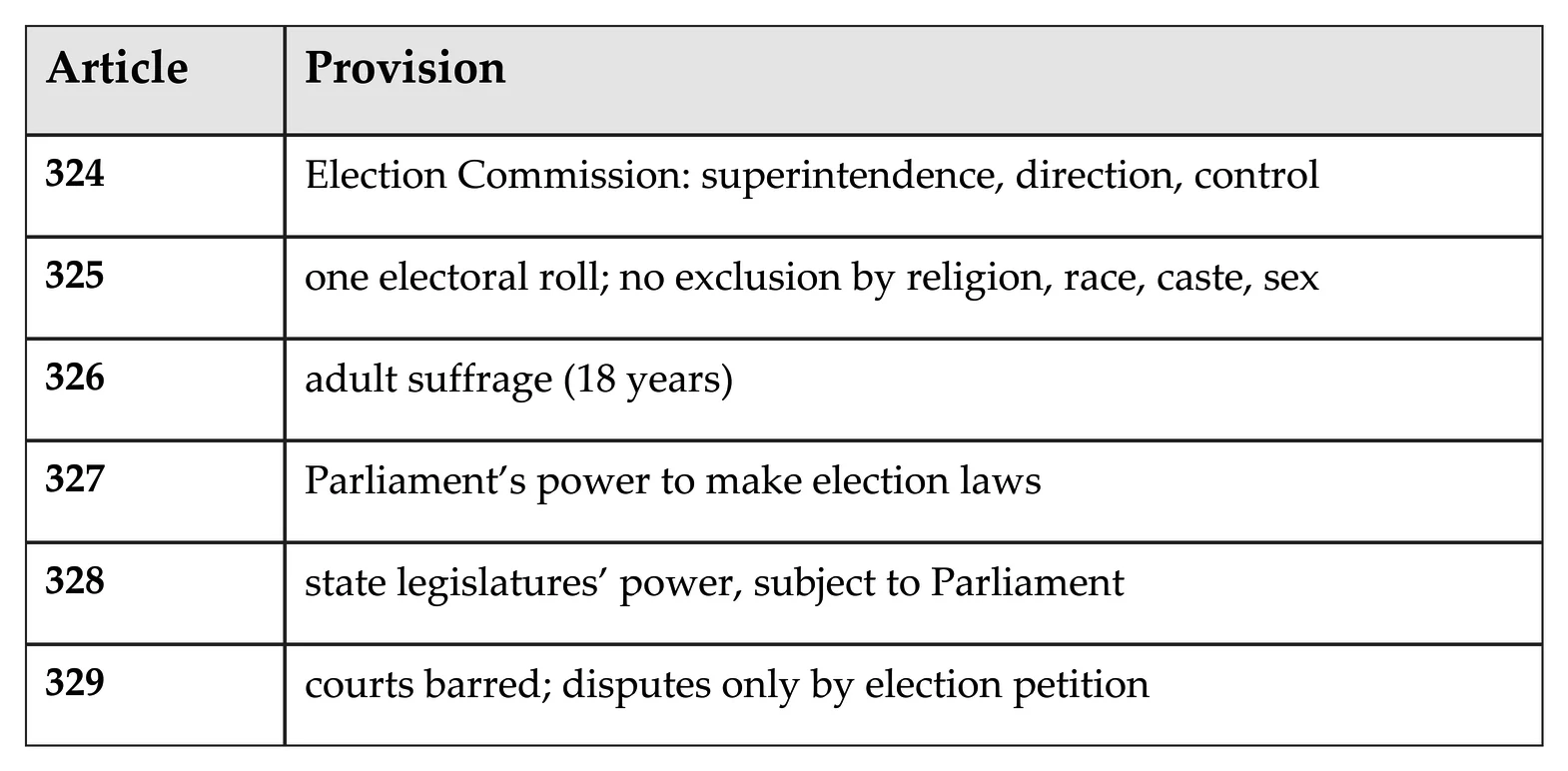
Part XV of the Constitution, Articles 324 to 329, deals with elections. Unlike many constitutions, which leave elections to ordinary law, the Indian Constitution placed the main principles and the electoral authority in the Constitution itself, showing how much importance the framers gave to free and fair elections.
The Six Articles
- Article 324. It vests the superintendence, direction and control of the preparation of electoral rolls and the conduct of all elections to Parliament, state legislatures and the offices of President and Vice-President in the Election Commission. The Commission consists of the Chief Election Commissioner and such number of other Election Commissioners as the President may fix; the Chief Election Commissioner can be removed only like a Supreme Court judge, and other Commissioners only on his recommendation.
- Article 325. There shall be one general electoral roll for every territorial constituency, and no person shall be excluded from it on grounds only of religion, race, caste or sex; this abolished the separate electorates of the colonial period.
- Article 326. Elections to the Lok Sabha and state assemblies shall be on the basis of adult suffrage, every citizen aged eighteen or above being entitled to vote unless disqualified.
- Article 327. Parliament may make laws on all matters relating to elections to Parliament and state legislatures, such as electoral rolls and delimitation, under which it passed the Representation of the People Acts.
- Article 328. State legislatures may make laws on elections to their own houses, subject to laws made by Parliament.
- Article 329. Courts cannot question laws on delimitation or the allotment of seats, and an election can be challenged only through an election petition under the law; in N.P. Ponnuswami (1952), the Supreme Court held that courts should not interfere while the electoral process is under way.
Why the Framers Created an Independent Commission
In the Constituent Assembly, B.R. Ambedkar explained that the Drafting Committee wanted the whole election machinery to be in the hands of a central Election Commission, independent of the executive, so that state governments could not manipulate electoral rolls to exclude minorities or opponents. The Assembly debated whether there should be separate commissions for the states, but decided on a single national commission to ensure uniform and impartial elections across the country. Ambedkar also noted that the Constitution did not lay down the qualifications or method of appointment of Commissioners, a gap that later became the subject of debate.
2.2 Structure, Composition and Appointment of the Election Commission
From Single-Member to Multi-Member
For its first four decades, the Election Commission had only one member, the Chief Election Commissioner (CEC), beginning with Sukumar Sen (1950–58). In October 1989, the government appointed two additional Election Commissioners, but their posts were abolished in January 1990. In 1993, after the assertive tenure of T.N. Seshan, the government again appointed two Election Commissioners and amended the law to make the Commission permanently multi-member. In T.N. Seshan v. Union of India (1995), the Supreme Court upheld this, holding that the CEC is first among equals and that decisions are taken by majority.
Composition and Tenure
- Members. The Commission consists of the Chief Election Commissioner and two Election Commissioners.
- Tenure. They hold office for six years or until the age of sixty-five, whichever is earlier.
- Removal. The CEC can be removed only by the process used for Supreme Court judges, i.e. by an address of both Houses of Parliament passed by a special majority on grounds of proved misbehaviour or incapacity; other Commissioners can be removed by the President on the recommendation of the CEC.
- Service conditions. Under Article 324(5), the conditions of service of the CEC cannot be varied to his disadvantage after appointment.
- Regional Commissioners. The President may appoint Regional Commissioners to assist the Commission before elections.
The Electoral Machinery
The Commission works through a hierarchy of officials. In each state, a Chief Electoral Officer supervises elections; in each district, the District Election Officer, usually the Collector, coordinates arrangements; each constituency has a Returning Officer, who conducts the election, and an Electoral Registration Officer, who prepares the roll; and Booth Level Officers maintain rolls at the level of polling stations. During elections, millions of government employees and security personnel work under the Commission’s control, and it deploys general, police and expenditure observers to monitor the process.

The Appointment Debate
The Constitution leaves the method of appointment to a law of Parliament, but until 2023 no law was made, so Commissioners were appointed by the President on the advice of the government. Critics argued that this allowed the ruling party to choose referees for a contest in which it was a player. In Anoop Baranwal v. Union of India (March 2023), a five-judge bench held that, until Parliament made a law, appointments should be made on the advice of a committee of the Prime Minister, the Leader of the Opposition and the Chief Justice of India. In December 2023, Parliament passed the Chief Election Commissioner and Other Election Commissioners (Appointment, Conditions of Service and Term of Office) Act, which provides for a selection committee of the Prime Minister, the Leader of the Opposition and a Union Cabinet Minister nominated by the Prime Minister, with a search committee to shortlist names. Critics argued that removing the Chief Justice gave the government a majority on the committee, while the government defended the law as Parliament’s prerogative.
2.3 Powers, Functions, Autonomy and Accountability
Powers and Functions
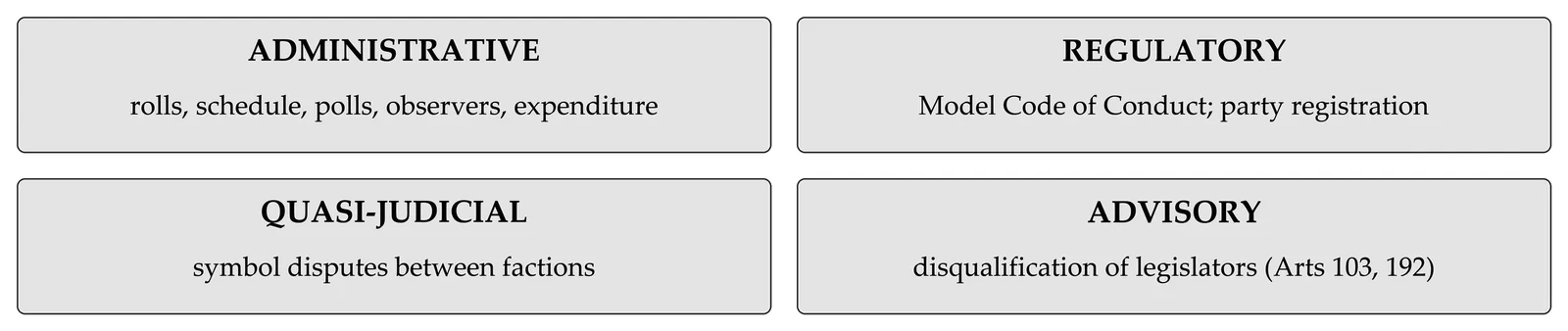
- Electoral rolls. It prepares and periodically revises electoral rolls and issues electors’ photo identity cards.
- Scheduling elections. It decides the schedule and phases of elections and notifies them through the President or Governor.
- Conduct of polls. It supervises nominations, scrutiny, polling and counting, can order re-polls and can countermand or postpone elections in case of serious malpractice.
- Model Code of Conduct. It enforces the Model Code of Conduct, a set of guidelines for parties, candidates and governments from the announcement of elections, such as a ban on new schemes and on using official machinery for campaigns.
- Parties and symbols. Under the Election Symbols (Reservation and Allotment) Order of 1968, it recognises national and state parties, allots symbols and decides disputes between factions over symbols, as in the cases of the Shiv Sena (2023) and the Nationalist Congress Party (2024).
- Expenditure control. It fixes and monitors candidates’ expenditure limits, raised in 2022 to ninety-five lakh rupees for Lok Sabha seats in larger states.
- Advisory role. It advises the President and Governors on the disqualification of legislators, for example for holding an office of profit (Articles 103 and 192).
- Voter education. Through its Systematic Voters’ Education and Electoral Participation programme (SVEEP), launched in 2009, it encourages registration and turnout.
The Reservoir of Power
The Supreme Court has interpreted Article 324 broadly. In Mohinder Singh Gill v. Chief Election Commissioner (1978), it described Article 324 as a plenary provision giving the Commission the powers needed to conduct free and fair elections, operating in areas not covered by law, but held that the Commission must act fairly and within the law. Under this power, the Commission has issued guidelines, deployed central forces and taken innovative measures such as electronic voting machines, VVPATs and the use of technology to track expenditure.
Autonomy of the Commission
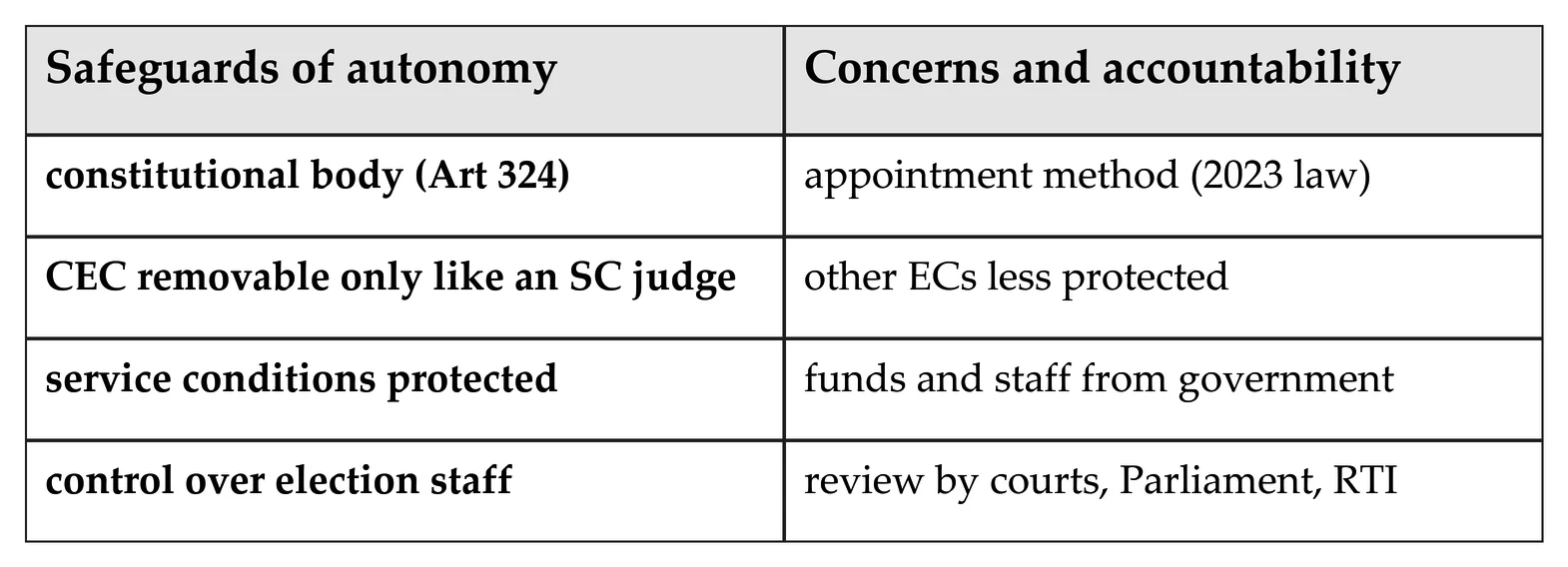
Several features protect the Commission’s autonomy: its constitutional status, security of tenure, protection of service conditions, removal of the CEC only by impeachment-like process and control over all election staff during elections. Strong CECs, such as T.N. Seshan (1990–96), who strictly enforced the Model Code, and J.M. Lyngdoh, who postponed elections in Gujarat in 2002 because conditions were not normal, showed that the Commission could stand up to governments. Yet concerns remain: the method of appointment, the absence of equal protection for the other Commissioners, dependence on the government for funds and staff, and the possibility of post-retirement appointments.
Accountability of the Commission
Autonomy must be balanced with accountability. The Commission is accountable to the courts, which review its decisions, as in Mohinder Singh Gill; to Parliament, which makes election laws; to the public through the Right to Information Act and the media; and to political parties, which can challenge its decisions. In recent years, opposition parties and civil society have questioned the Commission’s impartiality in enforcing the Model Code, scheduling elections and handling complaints about electronic voting machines, while the Commission has defended its record. Such debates show that public trust in the referee of elections is as important as legal independence.
2.4 Important Questions
- Question 1 Discuss the constitutional provisions relating to elections in India (Articles 324 to 329).
- Question 2 Discuss the structure, composition and method of appointment of the Election Commission of India.
- Question 3 Examine the powers and functions of the Election Commission of India.
- Question 4 Discuss the autonomy and accountability of the Election Commission of India.
DU asks the same idea in different words. So learn one broad answer for each question below; the same answer works for every question joined by OR.
Important Question 1
Discuss the constitutional provisions relating to elections in India (Articles 324 to 329).
OR
Examine the constitutional framework of elections in India.
OR
Why did the framers place the electoral machinery in the Constitution itself? Discuss.
Model Answer
“No person shall be ineligible for inclusion in any such roll or claim to be included in any special electoral roll for any such constituency on grounds only of religion, race, caste, sex or any of them.”
— Constitution of India, Article 325
Introduction. The Constitution of India devotes Part XV, Articles 324 to 329, to elections. These provisions create an independent Election Commission, guarantee a single electoral roll without discrimination, establish universal adult franchise, empower Parliament and state legislatures to make election laws and limit the interference of courts during the electoral process. Together they form the constitutional framework of Indian democracy.
1. Importance of Constitutional Provisions
By placing the principles of elections and the electoral authority in the Constitution, the framers protected them from easy change by the government of the day and showed that free and fair elections are fundamental to the republic.
2. Article 324: The Election Commission
Article 324 vests the superintendence, direction and control of electoral rolls and all elections to Parliament, state legislatures and the offices of President and Vice-President in the Election Commission, an independent constitutional body.
3. Composition under Article 324
The Commission consists of the Chief Election Commissioner and such other Commissioners as the President may fix. The CEC can be removed only like a Supreme Court judge, and his service conditions cannot be varied to his disadvantage.
4. Article 325: A Single Electoral Roll
Article 325 provides one general electoral roll for each constituency and forbids exclusion on grounds only of religion, race, caste or sex. This ended the separate electorates of the colonial period, which had divided voters by community.
5. Article 326: Adult Suffrage
Article 326 makes adult suffrage the basis of elections to the Lok Sabha and state assemblies, so every citizen aged eighteen or above can vote unless disqualified by law.
6. Article 327: Powers of Parliament
Article 327 allows Parliament to make laws on all matters relating to elections, including electoral rolls and delimitation. Under it, Parliament passed the Representation of the People Acts of 1950 and 1951 and the Delimitation Acts.
7. Article 328: Powers of State Legislatures
Article 328 permits state legislatures to make laws regarding elections to their own houses, to the extent that Parliament has not made provision, ensuring a role for states within a national framework.
8. Article 329: Bar on Court Interference
Article 329 bars courts from questioning laws on delimitation and allotment of seats and provides that elections can be challenged only through election petitions. In N.P. Ponnuswami (1952), the Court held that courts should not interrupt the electoral process.
9. The Framers’ Intentions
Ambedkar explained that a central, independent commission was needed to prevent state governments from manipulating rolls against minorities or opponents and to ensure uniform elections throughout the country.
10. Article 329A and Its Removal
During the Emergency, the 39th Amendment of 1975 inserted Article 329A to place the election of the Prime Minister beyond judicial review. The Supreme Court struck down part of it, and the 44th Amendment of 1978 removed it, reaffirming judicial review of elections.
11. Judicial Interpretation
In Mohinder Singh Gill (1978), the Supreme Court interpreted Article 324 as a plenary power enabling the Commission to fill gaps in election law, while requiring it to act fairly.
12. Free and Fair Elections as Basic Structure
In Indira Gandhi v. Raj Narain (1975), the Court held that free and fair elections are part of the basic structure, so these constitutional provisions cannot be destroyed even by amendment.
13. Gaps in the Framework
The Constitution did not specify the qualifications or method of appointment of Commissioners, leaving this to Parliament, which made a law only in 2023. Critics also note that other Commissioners lack the same removal protection as the CEC.
14. Evaluation
Articles 324 to 329 provide a strong constitutional framework that has enabled India to conduct regular, largely free and fair elections, though gaps relating to appointments have been debated.
Conclusion. Thus, Articles 324 to 329 create an independent Election Commission, guarantee a single electoral roll without discrimination and adult suffrage, empower Parliament and state legislatures to make election laws and limit judicial interference during elections. Interpreted by the courts as part of the basic structure, they form the constitutional backbone of Indian democracy.
Important Question 2
Discuss the structure, composition and method of appointment of the Election Commission of India.
OR
Examine the significance of the Anoop Baranwal judgment and the law of 2023 on the appointment of Election Commissioners.
OR
Why was the Election Commission made a multi-member body? Discuss.
Model Answer
“The Election Commission shall consist of the Chief Election Commissioner and such number of other Election Commissioners, if any, as the President may from time to time fix.”
— Constitution of India, Article 324(2)
Introduction. The Election Commission of India, established on 25 January 1950, is a constitutional body responsible for conducting elections. Its structure has changed over time, from a single Chief Election Commissioner to a three-member body, and the method of appointing its members has been one of the most debated questions in Indian democracy, leading to the Anoop Baranwal judgment of 2023 and a new law the same year.
1. Establishment
The Election Commission was established on 25 January 1950, a day before the Constitution came into force, with Sukumar Sen as the first Chief Election Commissioner. Since 2011, 25 January has been observed as National Voters’ Day.
2. The Single-Member Commission
For nearly forty years, the Commission consisted only of the CEC. This allowed quick decisions but concentrated great power in one individual, whose independence depended on personal character.
3. Experiments in 1989–90
In October 1989, just before a general election, the government appointed two additional Election Commissioners, a move seen by critics as an attempt to curb the CEC. The posts were abolished in January 1990.
4. The Multi-Member Commission from 1993
In 1993, during T.N. Seshan’s assertive tenure, the government appointed two Election Commissioners and amended the law to make the Commission multi-member, with decisions taken by majority.
5. The Seshan Case
In T.N. Seshan v. Union of India (1995), the Supreme Court upheld the multi-member Commission, holding that the CEC is first among equals and that a multi-member body reduces the risk of arbitrary decisions.
6. Composition and Tenure
Today the Commission has a Chief Election Commissioner and two Election Commissioners, who hold office for six years or until the age of sixty-five, whichever is earlier.
7. Removal
The CEC can be removed only by the procedure for removing Supreme Court judges, while other Commissioners can be removed by the President on the recommendation of the CEC. Critics argue that the other Commissioners should have equal protection.
8. The Electoral Machinery
The Commission works through Chief Electoral Officers in states, District Election Officers, Returning Officers, Electoral Registration Officers and Booth Level Officers, and controls millions of government staff during elections.
9. The Appointment Problem
The Constitution left appointments to a law of Parliament, but none was made for over seventy years, so the President appointed Commissioners on the government’s advice. Critics argued that this compromised the Commission’s independence.
10. Anoop Baranwal (2023)
In March 2023, a five-judge bench in Anoop Baranwal v. Union of India held that, until Parliament legislated, appointments should be made on the advice of a committee of the Prime Minister, the Leader of the Opposition and the Chief Justice of India.
11. The Law of 2023
In December 2023, Parliament passed a law providing for a selection committee of the Prime Minister, the Leader of the Opposition and a Union Cabinet Minister nominated by the Prime Minister, with a search committee to shortlist candidates.
12. Debate on the New Law
Critics argued that excluding the Chief Justice gave the government a majority on the selection committee, undermining the purpose of the judgment, while supporters said that appointments are an executive function and that Parliament had exercised its constitutional power.
13. Comparative Practice
In many democracies, election management bodies are appointed with the involvement of the opposition or the judiciary, or through parliamentary approval, to ensure neutrality, which informs the Indian debate.
14. Evaluation
The Commission’s structure has evolved to reduce the concentration of power, but the method of appointment remains the key to public confidence in its independence.
Conclusion. Thus, the Election Commission evolved from a single-member body under Sukumar Sen to a three-member Commission from 1993, upheld in T.N. Seshan (1995). Its members serve six years or until sixty-five, but the method of appointment, addressed by Anoop Baranwal (2023) and the law of 2023, remains central to debates about its independence.
Important Question 3
Examine the powers and functions of the Election Commission of India.
OR
Discuss the administrative, advisory and quasi-judicial functions of the Election Commission.
OR
How does the Election Commission ensure free and fair elections in India?
Model Answer
“Article 324 is a plenary provision vesting the whole responsibility for national and State elections and, therefore, the necessary powers to discharge that function.”
— Supreme Court of India, Mohinder Singh Gill v. Chief Election Commissioner (1978)
Introduction. The Election Commission of India has wide powers to conduct free and fair elections. Under Article 324, read with the Representation of the People Acts and other laws, it prepares electoral rolls, schedules and conducts elections, enforces the Model Code of Conduct, recognises political parties and allots symbols, monitors expenditure and advises on disqualifications. The Supreme Court has described Article 324 as a reservoir of power.
1. Source of Powers
The Commission’s powers come from Article 324, the Representation of the People Acts of 1950 and 1951, the Conduct of Election Rules of 1961 and the Election Symbols Order of 1968, as well as its own guidelines.
2. Electoral Rolls
The Commission prepares and periodically revises electoral rolls through Electoral Registration Officers and Booth Level Officers, adds new voters, removes dead and shifted voters and issues electors’ photo identity cards, introduced in 1993.
3. Scheduling Elections
It decides the timing and phases of elections, taking into account security, weather and festivals, and announces the schedule, after which the election is formally notified.
4. Conduct of Polls
It supervises nominations, scrutiny, withdrawal, polling and counting through Returning Officers, can order re-polls where irregularities occur and can countermand or postpone elections in serious cases.
5. The Model Code of Conduct
The Commission enforces the Model Code of Conduct from the announcement of elections, prohibiting the use of official machinery for campaigns, new schemes, appeals to caste or religion and hate speech. Though not a law, it is enforced through the Commission’s authority.
6. Observers and Security
It deploys general, police and expenditure observers, decides the deployment of central forces and identifies sensitive polling stations, helping prevent booth capturing and intimidation.
7. Recognition of Parties and Symbols
Under the Election Symbols Order of 1968, it registers and recognises national and state parties and allots symbols, which are essential for voters, especially those who cannot read.
8. Quasi-Judicial Role in Symbol Disputes
It decides disputes between rival factions over party names and symbols, as in Sadiq Ali (1971) over the Congress split, and more recently in the Shiv Sena (2023) and NCP (2024) disputes.
9. Expenditure Control
It fixes and monitors limits on candidates’ campaign expenditure, raised in 2022 to ninety-five lakh rupees for Lok Sabha constituencies in larger states, and requires candidates to submit accounts.
10. Advisory Role
Under Articles 103 and 192, it advises the President and Governors on whether a legislator has incurred disqualification, for example by holding an office of profit, and the President must act on its opinion.
11. Technology and Transparency
The Commission introduced EVMs, VVPATs, candidate affidavits disclosing criminal records and assets, and apps for citizens to report violations, using technology to improve credibility.
12. Voter Education
Through SVEEP, launched in 2009, it runs campaigns to increase registration and turnout, especially among young people, women and urban voters.
13. Limits of Powers
The Commission cannot deregister parties for misconduct, has no direct power to punish violations of the Model Code beyond censure and campaign bans, and depends on the government for staff and funds.
14. Delimitation and By-elections
The Commission also conducts by-elections to fill vacancies, normally within six months under Section 151A of the 1951 Act, and assists Delimitation Commissions, while state election commissions, created under Articles 243K and 243ZA, conduct elections to panchayats and municipalities separately.
15. International Role
The Election Commission of India shares its experience with other democracies through the India International Institute of Democracy and Election Management, set up in 2011, which trains election officials from many countries in Asia and Africa.
16. Evaluation
The Election Commission’s wide powers, interpreted broadly by the courts, have enabled it to conduct elections on a vast scale with general credibility, though gaps in its legal powers remain.
Conclusion. Thus, the Election Commission prepares rolls, schedules and conducts elections, enforces the Model Code of Conduct, deploys observers, recognises parties and allots symbols, controls expenditure and advises on disqualifications. Described in Mohinder Singh Gill as a reservoir of power, Article 324 has enabled it to ensure free and fair elections, though its powers have limits.
Important Question 4
Discuss the autonomy and accountability of the Election Commission of India.
OR
How independent is the Election Commission of India? Discuss.
OR
Suggest reforms to strengthen the independence of the Election Commission.
Model Answer
“The Chief Election Commissioner shall not be removed from his office except in like manner and on the like grounds as a Judge of the Supreme Court.”
— Constitution of India, Article 324(5), proviso
Introduction. The Election Commission can conduct free and fair elections only if it is independent of the government and political parties. The Constitution provides several safeguards for its autonomy, but debates about appointments, funding and impartiality continue. At the same time, an independent body must be accountable for its decisions. Balancing autonomy and accountability is central to the Commission’s credibility.
1. Meaning of Autonomy
Autonomy means that the Commission can make decisions on elections without pressure from the government, ruling party or any other interest, so that all parties compete on equal terms.
2. Constitutional Status
As a constitutional body under Article 324, the Commission cannot be abolished or its basic powers reduced by ordinary law, which gives it a strong foundation of independence.
3. Security of Tenure
The CEC can be removed only through the process used for Supreme Court judges, and his conditions of service cannot be varied to his disadvantage after appointment, protecting him from executive pressure.
4. Control over Election Staff
During elections, all officials involved in election work are deemed to be on deputation to the Commission and are subject to its control and discipline, allowing it to act against partisan officials.
5. Strong Commissioners
T.N. Seshan’s strict enforcement of the Model Code (1990–96) and J.M. Lyngdoh’s postponement of the Gujarat elections in 2002 showed that the Commission could assert its independence against governments.
6. Concern: Appointments
Until 2023, Commissioners were appointed on the government’s advice, and the new law of 2023 gives the government a majority on the selection committee, raising concerns about independence.
7. Concern: Unequal Protection
Election Commissioners other than the CEC can be removed on the CEC’s recommendation, so they lack the same security, which could make them vulnerable to pressure.
8. Concern: Funds and Staff
The Commission depends on the government for its budget and on state governments for staff. Reform bodies have recommended that its expenses be charged on the Consolidated Fund of India and that it have its own secretariat.
9. Concern: Post-Retirement Jobs
Some Commissioners have received government appointments after retirement, which critics argue may influence their decisions while in office.
10. Meaning of Accountability
Accountability means that the Commission must explain and justify its decisions and act within the law, so that its power is not misused.
11. Judicial Accountability
Courts review the Commission’s decisions, as in Mohinder Singh Gill (1978) and T.N. Seshan (1995), ensuring that it acts fairly and within constitutional limits.
12. Public Accountability
Parliament makes election laws, the media and civil society scrutinise the Commission’s conduct, and the Right to Information Act allows citizens to seek information, though the Commission’s responses have sometimes been criticised.
13. Recent Debates and Reforms
Opposition parties have questioned the Commission’s impartiality in enforcing the Model Code and scheduling elections. Proposed reforms include a neutral appointment committee, equal removal protection for all Commissioners, independent funding and greater transparency.
14. Recommendations of Reform Committees
The Dinesh Goswami Committee (1990) and the Law Commission’s 255th report (2015) recommended that Election Commissioners be appointed by a broad-based committee including the Leader of the Opposition and the Chief Justice, and that all Commissioners enjoy the same protection against removal as the Chief Election Commissioner.
15. Public Trust
Surveys by bodies such as the Centre for the Study of Developing Societies have long shown high public trust in the Election Commission compared with other institutions, which is its greatest asset; maintaining this trust requires both legal safeguards and visibly impartial conduct.
16. Evaluation
The Election Commission has generally enjoyed high public trust, but its autonomy depends on both legal safeguards and the conduct of Commissioners, and reforms could strengthen confidence in its impartiality.
Conclusion. Thus, the Election Commission’s autonomy rests on its constitutional status, the CEC’s security of tenure and control over election staff, but concerns about appointments, unequal protection, funding and post-retirement jobs persist. Accountable to courts, Parliament and the public, it must combine independence with transparency to remain the trusted referee of Indian democracy.
Short Notes
(a) Model Code of Conduct
Guidelines issued by the Election Commission for parties, candidates and governments, in force from the announcement of elections, to ensure fair campaigning and prevent misuse of official machinery.
(b) Anoop Baranwal case (2023)
The Supreme Court judgment that, until Parliament made a law, required appointments of Election Commissioners on the advice of the Prime Minister, the Leader of the Opposition and the Chief Justice.
(c) Election Symbols Order, 1968
The order under which the Election Commission registers and recognises political parties, allots symbols and decides disputes between factions over party symbols.
More notes: GE-11 Election Commission and Process in India
These notes are prepared by PADHO TO AISE for study help. They are not an official publication.