
Generic Electives (GE) GE-8 Introduction to Public Policy
Unit 2 · 25 min read · Updated 27 Nov 2026
As per the University of Delhi (DU) Generic Elective (GE) syllabus offered by the Department of Political Science
Contents
- 2.1 Elite Theory and Group Theory
- Elite Theory
- Group Theory
- 2.2 Incremental Theory and the Rational Model
- The Rational-Comprehensive Model
- Simon’s Bounded Rationality
- Incremental Theory
- 2.3 Rational Choice Theory
- Main Thinkers
- Implications for Policy
- Criticism
- 2.4 Important Questions
- Critically examine the elite theory of public policy.
- Explain the group theory of public policy. What are its limitations?
- Discuss the incremental model of policy-making. How does it differ from the rational-comprehensive model?
- Examine the rational choice approach to public policy.
- Short Notes
नीति एक बार में हमेशा के लिए नहीं बनती; वह अनंत रूप से बनती और फिर से बनती रहती है।
Policy is not made once and for all; it is made and re-made endlessly.
— Charles E. Lindblom, The Science of Muddling Through (1959)
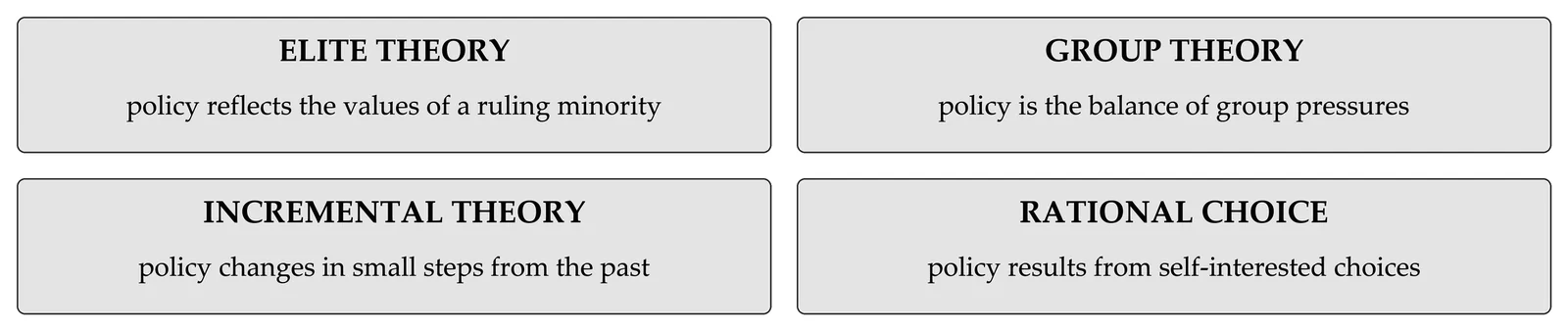
WWHO really makes public policy, and how are policy decisions made? Different theories give different answers. Elite theory says that policy reflects the preferences of a small ruling minority. Group theory sees policy as the balance reached in the struggle among organised groups. Incremental theory argues that policy changes in small steps from what already exists. Rational choice theory explains policy as the result of self-interested choices by voters, politicians and bureaucrats. This chapter explains each approach, its main thinkers, its application to India and its strengths and weaknesses.
2.1 Elite Theory and Group Theory
Theories of public policy are also theories of power. They ask whose preferences shape government decisions. Elite theory and group theory give opposite answers: the first says a small minority rules, while the second says many groups compete and share power.
Elite Theory
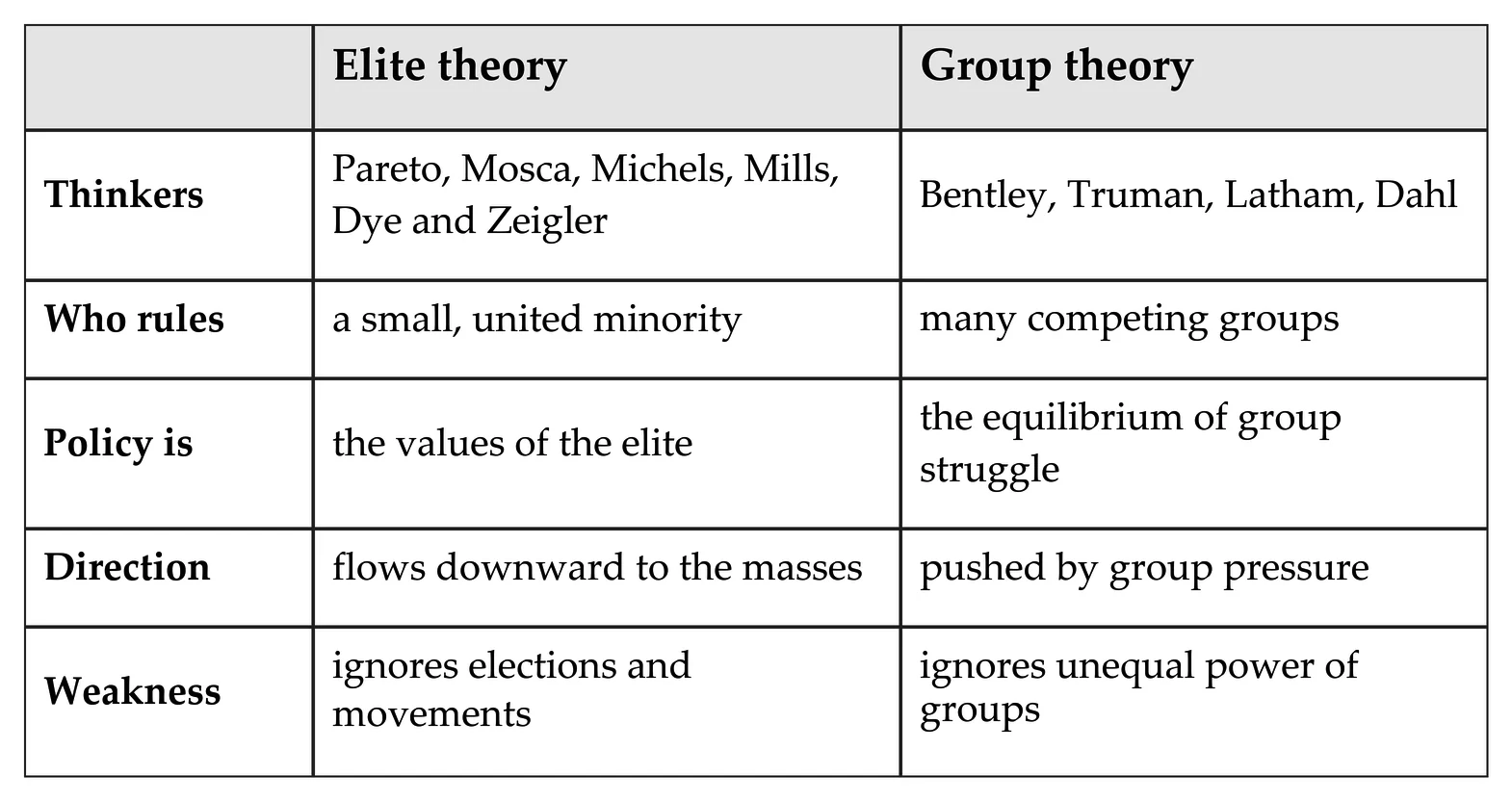
Classical elite theorists argued that every society is divided into a ruling minority and a ruled majority. Vilfredo Pareto spoke of the circulation of elites, in which one elite replaces another, using the images of lions (who rule by force) and foxes (who rule by cunning). Gaetano Mosca argued that in all societies a small, organised ruling class governs a large, unorganised majority. Robert Michels formulated the iron law of oligarchy, holding that even democratic organisations such as parties and unions come to be controlled by a few leaders. In the United States, C. Wright Mills argued in The Power Elite (1956) that a small group of leaders from the corporate, military and political institutions made the key decisions.
Applied to public policy, the theory was developed by Thomas Dye and Harmon Zeigler in The Irony of Democracy. Its main propositions are:
- Society is divided into the few who have power and the many who do not; only a small number of persons allocate values for society.
- The few who govern are not typical of the masses; elites come disproportionately from the upper socio-economic strata.
- The movement of non-elites into elite positions is slow and continuous, and only those who accept the basic elite consensus are admitted.
- Elites share a consensus on the basic values of the social system and on preserving it.
- Public policy reflects the prevailing values of the elite, not the demands of the masses; changes in policy are incremental, not revolutionary.
- Active elites are subject to little influence from the apathetic masses; elites influence the masses more than the masses influence elites.
In this view, policy flows downward from the elite through government officials to the masses. In India, critics point to the influence of big business, senior bureaucrats and political dynasties on policy, and to the role of a small group of technocrats in the economic reforms of 1991. However, elite theory underestimates the power of elections, social movements and courts in India, where the poor vote in large numbers and movements have won laws such as the RTI and MGNREGA.
Group Theory
Group theory holds that politics is the struggle among groups to influence public policy. It was founded by Arthur Bentley in The Process of Government (1908), who argued that when groups are adequately stated, everything is stated, and was developed by David Truman in The Governmental Process (1951). Earl Latham described public policy as the equilibrium reached in the group struggle at any given moment, and the legislature as a referee that ratifies the victories of successful coalitions. The theory is closely related to pluralism, associated with Robert Dahl, who argued in Who Governs? (1961) that power in an American city was dispersed among many groups.
- Individuals act through groups. Individuals are important in politics only when they act as part of or on behalf of group interests.
- Policy as equilibrium. Policy reflects the relative influence of groups; when one group gains influence, policy moves in its favour.
- Sources of group influence. Influence depends on numbers, wealth, organisational strength, leadership, access to decision-makers and internal cohesion.
- Checks on group power. Overlapping membership, a large latent group supporting the rules of the game, and the competition of rival groups prevent any one group from dominating.
- Role of government. Government manages group conflict by establishing rules, arranging compromises, enacting compromises as policy and enforcing them.
In India, groups such as the Confederation of Indian Industry, FICCI, trade unions, farmers’ organisations, caste associations and professional bodies lobby the government. The farmers’ movement against the three farm laws in 2020–21 showed the power of an organised group to reverse a policy. Critics argue that group theory ignores the unequal power of groups, since business groups have more resources than the poor, and that it neglects the independent role of the state and ideas.
2.2 Incremental Theory and the Rational Model
The Rational-Comprehensive Model
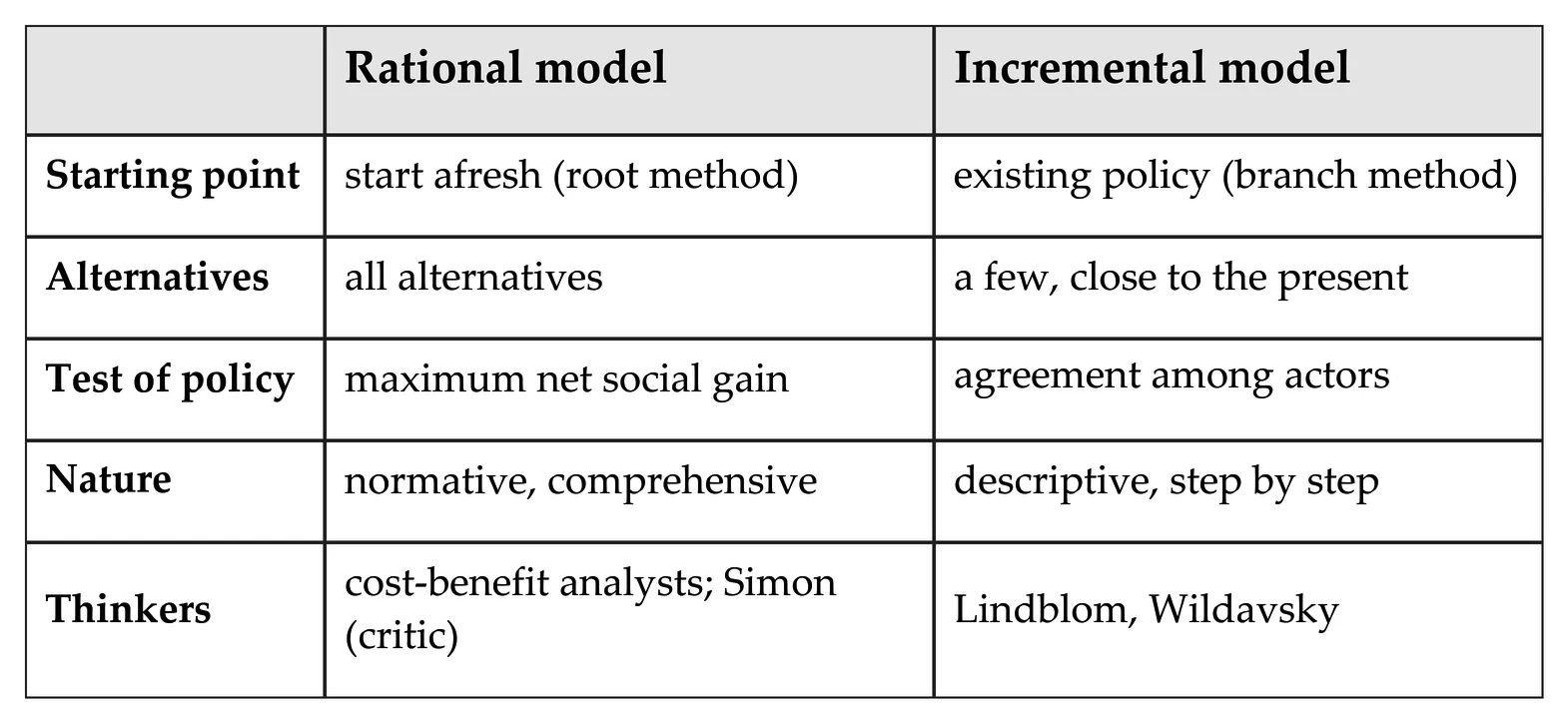
The rational-comprehensive model holds that policy-makers should choose the policy that achieves the greatest social gain. It requires the policy-maker to: identify and rank all social values and goals; know all the policy alternatives available; know all the consequences of each alternative; calculate the ratio of benefits to costs for each; and select the most efficient alternative. Tools such as cost-benefit analysis and planning-programming-budgeting systems are based on this model. Its appeal lies in its promise of scientific, efficient decisions.
Simon’s Bounded Rationality
Herbert Simon, in Administrative Behavior (1947), argued that comprehensive rationality is impossible in practice. Decision-makers have limited information, limited time and limited capacity to process information, so their rationality is bounded. Instead of maximising, they satisfice, choosing the first alternative that is good enough. Simon, who won the Nobel Prize in Economics in 1978, distinguished between the economic man of theory, who maximises, and the administrative man of reality, who satisfices.
Incremental Theory
Charles Lindblom, in his famous article The Science of Muddling Through (1959), offered incrementalism as both a description of how policy is actually made and a defence of it. He contrasted the rational root method, which starts afresh each time, with the branch method of successive limited comparisons, which builds on past policy. Aaron Wildavsky applied this to budgeting, showing that this year’s budget is largely determined by last year’s, with small changes at the margin.
- Past policy as base. Policy-makers take existing policies as given and consider only incremental changes, since they lack the time, information and money to investigate all alternatives.
- Limited alternatives. Only a few alternatives that differ marginally from existing policy are considered.
- Means and ends intertwined. Goals and means are chosen together, and a good policy is one on which analysts can agree, rather than one that is proven best.
- Reduced risk. Small changes reduce the risk of large errors, and mistakes can be corrected in later steps.
- Political feasibility. Incremental changes are easier to agree on in a pluralist system where many groups must be satisfied; this is called partisan mutual adjustment.
- Serial and remedial. Policy-making is a continuous series of steps addressing immediate problems rather than achieving grand goals.
Critics argue that incrementalism is conservative and biased towards the status quo, unsuited to crises or to societies needing rapid change, as Yehezkel Dror argued for developing countries. Some major policy changes, such as India’s economic reforms of 1991, demonetisation in 2016 and the GST in 2017, were non-incremental. Amitai Etzioni proposed mixed scanning as a middle path, in which policy-makers make broad, fundamental decisions after a general review and then make incremental decisions within that framework.
2.3 Rational Choice Theory
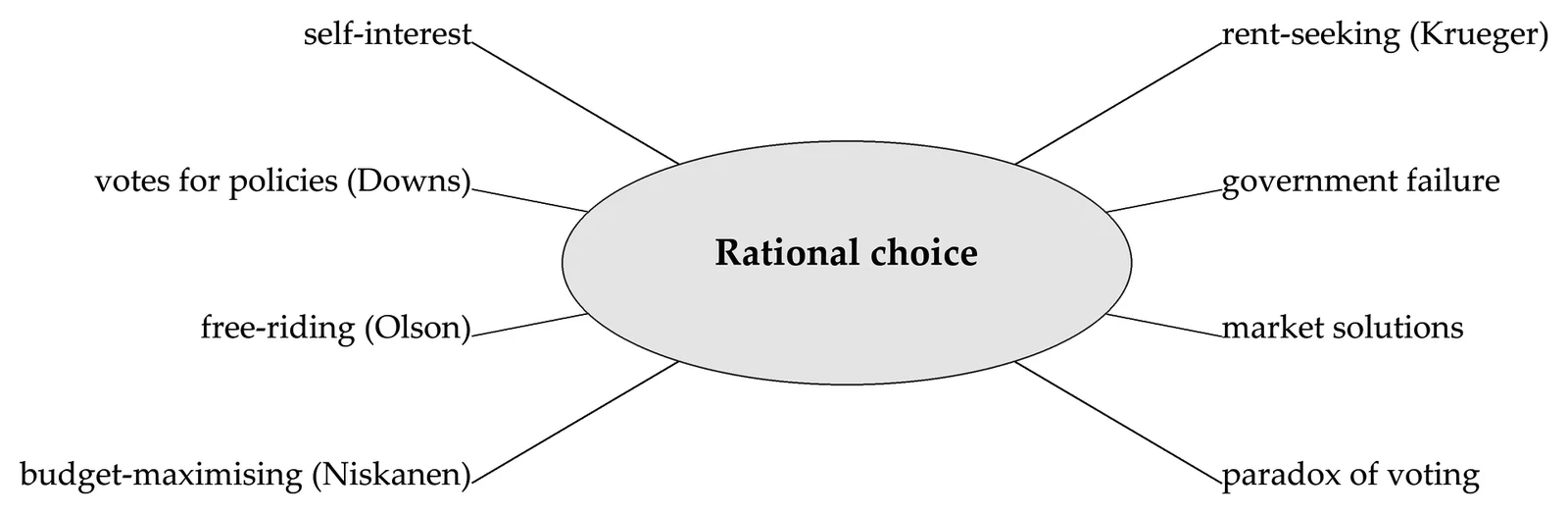
Rational choice theory, also called public choice theory, applies the methods of economics to politics. It assumes that individuals, whether voters, politicians, bureaucrats or interest groups, are rational and self-interested, and act to maximise their own benefits. Public policy is then the result of the interaction of these self-interested choices, much as market outcomes result from the choices of buyers and sellers.
Main Thinkers
- Anthony Downs. In An Economic Theory of Democracy (1957), Downs argued that parties formulate policies to win elections, rather than win elections to formulate policies, and that parties in a two-party system move towards the median voter.
- James Buchanan and Gordon Tullock. In The Calculus of Consent (1962), they analysed constitutional rules as choices by self-interested individuals; Buchanan won the Nobel Prize in Economics in 1986.
- Mancur Olson. In The Logic of Collective Action (1965), Olson showed that large groups find it hard to organise because individuals prefer to free-ride, so small, concentrated groups such as industries are better organised than large, diffuse groups such as consumers.
- William Niskanen. In Bureaucracy and Representative Government (1971), he argued that bureaucrats seek to maximise their budgets, leading to an oversupply of public services.
- Rent-seeking. Gordon Tullock and Anne Krueger showed that groups spend resources to obtain special privileges from the state, such as licences and protection, which Krueger studied in India’s licence regime in 1974.
Implications for Policy
Rational choice theory explains government failure: policies may serve politicians’ electoral interests, bureaucrats’ budget interests and organised groups’ special interests rather than the public interest. It explains why subsidies for small, organised groups persist and why reforms that benefit diffuse majorities are hard to pass. Its policy prescriptions include limiting the size of government, decentralisation, competition in public services, constitutional limits on spending, and market-based instruments. It influenced the new public management reforms and the move towards privatisation from the 1980s, including India’s liberalisation.
Criticism
Critics argue that the assumption of self-interest is too narrow, ignoring altruism, duty, ideology and identity, which also motivate political behaviour. The theory struggles to explain why people vote at all, since a single vote rarely decides an election (the paradox of voting). It is criticised as ideologically biased against the state, and as neglecting institutions, history and culture. Its focus on individuals ignores structural inequalities of power. Still, it offers a rigorous, testable framework and useful insights into the incentives of political actors.
2.4 Important Questions
- Question 1 Critically examine the elite theory of public policy.
- Question 2 Explain the group theory of public policy. What are its limitations?
- Question 3 Discuss the incremental model of policy-making. How does it differ from the rational-comprehensive model?
- Question 4 Examine the rational choice approach to public policy.
DU asks the same idea in different words. So learn one broad answer for each question below; the same answer works for every question joined by OR.
Important Question 1
Critically examine the elite theory of public policy.
OR
Public policy reflects the preferences of the elite. Discuss.
OR
Explain the main propositions of the elite model of policy-making.
Model Answer
“In all societies… two classes of people appear—a class that rules and a class that is ruled.”
— Gaetano Mosca, The Ruling Class (1939 English translation)
Introduction. Elite theory holds that public policy is shaped not by the people as a whole but by a small ruling minority whose values it reflects. Developed by classical thinkers such as Pareto, Mosca and Michels and applied to American politics by C. Wright Mills and to public policy by Thomas Dye and Harmon Zeigler, it challenges the democratic claim that policy reflects the will of the people.
1. Classical Roots
Classical elite theorists argued that all societies, whatever their form of government, are ruled by a minority. They saw this as a universal law of social organisation, not a feature of particular societies.
2. Pareto
Vilfredo Pareto argued that elites rule because of superior qualities and that history is a graveyard of aristocracies, as one elite replaces another in a circulation of elites. He distinguished lions, who rule by force, from foxes, who rule by cunning.
3. Mosca
Gaetano Mosca argued that in every society a small, organised ruling class governs a large, unorganised majority. The minority rules because it is organised, while the majority cannot act together.
4. Michels
Robert Michels studied the German Social Democratic Party and formulated the iron law of oligarchy: even organisations committed to democracy come to be controlled by a small group of leaders because of the needs of organisation.
5. C. Wright Mills
In The Power Elite (1956), Mills argued that key decisions in the United States were made by a power elite drawn from the top of the corporate, military and political institutions, who shared similar backgrounds and moved between these sectors.
6. Dye and Zeigler’s Model
Dye and Zeigler applied elite theory to public policy in The Irony of Democracy. They argued that policy reflects the values of elites, not the demands of the masses, and that democracy survives because elites, not masses, are committed to democratic values.
7. Society Divided
Society is divided into the few who have power and the many who do not. The few who allocate values come disproportionately from the upper socio-economic strata and are not typical of the masses they govern.
8. Elite Consensus
Elites share a consensus on the basic values of the system, such as private property and limited government. Non-elites are admitted to the elite only slowly and only if they accept this consensus, which ensures stability.
9. Policy Flows Downward
Public policy flows from the elite through officials and administrators to the masses. Policy reflects elite values, and the masses, being largely apathetic and ill-informed, have little influence on it.
10. Incremental Change
Since elites wish to preserve the system, policy changes are incremental rather than revolutionary. Changes occur when elites redefine their own values or respond to threats to the system.
11. Application to India
Critics in India point to the influence of big business houses, senior bureaucrats, technocrats and political dynasties on policy. The economic reforms of 1991 were designed by a small team of economists and officials with little public debate.
12. Limits in the Indian Context
Yet in India the poor vote in larger proportions than the rich, regional and backward-caste parties have come to power, and movements have won laws such as the RTI Act and MGNREGA, showing that non-elites can influence policy.
13. Merits
Elite theory draws attention to the unequal distribution of power, the influence of wealth and the gap between democratic ideals and reality. It explains why many policies favour the privileged.
14. Criticism: Underestimating Democracy
Pluralists such as Robert Dahl argued that power is dispersed among many groups and that elites compete with each other. Elections, a free press and courts give citizens real means to influence policy.
15. Criticism: Vague Concept
The concept of the elite is vague, and it is difficult to prove that a unified elite exists or that it controls policy. Elites are often divided, and their conflicts open space for other groups.
16. Evaluation
Elite theory is a useful corrective to an idealised view of democracy, but it overstates the unity of elites and the passivity of the masses, especially in a democracy as mobilised as India’s.
Conclusion. Thus, elite theory, from Pareto, Mosca and Michels to Mills and Dye and Zeigler, holds that public policy reflects the values of a ruling minority and flows downward to the masses. It highlights real inequalities of power, but underestimates elections, movements and competition among elites, which shape policy in democratic India.
Important Question 2
Explain the group theory of public policy. What are its limitations?
OR
Public policy is the equilibrium reached in the group struggle. Discuss.
OR
Examine the role of interest groups in policy-making with reference to group theory.
Model Answer
“What may be called public policy is the equilibrium reached in this group struggle at any given moment.”
— Earl Latham, The Group Basis of Politics (1952)
Introduction. Group theory sees politics as a struggle among organised groups to influence public policy. Founded by Arthur Bentley in 1908 and developed by David Truman and Earl Latham, it explains policy as the balance of group pressures at any time. It is closely linked to the pluralist theory of democracy, which holds that power is dispersed among many competing groups.
1. Arthur Bentley
In The Process of Government (1908), Bentley argued that the study of politics should focus on group activity rather than formal institutions. For him, when groups are adequately stated, everything is stated.
2. David Truman
Truman, in The Governmental Process (1951), defined an interest group as a shared-attitude group that makes claims on other groups in society. When such a group makes claims through government, it becomes a political interest group.

3. Individuals Act through Groups
Group theory holds that individuals are politically important only when they act as part of, or on behalf of, groups. Groups are the bridge between individuals and government.
4. Policy as Equilibrium
Public policy is the equilibrium reached in the group struggle at a given moment. As the relative influence of groups changes, policy moves in the direction of the groups gaining influence and away from those losing it.
5. Sources of Group Influence
A group’s influence depends on its size, wealth, organisational strength, leadership, access to decision-makers and internal cohesion. Groups with greater resources and better access usually win more favourable policies.
6. Role of Government
Government acts as a referee of group conflict. It sets the rules of the game, arranges compromises, enacts them as public policy and enforces them, while the legislature ratifies the victories of successful coalitions.
7. Checks on Group Power
Truman argued that overlapping membership, the existence of a large latent group supporting the rules of the game, and competition among groups prevent any single group from dominating the system.
8. Link with Pluralism
Robert Dahl’s study Who Governs? (1961) found that in New Haven, different groups influenced different issues, so power was dispersed. Pluralists saw this group competition as the essence of democracy.
9. Interest Groups in India
In India, groups such as CII, FICCI and ASSOCHAM represent business, while trade unions, farmers’ organisations, caste associations, student bodies and professional associations represent other interests.
10. Indian Examples
Business groups influenced the liberalisation of 1991, while the farmers’ movement of 2020–21 forced the repeal of the three farm laws. Doctors’ and lawyers’ associations regularly shape policies on their professions.
11. Merits
Group theory draws attention to the real forces behind policy and explains why policies change as groups gain or lose power. It focuses on the actual process of politics rather than formal institutions.
12. Unequal Power of Groups
Critics argue that groups are not equal. Business groups have far more money and access than the poor, women, Dalits or tribal communities, so group competition favours the already powerful.
13. Unorganised Interests
Many interests, such as those of consumers, migrant workers and future generations, are poorly organised. As Mancur Olson showed, large, diffuse groups find it hard to organise because of free-riding.
14. Neglect of the State
Group theory treats the state as a neutral referee, but the state has its own interests, ideas and capacities. In India, the bureaucracy and political leaders often shape policy independently of group pressures.
15. Neglect of Ideas and Institutions
The theory pays little attention to ideology, values and institutions, which also shape policy. Constitutional rules, party ideologies and judicial decisions cannot be reduced to group pressures.
16. Evaluation
Group theory offers a realistic picture of the pressures on policy-makers, but it must be combined with attention to inequalities of power and the independent role of the state.
Conclusion. Thus, group theory, developed by Bentley, Truman and Latham, sees public policy as the equilibrium reached in the struggle among organised groups, with government as referee. It explains much about policy change in India, but neglects the unequal power of groups, unorganised interests and the role of the state.
Important Question 3
Discuss the incremental model of policy-making. How does it differ from the rational-comprehensive model?
OR
Policy-making is a process of muddling through. Discuss.
OR
Critically evaluate Lindblom’s theory of incrementalism.
Model Answer
“The largest determining factor of the size and content of this year’s budget is last year’s budget.”
— Aaron Wildavsky, The Politics of the Budgetary Process (1964)
Introduction. How do policy-makers actually choose among alternatives? The rational-comprehensive model says they should examine all alternatives and choose the best, but Charles Lindblom argued that in practice they muddle through, making small changes to existing policy. His theory of incrementalism, presented in 1959, is both a description of real policy-making and a defence of it.
1. The Rational-Comprehensive Model
The rational model requires policy-makers to identify all values and goals, consider all alternatives, predict all consequences, compare costs and benefits, and choose the alternative that maximises net social gain.
2. Problems with the Rational Model
In reality, information is incomplete, values conflict and cannot be ranked easily, time and resources are limited, and predicting all consequences is impossible. Past investments in existing policies also limit choices.
3. Simon’s Bounded Rationality
Herbert Simon argued in Administrative Behavior (1947) that human rationality is bounded by limited information and capacity, so administrators satisfice, choosing the first acceptable option, rather than maximise.
4. Lindblom’s Muddling Through
In The Science of Muddling Through (1959), Lindblom contrasted the root method of starting afresh with the branch method of successive limited comparisons, in which policy-makers build on existing policy step by step.
5. Existing Policy as Base
Policy-makers take the existing programmes and spending as a base and consider only marginal changes. They do not review all existing policies each year, since this would be costly and politically disruptive.
6. Limited Alternatives
Only a few alternatives, differing slightly from current policy, are considered, and only some of their important consequences are analysed, which makes decision-making manageable.
7. Agreement as Test
Since goals and means are chosen together and values conflict, the test of a good policy is that analysts and interests agree on it, not that it is proven to be the best means to an agreed end.
8. Partisan Mutual Adjustment
In a pluralist democracy, policy emerges from bargaining among many actors. Incremental changes are easier to agree on because they threaten no group too much.
9. Wildavsky and Budgeting
Aaron Wildavsky showed that budgets are made incrementally: agencies take last year’s budget as a base and bargain over small increases. Indian budgets also largely follow this pattern.
10. Merits of Incrementalism
Incrementalism reduces the risk of large mistakes, allows errors to be corrected, respects existing commitments and is politically realistic. It suits stable democracies with many competing groups.
11. Conservative Bias
Critics argue that incrementalism favours the status quo and the interests of those who benefit from existing policies. It offers no guidance for fundamental change when existing policies are failing.
12. Dror’s Criticism
Yehezkel Dror argued that incrementalism suits stable societies with satisfactory policies, but not developing countries that need rapid social and economic transformation.
13. Non-Incremental Change in India
Some major Indian policies were non-incremental, such as bank nationalisation in 1969, the economic reforms of 1991, demonetisation in 2016 and the GST in 2017, showing that radical change is possible, especially in crises.
14. Etzioni’s Mixed Scanning
Amitai Etzioni proposed mixed scanning, in which policy-makers make broad, fundamental decisions after a general review of alternatives and then make detailed incremental decisions within that framework.
15. Comparison of the Two Models
The rational model is normative and comprehensive, seeking the best solution through analysis. Incrementalism is descriptive and limited, seeking acceptable solutions through bargaining and small steps.
16. Evaluation
Incrementalism describes much of everyday policy-making accurately, but it must be supplemented by strategic thinking for times when fundamental change is needed.
Conclusion. Thus, Lindblom’s incremental model holds that policy is made through successive limited comparisons and small changes to existing policy, unlike the rational model, which seeks the best alternative through comprehensive analysis. Incrementalism is realistic and safe but conservative, and Etzioni’s mixed scanning offers a balance between the two.
Important Question 4
Examine the rational choice approach to public policy.
OR
Discuss the contribution of public choice theory to the study of public policy.
OR
How does rational choice theory explain government failure?
Model Answer
“Parties formulate policies in order to win elections, rather than win elections in order to formulate policies.”
— Anthony Downs, An Economic Theory of Democracy (1957)
Introduction. Rational choice theory, also called public choice theory, applies the assumptions and methods of economics to the study of politics and policy. It assumes that political actors, like economic actors, are rational and self-interested. Public policy is then explained as the outcome of the choices of voters, politicians, bureaucrats and interest groups, each pursuing their own interests.
1. Basic Assumptions
The theory assumes methodological individualism, meaning that the individual is the unit of analysis; rationality, meaning that individuals rank their preferences and choose the best means to achieve them; and self-interest as the main motive.
2. Politics as a Market
Politics is seen as a market in which voters exchange votes for policies, politicians supply policies to win votes, and interest groups seek benefits, just as buyers and sellers exchange goods.
3. Anthony Downs
Downs argued in 1957 that parties seek office and adopt policies to win votes. In a two-party system, parties converge towards the median voter, and voters remain rationally ignorant because gathering information is costly.
4. Buchanan and Tullock
In The Calculus of Consent (1962), James Buchanan and Gordon Tullock analysed how self-interested individuals would choose constitutional rules, laying the foundation of public choice theory.
5. Olson and Collective Action
Mancur Olson showed in 1965 that large groups find it hard to organise because individuals free-ride on the efforts of others. Small, concentrated groups therefore have greater influence on policy than large, diffuse ones.
6. Niskanen and Bureaucracy
William Niskanen argued in 1971 that bureaucrats seek to maximise their budgets, since larger budgets bring power, prestige and promotion. This leads to oversupply of public services and inefficiency.
7. Rent-Seeking
Groups spend resources to win special privileges, such as licences, tariffs and subsidies, from the state. Anne Krueger’s study of 1974 used India’s licence regime as an example of the costs of rent-seeking.
8. Government Failure
Rational choice theory explains government failure: policies may serve electoral, bureaucratic and special interests rather than the public interest, leading to waste, inefficiency and corruption.
9. Political Business Cycle
Governments may increase spending and announce welfare schemes before elections to win votes, creating cycles in economic policy linked to the electoral calendar, a pattern observed in many democracies, including India.
10. Policy Prescriptions
Public choice theorists recommend limiting government, decentralisation, competition in public services, constitutional limits on spending and use of market mechanisms, ideas that influenced new public management and privatisation.
11. Application to India
The theory helps explain the persistence of subsidies for organised groups, the licence-permit raj before 1991 and the use of welfare schemes before elections. It also influenced arguments for liberalisation.
12. Merits
The approach is rigorous and testable, and it draws attention to the incentives of political actors, showing that good intentions are not enough and that institutions must be designed to align private interests with the public good.
13. Narrow View of Human Motives
Critics argue that people are also motivated by altruism, duty, ideology and identity. Many civil servants, activists and voters act for the public good rather than personal gain.
14. Paradox of Voting
If voters were purely rational and self-interested, few would vote, since a single vote rarely decides an election. The high turnout in Indian elections is difficult to explain with this theory alone.
15. Ideological Bias
Critics argue that the theory is biased against the state and in favour of markets, and that it neglects structural inequalities, history and culture, which shape both preferences and opportunities.
16. Evaluation
Rational choice theory offers powerful insights into incentives and government failure, but its assumptions are too narrow to provide a complete account of public policy.
Conclusion. Thus, rational choice theory explains public policy as the outcome of self-interested choices by voters, parties, bureaucrats and groups, as developed by Downs, Buchanan and Tullock, Olson and Niskanen. It illuminates government failure and rent-seeking, but its narrow view of human motives limits its explanatory power.
Short Notes
(a) Iron law of oligarchy
Robert Michels’s thesis that every organisation, even a democratic party or union, comes to be controlled by a small group of leaders because of the needs of organisation.
(b) Satisficing
Herbert Simon’s term for choosing the first alternative that is good enough, since bounded rationality prevents decision-makers from finding the best possible alternative.
(c) Mixed scanning
Amitai Etzioni’s model combining broad, fundamental decisions after a general review of alternatives with detailed incremental decisions within that framework.
(d) Free-rider problem
Mancur Olson’s idea that in large groups, individuals benefit from collective action whether or not they contribute, so they prefer to let others bear the cost; this makes large, diffuse groups such as consumers harder to organise than small, concentrated groups such as industries.
(e) Circulation of elites
Vilfredo Pareto’s idea that history is a succession of ruling minorities, as one elite declines and is replaced by another, so that rule by a minority continues even when the persons in power change.
More notes: GE-8 Introduction to Public Policy
These notes are prepared by PADHO TO AISE for study help. They are not an official publication.