
Generic Electives (GE) GE-11 Election Commission and Process in India
Unit 1 · 24 min read · Updated 27 Nov 2026
As per the University of Delhi (DU) Generic Elective (GE) syllabus offered by the Department of Political Science
Contents
- 1.1 Elections and Democracy
- Importance of Elections
- Free and Fair Elections
- 1.2 Electoral Systems: Types and Features
- Majoritarian or Plurality Systems
- Proportional Representation Systems
- Mixed Systems
- Duverger’s Law and the Indian Choice
- 1.3 Universal Adult Franchise, Representation and the Evolution of Elections in India
- Universal Adult Franchise
- The Representation of the People Acts
- Elections in Colonial India
- Evolution of the Electoral Process since Independence
- 1.4 Important Questions
- Discuss the importance of elections in a democracy.
- Examine the different types of electoral systems and their features. Which system is suitable for India?
- Discuss universal adult franchise and the main provisions of the Representation of the People Acts of 1950 and 1951.
- Trace the evolution of the electoral process in India.
- Short Notes
जनता की इच्छा सरकार के अधिकार का आधार होगी; यह इच्छा आवधिक और वास्तविक चुनावों में अभिव्यक्त होगी।
The will of the people shall be the basis of the authority of government; this will shall be expressed in periodic and genuine elections.
— Universal Declaration of Human Rights, Article 21(3) (1948)
EELECTIONS are the most visible feature of democracy. In India, the world’s largest democracy, nearly a hundred crore citizens are entitled to vote, and the general election of 2024 was the largest electoral exercise in human history. This first chapter explains why elections matter in a democracy, the main types of electoral systems and their features, the principle of universal adult franchise and the laws that govern representation in India, and the evolution of the electoral process from colonial times to the age of electronic voting machines.
1.1 Elections and Democracy
Democracy means rule by the people. In large modern states, the people cannot govern directly, so they choose representatives through elections, i.e. the procedure by which citizens select the persons who will hold public office and make laws on their behalf. The economist Joseph Schumpeter, in Capitalism, Socialism and Democracy (1942), defined democracy as an institutional arrangement in which leaders acquire the power to decide by means of a competitive struggle for the people’s vote. Robert Dahl, in Polyarchy (1971), listed free, fair and frequent elections and inclusive suffrage among the essential conditions of democracy. Article 21 of the Universal Declaration of Human Rights recognises the right of everyone to take part in government through genuine periodic elections.
Importance of Elections
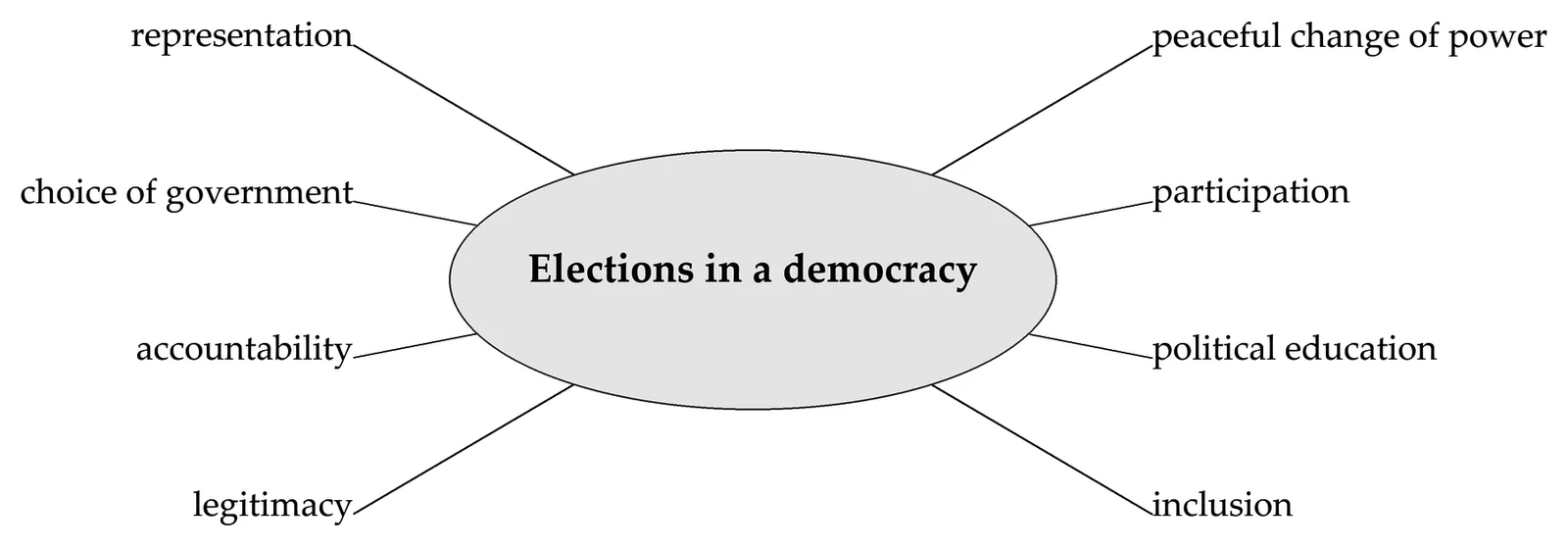
- Representation. Elections allow citizens to choose representatives who speak for their interests and opinions in the legislature.
- Choice of government. In a parliamentary system such as India’s, the party or coalition that wins a majority in the Lok Sabha forms the government.
- Accountability. Periodic elections allow voters to reward or punish governments for their performance, so rulers must remain responsive.
- Legitimacy. A government chosen through free and fair elections has the moral and legal authority to govern, and its decisions are more readily accepted.
- Peaceful transfer of power. Elections allow power to change hands without violence, as India has seen many times since 1977.
- Political participation and education. Campaigns inform citizens about issues and draw them into public life, building democratic habits.
- Inclusion. Elections give marginalised groups a voice and a share of power, as the rise of backward-caste and Dalit parties in India has shown.
Free and Fair Elections
Elections are meaningful only if they are free and fair. This requires universal and equal suffrage, a secret ballot, freedom for parties and candidates to campaign, an independent body to conduct elections, accurate electoral rolls, honest counting and peaceful acceptance of results. The Supreme Court of India, in Indira Gandhi v. Raj Narain (1975), held that free and fair elections are part of the basic structure of the Constitution. Political scientists warn of electoral authoritarianism, in which regimes hold elections but manipulate them, showing that elections alone do not make a democracy.
1.2 Electoral Systems: Types and Features
An electoral system is the set of rules by which votes are translated into seats. The choice of system has a deep effect on the party system, the representation of minorities and the stability of governments. Electoral systems fall into three broad families.
Majoritarian or Plurality Systems
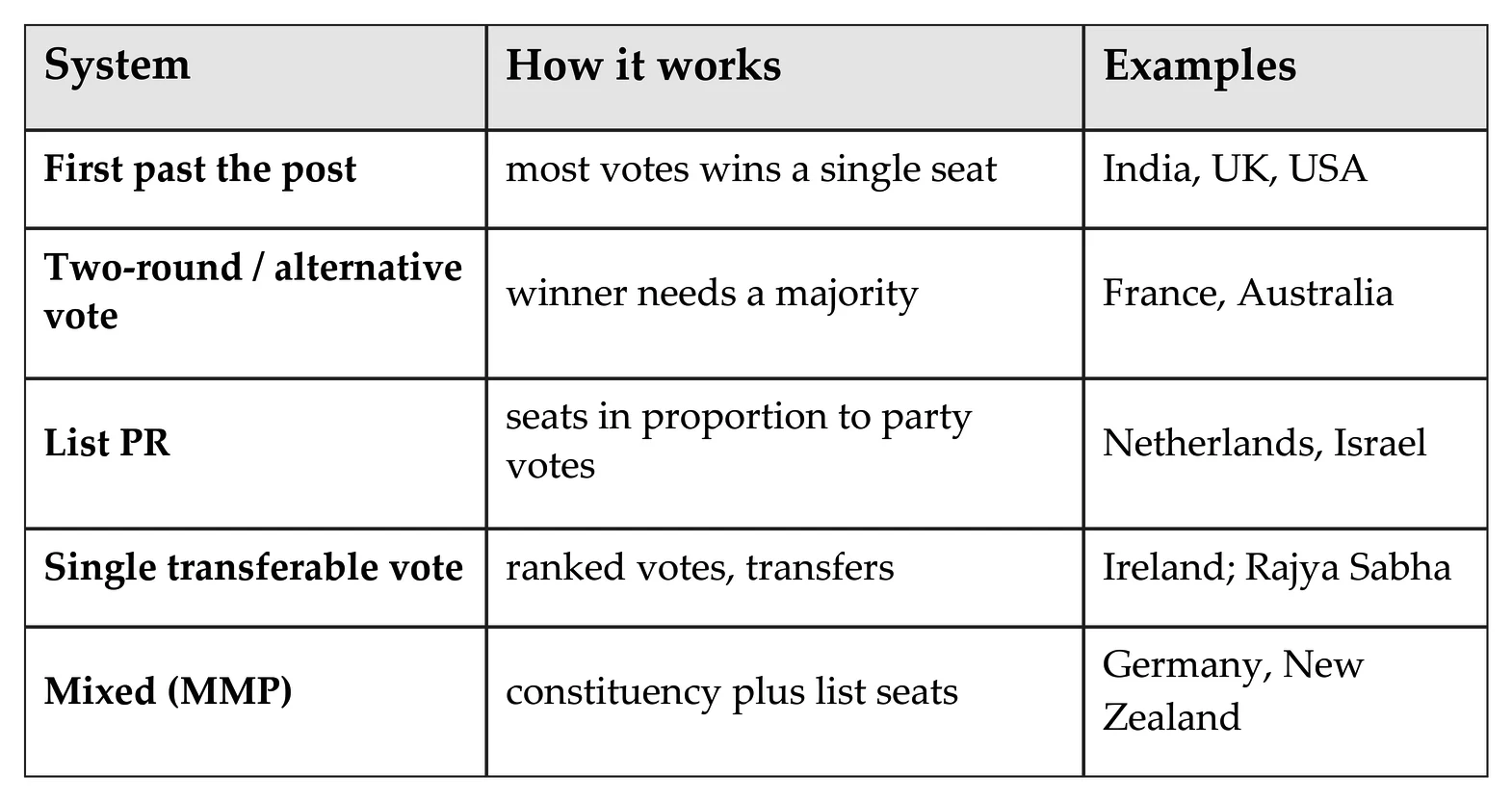
- First past the post (FPTP). The country is divided into single-member constituencies, and the candidate with the most votes wins, even without a majority; it is used in the United Kingdom, the United States, Canada and India.
- Two-round system. If no candidate wins a majority in the first round, a second round is held between the leading candidates, as in French presidential elections.
- Alternative vote. Voters rank candidates, and the lowest candidates are eliminated and their votes transferred until one has a majority, as in Australia’s House of Representatives.
- Features. These systems are simple and produce strong local links and often stable single-party governments, but they can give a party a large majority of seats with a minority of votes and waste the votes of losing candidates.
Proportional Representation Systems
- List system. Parties present lists of candidates, and seats are shared in proportion to votes, as in the Netherlands and Israel.
- Single transferable vote (STV). Voters rank candidates in multi-member constituencies, and surplus and eliminated votes are transferred, as in Ireland and, in India, for the Rajya Sabha and the election of the President.
- Features. Proportional systems produce fairer representation of parties and minorities, but often lead to many parties and coalition governments that may be unstable.
Mixed Systems
Mixed systems combine the two. In mixed member proportional systems, as in Germany since 1949 and New Zealand since 1996, voters cast one vote for a constituency candidate and one for a party list, and list seats are used to make the overall result proportional. In parallel systems, as in Japan, the two parts are counted separately.
Duverger’s Law and the Indian Choice
The French political scientist Maurice Duverger, in Political Parties (1951), argued that the simple-majority single-ballot system tends to produce two-party systems, while proportional representation tends to produce multi-party systems. India adopted FPTP for the Lok Sabha and state assemblies because it was simple for a largely illiterate electorate and likely to produce stable governments, but used STV for indirect elections to the Rajya Sabha, legislative councils and the offices of President and Vice-President. India’s many parties show that Duverger’s law works mainly at the constituency level. The Law Commission, in its 170th report (1999), discussed adding seats filled by proportional representation, but FPTP has continued.
1.3 Universal Adult Franchise, Representation and the Evolution of Elections in India
Universal Adult Franchise
Universal adult franchise means that every adult citizen has the right to vote, without any qualification of property, education, sex, caste or religion. Article 326 of the Constitution provides that elections to the Lok Sabha and state assemblies shall be on the basis of adult suffrage. The decision of the Constituent Assembly to grant the vote to every adult in 1950, when most Indians were poor and illiterate, was bold: in Britain women won equal voting rights only in 1928, and in Switzerland women could vote nationally only from 1971. The voting age was lowered from twenty-one to eighteen by the 61st Amendment of 1988, effective from 1989.
The Representation of the People Acts
- Representation of the People Act, 1950. It provides for the allocation of seats in Parliament and state legislatures, the delimitation of constituencies, the qualifications of voters and the preparation of electoral rolls.
- Representation of the People Act, 1951. It deals with the actual conduct of elections: qualifications and disqualifications of members, nomination, polling and counting, corrupt practices and electoral offences, election disputes and, since 1989, the registration of political parties (Section 29A).
- Delimitation Acts. Delimitation Commissions under Acts of 1952, 1962, 1972 and 2002 redrew constituency boundaries; the number of seats in each state has been frozen on the basis of the 1971 Census until after the first census after 2026.
- Reserved constituencies. Articles 330 and 332 reserve seats for Scheduled Castes and Scheduled Tribes in the Lok Sabha and state assemblies, and the 106th Amendment of 2023 provides for one-third reservation for women after the next delimitation.

Elections in Colonial India
Elections were introduced gradually under British rule. The Indian Councils Act of 1892 allowed indirect election to legislative councils, the Morley-Minto Reforms of 1909 introduced direct election for some seats and separate electorates for Muslims, the Government of India Act of 1919 extended the franchise to a few per cent of the population, and the Government of India Act of 1935 widened it to about a tenth, based on property, tax and education. The provincial elections of 1937 and 1946 gave Indian parties experience of electoral politics.
Evolution of the Electoral Process since Independence
- 1951–52 → The first general election, organised by Chief Election Commissioner Sukumar Sen, involved about 17 crore voters, used separate ballot boxes with party symbols for each candidate and took several months.
- 1962 → Voters began marking ballot papers instead of placing them in separate boxes.
- 1982 → Electronic voting machines (EVMs) were first used at Parur in Kerala; they were used across the country from 2004.
- 1989–93 → The voting age became eighteen, the Election Commission became multi-member (1989, and permanently from 1993), and T.N. Seshan introduced electors’ photo identity cards (1993).
- 2013 → Following PUCL v. Union of India, the option of None of the Above (NOTA) was introduced, and voter verifiable paper audit trail (VVPAT) machines were first used; they covered all constituencies by 2019.
- 2024 → The general election for the 18th Lok Sabha, held in seven phases, had nearly 97 crore registered voters.

1.4 Important Questions
- Question 1 Discuss the importance of elections in a democracy.
- Question 2 Examine the different types of electoral systems and their features. Which system is suitable for India?
- Question 3 Discuss universal adult franchise and the main provisions of the Representation of the People Acts of 1950 and 1951.
- Question 4 Trace the evolution of the electoral process in India.
DU asks the same idea in different words. So learn one broad answer for each question below; the same answer works for every question joined by OR.
Important Question 1
Discuss the importance of elections in a democracy.
OR
‘Elections are the heart of democracy.’ Discuss.
OR
What are the conditions of free and fair elections? Explain their significance.
Model Answer
“Government of the people, by the people, for the people, shall not perish from the earth.”
— Abraham Lincoln, Gettysburg Address (1863)
Introduction. Democracy means rule by the people, and in large modern states the people rule mainly through elections. Elections allow citizens to choose representatives, form governments, hold rulers accountable and transfer power peacefully. They give legitimacy to governments and a voice to all sections of society. Without free and fair elections, democracy cannot exist, though elections alone are not sufficient.
1. Meaning of Elections
An election is the process by which citizens choose the persons who will hold public office and make decisions on their behalf. In India, citizens elect members of the Lok Sabha, state assemblies and local bodies directly, and members of the Rajya Sabha and the President indirectly.
2. Elections in Democratic Theory
Joseph Schumpeter defined democracy as a competitive struggle for the people’s vote, and Robert Dahl listed free, fair and frequent elections and inclusive suffrage as essential features of polyarchy. Elections are thus the minimum condition of democracy.
3. Representation
Elections allow citizens to choose representatives who express their interests and opinions in the legislature. Through reserved constituencies, India also ensures that Scheduled Castes and Scheduled Tribes are represented.
4. Formation of Government
In India’s parliamentary system, the party or coalition that commands a majority in the Lok Sabha forms the government, so elections decide who governs as well as who legislates.
5. Accountability
Periodic elections allow voters to judge governments by their performance and replace them if dissatisfied. This threat of defeat makes rulers responsive to public needs, as the defeat of the Congress in 1977 after the Emergency showed.
6. Legitimacy
A government chosen in free and fair elections has legitimate authority, and citizens are more willing to obey its laws. Elections thus turn power into authority.
7. Peaceful Transfer of Power
Elections provide a peaceful way to change governments. India has seen many changes of government at the centre and in the states without violence, which is a sign of a mature democracy.
8. Political Participation
Elections draw citizens into politics as voters, campaigners and candidates. High turnout among women, rural voters and the poor in India shows how elections have widened participation.
9. Political Education
Campaigns, debates and manifestos inform citizens about public issues and policies, helping them form opinions and understand the choices facing the country.
10. Empowerment of the Marginalised
Elections have allowed backward castes, Dalits and regional groups to gain power, a process that Yogendra Yadav called the second democratic upsurge of the 1990s.
11. Conditions of Free and Fair Elections
Free and fair elections require universal and equal suffrage, a secret ballot, freedom to campaign, an independent election authority, accurate electoral rolls, honest counting and peaceful acceptance of results. The Supreme Court has held free and fair elections to be part of the basic structure.
12. Limits of Elections
Elections can be undermined by money power, criminalisation, communal appeals, misinformation and manipulation. Electoral authoritarian regimes hold elections without real competition, showing that elections must be combined with rights and the rule of law.
13. Elections in India
India has held regular elections since 1951–52, with high participation and frequent changes of government, making it the world’s largest democracy, though it faces challenges of money power and criminalisation.
14. Elections and Federalism
In India, elections are held at three levels, for Parliament, state assemblies and local bodies, so voters can choose different parties at different levels. This strengthens federalism, as regional parties win power in states while national parties compete at the centre, and allows diverse regions to express their preferences.
15. Elections and Social Change
Elections have changed India’s social structure of power. Members of historically marginalised communities have become chief ministers and prime ministers, and the reservation of seats in panchayats for women and Scheduled Castes has brought new leaders into public life, showing how the vote can challenge old hierarchies.
16. Evaluation
Elections are indispensable for democracy because they give the people power to choose and remove their rulers, but democracy also needs free media, independent institutions and protection of rights.
Conclusion. Thus, elections are the heart of democracy: they provide representation, form governments, ensure accountability, give legitimacy, allow peaceful transfer of power and widen participation. Their value depends on being free and fair, which is why India treats them as part of the Constitution’s basic structure.
Important Question 2
Examine the different types of electoral systems and their features. Which system is suitable for India?
OR
Compare the first past the post system with proportional representation.
OR
Why did India adopt the first past the post system? Should it be replaced? Discuss.
Model Answer
“The simple-majority single-ballot system favours the two-party system.”
— Maurice Duverger, Political Parties (1951), the statement known as Duverger’s law
Introduction. An electoral system is the set of rules that translates votes into seats. Different systems produce different results, shaping the number of parties, the fairness of representation and the stability of governments. The main families are majoritarian or plurality systems, proportional representation and mixed systems. India uses first past the post for direct elections and the single transferable vote for indirect elections, and the suitability of this choice is often debated.
1. Meaning of an Electoral System
An electoral system includes the size of constituencies, the way votes are cast and the formula for allocating seats. It is not a technical detail but a major influence on political competition and representation.
2. First Past the Post
Under FPTP, the country is divided into single-member constituencies, and the candidate with the most votes wins, even without an absolute majority. It is used in the United Kingdom, the United States, Canada and India.
3. Merits of FPTP
FPTP is simple to understand and count, creates a direct link between a representative and a constituency, and often produces stable single-party governments with clear accountability.
4. Demerits of FPTP
FPTP can give a party a large majority of seats with a minority of votes, waste the votes of losing candidates, under-represent small parties and minorities, and encourage strategic voting.
5. Other Majoritarian Systems
The two-round system, used in French presidential elections, and the alternative vote, used in Australia, require the winner to gain a majority, either through a second round or through transferred preferences.
6. List Proportional Representation
In list PR, parties present lists of candidates and seats are allocated in proportion to votes, as in the Netherlands and Israel. It produces fair representation of parties but weakens the link with constituencies.
7. Single Transferable Vote
Under STV, voters rank candidates in multi-member constituencies, and surplus and eliminated votes are transferred. It is used in Ireland and, in India, for Rajya Sabha elections and the election of the President and Vice-President.
8. Merits and Demerits of PR
PR gives fairer representation to parties, women and minorities and reduces wasted votes, but it often produces many parties and coalition governments, which may be unstable, and gives party leaders control over lists.
9. Mixed Systems
Mixed member proportional systems, as in Germany and New Zealand, combine constituency representatives with proportional list seats, trying to secure both local links and fair representation.
10. Duverger’s Law
Maurice Duverger argued that FPTP favours two-party systems and PR favours multi-party systems. India’s many parties show that the law works mainly at the constituency level, where competition is often between two main candidates.
11. Why India Chose FPTP
The Constituent Assembly chose FPTP because it was simple for a largely illiterate electorate, familiar from colonial elections and likely to produce stable governments, while reserved constituencies ensured representation for SCs and STs.
12. Criticisms of FPTP in India
Critics note that parties have won large majorities with around 40 per cent or less of the vote, that minorities and women are under-represented and that FPTP encourages vote-bank politics in constituencies.
13. Proposals for Reform
The Law Commission’s 170th report (1999) discussed adding seats filled by proportional representation, and some scholars favour a mixed system. Others argue that FPTP has served India’s diversity and stability well.
14. Evaluation
No electoral system is perfect; each balances fairness, stability and accountability differently. For India, FPTP has provided simplicity and stability, though a mixed system could improve representation.
Conclusion. Thus, electoral systems range from FPTP and other majoritarian systems to list PR, STV and mixed systems, each with distinct merits and demerits. India adopted FPTP for direct elections for its simplicity and stability and STV for indirect elections, and while reform proposals continue, FPTP remains central to Indian democracy.
Important Question 3
Discuss universal adult franchise and the main provisions of the Representation of the People Acts of 1950 and 1951.
OR
Why did the Constituent Assembly adopt universal adult franchise? Discuss its significance.
OR
Explain the legal framework of elections in India.
Model Answer
“The elections to the House of the People and to the Legislative Assembly of every State shall be on the basis of adult suffrage.”
— Constitution of India, Article 326
Introduction. Universal adult franchise, the right of every adult citizen to vote, is the foundation of Indian democracy. The Constitution adopted it in 1950, and Parliament created a detailed legal framework for elections through the Representation of the People Acts of 1950 and 1951. Together they ensure that every adult citizen can take part in choosing the government on equal terms.
1. Meaning of Universal Adult Franchise
Universal adult franchise means that every adult citizen has the right to vote without any qualification of property, income, education, sex, caste or religion. It embodies the principle of political equality: one person, one vote, one value.
2. The Constitutional Basis
Article 326 provides that elections to the Lok Sabha and state assemblies shall be on the basis of adult suffrage, and that every citizen of the prescribed age who is not disqualified on grounds such as non-residence, unsoundness of mind, crime or corrupt practice is entitled to vote.
3. A Bold Decision
In 1950, most Indians were poor and illiterate, and colonial elections had allowed only a small, propertied minority to vote. The Constituent Assembly nevertheless granted the vote to all adults, trusting ordinary people with self-government.
4. Comparison with Western Democracies
Many Western democracies extended the vote gradually: Britain gave women equal voting rights only in 1928 and Switzerland gave women the national vote in 1971. India granted universal suffrage from the very first election.
5. Lowering the Voting Age
The 61st Amendment of 1988, effective from 1989, lowered the voting age from twenty-one to eighteen, bringing millions of young citizens into the electorate.
6. Significance of Adult Franchise
Universal adult franchise gave political equality to all citizens, empowered the poor, women and lower castes, and made governments accountable to the whole people rather than to elites.
7. The RPA, 1950
The Representation of the People Act, 1950 provides for the allocation of seats in Parliament and state legislatures, the delimitation of constituencies, the qualifications of voters and the preparation and revision of electoral rolls.
8. The RPA, 1951: Conduct of Elections
The Representation of the People Act, 1951 lays down the procedure for elections, including notification, nomination, scrutiny, withdrawal, polling, counting and declaration of results.
9. Qualifications and Disqualifications
The 1951 Act sets out qualifications and disqualifications of candidates, such as conviction for certain offences. In Lily Thomas (2013), the Supreme Court held that sitting legislators convicted and sentenced to two years or more are disqualified immediately.
10. Corrupt Practices and Election Disputes
The Act defines corrupt practices such as bribery, undue influence and appeals on grounds of religion or caste, and provides for election petitions in High Courts to challenge results.
11. Registration of Parties
Section 29A, added in 1989, provides for the registration of political parties with the Election Commission, which then recognises national and state parties according to their performance.
12. Delimitation and Reservation
Delimitation Commissions redraw constituency boundaries, and Articles 330 and 332 reserve seats for Scheduled Castes and Scheduled Tribes. The 106th Amendment of 2023 provides for women’s reservation after the next delimitation.
13. Challenges
Challenges include errors in electoral rolls, exclusion of migrants and the homeless, low urban turnout and the freeze on seat allocation based on the 1971 Census.
14. Voters Abroad and Migrants
The law was amended in 2010 to allow Indian citizens living abroad to register as overseas electors, though they must vote in person in their constituency. Domestic migrant workers also find it hard to vote away from home, which has led to proposals for remote voting machines.
15. Disqualification of Voters
A person may be excluded from the electoral roll if not a citizen, of unsound mind as declared by a court, or disqualified for corrupt practices or certain offences. Section 62(5) of the 1951 Act also prevents persons in prison from voting, a rule criticised by some as too broad.
16. Evaluation
Universal adult franchise and the RPAs have given India a strong legal foundation for inclusive and orderly elections, which has sustained democracy for more than seventy years.
Conclusion. Thus, Article 326 established universal adult franchise from the first election, a bold choice that gave political equality to all adult citizens, and the RPAs of 1950 and 1951 created the framework for seats, rolls, conduct of elections, disqualifications, corrupt practices and party registration. Together they form the legal foundation of Indian democracy.
Important Question 4
Trace the evolution of the electoral process in India.
OR
Discuss the major changes in the conduct of elections in India since 1951.
OR
Examine the significance of the first general election of 1951–52.
Model Answer
“In politics we will be recognizing the principle of one man one vote and one vote one value.”
— B.R. Ambedkar, Constituent Assembly (25 November 1949)
Introduction. India’s electoral process has evolved from limited colonial elections with a small, propertied electorate to the world’s largest democratic exercise, using electronic voting machines and paper trails. Each stage, from the first general election of 1951–52 to the reforms of recent decades, reflects efforts to make elections more inclusive, efficient and credible.
1. Colonial Beginnings
The Indian Councils Act of 1892 introduced indirect election, the Morley-Minto Reforms of 1909 introduced direct election for some seats with separate electorates, and the Acts of 1919 and 1935 gradually widened the franchise, though only to a minority based on property and education.
2. The Constitution and Adult Franchise
The Constitution of 1950 adopted universal adult franchise, created an independent Election Commission under Article 324 and abolished separate electorates, laying the foundation for democratic elections.
3. The First General Election
The first general election, held between October 1951 and February 1952 under Chief Election Commissioner Sukumar Sen, involved about 17 crore voters, most of them illiterate. Separate ballot boxes with party symbols allowed people to vote without reading.
4. Significance of the First Election
The successful conduct of the first election, with a turnout of about 45 per cent, proved that democracy could work in a poor, diverse and largely illiterate country, surprising many foreign observers.
5. The Marking System
From 1962, voters marked their choice on ballot papers instead of placing them in separate boxes, simplifying the process and reducing manipulation.
6. Electronic Voting Machines
EVMs were first used in a by-election at Parur in Kerala in 1982, and after legal amendments and trials they were used in all constituencies from the 2004 general election, making voting and counting faster and reducing invalid votes and booth capturing.
7. Voting Age and Multi-Member Commission
The voting age was lowered to eighteen from 1989, and the Election Commission became a multi-member body, first briefly in 1989 and permanently from 1993.
8. The Seshan Era
T.N. Seshan, Chief Election Commissioner from 1990 to 1996, enforced the Model Code of Conduct strictly, introduced electors’ photo identity cards in 1993 and curbed malpractices, greatly increasing the Commission’s authority.
9. Disclosure of Candidate Information
Following Union of India v. ADR (2002) and PUCL (2003), candidates must disclose their criminal records, assets, liabilities and education, enabling voters to make informed choices.
10. NOTA and VVPAT
In 2013, following PUCL v. Union of India, voters were given the option of None of the Above, and VVPAT machines were introduced, allowing voters to verify their vote on a paper slip; they covered all constituencies by 2019.
11. Voter Participation
Turnout has risen over the decades, and women’s turnout has grown faster than men’s, with women voting at rates equal to or higher than men in recent elections, reflecting campaigns such as Systematic Voters’ Education and Electoral Participation.
12. The 2024 Election
The 2024 general election, held in seven phases with nearly 97 crore registered voters, was the largest electoral exercise in history, showing the scale of India’s electoral machinery.
13. Continuing Challenges
Challenges include money power, criminalisation, misinformation on social media, debates over EVM credibility and the need for remote voting for migrants.
14. Elections and Technology Today
The Commission now uses online voter registration, mobile apps for complaints and candidate information, webcasting of sensitive polling stations and software to monitor expenditure. Technology has made elections faster and more transparent, though it also raises concerns about data security and misinformation.
15. Evaluation
The evolution of India’s electoral process shows steady progress towards inclusion, efficiency and transparency, making Indian elections a model for many democracies, though reforms remain necessary.
Conclusion. Thus, India’s electoral process evolved from limited colonial elections to universal adult franchise in 1950, the historic first election of 1951–52, the marking system, EVMs, photo identity cards, candidate disclosures, NOTA and VVPAT. Guided by the principle of one person one vote one value, it has become the world’s largest democratic exercise.
Short Notes
(a) First past the post
An electoral system in which the candidate with the most votes in a single-member constituency wins, even without an absolute majority; it is used for the Lok Sabha and state assemblies.
(b) Single transferable vote
A system of proportional representation in which voters rank candidates and votes are transferred; India uses it for the Rajya Sabha and presidential elections.
(c) NOTA
The None of the Above option introduced in 2013 after PUCL v. Union of India, which allows voters to reject all candidates while keeping their vote secret.
(d) Representation of the People Act, 1951
The law that governs the conduct of elections in India, including qualifications and disqualifications of candidates, corrupt practices, election disputes and the registration of political parties.
More notes: GE-11 Election Commission and Process in India
These notes are prepared by PADHO TO AISE for study help. They are not an official publication.