

Generic Electives (GE) GE-8 Introduction to Public Policy
Unit 1 · 26 min read · Updated 27 Nov 2026
As per the University of Delhi (DU) Generic Elective (GE) syllabus offered by the Department of Political Science
Contents
- 1.1 Concept, Characteristics and Significance of Public Policy
- Definitions
- Characteristics of Public Policy
- Types of Public Policy
- Significance of Public Policy
- 1.2 Determinants of Public Policy
- Constitutional and Institutional Framework
- Political Factors
- Socio-Economic Factors
- Interest Groups, Public Opinion and Media
- The Bureaucracy and the Judiciary
- International Factors
- 1.3 Policy Impact: Socio-Economic
- Economic Impact
- Social Impact
- Unintended Consequences and Limits
- 1.4 Important Questions
- What is public policy? Discuss its characteristics and significance.
- Discuss the major determinants of public policy with reference to India.
- Examine the socio-economic impact of public policy with suitable examples from India.
- Explain the different types of public policy. How do they shape the politics of policy-making?
- Short Notes
सार्वजनिक नीति वह सब कुछ है जिसे सरकारें करने या न करने का चुनाव करती हैं।
Public policy is whatever governments choose to do or not to do.
— Thomas R. Dye, Understanding Public Policy
EEVERY day, governments decide how much to spend on schools and hospitals, which crops to support, how to tax incomes and whether to regulate new technologies. These decisions, and also the decisions not to act, make up public policy. Public policy is the means through which a government translates its governing philosophy and constitutional goals into programmes that affect the lives of citizens. This chapter explains the concept, characteristics and significance of public policy, the determinants that shape it, and its socio-economic impact, with examples from India.
1.1 Concept, Characteristics and Significance of Public Policy
The word policy comes from the Greek polis (city-state) and the Latin politia (state). In ordinary use, a policy is a settled course of action adopted by a person or organisation. Public policy is policy made by the government, backed by its authority, and meant to deal with public problems. The study of public policy as a separate field began with Harold Lasswell, who in 1951 called for the policy sciences, an inter-disciplinary study aimed at understanding and improving the way governments make decisions.
Definitions
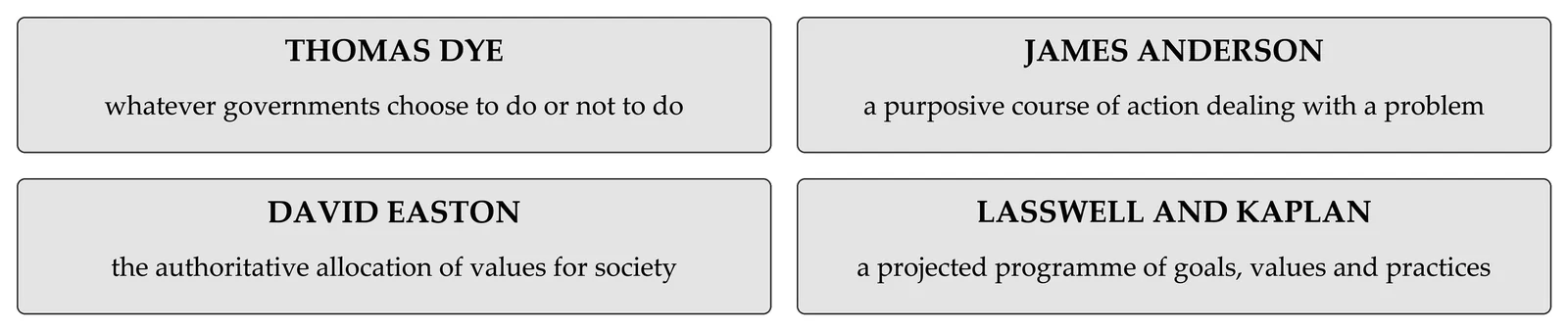
- Thomas Dye. Public policy is whatever governments choose to do or not to do. This broad definition includes inaction, since a decision not to act is also a policy.
- James Anderson. Public policy is a purposive course of action followed by an actor or set of actors in dealing with a problem or matter of concern. This stresses that policy is goal-oriented and deals with problems.
- David Easton. Public policy is the authoritative allocation of values for the whole society. This links policy to the political system and its power to bind all members.
- Harold Lasswell and Abraham Kaplan. Policy is a projected programme of goals, values and practices. This highlights that policy is a plan for the future.
- Carl Friedrich. Policy is a proposed course of action of a person, group or government within a given environment, providing obstacles and opportunities which the policy was proposed to utilise and overcome.
Characteristics of Public Policy
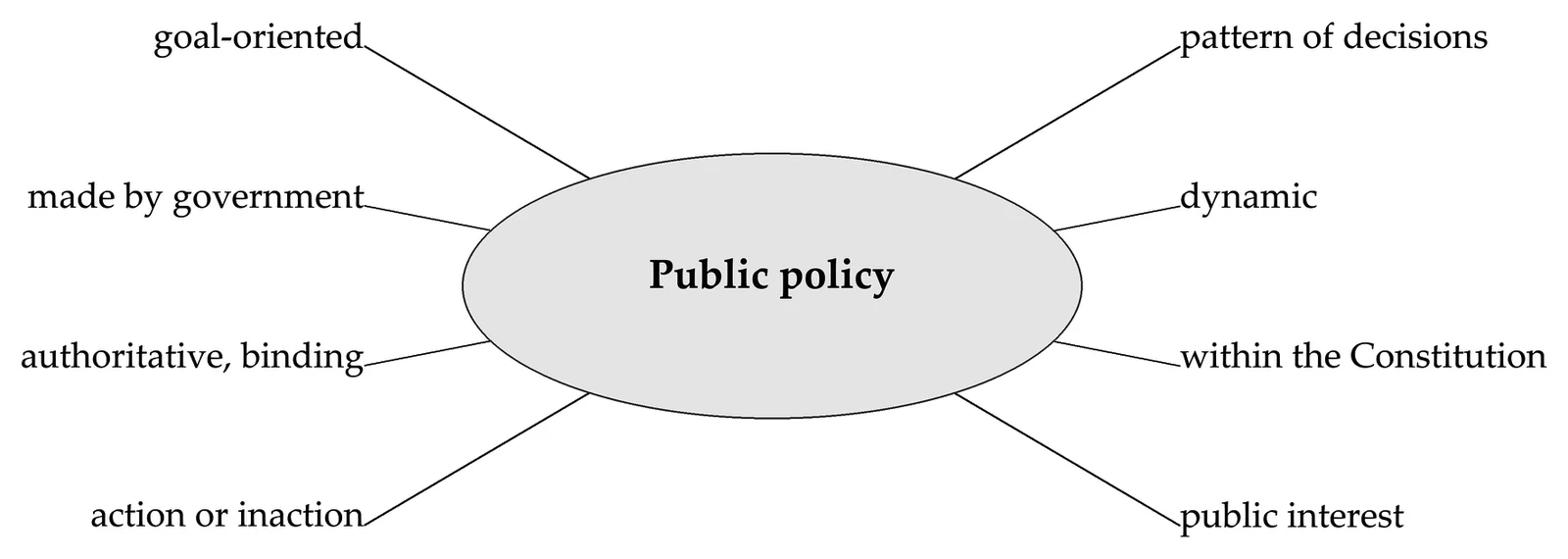
- Goal-oriented. Public policy is purposive and aims at definite goals, such as reducing poverty or improving literacy.
- Made by government. It is formulated by governmental authorities such as legislatures, executives and courts, though non-state actors influence it.
- Authoritative. It is backed by the legal authority of the state and is binding on citizens, with penalties for violation.
- Positive or negative. It may involve action, such as building schools, or deliberate inaction, such as not regulating a market.
- Pattern of actions. It is a series of related decisions over time, not a single isolated decision; a policy on education includes laws, schemes, budgets and rules.
- Dynamic. It changes with circumstances, public opinion and new knowledge, as Indian economic policy changed in 1991.
- Based on law and the Constitution. In India, policies must conform to the Constitution, and they are guided by the Directive Principles of State Policy.
- Public interest. It is meant to serve the interests of the public as a whole, though in practice some groups benefit more than others.
Types of Public Policy
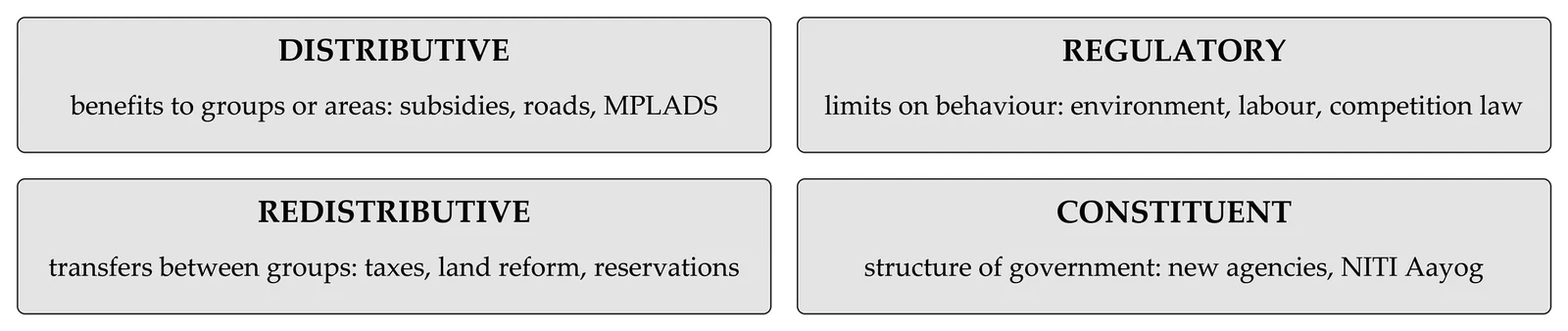
Theodore Lowi classified policies into four types. Distributive policies provide goods and services to particular groups, such as subsidies to farmers or roads in a region. Regulatory policies limit the actions of individuals and firms, such as environmental and labour laws. Redistributive policies transfer resources from some groups to others, such as progressive taxation and welfare schemes, and are usually the most controversial. Constituent policies concern the structure of government itself, such as setting up new agencies or reorganising states. Lowi argued that each type of policy produces a different kind of politics, which he summed up in the phrase policies determine politics. Other classifications distinguish substantive from procedural policies and material from symbolic policies.
Significance of Public Policy
- Translating philosophy into action. Policy turns the ideals of the Preamble and the Directive Principles, such as social and economic justice, into concrete programmes.
- Solving public problems. Policies address problems such as poverty, unemployment, disease and pollution that individuals cannot solve alone.
- Development. In developing countries like India, the state has used policy to promote growth, industrialisation and social change, first through Five-Year Plans and now through missions and schemes.
- Welfare. Policies provide food, health care, education and social security to the poor and vulnerable.
- Legitimacy and accountability. Effective policies increase public trust in government, and policy analysis helps citizens judge governments by their results.
- Allocation of resources. Since resources are limited, policy decides priorities, which is why policy-making involves conflict among groups.
1.2 Determinants of Public Policy
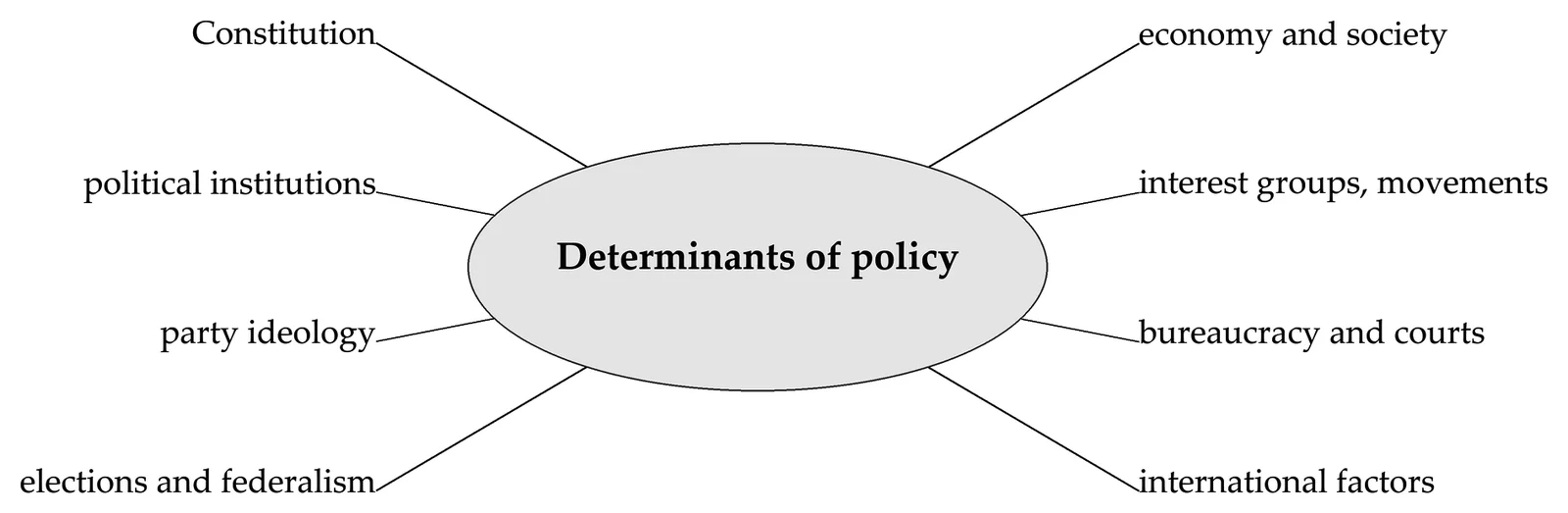
Public policy does not emerge in a vacuum. It is shaped by many factors, some within the political system and others in its environment. David Easton’s systems model explains this well: inputs of demands and support from the environment enter the political system, which converts them into outputs of policies and decisions, and feedback from the effects of these outputs creates new demands. The main determinants of public policy are discussed below.
Constitutional and Institutional Framework
The Constitution sets the framework within which policy is made. In India, the division of powers between the Union and the states in the Seventh Schedule decides who makes policy on which subject; the Fundamental Rights limit what policies can do; and the Directive Principles set the goals that policy should pursue, such as the right to work and education in Articles 41 and 45. Institutions such as Parliament, the Cabinet, the bureaucracy, the judiciary and bodies like NITI Aayog, which replaced the Planning Commission in 2015, shape how policies are made.
Political Factors
- Ideology of the ruling party. Parties bring their ideologies and manifestos into government; the Nehruvian commitment to planning and the public sector shaped early policy, while later governments emphasised markets.
- Electoral competition. Governments make policies to win votes, such as welfare schemes and loan waivers before elections.
- Coalitions and federalism. Coalition partners and state governments influence national policy, as with the Goods and Services Tax, negotiated through the GST Council.
- Leadership. The vision of leaders, such as P.V. Narasimha Rao and Manmohan Singh in 1991, can bring major policy change.
Socio-Economic Factors
The level of economic development, the structure of society and the availability of resources shape policy. A poor, agricultural society needs policies on food security and rural employment, while an industrial society needs policies on urban services and industrial relations. India’s caste, class, gender and regional inequalities have led to policies of reservation, land reform and targeted welfare. Economic crises often force policy change, as the balance of payments crisis of 1991 led to liberalisation, privatisation and globalisation.
Interest Groups, Public Opinion and Media
Interest groups such as business associations (FICCI, CII), trade unions and farmers’ organisations press their demands on policy-makers. Social movements have shaped major laws: the right to information movement led by the Mazdoor Kisan Shakti Sangathan contributed to the RTI Act, 2005, and campaigns for the right to food and work shaped the MGNREGA, 2005 and the National Food Security Act, 2013. Public opinion and the media, including social media, set the agenda by highlighting problems, as the protests after the Delhi gang rape of 2012 led to the Criminal Law (Amendment) Act, 2013.
The Bureaucracy and the Judiciary
Civil servants advise ministers, draft policies and implement them, so their expertise and attitudes influence policy. The judiciary has also become an important policy actor through public interest litigation: the Supreme Court’s orders shaped policies on the midday meal scheme (PUCL case, 2001), environmental protection (M.C. Mehta cases) and sexual harassment at the workplace (Vishaka, 1997).
International Factors
In a globalised world, international organisations, treaties and global markets influence national policy. Loans from the IMF and World Bank came with conditions in 1991; the WTO agreements shape trade and patent policy; international climate agreements such as the Paris Agreement (2015) shape energy policy; and the Sustainable Development Goals guide social policy. Technology and global ideas, such as new public management, also spread across countries.
1.3 Policy Impact: Socio-Economic
Policies are judged by their effects on society. Scholars distinguish between policy outputs, the things governments actually do, such as the number of schools built or the money spent; policy outcomes, the results for the target group, such as higher enrolment; and policy impact, the wider and long-term effects on society, such as improved literacy, economic growth or reduced inequality. Impact may be intended or unintended, short-term or long-term, and may fall on the target group as well as on other groups (spillover effects).
Economic Impact
- Growth. The economic reforms of 1991 raised India’s growth rate and integrated the economy with the world, though critics argue that the gains were unevenly distributed.
- Agriculture. The Green Revolution of the 1960s, based on high-yielding seeds, irrigation and fertilisers, made India self-sufficient in food grains, but also increased regional inequality and environmental damage in states like Punjab.
- Financial inclusion. The Pradhan Mantri Jan-Dhan Yojana (2014) opened over fifty crore bank accounts, allowing direct transfers of subsidies and reducing leakages.
- Infrastructure. Policies on roads, railways, electricity and digital networks have shaped the pace and pattern of development.
Social Impact
- Poverty reduction. Growth combined with welfare policies helped reduce poverty; NITI Aayog’s multidimensional poverty estimates indicate that a large number of people moved out of multidimensional poverty between 2015–16 and 2019–21.
- Education. Policies such as the Sarva Shiksha Abhiyan (2001), the midday meal scheme and the Right to Education Act (2009) brought near-universal enrolment in elementary education, though learning levels remain a concern.
- Health. Programmes like the National Health Mission reduced infant and maternal mortality, while immunisation campaigns eradicated polio, with India declared polio-free in 2014.
- Social justice. Reservation policies increased the representation of Scheduled Castes, Scheduled Tribes and Other Backward Classes in education, jobs and legislatures.
- Gender. Reservation of one-third of seats for women in panchayats under the 73rd Amendment (1992) brought lakhs of women into local leadership.
Unintended Consequences and Limits
Policies sometimes have effects their makers did not intend. Subsidies on electricity for farmers led to over-extraction of groundwater; demonetisation in 2016 aimed at black money but caused hardship to the informal sector; and some welfare schemes suffered from leakages and exclusion errors. Measuring impact is also difficult, since many other factors affect social outcomes. This is why policy evaluation, discussed in Chapter 3, is essential.

1.4 Important Questions
- Question 1 What is public policy? Discuss its characteristics and significance.
- Question 2 Discuss the major determinants of public policy with reference to India.
- Question 3 Examine the socio-economic impact of public policy with suitable examples from India.
- Question 4 Explain the different types of public policy. How do they shape the politics of policy-making?
DU asks the same idea in different words. So learn one broad answer for each question below; the same answer works for every question joined by OR.
Important Question 1
What is public policy? Discuss its characteristics and significance.
OR
Define public policy and explain its main features.
OR
Discuss the importance of public policy in a democratic welfare state.
Model Answer
“A purposive course of action followed by an actor or set of actors in dealing with a problem or matter of concern.”
— James E. Anderson, Public Policymaking (1975)
Introduction. Public policy is the course of action adopted by a government to deal with public problems and achieve social goals. It is the means through which the abstract ideals of a constitution and the promises of political parties are converted into programmes, laws and services that reach citizens. Its study, begun by Harold Lasswell’s idea of the policy sciences in 1951, helps us understand what governments do, why they do it and with what effect.
1. Meaning of Policy
A policy is a settled course of action. The word is related to the Greek polis and the Latin politia, both meaning the state. A public policy is a policy adopted by public authorities, backed by the power of the state and meant to deal with matters of public concern.
2. Definitions
Thomas Dye defines public policy as whatever governments choose to do or not to do, while James Anderson calls it a purposive course of action dealing with a problem. David Easton sees it as the authoritative allocation of values for the whole society, and Lasswell and Kaplan as a projected programme of goals, values and practices.
3. Goal-Oriented
Public policy is purposive. It aims at definite objectives such as reducing poverty, expanding literacy, protecting the environment or promoting industrial growth, and its success is measured by how far these goals are achieved.
4. Made by Governmental Authorities
Policies are made by legislatures, executives, bureaucracies and courts acting in their official capacity. Interest groups, experts and citizens influence policy, but it is the authority of government that turns a proposal into public policy.
5. Authoritative and Binding
Public policy carries the legal authority of the state. Citizens must obey laws and rules made under it, and violations can be punished, which distinguishes public policy from the policies of private organisations.
6. Action and Inaction
Policy may be positive, involving action such as building schools, or negative, involving a deliberate decision not to act. As Dye points out, a government’s choice not to regulate a market or not to address a problem is also a policy with consequences.
7. A Pattern of Decisions
A public policy is not a single decision but a series of related decisions over time, including laws, budgets, rules, schemes and their implementation. India’s education policy, for example, includes the RTE Act, NEP 2020, budgets and many state schemes.
8. Dynamic Nature
Policies change with circumstances, knowledge and public opinion. India moved from a state-led, planned economy to liberalisation in 1991, and from the Planning Commission to NITI Aayog in 2015, showing that policy is constantly revised.
9. Constitutional Basis
In India, policies must conform to the Constitution, respect Fundamental Rights and follow the federal division of powers. The Directive Principles of State Policy, such as Articles 39, 41 and 47, set the goals that policy should pursue.
10. Types of Policy
Theodore Lowi classified policies as distributive, regulatory, redistributive and constituent. Other scholars distinguish substantive from procedural policies and material from symbolic ones, showing the variety of government action.
11. Significance: Turning Ideals into Action
Policy translates the governing philosophy of a state into practice. The Preamble’s promise of social, economic and political justice becomes real only through policies on land, education, employment and social security.
12. Significance: Solving Public Problems
Many problems, such as poverty, epidemics, pollution and unemployment, cannot be solved by individuals or markets alone. Public policy provides collective solutions through laws, public spending and regulation.
13. Significance: Development and Welfare
In a developing country like India, the state has used policy to promote growth and social change, from the Five-Year Plans to missions on health, sanitation and digital inclusion, and to provide welfare to the poor and vulnerable.
14. Significance: Democracy and Accountability
In a democracy, policies reflect the choices of elected representatives, and citizens judge governments by their policies at elections. Policy analysis therefore strengthens accountability by showing what governments promised and what they delivered.
15. Limitations
Policies may serve powerful groups rather than the public, may be poorly designed or implemented, and may have unintended effects. The gap between policy goals and results is a recurring problem in India.
16. Evaluation
Public policy is the central activity of modern government. Understanding its nature helps citizens see that governance is not only about elections and institutions, but about the choices that shape everyday life.
Conclusion. Thus, public policy is a goal-oriented, authoritative pattern of government action or inaction, made within the constitutional framework to deal with public problems. It is significant because it turns the ideals of the state into programmes, promotes development and welfare, and makes democratic governments accountable for their results.
Important Question 2
Discuss the major determinants of public policy with reference to India.
OR
What factors shape the making of public policy? Explain.
OR
Examine the role of political and socio-economic factors in policy-making.
Model Answer
“A political system can be designated as those interactions through which values are authoritatively allocated for a society.”
— David Easton, A Systems Analysis of Political Life (1965)
Introduction. Public policy is the product of many forces acting together. The constitutional framework, political institutions and parties, the economy and society, interest groups and public opinion, the bureaucracy, the courts and the international environment all shape what policies are made and how. David Easton’s systems model shows how demands and support from the environment are converted into policy outputs by the political system.
1. The Systems Approach
Easton saw the political system as receiving inputs of demands and support from its environment and converting them into outputs of authoritative decisions and policies. Feedback from these outputs generates new demands, so policy-making is a continuous process shaped by the environment.
2. The Constitutional Framework
The Constitution decides who can make policy on which subject through the Union, State and Concurrent Lists of the Seventh Schedule. Fundamental Rights limit state action, and the Directive Principles provide the goals of policy, such as social justice and the welfare of the people.
3. Political Institutions
Parliament, the Cabinet, ministries, NITI Aayog and the GST Council are central to policy-making. In India’s parliamentary system, the executive dominates policy, while Parliament debates and approves laws and budgets.
4. Ideology of the Ruling Party
The ideology of the governing party shapes policy priorities. Nehru’s socialist vision led to planning and a large public sector, while later governments favoured liberalisation, private investment and new welfare approaches such as direct benefit transfers.
5. Electoral Politics
Parties make policies to win and retain votes. Welfare schemes, subsidies and loan waivers are often announced before elections, and the need to respond to voters makes policy sensitive to popular demands.
6. Federalism and Coalitions
State governments make policy on many subjects and implement most central schemes, while coalition partners shaped national policy during 1989–2014. The GST, decided by the GST Council of the Union and the states, shows how federal bargaining shapes policy.
7. Economic Conditions
The level of development, resources and economic crises influence policy. The balance of payments crisis of 1991 led to liberalisation, while the Covid-19 pandemic led to new relief measures such as free food grains under the Pradhan Mantri Garib Kalyan Anna Yojana.
8. Social Structure
India’s caste, class, religious, gender and regional diversities shape policy. Reservation, land reforms, tribal welfare and minority schemes are responses to social inequalities, and social groups mobilise to demand policies in their favour.
9. Interest Groups
Business associations such as FICCI and CII, trade unions, farmers’ organisations and professional bodies lobby the government. Powerful groups often have greater influence, which raises concerns about policy capture.
10. Social Movements and Civil Society
Movements have shaped major laws. The campaign of the Mazdoor Kisan Shakti Sangathan contributed to the RTI Act of 2005, and the right to food campaign influenced the MGNREGA of 2005 and the National Food Security Act of 2013.
11. Public Opinion and Media
The media and public opinion set the policy agenda by highlighting problems. The public protests after the Delhi gang rape of December 2012 led quickly to the Criminal Law (Amendment) Act of 2013.
12. The Bureaucracy
Civil servants provide expertise, draft policies and implement them. Their knowledge gives them great influence, but bureaucratic resistance or inertia can also slow or change policies.
13. The Judiciary
Through public interest litigation, courts have shaped policy on food security (PUCL, 2001), the environment (M.C. Mehta cases) and workplace sexual harassment (Vishaka, 1997), making the judiciary an active policy actor.
14. International Factors
International institutions, treaties and markets influence national policy. IMF and World Bank conditions in 1991, WTO rules on trade and patents, and the Paris Agreement on climate change have all shaped Indian policy.
15. Interaction of Determinants
These factors do not act separately. A policy such as the farm laws of 2020 was shaped by economic ideas, party ideology and federal politics, and later withdrawn because of farmers’ movements and public opinion.
16. Evaluation
The determinants of policy show that policy-making is not a purely technical exercise but a political process, in which power, ideas, interests and institutions interact.
Conclusion. Thus, public policy in India is shaped by the constitutional framework, political institutions, party ideology, electoral and federal politics, socio-economic conditions, interest groups, movements, the media, the bureaucracy, the judiciary and international forces. As Easton’s systems model shows, policy is the authoritative allocation of values produced by the interaction of the political system with its environment.
Important Question 3
Examine the socio-economic impact of public policy with suitable examples from India.
OR
Distinguish between policy outputs, outcomes and impact.
OR
How do public policies bring about social and economic change? Discuss.
Model Answer
“The State shall strive to promote the welfare of the people by securing and protecting as effectively as it may a social order in which justice, social, economic and political, shall inform all the institutions of the national life.”
— Constitution of India, Article 38(1)
Introduction. Policies are made to change society, and they are ultimately judged by their effects. The study of policy impact asks what difference a policy makes to people’s lives, to the economy and to society. In India, where the Constitution commits the state to social, economic and political justice, policies have had deep, though uneven, socio-economic effects.
1. Outputs, Outcomes and Impact
Policy outputs are what governments do, such as money spent or schools built. Outcomes are the results for target groups, such as higher enrolment. Impact refers to the wider, long-term effects on society, such as improved literacy or reduced inequality.
2. Kinds of Impact
Impact may be intended or unintended, short-term or long-term, and may affect the target group as well as others through spillover effects. Some impacts are tangible, such as income, while others are symbolic, such as dignity and recognition.
3. Economic Growth
The reforms of 1991, which reduced licensing, opened the economy to trade and investment and reformed taxes, raised India’s growth rate and made it one of the fastest-growing major economies, though critics note that growth was unequal.
4. Agriculture and Food Security
The Green Revolution of the 1960s made India self-sufficient in food grains, and the public distribution system and the National Food Security Act of 2013 extended food security to about two-thirds of the population.
5. Unintended Effects in Agriculture
The Green Revolution also increased regional inequality and caused groundwater depletion and soil degradation in Punjab and Haryana, while free electricity for farmers encouraged over-extraction of groundwater.
6. Poverty Reduction
Growth combined with welfare policies has reduced poverty. NITI Aayog’s multidimensional poverty estimates indicate that a large number of people moved out of multidimensional poverty between 2015–16 and 2019–21.
7. Employment and Rural Livelihoods
The MGNREGA of 2005 provides up to one hundred days of wage employment to rural households, raising rural wages, reducing distress migration and creating rural assets, though delays in payment remain a problem.
8. Education
The Sarva Shiksha Abhiyan, the midday meal scheme and the Right to Education Act of 2009 helped achieve near-universal enrolment in elementary education, though surveys such as ASER show that learning levels remain low.
9. Health
The National Health Mission improved maternal and child health through institutional deliveries and immunisation, and India was declared polio-free in 2014, showing the impact of sustained public health policy.
10. Financial Inclusion
The Pradhan Mantri Jan-Dhan Yojana of 2014 opened over fifty crore bank accounts, and combined with Aadhaar and mobile phones it made direct benefit transfers possible, reducing leakages in welfare.
11. Social Justice
Reservations in education, jobs and legislatures have increased the representation of Scheduled Castes, Scheduled Tribes and Other Backward Classes, creating new elites and changing the social composition of institutions.
12. Gender
The 73rd and 74th Amendments reserved one-third of seats in local bodies for women, bringing lakhs of women into public life, and schemes on girls’ education and maternal health have improved indicators.
13. Policy Failures and Costs
Some policies have had harmful effects, such as displacement caused by large dams, hardship to the informal sector after demonetisation in 2016, and exclusion of genuine beneficiaries due to technical errors.
14. Difficulty of Measuring Impact
It is hard to separate the effect of a policy from other factors such as economic growth, monsoons or social change. Rigorous evaluation using data and field studies is therefore needed.
15. Lessons
The Indian experience shows that policies succeed when they are well designed, adequately funded, implemented with local participation and regularly evaluated and revised.
16. Evaluation
Public policies have transformed Indian society in many ways, but their benefits have been uneven across regions, classes and social groups, making equity a continuing challenge.
Conclusion. Thus, public policies produce outputs, outcomes and long-term impacts on the economy and society. In India, policies on growth, food, employment, education, health, financial inclusion and social justice have had major positive effects, alongside unintended costs, showing how policy serves the goal of Article 38.
Important Question 4
Explain the different types of public policy. How do they shape the politics of policy-making?
OR
Discuss Theodore Lowi’s classification of public policies.
OR
Distinguish between distributive, regulatory and redistributive policies.
Model Answer
“Policies determine politics.”
— Theodore J. Lowi, Four Systems of Policy, Politics, and Choice (1972)
Introduction. Governments make many kinds of policies, from building roads to regulating industries and redistributing income. Classifying policies helps us understand their nature and the political conflicts they generate. The best-known classification is that of Theodore Lowi, who argued that different types of policy produce different kinds of politics.
1. Why Classify Policies
Classification helps compare policies, predict who will support or oppose them, and understand why some policies are easy to adopt while others face fierce resistance. It also helps policy-makers design strategies for adoption and implementation.
2. Lowi’s Argument
Lowi reversed the common view that politics determines policy. He argued that the expected effects of a policy on different groups shape the political process around it, so each type of policy has its own arena of power.
3. Distributive Policies
Distributive policies provide benefits to particular groups or areas, such as subsidies, grants, roads and irrigation projects. Since costs are spread over all taxpayers and benefits are concentrated, they face little opposition.
4. Politics of Distributive Policies
Distributive politics involves bargaining and logrolling, as representatives seek benefits for their constituencies. Schemes such as the MPLADS, which gives each MP funds for local works, are typical examples.
5. Regulatory Policies
Regulatory policies limit the behaviour of individuals and firms, such as environmental laws, labour laws, food safety standards and competition law. They impose costs on some groups for the benefit of others.
6. Politics of Regulatory Policies
Regulation produces conflict between those regulated and those protected, such as industries and environmental groups. Regulatory bodies such as SEBI, TRAI and the Competition Commission of India are often lobbied by the industries they regulate.
7. Redistributive Policies
Redistributive policies transfer resources or rights from some groups to others, such as progressive taxation, land reforms, reservations and welfare schemes for the poor.
8. Politics of Redistributive Policies
Redistributive policies are the most controversial, since they create clear winners and losers along class or social lines. Land reforms in India faced resistance from landlords, and reservations have often led to protests and counter-mobilisation.
9. Constituent Policies
Constituent policies concern the structure and rules of government itself, such as creating new agencies, reorganising states or changing electoral rules. The creation of NITI Aayog in 2015 and the reorganisation of states are examples.
10. Substantive and Procedural Policies
Substantive policies deal with what the government will do, such as building schools, while procedural policies deal with how things will be done and by whom, such as rules for public procurement.
11. Material and Symbolic Policies
Material policies provide tangible resources or impose real costs, while symbolic policies appeal to values and identities, such as declaring national days, with little material effect.
12. Public Goods and Private Goods
Some policies provide public goods that benefit everyone, such as defence and clean air, while others provide goods that can be divided among individuals, such as subsidised food grains.
13. Indian Examples
India’s policy mix includes distributive schemes such as irrigation projects, regulatory laws such as the Environment Protection Act of 1986, redistributive policies such as reservations, and constituent changes such as the 73rd Amendment on panchayats.
14. Criticism of Lowi
Critics argue that many policies combine features of several types, and that the same policy can be seen as distributive by some and redistributive by others, so the categories overlap in practice.
15. Value of the Typology
Despite overlaps, Lowi’s typology helps explain why welfare and land reform policies face more resistance than subsidies and local works, and why regulatory agencies risk capture.
16. Evaluation
Classifying policies shows that policy-making is shaped by who gains and who loses. Understanding these patterns helps explain the politics of reform in India.
Conclusion. Thus, public policies may be distributive, regulatory, redistributive or constituent, as well as substantive or procedural and material or symbolic. Lowi’s insight that policies determine politics explains why some policies pass easily while others, especially redistributive ones, provoke intense political conflict.
Short Notes
(a) Policy sciences
An inter-disciplinary field proposed by Harold Lasswell in 1951 to study the process of policy-making and to provide knowledge for improving government decisions.
(b) Redistributive policy
A policy that transfers resources or rights from some groups to others, such as progressive taxation, land reform or reservations; it is usually the most controversial type of policy.
(c) Policy impact
The wider and long-term effects of a policy on society, beyond its immediate outputs and outcomes, which may be intended or unintended.
More notes: GE-8 Introduction to Public Policy
These notes are prepared by PADHO TO AISE for study help. They are not an official publication.