
Semester VII MDSE-9 Citizenship and Governance
Unit IV · 19 min read · Updated 24 Nov 2026
As per the University of Delhi (DU) BA (Hons) Political Science syllabus
Contents
- 4.1 Civil Society
- 4.2 Citizen Participation in Governance
- 4.3 Community Relationship: The Bhagidari Model of Delhi
- 4.4 Important Questions
- What is civil society? Discuss its role in governance.
- Discuss the Bhagidari model of Delhi as an example of citizen–government partnership.
- Discuss the importance of citizen participation in governance.
- Discuss the role of decentralisation and local communities in strengthening the relationship between citizens and governance.
- Short Notes
हर उम्र, हर हालत और हर स्वभाव के अमेरिकी लगातार संगठन बनाते रहते हैं।
Americans of all ages, all conditions, and all dispositions constantly form associations.
— Alexis de Tocqueville, Democracy in America, Volume II (1840)
CITIZENS do not meet government only at election time. They meet it every day, as individuals and through associations, in demanding services, voicing grievances and solving shared problems. Civil society, the sphere of voluntary associations between the family and the state, shapes this relationship. Delhi’s Bhagidari scheme, launched in 2000, tried to make citizens and government partners in solving local problems. This chapter explains civil society, citizen participation and the Bhagidari model, drawing on Tocqueville, Gramsci, Robert Putnam, Partha Chatterjee, Sherry Arnstein and Deserai Crow.

4.1 Civil Society
Civil society is the sphere of voluntary associations, groups and movements that lies between the family, the market and the state. It includes non-governmental organisations, trade unions, professional bodies, religious and cultural groups, resident associations, the media and social movements. Civil society gives citizens a voice, helps monitor government and often delivers services in partnership with the state.
4.2 Citizen Participation in Governance
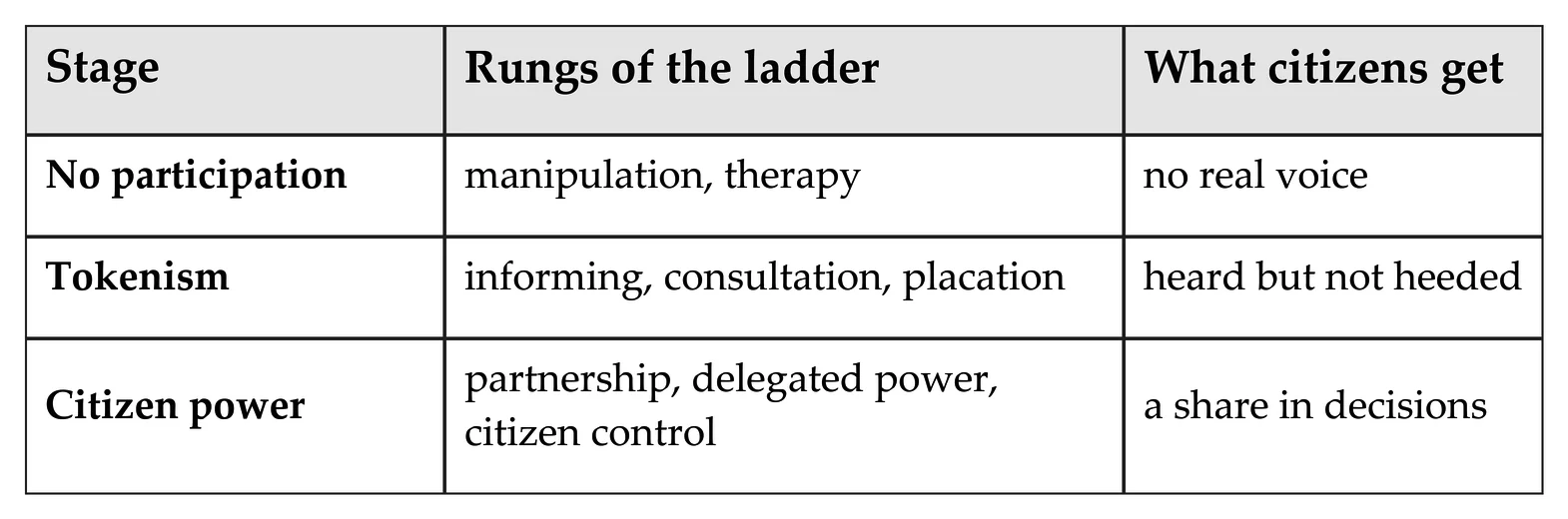
Citizen participation means that citizens take part in decisions that affect them, beyond voting. Sherry Arnstein described a ladder of participation, from manipulation at the bottom to citizen control at the top. Deserai Crow explains why the way citizens interact with government matters for trust and legitimacy. In India, gram sabhas, ward committees, public hearings and online consultations provide channels for participation.
4.3 Community Relationship: The Bhagidari Model of Delhi
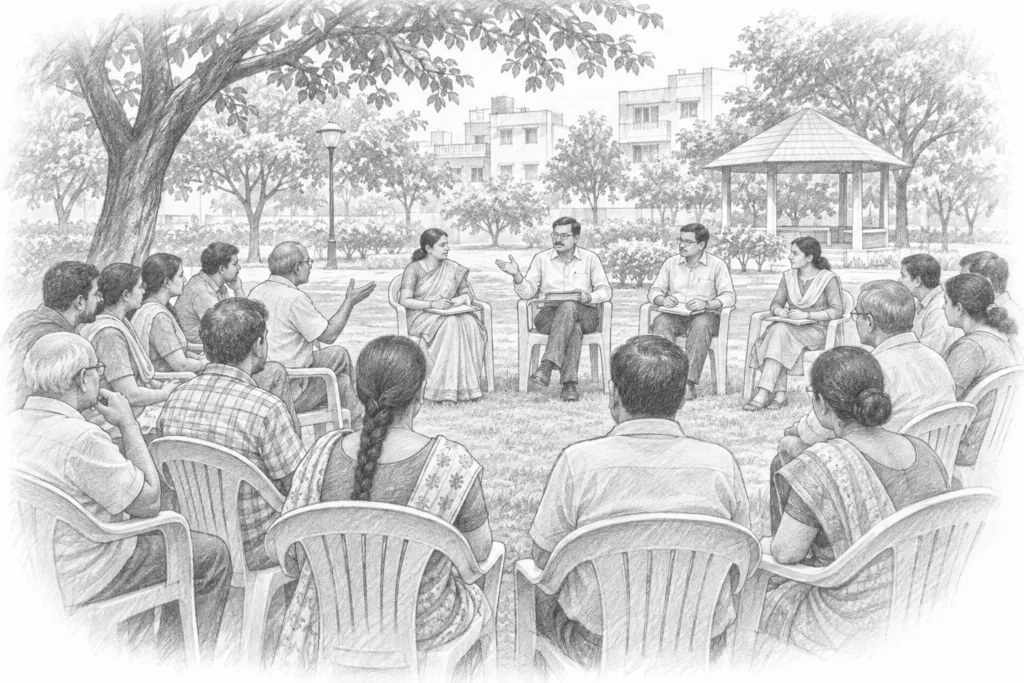
Bhagidari, meaning partnership, was a scheme launched by the Government of Delhi in 2000 under Chief Minister Sheila Dikshit. It brought resident welfare associations, market traders and industrial associations together with civic agencies in large workshops to solve local problems such as water supply, garbage, parks and security. It was praised as a model of citizen–government partnership, but critics argued that it favoured middle-class neighbourhoods.

4.4 Important Questions
- Question 1 What is civil society? Discuss its role in governance.
- Question 2 Discuss the Bhagidari model of Delhi as an example of citizen–government partnership.
- Question 3 Discuss the importance of citizen participation in governance.
- Question 4 Discuss the role of decentralisation and local communities in strengthening the relationship between citizens and governance.
DU asks the same idea in different words. So learn one broad answer for each question below; the same answer works for every question joined by OR.
Important Question 1
What is civil society? Discuss its role in governance.
OR
Examine the relationship between civil society and the state in India.
OR
Discuss the role of civil society in making governance accountable.
Model Answer
“Americans of all ages, all conditions, and all dispositions constantly form associations.”
— Alexis de Tocqueville, Democracy in America, Volume II (1840)
Introduction. Civil society is the sphere of voluntary associations that lies between the individual and the state. It gives citizens a collective voice, monitors those in power and often provides services. Since the 1980s, civil society has been seen as essential to democracy and good governance, and in India it has played a key role in movements for rights, transparency and accountability.
1. Meaning
Civil society refers to the voluntary associations, organisations and movements through which citizens pursue common interests outside the family, the market and the state. It includes NGOs, trade unions, cooperatives, professional associations, religious and cultural bodies, resident associations, the media and social movements.
2. Early Ideas
Early modern thinkers such as Locke used civil society to mean political society governed by law, as opposed to the state of nature. Adam Ferguson, in his Essay on the History of Civil Society (1767), linked it with the growth of commerce, refinement and civic virtue.
3. Hegel and Marx
Hegel saw civil society as the sphere between the family and the state where individuals pursue their particular interests through the market and associations, which the state must unite in a universal interest. Marx saw civil society as bourgeois society, the sphere of economic relations that shaped the state.
4. Tocqueville on Associations
Alexis de Tocqueville, in Democracy in America, praised Americans’ habit of forming associations for every purpose. He argued that associations teach citizens to cooperate, check the power of the state and prevent the tyranny of the majority, making democracy stable.
5. Gramsci and Habermas
Antonio Gramsci saw civil society as the sphere where the ruling class wins consent through culture, religion and education, but also where counter-hegemonic ideas can grow. Jürgen Habermas described the public sphere, where citizens debate public matters freely and form public opinion.
6. Putnam and Social Capital
Robert Putnam, in Making Democracy Work (1993), found that Italian regions with dense networks of civic associations had more effective governments. He argued that social capital, the trust and norms of cooperation built through associations, makes democracy and governance work.
7. Civil Society in India
Indian civil society has deep roots in nineteenth-century social reform associations, the national movement and Gandhian constructive work. After the Emergency, NGOs and social movements grew rapidly, working on environment, women’s rights, Dalit and Adivasi rights, health, education and transparency.
8. Voice and Advocacy
Civil society gives citizens a voice and presses for new rights. The MKSS campaign led to the Right to Information Act of 2005, the Right to Food campaign influenced the National Food Security Act of 2013, and movements such as Chipko and the Narmada Bachao Andolan raised questions about development.
9. Monitoring Government
Civil society organisations monitor government through social audits, report cards, election watch and public interest litigation. The Public Affairs Centre in Bangalore, founded by Samuel Paul, used citizen report cards to rate public services and press for improvement.
10. Service Delivery
Many NGOs and self-help groups deliver services in health, education, sanitation and livelihoods, often in partnership with government. Kerala’s Kudumbashree network of women’s groups, begun in 1998, works with local governments to fight poverty.
11. Chatterjee’s Political Society
Partha Chatterjee, in The Politics of the Governed (2004), argued that civil society in India is largely the sphere of the educated middle class with legal rights. Most of the poor deal with the state through political society, negotiating as populations for welfare and tolerance of illegal settlements.
12. The State and Civil Society
The relationship between the state and civil society involves both cooperation and conflict. Governments partner with NGOs in welfare schemes but also regulate them, for example through the Foreign Contribution (Regulation) Act of 2010, amended in 2020 to tighten controls on foreign funds.
13. Limitations
Civil society is not always democratic or inclusive. Some NGOs are unaccountable, depend on foreign or government funds, or reflect urban elite interests. Associations based on caste or religion can spread hatred, forming what some call an uncivil society.
14. Civil Society and Accountability
At its best, civil society creates social accountability, holding government answerable between elections. Movements for information, food, employment and against corruption show how organised citizens can change laws and institutions.
15. Evaluation
Civil society strengthens democracy and governance by giving voice, monitoring power and delivering services, but it must itself be inclusive and accountable.
Conclusion. Thus, civil society is the sphere of voluntary associations between the family, the market and the state. From Tocqueville and Gramsci to Putnam, thinkers have seen it as vital for democracy. In India, it has won rights to information and food and monitors government, though Chatterjee reminds us that the poor often engage the state through political society.
Important Question 2
Discuss the Bhagidari model of Delhi as an example of citizen–government partnership.
OR
Examine the achievements and limitations of the Bhagidari scheme.
OR
How did Bhagidari change the relationship between citizens and governance in Delhi?
Model Answer
“Co-production is the process through which inputs used to produce a good or service are contributed by individuals who are not ‘in’ the same organization.”
— Elinor Ostrom, Crossing the Great Divide (1996)
Introduction. Bhagidari, a Hindi word meaning partnership, was a scheme launched by the Government of the National Capital Territory of Delhi in 2000. It aimed to make citizens partners with government in solving local problems rather than mere recipients of services. It became one of India’s best-known experiments in participatory urban governance, though it also drew serious criticism.
1. Background
By the late 1990s, Delhi faced problems of water shortage, poor sanitation, garbage, traffic and crime, while citizens complained that many agencies, such as the municipal corporation, the Delhi Jal Board and the Delhi Development Authority, worked separately and did not listen to them.
2. Launch of Bhagidari
Chief Minister Sheila Dikshit launched Bhagidari in January 2000, with a Bhagidari Cell in her office to coordinate it. The aim was to bring citizens’ groups and government agencies together to identify problems and find joint solutions.
3. The Partners
On the citizens’ side were resident welfare associations of colonies, market traders’ associations and industrial associations. On the government side were the departments of the Delhi government, the municipal bodies, the Delhi Jal Board, the police and, later, the power distribution companies.
4. The Method
Bhagidari used large group interactive workshops, where hundreds of citizens and officials sat together, discussed problems and agreed on action plans. Facilitators helped participants move from complaints to joint commitments, and follow-up meetings monitored progress.
5. Areas of Work
Partnerships addressed water supply and rainwater harvesting, cleanliness and segregation of garbage, maintenance of parks, street lighting, sewerage, power supply, traffic and neighbourhood security. Residents often took responsibility for tasks such as maintaining parks with government funds.
6. Growth of the Scheme
Bhagidari began with a small number of resident associations and grew to include well over a thousand citizens’ groups. An annual Bhagidari Utsav celebrated the partnership and encouraged participation through cultural events and recognition of successful groups.
7. Co-production
Bhagidari is an example of co-production, a concept developed by Elinor Ostrom, in which citizens contribute to producing public services along with government. It changed the role of citizens from passive consumers to active partners in governance.
8. Achievements
Bhagidari improved communication between citizens and officials, solved many local problems quickly, promoted rainwater harvesting and waste management, and built a sense of ownership among residents. It made agencies more responsive and coordinated.
9. Political Significance
Bhagidari gave the Chief Minister a direct connection with citizens and helped her government win public support. It showed how political leadership can drive participatory reforms in urban governance.
10. Middle-Class Bias
Critics, such as Poulomi Chakrabarti, argued that Bhagidari mainly involved resident welfare associations of planned middle-class colonies. Residents of slums and unauthorised colonies, who formed a large part of Delhi’s population, were largely left out.
11. Exclusion of the Poor
Some associations used their influence to demand removal of hawkers, slums and informal workers from their neighbourhoods. In this way, participation by the middle class could strengthen exclusion of the urban poor, raising questions about whose partnership Bhagidari was.
12. Bypassing Elected Bodies
Elected municipal councillors complained that Bhagidari bypassed them, since associations dealt directly with the Chief Minister’s office and officials. This raised concerns about weakening representative local democracy and the 74th Amendment.
13. Dependence on Leadership
Bhagidari depended heavily on the Chief Minister’s personal commitment and was not backed by law. After the change of government in 2013, it lost momentum, showing the weakness of participatory schemes that are not institutionalised.
14. Lessons
Bhagidari shows that citizen–government partnership can improve services, but it must include the poor, work through elected local bodies and have legal backing to last. Later ideas such as mohalla sabhas reflect continued interest in local participation in Delhi.
15. Evaluation
Bhagidari was a pioneering experiment in partnership that changed how citizens and government related in Delhi, but its middle-class focus limited its democratic value.
Conclusion. Thus, Bhagidari, launched in Delhi in 2000, brought resident welfare associations and traders together with civic agencies to solve local problems through partnership and co-production. It improved services and responsiveness, but critics showed that it favoured the middle class, bypassed elected councillors and faded without legal backing.
Important Question 3
Discuss the importance of citizen participation in governance.
OR
Examine Arnstein’s ladder of citizen participation.
OR
How do citizens interact with their government, and why does it matter?
Model Answer
“Citizen participation is a categorical term for citizen power.”
— Sherry R. Arnstein, A Ladder of Citizen Participation (1969)
Introduction. Citizen participation means that citizens take part in the decisions and processes of governance, not only by voting but also by consulting, deliberating, monitoring and partnering with government. It is central to the relationship between citizens and governance, because it makes government more responsive, legitimate and effective. Scholars such as Sherry Arnstein and Deserai Crow have explained its forms and significance.
1. Meaning
Citizen participation is the involvement of citizens in public decisions that affect their lives. It ranges from receiving information to being consulted, deliberating on policy, sharing in decisions and controlling local institutions. Its aim is to give citizens real influence over governance.
2. Arnstein’s Ladder
Sherry Arnstein, in 1969, described a ladder of eight rungs. Manipulation and therapy at the bottom are non-participation; informing, consultation and placation are tokenism; and partnership, delegated power and citizen control at the top represent real citizen power.
3. Tokenism
Arnstein warned that much participation is tokenism, where citizens are informed or consulted but their views are ignored. Real participation requires a redistribution of power, so that citizens can influence outcomes.
4. Crow on Citizen–Government Interaction
Deserai Crow argues that how citizens interact with government matters because these interactions shape trust, satisfaction and willingness to comply with laws. Positive experiences of participation and service build legitimacy, while negative ones breed distrust.
5. Civic Culture
Almond and Verba argued that democracy needs a participant political culture, in which citizens are aware of politics and believe they can influence it. Participation also builds this culture by teaching citizens skills of cooperation and public reasoning.
6. Citizen Confidence
Sandeep Shastri’s study using the World Values Survey shows that Indian citizens’ confidence in political institutions varies. Participation can increase confidence when citizens see that their voice makes a difference.
7. Forms of Participation
Participation takes many forms: voting and campaigning; attending gram sabhas and ward meetings; public hearings on projects; consultations on draft laws; complaints and feedback; social audits; and partnerships in delivering services.
8. Channels in India
India has created many channels, including gram sabhas under the 73rd Amendment, ward committees under the 74th Amendment, public hearings for environmental clearance, the Pre-Legislative Consultation Policy of 2014 and the MyGov platform for online suggestions.
9. Participatory Budgeting
Participatory budgeting, which began in Porto Alegre in Brazil in 1989, lets citizens decide how part of a public budget is spent. Pune was among the first Indian cities to adopt it in the mid-2000s, allowing residents to propose local works.
10. Kerala’s People’s Plan
Kerala’s People’s Plan Campaign of 1996 devolved a large share of plan funds to local governments and involved citizens in preparing plans through gram sabhas, seminars and task forces, a landmark in participatory governance.
11. Benefits
Participation makes policies reflect people’s needs, improves service delivery, reduces corruption through monitoring, increases legitimacy and compliance, and empowers marginalised groups by giving them a voice.
12. Barriers
Barriers include poverty, illiteracy, lack of time, caste and gender hierarchies, domination of meetings by local elites, official reluctance to share power and lack of information about opportunities to participate.
13. Digital Participation
Online platforms allow citizens to give feedback, sign petitions and track services, but the digital divide excludes many, and online participation can become a formality without real influence.
14. Making Participation Real
Real participation requires legal rights, information, resources, capacity-building and institutions that respond to citizens’ views. Without these, participation risks becoming the tokenism Arnstein warned against.
15. Evaluation
Citizen participation is the heart of the relationship between citizens and governance, but it must move up Arnstein’s ladder towards real power.
Conclusion. Thus, citizen participation means involving citizens in public decisions beyond voting. Arnstein’s ladder distinguishes non-participation, tokenism and citizen power, and Crow shows why interactions with government shape trust. India has created many channels, from gram sabhas to participatory budgeting, but barriers of inequality must be overcome for participation to be real.
Important Question 4
Discuss the role of decentralisation and local communities in strengthening the relationship between citizens and governance.
OR
How have the 73rd and 74th Amendments brought governance closer to citizens?
OR
Examine decentralisation as a means of good governance and service delivery in India.
Model Answer
“True democracy cannot be worked by twenty men sitting at the Centre. It has to be worked from below by the people of every village.”
— M.K. Gandhi, Harijan (1948)
Introduction. Decentralisation means transferring power, functions and resources from higher to lower levels of government, closer to citizens. It allows local communities to take part in governance and hold local officials accountable. In India, the 73rd and 74th Amendments of 1992 created a constitutional framework for local self-government, and scholars such as S. Sangita link decentralisation with good governance and service delivery.
1. Meaning of Decentralisation
Decentralisation may be political, transferring power to elected local bodies; administrative, transferring functions to local offices; or fiscal, transferring funds and taxing powers. Democratic decentralisation combines all three and makes local governments answerable to local citizens.
2. Gandhi’s Vision
Gandhi believed that true democracy must work from below, through self-governing village republics. Although the Constituent Assembly did not make panchayats central, Article 40 of the Directive Principles asked the state to organise village panchayats as units of self-government.

3. Early Experiments
The Balwantrai Mehta Committee of 1957 recommended a three-tier panchayati raj system, first adopted by Rajasthan in 1959. The Ashok Mehta Committee of 1978 suggested reforms, but panchayats remained weak and irregular until constitutional recognition.
4. The 73rd Amendment
The 73rd Amendment of 1992 created a three-tier panchayat system with regular elections every five years, reservation of seats for Scheduled Castes, Scheduled Tribes and one-third for women, state election commissions, state finance commissions and a list of 29 subjects in the Eleventh Schedule.
5. The Gram Sabha
Article 243A recognises the gram sabha, the assembly of all voters in a village, as the foundation of panchayati raj. Gram sabhas approve plans, select beneficiaries and conduct social audits, giving citizens a direct role in local governance.
6. The 74th Amendment
The 74th Amendment of 1992 provided for municipalities in urban areas, with regular elections, reservations, ward committees in larger cities and a list of 18 functions in the Twelfth Schedule, such as urban planning, water supply and public health.
7. PESA, 1996
The Panchayats (Extension to the Scheduled Areas) Act of 1996 gave gram sabhas in tribal areas special powers over natural resources, minor forest produce, land alienation and local disputes, recognising community traditions.
8. Sangita on Service Delivery
S. Sangita argues that decentralisation can improve governance and service delivery when local governments have real powers, funds and capacity, and when citizens can hold them accountable. Without these, decentralisation may only shift problems to the local level.
9. Kerala’s Experience
Kerala’s People’s Plan Campaign of 1996 devolved a large share of plan funds to local bodies and involved citizens in planning, improving local infrastructure and services and showing what effective decentralisation can achieve.
10. Community Organisations
Beyond elected bodies, community organisations such as self-help groups, resident welfare associations, water user associations and joint forest management committees involve citizens in managing local resources and services.
11. Women’s Empowerment
Reservation for women, raised to half in many states, has brought over a million women into local government. Studies show that women leaders often give priority to drinking water, health and sanitation, changing local governance.
12. Urban Participation
Urban participation has been weaker than rural, as ward committees often do not function. The Model Nagara Raj Bill of 2008 proposed area sabhas in each ward, and experiments such as Bhagidari tried other routes to citizen partnership.
13. Problems
Problems include limited devolution of funds, functions and functionaries, dominance of state bureaucracies, elite capture of panchayats, proxy rule by male relatives of women representatives and irregular gram sabha meetings.
14. Strengthening Decentralisation
Reforms needed include devolving real powers and finances, strengthening state finance commissions, training elected members, making gram sabhas and ward committees active, and using social audits and digital tools to increase transparency.
15. Evaluation
Decentralisation has brought governance closer to citizens, but its promise depends on real devolution and active community participation.
Conclusion. Thus, decentralisation transfers power to local levels where citizens can participate and hold officials accountable. The 73rd and 74th Amendments, PESA and experiments such as Kerala’s People’s Plan have strengthened the citizen–government relationship, but, as Sangita shows, effective service delivery needs real devolution, capacity and accountability.
Short Notes
(a) Social capital
The networks, norms and trust that enable people to cooperate, which Robert Putnam (1993) linked with effective democratic government.
(b) Political society
Partha Chatterjee’s term for the sphere in which the poor negotiate with the state as populations for welfare and protection, outside the legal civil society of the middle class.
(c) Resident welfare association
An association of residents of a colony or housing area that manages local matters. RWAs were the main citizen partners in Delhi’s Bhagidari scheme from 2000.
More notes: MDSE-9 Citizenship and Governance
These notes are prepared by PADHO TO AISE for study help. They are not an official University of Delhi publication.