
Semester VII MDSE-9 Citizenship and Governance
Unit III · 25 min read · Updated 24 Nov 2026
As per the University of Delhi (DU) BA (Hons) Political Science syllabus
Contents
- 3.1 Meaning of Accountability
- 3.2 Citizen’s Charter and the Right to Information
- 3.3 Consumer Protection and Social Audit
- 3.4 Lokpal and Lokayukta
- 3.5 Important Questions
- What is a Citizen’s Charter? Examine its working in India.
- Discuss the Right to Information Act, 2005, as a tool of good governance.
- Discuss the Consumer Protection Act as a tool of accountability.
- What is social audit? Discuss its role in ensuring accountability in India.
- Discuss the role of the Lokpal and Lokayuktas in fighting corruption in India.
- Short Notes
इस देश के लोगों को हर सार्वजनिक कार्य को जानने का अधिकार है, हर उस काम को जो उनके लोक-सेवक सार्वजनिक रूप से करते हैं।
The people of this country have a right to know every public act, everything that is done in a public way, by their public functionaries.
— Justice K.K. Mathew, State of Uttar Pradesh v. Raj Narain (1975)
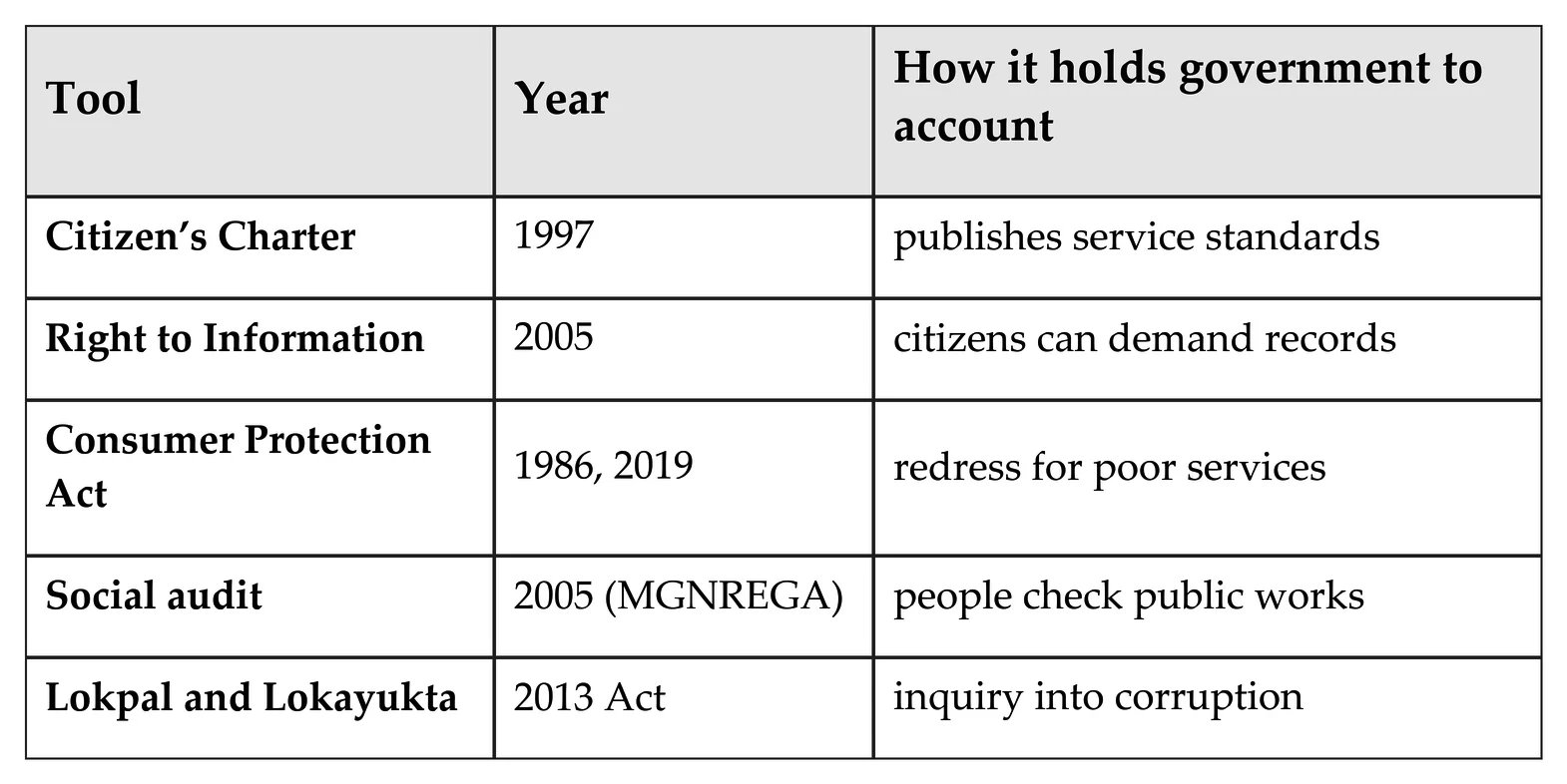
ACCOUNTABILITY means that those who hold public power must answer for its use and face consequences when they fail. In a democracy, elections make governments accountable every few years, but citizens also need tools to hold government to account every day. India has developed several such tools: the Citizen’s Charter, the Right to Information, the Consumer Protection Act, the social audit, and the Lokpal and Lokayukta. This chapter explains each tool, its working and its limits, drawing on Samuel Paul, M. Shamsul Haque, Alok Jain, Patrick Birkinshaw and Sriram Panchu.
3.1 Meaning of Accountability
Accountability has two parts: answerability, the duty of officials to explain and justify their actions, and enforcement, the power to impose penalties or obtain remedies when they fail. It may be vertical, through elections; horizontal, through courts, auditors and legislatures; or social, through citizens, the media and civil society. The tools in this chapter strengthen the link between citizenship and governance by giving citizens the information and the means to demand answers.
3.2 Citizen’s Charter and the Right to Information
A Citizen’s Charter is a public statement by a government department of the standards of service citizens can expect and how they can complain. The Right to Information Act, 2005, gives every citizen the right to seek information from public authorities within thirty days. Together they aim to make administration open and citizen-centred, though Samuel Paul and M. Shamsul Haque show that charters have often been weak in practice.
3.3 Consumer Protection and Social Audit
The Consumer Protection Act of 1986, replaced in 2019, allows citizens to seek quick and cheap redress for defective goods and deficient services, including many public services. A social audit lets the people for whom a programme is meant check its records and works in a public meeting, as required under the Mahatma Gandhi National Rural Employment Guarantee Act of 2005.
3.4 Lokpal and Lokayukta
The Lokpal at the Centre and the Lokayuktas in the states are anti-corruption bodies, modelled on the Scandinavian ombudsman, that inquire into complaints of corruption against public servants. After nearly fifty years of debate and a mass movement in 2011, the Lokpal and Lokayuktas Act was passed in 2013.

3.5 Important Questions
- Question 1 What is a Citizen’s Charter? Examine its working in India.
- Question 2 Discuss the Right to Information Act, 2005, as a tool of good governance.
- Question 3 Discuss the Consumer Protection Act as a tool of accountability.
- Question 4 What is social audit? Discuss its role in ensuring accountability in India.
- Question 5 Discuss the role of the Lokpal and Lokayuktas in fighting corruption in India.
DU asks the same idea in different words. So learn one broad answer for each question below; the same answer works for every question joined by OR.
Important Question 1
What is a Citizen’s Charter? Examine its working in India.
OR
Discuss the objectives and limitations of Citizen’s Charters in India.
OR
How far have Citizen’s Charters made administration citizen-centric in India?
Model Answer
“Recall the face of the poorest and the weakest man whom you may have seen, and ask yourself, if the step you contemplate is going to be of any use to him.”
— M.K. Gandhi, Talisman (1948)
Introduction. A Citizen’s Charter is a written statement by a public organisation that tells citizens what services it provides, what standards they can expect and how they can seek redress. The idea began in Britain in 1991 and was adopted in India in 1997 as part of the effort to make administration responsive and citizen-centric. Scholars such as Samuel Paul and M. Shamsul Haque have examined its working and limits.
1. Meaning
A Citizen’s Charter is a document that sets out the commitment of a government department towards citizens. It lists the services offered, the standards and time limits for each, the information available, the procedure for complaints and the duties expected of citizens. It treats citizens as clients with a right to good service rather than as passive subjects.
2. Origin in Britain
The Citizen’s Charter was launched in Britain in 1991 by Prime Minister John Major. Its principles included clear standards of service, information and openness, choice and consultation, courtesy and helpfulness, putting things right when they go wrong, and value for money. It influenced many countries, including India.

3. Adoption in India
A Conference of Chief Ministers on effective and responsive government in May 1997 adopted an action plan that included Citizen’s Charters for departments dealing with the public. The Department of Administrative Reforms and Public Grievances coordinates the formulation of charters by central ministries, and states have their own charters.
4. Components of a Charter
A typical charter contains a vision and mission statement, details of business transacted, a list of clients, the services provided and their standards, the grievance redress mechanism, what citizens are expected to do, and the date of the next review. Charters are meant to be displayed in offices and on websites.
5. The Sevottam Model
In 2006, the Department of Administrative Reforms developed the Sevottam model, combining sewa, service, and uttam, excellence. It has three parts: the Citizen’s Charter, a grievance redress system and the capability of the organisation to deliver services, and it is linked to the Indian standard IS 15700:2005 for quality in public services.
6. Objectives
Charters aim to make administration transparent and accountable, inform citizens of their entitlements, set measurable standards, reduce delays and harassment, and create a culture of service in the bureaucracy. They link accountability with citizenship by giving citizens a yardstick to judge government.
7. Paul’s Evaluation
Samuel Paul, in his 2008 article ‘India’s Citizen’s Charters: In Search of a Champion’, argued that charters had largely failed because they were prepared without consulting citizens, set vague standards, offered no remedy when standards were not met and lacked a champion at the top to drive and monitor them.
8. Haque on Social Exclusion
M. Shamsul Haque argued that charters in India were limited by social exclusion. The poor, illiterate, women, Dalits and rural people often did not know about charters, could not read them and lacked the power to demand services, so charters mainly served better-off citizens.
9. Other Weaknesses
Charters are not legally enforceable, so citizens cannot claim compensation when they are violated. Many are written in official language, are not updated, and are not backed by training or resources. Officials often see them as a formality rather than a commitment.
10. The 2011 Bill
The Citizens’ Right to Grievance Redress Bill of 2011 sought to make charters legally binding, with time limits, grievance redress officers and penalties for officials who failed to deliver. However, it lapsed with the dissolution of the Lok Sabha in 2014.
11. Right to Services Laws
Many states have passed right to services laws that make the time-bound delivery of specified services a legal right, with penalties on officials for delay. Madhya Pradesh passed the first such law in 2010, followed by Bihar, Delhi, Punjab and others, turning the promise of charters into enforceable rights.
12. Grievance Redress
The Centralised Public Grievance Redress and Monitoring System, known as CPGRAMS, allows citizens to file complaints online against central ministries and track their progress. Grievance redress is the part of the charter that gives citizens a remedy when services fail.
13. The Second Administrative Reforms Commission
The Second Administrative Reforms Commission, in its 2009 report on citizen-centric administration, recommended that charters be prepared after consulting citizens, be precise and measurable, provide remedies for default, and be reviewed regularly.
14. Gandhi’s Talisman
Gandhi’s talisman, asking whether a step would help the poorest person, expresses the spirit that charters should serve. A truly citizen-centric charter would be designed around the needs of the most vulnerable rather than the convenience of officials.
15. Evaluation
Citizen’s Charters introduced the idea that citizens have a right to good service, but without legal backing, consultation and inclusion they have achieved limited results.
Conclusion. Thus, a Citizen’s Charter sets out the standards of service citizens can expect and how they can seek redress. Adopted in India in 1997 and strengthened by the Sevottam model, charters have been weakened by vague standards, lack of remedies and social exclusion, as Paul and Haque show. Right to services laws have begun to make them enforceable.
Important Question 2
Discuss the Right to Information Act, 2005, as a tool of good governance.
OR
Examine the main provisions of the RTI Act and its impact on accountability.
OR
Is the right to information a fundamental human right? Discuss.
Model Answer
“The people of this country have a right to know every public act, everything that is done in a public way, by their public functionaries.”
— Justice K.K. Mathew, State of Uttar Pradesh v. Raj Narain (1975)
Introduction. The Right to Information Act, 2005, is one of India’s most important laws for transparency and accountability. Its preamble states that democracy requires an informed citizenry and transparency of information to contain corruption and hold governments accountable. It grew from the struggles of a grassroots movement and has empowered millions of citizens to question government.
1. Right to Know
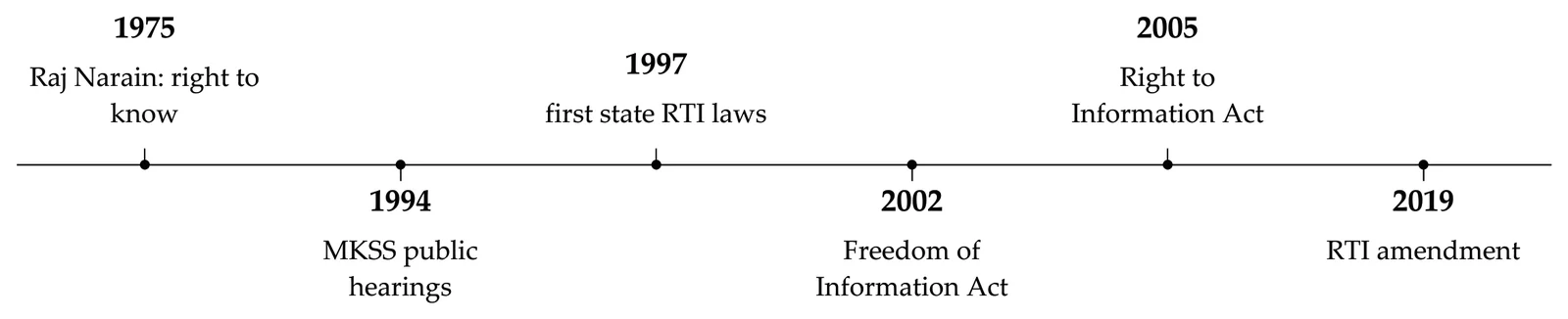
The Supreme Court, in State of Uttar Pradesh v. Raj Narain (1975), held that the people have a right to know about public acts, and later judgments recognised the right to information as part of freedom of speech and expression under Article 19(1)(a).
2. The MKSS Movement
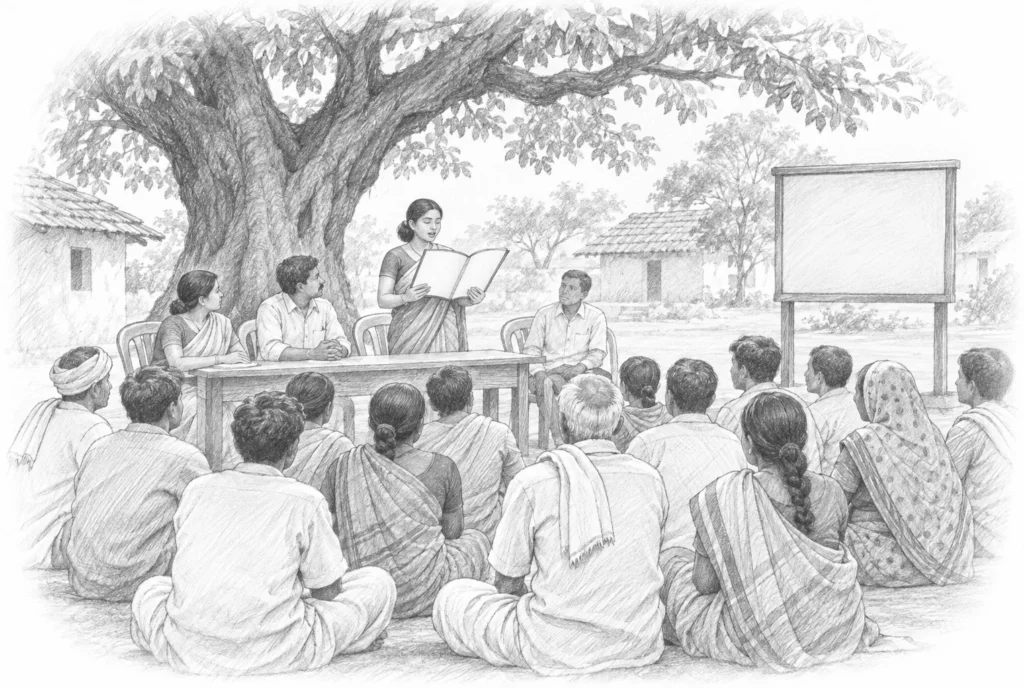
The Mazdoor Kisan Shakti Sangathan, led by Aruna Roy, Nikhil Dey and Shanker Singh, held public hearings in rural Rajasthan from 1994, reading out records of public works and exposing fake bills and muster rolls. Their slogan, ‘our money, our accounts’, launched a national campaign for the right to information.
3. State Laws and the 2002 Act
Tamil Nadu and Goa passed right to information laws in 1997, followed by Rajasthan, Karnataka, Delhi, Maharashtra and others. Parliament passed the Freedom of Information Act in 2002, but it was weak and never came into force, leading to the stronger law of 2005.
4. The 2005 Act
The Right to Information Act was passed in June 2005 and came into force on 12 October 2005. It applies to all public authorities at the central, state and local levels, including bodies substantially financed by government, and gives every citizen the right to request information.
5. The Process
A citizen applies to the Public Information Officer of a public authority with a small fee, waived for people below the poverty line, without having to give reasons. Information must be supplied within thirty days, or within forty-eight hours when it concerns a person’s life or liberty.
6. Proactive Disclosure
Section 4 requires public authorities to publish information about their functions, officers, budgets, decision-making procedures and schemes on their own, so that citizens need to file fewer requests.
7. Appeals and Commissions
If information is refused, the citizen may make a first appeal within the department and a second appeal to the Central or State Information Commission. Commissions can impose penalties of Rs 250 a day, up to Rs 25,000, on officers who refuse or delay information without reason.
8. Exemptions
Section 8 exempts information that would harm sovereignty and security, cabinet papers before decisions, information received in confidence and personal information unrelated to public interest. Some security and intelligence organisations are exempt, except for allegations of corruption and human rights violations.
9. Impact on Governance
RTI has exposed scams in ration shops, public works and housing, helped citizens obtain pensions, ration cards and passports, and made officials aware that their decisions can be examined. It has become a tool of everyday citizenship for millions of Indians.
10. Jain on RTI and Good Governance
Alok Jain argues that the right to information is a foundation of good governance because it promotes transparency, reduces corruption and enables participation. Without information, citizens cannot judge government performance or demand accountability.
11. Birkinshaw on Freedom of Information
Patrick Birkinshaw argues that freedom of information should be seen as a fundamental human right, because access to information is necessary for the exercise of other rights, such as free speech, participation and holding power to account.
12. Important Judgments
The Supreme Court has held that students may see their evaluated answer sheets (2011) and that the office of the Chief Justice of India is a public authority under the Act (2019), widening the reach of transparency.
13. Amendments and Concerns
The 2019 amendment allowed the central government to fix the tenure and salaries of Information Commissioners, which critics said weakened their independence. The Digital Personal Data Protection Act of 2023 widened the exemption for personal information.
14. Challenges
Challenges include large backlogs of appeals, vacancies in commissions, poor record-keeping, weak proactive disclosure and attacks on RTI activists, many of whom have been harassed or killed for exposing corruption.
15. Evaluation
The RTI Act has transformed the relationship between citizens and government in India, though its strength depends on independent commissions and protection of users.
Conclusion. Thus, the Right to Information Act, 2005, born of the MKSS movement and the courts’ recognition of the right to know, allows every citizen to seek information from public authorities. As Jain and Birkinshaw argue, it is a foundation of good governance and a human right, but amendments, backlogs and attacks on users threaten its effectiveness.
Important Question 3
Discuss the Consumer Protection Act as a tool of accountability.
OR
Examine the main features of the Consumer Protection Act, 2019.
OR
How does consumer protection strengthen the relationship between citizens and governance?
Model Answer
“Consumers, by definition, include us all. They are the largest economic group in the economy, affecting and affected by almost every public and private economic decision.”
— John F. Kennedy, Message to Congress (15 March 1962)
Introduction. Citizens are also consumers of goods and services, many of them provided by government. The Consumer Protection Act of 1986 created a simple, cheap and quick system of redress for consumers, and the Consumer Protection Act of 2019 updated it for the age of e-commerce. Because public services such as housing, health, transport and electricity are covered, consumer law is also a tool of accountability in governance.
1. Consumer Rights
The consumer movement grew after US President John F. Kennedy declared basic consumer rights on 15 March 1962, now observed as World Consumer Rights Day. Indian law recognises six rights: safety, information, choice, to be heard, to seek redress and to consumer education.
2. The 1986 Act
The Consumer Protection Act received assent on 24 December 1986, now observed as National Consumer Day. It created consumer protection councils to promote consumer rights and a three-tier system of quasi-judicial bodies at the district, state and national levels to settle disputes.

3. Simple and Cheap Redress
Unlike ordinary courts, consumer forums have simple procedures, low fees and no need for lawyers. Consumers can complain about defective goods, deficient services, unfair trade practices and overcharging, and forums can order replacement, refund or compensation.
4. Saxena’s Viewpoint
I. Saxena, writing in 1988, welcomed the 1986 Act as a step towards speedy and inexpensive justice for consumers, while pointing to gaps in its drafting and enforcement that could limit its effectiveness unless the forums were properly staffed and supported.
5. Public Services Covered
The Supreme Court held in Lucknow Development Authority v. M.K. Gupta (1994) that housing provided by a statutory authority is a service under the Act, and in Indian Medical Association v. V.P. Shantha (1995) that medical services are covered. This brought many public bodies within consumer law.
6. Accountability of Public Bodies
In the Lucknow Development Authority case, the Court also said that compensation paid for harassment by public officials could be recovered from the officers responsible. Consumer forums thus became a way for citizens to hold public utilities, such as electricity boards, railways and the post office, accountable.
7. The 2019 Act
The Consumer Protection Act, 2019, which came into force in July 2020, replaced the 1986 Act. It covers online and offline transactions, adds product liability and mediation, and allows complaints to be filed where the consumer lives and online through the e-Daakhil portal.
8. Central Consumer Protection Authority
The 2019 Act created the Central Consumer Protection Authority, which can investigate violations of consumer rights, order recalls of unsafe goods, act against unfair trade practices and impose penalties for false or misleading advertisements, including on celebrity endorsers.
9. Pecuniary Limits
Under rules of 2021, District Commissions hear claims up to Rs 50 lakh, State Commissions claims between Rs 50 lakh and Rs 2 crore, and the National Commission claims above Rs 2 crore, along with appeals.
10. E-Commerce
The Consumer Protection (E-Commerce) Rules of 2020 require online platforms to show details of sellers, prices and return policies, appoint grievance officers and avoid unfair practices, extending accountability to the digital market.
11. Consumer and Citizen
The consumer approach treats citizens as clients who are entitled to quality service, an idea linked with New Public Management. It empowers citizens to demand standards but may reduce citizenship to buying services, neglecting rights and participation.
12. Achievements
Consumer forums have handled millions of cases and awarded compensation against banks, builders, hospitals, airlines and public utilities. They have raised awareness of consumer rights and made sellers and service providers more careful.
13. Challenges
Challenges include delays and pending cases, vacancies in commissions, poor infrastructure, low awareness among rural and poor consumers, and the difficulty of enforcing orders against powerful companies and government bodies.
14. Consumer Awareness
Campaigns such as ‘Jago Grahak Jago’ and the National Consumer Helpline aim to inform consumers of their rights. Awareness is essential, because consumer law works only when citizens know how to use it.
15. Evaluation
The Consumer Protection Act has given citizens a practical remedy against poor goods and services, including public services, though delays and low awareness limit its reach.
Conclusion. Thus, the Consumer Protection Act of 1986, and its successor of 2019, created a simple, cheap and three-tier system of redress, and the courts extended it to public services. It strengthens accountability by allowing citizens to hold both businesses and public bodies answerable, though delays and low awareness remain challenges.
Important Question 4
What is social audit? Discuss its role in ensuring accountability in India.
OR
Examine the practice of social audit under MGNREGA.
OR
How does social audit empower citizens to hold government accountable?
Model Answer
“The Gram Sabha shall conduct regular social audits of all the projects under the Scheme taken up within the Gram Panchayat.”
— Mahatma Gandhi National Rural Employment Guarantee Act, 2005, Section 17(2)
Introduction. A social audit is a process in which the people who are meant to benefit from a government programme examine its records and works, and publicly discuss the findings with officials. It combines the right to information with participation, turning citizens into auditors of government. In India, social audit grew from the MKSS public hearings and became a legal requirement under MGNREGA.
1. Meaning
A social audit is a review of a public programme by the community it serves. Unlike a financial audit by experts, it checks not only whether money was spent according to rules but also whether the work was done, whether it met people’s needs and whether the intended beneficiaries actually received benefits.
2. Origin in the MKSS Hearings
The Mazdoor Kisan Shakti Sangathan began public hearings, called jan sunwais, in rural Rajasthan in 1994. Villagers read out records of public works and found payments for works never done and wages for workers who did not exist, exposing corruption and pressing for its correction.

3. Steps of a Social Audit
A social audit involves collecting records such as muster rolls, bills and sanctions; verifying them by visiting work sites and meeting workers door to door; holding a public hearing in the gram sabha where findings are read out; and preparing an action taken report to correct wrongs and recover money.
4. MGNREGA and Section 17
The Mahatma Gandhi National Rural Employment Guarantee Act of 2005 made social audit a legal requirement. Section 17 provides that the gram sabha shall monitor works and conduct regular social audits, and that the gram panchayat shall make all relevant documents available.
5. The Audit of Schemes Rules, 2011
The Audit of Schemes Rules, framed in 2011 in consultation with the Comptroller and Auditor General, require each state to set up a social audit unit independent of the implementing agency and to conduct social audits in every gram panchayat at least twice a year.
6. Andhra Pradesh Model
Andhra Pradesh became the first state to carry out social audits on a large scale from 2006, and in 2009 set up an independent society for social audit. Its trained village resource persons verified records across the state, recovering misused funds and acting against officials.
7. Wider Use
Social audits are now required under other laws and schemes, such as the National Food Security Act of 2013. Meghalaya passed a law in 2017 to make social audits of public programmes a right, the first state to do so.
8. Link with RTI
Social audit depends on access to records, so it is closely linked with the right to information. RTI gives citizens the documents, and social audit gives them a public forum to verify and discuss them.
9. Benefits for Accountability
Social audits expose corruption, recover misused money, deter future wrongdoing and make officials answerable to the community. They also educate people about their entitlements and build their confidence to question authority.
10. Empowering Citizens
Social audits turn beneficiaries into active citizens who monitor government. Poor and marginalised people, especially women and Dalit labourers, gain a voice in public meetings, which strengthens participatory democracy at the grassroots.
11. Decentralisation and Service Delivery
S. Sangita argues that decentralisation can improve service delivery when local communities have information and power to monitor services. Social audits give gram sabhas a practical role in holding local governments and officials accountable.
12. Challenges
Social audit units in many states lack independence, staff and funds. Records are often not provided, local elites dominate meetings, and findings are not acted upon, so wrongdoers escape punishment.
13. Resistance
Officials and local power holders often resist social audits because they expose corruption. Social audit teams and activists have faced threats and violence, which discourages participation.
14. Supreme Court’s Role
The Supreme Court, in cases on drought relief and rural employment, has directed governments to strengthen social audit units and ensure that audits are conducted regularly, recognising them as a means of accountability.
15. Evaluation
Social audit is a powerful tool that combines information and participation, but it needs independent units, political support and protection for participants.
Conclusion. Thus, social audit allows the people a programme serves to examine its records and works in public. Born in the MKSS hearings and made mandatory under MGNREGA, it empowers citizens and exposes corruption, though weak units, elite capture and resistance from officials limit its effectiveness.
Important Question 5
Discuss the role of the Lokpal and Lokayuktas in fighting corruption in India.
OR
Examine the main provisions of the Lokpal and Lokayuktas Act, 2013.
OR
Trace the evolution of the Lokpal in India and assess its effectiveness.
Model Answer
“Just as it is impossible not to taste the honey or the poison that finds itself at the tip of the tongue, so it is impossible for a government servant not to eat up, at least, a bit of the king’s revenue.”
— Kautilya, Arthashastra, Book II (tr. R. Shamasastry)
Introduction. Corruption weakens governance, denies citizens their rights and destroys trust in democracy. To fight it, India created the Lokpal at the Centre and Lokayuktas in the states, independent bodies that inquire into complaints of corruption against public servants. The idea took nearly fifty years to become law, and its working has raised many questions, as Sriram Panchu shows.
1. The Ombudsman Idea
The Lokpal is based on the ombudsman, an independent official who investigates complaints against public authorities. Sweden created the first ombudsman in 1809, and the idea spread to other Scandinavian countries, Britain, New Zealand and many others.
2. Early History in India
The term Lokpal was suggested by L.M. Singhvi in 1963. In 1966, the first Administrative Reforms Commission, chaired initially by Morarji Desai, recommended a Lokpal at the Centre and Lokayuktas in the states to redress citizens’ grievances against the administration.
3. Failed Bills
A Lokpal bill was first introduced in 1968 and passed by the Lok Sabha in 1969, but lapsed. Further bills between 1971 and 2008 also lapsed, as governments were reluctant to create a strong body that could investigate ministers and officials.
4. The 2011 Movement
In 2011, after several corruption scandals, the India Against Corruption movement led by Anna Hazare demanded a strong Jan Lokpal. Mass protests and fasts across the country pressured Parliament, which finally passed the Lokpal and Lokayuktas Act in December 2013.
5. Composition
The Lokpal consists of a chairperson and up to eight members, at least half of whom must be judicial members. At least half of the members must be from Scheduled Castes, Scheduled Tribes, Other Backward Classes, minorities or women.
6. Selection
Members are appointed by the President on the recommendation of a selection committee of the Prime Minister, the Speaker of the Lok Sabha, the Leader of the Opposition, the Chief Justice of India or a judge nominated by them, and an eminent jurist.
7. Jurisdiction
The Lokpal can inquire into allegations of corruption against the Prime Minister, with safeguards, ministers, Members of Parliament and central government officials of all groups. It also covers bodies receiving government funds and certain organisations receiving foreign donations.
8. Powers
The Lokpal has an inquiry wing and a prosecution wing and can direct the Central Bureau of Investigation to investigate cases. It can recommend transfer or suspension of officials and order attachment of property obtained through corruption.
9. Delay in Appointment
Although the Act came into force in January 2014, the first Lokpal, Justice Pinaki Chandra Ghose, was appointed only in March 2019. The delay was partly blamed on the absence of a recognised Leader of the Opposition, though the Supreme Court held in 2017 that this was no bar.
10. Lokayuktas
Maharashtra set up the first Lokayukta in 1972 under a law of 1971. Karnataka’s Lokayukta became well known for exposing illegal mining. The 2013 Act required every state to set up a Lokayukta within a year, though many states delayed.
11. Panchu’s Critique
Sriram Panchu, writing in 2011 and 2012, traced how the Lokpal bill evolved and argued that it needed repair. He stressed that the Lokpal must be independent of government in appointment, funding and investigation, and must have its own investigative capacity to be effective.
12. Working of the Lokpal
In its early years, the Lokpal received relatively few complaints in the required format, many of which were outside its jurisdiction, and it conducted few full investigations. Critics argue that it has not yet become the strong body the movement demanded.
13. Other Anti-Corruption Bodies
The Lokpal works alongside the Central Vigilance Commission, the Central Bureau of Investigation and the Comptroller and Auditor General. Coordination among these bodies and protection of whistle-blowers are necessary for effective action against corruption.
14. Limitations
Limitations include dependence on government for staff and funds, the CBI’s control by the government, complex procedures for complaints, the exclusion of the judiciary and the risk of political influence in appointments.
15. Evaluation
The Lokpal and Lokayuktas are important institutions of accountability, but their success depends on independence, resources and political will.
Conclusion. Thus, the Lokpal and Lokayuktas, based on the ombudsman idea and recommended in 1966, became law only in 2013 after a mass movement. They can inquire into corruption by the highest public servants, but delays, dependence on government and weak investigative capacity, as Panchu argues, have limited their role in fighting corruption.
Short Notes
(a) Sevottam
A model of citizen-centric service delivery developed in 2006, combining the Citizen’s Charter, grievance redress and the capability of organisations to deliver services.
(b) Jan sunwai
A public hearing in which records of public works are read out before villagers, begun by the Mazdoor Kisan Shakti Sangathan in Rajasthan in 1994 and the forerunner of social audit.
(c) Lokayukta
A state-level anti-corruption ombudsman. Maharashtra set up the first in 1972, and the Lokpal and Lokayuktas Act of 2013 required every state to have one.
More notes: MDSE-9 Citizenship and Governance
These notes are prepared by PADHO TO AISE for study help. They are not an official University of Delhi publication.