
Semester VII MDSE-9 Citizenship and Governance
Unit II · 20 min read · Updated 24 Nov 2026
As per the University of Delhi (DU) BA (Hons) Political Science syllabus
Contents
- 2.1 Meaning of Governance
- 2.2 Democracy and Governance
- 2.3 Good Governance and E-Governance
- 2.4 Important Questions
- What is governance? Distinguish between government and governance.
- Discuss the relationship between democracy and governance.
- What is good governance? Discuss its main features.
- What is e-governance? Discuss its role in promoting good governance in India.
- Short Notes
सुशासन शायद गरीबी मिटाने और विकास को बढ़ावा देने का सबसे महत्वपूर्ण कारक है।
Good governance is perhaps the single most important factor in eradicating poverty and promoting development.
— Kofi Annan, Annual Report on the Work of the Organization (1998)
GOVERNANCE is the way power is exercised in managing a country’s affairs. It is wider than government, because it includes markets, civil society and networks as well as the state. Since the World Bank began to speak of governance in 1989, good governance, meaning accountable, transparent, responsive and efficient government, has become a goal of reform everywhere. This chapter explains the meaning of governance, its relationship with democracy, and the ideas of good governance and e-governance, drawing on H. George Frederickson, Adrian Leftwich, Yu Keping, Bob Currie and the World Development Report 2017.

2.1 Meaning of Governance
Governance means the process by which a society is steered and its affairs managed. The World Bank in 1992 defined it as the manner in which power is exercised in the management of a country’s economic and social resources for development. Unlike government, which refers to the formal institutions of the state, governance includes the market, civil society and networks of public and private actors. H. George Frederickson and his co-authors treat governance as a broad framework for understanding how public purposes are achieved today.
2.2 Democracy and Governance
Democracy is about who rules and how authority is made legitimate, through elections, rights and accountability. Governance is about how power is exercised and how well public needs are met. Adrian Leftwich argued that good governance depends on the political character of the state, not just on administrative reform, and Bob Currie questioned the easy assumption that democracy, good governance and market reform always go together in India.

2.3 Good Governance and E-Governance
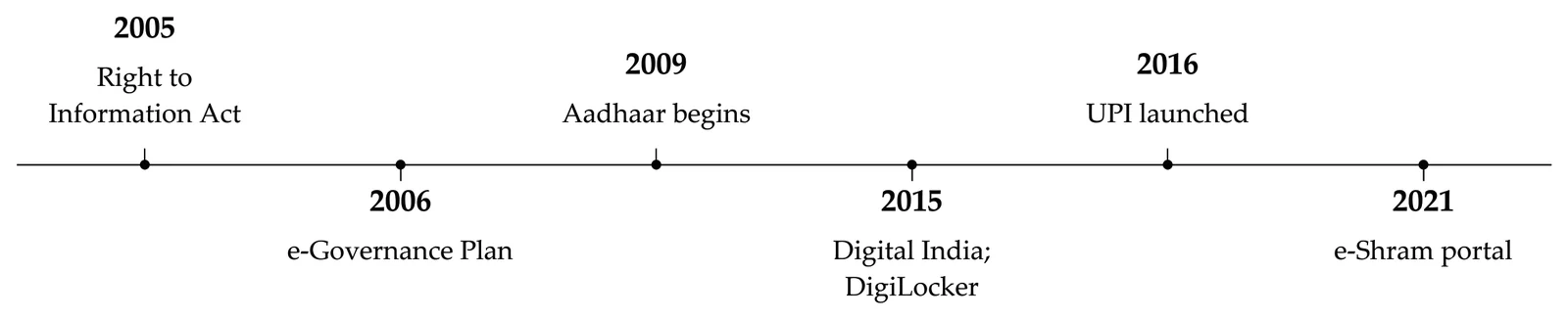
Good governance means governance that is participatory, transparent, accountable, responsive, effective and fair, and that follows the rule of law. E-governance uses information and communication technology to deliver services, share information and connect citizens with government. In India, the National e-Governance Plan of 2006 and Digital India of 2015 have made e-governance central to the pursuit of good governance.
2.4 Important Questions
- Question 1 What is governance? Distinguish between government and governance.
- Question 2 Discuss the relationship between democracy and governance.
- Question 3 What is good governance? Discuss its main features.
- Question 4 What is e-governance? Discuss its role in promoting good governance in India.
DU asks the same idea in different words. So learn one broad answer for each question below; the same answer works for every question joined by OR.
Important Question 1
What is governance? Distinguish between government and governance.
OR
Explain the meaning and nature of governance.
OR
Discuss the rise of the concept of governance in political science.
Model Answer
“Governance is the manner in which power is exercised in the management of a country’s economic and social resources for development.”
— World Bank, Governance and Development (1992)
Introduction. Governance has become one of the most widely used words in political science and public administration since the late 1980s. It refers to the process of steering a society and managing its affairs, and it is wider than government because it involves many actors beyond the state. Understanding the difference between government and governance helps explain how public policy is made and delivered today.
1. Origin of the Word
The word governance comes from the Greek kubernao and the Latin gubernare, meaning to steer a ship. It was long used as a synonym for government, but from the late 1980s it acquired a new meaning, referring to the wider process of steering society through many actors and institutions.
2. The World Bank Definitions
The World Bank’s 1989 report on Sub-Saharan Africa traced the region’s problems to a crisis of governance. Its 1992 report, Governance and Development, defined governance as the manner in which power is exercised in managing a country’s economic and social resources for development, focusing on public sector management, accountability, the legal framework and transparency.
3. The UNDP Definition
The United Nations Development Programme in 1997 defined governance as the exercise of economic, political and administrative authority to manage a country’s affairs at all levels. It includes the mechanisms, processes and institutions through which citizens and groups express their interests, exercise their rights, meet their obligations and settle their differences.
4. Government and Governance
Government refers to the formal institutions of the state, such as the legislature, executive and judiciary, which make and enforce laws through authority and command. Governance is a wider process in which the state works with markets, civil society and international bodies through networks, partnerships and negotiation to achieve public goals.
5. Actors of Governance
Governance involves three sets of actors: the state, which provides laws and public services; the market, which produces goods and jobs; and civil society, including voluntary groups, the media and community organisations, which voice citizens’ interests and hold the state accountable. Good governance requires cooperation among all three.
6. Rhodes and Stoker
R.A.W. Rhodes described governance as governing without government, through self-organising networks of public and private actors. Gerry Stoker, in 1998, argued that governance refers to institutions and actors drawn from but also beyond government, blurred boundaries between public and private, and a reliance on steering rather than direct command.
7. Frederickson on Governance Theory
H. George Frederickson and his co-authors explain that governance theory studies how public purposes are achieved through contracts, partnerships, networks and intergovernmental relations. They see governance as an umbrella for the many ways in which public administration now works beyond the boundaries of a single government agency.
8. Reasons for the Rise of Governance
The concept grew because of the fiscal crisis of the welfare state, the New Public Management reforms of the 1980s, globalisation, privatisation and the growth of non-governmental organisations. International lenders also promoted governance reforms as conditions for aid and structural adjustment in developing countries.
9. Levels of Governance
Governance operates at many levels: global governance through bodies such as the United Nations and the World Trade Organization; national governance; and local governance through panchayats, municipalities and community groups. The idea of multi-level governance describes how authority is shared among these levels.
10. Types of Governance
Scholars speak of corporate governance in companies, network governance among public and private partners, participatory governance involving citizens directly, and e-governance using digital technology. Each type stresses a different way of coordinating action and achieving public goals.
11. Levi-Faur on Big Governance
David Levi-Faur argues that we have moved from big government to big governance. The state has not shrunk but now governs through regulation, agencies and networks, so that governance has expanded rather than replaced the state, creating a regulatory state that steers many actors.
12. Capano: Bringing Government Back In
Giliberto Capano argues that studies of governance often underestimated the role of government. In practice, governments still design the rules, choose policy instruments and steer networks, so the state remains the central actor in governance even when it shares power with others.
13. Keping on Governance
Yu Keping explains governance as the exercise of public authority to maintain order and meet public needs through cooperation between government and citizens. He sees good governance as a process that maximises the public interest, built on legitimacy, transparency, accountability, rule of law, responsiveness and effectiveness.
14. Criticisms
Critics say the idea of governance is vague and can be used to weaken the state, promote markets and shift responsibility onto private and voluntary actors. Leftwich argued that the governance agenda treated political problems as technical ones, ignoring questions of power and interest.
15. Evaluation
Governance broadens our understanding of how societies are steered, but government remains central, and accountability must be preserved as power spreads across many actors.
Conclusion. Thus, governance is the manner in which power is exercised in managing a country’s resources and affairs. It is wider than government, involving the state, market and civil society in networks of cooperation. Scholars such as Rhodes, Stoker and Frederickson explain its rise, while Capano and Levi-Faur remind us that the state still steers.
Important Question 2
Discuss the relationship between democracy and governance.
OR
Is democracy necessary for good governance? Discuss.
OR
Examine Leftwich’s views on governance, democracy and development.
Model Answer
“Government of the people, by the people, for the people, shall not perish from the earth.”
— Abraham Lincoln, Gettysburg Address (1863)
Introduction. Democracy and governance are closely related but distinct ideas. Democracy concerns the source and legitimacy of power, while governance concerns how power is exercised and how well public needs are met. Many scholars and international agencies argue that democracy and good governance support each other, but others, such as Adrian Leftwich and Bob Currie, show that the relationship is complex.
1. Meaning of Democracy
Democracy is a system in which people rule, directly or through elected representatives, with free and fair elections, political rights, the rule of law and accountability of rulers. Lincoln’s famous phrase describes it as government of the people, by the people and for the people.
2. Meaning of Governance
Governance is the way power is exercised in managing a country’s economic and social resources. It concerns the quality of policy-making, administration, service delivery and accountability, and it involves the state, the market and civil society working together.
3. How They Differ
Democracy answers the question of who governs and how they are chosen, while governance answers the question of how well they govern. A country may be democratic in its elections but weak in governance, with corruption and poor services, while an authoritarian state may deliver efficient administration.
4. Democracy Supports Governance
Democracy promotes good governance through accountability, because rulers who must face elections have reasons to respond to citizens’ needs. A free press, independent courts and opposition parties expose corruption and misuse of power, and political rights allow citizens to demand better services.
5. Sen on Famines
Amartya Sen observed that no substantial famine has occurred in a functioning democracy with regular elections and a free press, because governments that face criticism and elections have strong incentives to prevent disasters. This shows how democracy can improve governance outcomes.
6. Governance Supports Democracy
Good governance also strengthens democracy. When governments deliver services fairly and efficiently, citizens trust democratic institutions. Poor governance, with corruption and failure to deliver, can lead citizens to lose faith in democracy and turn to authoritarian alternatives.
7. Leftwich’s Three Levels
Adrian Leftwich, in 1993, distinguished three senses of good governance: systemic, concerning how power is distributed among state, market and society; political, concerning a state with legitimacy and a democratic mandate; and administrative, concerning an efficient, open and accountable public service.
8. Leftwich’s Critique
Leftwich argued that the Western agencies’ claim that democratic good governance leads to development was too simple. He pointed to developmental states, such as South Korea and Taiwan, which achieved rapid growth under authoritarian rule, and argued that what matters is the political capacity of the state.
9. The Developmental State
For Leftwich, a developmental state is one whose political elite is committed to development and has a competent, insulated bureaucracy able to direct the economy. Development, he argued, depends on politics and state capacity, and democratic good governance may be a result rather than a precondition of development.
10. Currie on India
Bob Currie examined how the World Bank’s idea of governance applied to India’s economic adjustment after 1991. He pointed to conceptual and empirical problems in assuming that democracy, good governance and market reform always go together, since democratic pressures in India often shaped and slowed reform.
11. The World Development Report 2017
The World Development Report 2017, Governance and the Law, argued that policies fail not because of bad design but because of power asymmetries. It identified commitment, coordination and cooperation as the core functions that institutions must perform, and stressed that the function of institutions matters more than their form.
12. Accountability
Democracy creates several forms of accountability: vertical accountability through elections, horizontal accountability through courts, auditors and legislatures, and social accountability through civil society and the media. Together they connect democracy with good governance.
13. India’s Experience
India has a strong electoral democracy with high participation, but faces governance problems such as corruption, delays and weak delivery of services. Reforms like the Right to Information, social audits and e-governance aim to bring the quality of governance closer to democratic ideals.
14. Governance without Democracy
Some argue that efficiency can be achieved without democracy, pointing to China and Singapore. Critics reply that governance without democracy lacks accountability, protects rulers rather than citizens and cannot guarantee rights, so its gains may not last.
15. Evaluation
Democracy and governance are mutually supportive but not identical. Democracy provides legitimacy and accountability, while good governance gives democracy substance.
Conclusion. Thus, democracy concerns who rules and how, while governance concerns how well power is exercised. Democracy supports good governance through accountability, and good governance strengthens trust in democracy. Leftwich and Currie warn that the link is complex and depends on politics and state capacity, as India’s experience shows.
Important Question 3
What is good governance? Discuss its main features.
OR
Explain the concept of good governance with reference to India.
OR
Discuss the characteristics of good governance identified by the United Nations.
Model Answer
“Good governance is perhaps the single most important factor in eradicating poverty and promoting development.”
— Kofi Annan, Annual Report on the Work of the Organization (1998)
Introduction. Good governance is a normative idea that describes how power should be exercised. It became popular in the 1990s through the World Bank, the United Nations and other international agencies, which saw it as essential for development and democracy. In India, good governance has become a central goal of administrative reform, from the Second Administrative Reforms Commission to digital initiatives.
1. Meaning of Good Governance
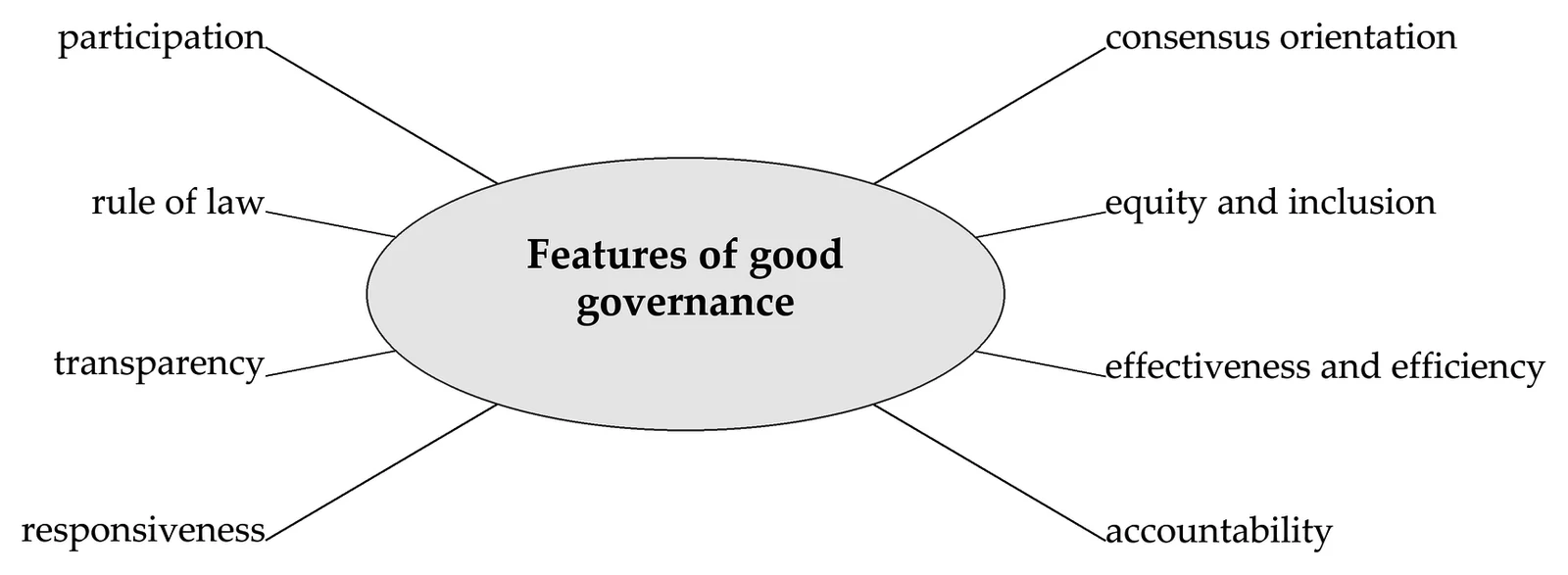
Good governance means the exercise of authority in a way that is participatory, transparent, accountable, responsive, effective and fair, and that follows the rule of law. It aims to ensure that corruption is minimised, the views of minorities are considered and the voices of the most vulnerable are heard in decision-making.
2. Origin of the Idea
The World Bank, the International Monetary Fund and donor countries promoted good governance in the 1990s as a condition for aid and loans. They argued that development failed in many countries because of corruption, weak institutions and poor management, and that better governance would make aid effective.
3. Participation
Good governance requires that men and women participate in decisions, directly or through legitimate representatives and organisations. Participation needs freedom of association and expression and an organised civil society, so that citizens can shape the policies that affect them.
4. Rule of Law
Good governance requires fair legal frameworks enforced impartially, full protection of human rights, especially of minorities, an independent judiciary and an impartial and incorruptible police force. No one, including rulers, should be above the law.
5. Transparency
Transparency means that decisions are taken and enforced according to rules, and that information is freely available and directly accessible to those affected. India’s Right to Information Act of 2005 is an important tool for transparency.
6. Responsiveness
Responsiveness means that institutions and processes try to serve all stakeholders within a reasonable time. Citizen’s Charters, grievance portals and time-bound service laws aim to make government more responsive to citizens’ needs.
7. Consensus Orientation
Good governance mediates between the different interests in society to reach a broad consensus on what is in the best interest of the whole community and how it can be achieved, taking a long-term view of human development.
8. Equity and Inclusiveness
Good governance ensures that all members of society, especially the most vulnerable, feel they have a stake in it and are not excluded from the mainstream. Policies for women, Dalits, Adivasis, minorities and the poor are part of inclusive governance.
9. Effectiveness and Efficiency
Good governance means that processes and institutions produce results that meet the needs of society while making the best use of resources, including the sustainable use of natural resources and protection of the environment.
10. Accountability
Accountability is a key requirement of good governance. Government institutions, the private sector and civil society organisations must be accountable to the public and to those affected by their decisions. Accountability cannot be enforced without transparency and the rule of law.
11. Keping’s Elements
Yu Keping describes good governance as a process of social management that maximises the public interest through cooperation between government and citizens. He lists elements such as legitimacy, transparency, accountability, rule of law, responsiveness and effectiveness, stressing that good governance needs active citizens.
12. Good Governance in India
The Second Administrative Reforms Commission, set up in 2005, made recommendations on ethics in governance, citizen-centric administration, e-governance and local government. Since 2014, India observes Good Governance Day on 25 December, and a Good Governance Index was launched in 2019.
13. Tools in India
India has adopted many tools of good governance, including the Right to Information, Citizen’s Charters, social audits, the Lokpal, e-governance, direct benefit transfers and public grievance portals such as CPGRAMS, which aim to make administration more open and accountable.
14. Criticisms
Critics argue that good governance was imposed by donors, reflects Western models and focuses on markets and efficiency rather than justice. Leftwich warned that it ignores politics, while others note that good governance means little without social and economic equality.
15. Evaluation
Good governance sets valuable standards for how power should be exercised, but it must be grounded in democracy, social justice and local conditions.
Conclusion. Thus, good governance means governance that is participatory, transparent, accountable, responsive, effective, equitable, consensus-oriented and based on the rule of law. Promoted by international agencies since the 1990s and explained by scholars such as Keping, it has become a central goal of administrative reform in India.
Important Question 4
What is e-governance? Discuss its role in promoting good governance in India.
OR
Examine the major e-governance initiatives in India.
OR
Discuss the opportunities and challenges of e-governance in India.
Model Answer
“Make all Government services accessible to the common man in his locality, through common service delivery outlets and ensure efficiency, transparency and reliability of such services at affordable costs to realise the basic needs of the common man.”
— Vision of the National e-Governance Plan (2006)
Introduction. E-governance means the use of information and communication technology by government to deliver services, share information and interact with citizens and businesses. In India, it has grown from small state projects in the late 1990s to national programmes such as the National e-Governance Plan and Digital India. Scholars such as Alka Saxena and S. Yadav link e-governance with good governance and administrative reform.
1. Meaning of E-Governance
E-governance is the application of information and communication technology to the functions of government. It aims to make government simple, moral, accountable, responsive and transparent, which the Second Administrative Reforms Commission summed up as SMART government in its report of 2008.
2. Types of Interaction
E-governance involves four types of interaction: government to citizen (G2C), such as online certificates; government to business (G2B), such as online tax filing; government to government (G2G), such as data sharing between departments; and government to employee (G2E), such as online payroll.
3. Early State Projects
Early projects included Gyandoot in Dhar district of Madhya Pradesh (2000), which set up rural information kiosks; FRIENDS in Kerala for bill payments; Bhoomi in Karnataka, which computerised land records; and e-Seva in Andhra Pradesh, which offered many services at one centre.
4. The Legal Framework
The Information Technology Act of 2000 gave legal recognition to electronic records and digital signatures, making e-governance possible. The Digital Personal Data Protection Act of 2023 now regulates how personal data is collected and used.
5. The National e-Governance Plan
The National e-Governance Plan, approved in 2006, included 27 Mission Mode Projects in areas such as passports, income tax, land records and police, later expanded. It set up State Wide Area Networks, State Data Centres and Common Service Centres to bring services close to citizens.
6. Digital India
Digital India, launched on 1 July 2015, aims to provide digital infrastructure as a utility to every citizen, governance and services on demand, and digital empowerment of citizens. It includes DigiLocker, e-Hospital, the BharatNet broadband network and e-Kranti, the second phase of the national plan.
7. Aadhaar and the JAM Trinity
Aadhaar, a unique identity number based on biometrics, has been linked with Jan Dhan bank accounts and mobile phones to form the JAM trinity. This enables Direct Benefit Transfer of subsidies and welfare payments into bank accounts, reducing leakages and middlemen.
8. Digital Payments and Platforms
The Unified Payments Interface, launched in 2016, made India a leader in digital payments. Platforms such as the Government e-Marketplace for public purchases, the e-Shram portal for informal workers and CoWIN for vaccination show the reach of digital public infrastructure.
9. Benefits for Good Governance
E-governance increases transparency by putting information online, reduces corruption by cutting discretion and middlemen, saves time and cost, improves efficiency and allows citizens to track applications and lodge grievances online.
10. Saxena on E-Governance
Alka Saxena argues that e-governance can promote good governance in India by making administration transparent and citizen-friendly, but only if it is accompanied by reform of administrative processes, training of officials and attention to citizens’ needs.
11. Yadav on Administrative Reform
S. Yadav argues that implementing e-governance is part of the wider administrative reform agenda. Technology alone cannot change government; it must be combined with re-engineering of processes, changes in organisational culture and political commitment.
12. The Digital Divide
Many citizens, especially the rural poor, the elderly and women, lack internet access, devices or digital skills. This digital divide can exclude them from services, as when biometric authentication failures have denied people their rations.
13. Privacy and Surveillance
Large databases raise concerns about privacy, data security and surveillance. In the Puttaswamy judgment of 2017, the Supreme Court held privacy to be a fundamental right, and in 2018 it upheld Aadhaar for welfare but limited its use by private companies.
14. Other Challenges
Other challenges include poor connectivity in remote areas, lack of services in local languages, resistance within the bureaucracy, cyber security threats and projects designed without consulting users.
15. Evaluation
E-governance has made many services faster and more transparent, but it must be inclusive, protect privacy and support rather than replace human contact.
Conclusion. Thus, e-governance uses technology to make government SMART: simple, moral, accountable, responsive and transparent. From Gyandoot and Bhoomi to the National e-Governance Plan, Digital India, Aadhaar and UPI, it has transformed service delivery in India, but the digital divide and privacy concerns must be addressed for it to promote good governance.
Short Notes
(a) Governance
The manner in which power is exercised in managing a country’s economic and social resources, involving the state, the market and civil society, as defined by the World Bank in 1992.
(b) SMART government
The aim of e-governance described by the Second Administrative Reforms Commission in 2008: simple, moral, accountable, responsive and transparent government.
(c) Digital India
A programme launched on 1 July 2015 to provide digital infrastructure, governance and services on demand, and digital empowerment of citizens, including DigiLocker and BharatNet.
More notes: MDSE-9 Citizenship and Governance
These notes are prepared by PADHO TO AISE for study help. They are not an official University of Delhi publication.