
Semester VII MDSE-9 Citizenship and Governance
Unit I · 18 min read · Updated 24 Nov 2026
As per the University of Delhi (DU) BA (Hons) Political Science syllabus
Contents
- 1.1 What Is Citizenship
- 1.2 Jus Soli and Jus Sanguinis
- 1.3 The Citizenship Act: Amendments and Process
- 1.4 Important Questions
- What is citizenship? Distinguish between jus soli and jus sanguinis.
- Discuss the provisions of the Citizenship Act, 1955, and its amendments.
- Discuss the rights and duties of citizens in India.
- Discuss the idea of active citizenship and civic culture.
- Short Notes
जिसे किसी राज्य के विचार-विमर्श या न्यायिक प्रशासन में भाग लेने का अधिकार है, उसे हम उस राज्य का नागरिक कहते हैं।
He who has the power to take part in the deliberative or judicial administration of any state is said by us to be a citizen of that state.
— Aristotle, Politics, Book III
CITIZENSHIP is membership of a political community, bringing rights, duties and a sense of belonging. Every state must decide who its citizens are. Some follow jus soli, the right of the soil, giving citizenship to those born on their territory; others follow jus sanguinis, the right of blood, giving it to the children of citizens. India’s Citizenship Act, 1955, and its many amendments have shifted the balance between these principles. This chapter explains the meaning of citizenship, the two principles and the Indian law and process of citizenship, drawing on T.H. Marshall, Anupama Roy, S.K. Ragi and Gabriel Almond and Sidney Verba.
1.1 What Is Citizenship
Citizenship is full membership of a political community. It has several dimensions: a legal status that defines who belongs; a set of rights and duties; participation in public life; and an identity that gives a sense of belonging. Aristotle defined the citizen as one who shares in deliberation and judgement, and T.H. Marshall traced the growth of citizenship through civil, political and social rights. S.K. Ragi links citizenship with governance, arguing that active, informed citizens are essential to good government.
1.2 Jus Soli and Jus Sanguinis
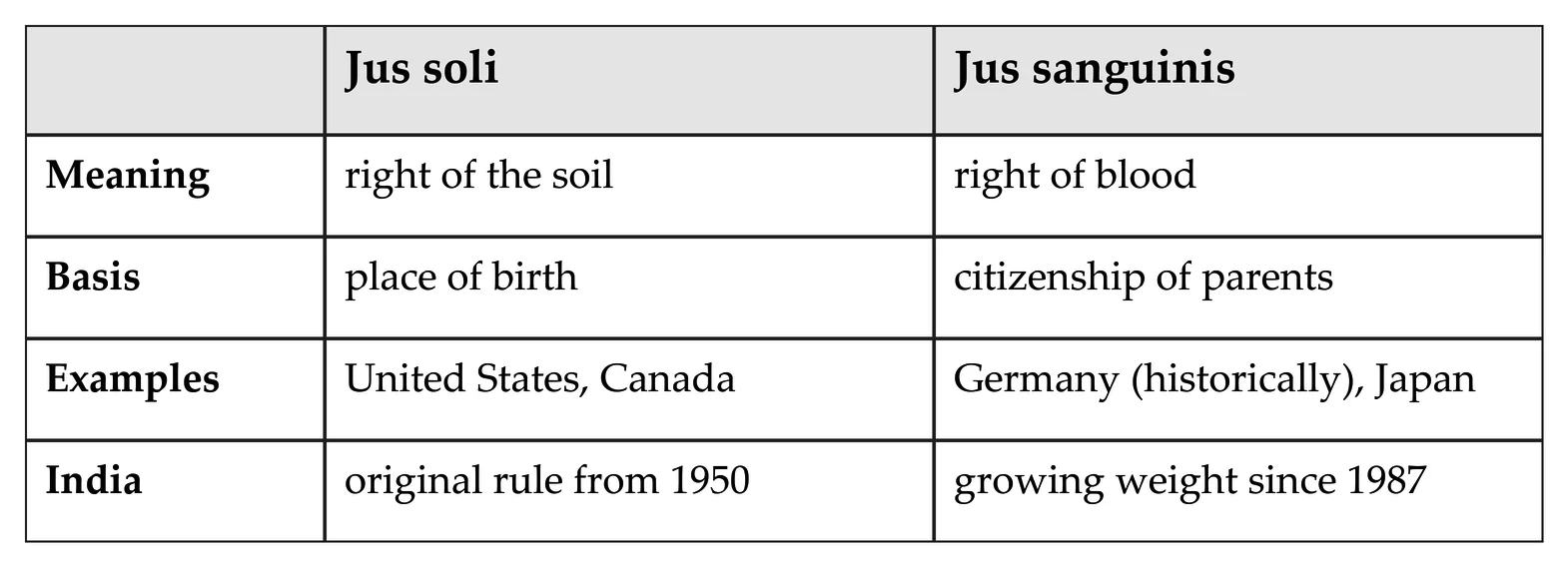
States follow two main principles in granting citizenship at birth. Jus soli, the right of the soil, gives citizenship to anyone born on the state’s territory, as in the United States and Canada. Jus sanguinis, the right of blood, gives citizenship to the children of citizens, wherever they are born, as traditionally in Germany and Japan. Many states combine the two. India began with jus soli in 1950 but, as Anupama Roy shows, has moved towards jus sanguinis since 1987.
1.3 The Citizenship Act: Amendments and Process
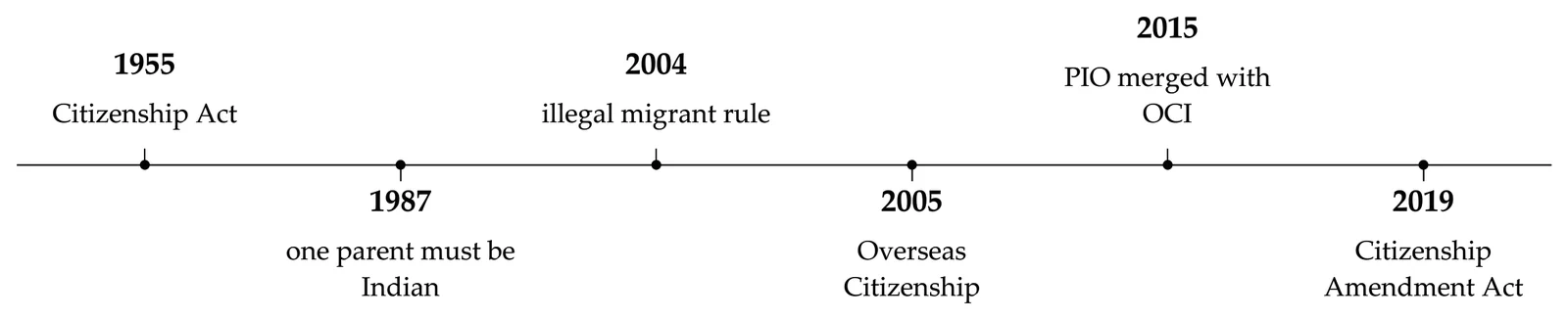
The Citizenship Act, 1955, provides for acquiring citizenship by birth, descent, registration, naturalisation and incorporation of territory, and for its loss by renunciation, termination and deprivation. Amendments in 1986, 2003, 2005, 2015 and 2019 tightened citizenship by birth, introduced the category of illegal migrant, created Overseas Citizenship of India and offered a fast track to certain migrants from neighbouring countries.
1.4 Important Questions
- Question 1 What is citizenship? Distinguish between jus soli and jus sanguinis.
- Question 2 Discuss the provisions of the Citizenship Act, 1955, and its amendments.
- Question 3 Discuss the rights and duties of citizens in India.
- Question 4 Discuss the idea of active citizenship and civic culture.
DU asks the same idea in different words. So learn one broad answer for each question below; the same answer works for every question joined by OR.
Important Question 1
What is citizenship? Distinguish between jus soli and jus sanguinis.
OR
Discuss the meaning and dimensions of citizenship.
OR
Examine the principles of jus soli and jus sanguinis with reference to India.
Model Answer
“Citizenship is a status bestowed on those who are full members of a community. All who possess the status are equal with respect to the rights and duties with which the status is endowed.”
— T.H. Marshall, Citizenship and Social Class (1950)
Introduction. Citizenship is one of the central concepts of political science. It defines who belongs to a political community and what rights and duties they have. Every state must decide how citizenship is acquired, and two principles, jus soli and jus sanguinis, have shaped these decisions. India’s own law reflects a shift from the first towards the second.
1. Meaning of Citizenship
Citizenship is full and equal membership of a political community. A citizen enjoys rights, such as voting and protection of the law, and owes duties, such as obeying the law and paying taxes, in a relationship of mutual obligation with the state.
2. Dimensions of Citizenship
Citizenship has four dimensions: a legal status defining membership; rights and duties; participation in public life through voting, debate and civic activity; and identity, the sense of belonging to a community.
3. Ancient Origins
In ancient Athens, citizenship meant participation in the assembly and courts, but was limited to free adult men born of citizen parents. Aristotle defined the citizen as one who shares in deliberation and judgement. Rome extended citizenship more widely across its empire.
4. Modern Citizenship
Modern citizenship developed with the nation-state and democratic revolutions, which declared citizens equal before the law. Over time, citizenship expanded to include workers, women and formerly colonised peoples.
5. Marshall’s Three Elements
T.H. Marshall described civil rights, such as liberty and property, developed in the eighteenth century; political rights, such as voting, in the nineteenth; and social rights, such as education and welfare, in the twentieth.
6. Jus Soli
Jus soli, the right of the soil, grants citizenship to anyone born on a state’s territory, regardless of parents’ nationality. The United States adopted it through the Fourteenth Amendment of 1868, and Canada and many American countries follow it.
7. Jus Sanguinis
Jus sanguinis, the right of blood, grants citizenship to the children of citizens, wherever they are born. It was traditionally followed by Germany, Japan and Italy, linking citizenship to descent and ethnicity.
8. Mixed Systems
Many states combine both principles. Britain ended unconditional jus soli in 1983, while Germany in 2000 introduced conditional jus soli for children of long-resident foreigners, showing convergence between the two models.
9. India’s Original Choice
The Constitution and the Citizenship Act of 1955 adopted jus soli: anyone born in India on or after 26 January 1950 was a citizen by birth, reflecting the inclusive vision of the Constituent Assembly.
10. The Shift towards Descent
Amendments made citizenship by birth depend on parents’ citizenship: from 1987, one parent had to be Indian; from 2004, both parents, or one parent with the other not an illegal migrant. Anupama Roy describes this as a shift towards jus sanguinis.
11. Ragi on Citizenship and Governance
S.K. Ragi argues that citizenship is not only a legal status but an active relationship with government. Informed and participating citizens hold governments accountable, while good governance makes citizenship meaningful.
12. Statelessness and Dual Citizenship
People who belong to no state are stateless and lack basic protection. India does not permit dual citizenship, but offers Overseas Citizenship of India to people of Indian origin abroad.
13. Theories of Citizenship
Liberals emphasise rights, republicans emphasise civic participation and virtue, and communitarians emphasise belonging to a community with shared values.
14. Debates
Debates over citizenship today concern migration, refugees, minorities and documents, as states decide who belongs and on what basis.
15. Evaluation
Citizenship combines status, rights, participation and identity. The choice between jus soli and jus sanguinis reflects how a nation understands itself.
Conclusion. Thus, citizenship is full membership of a political community with rights, duties, participation and identity. Jus soli grants citizenship by birthplace and jus sanguinis by descent, and many states mix them. India began with jus soli but has moved towards jus sanguinis since 1987, as Anupama Roy shows.
Important Question 2
Discuss the provisions of the Citizenship Act, 1955, and its amendments.
OR
Explain the ways in which Indian citizenship can be acquired and lost.
OR
Examine the major amendments to the Citizenship Act since 1986.
Model Answer
“Nothing in the foregoing provisions of this Part shall derogate from the power of Parliament to make any provision with respect to the acquisition and termination of citizenship and all other matters relating to citizenship.”
— Constitution of India, Article 11
Introduction. The Constitution of India deals with citizenship at its commencement in Articles 5 to 11 and leaves Parliament to regulate it afterwards. Parliament passed the Citizenship Act in 1955, which sets out how Indian citizenship is acquired and lost. The Act has been amended several times, especially in 1986, 2003, 2005, 2015 and 2019, changing the meaning of citizenship in India.
1. Constitutional Provisions
Articles 5 to 8 defined citizens at the commencement of the Constitution, including those who migrated from Pakistan and people of Indian origin abroad. Article 9 rules out dual citizenship, and Article 11 empowers Parliament to make laws on citizenship.
2. The 1955 Act
The Citizenship Act of 1955 provides five ways of acquiring citizenship: by birth, by descent, by registration, by naturalisation and by incorporation of territory. It also sets out how citizenship can be lost.
3. Citizenship by Birth
Persons born in India between 26 January 1950 and 1 July 1987 are citizens by birth regardless of their parents’ nationality. Later amendments added conditions relating to parents’ citizenship.
4. Citizenship by Descent
A person born outside India may become a citizen by descent if a parent is an Indian citizen, provided the birth is registered at an Indian consulate within the prescribed time.
5. Registration
Certain persons, such as people of Indian origin who have lived in India for a specified period and spouses of Indian citizens, may become citizens by registration.
6. Naturalisation
A foreigner who has lived in India for the twelve months before applying, and for eleven of the fourteen years before that, and who meets other conditions such as good character and knowledge of a language in the Eighth Schedule, may become a citizen by naturalisation.
7. Incorporation of Territory
When a territory becomes part of India, the government may specify that its people become Indian citizens, as happened with Goa, Pondicherry and Sikkim.
8. Loss of Citizenship
Citizenship may be lost by renunciation, by termination when a citizen voluntarily acquires another country’s citizenship, or by deprivation, for example if it was obtained by fraud or the person shows disloyalty.
9. The 1986 Amendment
The 1986 amendment, effective from 1 July 1987, provided that a person born in India would be a citizen only if at least one parent was an Indian citizen, responding to concerns about migration in Assam.
10. The 2003 Amendment
The 2003 amendment, effective from December 2004, required both parents to be citizens, or one a citizen and the other not an illegal migrant. It defined illegal migrants, provided for a National Register of Indian Citizens and introduced Overseas Citizenship of India.
11. Overseas Citizenship
Overseas Citizenship of India was extended in 2005 to people of Indian origin in most countries, and in 2015 the separate Person of Indian Origin card was merged into it.
12. The 2019 Amendment
The Citizenship (Amendment) Act, 2019, made Hindu, Sikh, Buddhist, Jain, Parsi and Christian migrants from Afghanistan, Bangladesh and Pakistan who entered India before 2015 eligible for citizenship, with a shorter residence period. Its rules were notified in 2024.
13. The Process
Applications for citizenship by registration and naturalisation are made to the government, now largely through online portals, and are examined by the Ministry of Home Affairs, which grants or refuses citizenship.
14. Debates
The amendments have raised debates about the shift from birth to descent, the treatment of migrants, the use of religion in the 2019 law and the burden of documents on the poor.
15. Evaluation
The Citizenship Act has evolved from an inclusive, birth-based law towards one shaped by descent, migration control and, critics argue, religion.
Conclusion. Thus, the Citizenship Act, 1955, provides for acquiring citizenship by birth, descent, registration, naturalisation and incorporation of territory, and for losing it by renunciation, termination and deprivation. Its amendments of 1986, 2003, 2005, 2015 and 2019 have tightened citizenship by birth, created Overseas Citizenship and changed the meaning of Indian citizenship.
Important Question 3
Discuss the rights and duties of citizens in India.
OR
Examine the relationship between rights and duties in Indian citizenship.
OR
Discuss the Fundamental Duties of Indian citizens.
Model Answer
“I learnt from my illiterate but wise mother that all rights to be deserved and preserved came from duty well done.”
— M.K. Gandhi, letter to UNESCO (1947)
Introduction. Citizenship involves both rights and duties. The Indian Constitution guarantees citizens fundamental rights enforceable in courts and sets out Directive Principles to secure their social and economic welfare. Since 1976, it has also listed Fundamental Duties. The balance between rights and duties is central to the relationship between citizens and the state.
1. Rights and Duties
Rights are entitlements that citizens can claim from the state and society, while duties are obligations that citizens owe to the community. In a democracy, rights and duties support each other.
2. Fundamental Rights
Part III of the Constitution guarantees rights to equality, freedom, protection against exploitation, freedom of religion, cultural and educational rights and constitutional remedies, enforceable in the courts.

3. Rights for Citizens Only
Some rights, such as freedom of speech and movement under Article 19, protection against discrimination under Article 15 and equal opportunity in public employment under Article 16, are available only to citizens.
4. Political Rights
Citizens have the right to vote at eighteen, to contest elections and to hold public office, rights not available to foreigners.
5. Social and Economic Rights
The Directive Principles direct the state to secure adequate livelihood, education, health and social security. Courts and laws have turned many of these into enforceable rights, such as the right to education and food.
6. Fundamental Duties
The 42nd Amendment of 1976 added Fundamental Duties in Article 51A, following the Swaran Singh Committee. They include respecting the Constitution, promoting harmony, protecting the environment, developing a scientific temper and safeguarding public property.
7. The Eleventh Duty
The 86th Amendment of 2002 added a duty for parents and guardians to provide opportunities for education to children between six and fourteen years, linked to the right to education.
8. Nature of Duties
Fundamental Duties are not directly enforceable in courts, but they guide citizens and help courts interpret laws, and Parliament can enforce them through legislation.
9. Gandhi on Duties
Gandhi believed that rights flow from duties well performed, and that a society where everyone did their duty would secure everyone’s rights.
10. Rights and Democracy
Ambedkar and others emphasised that rights must be protected against the state and the majority, especially for weaker sections, and that duties should not be used to limit rights.
11. Active Citizenship
Active citizenship means participating in public life, voting, staying informed, joining associations and holding government accountable, which strengthens democracy.
12. Civic Culture
Gabriel Almond and Sidney Verba, in The Civic Culture (1963), argued that stable democracy requires a culture in which citizens participate while also trusting and supporting institutions.
13. Citizen Confidence in India
Sandeep Shastri’s study (2002), based on the World Values Survey, examined how far Indian citizens trust institutions such as Parliament, the courts, the civil service, the police and political parties, showing that confidence varies widely from one institution to another.
14. Challenges
Many citizens, especially the poor and marginalised, cannot fully enjoy their rights because of poverty, discrimination and lack of awareness, making the promise of equal citizenship incomplete.
15. Rights of Non-Citizens
Some rights are available to every person in India, citizen or foreigner, such as equality before the law under Article 14, protection of life and personal liberty under Article 21 and freedom of religion under Article 25. This shows that the Constitution protects basic human dignity for all, while reserving certain political and economic rights for citizens as full members of the community.
16. Courts and Duties
The Supreme Court has used Fundamental Duties to support laws protecting the environment, national symbols and public property, and has held that duties can guide the reasonableness of restrictions on rights. In cases on environmental protection, for example, the Court linked the citizen’s duty to protect nature with the state’s duty under the Directive Principles and the right to life.
17. Evaluation
Indian citizenship combines enforceable rights, guiding principles and moral duties. Making rights real for all remains the central challenge.
Conclusion. Thus, Indian citizens enjoy Fundamental Rights, some reserved for citizens, and social and economic rights through the Directive Principles, while owing Fundamental Duties added in 1976. As Gandhi taught, rights and duties go together, and active citizenship, as Almond and Verba suggest, sustains democracy.
Important Question 4
Discuss the idea of active citizenship and civic culture.
OR
Examine Almond and Verba’s concept of civic culture.
OR
Why is citizen participation important for democracy and governance?
Model Answer
“We regard a man who takes no interest in public affairs, not as a harmless, but as a useless character.”
— Pericles, Funeral Oration, in Thucydides, History of the Peloponnesian War
Introduction. Citizenship is not only a legal status but also a practice. Active citizenship means that citizens participate in public life, inform themselves, vote, join associations and hold governments accountable. Political scientists such as Gabriel Almond and Sidney Verba studied the political culture that supports such participation, which is closely linked to good governance.
1. Meaning of Active Citizenship
Active citizenship involves participating in elections, public debate, community organisations, protests and consultations, taking responsibility for the common good rather than leaving politics to leaders alone.
2. The Republican Tradition
The civic republican tradition, from Pericles and Aristotle to Machiavelli and Rousseau, held that freedom depends on citizens’ active participation in public affairs and their civic virtue.

3. Almond and Verba
In The Civic Culture (1963), Gabriel Almond and Sidney Verba compared five countries and identified three types of political culture: parochial, in which citizens know little about politics; subject, in which they are passive recipients of government; and participant, in which they are active.
4. The Civic Culture
Almond and Verba argued that stable democracy rests on a civic culture, a mixture in which citizens participate but also accept authority and trust institutions, balancing activity with stability.
5. Social Capital
Robert Putnam argued that networks of trust and civic association, which he called social capital, make democracy and governance work better, as he found in his study of Italian regions (1993).
6. Participation in India
Indian voters, including the poor and rural, participate in elections in large numbers. Since the 1990s, turnout among marginalised groups has grown, a process Yogendra Yadav called a democratic upsurge.
7. Citizen Confidence
Sandeep Shastri’s analysis of the World Values Survey shows varying levels of citizen confidence in Indian institutions, which affects how citizens engage with government.
8. Crow on Citizens and Government
Deserai Crow argues that how citizens interact with their government matters because trust, participation and satisfaction with services shape the legitimacy and effectiveness of government.
9. Channels of Participation
Citizens participate through elections, gram sabhas, ward committees, public hearings, consultations, the Right to Information and social media, which provide many channels for voice.
10. Participation and Governance
Active citizens make governance more accountable, responsive and effective by monitoring officials, demanding information and taking part in decisions.
11. Barriers
Poverty, illiteracy, caste and gender inequality, lack of time and distrust of institutions limit participation, especially for marginalised groups.
12. Digital Citizenship
Digital platforms allow citizens to access services, give feedback and mobilise, but also spread misinformation and exclude those without access.
13. Civic Education
Civic education in schools and campaigns such as voter awareness programmes help create informed and active citizens.
14. Criticisms
Critics of Almond and Verba argue that their idea of civic culture reflected Anglo-American democracy and underestimated the participation of citizens in developing countries.
15. Local Participation
The 73rd and 74th Amendments of 1992 created panchayats and municipalities with gram sabhas and ward committees, giving citizens a direct role in local decisions. Through gram sabhas, villagers can discuss development plans, select beneficiaries of schemes and question officials, making participation part of everyday governance rather than an act limited to elections every five years.
16. Citizens as Partners
Newer ideas of governance treat citizens not only as voters or customers but as partners who help design and deliver public services. Resident welfare associations, social audits and participatory budgeting show how citizens can work with government. S.K. Ragi argues that such partnership strengthens both citizenship and governance, because people take ownership of public decisions.
17. Women and Participation
Women’s participation has grown through reservation of one-third of seats in panchayats and municipalities, raised to half in many states, and through rising turnout of women voters, which now often equals or exceeds men’s. The 106th Amendment of 2023 provides for one-third reservation for women in the Lok Sabha and state assemblies after the next delimitation.
18. Evaluation
Active citizenship and a supportive civic culture are essential for democracy and good governance, and must be made available to all citizens.
Conclusion. Thus, active citizenship means participating in public life and holding government accountable. Almond and Verba identified a civic culture combining participation with trust as the basis of stable democracy, and Putnam stressed social capital. In India, citizens participate strongly in elections, but barriers of inequality limit wider participation.
Short Notes
(a) Jus soli
The right of the soil: the principle that a person born on a state’s territory becomes its citizen, as in the United States. India followed it from 1950 until amendments added conditions from 1987.
(b) Jus sanguinis
The right of blood: the principle that citizenship passes from parents to children, wherever they are born. India has moved towards it since 1987.
(c) Fundamental Duties
Duties of Indian citizens listed in Article 51A, added by the 42nd Amendment of 1976 and expanded in 2002, such as respecting the Constitution, promoting harmony and protecting the environment.
More notes: MDSE-9 Citizenship and Governance
These notes are prepared by PADHO TO AISE for study help. They are not an official University of Delhi publication.