
Semester VIII MDSE-12 Ethics, Politics and Governance
Unit III · 24 min read · Updated 24 Nov 2026
As per the University of Delhi (DU) BA (Hons) Political Science syllabus
Contents
- 3.1 The Values of Free Speech
- The Classical Defences of Free Speech
- Democracy, Autonomy and Self-Realisation
- Harm, Offence and Hate Speech
- Hate Speech Law in India
- 3.2 Free Speech and Democracy
- Milestones of Free Speech in India
- Media Freedom and Defamation
- 3.3 Social Media: Enabler or Deceptive
- Social Media as an Enabler
- Social Media as Deceptive
- Regulating Social Media
- 3.4 Important Questions
- Why is free speech valuable? Discuss the main arguments.
- Discuss the moral limits of free speech.
- Discuss the relationship between free speech and democracy with reference to India.
- Is social media an enabler of democracy or a tool of deception? Discuss.
- Short Notes
यदि एक व्यक्ति को छोड़कर पूरी मानवजाति एक मत की हो, तब भी मानवजाति को उस एक व्यक्ति को चुप कराने का उतना ही कम अधिकार है जितना उस व्यक्ति को मानवजाति को चुप कराने का।
If all mankind minus one, were of one opinion, and only one person were of the contrary opinion, mankind would be no more justified in silencing that one person, than he, if he had the power, would be justified in silencing mankind.
— John Stuart Mill, On Liberty (1859)
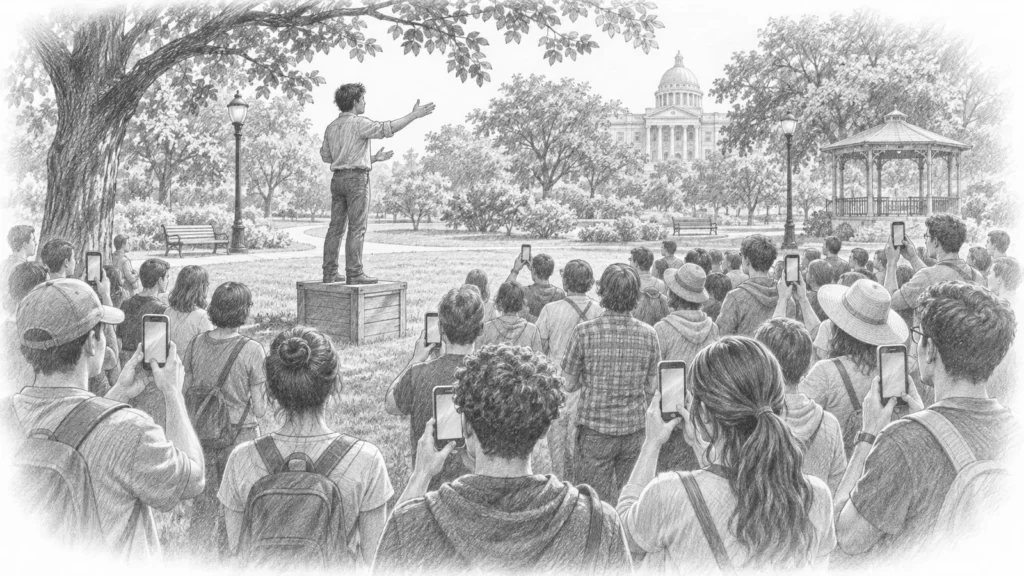
FREEDOM of speech is one of the most valued and most contested rights in a democracy. It allows people to seek truth, govern themselves and express who they are. But speech can also harm, through incitement, hate and lies. This chapter examines the values of free speech and its moral limits, the relationship between free speech and democracy, especially in India, and whether social media is an enabler of freedom or a tool of deception. It draws on John Stuart Mill, Thomas Scanlon, Martin Redish, Gehan Gunatilleke, Clay Shirky, Thomas Zeitzoff and Richard Rogers.

3.1 The Values of Free Speech
Free speech is defended on three main grounds: it helps us discover truth, it is necessary for democratic self-government and it expresses individual autonomy and self-realisation. Yet speech is not unlimited. Its moral limits are drawn through the harm principle, protection of dignity against hate speech and tests of necessity and proportionality.
The Classical Defences of Free Speech
John Milton, in Areopagitica (1644), argued against licensing of printing, asking who ever knew truth to be put to the worse in a free and open encounter. John Stuart Mill, in chapter two of On Liberty (1859), gave four reasons for freedom of thought and discussion: a silenced opinion may be true; even a false opinion may contain part of the truth; even a wholly true opinion, if not challenged, will be held as dead dogma rather than understood; and its meaning may be lost. Justice Oliver Wendell Holmes, dissenting in Abrams v. United States (1919), wrote that the best test of truth is the power of thought to get itself accepted in the competition of the market, which gave rise to the image of the marketplace of ideas.
Democracy, Autonomy and Self-Realisation
- Self-government. Alexander Meiklejohn, in Free Speech and Its Relation to Self-Government (1948), argued that free speech is essential because citizens must hear all views to govern themselves.
- Autonomy. T.M. Scanlon, in A Theory of Freedom of Expression (1972), argued that autonomous people must be free to weigh arguments for themselves, so the state may not suppress speech merely because it might persuade people to do harmful things.
- Self-realisation. Martin Redish (1982) argued that free speech serves the development of each individual’s faculties and control over their own life.
- Checking power. Free speech exposes abuses of power, a value stressed by journalists and courts alike.
Harm, Offence and Hate Speech
Mill’s harm principle holds that power can rightfully be exercised over any member of a civilised community, against his will, only to prevent harm to others. Joel Feinberg, in Offense to Others (1985), added an offence principle for serious offence, judged by its intensity, duration and avoidability, but warned against restricting speech merely because it offends. Jeremy Waldron, in The Harm in Hate Speech (2012), argued that hate speech damages the dignity and social standing of vulnerable groups, which justifies restrictions. Internationally, Article 20 of the ICCPR requires states to prohibit advocacy of national, racial or religious hatred that constitutes incitement, and the Rabat Plan of Action (2012) set a six-part test: context, speaker, intent, content and form, extent, and likelihood of harm, including imminence. In the United States, Brandenburg v. Ohio (1969) protects speech unless it is directed to inciting imminent lawless action and likely to produce it.
Hate Speech Law in India
Indian law penalises promoting enmity between groups and insulting religious feelings, offences formerly in Sections 153A and 295A of the Indian Penal Code and now in Sections 196 and 299 of the Bharatiya Nyaya Sanhita of 2023. Section 123(3A) of the Representation of the People Act treats appeals to hatred on grounds of religion, race, caste or language as a corrupt practice in elections. In Pravasi Bhalai Sangathan (2014), the Supreme Court asked the Law Commission to examine hate speech, and the Commission’s 267th report (2017) proposed new offences. Critics argue that vague laws are used selectively against critics while real incitement often goes unpunished.
3.2 Free Speech and Democracy
Democracy depends on citizens being able to criticise government, debate policies and receive information. In India, Article 19(1)(a) protects free speech, while Article 19(2) allows reasonable restrictions on specified grounds. Courts have expanded protection, as in Shreya Singhal (2015), but laws on sedition, defamation and public order remain contested.

Milestones of Free Speech in India
- 1950 → In Romesh Thappar, the Supreme Court struck down a ban on the journal Cross Roads, holding that public order was not then a ground for restriction.
- 1951 → The First Amendment added public order, friendly relations with foreign states and incitement to an offence as grounds, and required restrictions to be reasonable.
- 1962 → In Kedar Nath Singh, the Court upheld the sedition law but limited it to speech inciting violence or public disorder.
- 1975 to 1977 → The Emergency imposed press censorship; the Indian Express protested with a blank editorial space.
- 1989 → In S. Rangarajan, the Court held that speech can be restricted only if the danger is proximate, like a spark in a powder keg.
- 2015 → Shreya Singhal struck down Section 66A of the IT Act, distinguishing discussion and advocacy, which are protected, from incitement.
- 2020 → Anuradha Bhasin held that internet shutdowns must be necessary, proportionate, temporary and published.
- 2022 and 2023 → The Court put the sedition law in abeyance, and the new criminal code dropped the offence by name while creating an offence of endangering sovereignty and unity.
Media Freedom and Defamation
A free press is essential to democracy, but Indian media face pressures from ownership concentration, advertising dependence, legal cases and attacks on journalists. International press freedom rankings have placed India low in recent years. In Subramanian Swamy (2016), the Supreme Court upheld criminal defamation, which critics say is used to silence journalists and opponents. The chilling effect, the tendency of people to censor themselves for fear of legal action, can be as damaging as formal censorship. Courts have therefore stressed that restrictions must be narrowly drawn and that the remedy for bad speech is often more speech.
3.3 Social Media: Enabler or Deceptive
Social media gives ordinary people a voice and helps movements organise, as Clay Shirky argues. But it also spreads misinformation, hate and manipulation through bots and targeted propaganda, as Richard Rogers and Sabine Niederer show. Thomas Zeitzoff shows how it is changing conflict itself.

Social Media as an Enabler
- Collective action. Clay Shirky, in Here Comes Everybody (2008), argued that social media lowers the costs of organising, letting groups form without formal organisations.
- The Arab Spring. Protests that began in Tunisia in December 2010 spread across the Arab world in 2011, using Facebook and Twitter to coordinate and broadcast.
- Voice for the marginalised. Movements such as #MeToo (2017) and Dalit and Adivasi activists online have used social media to bypass traditional media gatekeepers.
- Accountability. Citizens use phones and social media to record and expose abuses by officials.
Social Media as Deceptive
- Misinformation. A study published in Science in 2018 by Soroush Vosoughi, Deb Roy and Sinan Aral found that false news spreads farther and faster on Twitter than true news.
- Echo chambers and filter bubbles. Cass Sunstein, in #Republic (2017), and Eli Pariser, in The Filter Bubble (2011), warned that algorithms and self-selection trap people among like-minded views.
- Manipulation. The Cambridge Analytica scandal of 2018 revealed that data from up to 87 million Facebook users had been harvested for political targeting.
- Authoritarian use. Evgeny Morozov, in The Net Delusion (2011), warned that authoritarian governments use the internet for surveillance and propaganda, and Zeynep Tufekci, in Twitter and Tear Gas (2017), showed that movements built quickly online can lack the capacity to sustain themselves.
- Violence. In India, rumours on WhatsApp about child kidnappers led to lynchings in 2018, prompting WhatsApp to limit message forwarding.
Regulating Social Media
Governments are trying to regulate platforms while protecting free speech. India’s Information Technology (Intermediary Guidelines and Digital Media Ethics Code) Rules of 2021 require platforms to appoint grievance officers, remove unlawful content quickly and, for large messaging services, identify the first originator of messages, which critics say threatens encryption and privacy. The European Union’s Digital Services Act of 2022 requires large platforms to assess and reduce systemic risks such as disinformation. Thomas Zeitzoff, in How Social Media Is Changing Conflict (2017), shows that social media speeds up and widens conflicts, and Richard Rogers and Sabine Niederer, in The Politics of Social Media Manipulation (2020), document how junk news and fake accounts distort debate. The ethical challenge is to curb manipulation and hate without giving governments or companies unchecked power to decide what may be said.
3.4 Important Questions
- Question 1 Why is free speech valuable? Discuss the main arguments.
- Question 2 Discuss the moral limits of free speech.
- Question 3 Discuss the relationship between free speech and democracy with reference to India.
- Question 4 Is social media an enabler of democracy or a tool of deception? Discuss.
DU asks the same idea in different words. So learn one broad answer for each question below; the same answer works for every question joined by OR.
Important Question 1
Why is free speech valuable? Discuss the main arguments.
OR
Examine the arguments of Mill, Scanlon and Redish for free speech.
OR
Is free speech valuable because of truth, democracy or autonomy? Discuss.
Model Answer
“The best test of truth is the power of the thought to get itself accepted in the competition of the market.”
— Justice Oliver Wendell Holmes, dissent in Abrams v. United States (1919)
Introduction. Freedom of speech is considered one of the most important rights in a free society. But why is it valuable? Philosophers and judges have offered different justifications, based on the search for truth, the needs of democracy and the autonomy of individuals. John Stuart Mill, Thomas Scanlon and Martin Redish are among the most influential defenders of free speech.
1. Meaning
Free speech is the freedom to express opinions, ideas and information through words, writing, art, symbols and other media, without censorship or punishment by the state.
2. Mill’s Argument from Truth
Mill argued that silencing an opinion is wrong because the opinion may be true; even if false, it may contain part of the truth; and even if wholly false, challenging it keeps the truth alive rather than a dead dogma.
3. Mill on Individuality
Mill also valued free expression for the development of individuality, since people grow by forming and expressing their own opinions rather than following custom.
4. The Marketplace of Ideas
Justice Oliver Wendell Holmes argued in 1919 that the best test of truth is the power of an idea to win acceptance in the competition of the market, an image that became central to free speech law.
5. The Argument from Democracy
Alexander Meiklejohn argued that free speech is essential for self-government, because citizens must hear all views to make informed political decisions. Political speech therefore deserves the strongest protection.
6. Scanlon’s Autonomy Argument
Thomas Scanlon, in A Theory of Freedom of Expression (1972), argued that respect for people as autonomous rational agents means that the state may not restrict speech merely because it might lead people to form false beliefs or to choose harmful acts on their own judgement.
7. The Millian Principle
Scanlon called this the Millian principle: the harms of people coming to hold false beliefs, or acting on beliefs formed through expression, cannot justify restricting that expression, because people must judge for themselves.
8. Redish on Self-Realisation
Martin Redish argued in 1982 that free speech serves one fundamental value, individual self-realisation, which includes developing one’s faculties and controlling one’s own destiny. Other values, such as democracy and truth, are means to this end.
9. Stone and Schauer
The Oxford Handbook of Freedom of Speech, edited by Adrienne Stone and Frederick Schauer, shows that free speech theories are often pluralist, combining arguments from truth, democracy and autonomy.
10. Speech and Dignity
Free expression also expresses human dignity, since being able to speak one’s mind is part of being treated as a full member of society.
11. Indian Constitution
Article 19(1)(a) guarantees freedom of speech and expression. Courts have held that it includes freedom of the press and the right to receive information, as in Raj Narain (1975).
12. Speech and Minorities
Free speech protects minorities and dissenters, whose views are most likely to be suppressed by majorities and governments.
13. Criticisms
Critics argue that the marketplace of ideas does not always favour truth, especially when powerful groups control media, and that falsehoods can spread faster than truth.
14. Balancing Values
Because free speech serves several values, its protection may vary: political speech is strongly protected, while commercial advertising or defamation may be regulated more.
15. Free Speech and Science
The history of science shows the value of free inquiry. Galileo was forced in 1633 to recant his support for the view that the earth moves around the sun. Mill and others argue that progress in knowledge depends on the freedom to question established beliefs, even those held by powerful authorities.
16. Speech and the Search for Justice
Movements for justice have depended on free expression. Reformers such as Raja Rammohan Roy, Jyotirao Phule and Ambedkar used newspapers, pamphlets and speeches to challenge sati, caste and untouchability. Their example shows that free speech allows the oppressed to question the beliefs that justify their oppression.
17. Evaluation
Free speech is valuable because it serves truth, democracy and autonomy, which together make it a cornerstone of a free society.
Conclusion. Thus, Mill defended free speech for truth and individuality, Holmes as a marketplace of ideas, Meiklejohn for democracy, Scanlon for autonomy and Redish for self-realisation. These arguments, combined in pluralist theories, explain why Article 19(1)(a) is central to Indian democracy.
Important Question 2
Discuss the moral limits of free speech.
OR
Can hate speech be restricted? Discuss.
OR
Examine the principles that justify limitations on freedom of expression.
Model Answer
“The most stringent protection of free speech would not protect a man in falsely shouting fire in a theatre and causing a panic.”
— Justice Oliver Wendell Holmes, Schenck v. United States (1919)
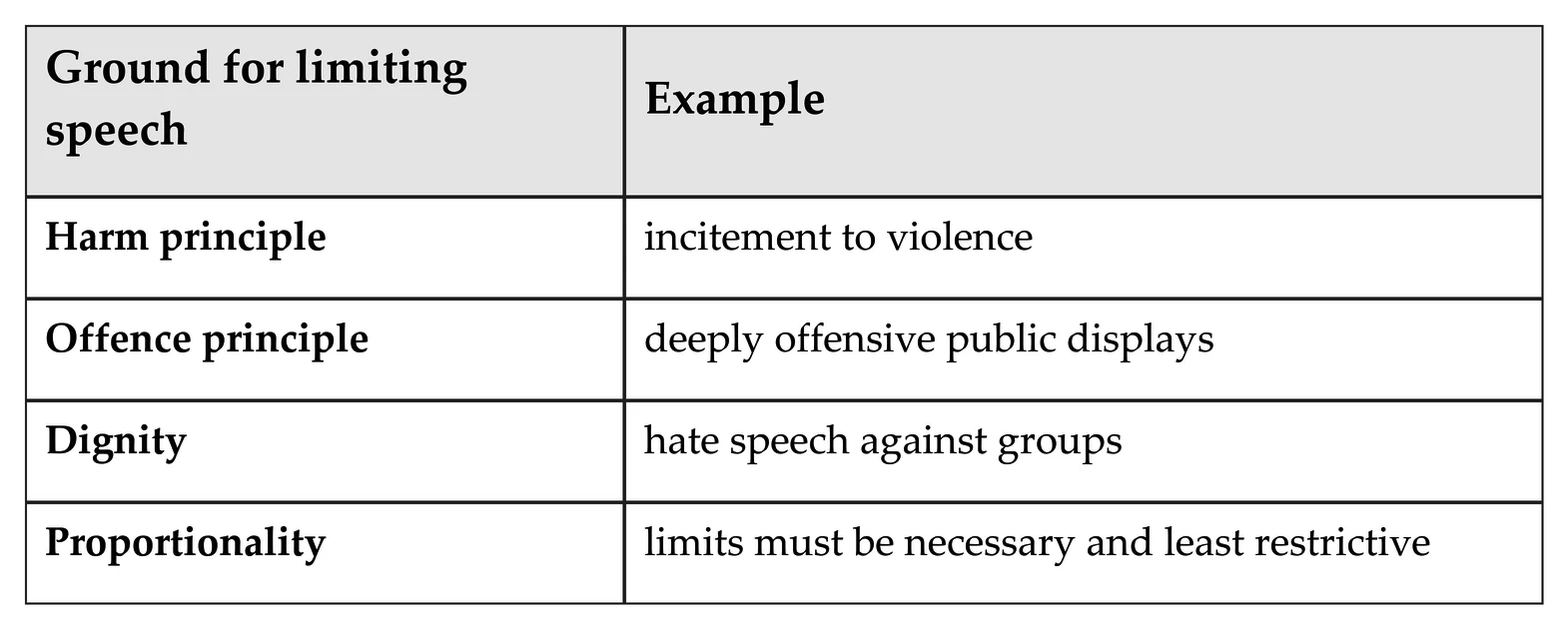
Introduction. No society treats free speech as absolute. Incitement to violence, defamation, fraud and some forms of hate speech are restricted almost everywhere. The question is where to draw the line between protected speech and speech that may be limited. Mill’s harm principle, Joel Feinberg’s offence principle, Jeremy Waldron’s dignity argument and Gehan Gunatilleke’s framework of justification offer different answers.
1. Free Speech Is Not Absolute
Even strong defenders of free speech accept limits. Justice Holmes said that free speech does not protect falsely shouting fire in a crowded theatre and causing a panic.
2. Mill’s Harm Principle
Mill argued that the only purpose for which power can rightfully be exercised over anyone against their will is to prevent harm to others. Speech may be restricted when it directly incites harm, as when an angry mob is incited outside a corn dealer’s house.
3. Feinberg’s Offence Principle
Joel Feinberg argued that some deeply offensive public conduct may also be restricted, but only when the offence is serious, widespread and hard to avoid, and the speech has little value.
4. Hate Speech
Hate speech attacks people on the basis of religion, caste, race or other identity. Jeremy Waldron argues that it harms the dignity of members of targeted groups by undermining their assurance of equal standing in society.
5. International Law
Article 19 of the International Covenant on Civil and Political Rights allows restrictions to protect the rights of others, national security, public order, health or morals, and Article 20 requires prohibiting advocacy of hatred that constitutes incitement.
6. Gunatilleke’s Framework
Gehan Gunatilleke argues that limitations on expression must be justified by reasons that all can share, and must meet tests of legality, legitimate aim, necessity and proportionality, so that restrictions are the least necessary to protect others.
7. The Rabat Plan
The UN’s Rabat Plan of Action of 2012 proposed a six-part test for incitement: the context, the speaker, intent, content, extent of the speech and the likelihood of harm.
8. Article 19(2)
India’s Constitution allows reasonable restrictions on free speech in the interests of sovereignty and integrity, security of the state, friendly relations with foreign states, public order, decency or morality, contempt of court, defamation and incitement to an offence.
9. Indian Hate Speech Laws
Indian criminal law punishes promoting enmity between groups and deliberately insulting religious beliefs. Critics say these provisions are sometimes misused against critics and minorities, while hate speech by powerful people often goes unpunished.
10. Defamation
Defamation protects reputation. In Subramanian Swamy (2016), the Supreme Court upheld criminal defamation, though critics argue that it chills journalism and criticism.
11. The Chilling Effect
Vague and broad restrictions create a chilling effect, discouraging people from speaking for fear of punishment, which harms democracy even when prosecutions are rare.
12. Offence and Sensitivity
In a diverse society, many people are offended by speech about religion and identity. Liberals argue that mere offence should not justify restriction, while others stress respect for communities.
13. Misinformation
False information about health or elections can cause harm, but laws against fake news risk giving governments power to decide what is true, which may be used to silence critics.
14. Counter-Speech
Many argue that the best response to harmful speech is more speech, education and counter-arguments rather than censorship, except where speech incites imminent harm.
15. The Brandenburg Test
In Brandenburg v. Ohio (1969), the United States Supreme Court held that speech advocating violence can be punished only if it is directed to inciting imminent lawless action and is likely to produce it. This strict test protects even offensive speech, and it contrasts with the wider limits on hate speech accepted in many other democracies, including India.
16. Hate Speech in Indian Courts
In Pravasi Bhalai Sangathan (2014), the Supreme Court discussed the harm of hate speech but left it to the Law Commission to recommend changes. In later cases, the Court directed police to act on their own against hate speeches regardless of the religion of the speaker, showing growing concern about speech that targets communities.
17. Evaluation
The moral limits of free speech should be narrow, clearly defined and proportionate, protecting people from real harm without silencing dissent.
Conclusion. Thus, free speech is limited by the harm principle, as Mill and Holmes accepted, by Feinberg’s offence principle in narrow cases and by the need to protect dignity against hate speech, as Waldron argues. Gunatilleke requires necessity and proportionality, and Article 19(2) sets India’s limits, which must not chill legitimate dissent.
Important Question 3
Discuss the relationship between free speech and democracy with reference to India.
OR
Examine the judicial interpretation of freedom of speech in India.
OR
Why is free speech essential for democracy?
Model Answer
“Freedom of speech and of the press lay at the foundation of all democratic organisations, for without free political discussion no public education, so essential for the proper functioning of the processes of popular government, is possible.”
— Justice Patanjali Sastri, Romesh Thappar v. State of Madras (1950)
Introduction. Democracy is government by discussion. Citizens must be able to criticise those in power, debate policies and receive information to govern themselves. Free speech is therefore not only an individual right but a condition of democracy. In India, the relationship between free speech and democracy has been shaped by constitutional provisions, court judgments and political struggles.
1. Speech and Self-Government
Alexander Meiklejohn argued that the people, as rulers, must hear all relevant ideas to decide public questions, so free political speech is essential to self-government.
2. Accountability
Free speech and a free press expose corruption, abuse of power and policy failures, making governments accountable between elections.
3. The Public Sphere
Jürgen Habermas described the public sphere, where citizens discuss public affairs and form public opinion. Free speech keeps this sphere open and lively.
4. Romesh Thappar, 1950
In Romesh Thappar (1950), the Supreme Court held that freedom of speech and of the press lay at the foundation of democracy and struck down a ban on a journal, showing early judicial commitment to free speech.
5. The First Amendment, 1951
In response to court judgments, the First Amendment of 1951 added public order, friendly relations with foreign states and incitement to an offence as grounds for restriction, and required restrictions to be reasonable.
6. Sedition
In Kedar Nath Singh (1962), the Court upheld the sedition law but limited it to speech inciting violence or public disorder. In 2022, the Court put sedition cases in abeyance, and the new criminal code of 2023 replaced it with a provision on acts endangering sovereignty and unity.
7. The Emergency
During the Emergency of 1975–77, the press was censored and critics jailed, showing how the loss of free speech threatens democracy. Many newspapers resisted, and the experience strengthened commitment to press freedom.
8. Rangarajan’s Test
In S. Rangarajan (1989), the Court said that speech may be restricted only if its connection with public disorder is close, like a spark in a powder keg, not remote or speculative.
9. Shreya Singhal, 2015
In Shreya Singhal (2015), the Court struck down Section 66A of the IT Act, which punished offensive online messages, distinguishing discussion and advocacy, which are protected, from incitement, which may be restricted.
10. Internet Shutdowns
In Anuradha Bhasin (2020), concerning internet shutdowns in Jammu and Kashmir, the Court held that restrictions on internet access must be necessary, proportionate and subject to review.
11. Media Freedom
Concerns about press freedom in India include concentration of media ownership, pressure on journalists, attacks on reporters and the use of laws against critics.
12. Speech and Diversity
In a diverse democracy, free speech must coexist with respect for religious and cultural communities, which makes the balance between liberty and harmony a constant challenge.
13. Courts as Guardians
Indian courts have often protected free speech, but critics note that they have also upheld restrictive laws and been slow to hear challenges, so protection depends on judicial consistency.
14. Citizens’ Role
Free speech depends on a culture of tolerance in society, not only on courts. Citizens must accept criticism and disagreement as part of democratic life.
15. Right to Information as Speech
Indian courts have held that the right to know is part of freedom of speech, since meaningful expression requires access to information. This reasoning supported the Right to Information Act of 2005 and the requirement that election candidates disclose their criminal records and assets, linking free speech with informed democratic choice.
16. Artistic Freedom
Courts have defended artistic and cinematic expression against bans demanded by offended groups. In cases involving films and books, the Supreme Court has said that the state must protect the freedom of artists and cannot allow the threat of violence by some to override the right to express.
17. Evaluation
Free speech is the lifeblood of democracy, and India’s experience shows both strong protection and persistent restrictions.
Conclusion. Thus, free speech is essential for self-government, accountability and the public sphere. In India, Romesh Thappar affirmed its democratic role, while the First Amendment, Kedar Nath and sedition law limited it. Rangarajan, Shreya Singhal and Anuradha Bhasin strengthened protection, but the Emergency and current pressures show its fragility.
Important Question 4
Is social media an enabler of democracy or a tool of deception? Discuss.
OR
Examine the political power of social media.
OR
How is social media changing politics and conflict?
Model Answer
“The same rights that people have offline must also be protected online, in particular freedom of expression.”
— UN Human Rights Council, Resolution 20/8 (2012)
Introduction. Social media platforms such as Facebook, X (formerly Twitter), YouTube, Instagram and WhatsApp have transformed communication and politics. They allow millions to speak, organise and access information, but they also spread misinformation, hate and propaganda. Clay Shirky, Thomas Zeitzoff and Richard Rogers and Sabine Niederer examine whether social media enables democracy or deceives citizens.
1. Meaning
Social media are online platforms that allow users to create and share content and interact with others in networks, making everyone a potential publisher.
2. Shirky on Political Power
Clay Shirky, writing in 2011, argued that the real power of social media lies in strengthening civil society and the public sphere over time, by helping people share information and coordinate action.
3. Shared Awareness
Shirky stressed shared awareness: when people know that others share their grievances, they are more likely to act together, as in protests in the Philippines in 2001 and the Arab uprisings of 2011.
4. Giving Voice
Social media gives voice to marginalised groups, citizen journalists and movements, such as #MeToo and farmers’ protests, which might be ignored by traditional media.
5. Zeitzoff on Conflict
Thomas Zeitzoff shows that social media is changing conflict by lowering the cost of communication, increasing the speed and spread of information and allowing both governments and rebels to influence audiences directly.
6. Propaganda and Terror
Armed groups such as ISIS used social media for recruitment and propaganda, and states use it to shape narratives in wars, making it a new battlefield.
7. Rogers and Niederer on Manipulation
Richard Rogers and Sabine Niederer examine the politics of social media manipulation, showing how junk news, bots, trolls and coordinated campaigns artificially amplify messages and mislead users.
8. Misinformation
False information spreads quickly on social media. In India, rumours spread through WhatsApp led to mob lynchings in 2018, prompting the platform to limit message forwarding.
9. Data and Targeting
The Cambridge Analytica scandal of 2018 revealed that personal data from millions of Facebook users was used to target political advertising, raising concerns about manipulation of voters.
10. Echo Chambers
Algorithms show users content similar to what they already like, creating filter bubbles and echo chambers that deepen polarisation and reduce exposure to other views.
11. Regulation in India
India’s Information Technology Rules of 2021 require platforms to appoint grievance officers and remove unlawful content, and in some cases trace originators of messages. Critics fear these rules threaten privacy and free speech, and a government fact-check unit was struck down by the Bombay High Court in 2024.
12. Global Regulation
The European Union’s Digital Services Act of 2022 requires large platforms to assess and reduce systemic risks such as disinformation, offering a different model of regulation.
13. Platform Power
Private companies now decide what billions of people can see and say, raising questions about their accountability and their power over public debate.
14. Deepfakes and AI
Artificial intelligence now makes it easy to create realistic fake videos and audio, which may deceive voters and damage reputations, posing new challenges for democracy.
15. Digital Literacy
Many experts argue that the best defence against misinformation is digital literacy, teaching citizens to check sources, recognise manipulation and think critically about what they share. Fact-checking organisations and media education programmes help build resistance to false information without giving governments power to censor.
16. Political Advertising Online
Online political advertising allows parties to target narrow groups of voters with different messages, often invisible to the wider public. Platforms now publish libraries of political ads, and election commissions have issued rules on online campaigning, but monitoring targeted messages remains difficult.
17. Evaluation
Social media is both an enabler and a deceiver; its effect on democracy depends on regulation, platform design and the digital literacy of citizens.
Conclusion. Thus, social media enables voice, shared awareness and mobilisation, as Shirky argues, but it also spreads misinformation, propaganda and manipulation, as Zeitzoff and Rogers and Niederer show. From WhatsApp lynchings to Cambridge Analytica, its dangers are real, so rights online must be protected while platforms are made accountable.
Short Notes
(a) Marketplace of ideas
The view, associated with Justice Holmes, that truth is best found through free competition among ideas rather than censorship.
(b) Harm principle
Mill’s principle that power may be exercised over individuals against their will only to prevent harm to others.
(c) Chilling effect
The discouragement of legitimate speech caused by vague or broad laws and fear of punishment.
More notes: MDSE-12 Ethics, Politics and Governance
These notes are prepared by PADHO TO AISE for study help. They are not an official University of Delhi publication.