
Semester VIII MDSC-8 Development Process and Social Movements
Unit III · 22 min read · Updated 24 Nov 2026
As per the University of Delhi (DU) BA (Hons) Political Science syllabus
Contents
- 3.1 Land Reforms
- 3.2 The Green Revolution
- 3.3 The Agrarian Crisis since the 1990s
- 3.4 Land Acquisition and Land Markets
- 3.5 Important Questions
- Discuss the land reforms in India after Independence and evaluate their success.
- Discuss the Green Revolution and its impact on India’s agrarian social structure.
- Discuss the agrarian crisis in India since the 1990s and its impact on farmers.
- Discuss the politics of land acquisition and the development of land markets in India.
- Short Notes
जय जवान, जय किसान।
Hail the soldier, hail the farmer.
— Lal Bahadur Shastri, Slogan raised in 1965
IN 1951, about seven out of ten Indian workers depended on agriculture, and even today agriculture employs nearly half of the workforce. How the state develops agriculture therefore shapes the lives of most Indians. After Independence, India tried to change its unequal agrarian structure through land reforms. From the mid-1960s, the Green Revolution raised food production but widened inequalities. Since the 1990s, an agrarian crisis of debt and farmers’ suicides, together with conflicts over land acquisition and the growth of land markets, has transformed rural India. This chapter draws on Francine Frankel, John Harriss, P. Sainath, K.C. Suri, Ashish Kothari and Dhanmanjiri Sathe.
3.1 Land Reforms
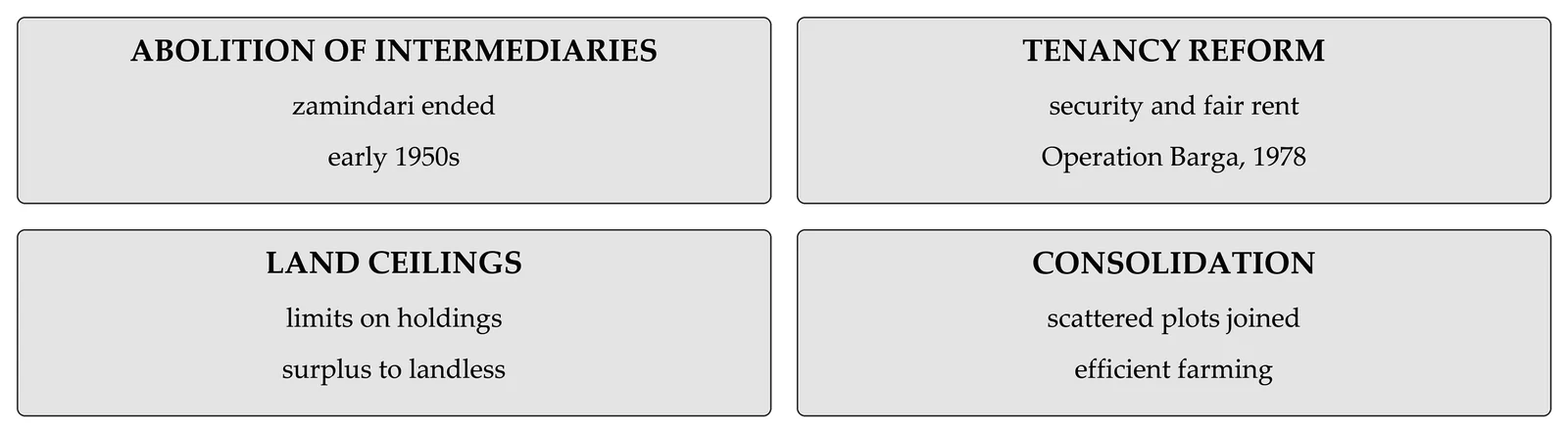
At Independence, much of rural India was dominated by intermediaries, zamindars and jagirdars, who collected rent from cultivators, while tenants had little security and millions of landless labourers, many of them Dalits, owned nothing. Land reforms had four parts: abolition of intermediaries, tenancy reform to give tenants security and fair rent, land ceilings to redistribute surplus land to the landless, and consolidation of scattered holdings.
Zamindari was abolished in the early 1950s, but tenancy reforms and ceilings achieved much less, because landowners evaded laws through benami transfers and concealed tenancy, and state governments lacked political will. Kerala and West Bengal were exceptions. John Harriss shows how local power structures, dominated by landowning castes, shaped the implementation of agrarian policy. Land reforms weakened the old landlords but strengthened a class of dominant peasant castes.
3.2 The Green Revolution
In the mid-1960s, after droughts and dependence on food imports, India adopted a new agricultural strategy based on high-yielding varieties of wheat and rice, fertilisers, irrigation and credit, backed by minimum support prices and government procurement. Food production rose sharply, especially in Punjab, Haryana and western Uttar Pradesh. Francine Frankel, in India’s Green Revolution: Economic Gains and Political Costs (1971), showed that its benefits went mainly to larger farmers, increasing inequality and rural tensions.

3.3 The Agrarian Crisis since the 1990s
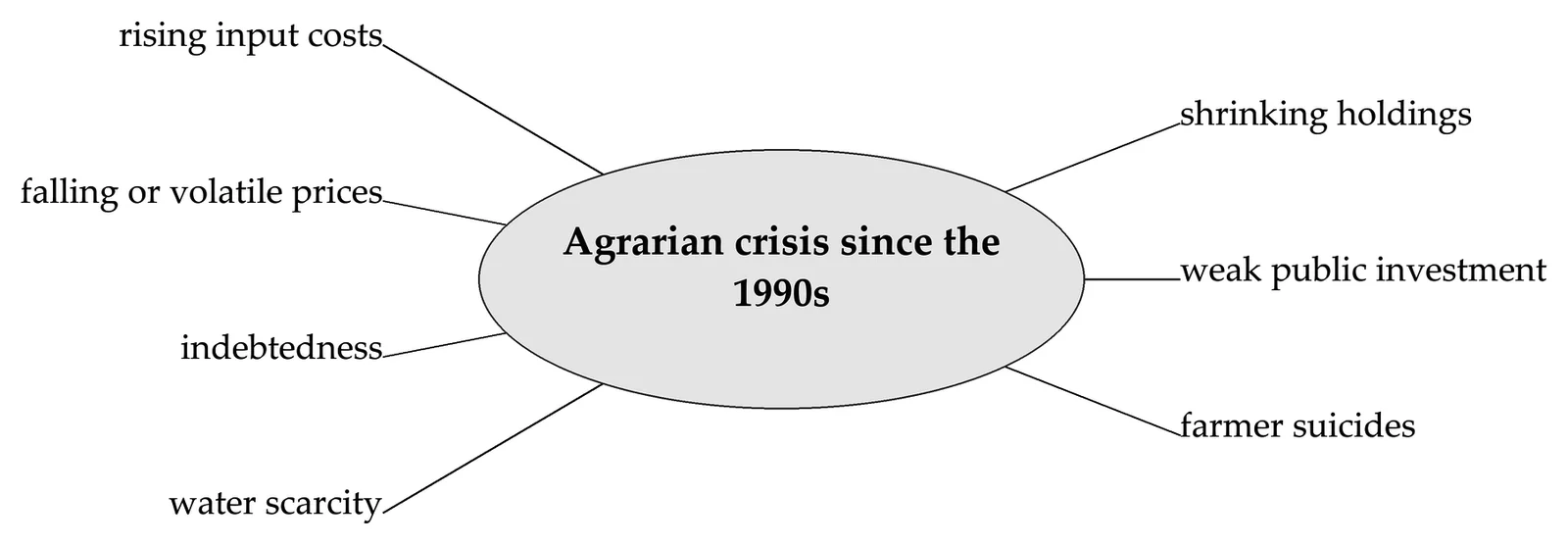
From the 1990s, Indian agriculture entered a prolonged crisis. Rising input costs, volatile prices, shrinking holdings, falling public investment, water scarcity and indebtedness made farming unviable for many. The most tragic sign was the wave of farmers’ suicides, documented by the journalist P. Sainath. K.C. Suri and V. Sridhar studied the crisis in Andhra Pradesh, M. Sidhu linked it to globalisation and Gian Singh and others documented indebtedness in rural Punjab.
3.4 Land Acquisition and Land Markets
Liberalisation increased the demand for land for industry, infrastructure, mining and cities. States acquired farmland under the colonial Land Acquisition Act of 1894, often for private companies, provoking resistance at Singur and Nandigram in West Bengal. Shrivastava and Kothari describe these conflicts as land wars linked to crony capitalism. In 2013, Parliament passed a new law requiring consent, social impact assessment and higher compensation. Rising land prices have also created active land markets around cities.

3.5 Important Questions
- Question 1 Discuss the land reforms in India after Independence and evaluate their success.
- Question 2 Discuss the Green Revolution and its impact on India’s agrarian social structure.
- Question 3 Discuss the agrarian crisis in India since the 1990s and its impact on farmers.
- Question 4 Discuss the politics of land acquisition and the development of land markets in India.
DU asks the same idea in different words. So learn one broad answer for each question below; the same answer works for every question joined by OR.
Important Question 1
Discuss the land reforms in India after Independence and evaluate their success.
OR
Why did land reforms in India achieve only limited success?
OR
Examine the impact of land reforms on India’s agrarian social structure.
Model Answer
“That the ownership and control of the material resources of the community are so distributed as best to subserve the common good.”
— Constitution of India, Article 39(b)
Introduction. Land reforms were meant to transform India’s unequal and exploitative agrarian structure inherited from colonial rule. They aimed to abolish intermediaries, protect tenants, redistribute land to the landless and make agriculture more productive. While zamindari was abolished, the more radical goals of redistribution were only partly achieved, and the reforms reshaped rural power rather than ending inequality.
1. Agrarian Structure at Independence
Colonial land systems, zamindari, ryotwari and mahalwari, created layers of intermediaries between the state and the cultivator. Zamindars extracted high rents, tenants and sharecroppers had no security, and millions of landless labourers, mostly from Dalit and lower castes, worked for others. Land ownership was highly concentrated and linked closely to caste hierarchy.
2. Aims of Land Reform
The Congress Agrarian Reforms Committee under J.C. Kumarappa (1949) recommended that land should belong to the tiller. Land reforms aimed to end feudal exploitation, give security and ownership to cultivators, reduce inequality by redistributing land and raise productivity by giving cultivators an incentive to invest.
3. Abolition of Zamindari
In the early 1950s, states passed laws abolishing zamindari and other intermediary tenures, starting with Uttar Pradesh, Bihar and Madhya Pradesh. Intermediaries were removed and millions of tenants came into direct contact with the state. But zamindars kept land under their personal cultivation and received compensation, so many became large landowners.
4. Constitutional Battles
Zamindars challenged the new laws in courts as violations of the fundamental right to property. Parliament responded with the First Amendment (1951), which added Articles 31A and 31B and the Ninth Schedule to protect land reform laws from judicial review. The right to property was finally removed from the list of fundamental rights by the 44th Amendment in 1978.
5. Tenancy Reforms
Tenancy laws aimed to give tenants security of tenure, fix fair rents at one-fourth or one-fifth of the produce and confer ownership rights. In practice, landlords evicted tenants in the name of voluntary surrender or resuming land for personal cultivation, and much tenancy went underground as concealed, oral arrangements.
6. Land Ceilings
Ceiling laws, passed mostly in the 1960s and revised after national guidelines in 1972, limited the amount of land a family could own. But high ceilings, many exemptions, benami transfers to relatives and servants, and delays in courts meant that only a small fraction of cultivated land was declared surplus and distributed to the landless.
7. The Bhoodan Movement
Vinoba Bhave began the Bhoodan, or land-gift, movement in Telangana in 1951, asking landowners to donate land voluntarily to the landless. It collected pledges of over four million acres and later developed into Gramdan, the gift of whole villages. But much donated land was poor in quality or never distributed.
8. Success Stories
Kerala’s land reforms, completed under the Land Reforms (Amendment) Act of 1969, abolished tenancy and gave ownership to tenants and hutment dwellers. In West Bengal, the Left Front’s Operation Barga (1978) recorded the names of sharecroppers, giving them security and a fixed share of the crop. Jammu and Kashmir also redistributed large estates in 1950.
9. Reasons for Limited Success
Land reforms failed in most states because landowning classes dominated state politics and the Congress at the local level, land was a state subject, land records were poor, the bureaucracy was slow or complicit, and courts delayed implementation. Frankel describes this as the accommodative politics that blunted radical goals.
10. Harriss: Local Power
John Harriss shows that the agrarian political economy is shaped by local power. Dominant landowning castes controlled land, credit, labour and local institutions such as panchayats and cooperatives, and they mediated how state policies were implemented. Land reforms therefore often reinforced the power of these groups.
11. Impact on Social Structure
Land reforms weakened the old zamindars and strengthened owner-cultivators from middle peasant castes, such as Jats, Yadavs, Kammas and Reddys, who became dominant castes in rural politics. Landless labourers, mostly Dalits, gained little land, and their dependence on landowners continued.
12. Consolidation of Holdings
Consolidation brought together scattered plots into compact holdings, mainly in Punjab, Haryana and western Uttar Pradesh. It made irrigation and mechanisation easier and helped prepare these regions for the Green Revolution, though it did little for the landless.
13. From Land Reforms to Land Titling
Pradeep Nayak traces the shift in policy from redistribution to land titling. Since the 1990s, the emphasis has moved to digitising land records, clarifying titles and legalising land leasing, as in NITI Aayog’s Model Agricultural Land Leasing Act of 2016, to make land markets work rather than to redistribute land.
14. Evaluation
Land reforms ended the zamindari system and gave many tenants ownership, but failed to redistribute land on a large scale. Their uneven success reflected the power of landowning classes, and landlessness remains a major source of rural poverty and caste inequality.
Conclusion. Thus, India’s land reforms abolished intermediaries but achieved limited success in tenancy reform and redistribution, except in states such as Kerala and West Bengal. As Harriss and Frankel show, local power and accommodative politics blunted them. They strengthened dominant peasant castes while leaving most landless labourers without land.
Important Question 2
Discuss the Green Revolution and its impact on India’s agrarian social structure.
OR
‘The Green Revolution brought economic gains but political costs.’ Discuss with reference to Francine Frankel.
OR
Examine the achievements and limitations of the Green Revolution in India.
Model Answer
“The State shall endeavour to organise agriculture and animal husbandry on modern and scientific lines.”
— Constitution of India, Article 48
Introduction. The Green Revolution was the transformation of Indian agriculture from the mid-1960s through high-yielding seeds, fertilisers, irrigation and state support. It ended India’s dependence on food imports and made the country self-sufficient in food grains. But, as Francine Frankel showed in 1971, its economic gains came with political costs: rising inequality between regions and classes and new tensions in rural society.
1. The Food Crisis of the 1960s
In the mid-1960s, India faced severe food shortages. Droughts in 1965 and 1966 reduced harvests, and the country depended on wheat imports from the United States under the PL-480 programme. This dependence was seen as a threat to national sovereignty, and Shastri’s slogan ‘Jai Jawan, Jai Kisan’ honoured the farmer’s role in national security.
2. The New Agricultural Strategy
Under Agriculture Minister C. Subramaniam, the government shifted from the earlier emphasis on institutional reform to a technological strategy. Resources were concentrated in irrigated areas with the best potential, where new seeds and inputs could produce rapid gains in output.
3. The Technology
The strategy used high-yielding dwarf varieties of wheat developed by Norman Borlaug in Mexico and rice varieties such as IR8, adapted by Indian scientists led by M.S. Swaminathan. These seeds required assured irrigation, chemical fertilisers and pesticides, so tube wells and credit became essential.
4. Institutional Support
In 1965, the government set up the Agricultural Prices Commission to recommend minimum support prices and the Food Corporation of India to procure grain and maintain buffer stocks. Subsidised fertilisers, electricity and water, along with agricultural universities and extension services, supported the new strategy.
5. Achievements
Wheat production rose from about 12 million tonnes in 1964–65 to about 26 million tonnes in 1971–72. India became self-sufficient in food grains, built buffer stocks, ended dependence on food aid and eliminated the threat of famine. Farm incomes rose in Punjab, Haryana and western Uttar Pradesh.
6. Frankel: Economic Gains, Political Costs
Francine Frankel studied districts such as Ludhiana, West Godavari and Thanjavur. She found that the gains went mainly to larger farmers who could afford irrigation, fertilisers and machinery. Inequality grew, tenants were evicted as landlords resumed land for profitable cultivation, and conflicts between landowners and labourers increased, raising the risk of agrarian unrest.
7. Regional Inequality
The Green Revolution was concentrated in irrigated regions such as Punjab, Haryana, western Uttar Pradesh and parts of Andhra Pradesh and Tamil Nadu. Eastern India and dryland regions were largely left out. Wheat and rice expanded, while pulses and coarse grains grown by poorer farmers received less support.
8. Class Inequality
Large and medium farmers benefited first and most. Small farmers adopted the new technology later and with greater risk. Landless labourers gained some employment as output increased, but mechanisation later reduced demand for labour, and real wage gains were uneven.
9. Rise of Rich Farmers
The Green Revolution created a class of prosperous farmers, often from middle peasant castes. Lloyd and Susanne Rudolph called many of them bullock capitalists, self-employed cultivators using family labour. This class became a powerful political force, led by leaders such as Charan Singh, and demanded higher prices and subsidies.
10. Harriss: Local Power
John Harriss shows that local dominant classes captured much of the benefit of subsidies, credit and cooperatives. Access to irrigation, inputs and markets depended on local power, so the Green Revolution reinforced existing hierarchies of caste and class in many villages.
11. Ecological Costs
Intensive cultivation of wheat and paddy depleted groundwater in Punjab and Haryana, degraded soils, increased pesticide use and reduced crop diversity. Paddy stubble burning now contributes to air pollution in north India, and the ecological sustainability of the model is widely questioned.
12. Spread and Second Phase
In the 1980s, new technology spread to rice in eastern and southern states, reducing regional gaps somewhat. Later programmes, such as Bringing Green Revolution to Eastern India, launched in 2010–11, sought to extend gains to lagging regions.
13. Political Consequences
The Green Revolution made farmers dependent on state support through minimum support prices, procurement and input subsidies. It produced the farmers’ movements of the 1980s and shaped the politics of the 2020–21 protests, in which farmers of Punjab and Haryana defended the MSP system.
14. Evaluation
The Green Revolution achieved food self-sufficiency and ended famine, a major achievement. But, as Frankel predicted, it widened inequalities between regions and classes, strengthened rich farmers and carried heavy ecological costs.
Conclusion. Thus, the Green Revolution transformed Indian agriculture through new seeds, inputs and state support, making India self-sufficient in food. Yet, as Frankel showed, its economic gains came with political costs: rising regional and class inequality, the rise of rich farmers, rural tensions and ecological damage.
Important Question 3
Discuss the agrarian crisis in India since the 1990s and its impact on farmers.
OR
What are the causes of farmers’ suicides in India?
OR
Examine the relationship between globalisation and agrarian distress in India.
Model Answer
“The State shall, within the limits of its economic capacity and development, make effective provision for securing the right to work, to education and to public assistance in cases of unemployment, old age, sickness and disablement, and in other cases of undeserved want.”
— Constitution of India, Article 41
Introduction. Since the 1990s, Indian agriculture has faced a deep and prolonged crisis. Farming has become less profitable and more risky, debts have grown and hundreds of thousands of farmers have taken their own lives. Scholars and journalists such as P. Sainath, K.C. Suri, V. Sridhar and M. Sidhu link this crisis to state policies, globalisation and the changing structure of rural India.
1. Meaning of the Agrarian Crisis
The agrarian crisis refers not only to slow growth in agricultural output but to a broader crisis of rural livelihoods: falling profitability, rising debt, shrinking holdings, ecological stress and distress migration. It affects farmers, tenants and agricultural labourers, and it reflects the growing gap between rural and urban incomes.
2. Slowdown in Growth
After the Green Revolution, agricultural growth slowed significantly from the mid-1990s. Public investment in irrigation, research and extension declined, while the rest of the economy grew rapidly. Agriculture’s share of national income fell faster than its share of employment, leaving many people dependent on low-income farming.
3. Farmers’ Suicides
According to National Crime Records Bureau data analysed by P. Sainath, nearly three lakh farmers took their lives between 1995 and 2012. The suicides were concentrated in Maharashtra, especially Vidarbha, Andhra Pradesh, Karnataka, Madhya Pradesh and Chhattisgarh, often among cotton farmers burdened by debt.
4. Sainath’s Analysis
P. Sainath argues that farmers’ suicides are a symptom of a policy-driven crisis. The withdrawal of state support, rising costs, declining access to bank credit and the commercialisation of agriculture made farming unviable for small cultivators, while the state favoured corporate and urban interests.
5. Rising Costs
The cost of cultivation rose sharply. Fertiliser prices increased after partial decontrol in 1992, expensive seeds such as Bt cotton spread from 2002, and costs of pesticides, diesel and electricity grew. Farmers who borrowed to pay these costs were ruined when crops failed or prices fell.
6. Globalisation and Prices
M. Sidhu links the crisis to globalisation. After the WTO Agreement on Agriculture (1995) and the removal of import restrictions in 2001, Indian farmers were exposed to volatile world prices, which fell sharply for crops such as cotton in the late 1990s, while subsidised farmers in rich countries enjoyed protection.
7. Indebtedness
Formal credit did not reach many small farmers and tenants, who borrowed from moneylenders and input dealers at high interest. Gian Singh and others found heavy indebtedness among farmers and agricultural labourers even in rural Punjab. The NSS survey of 2019 found that about half of agricultural households were in debt.
8. Sridhar: The Andhra Pradesh Case
V. Sridhar’s study of suicides in Andhra Pradesh shows that victims were often small cotton farmers and tenant farmers who had invested in borewells that failed, faced crop losses and borrowed from private lenders. Tenant farmers were especially vulnerable because they could not obtain bank loans without land titles.
9. Suri: Political Economy of Distress
K.C. Suri argues that the crisis in Andhra Pradesh reflected the state government’s neglect of agriculture in favour of information technology and urban development, declining public investment in irrigation and power reforms that raised costs. Rural discontent contributed to the ruling party’s defeat in the 2004 elections.
10. Water and Ecology
Most Indian farmland depends on rain. Groundwater depletion, failed borewells, droughts and erratic monsoons linked to climate change increase risks for farmers, particularly in dryland regions where the Green Revolution never reached.
11. Shrinking Holdings
Repeated division of land among heirs has reduced the average size of holdings to about 1.08 hectares in 2015–16, and about 86 per cent of holdings are small or marginal. Such farms cannot provide enough income, pushing family members to seek work outside agriculture.
12. Impact on Farmers and Labourers
The crisis has caused distress migration to cities, increased the burden on women, who increasingly manage farms as men migrate, and deepened poverty among Dalit labourers. It has also produced farmers’ protests demanding loan waivers and remunerative prices.
13. State Responses
The state responded with a national debt waiver in 2008, the National Commission on Farmers chaired by M.S. Swaminathan (2004–06), which recommended prices at cost plus 50 per cent, crop insurance under the Pradhan Mantri Fasal Bima Yojana (2016) and direct income support under PM-KISAN (2019), which gives Rs 6,000 a year.
14. Evaluation
The agrarian crisis reflects structural problems, rising costs, small holdings and ecological stress, along with policy choices that reduced public support and exposed farmers to global markets. Relief measures have helped, but long-term solutions require investment and secure incomes.
Conclusion. Thus, India’s agrarian crisis since the 1990s, marked by rising costs, debt, volatile prices and farmers’ suicides, reflects both structural problems and policy choices. As Sainath, Suri and Sridhar show, small farmers and tenants have borne its heaviest burden, and its resolution requires renewed public investment and income security.
Important Question 4
Discuss the politics of land acquisition and the development of land markets in India.
OR
Examine the Right to Fair Compensation and Transparency in Land Acquisition, Rehabilitation and Resettlement Act, 2013.
OR
‘Land wars and crony capitalism.’ Discuss with reference to land acquisition in India.
Model Answer
“No person shall be deprived of his property save by authority of law.”
— Constitution of India, Article 300A
Introduction. Land is essential for industry, infrastructure and cities, but for farmers and tribal communities it is also livelihood, identity and security. Since liberalisation, the acquisition of land for private industry, special economic zones and infrastructure has produced intense conflicts across India. At the same time, rising land prices have created active land markets, transforming rural society.
1. Land and Development
Development requires land for factories, roads, dams, mines and housing. But most Indian land is held in small plots by farmers who depend on it for survival, and many forest lands belong to tribal communities. Acquiring land therefore involves difficult choices about who benefits and who pays the costs of development.
2. The Act of 1894
The colonial Land Acquisition Act of 1894 gave the state the power of eminent domain to acquire land for a public purpose. Public purpose was defined broadly, affected people were hardly consulted and compensation was based on low recorded market values. The Act remained in force for nearly 120 years.
3. Displacement
Dams, mines and industries displaced millions of people after Independence. The scholar Walter Fernandes estimated that about 60 million people were displaced or affected between 1947 and 2004, a large share of them tribals, and most were never properly resettled.
4. Land after Liberalisation
After 1991, state governments competed for private investment and acquired land for companies and SEZs. The sociologist Michael Levien describes the state as a land broker that dispossesses farmers on behalf of private capital, rather than acquiring land for public projects.
5. Singur and Nandigram
In Singur in West Bengal, land acquired in 2006 for the Tata Nano car factory led to farmers’ protests, and Tata moved the project to Gujarat in 2008; the Supreme Court quashed the acquisition in 2016. In Nandigram, police firing during protests against a proposed chemical hub killed 14 people in March 2007.
6. Land Wars and Crony Capitalism
Aseem Shrivastava and Ashish Kothari, in Churning the Earth (2012), describe land wars across India, as corporations backed by governments seek land for mines, power plants and SEZs. They argue that this reflects crony capitalism, destroys ecosystems and livelihoods and provokes resistance, as at Niyamgiri and against the POSCO steel project in Odisha.
7. The Act of 2013
The Right to Fair Compensation and Transparency in Land Acquisition, Rehabilitation and Resettlement Act, 2013, replaced the 1894 Act. It requires the consent of 80 per cent of affected families for private projects and 70 per cent for public-private projects, a social impact assessment, compensation of up to four times the market value in rural areas and rehabilitation of those affected.
8. The Ordinance Controversy
In 2014–15, the Union government issued ordinances to exempt projects such as defence, industrial corridors and rural infrastructure from consent and social impact assessment. Opposition parties and farmers protested, and the ordinance lapsed in 2015. Several states then amended the law for themselves to ease acquisition.
9. Sathe: How a Village Stops Being One
Dhanmanjiri Sathe’s study of land acquisition in Maharashtra shows how acquisition transforms a village. Some landowners gain from compensation and rising land prices, while labourers and others without land lose livelihoods. Social ties weaken and the village is absorbed into urban development. She stresses fair compensation and participation.
10. The Growth of Land Markets
Rising land prices near cities, highways and industrial corridors have turned land into a valuable asset for speculation. Farmers sell land to developers, and land pooling schemes, such as the one for Amaravati in Andhra Pradesh, offer developed plots in return for farmland.
11. Titles and Leasing
Governments have promoted clear land titles and leasing to make land markets work. Land records have been digitised, and NITI Aayog’s Model Agricultural Land Leasing Act (2016) encourages states to legalise tenancy so that owners can lease land without fear of losing it.
12. Impact on Social Structure
Land markets have created a new rural rich of landowners and brokers who profit from sales, while small farmers, tenants and labourers who depend on land without owning it often lose. Tribals and Dalits are particularly vulnerable to dispossession.
13. Resistance and Negotiation
Movements such as the Narmada Bachao Andolan and the resistance at Niyamgiri challenged displacement. Increasingly, farmers bargain for higher compensation, jobs and shares in development rather than rejecting acquisition outright.
14. Evaluation
Land acquisition shows the conflict between development and livelihoods. The 2013 Act made acquisition fairer, but pressures to dilute it, the growth of land markets and crony capitalism continue to threaten vulnerable rural communities.
Conclusion. Thus, land acquisition in India has moved from the colonial Act of 1894 to the more just Act of 2013, but conflicts such as Singur and Nandigram show the stakes involved. As Shrivastava and Kothari and Sathe show, acquisition and land markets enrich some while dispossessing others, transforming rural social structure.
Short Notes
(a) Operation Barga
A programme launched by West Bengal’s Left Front government in 1978 to record the names of sharecroppers, called bargadars. Registration gave them security against eviction and a legal right to a fixed share of the crop, making it one of India’s most successful tenancy reforms.
(b) Bhoodan movement
The land-gift movement started by Vinoba Bhave in Telangana in 1951, which asked landowners to donate land voluntarily to the landless. It later expanded into Gramdan, the gift of whole villages, but much pledged land was never distributed.
(c) Minimum Support Price
The price at which the government promises to buy crops from farmers, recommended by the Commission for Agricultural Costs and Prices. Introduced with the Green Revolution in the 1960s, it protects farmers from falling prices, though effective procurement covers mainly wheat and rice in some states.
(d) Land Acquisition Act, 2013
The Right to Fair Compensation and Transparency in Land Acquisition, Rehabilitation and Resettlement Act, which replaced the colonial Act of 1894. It requires consent for private projects, a social impact assessment, higher compensation and rehabilitation of affected families.
More notes: MDSC-8 Development Process and Social Movements
These notes are prepared by PADHO TO AISE for study help. They are not an official University of Delhi publication.