
Semester VII MDSE-5 Contemporary Debates in Indian Politics
Unit III · 20 min read · Updated 24 Nov 2026
As per the University of Delhi (DU) BA (Hons) Political Science syllabus
Contents
- 3.1 Free Speech
- 3.2 Public Order
- 3.3 Media, Disinformation and Regulation
- 3.4 Important Questions
- Discuss the right to freedom of speech and expression under the Indian Constitution and its limits.
- Examine the relationship between free speech and public order in India.
- Discuss the problem of hate speech and its regulation in India.
- Discuss the role of the media as a pillar of democracy in India and the challenges it faces.
- Short Notes
सभी नागरिकों को वाक्-स्वातंत्र्य और अभिव्यक्ति-स्वातंत्र्य का अधिकार होगा।
All citizens shall have the right to freedom of speech and expression.
— Constitution of India, Article 19(1)(a)
FREE speech and a free press are often called the lifeblood of democracy, because citizens cannot govern themselves without information and open debate. The Indian Constitution guarantees freedom of speech and expression, but allows reasonable restrictions on grounds such as public order. Today, these questions have become urgent: social media spreads both voice and disinformation, hate speech has fuelled violence, internet shutdowns are frequent and regulation remains weak. This chapter studies free speech and public order, and the role of the media in democracy, drawing on Gautam Bhatia, Nishant Kumar and key judgments of the Supreme Court.

3.1 Free Speech
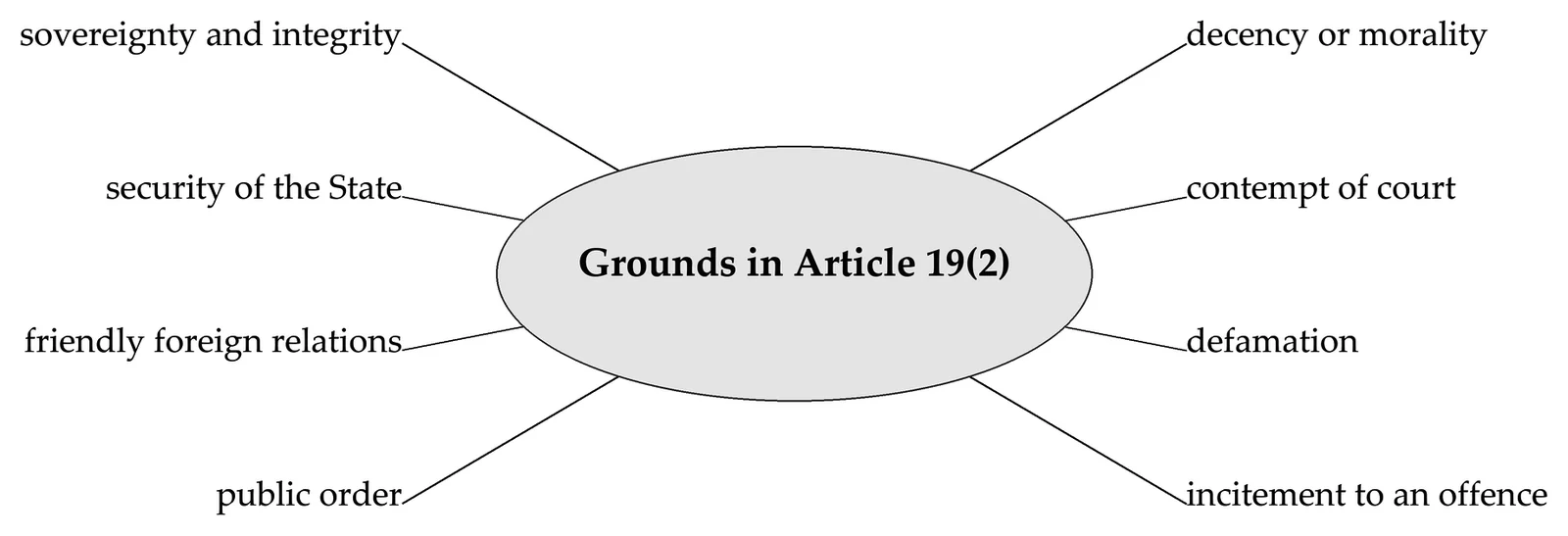
Freedom of speech serves the search for truth, democratic self-government and individual self-expression. The Supreme Court has held that it includes freedom of the press, the right to receive information and expression on the internet. But Article 19(2) allows the state to impose reasonable restrictions in the interests of sovereignty, security, public order, decency, defamation and other grounds. Gautam Bhatia, in Offend, Shock, or Disturb (2016), argues that Indian free speech law has inherited colonial laws and vague standards, and calls for an interpretation that protects even offensive speech unless it is closely linked to harm.
3.2 Public Order
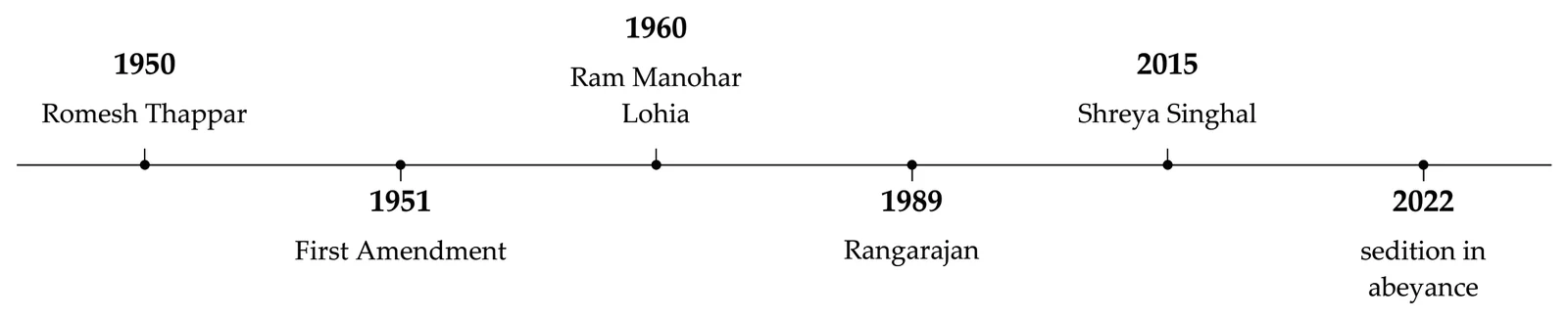
Public order, added to Article 19(2) in 1951, is the ground most often used to restrict speech. The Supreme Court held in 1960 that a restriction must have a proximate, not remote, connection with public order, and in S. Rangarajan (1989) that speech can be restricted only when it is like a spark in a powder keg. In practice, however, books and films have been banned, prohibitory orders imposed and the internet shut down in the name of public order. In Anuradha Bhasin (2020), the Court held that internet shutdowns must be necessary, proportionate and open to review.
3.3 Media, Disinformation and Regulation
The media act as a fourth estate, informing citizens and holding power to account. But Indian media face concentrated ownership, paid news, pressure on journalists and a low rank in global press freedom indices. Social media has given ordinary people a voice but also spread disinformation, hate speech and rumours that have led to lynchings and riots. Regulation remains weak: the Press Council has few powers, broadcasters regulate themselves and new rules for digital media have been criticised as threats to free speech.
3.4 Important Questions
- Question 1 Discuss the right to freedom of speech and expression under the Indian Constitution and its limits.
- Question 2 Examine the relationship between free speech and public order in India.
- Question 3 Discuss the problem of hate speech and its regulation in India.
- Question 4 Discuss the role of the media as a pillar of democracy in India and the challenges it faces.
DU asks the same idea in different words. So learn one broad answer for each question below; the same answer works for every question joined by OR.
Important Question 1
Discuss the right to freedom of speech and expression under the Indian Constitution and its limits.
OR
Examine Gautam Bhatia’s analysis of free speech under the Indian Constitution.
OR
‘Freedom of speech includes the freedom to offend, shock or disturb.’ Discuss.
Model Answer
“Freedom of expression is applicable not only to information or ideas that are favourably received or regarded as inoffensive or as a matter of indifference, but also to those that offend, shock or disturb the State or any sector of the population.”
— European Court of Human Rights, Handyside v United Kingdom (1976)
Introduction. Freedom of speech and expression is central to democracy, because citizens need information and open debate to govern themselves. The Indian Constitution guarantees it in Article 19(1)(a), but also allows reasonable restrictions in Article 19(2). How courts and governments balance this freedom against other interests determines how free Indian democracy really is, a question Gautam Bhatia examines in Offend, Shock, or Disturb (2016).
1. Why Free Speech Matters
J.S. Mill argued that free discussion is necessary for discovering truth, since even false opinions challenge us to defend the truth. Others defend free speech as essential to democratic self-government and to individual self-expression and dignity. Together, these arguments make free speech a foundational right.
2. Scope of Article 19(1)(a)
The Supreme Court has read Article 19(1)(a) broadly. It includes freedom of the press, as held in Romesh Thappar and Brij Bhushan (1950) and Bennett Coleman (1973), the right to receive information, commercial speech, broadcasting and, as held in Anuradha Bhasin (2020), expression through the internet.
3. Reasonable Restrictions
Article 19(2) allows reasonable restrictions in the interests of the sovereignty and integrity of India, the security of the state, friendly relations with foreign states, public order, decency or morality, contempt of court, defamation and incitement to an offence. Restrictions must be imposed by law and must be reasonable.
4. The First Amendment
In 1950, the Supreme Court struck down restrictions on two journals because ‘public order’ was not then a ground in Article 19(2). Nehru’s government responded with the First Amendment of 1951, adding public order, friendly relations with foreign states and incitement to an offence, and qualifying restrictions with the word reasonable.
5. Bhatia: Offend, Shock, or Disturb
Gautam Bhatia argues that Indian free speech law is shaped by colonial laws on sedition, hate speech, obscenity and defamation, and that courts have often used vague standards that protect the sensibilities of communities rather than individual freedom. He argues for a democratic interpretation that protects offensive speech unless it is closely connected to real harm.
6. Sedition
Section 124A of the Indian Penal Code, introduced in 1870, punished bringing the government into hatred or contempt. In Kedar Nath Singh (1962), the Supreme Court upheld it but limited it to incitement to violence or public disorder. It was widely misused against critics, and in 2022 the Court put it in abeyance.
7. Obscenity and Defamation
In 2014, the Supreme Court replaced the old Hicklin test of obscenity, which judged material by its effect on the most vulnerable, with a contemporary community standards test. In Subramanian Swamy (2016), it upheld criminal defamation, which critics argue chills journalism and political criticism.
8. Shreya Singhal
In Shreya Singhal v Union of India (2015), the Supreme Court struck down Section 66A of the Information Technology Act, which punished online messages that were grossly offensive or caused annoyance. The Court held that it was vague and had a chilling effect, and distinguished discussion and advocacy, which are protected, from incitement, which may be restricted.
9. Censorship and Bans
Films are subject to pre-certification, which the Court upheld in K.A. Abbas (1970). Books, plays and films have been banned when governments feared protests. Courts have sometimes lifted such bans, holding that the state must protect expression rather than give in to threats.
10. The Chilling Effect
Vague laws, criminal cases and arrests deter people from speaking even when their speech is lawful. Journalists, students and comedians have faced multiple police complaints for their speech. The resulting self-censorship weakens democratic debate even without formal bans.
11. Hate Speech and Equality
Free speech must also be balanced with equality and dignity. Laws against promoting enmity between groups and insulting religion aim to protect vulnerable communities, but Bhatia and others argue that they are often applied selectively and should be limited to speech that incites violence or discrimination.
12. Proportionality
Since Puttaswamy (2017) and Anuradha Bhasin (2020), courts increasingly apply proportionality: a restriction must pursue a legitimate aim, be suitable and necessary, and be the least restrictive means available. This offers a stronger test than the older idea of reasonableness.
13. Evaluation
India’s Constitution gives broad protection to speech, and judgments such as Shreya Singhal strengthened it. But colonial-era laws, vague standards and selective enforcement continue to restrict speech in practice, as Bhatia argues.
Conclusion. Thus, freedom of speech under Article 19(1)(a) is broad and includes the press and the internet, but Article 19(2) permits reasonable restrictions on eight grounds. As Gautam Bhatia argues, a democratic Constitution should protect even speech that offends, shocks or disturbs, restricting it only when it is closely linked to real harm.
Important Question 2
Examine the relationship between free speech and public order in India.
OR
How have Indian courts interpreted ‘public order’ as a ground for restricting free speech?
OR
Discuss internet shutdowns and the freedom of speech in India.
Model Answer
“The anticipated danger should not be remote, conjectural or far-fetched. It should have proximate and direct nexus with the expression.”
— Supreme Court of India, S. Rangarajan v P. Jagjivan Ram (1989)
Introduction. Public order is the most frequently used ground for restricting speech in India. Governments ban books and films, impose prohibitory orders, arrest speakers and shut down the internet to prevent violence. Courts have tried to limit these powers by requiring a close connection between speech and disorder. The relationship between free speech and public order therefore lies at the heart of Indian democracy.
1. Romesh Thappar
In Romesh Thappar v State of Madras (1950), the Supreme Court struck down a ban on a journal because ‘public order’ was not a ground for restriction in the original Article 19(2). Only speech undermining the security of the state could be restricted. The government responded by adding public order through the First Amendment of 1951.
2. Proximate Nexus
In Superintendent, Central Prison v Ram Manohar Lohia (1960), the Court held that a restriction on speech in the interest of public order must have a proximate, not a remote or fanciful, connection with public order. It struck down a law punishing speech that encouraged people not to pay taxes.
3. Concentric Circles
In Ram Manohar Lohia v State of Bihar (1966), the Court distinguished law and order, public order and the security of the state as three concentric circles. Law and order is the largest circle, public order a smaller one within it and security of the state the smallest. Not every breach of law disturbs public order.
4. Rangarajan: A Spark in a Powder Keg
In S. Rangarajan (1989), concerning a film on reservations, the Court held that speech can be restricted only if it is intrinsically dangerous, like a spark in a powder keg. The state cannot suppress expression merely because some people threaten violence; it must protect the speaker.
5. The Heckler’s Veto
A heckler’s veto occurs when the state silences a speaker because opponents threaten disorder. Courts have rejected this, as when the Supreme Court stayed state bans on a film in 2018. In practice, however, governments often ban works or cancel events to avoid trouble.
6. Prohibitory Orders
Section 144 of the old Criminal Procedure Code, now in the new criminal procedure code, allows magistrates to prohibit assemblies and activities to prevent disturbances. In Anuradha Bhasin (2020), the Court held that such orders cannot be used repeatedly to suppress legitimate expression.
7. Internet Shutdowns
India has recorded more internet shutdowns than any other country in several recent years. The longest followed the changes in Jammu and Kashmir in August 2019. In Anuradha Bhasin, the Court held that shutdowns must be temporary, necessary and proportionate, and that orders must be published and reviewed.
8. Social Media and Violence
Rumours spread through messaging apps led to lynchings in several states in 2017 and 2018, and fake videos have been used to provoke riots. Governments cite such dangers to justify shutdowns, while critics argue that shutdowns also block emergency information and legitimate expression.
9. Protest and Public Space
Courts have recognised the right to peaceful protest but also limits on its location. In 2018, the Supreme Court allowed regulated protests at Jantar Mantar, and in 2020, concerning the Shaheen Bagh sit-in, it held that public roads cannot be occupied indefinitely.
10. Bhatia’s Critique
Gautam Bhatia argues that the idea of public order has been stretched to protect the sensibilities of groups and the convenience of the state, continuing a colonial approach. He argues that courts should insist on a close link between speech and actual disorder.
11. Preventive Arrests
Activists, journalists and students have been arrested under preventive detention and anti-terror laws for speeches and posts. Long pre-trial detention under such laws punishes speech even when convictions are rare.
12. Proportionality and Review
A democratic approach requires that restrictions be narrowly tailored, time-bound and subject to judicial review. The state’s duty is to protect speakers and maintain order through policing rather than by silencing expression.
13. Evaluation
The courts have developed strong tests linking restrictions to real danger, but the executive often uses public order broadly. The gap between doctrine and practice remains a major challenge for free speech.
Conclusion. Thus, public order became a ground for restricting speech through the First Amendment, but courts have required a proximate nexus, as in Lohia, and a spark in a powder keg, as in Rangarajan. Internet shutdowns and prohibitory orders show that the executive often uses public order broadly, so proportionality and review remain essential.
Important Question 3
Discuss the problem of hate speech and its regulation in India.
OR
Examine the relationship between hate speech, freedom of expression and Indian law.
OR
How should a democracy deal with hate speech?
Model Answer
“To promote harmony and the spirit of common brotherhood amongst all the people of India transcending religious, linguistic and regional or sectional diversities.”
— Constitution of India, Article 51A(e)
Introduction. Hate speech is expression that attacks or incites hatred against people because of their religion, caste, race, ethnicity, gender or other identity. In a diverse society like India, it can lead to discrimination and violence. Yet laws against it can also be used to silence dissent. Nishant Kumar, writing in the Hindi journal Pratiman, and Gautam Bhatia examine this tension between hate speech, freedom of expression and Indian law.
1. Meaning of Hate Speech
Indian law does not define hate speech. The Law Commission, in its 267th Report (2017), described it as expression that incites hatred against a group identified by religion, race, caste, sex, sexual orientation or similar characteristics, and that may cause fear, violence or discrimination.
2. Why Regulate Hate Speech
Hate speech harms the dignity and equal status of vulnerable groups and can prepare the ground for violence. The philosopher Jeremy Waldron argues that hate speech undermines the assurance that all citizens can live as equals in society, which democracies must protect.
3. Liberal Concerns
Liberals worry that hate speech laws can be vague, used selectively and turned against minorities, dissenters and artists. Following Mill’s harm principle, they argue that only speech that incites violence or causes direct harm should be punished, and that offensive ideas should be answered with more speech.
4. Indian Laws
The Indian Penal Code punished promoting enmity between groups (Section 153A), deliberate and malicious acts outraging religious feelings (Section 295A) and statements conducing to public mischief (Section 505). These provisions continue in the Bharatiya Nyaya Sanhita, 2023. Election law also prohibits appeals on grounds of religion and caste.
5. Judicial Approach
In Ramji Lal Modi (1957), the Supreme Court upheld Section 295A, but limited it to aggravated, deliberate and malicious insults. In Abhiram Singh (2017), it held that appeals to voters on grounds of religion, caste or community are corrupt practices in elections.
6. The Law Commission’s Recommendations
In Pravasi Bhalai Sangathan (2014), the Supreme Court declined to frame guidelines on hate speech and asked the Law Commission to examine it. The Commission’s 267th Report recommended new offences against incitement to hatred and causing fear or alarm.
7. Kumar: Hate Speech and Indian Law
Nishant Kumar examines how Indian law struggles to balance freedom of expression with protection against hate speech. He shows that existing laws are both overused and underused: applied against critics and minorities in some cases, while inflammatory speech by powerful figures often goes unpunished.
8. Selective Enforcement
Concerned by repeated hate speeches, the Supreme Court in 2022 and 2023 directed police to register cases on their own against hate speech, without waiting for complaints, and warned that failure would be treated as contempt.
9. Social Media and Hate
Social media spreads hate speech quickly and widely, and algorithms often amplify outrage. Hate content has been linked to riots and lynchings. Platforms have been criticised for inconsistent moderation, especially in Indian languages.
10. Lynching and Hate
In Tehseen Poonawalla (2018), the Supreme Court issued guidelines to prevent mob lynching, including action against those spreading inflammatory messages, and urged Parliament to make a special law. It called lynching a horrendous act of mobocracy.
11. Counter-Speech and Education
Legal punishment is not the only response. Counter-speech, education, interfaith dialogue, responsible journalism and platform moderation can reduce hate. Many scholars argue these are more effective than criminal law alone.
12. A Balanced Approach
A democratic approach would define hate speech narrowly, focusing on incitement to violence, discrimination or hostility against vulnerable groups, enforce laws equally regardless of the speaker’s power, and protect criticism of religion and government.
13. Evaluation
Hate speech threatens equality and peace, but vague and selectively enforced laws threaten free speech. India needs clearer definitions and impartial enforcement.
Conclusion. Thus, hate speech in India is regulated by provisions on promoting enmity and outraging religious feelings, but there is no clear definition, and enforcement is selective, as Nishant Kumar shows. A democracy should define hate speech narrowly, enforce laws equally and combine legal action with counter-speech and education.
Important Question 4
Discuss the role of the media as a pillar of democracy in India and the challenges it faces.
OR
Examine the challenges of disinformation and social media for Indian democracy.
OR
How should the media be regulated in a democracy?
Model Answer
“Were it left to me to decide whether we should have a government without newspapers or newspapers without a government, I should not hesitate a moment to prefer the latter.”
— Thomas Jefferson, letter to Edward Carrington (1787)
Introduction. The media are often called the fourth estate, alongside the legislature, executive and judiciary, because they inform citizens and hold power to account. In India, a large and diverse media helped sustain democracy. Today, however, the media face concentrated ownership, commercial pressures, threats to journalists, disinformation on social media and weak regulation, raising questions about their democratic role.
1. The Fourth Estate
The media inform citizens, investigate wrongdoing, set the agenda of public debate and provide a forum for diverse voices. The philosopher Jürgen Habermas described a public sphere in which citizens debate public affairs, and the media are central to such a sphere.
2. Media in Indian History
Newspapers such as Tilak’s Kesari and Gandhi’s Young India played a key role in the freedom movement. During the Emergency of 1975–77, press censorship showed how fragile media freedom can be. Later, investigative journalism exposed scandals and strengthened accountability.
3. A Vast Media Landscape
India has one of the world’s largest media markets, with many thousands of newspapers in dozens of languages, hundreds of news channels and more than 90 crore internet subscribers. This diversity gives citizens many sources of information.
4. Ownership and Commercialisation
Many media houses are owned by large corporate groups or by people linked to political parties, raising conflicts of interest. Dependence on advertising and television ratings encourages sensationalism, and the Press Council reported on the practice of paid news, in which coverage is sold as news.
5. Press Freedom
India ranks low in international press freedom indices, around the 150s among 180 countries in recent years. Journalists have faced criminal cases, defamation suits, arrests under anti-terror laws and physical attacks, especially in conflict areas and small towns.
6. Social Media and Voice
Social media has given ordinary citizens, marginalised groups and independent journalists a voice and helped mobilise movements, such as the anti-corruption protests of 2011 and the protests after the Delhi gang rape of 2012.
7. Disinformation
Social media also spreads disinformation: fake news, doctored videos and deep fakes. Rumours on messaging apps led to lynchings in 2017 and 2018, and a fake video circulated before the Muzaffarnagar riots of 2013. Disinformation during elections threatens informed choice.
8. Regulation of the Press and Television
The Press Council of India, under the Press Council Act of 1978, can only censure newspapers. Television news relies on self-regulation through the News Broadcasting and Digital Standards Authority, which critics consider weak. Cable channels are governed by the Cable Television Networks Act of 1995.
9. Regulation of Digital Media
The Information Technology Rules of 2021 created a code of ethics and grievance system for digital news and streaming platforms and required messaging services to trace message originators. In 2024, the Bombay High Court struck down a government fact-check unit as a threat to free speech.
10. The Regulatory Dilemma
Weak self-regulation fails to stop misinformation and hate, but government regulation risks censorship. Many scholars argue for independent regulators, transparency about ownership and platform algorithms, and strong protection for journalists.
11. Platform Power
Large technology platforms decide what content is seen and removed. Governments use takedown orders under Section 69A of the IT Act, which the Supreme Court upheld in Shreya Singhal with procedural safeguards. Accountability for platforms remains a global challenge.
12. Fact-Checking and Media Literacy
Independent fact-checking organisations and media literacy programmes help citizens identify false information. The Election Commission introduced a voluntary code of ethics for social media platforms during the 2019 elections.
13. Evaluation
The media remain essential to Indian democracy, but commercial pressures, threats to journalists and disinformation weaken their role. Free, plural and responsible media require both protection from the state and accountability to the public.
Conclusion. Thus, the media serve as a pillar of democracy by informing citizens and holding power to account. In India, concentrated ownership, attacks on press freedom, disinformation on social media and weak regulation threaten this role. Independent regulation, protection of journalists and media literacy are needed to strengthen it.
Short Notes
(a) Section 66A
A provision of the Information Technology Act that punished sending grossly offensive or annoying messages online. It was widely misused to arrest people for social media posts and was struck down by the Supreme Court in Shreya Singhal (2015) as vague and unconstitutional.
(b) Sedition
Section 124A of the Indian Penal Code, introduced in 1870, punished exciting disaffection against the government. Limited by Kedar Nath Singh (1962) to incitement to violence, it was put in abeyance by the Supreme Court in 2022 and was not retained in the same form in the Bharatiya Nyaya Sanhita.
(c) Press Council of India
A statutory body under the Press Council Act of 1978 to preserve the freedom of the press and maintain standards of journalism. It can warn or censure newspapers but cannot punish them, and it does not cover television or digital media.
More notes: MDSE-5 Contemporary Debates in Indian Politics
These notes are prepared by PADHO TO AISE for study help. They are not an official University of Delhi publication.