
Semester VI MDSE-4b Understanding Savarkar
Unit V · 21 min read · Updated 24 Nov 2026
As per the University of Delhi (DU) BA (Hons) Political Science syllabus
Contents
- 5.1 Savarkar’s Argument on Conversion and the Nation
- Holy Land and Loyalty
- History and Numbers
- Critiques
- Conversion in Indian History
- 5.2 Shuddhi, Sangathan and the Hindu Mahasabha
- The Shuddhi and Sangathan Movements
- Sareen: The Hindu Mahasabha’s Tryst with United India
- Communal Politics of the 1920s
- 5.3 Conversion, the Constitution and Contemporary Debates
- The Right to Propagate
- Anti-Conversion Laws
- Ambedkar, Savarkar and Conversion
- Conversion and Tribal Communities
- Positions on Conversion Compared
- 5.4 Important Questions
- Discuss Savarkar’s views on religious conversion.
- Discuss the Shuddhi and Sangathan movements and Savarkar’s support for reconversion.
- Discuss the role of the Hindu Mahasabha in the debates on conversion and a united India.
- Discuss the debate on religious conversion in the Indian Constitution and law.
- Short Notes
लोक व्यवस्था, सदाचार और स्वास्थ्य तथा इस भाग के अन्य उपबंधों के अधीन रहते हुए, सभी व्यक्तियों को अंतःकरण की स्वतंत्रता का और धर्म के अबाध रूप से मानने, आचरण करने और प्रचार करने का समान हक होगा।
Subject to public order, morality and health and to the other provisions of this Part, all persons are equally entitled to freedom of conscience and the right freely to profess, practise and propagate religion.
— Constitution of India, Article 25(1)
RRELIGIOUS conversion has been one of the most sensitive issues in Indian public life. For Savarkar, conversion was not only a matter of personal faith; it changed a person’s holy land and therefore, in his view, their place in the nation. He supported the Shuddhi (reconversion) and Sangathan (organisation) movements and, as president of the Hindu Mahasabha, spoke repeatedly about conversion by Muslims and Christian missionaries. This chapter studies Unit V of the syllabus: Savarkar’s views on religious conversion, the reconversion movements, the role of the Hindu Mahasabha, and the continuing constitutional and legal debates on conversion in India.
5.1 Savarkar’s Argument on Conversion and the Nation
Holy Land and Loyalty
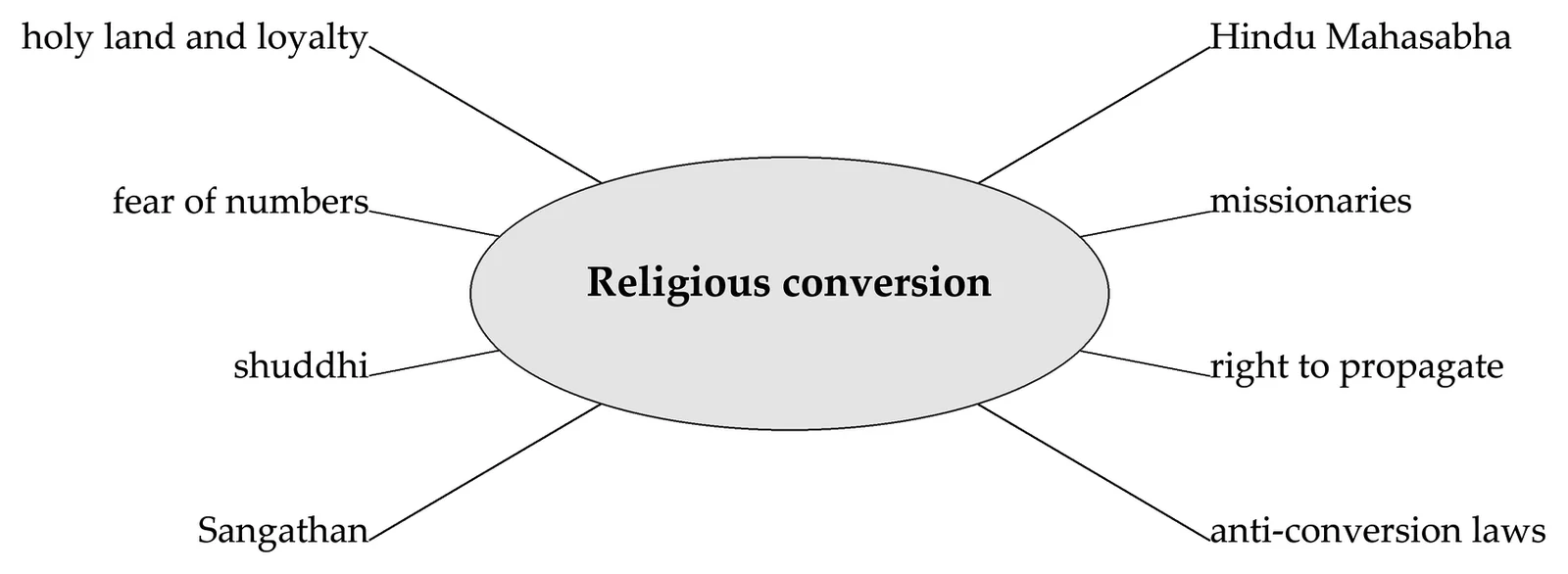
Savarkar’s view of conversion followed from his definition of a Hindu. Since a Hindu regards India as both fatherland and holy land, a person who converts to a religion whose holy land lies outside India, such as Islam or Christianity, changes his sacred centre. Savarkar argued that such converts, though their fatherland remained India, would look to Arabia or Palestine for their religious inspiration, heroes and history, and that this could divide their loyalty. In this sense he saw conversion away from Indic religions as a form of denationalisation, a loss to the nation as well as to the Hindu community. Conversion among Indic religions, such as to Sikhism or Buddhism, did not take a person outside Hindutva in his sense.
History and Numbers
Savarkar read Indian history as including periods of forced conversion under some Muslim rulers and missionary activity under colonial rule. He was also influenced by the anxiety, produced by colonial censuses, that the Hindu share of the population was declining. He argued that Hindus had wrongly closed the door to returning converts, because of caste rules and notions of pollution, so that conversion was a one-way process. A strong nation, he believed, required Hindus to stop losses through conversion and to welcome back those who wished to return.
Critiques
- Freedom of conscience. Critics argue that treating conversion as disloyalty denies the individual’s freedom to choose and change faith, which is a basic liberal right.
- Loyalty and citizenship. Indian Muslims and Christians have served the nation in every field, which critics say disproves the idea that a holy land abroad divides loyalty.
- Social causes. Many conversions, especially among Dalits and tribal communities, were responses to caste oppression and the search for dignity, as Ambedkar argued, rather than results of force.
- Supporters’ view. Supporters argue that Savarkar’s concern was with organised proselytisation and its political effects, not with sincere individual choices.

Conversion in Indian History
Conversion has a long and varied history in India. Buddhism and Jainism spread through monks and royal patronage; Islam spread through traders, Sufi saints and, at times, state power. Richard Eaton, in The Rise of Islam and the Bengal Frontier (1993), showed that mass conversion in eastern Bengal happened gradually, as forest land was cleared and settled under Sufi-led communities, rather than mainly by force. Christianity has ancient roots in Kerala, expanded under Portuguese rule in Goa, where an Inquisition was established in 1560, and grew through Protestant missions such as Serampore (1800). In the late nineteenth and early twentieth centuries, mass movements of Dalits in Punjab and Andhra converted to Christianity in search of dignity and education.
5.2 Shuddhi, Sangathan and the Hindu Mahasabha
The Shuddhi and Sangathan Movements
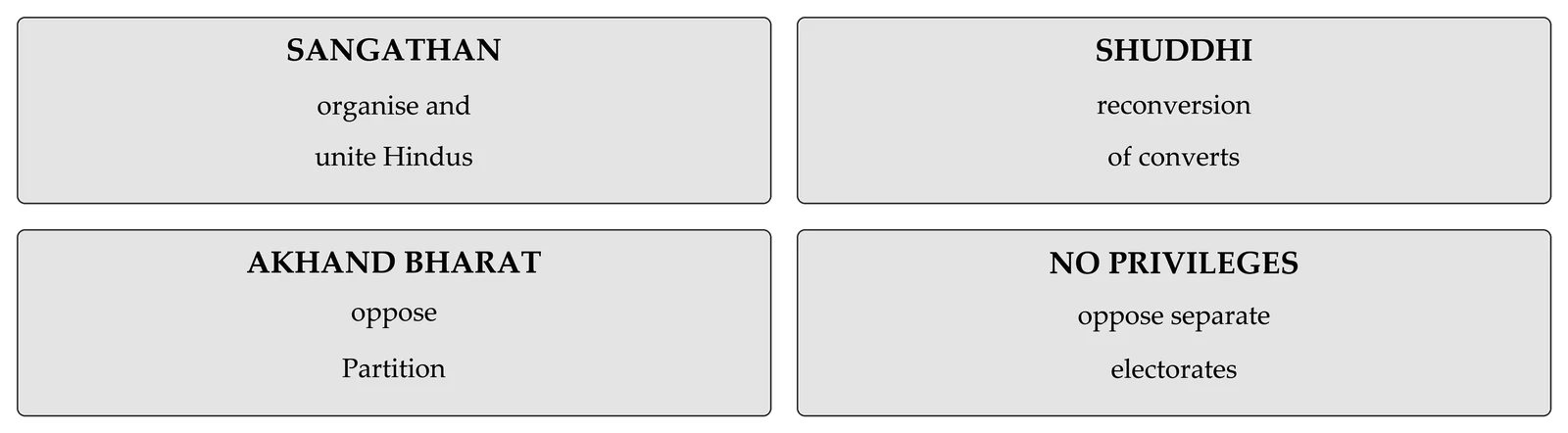
Shuddhi (purification) was a ritual of reconversion developed by the Arya Samaj to bring back into Hinduism people who had converted to Islam or Christianity, and to admit others. In the 1920s, after the Khilafat-Non-Cooperation period and amid rising communal tension, Swami Shraddhanand led a major shuddhi campaign, founding the Bharatiya Hindu Shuddhi Sabha in 1923 and reconverting the Malkana Rajputs of western Uttar Pradesh, communities with mixed Hindu and Muslim customs. At the same time, leaders such as Madan Mohan Malaviya promoted Sangathan, the organisation of Hindus for self-defence and unity. Muslim organisations responded with Tabligh and Tanzeem movements, and the competition sharpened communal conflict. Shraddhanand was assassinated in 1926.
Gandhi criticised these movements. He argued that Hinduism did not traditionally seek converts and that shuddhi and tabligh were damaging Hindu-Muslim relations. In 1935 he said that if he had the power to legislate, he would stop all proselytising. Savarkar, by contrast, strongly supported shuddhi. At Ratnagiri he organised reconversions and insisted that reconverts be accepted fully, without caste discrimination. He counted the ban on reconversion, shuddhibandi, among the seven shackles that weakened Hindu society (Chapter 6).
Sareen: The Hindu Mahasabha’s Tryst with United India
T. R. Sareen, in Hindu Mahasabha Tryst with United India (2019), traces the history of the Hindu Mahasabha from its founding in 1915. Under leaders such as Malaviya, Lajpat Rai, B. S. Moonje, Savarkar and Syama Prasad Mookerjee, it promoted Hindu unity, shuddhi and Sangathan, and opposed what it saw as the Congress’s concessions to the Muslim League. Sareen emphasises its struggle for a united India against the demand for Pakistan, presenting it as a defender of national unity. Critics, however, argue that the Mahasabha’s communal politics contributed to the polarisation that made Partition more likely.
- Presidential speeches. In his Mahasabha addresses (1937–43), Savarkar criticised Christian missionary activity and Muslim proselytisation and called for Hindu consolidation.
- Programme. The Mahasabha opposed separate electorates and special privileges, supported shuddhi and called for military training of Hindus.
- Opposition to Pakistan. It rejected the Lahore Resolution of 1940 and the partition plan of 1947, calling for Akhand Bharat.
Communal Politics of the 1920s
The debates on conversion intensified in the 1920s. During the Malabar (Moplah) rebellion of 1921, there were reports of forced conversion of Hindus, which shocked Hindu opinion; Savarkar wrote a Marathi novel on these events in 1924. Riots at Kohat (1924) and elsewhere followed, and Gandhi undertook a 21-day fast for Hindu-Muslim unity in September 1924. In this atmosphere, shuddhi and tabligh became instruments of communal mobilisation.
5.3 Conversion, the Constitution and Contemporary Debates
The Right to Propagate
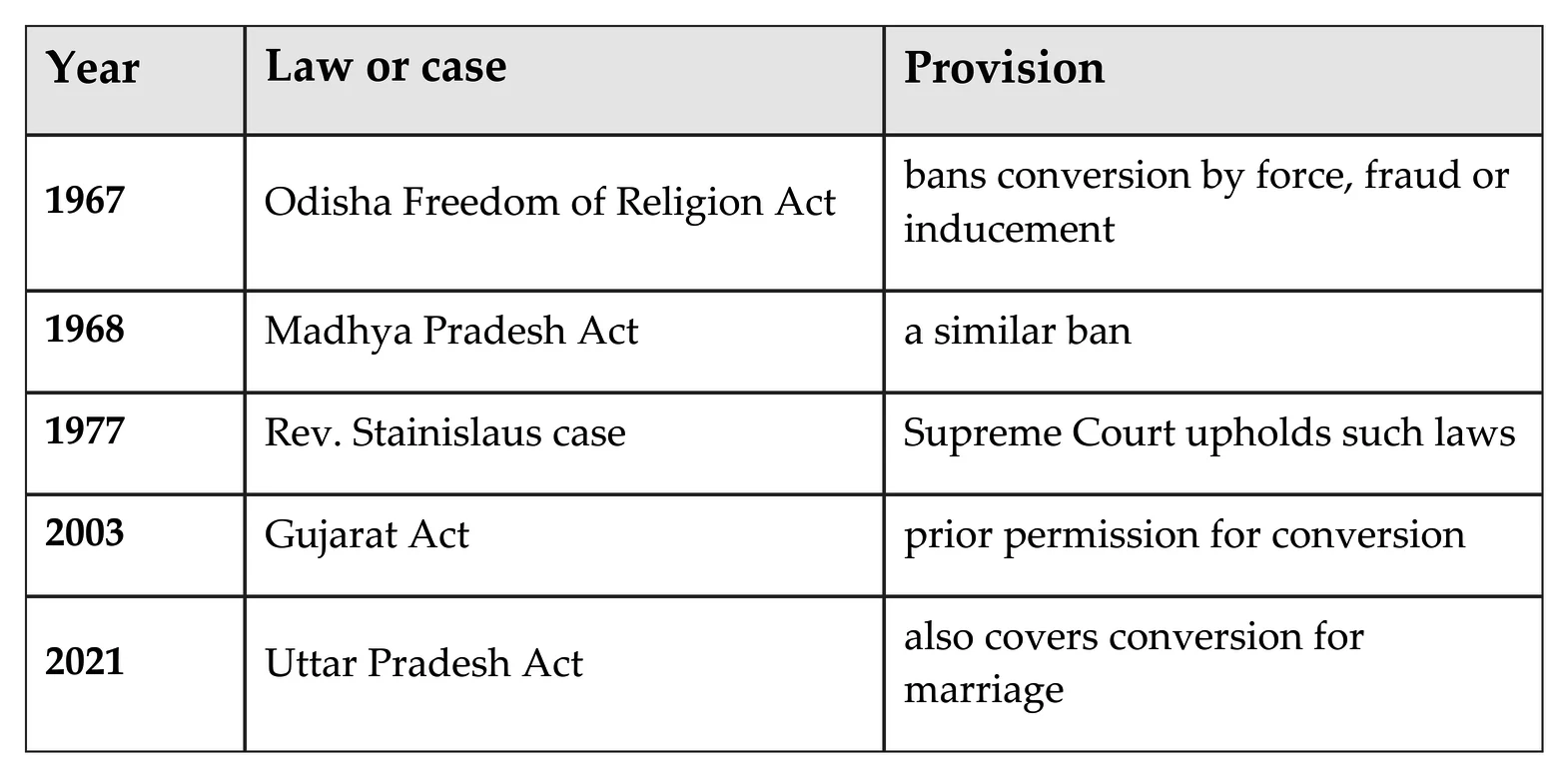
In the Constituent Assembly, some members wanted to drop the word propagate from the article on religious freedom, fearing that it would encourage conversion. Others, including Christian members and leaders such as K. M. Munshi, argued that propagation was part of freedom of religion. Article 25 therefore guarantees to all persons freedom of conscience and the right to profess, practise and propagate religion, subject to public order, morality and health. In Rev. Stainislaus v. State of Madhya Pradesh (1977), the Supreme Court held that the right to propagate means the right to spread one’s religion by explaining its tenets, not a right to convert another person, and upheld state laws against conversion by force, fraud or inducement.
Anti-Conversion Laws
Several states have passed so-called freedom of religion laws: Odisha (1967), Madhya Pradesh (1968), Arunachal Pradesh (1978), and later Gujarat (2003), Himachal Pradesh, Jharkhand, Uttarakhand, Uttar Pradesh (2021) and Karnataka (2022). They forbid conversion by force, fraud or allurement, and some require prior notice to officials or cover conversion for marriage. Earlier, the Niyogi Committee (1956) in Madhya Pradesh had reported on Christian missionary activities and recommended controls. Supporters argue that these laws protect vulnerable people from exploitation; critics argue that they burden freedom of conscience, are used against minorities and inter-faith couples, and treat converts as incapable of choice.
Ambedkar, Savarkar and Conversion
The debate also involves Dalits. Ambedkar argued that untouchables had the right to leave a religion that degraded them and embraced Buddhism in 1956. Savarkar, who regarded Buddhism as an Indic religion within his definition of Hindutva, did not see this as leaving the nation, but he opposed conversion to Islam or Christianity. Later, reconversion programmes, sometimes called ghar wapsi, revived controversies in the 2010s. The question of whether Dalits who convert to Islam or Christianity should receive Scheduled Caste status has also been debated, and a commission headed by former Chief Justice K. G. Balakrishnan was set up in 2022 to examine it.
Conversion and Tribal Communities
Conversion debates are especially intense in tribal regions of central and eastern India. Christian missions there ran schools and hospitals, and many Adivasis converted. Hindu organisations such as the Vanvasi Kalyan Ashram (1952) work among tribal communities and oppose conversion to Christianity. Tension led to violence in Kandhamal, Odisha, in 2008. Some tribal groups, such as followers of the Sarna faith in Jharkhand, demand recognition as a separate religion, showing that tribal people assert their own identities beyond both sides of this debate.
Positions on Conversion Compared
- Savarkar: conversion to non-Indic religions is denationalisation; reconversion should be welcomed.
- Gandhi: opposed proselytising by all religions and criticised both shuddhi and tabligh.
- Ambedkar: conversion is a right and a path to dignity for those oppressed by caste.
- The Constitution: protects the right to propagate religion, but courts allow laws against forced or induced conversion.
5.4 Important Questions
- Question 1 Discuss Savarkar’s views on religious conversion.
- Question 2 Discuss the Shuddhi and Sangathan movements and Savarkar’s support for reconversion.
- Question 3 Discuss the role of the Hindu Mahasabha in the debates on conversion and a united India.
- Question 4 Discuss the debate on religious conversion in the Indian Constitution and law.
DU asks the same idea in different words. So learn one broad answer for each question below; the same answer works for every question joined by OR.
Important Question 1
Discuss Savarkar’s views on religious conversion.
OR
Examine Savarkar’s argument that conversion leads to denationalisation.
OR
Discuss the relationship between conversion, Hindutva and the nation in Savarkar’s thought.
Model Answer
“Their holyland is far off in Arabia or Palestine. Their mythology and Godmen, ideas and heroes are not the children of this soil.”
— V. D. Savarkar, Essentials of Hindutva (1923)
Introduction. Savarkar’s view of conversion followed from his definition of a Hindu as one who regards India as both fatherland and holy land. Conversion to a religion with a holy land abroad, in his view, changed a person’s sacred centre and could divide loyalty. He therefore saw such conversion as denationalisation and supported reconversion. Critics argue that this view denies freedom of conscience and questions the loyalty of minorities.
1. Starting Point
Savarkar defined a Hindu as one who regards India as fatherland and holy land. Conversion affects the second criterion.
2. Change of Holy Land
Converts to Islam or Christianity, in his view, acquire a holy land outside India. Their sacred centre moves abroad.
3. Divided Loyalty
He argued that their religious inspiration, heroes and history would lie abroad, dividing their loyalty.
4. Denationalisation
He therefore saw conversion away from Indic religions as a loss to the nation, not only to Hindus.
5. Indic Conversions
Conversion to Sikhism, Jainism or Buddhism did not take a person outside Hindutva in his sense.
6. Historical Reading
He read history as including forced conversion under some rulers and missionary activity under colonial rule.
7. Fear of Numbers
Colonial censuses created anxiety about the Hindu share of the population, which Savarkar shared.
8. One-Way Door
He argued that caste rules had made conversion a one-way process by refusing to accept returning converts.
9. Support for Shuddhi
He therefore supported shuddhi to welcome back converts, without caste discrimination.
10. Critique of Missionaries
As Mahasabha president, he criticised Christian missionary activity and Muslim proselytisation.
11. Rationalist Paradox
Though himself a rationalist, he treated religion as central to national identity through the holy land criterion.
12. Freedom of Conscience
Critics argue that his view denies the individual’s right to choose and change faith.
13. Loyalty of Minorities
Critics also point out that Muslims and Christians have served India loyally, disproving the divided loyalty claim.
14. Social Causes of Conversion
Many conversions, especially of Dalits and tribal people, were responses to caste oppression, as Ambedkar argued.
15. Supporters’ View
Supporters argue that his concern was with organised proselytisation and its political effects.
16. Legacy
His views influenced later debates on anti-conversion laws and reconversion programmes.
17. Constitutional Contrast
The Constitution guarantees the right to propagate religion, though courts have limited it.
18. Savarkar and Buddhism
Since Buddhism was an Indic religion, Savarkar did not regard Ambedkar’s conversion of 1956 as taking his followers outside Hindutva in his sense.
19. Census Politics
Debates over census figures and the growth rates of communities continue to shape arguments about conversion, often with exaggerated claims.
20. The Moplah Rebellion
Reports of forced conversions during the Malabar rebellion of 1921 deeply influenced Savarkar, who wrote a Marathi novel on these events in 1924.
21. Eaton’s Counter-Evidence
Richard Eaton showed that mass conversion in Bengal happened gradually through land settlement and Sufi influence, challenging the view that conversion was mainly forced.
22. Evaluation
Savarkar’s view of conversion is consistent with his Hindutva but conflicts with liberal ideas of individual freedom.
Conclusion. Thus, Savarkar saw conversion to religions whose holy land lies far off in Arabia or Palestine as denationalisation and supported reconversion. His view, rooted in his definition of Hindutva, remains central to debates on conversion and freedom of conscience.
Important Question 2
Discuss the Shuddhi and Sangathan movements and Savarkar’s support for reconversion.
OR
Examine the Shuddhi movement of the 1920s.
OR
Discuss Savarkar’s role in promoting reconversion.
Model Answer
“In my opinion there is no such thing as proselytism in Hinduism as it is understood in Christianity or to a lesser extent in Islam.”
— M. K. Gandhi, Young India (29 May 1924)
Introduction. In the 1920s, the Arya Samaj’s Shuddhi movement and the Sangathan movement sought to reconvert those who had left Hinduism and to organise Hindus for unity and self-defence. Muslim organisations responded with Tabligh and Tanzeem. Gandhi criticised these movements, while Savarkar strongly supported shuddhi, organising reconversions at Ratnagiri and attacking caste barriers to accepting reconverts.
1. Meaning of Shuddhi
Shuddhi means purification, a ritual developed by the Arya Samaj to bring converts back into Hinduism.
2. The Arya Samaj
Founded by Dayananda Saraswati in 1875, the Arya Samaj promoted Vedic reform and reconversion.

3. Context of the 1920s
After the Khilafat-Non-Cooperation period, communal tensions rose and riots spread in many places.
4. Shraddhanand’s Campaign
Swami Shraddhanand founded the Bharatiya Hindu Shuddhi Sabha in 1923 and led a major campaign.
5. The Malkana Rajputs
The reconversion of the Malkana Rajputs of western UP, with mixed customs, became the best-known case.
6. Sangathan
Leaders such as Madan Mohan Malaviya promoted Sangathan, the organisation of Hindus for unity and self-defence.
7. Tabligh and Tanzeem
Muslim organisations responded with Tabligh (propagation) and Tanzeem (organisation), sharpening competition.
8. Shraddhanand’s Assassination
Shraddhanand was assassinated in Delhi in 1926, a sign of the bitterness of the conflict.
9. Gandhi’s Criticism
Gandhi argued that Hinduism did not traditionally seek converts and that these movements harmed communal relations.
10. Savarkar’s Support
Savarkar strongly supported shuddhi as a way to stop losses and strengthen Hindus.
11. Reconversions at Ratnagiri
At Ratnagiri he organised reconversions and insisted that reconverts be accepted fully.
12. Against Caste Barriers
He attacked the caste rules that refused to accept returning converts, calling the ban on reconversion a shackle.
13. Hindu Unity
For Savarkar, shuddhi was part of building a united and strong Hindu nation.
14. Mahasabha Programme
As Mahasabha president, he made shuddhi and Sangathan part of the organisation’s programme.
15. Communal Consequences
Historians argue that competing conversion campaigns deepened communal polarisation in the 1920s.
16. Later Echoes
Reconversion programmes in recent decades, sometimes called ghar wapsi, revived these debates.
17. Criticism
Critics say reconversion campaigns treat people as numbers and can involve pressure rather than free choice.
18. Dayananda’s Reform
Dayananda Saraswati’s Satyarth Prakash (1875) criticised idol worship and other religions, and gave the Arya Samaj its reformist and assertive character.
19. Women and Shuddhi
Reconversion campaigns often focused on women who had converted or married across religions, linking conversion with family and community honour.
20. Gandhi’s Fast of 1924
Gandhi’s 21-day fast for Hindu-Muslim unity in September 1924 was a response to the communal tension that these movements had deepened.
21. Evaluation
The Shuddhi and Sangathan movements, backed by Savarkar, show how religion and politics became linked in the 1920s.
Conclusion. Thus, while Gandhi held that Hinduism had no tradition of proselytism, the Shuddhi and Sangathan movements sought to reconvert and organise Hindus. Savarkar supported them strongly, linking reconversion with Hindu unity and national strength.
Important Question 3
Discuss the role of the Hindu Mahasabha in the debates on conversion and a united India.
OR
Examine T. R. Sareen’s account of the Hindu Mahasabha’s tryst with united India.
OR
Discuss Savarkar’s Hindu Mahasabha speeches on conversion and minorities.
Model Answer
“The areas in which the Muslims are numerically in a majority as in the North-Western and Eastern zones of India should be grouped to constitute Independent States in which the constituent units shall be autonomous and sovereign.”
— Lahore Resolution of the All-India Muslim League (March 1940)
Introduction. The Hindu Mahasabha, founded in 1915, promoted Hindu unity, reconversion and opposition to concessions to the Muslim League. Under Savarkar’s presidency (1937–43), it opposed the Lahore Resolution and the demand for Pakistan, calling for Akhand Bharat. T. R. Sareen presents its struggle for a united India, while critics argue that its communal politics contributed to polarisation.
1. Founding
The Hindu Mahasabha was founded at Haridwar in 1915 to protect Hindu interests.
2. Leaders
Its leaders included Malaviya, Lajpat Rai, B. S. Moonje, Savarkar and Syama Prasad Mookerjee.
3. Programme
It promoted Sangathan, shuddhi and opposition to separate electorates and special privileges.
4. Savarkar’s Presidency
Savarkar led the Mahasabha from 1937 to 1943, giving it a clear Hindutva ideology.
5. Speeches on Conversion
In his addresses he criticised missionary activity and Muslim proselytisation and called for Hindu consolidation.
6. Minorities
He promised minorities equal rights as citizens but opposed special privileges for them.
7. The Lahore Resolution
The Muslim League’s Lahore Resolution of 1940 demanded independent states in Muslim-majority areas.
8. Opposition to Pakistan
The Mahasabha rejected the resolution and called for an undivided India, Akhand Bharat.
9. Sareen’s Account
Sareen presents the Mahasabha as a defender of national unity against the demand for Pakistan.
10. Critique of the Congress
The Mahasabha accused the Congress of appeasing the League and weakening Hindu interests.
11. Wartime Coalitions
It joined coalition governments with the League in Sind and with Fazlul Huq in Bengal during the war.
12. Limited Support
It performed poorly in the 1945–46 elections, showing that most Hindus supported the Congress.
13. Partition
Despite its opposition, Partition came in 1947; the Mahasabha blamed the Congress for accepting it.
14. Critics’ View
Critics argue that the Mahasabha’s communal politics contributed to the polarisation that made Partition likely.
15. After Independence
The Mahasabha declined after Gandhi’s assassination, and Mookerjee founded the Jana Sangh in 1951.
16. Legacy
Its ideas on conversion and national unity influenced later Hindu nationalist organisations.
17. Assessing Sareen
Sareen’s account is useful for the Mahasabha’s own perspective but should be read alongside critical histories.
18. Moonje and Militarisation
B. S. Moonje, a Mahasabha leader, founded the Bhonsala Military School at Nashik in 1937 to give Hindus military training.
19. Relations with the RSS
The Mahasabha and the RSS shared ideas but remained separate organisations with different methods.
20. Mookerjee’s Role
Syama Prasad Mookerjee, who succeeded Savarkar as a leading figure, later joined Nehru’s first cabinet before founding the Jana Sangh in 1951.
21. Tribal Work
Hindu organisations later extended their work among tribal communities, such as through the Vanvasi Kalyan Ashram founded in 1952, partly to counter conversion.
22. Evaluation
The Mahasabha was a significant voice for Hindu nationalism, though its influence on events was limited.
Conclusion. Thus, the Hindu Mahasabha under Savarkar opposed conversion and the Lahore Resolution’s demand for Muslim-majority states, calling for a united India. Sareen presents this as a defence of unity, while critics see its politics as part of the polarisation that led to Partition.
Important Question 4
Discuss the debate on religious conversion in the Indian Constitution and law.
OR
Examine the debate on the right to propagate religion.
OR
Discuss anti-conversion laws in India.
Model Answer
“What is freedom for one, is freedom for the other, in equal measure, and there can therefore be no such thing as a fundamental right to convert any person to one’s own religion.”
— Supreme Court, Rev. Stainislaus v. State of Madhya Pradesh (1977)
Introduction. Article 25 guarantees the right to profess, practise and propagate religion. Whether this includes a right to convert others has been debated since the Constituent Assembly. The Supreme Court held in 1977 that it does not, and upheld state laws against conversion by force, fraud or inducement. Many states have since passed such laws, which supporters see as protection and critics as restrictions on freedom of conscience.
1. Article 25
Article 25 guarantees freedom of conscience and the right to profess, practise and propagate religion.
2. The Assembly Debate
Some members wanted to drop the word propagate, fearing it would encourage conversion.
3. Defence of Propagation
Christian members and leaders such as K. M. Munshi argued that propagation was part of religious freedom.
4. Limits
The right is subject to public order, morality, health and other fundamental rights.
5. The Niyogi Committee
The Niyogi Committee (1956) in Madhya Pradesh reported on missionary activities and recommended controls.
6. Early State Laws
Odisha (1967) and Madhya Pradesh (1968) passed laws against conversion by force, fraud or inducement.
7. The Stainislaus Case
In 1977 the Supreme Court upheld these laws, saying there is no fundamental right to convert another person.
8. Meaning of Propagate
The Court held that to propagate means to spread one’s religion by explaining its tenets.
9. Later Laws
Gujarat (2003), Uttar Pradesh (2021), Karnataka (2022) and other states passed similar laws.
10. Prior Notice
Some laws require prior notice to officials before conversion, which critics see as intrusive.
11. Conversion for Marriage
Recent laws also cover conversion for the purpose of marriage, affecting inter-faith couples.
12. Supporters’ View
Supporters argue that these laws protect poor and vulnerable people from exploitation.
13. Critics’ View
Critics argue that they burden freedom of conscience and are used against minorities.
14. Savarkar’s Influence
Savarkar’s view of conversion as denationalisation informs some arguments for such laws.
15. Ambedkar’s Perspective
Ambedkar’s conversion shows that conversion can be an act of dignity and protest against caste.
16. Dalit Converts
Whether Dalit converts to Islam or Christianity should get SC status is being examined by a commission set up in 2022.
17. Freedom and Protection
The debate involves balancing individual freedom with protection against coercion.
18. Courts on Inter-Faith Marriage
In the Hadiya case (2018) the Supreme Court upheld an adult woman’s right to choose her religion and partner, stressing individual autonomy.
19. International Standards
Article 18 of the Universal Declaration of Human Rights (1948) includes the freedom to change one’s religion or belief.
20. Evaluation
Conversion remains a contested area where religious freedom, minority rights and majoritarian concerns meet.
Conclusion. Thus, the Supreme Court held in 1977 that there is no fundamental right to convert another person, upholding anti-conversion laws. The debate between protection from coercion and freedom of conscience, shaped partly by Savarkar’s ideas, continues today.
Short Notes
(a) Shuddhi
A ritual of purification developed by the Arya Samaj to reconvert to Hinduism those who had become Muslims or Christians; it became a mass movement in the 1920s.
(b) Sangathan
The movement of the 1920s, associated with Madan Mohan Malaviya and the Hindu Mahasabha, to organise Hindus for unity and self-defence.
(c) Rev. Stainislaus case
The 1977 Supreme Court judgment holding that the right to propagate religion does not include a right to convert others, and upholding state anti-conversion laws.
More notes: MDSE-4b Understanding Savarkar
These notes are prepared by PADHO TO AISE for study help. They are not an official University of Delhi publication.