
Semester VI MDSE-4b Understanding Savarkar
Unit IV · 21 min read · Updated 24 Nov 2026
As per the University of Delhi (DU) BA (Hons) Political Science syllabus
Contents
- 4.1 Savarkar’s Language Purification Movement
- Bhasha Shuddhi
- Thube: A Precursor to a Hindu Language
- The Hindi-Urdu Controversy
- 4.2 Savarkar on the National Language and Script
- Hindi as Rashtrabhasha
- Script Reform
- Savarkar and Gandhi on Language
- Savarkar’s Writings on Social Questions
- 4.3 The Quest for an All-India Language after Independence
- The Constituent Assembly and the Munshi-Ayyangar Formula
- Rao: Many Languages, One Nation
- Savarkar’s Ideas and the Constitution
- Language Movements after Independence
- Key Positions Compared
- 4.4 Important Questions
- Discuss Savarkar’s language purification movement.
- Discuss Savarkar’s views on the national language and the script.
- Discuss the quest for an all-India language with reference to V. K. R. V. Rao.
- Discuss the official language question in the Constituent Assembly and after independence.
- Short Notes
संघ की राजभाषा हिंदी और लिपि देवनागरी होगी।
The official language of the Union shall be Hindi in Devanagari script.
— Constitution of India, Article 343(1)
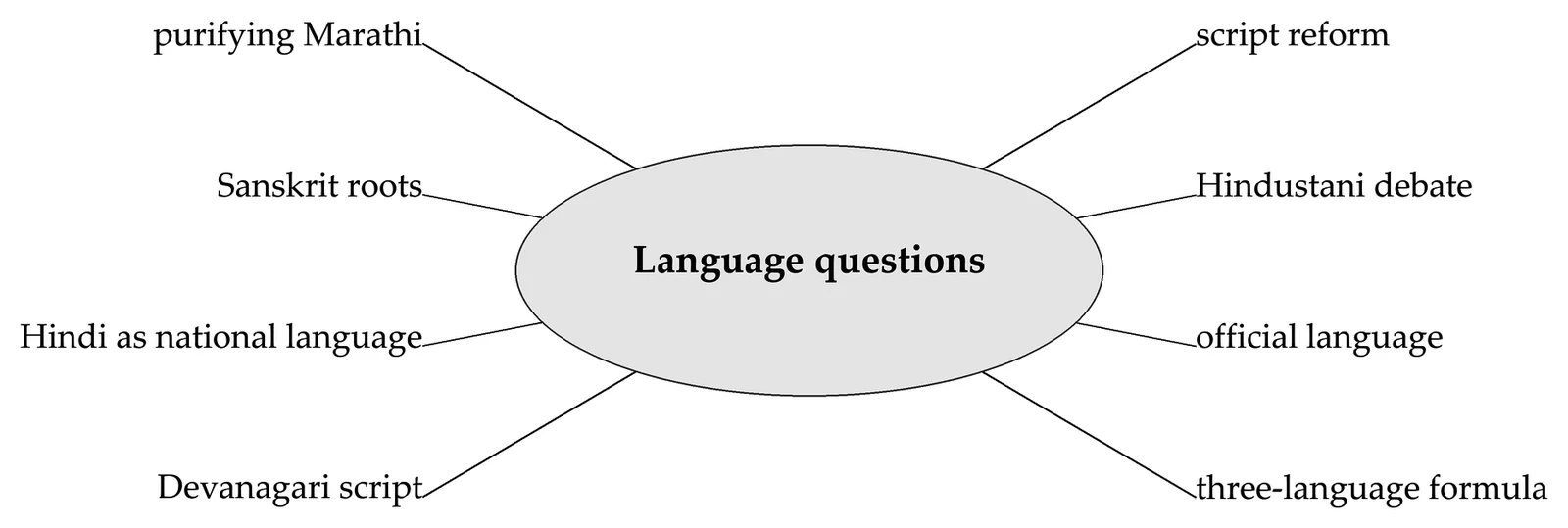
LLANGUAGE has been one of the most sensitive questions in modern India, linked to identity, power, education and national unity. Savarkar took a strong position on it. He led a campaign to purify Marathi of Persian, Arabic and English words, coined new words from Sanskrit roots, proposed reforms of the Devanagari script, and argued that a Sanskritised Hindi in Devanagari should be the national language. His ideas were part of his wider project of Hindutva. This chapter studies Unit IV of the syllabus: Savarkar and the language questions in India, in the context of the broader debate on an all-India language and the language provisions of the Constitution.
4.1 Savarkar’s Language Purification Movement
Bhasha Shuddhi
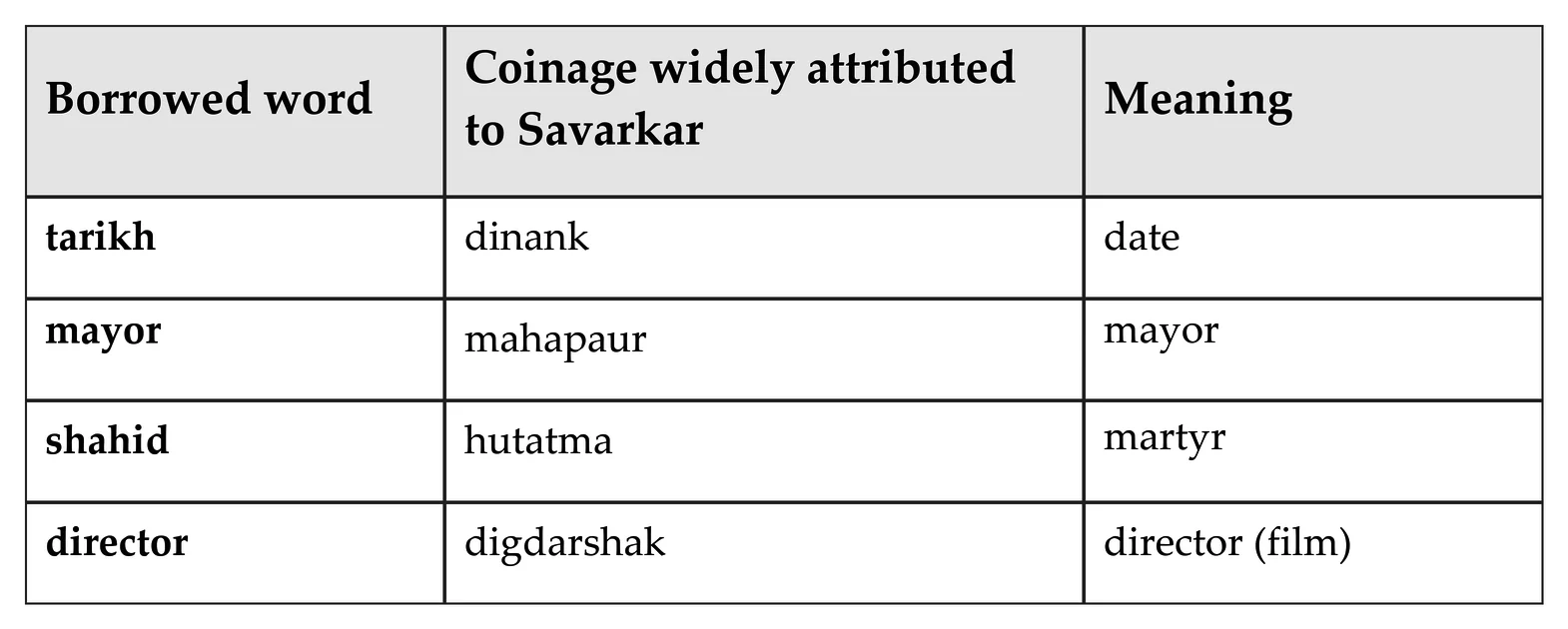
During his years at Ratnagiri, Savarkar launched a movement for bhasha shuddhi, the purification of Marathi. He argued that centuries of Muslim rule had filled Marathi with Persian and Arabic words, and British rule with English ones, and that these foreign words were signs of cultural subjection. He urged writers, newspapers and institutions to replace them with words drawn from Sanskrit and native Marathi roots. He coined many new words himself, especially for administration, politics, cinema and sport. Terms widely attributed to him include dinank for date (replacing tarikh), mahapaur for mayor, hutatma for martyr (replacing shahid) and digdarshak for director. Several of these words are still used in Marathi today.
Thube: A Precursor to a Hindu Language
Surajkumar Thube, in his essay V. D. Savarkar’s Language Purification Project Was a Precursor to Creating a Hindu Language (2020), argues that bhasha shuddhi was not merely a literary reform. It was linked to Savarkar’s Hindutva: by removing Persian and Arabic words, which were associated with Muslims, and by drawing on Sanskrit, associated with Hindu civilisation, Savarkar sought to make language a marker of Hindu identity and to separate it from a shared Indo-Islamic heritage. Thube sees the Marathi campaign as a model for a broader project of a Sanskritised Hindi as the national language of a Hindu nation. Supporters, by contrast, present the movement as a defence of the dignity of Indian languages against foreign domination, comparable to language purism in many other nationalisms.
- Nationalist purism elsewhere. Language purification has been part of many nationalisms, such as Turkish language reform under Atatürk in the 1930s, which removed Arabic and Persian words.
- Tamil purism. In Tamil Nadu, the Pure Tamil movement of Maraimalai Adigal (from 1916) sought to remove Sanskrit words from Tamil, showing that purism could also be directed against Sanskrit.
- Language and power. These cases show that choices about words are also choices about identity, history and who belongs to the nation.
The Hindi-Urdu Controversy
Savarkar’s views grew out of a long controversy in north India. Hindi and Urdu share a common spoken base, but by the nineteenth century Hindi in Devanagari came to be associated with Hindus and Urdu in the Persian script with Muslims. Urdu was the language of courts in the North-Western Provinces and Oudh until 1900, when Lieutenant-Governor Antony MacDonnell allowed the use of Devanagari as well. The Nagari Pracharini Sabha (1893) at Banaras campaigned for Hindi in Devanagari, while Muslim leaders defended Urdu. Writers such as Bharatendu Harishchandra promoted Hindi as a national language. This controversy made language a marker of religious community, a link that Savarkar strengthened.
4.2 Savarkar on the National Language and Script
Hindi as Rashtrabhasha
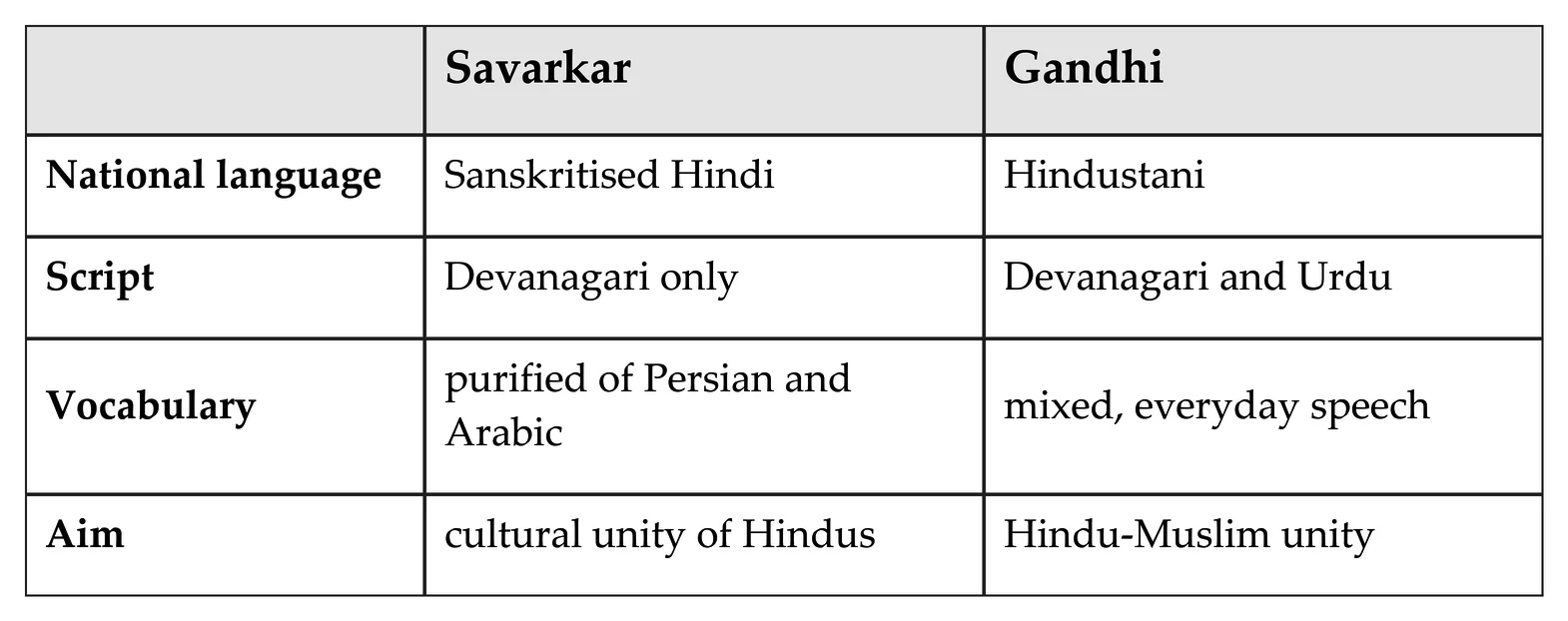
Savarkar argued that India needed a common national language (rashtrabhasha) to unite its people, and that this should be Hindi, enriched from Sanskrit, which he regarded as the classical language of Hindu civilisation and the common source of most Indian languages. He opposed Hindustani, the mixed language of everyday speech that Gandhi supported, and he rejected the use of the Urdu (Persian-Arabic) script for the national language. In his view, a Sanskritised Hindi in Devanagari would strengthen the cultural unity of Hindus across regions, while regional languages such as Marathi, Bengali or Tamil would continue to flourish in their own areas.
Script Reform
Savarkar also proposed reforms of the Devanagari script (lipi shuddhi) to make it simpler to learn, write and print. Printing Devanagari required many separate pieces of type because of its conjunct letters and vowel signs. He suggested writing vowels by adding vowel signs to the letter a, and simplifying some letters, so that the script would need fewer forms and could be used more easily with modern printing and typewriters. Some of his proposals were adopted by publications in Maharashtra, though they did not become general.
Savarkar and Gandhi on Language
Gandhi favoured Hindustani, a simple language understood by both Hindus and Muslims across north India, to be written in both Devanagari and Urdu scripts. He saw it as a bridge between communities. When the Hindi Sahitya Sammelan insisted on Hindi in Devanagari alone, Gandhi resigned from it in 1945. Savarkar and the Hindu Mahasabha supported Sanskritised Hindi in Devanagari and criticised Hindustani as a concession to Urdu and Muslim separatism. The slogan Hindi, Hindu, Hindustan, popularised by the writer Pratap Narayan Mishra in the 1880s, expressed a similar link between language, religion and nation that Hindu nationalists embraced.
Savarkar’s Writings on Social Questions
Savarkar wrote extensively on social questions in Marathi, collected in the volumes of Savarkar Samagra on social reform. Alongside his essays on language and script, he wrote on untouchability, the position of women, superstition and science, and he wrote plays such as Sangeet Sanyasta Khadga (1931), which criticised an extreme reading of non-violence. These writings show that his language reform was part of a broader programme of modernising Hindu society while strengthening its national identity.
4.3 The Quest for an All-India Language after Independence
The Constituent Assembly and the Munshi-Ayyangar Formula
The question of an official language divided the Constituent Assembly. Members from the Hindi-speaking north pressed for Hindi, while members from the south and east feared domination. The compromise, known as the Munshi-Ayyangar formula after K. M. Munshi and N. Gopalaswami Ayyangar, was adopted in September 1949. Article 343 made Hindi in Devanagari script the official language of the Union, with international numerals, but allowed English to continue for official purposes for fifteen years. Article 351 directed the Union to develop Hindi so that it could express the composite culture of India, drawing on Hindustani and other Indian languages, and primarily on Sanskrit for vocabulary. The Eighth Schedule listed fourteen languages, now twenty-two.
Rao: Many Languages, One Nation
V. K. R. V. Rao, the economist and educationist, in Many Languages, One Nation: Quest for an All-India Language (1978), argued that India must remain a multilingual nation in which regional languages are the main languages of education and administration in the states. He accepted the need for an all-India link language and believed that Hindi could gradually become one, but only through voluntary acceptance, not imposition, and only if Hindi itself became more inclusive by drawing on other Indian languages. Meanwhile, English would continue as an associate language. Rao supported the three-language formula and warned that forcing Hindi would threaten national unity rather than strengthen it.
- Linguistic states (1956). Following the States Reorganisation Commission (1955), states were reorganised largely on linguistic lines.
- Official Languages Act (1963). It provided for English to continue alongside Hindi after 1965.
- Anti-Hindi agitation (1965). Violent protests in Tamil Nadu against Hindi becoming the sole official language led to assurances that English would continue indefinitely; the Act was amended in 1967.
- Three-language formula. Recommended by the Kothari Commission (1964–66) and the National Policy on Education (1968), and restated in the National Education Policy (2020).
- Article 350A. It directs states to provide instruction in the mother tongue at the primary stage for linguistic minorities.

Savarkar’s Ideas and the Constitution
The Constitution’s choice of Hindi in Devanagari, and its direction to draw primarily on Sanskrit, partly matched Savarkar’s preferences, but its reference to the composite culture of India and to Hindustani, and its protection of English and regional languages, reflected a more plural vision. India’s language policy has since moved towards multilingualism, accepting that national unity depends on respecting linguistic diversity. Debates on Hindi and on the place of English and regional languages continue, and Savarkar’s ideas remain one strand in them.

Language Movements after Independence
- Andhra (1953). The death of Potti Sriramulu after a fast in 1952 led to the creation of Andhra State, the first linguistic state.
- Maharashtra and Gujarat (1960). The Samyukta Maharashtra movement led to the division of Bombay State on linguistic lines.
- Punjab (1966). The Punjabi Suba movement led to the creation of Punjab and Haryana.
- Classical languages. Tamil became the first classical language in 2004; Marathi, Pali, Prakrit, Assamese and Bengali received the status in 2024.
Key Positions Compared
- Savarkar: Sanskritised Hindi in Devanagari as national language; purification of vocabulary; script reform.
- Gandhi: Hindustani in two scripts as a bridge between Hindus and Muslims.
- Nehru and the Constitution: Hindi as official language with English continuing and regional languages protected.
- V. K. R. V. Rao: a multilingual nation with Hindi as a link language only by consent.
4.4 Important Questions
- Question 1 Discuss Savarkar’s language purification movement.
- Question 2 Discuss Savarkar’s views on the national language and the script.
- Question 3 Discuss the quest for an all-India language with reference to V. K. R. V. Rao.
- Question 4 Discuss the official language question in the Constituent Assembly and after independence.
DU asks the same idea in different words. So learn one broad answer for each question below; the same answer works for every question joined by OR.
Important Question 1
Discuss Savarkar’s language purification movement.
OR
Examine Surajkumar Thube’s argument that Savarkar’s language purification was a precursor to creating a Hindu language.
OR
Discuss Savarkar’s views on the Marathi language and its reform.
Model Answer
“If thought corrupts language, language can also corrupt thought.”
— George Orwell, Politics and the English Language (1946)
Introduction. During his years at Ratnagiri, Savarkar launched a movement to purify Marathi by replacing Persian, Arabic and English words with words from Sanskrit and Marathi roots. Supporters see it as a defence of Indian languages against foreign domination, while Surajkumar Thube argues that it was a precursor to creating a Hindu language as part of Hindutva.
1. Bhasha Shuddhi
Savarkar’s campaign for bhasha shuddhi aimed to cleanse Marathi of foreign words. He began it in the 1920s at Ratnagiri.
2. Foreign Words as Subjection
He argued that Persian, Arabic and English words were signs of cultural subjection under Muslim and British rule.
3. Sanskrit Roots
He urged replacing them with words drawn from Sanskrit and native Marathi roots.
4. New Coinages
He coined many words for administration, politics, cinema and sport, such as dinank for date and mahapaur for mayor.
5. Hutatma
The word hutatma for martyr, replacing shahid, is widely attributed to him and remains in use.
6. Lasting Influence
Several of his coinages are still part of everyday Marathi, showing the reach of the campaign.
7. Orwell’s Insight
Orwell noted that language and thought shape each other, which helps explain why nationalists care about words.
8. Thube’s Argument
Thube argues that the campaign aimed to make language a marker of Hindu identity, separating it from Indo-Islamic heritage.
9. Precursor to a Hindu Language
He sees the Marathi campaign as a model for a Sanskritised Hindi as the language of a Hindu nation.
10. Supporters’ View
Supporters present the movement as a defence of the dignity of Indian languages against foreign domination.
11. Comparison with Turkey
Turkish language reform under Atatürk in the 1930s also removed Arabic and Persian words in the name of nationalism.
12. The Pure Tamil Movement
Maraimalai Adigal’s Pure Tamil movement sought to remove Sanskrit words from Tamil, a purism in the opposite direction.
13. Language and Identity
These cases show that language reform is also a choice about identity and belonging.
14. Linguistic Reality
Linguists note that all languages borrow words, and that Persian and Arabic words are part of Marathi’s history.
15. Link to Hindutva
The campaign fitted Savarkar’s view of Sanskriti, a common Hindu culture, as an essential of Hindutva.
16. Script Reform
Alongside word purification, he proposed simplifying the Devanagari script for printing.
17. Criticism
Critics argue that purism treats a shared heritage as foreign and can deepen communal divisions.
18. Purification in Practice
Savarkar urged editors to adopt his coinages and wrote articles explaining them, and some Marathi newspapers and institutions followed his lead.
19. Resistance from Writers
Some Marathi writers resisted the campaign, arguing that the language’s Persian words were part of its living history and literary richness.
20. Evaluation
Bhasha shuddhi enriched Marathi vocabulary but also carried a political project of Hindu cultural identity.
Conclusion. Thus, Savarkar’s bhasha shuddhi replaced Persian, Arabic and English words with Sanskrit-based coinages. As Orwell warned, language and thought shape each other, and Thube argues that this purification was a precursor to a Hindu language within the Hindutva project.
Important Question 2
Discuss Savarkar’s views on the national language and the script.
OR
Compare Savarkar and Gandhi on the national language question.
OR
Examine Savarkar’s views on Hindi, Sanskrit and the Devanagari script.
Model Answer
“It shall be the duty of the Union to promote the spread of the Hindi language, to develop it so that it may serve as a medium of expression for all the elements of the composite culture of India.”
— Constitution of India, Article 351
Introduction. Savarkar argued that India needed a national language and that it should be a Sanskritised Hindi written in Devanagari. He opposed Gandhi’s Hindustani and the Urdu script, and proposed reforms of Devanagari to make it easier to print. His views linked language with the cultural unity of the Hindu nation, while Gandhi saw language as a bridge between communities.
1. Need for a National Language
Savarkar believed that a common national language was essential to unite India’s people.
2. Hindi as Rashtrabhasha
He argued that Hindi should be the national language, being widely spoken across north India.
3. Sanskrit as Source
He regarded Sanskrit as the classical source of most Indian languages and wanted Hindi enriched from it.
4. Regional Languages
He accepted that regional languages would flourish in their own areas, alongside the national language.
5. Against Hindustani
He opposed Gandhi’s Hindustani as a concession to Urdu and Muslim separatism.
6. Against the Urdu Script
He rejected the Persian-Arabic script for the national language and supported Devanagari alone.
7. Script Reform
He proposed simplifying Devanagari, for example by writing vowels with signs added to the letter a, to ease printing.
8. Modernising Aim
His script reform aimed to suit Devanagari to modern printing and typewriters.
9. Gandhi’s Hindustani
Gandhi favoured Hindustani, a simple everyday language understood by Hindus and Muslims alike.
10. Two Scripts
Gandhi wanted Hindustani written in both Devanagari and Urdu scripts as a bridge between communities.
11. The 1945 Resignation
When the Hindi Sahitya Sammelan rejected Hindustani, Gandhi resigned from it in 1945.
12. Hindi, Hindu, Hindustan
The slogan popularised by Pratap Narayan Mishra in the 1880s linked language, religion and nation, an idea Hindu nationalists embraced.
13. The Constitution’s Choice
Article 343 chose Hindi in Devanagari, close to Savarkar’s preference, but Article 351 referred to India’s composite culture.
14. Article 351’s Balance
Article 351 asked Hindi to draw on Hindustani and other languages, and primarily on Sanskrit, balancing different views.
15. Southern Opposition
Many in the south opposed Hindi as a national language, showing the limits of Savarkar’s vision.
16. Supporters’ View
Supporters see his views as a defence of Indian languages and a practical step towards unity.
17. Critics’ View
Critics argue that linking Hindi with Hindu identity alienated Muslims and non-Hindi speakers.
18. Sanskrit as Devabhasha
Savarkar honoured Sanskrit as the classical language of Indian civilisation and the bond linking regional languages.
19. Ambedkar on Hindi
Ambedkar, in Thoughts on Linguistic States (1955), also supported Hindi as the official language, though for reasons of unity rather than religion.
20. Language and Defence
Savarkar linked a common language with national strength and unity, as part of his wider call to strengthen the Hindu nation.
21. Evaluation
Savarkar’s language views were part of his Hindutva project, partly reflected in but also moderated by the Constitution.
Conclusion. Thus, Savarkar wanted a Sanskritised Hindi in Devanagari as India’s national language, opposing Gandhi’s Hindustani. The Constitution adopted Hindi in Devanagari but asked it to express India’s composite culture, a balance between these competing visions.
Important Question 3
Discuss the quest for an all-India language with reference to V. K. R. V. Rao.
OR
Examine V. K. R. V. Rao’s argument in Many Languages, One Nation.
OR
Discuss the three-language formula and India’s multilingual policy.
Model Answer
“It shall be the endeavour of every State and of every local authority within the State to provide adequate facilities for instruction in the mother-tongue at the primary stage of education to children belonging to linguistic minority groups.”
— Constitution of India, Article 350A
Introduction. After independence, India searched for a language that could link its many linguistic communities without threatening their identities. V. K. R. V. Rao argued that India must remain a multilingual nation, with regional languages central in the states and Hindi gradually becoming a link language through voluntary acceptance. His views reflect the path India’s language policy has largely taken.
1. A Multilingual Nation
India has hundreds of languages, and the Eighth Schedule now lists twenty-two.
2. Rao’s Starting Point
Rao argued that India must remain multilingual, with regional languages central in education and administration.
3. Need for a Link Language
He accepted that India needed an all-India link language for communication across states.
4. Hindi as Link Language
He believed Hindi could gradually become the link language, being the most widely spoken.
5. Voluntary Acceptance
He insisted that Hindi should spread through voluntary acceptance, not imposition.
6. Inclusive Hindi
He argued that Hindi should become more inclusive by drawing on other Indian languages.
7. English as Associate
Meanwhile, English would continue as an associate language for official and higher education purposes.
8. Warning against Imposition
He warned that forcing Hindi would threaten national unity rather than strengthen it.
9. Three-Language Formula
Rao supported the formula of the mother tongue or regional language, Hindi and English.
10. Kothari Commission
The Kothari Commission (1964–66) and the 1968 education policy recommended the three-language formula.
11. Linguistic States
States were reorganised on linguistic lines in 1956, strengthening regional languages.
12. The 1965 Agitation
Protests in Tamil Nadu against Hindi in 1965 led to assurances that English would continue.
13. Article 350A
Article 350A protects instruction in the mother tongue for linguistic minorities at the primary stage.
14. NEP 2020
The National Education Policy of 2020 restated the three-language formula with flexibility for states.
15. Contrast with Savarkar
Rao’s plural, voluntary approach contrasts with Savarkar’s idea of a Sanskritised national language.
16. Implementation Problems
The formula has been unevenly implemented, with Hindi states often not teaching a southern language.
17. Criticism
Some argue that the dominance of English undermines both Hindi and regional languages.
18. Link Language in Practice
In practice, both English and Hindi function as link languages, used in different domains such as courts, business, cinema and politics.
19. Technology and Translation
Digital translation tools, such as the government’s Bhashini platform launched in 2022, may reduce the need for a single link language.
20. Rao as Educationist
Rao, an economist who served as Union Education Minister (1971–77), brought practical experience of education policy to the language question.
21. Regional Languages in Higher Education
Rao supported the use of regional languages in higher education, so that students could learn in the language they understood best.
22. Hindi Belt and the South
He recognised that the language question divided the Hindi belt and the south, and that any solution needed the consent of both.
23. Evaluation
Rao’s vision of many languages in one nation has largely guided India’s language policy.
Conclusion. Thus, Rao argued that India must remain a nation of many languages, with Hindi becoming a link language only by consent. Protections such as Article 350A for mother-tongue instruction and the three-language formula reflect this plural approach.
Important Question 4
Discuss the official language question in the Constituent Assembly and after independence.
OR
Examine the official language provisions of the Constitution.
OR
Discuss the relationship between language and nationalism in India.
Model Answer
“A language is a dialect with an army and navy.”
— Max Weinreich (1945)
Introduction. The official language question divided the Constituent Assembly between those who wanted Hindi and those who feared Hindi domination. The Munshi-Ayyangar formula of 1949 made Hindi in Devanagari the official language while allowing English to continue. Later agitations, especially in Tamil Nadu in 1965, led to a policy of continuing English and respecting linguistic diversity.
1. Language and Power
Weinreich’s remark that a language is a dialect with an army and navy shows that language status reflects power.
2. Divisions in the Assembly
Northern members pressed for Hindi, while southern and eastern members feared domination.
3. The Munshi-Ayyangar Formula
The compromise of September 1949 was named after K. M. Munshi and N. Gopalaswami Ayyangar.
4. Article 343
Article 343 made Hindi in Devanagari the official language of the Union, with international numerals.
5. English for Fifteen Years
English was to continue for official purposes for fifteen years, until 1965.
6. Article 351
Article 351 directed the development of Hindi to express India’s composite culture.
7. Eighth Schedule
The Eighth Schedule listed fourteen languages, now twenty-two, recognising linguistic diversity.
8. Linguistic States
States were reorganised largely on linguistic lines in 1956 after the States Reorganisation Commission.
9. Official Languages Act
The Act of 1963 provided for English to continue alongside Hindi after 1965.
10. The 1965 Agitation
Violent protests in Tamil Nadu against Hindi as the sole official language shook the country.
11. Assurances and Amendment
The government assured that English would continue indefinitely, and the Act was amended in 1967.
12. Savarkar’s Position
Savarkar’s preference for Sanskritised Hindi in Devanagari was partly reflected in Article 343.
13. Plural Nationalism
India’s eventual policy recognised that unity depends on respecting linguistic diversity.
14. Language and Federalism
Language became a basis of state identity, strengthening federalism and regional parties.
15. Recent Debates
Debates over Hindi in examinations, signboards and education show that the question remains alive.
16. Role of English
English remains important in courts, higher education and business, raising questions of class and access.
17. Criticism
Some argue that the compromise left India without a true national language; others see this as its strength.
18. Hindi Day
Hindi Diwas is observed on 14 September, the day in 1949 when the Constituent Assembly adopted Hindi as the official language.
19. Parliamentary Committee
The Committee of Parliament on Official Language, set up under the 1963 Act, reviews the progress of Hindi in official work.
20. Linguistic Reorganisation
The creation of Andhra in 1953 after Potti Sriramulu’s death and the reorganisation of 1956 showed the political force of language.
21. Classical Language Status
The government’s grant of classical status to languages such as Tamil (2004) and Marathi (2024) reflects official respect for linguistic diversity.
22. Evaluation
India’s language settlement shows how a diverse nation can balance unity with diversity through compromise.
Conclusion. Thus, India’s language settlement made Hindi the official language while protecting English and regional languages. Weinreich’s remark reminds us that language status reflects power, and India’s compromise sought to prevent any one language from dominating.
Short Notes
(a) Bhasha shuddhi
Savarkar’s movement from the 1920s to purify Marathi by replacing Persian, Arabic and English words with words from Sanskrit and Marathi roots.
(b) Munshi-Ayyangar formula
The compromise of 1949 that made Hindi in Devanagari the official language of the Union while allowing English to continue for fifteen years.
(c) Three-language formula
The policy, recommended by the Kothari Commission and restated in 2020, that students learn their regional language, Hindi and English.
(d) Hindi-Urdu controversy
The nineteenth-century dispute in north India over the use of Hindi in Devanagari and Urdu in the Persian script in courts and schools, which made language a marker of religious community and shaped later debates.
More notes: MDSE-4b Understanding Savarkar
These notes are prepared by PADHO TO AISE for study help. They are not an official University of Delhi publication.