
Semester VI MDSE-4b Understanding Savarkar
Unit III · 21 min read · Updated 24 Nov 2026
As per the University of Delhi (DU) BA (Hons) Political Science syllabus
Contents
- 3.1 Hindu, Hindustan, Hinduism and Hindutva: The History of the Terms
- Sharma: On Hindu, Hindustan, Hinduism and Hindutva
- The Census and Hindu Identity
- 3.2 Savarkar’s Essentials of Hindutva
- Hindutva Is Not Hinduism
- The Definition of a Hindu
- The Three Essentials
- Rationalism and Religion
- Hindutva and Other Nationalisms
- 3.3 Hindu Rashtra and the Hindutva-Hinduism Debate
- Hindu Rashtra Darshan
- Supporters and Critics
- Hindutva in Indian Politics
- Reading Savarkar Today
- Key Terms at a Glance
- 3.4 Important Questions
- Discuss Savarkar’s concept of Hindutva as set out in Essentials of Hindutva.
- Discuss Arvind Sharma’s account of the terms Hindu, Hindustan, Hinduism and Hindutva.
- Discuss Savarkar’s idea of Hindu Rashtra as set out in Hindu Rashtra Darshan.
- Distinguish between Hindutva and Hinduism.
- Short Notes
आसिन्धुसिन्धुपर्यन्ता यस्य भारतभूमिका। पितृभूः पुण्यभूश्चैव स वै हिन्दुरिति स्मृतः॥
A Hindu means a person who regards this land of Bharatvarsha, from the Indus to the Seas, as his Fatherland as well as his Holy-land, that is the cradle land of his religion.
— V. D. Savarkar, Essentials of Hindutva (1923)
HHINDUTVA is one of the most influential and debated ideas in modern Indian politics, and Savarkar gave it its classic form. In Essentials of Hindutva (1923), written in prison, he defined a Hindu not by belief or worship but by attachment to India as both fatherland and holy land, and by shared descent and culture. He insisted that Hindutva is not the same as Hinduism, the religion. This chapter studies Unit III of the syllabus: the meaning of the terms Hindu, Hindustan, Hinduism and Hindutva, Savarkar’s definition of Hindutva and its three essentials, his idea of a Hindu Rashtra, and the debates on the relationship between Hindutva and Hinduism.

3.1 Hindu, Hindustan, Hinduism and Hindutva: The History of the Terms
Sharma: On Hindu, Hindustan, Hinduism and Hindutva
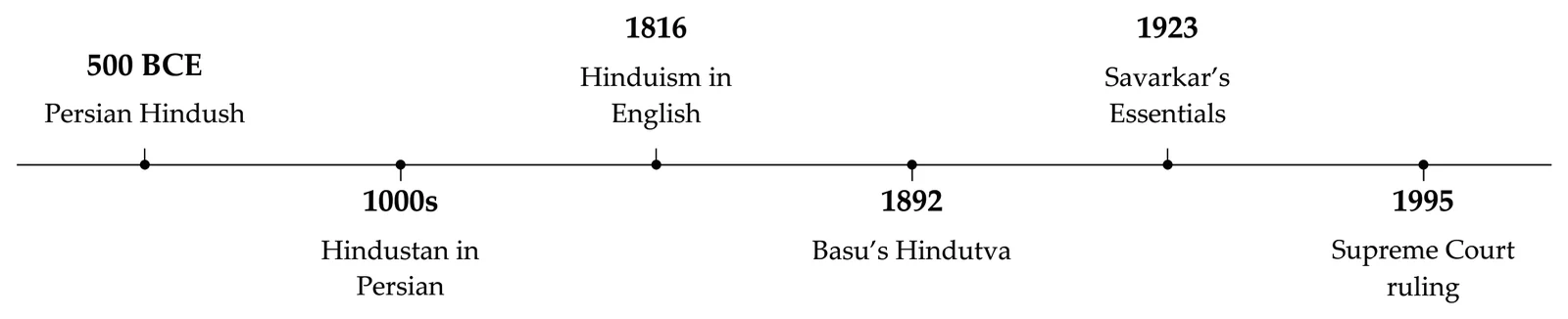
Arvind Sharma, in On Hindu, Hindustan, Hinduism and Hindutva (2002), traces how these words acquired their meanings. The word Hindu is derived from Sindhu, the Sanskrit name of the Indus; ancient Persians, who pronounced s as h, used it for the people and land beyond the Indus. For centuries the word was mainly geographical and ethnic, referring to the inhabitants of India. Hindustan came into use in Persian and later Mughal writing for the land of the Hindus, i.e. India. Over time, especially in contrast with Muslims, the word Hindu acquired a religious meaning for followers of the many indigenous traditions.
The word Hinduism is modern: it came into English use in the early nineteenth century, when colonial scholars, missionaries and Indian reformers began to describe the varied traditions of India as one religion, comparable to Christianity or Islam. Sharma shows that the word Hindutva, meaning Hinduness, was used by Chandranath Basu in a Bengali book of 1892 in a cultural and religious sense. Savarkar gave it a new, political meaning, defining Hinduness by land, descent and culture rather than belief. Sharma thus shows that each term carries layers of geographical, religious and political meaning, and that confusion between them shapes current debates.
The Census and Hindu Identity
Colonial censuses, held from 1871–72 onwards, classified every Indian by religion and caste and published the numbers of each community. This encouraged people to think of Hindus and Muslims as fixed, countable communities competing for numbers and representation. In 1909 U. N. Mukherji’s pamphlet Hindus: A Dying Race warned that Hindus were declining relative to Muslims, and Lal Chand’s Self-Abnegation in Politics (1909) urged Hindus to organise politically as Hindus. The Arya Samaj (1875) promoted reform and reconversion, and the Hindu Mahasabha was founded in 1915. Savarkar’s Hindutva grew out of this atmosphere of anxiety about numbers and unity.
3.2 Savarkar’s Essentials of Hindutva
Hindutva Is Not Hinduism
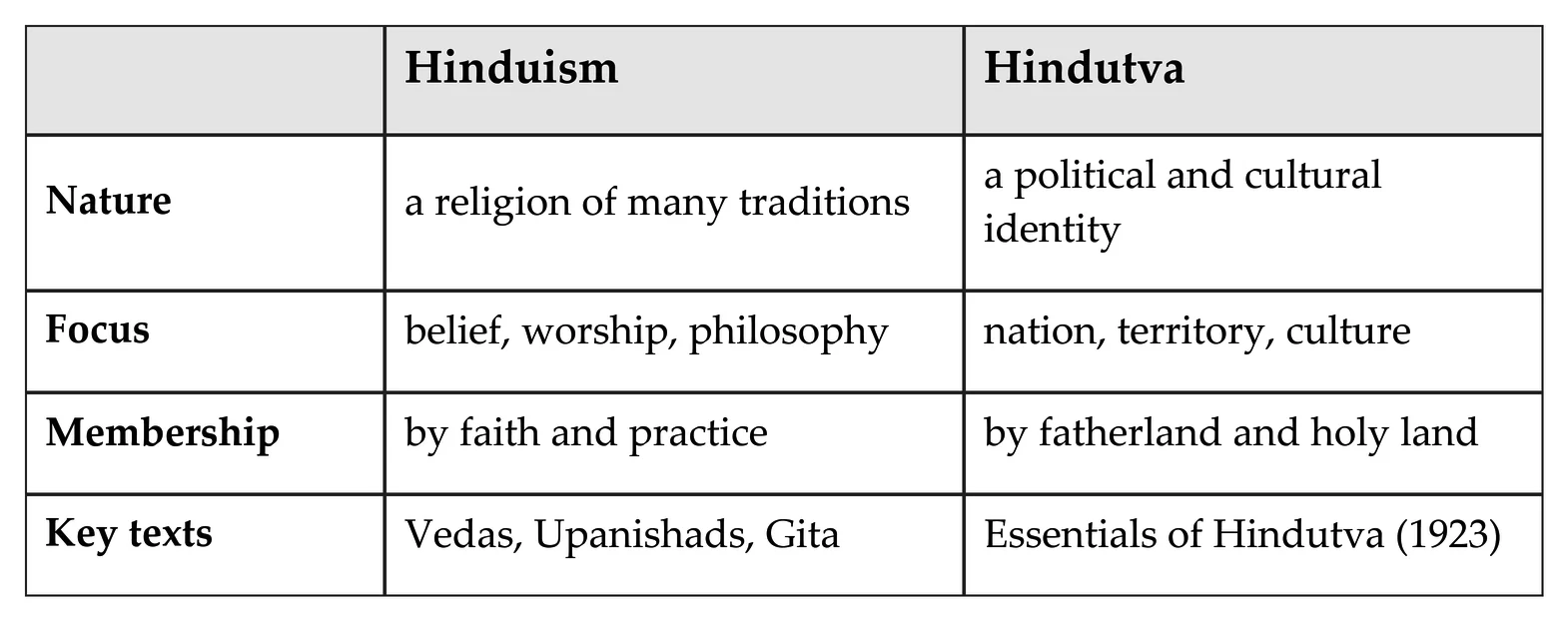
Savarkar began by distinguishing Hindutva from Hinduism. Hinduism, for him, referred to the religious beliefs and practices of the Hindus, which are many and varied. Hindutva was much wider: it was not a word but a history, embracing all aspects of the thought and life of the Hindu people, their land, their descent, their culture and their struggles. Savarkar himself was a rationalist with little interest in ritual, and he stressed that one could be a Hindu in his sense without accepting any particular belief.
The Definition of a Hindu
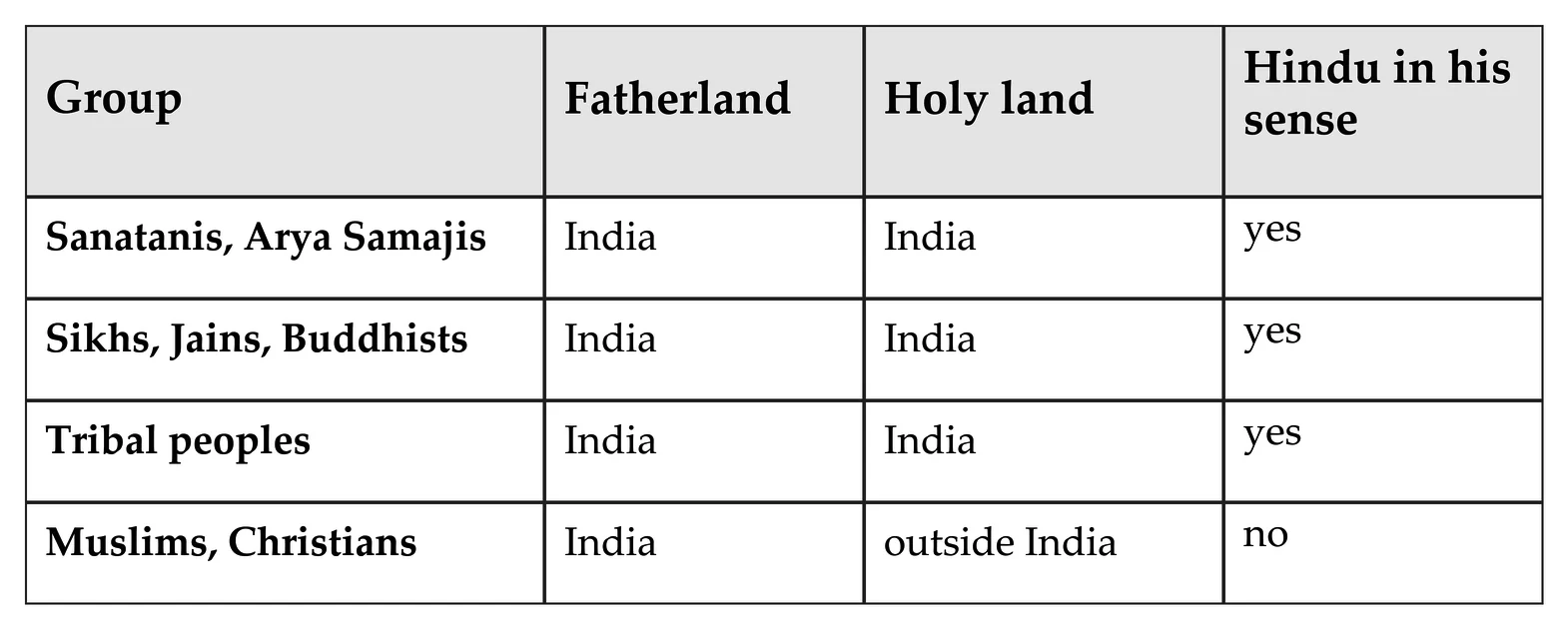
Savarkar summarised his definition in a Sanskrit verse: a Hindu is one who regards the land of Bharatvarsha, from the Indus to the seas, as his pitribhu (fatherland, the land of his ancestors) and his punyabhu (holy land, the cradle of his religion). This definition included followers of all religions born in India, i.e. Sanatanis, Arya Samajis, Sikhs, Jains and Buddhists, as well as tribal peoples. It excluded those, mainly Muslims and Christians, whose holy lands lay outside India, even though India was their fatherland. Savarkar argued that their loyalty would be divided between India and the lands of their faith.
The Three Essentials
- Rashtra (common nation). A common territory, Hindusthan, stretching from the Indus to the seas, to which Hindus are attached as their homeland.
- Jati (common race or descent). A common blood or descent from the people who settled this land, which Savarkar believed had been mixed and enriched over time but remained one.
- Sanskriti (common culture). A shared civilisation expressed in Sanskrit and Indian languages, history, heroes, literature, art, law, festivals and rites.
Savarkar presented Hindutva as a cultural nationalism that could unite the many sects and castes of India into a single nation, strong enough to resist foreign domination. He wrote it partly in response to the Khilafat movement (1919–24), which he saw as showing the extra-territorial loyalties of Indian Muslims, and partly to unite a Hindu society divided by caste and sect.
Rationalism and Religion
Unusually for a Hindu nationalist, Savarkar was a rationalist. In his essays he attacked superstition, astrology and blind ritual, and he argued that the cow should be protected as a useful animal for economic reasons, not worshipped as divine. He supported science, modern industry and military power. This shows that his Hindutva was a political and national project rather than a religious revival, which helps explain his distinction between Hindutva and Hinduism.
Hindutva and Other Nationalisms
- Gandhi. A devout Hindu whose nationalism was religious in spirit but pluralist, treating all faiths as equal and Hindus and Muslims as one nation.
- Nehru. A secular nationalist who saw India as a composite civilisation, as in The Discovery of India (1946).
- Muslim nationalism. Iqbal and Jinnah argued that Muslims formed a separate nation, the mirror image of Savarkar’s two-nation premise.
- Golwalkar. M. S. Golwalkar, in We or Our Nationhood Defined (1939), gave Hindu nationalism a more religious and cultural form than Savarkar’s rationalist version.
- Deendayal Upadhyaya. His Integral Humanism (1965) later became the official philosophy of the Jana Sangh and the BJP.
3.3 Hindu Rashtra and the Hindutva-Hinduism Debate
Hindu Rashtra Darshan
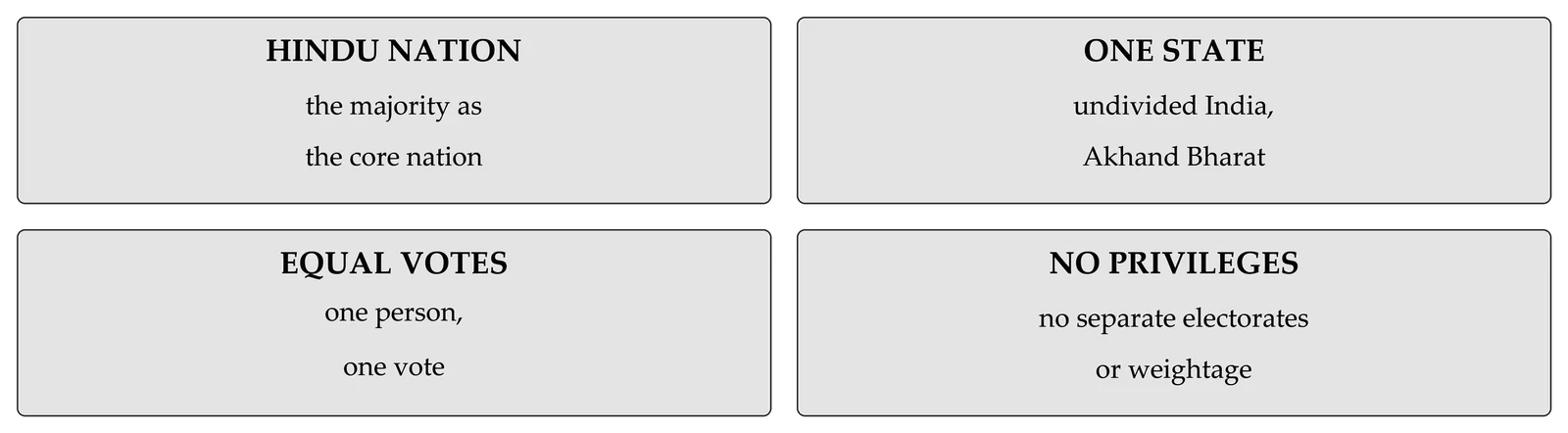
In his presidential speeches to the Hindu Mahasabha, collected as Hindu Rashtra Darshan (1949), Savarkar described the Hindus as the nation of India, the majority whose history, culture and interests should shape the state. He opposed the Congress’s idea of a composite nation and the Muslim League’s demand for Pakistan. He argued that the Indian state should be based on one person, one vote, with equal rights for all citizens and freedom of religion, but with no special privileges, such as separate electorates, weightage or reserved seats on the basis of religion. Minorities, in his view, should accept the culture of the majority as the national culture.
Supporters and Critics
- Supporters argue that Hindutva is a cultural and territorial nationalism, not a theocracy, since it includes all Indic religions and does not require belief; Vikram Sampath stresses Savarkar’s rationalism and social reformism.
- Critics argue that by making a holy land in India a condition of full belonging, Hindutva places Muslims and Christians in a secondary position, contradicting equal citizenship; Jyotirmaya Sharma (2003) traces how Hindutva narrowed the plural traditions of Hinduism.
- Hinduism and Hindutva. Writers such as Shashi Tharoor, in Why I Am a Hindu (2018), distinguish the pluralist religion of Hinduism from the political ideology of Hindutva.
- The Supreme Court. In 1995, in the Ramesh Yeshwant Prabhoo case, Justice J. S. Verma observed that Hindutva could describe a way of life of the people of the subcontinent and is not necessarily a communal term; this view has itself been debated.
Hindutva in Indian Politics
Savarkar’s Hindutva influenced the Rashtriya Swayamsevak Sangh (founded 1925), the Hindu Mahasabha, the Bharatiya Jana Sangh (1951) and the Bharatiya Janata Party (1980), though these organisations developed their own interpretations. Debates on secularism, citizenship, conversion, cow protection and history in contemporary India often return to the questions Savarkar raised. Understanding the difference between Hinduism and Hindutva, and between Savarkar’s ideas and later uses of them, is therefore essential.
Reading Savarkar Today
Students should read Savarkar’s texts carefully and in context. His definition of Hindutva was territorial and cultural, his outlook rationalist, and his politics opposed to both the Congress and the Muslim League. At the same time, his idea of the nation gave Muslims and Christians a doubtful place, which his critics see as the core problem of Hindutva. It is also important to distinguish what Savarkar wrote from the ways later organisations have used his name and ideas, since they have adapted, selected and sometimes changed them.
Key Terms at a Glance
- Hindu: originally the people beyond the Indus; later the followers of indigenous Indian religions.
- Hinduism: a modern English term for the varied religious traditions of the Hindus.
- Hindutva: Hinduness; for Savarkar, an identity of land, descent and culture rather than belief.
- Hindu Rashtra: the idea of India as a nation centred on its Hindu majority.
- Composite nationalism: the Congress view that people of all religions together form the Indian nation.
3.4 Important Questions
- Question 1 Discuss Savarkar’s concept of Hindutva as set out in Essentials of Hindutva.
- Question 2 Discuss Arvind Sharma’s account of the terms Hindu, Hindustan, Hinduism and Hindutva.
- Question 3 Discuss Savarkar’s idea of Hindu Rashtra as set out in Hindu Rashtra Darshan.
- Question 4 Distinguish between Hindutva and Hinduism.
DU asks the same idea in different words. So learn one broad answer for each question below; the same answer works for every question joined by OR.
Important Question 1
Discuss Savarkar’s concept of Hindutva as set out in Essentials of Hindutva.
OR
Examine Savarkar’s definition of a Hindu.
OR
Explain the three essentials of Hindutva: rashtra, jati and sanskriti.
Model Answer
“Hindutva is not a word but a history.”
— V. D. Savarkar, Essentials of Hindutva (1923)
Introduction. In Essentials of Hindutva, written in prison and published in 1923, Savarkar gave the classic definition of Hindutva. He defined a Hindu as one who regards India as both fatherland and holy land, and identified three essentials of Hindutva: a common nation, a common descent and a common culture. He presented it as a cultural nationalism distinct from the religion of Hinduism.
1. Context of Writing
Savarkar wrote the work in Ratnagiri jail in 1921–22. It was published in 1923 under the pen-name A Maratha.
2. Response to the Times
He wrote partly in response to the Khilafat movement and partly to unite a Hindu society divided by caste and sect.
3. Hindutva as History
Savarkar said that Hindutva is not a word but a history, embracing the whole life of the Hindu people.
4. Not Hinduism
He distinguished Hindutva from Hinduism, which refers only to religious beliefs and practices.
5. Fatherland
A Hindu regards Bharatvarsha, from the Indus to the seas, as his pitribhu, the land of his ancestors.
6. Holy Land
A Hindu also regards it as his punyabhu, the cradle land of his religion.
7. Rashtra
The first essential is a common nation, a territory to which Hindus are attached as their homeland.
8. Jati
The second essential is a common descent from the people who settled the land, mixed but one.
9. Sanskriti
The third essential is a common culture of language, history, heroes, literature, festivals and law.
10. Inclusion of Indic Religions
Sikhs, Jains, Buddhists and tribal peoples are Hindus in his sense, since their holy lands are in India.
11. Exclusion
Muslims and Christians, whose holy lands lie elsewhere, fall outside his definition despite sharing the fatherland.
12. Divided Loyalty Argument
Savarkar argued that their loyalty might be divided between India and the lands of their faith.
13. Cultural Nationalism
He presented Hindutva as a cultural nationalism that could unite India’s sects and castes.
14. Rationalist Basis
As a rationalist, he did not require belief or ritual; Hindutva was a national, not a religious, identity.
15. Influence
The work shaped the RSS, the Hindu Mahasabha and later Hindu nationalist politics.
16. Criticism
Critics argue that the holy land criterion makes Muslims and Christians second-class members of the nation.
17. Title and Editions
The 1928 edition was titled Hindutva: Who Is a Hindu?, and the work has since been reprinted many times in English, Marathi and Hindi.
18. Nationalism Elsewhere
Savarkar drew on European ideas of the nation as a people bound by land, blood and culture, similar to German and Italian nationalist thought.
19. Census Anxieties
Colonial censuses and pamphlets such as Hindus: A Dying Race (1909) created anxiety about Hindu numbers, which Savarkar’s project sought to answer.
20. Unity across Castes
By defining Hindus through land, descent and culture, Savarkar hoped to unite castes and sects that were divided in religious practice.
21. Pen-Name and Publication
The work was first published anonymously under the pen-name A Maratha because Savarkar was still a prisoner under restrictions.
22. Evaluation
Essentials of Hindutva is the founding text of Hindu nationalism, whose definition of belonging remains deeply debated.
Conclusion. Thus, Savarkar defined Hindutva as a history of land, descent and culture, and a Hindu as one who regards India as fatherland and holy land. Its inclusion of Indic religions and exclusion of others make it both influential and controversial.
Important Question 2
Discuss Arvind Sharma’s account of the terms Hindu, Hindustan, Hinduism and Hindutva.
OR
Trace the evolution of the meaning of the word Hindu.
OR
Examine how Savarkar transformed the meaning of the term Hindutva.
Model Answer
“The reference to Hindus shall be construed as including a reference to persons professing the Sikh, Jaina or Buddhist religion.”
— Constitution of India, Article 25, Explanation II
Introduction. Arvind Sharma traces how the words Hindu, Hindustan, Hinduism and Hindutva acquired their meanings over centuries. He shows that the word Hindu began as a geographical term, acquired religious meaning over time, that Hinduism is a modern term, and that Savarkar gave Hindutva a new political meaning. Understanding these layers helps clarify current debates.
1. Origin of Hindu
The word Hindu comes from Sindhu, the Sanskrit name of the Indus, pronounced Hindu by the ancient Persians.
2. A Geographical Term
For centuries Hindu referred to the people and land beyond the Indus, not to a religion.
3. Hindustan
Hindustan came into use in Persian and Mughal writing for the land of India.
4. Religious Meaning
Especially in contrast with Muslims, Hindu gradually came to mean followers of indigenous traditions.
5. Hinduism as a Modern Term
Hinduism came into English use in the early nineteenth century, describing varied traditions as one religion.
6. Colonial Role
Colonial scholars, census officials and missionaries helped define Hinduism as a single religion.
7. Reformers’ Role
Indian reformers such as Rammohan Roy and Vivekananda also used the term, presenting Hinduism to the world.
8. Chandranath Basu’s Hindutva
Sharma shows that Chandranath Basu used Hindutva in 1892 in a cultural and religious sense.
9. Savarkar’s Transformation
Savarkar gave Hindutva a political meaning defined by land, descent and culture.
10. Legal Definition
Explanation II to Article 25 and the Hindu Code laws define Hindus broadly to include Sikhs, Jains and Buddhists.
11. Overlap with Savarkar
This legal breadth partly overlaps with Savarkar’s inclusion of Indic religions.
12. Sikh and Buddhist Objections
Many Sikhs and Buddhists object to being classed as Hindus, asserting distinct religious identities.
13. Supreme Court’s View
In 1995 the Supreme Court said Hindutva could describe a way of life, a view that remains debated.
14. Layers of Meaning
Sharma shows that geographical, religious and political meanings coexist, causing confusion in debates.
15. Importance of Precision
Distinguishing these meanings helps students analyse claims about Hindu identity carefully.
16. Criticism
Some scholars argue that pre-colonial Hindu identity was more developed than the modern-invention thesis allows.
17. The Census and Religion
Colonial censuses from 1871 classified Indians by religion, encouraging people to see themselves as members of fixed religious communities.
18. Al-Biruni’s India
The eleventh-century scholar Al-Biruni wrote about the beliefs and customs of the Hindus, showing that the word had religious as well as geographical meaning long before colonial rule.
19. Arya Samaj and Reform
Reform movements such as the Arya Samaj (1875) gave the term Hindu a more organised, reformist meaning in the late nineteenth century.
20. Self-Description
Sharma notes that for long periods people described themselves by sect, caste or region rather than as Hindus, which shows how identities change.
21. Political Uses
Because the words carry several meanings, political actors can shift between them, which is why precise definitions matter in debate.
22. Evaluation
Sharma’s genealogy shows that the meanings of these terms are historical and contested, not fixed.
Conclusion. Thus, Sharma traces Hindu from a Persian geographical term to a religious identity, Hinduism to a modern label and Hindutva to Savarkar’s political concept. The broad legal definition in Article 25 shows how these layers continue to shape law and politics.
Important Question 3
Discuss Savarkar’s idea of Hindu Rashtra as set out in Hindu Rashtra Darshan.
OR
Examine Savarkar’s views on minorities and citizenship in a Hindu Rashtra.
OR
Discuss the difference between Savarkar’s Hindu Rashtra and the Congress idea of composite nationalism.
Model Answer
“We, the people of India, having solemnly resolved to constitute India into a Sovereign Socialist Secular Democratic Republic.”
— Constitution of India, Preamble (as amended in 1976)
Introduction. In his presidential speeches to the Hindu Mahasabha, collected as Hindu Rashtra Darshan (1949), Savarkar set out his idea of India as a Hindu Rashtra, a nation whose core is the Hindu majority. He opposed both composite nationalism and the Pakistan demand, and proposed equal citizenship without special privileges for minorities. The Constitution chose a different path, a secular democratic republic.
1. Hindu Rashtra Darshan
Savarkar’s addresses to the Mahasabha from 1937 to 1943 were collected as Hindu Rashtra Darshan in 1949.
2. Hindus as the Nation
He described the Hindus as the nation of India, whose history and culture should shape the state.
3. Against Composite Nationalism
He rejected the Congress idea that Indians of all religions formed one composite nation.
4. Against Pakistan
He opposed the Muslim League’s demand for Pakistan and called for an undivided India.
5. One Person, One Vote
He argued that the state should be based on one person, one vote and majority rule.
6. Equal Rights
He promised equal rights and freedom of religion to all citizens, including minorities.
7. No Special Privileges
He rejected separate electorates, weightage and religious reservations for minorities.
8. Majority Culture
He expected minorities to accept the culture of the Hindu majority as the national culture.
9. Militarisation
He linked Hindu Rashtra with military strength, urging Hindus to build martial capacity.
10. Akhand Bharat
His Hindu Rashtra was territorial, covering the whole of undivided India.
11. The Constitution’s Choice
The Constitution established a secular republic with equal citizenship regardless of religion.
12. Minority Rights in the Constitution
Articles 29 and 30 protect the cultural and educational rights of minorities, which Savarkar’s scheme would not have favoured.
13. Supporters’ View
Supporters argue that his scheme offered equal citizenship without appeasement or division.
14. Critics’ View
Critics argue that a nation defined by the majority’s culture makes minorities second-class in practice.
15. Later Influence
His ideas influenced Hindu nationalist debates on secularism, citizenship and minority rights.
16. Debates on Secularism
Debates on whether Indian secularism favours minorities or protects equality often echo his arguments.
17. Secularism in the Constitution
The word secular was added to the Preamble by the 42nd Amendment in 1976, though the Constitution’s secular character was present from the start through Articles 14 to 30.
18. Comparison with Ambedkar
Ambedkar warned in 1945 that Hindu Raj would be a calamity for liberty, equality and fraternity, a view sharply opposed to Savarkar’s.
19. Golwalkar’s Version
M. S. Golwalkar’s We or Our Nationhood Defined (1939) gave Hindu Rashtra a more religious and cultural form, differing from Savarkar’s rationalism.
20. The Nation-State Model
Savarkar’s idea reflects the European model of one nation, one state, which assumes a single dominant cultural community.
21. Language and the Nation
His Hindu Rashtra included a national language, Sanskritised Hindi in Devanagari, as Chapter 4 explains.
22. Evaluation
Savarkar’s Hindu Rashtra offered a majoritarian alternative to the Constitution’s secular nationalism.
Conclusion. Thus, Savarkar’s Hindu Rashtra made the Hindu majority the core of the nation, promising equal votes but no special rights for minorities. The Constitution instead created a sovereign, secular, democratic republic, and the debate between these visions continues.
Important Question 4
Distinguish between Hindutva and Hinduism.
OR
Discuss whether Hindutva is a religious or a cultural concept.
OR
Discuss the debates on the relationship between Hindutva and Hinduism in contemporary India.
Model Answer
“I am proud to belong to a religion which has taught the world both tolerance and universal acceptance.”
— Swami Vivekananda, Parliament of the World’s Religions, Chicago (11 September 1893)
Introduction. Savarkar himself insisted that Hindutva is not the same as Hinduism. Hinduism is a religion of many traditions, beliefs and practices, while Hindutva is a political and cultural identity based on land, descent and culture. The relationship between the two is at the centre of debates on religion and politics in India, involving scholars, writers and the Supreme Court.
1. Hinduism as Religion
Hinduism includes many traditions, gods, philosophies and practices, without a single founder or book.
2. Plural Character
Vivekananda presented Hinduism as a religion of tolerance and universal acceptance.
3. Hindutva as Identity
Savarkar defined Hindutva as a history and identity based on fatherland, holy land, descent and culture.
4. Savarkar’s Own Distinction
He insisted that Hindutva is wider than Hinduism and does not require religious belief.
5. Savarkar’s Rationalism
He criticised superstition and argued that the cow should be protected for its usefulness, not worshipped.
6. Religious or Cultural
Supporters see Hindutva as cultural nationalism; critics see religion used as the basis of political identity.
7. The Holy Land Criterion
Critics note that the holy land test brings religion back in, since it divides citizens by the location of their sacred sites.
8. Jyotirmaya Sharma’s Critique
Sharma argues that Hindutva narrowed the plural traditions of Hinduism into a uniform political identity.
9. Tharoor’s Distinction
Tharoor distinguishes the pluralist religion of Hinduism from the political ideology of Hindutva.
10. Sampath’s View
Sampath stresses Savarkar’s rationalism and social reformism, presenting Hindutva as a modernising nationalism.
11. The Supreme Court in 1995
The Court observed that Hindutva could describe a way of life and is not necessarily communal.
12. Debate on the Judgment
Critics argued that the Court ignored Savarkar’s political definition, while supporters welcomed it.
13. Political Organisations
The RSS, Jana Sangh and BJP drew on Hindutva, adapting Savarkar’s ideas in different ways.
14. Gandhi’s Hinduism
Gandhi, a devout Hindu, opposed Hindutva politics, showing that Hinduism and Hindutva can diverge.
15. Contemporary Debates
Debates on secularism, conversion and cultural nationalism return to this distinction.
16. Criticism of the Distinction
Some argue that the distinction is too sharp, since Hindutva draws on Hindu symbols and festivals.
17. Bhakti and Pluralism
The Bhakti saints, from Kabir to Tukaram, show the plural and devotional traditions within Hinduism that critics contrast with Hindutva’s uniform identity.
18. Diaspora Debates
Debates over Hinduism and Hindutva also occur among Indians abroad, where conferences and campus events have drawn sharp disagreements.
19. Evaluation
Hinduism is a plural religion and Hindutva a political ideology; understanding both is essential for Indian politics.
Conclusion. Thus, Hinduism, which Vivekananda presented as a religion of tolerance and acceptance, differs from Hindutva, Savarkar’s political identity of land, descent and culture. Whether Hindutva is cultural or religious remains one of the central debates of Indian politics.
Short Notes
(a) Pitribhu and punyabhu
Savarkar’s terms for fatherland (the land of one’s ancestors) and holy land (the cradle of one’s religion), the two criteria of his definition of a Hindu.
(b) Essentials of Hindutva
Savarkar’s work of 1923, later titled Hindutva: Who Is a Hindu?, which defined Hindutva through rashtra, jati and sanskriti.
(c) Hindu Rashtra
Savarkar’s idea of India as a nation whose core is the Hindu majority, with equal votes for all citizens but no special privileges for minorities.
More notes: MDSE-4b Understanding Savarkar
These notes are prepared by PADHO TO AISE for study help. They are not an official University of Delhi publication.